pith. sign in

arxiv: 2606.02390 · v1 · pith:5KT7FMVKnew · submitted 2026-06-01 · 🧮 math.GT

Symmetric ribbon numbers of low-complexity knots

Pith reviewed 2026-06-28 11:49 UTC · model grok-4.3

classification 🧮 math.GT MSC 57M25
keywords symmetric ribbon numberribbon singularitiessymmetric union presentationknot determinantAlexander polynomialJones polynomialKauffman polynomiallow-crossing knots
0
0 comments X

The pith

Knot determinants and Alexander, Jones, and Kauffman polynomials supply new lower bounds on the symmetric ribbon number for all knots with at most 12 crossings.

A machine-rendered reading of the paper's core claim, the machinery that carries it, and where it could break.

The paper defines the symmetric ribbon number r_s(K) as the fewest ribbon singularities that can appear in any symmetric ribbon disk bounded by a given knot K. It derives explicit lower bounds on r_s(K) from the knot determinant together with the Alexander, Jones, and Kauffman polynomials, then applies the bounds to every knot of crossing number twelve or less. A reader cares because symmetric ribbon disks are the geometric objects that would realize symmetric union presentations, and the converse direction of that correspondence remains open. The work therefore gives concrete numerical constraints that any future symmetric union presentation must satisfy.

Core claim

Every knot that admits a symmetric union presentation bounds an immersed ribbon disk in S^3, yet the converse is open. The symmetric ribbon number r_s(K) is the minimal number of ribbon singularities over all symmetric ribbon disks bounded by K. Novel lower bounds on r_s(K) are obtained from the knot determinant, the Alexander polynomial, the Jones polynomial, and the Kauffman polynomial; these bounds are computed explicitly for every knot of at most twelve crossings.

What carries the argument

The symmetric ribbon number r_s(K), the smallest number of ribbon singularities appearing in any symmetric ribbon disk bounded by K.

If this is right

  • The absolute value of the knot determinant minus one supplies a lower bound on r_s(K).
  • The Alexander polynomial yields an additional lower bound on r_s(K) that can be read off from its coefficients.
  • Both the Jones polynomial and the Kauffman polynomial produce further independent lower bounds on r_s(K).
  • These four families of bounds together constrain the possible values of r_s(K) for every knot of crossing number at most twelve.

Where Pith is reading between the lines

These are editorial extensions of the paper, not claims the author makes directly.

  • If the polynomial bounds prove sharp for a large fraction of low-crossing knots, they would narrow the search for which knots admit symmetric union presentations.
  • The same polynomial techniques could be tested on knots of higher crossing number to see whether the bounds remain informative.
  • Relations between symmetric ribbon singularities and other immersed surfaces bounded by the same knot could be compared using the same invariants.

Load-bearing premise

The algebraic expressions extracted from the determinant and from the Alexander, Jones, and Kauffman polynomials are correctly related to the minimal number of ribbon singularities that a symmetric ribbon disk must contain.

What would settle it

An explicit symmetric ribbon disk for any knot whose number of singularities is strictly smaller than the lower bound predicted by its Jones polynomial would falsify the claimed inequality.

Figures

Figures reproduced from arXiv: 2606.02390 by Alexander Zupan, Anok Timothy, Bishop Placke, Eric Corrado, Nick Starns, Sajid Raihan Akash, Sam Sanketh.

Figure 1
Figure 1. Figure 1: At left, a symmetric union presentation for the knot 12n313, appearing in [Lam21a]. At center, the corresponding symmetric ribbon disk, whose diagram can be obtained by “folding” the left picture in half across the axis of symmetry. At right, the symmetric ribbon disk is encoded as a labeled knotoid diagram. Lamm observed that if K admits a symmetric union presentation, then K is a ribbon knot, posing the … view at source ↗
Figure 2
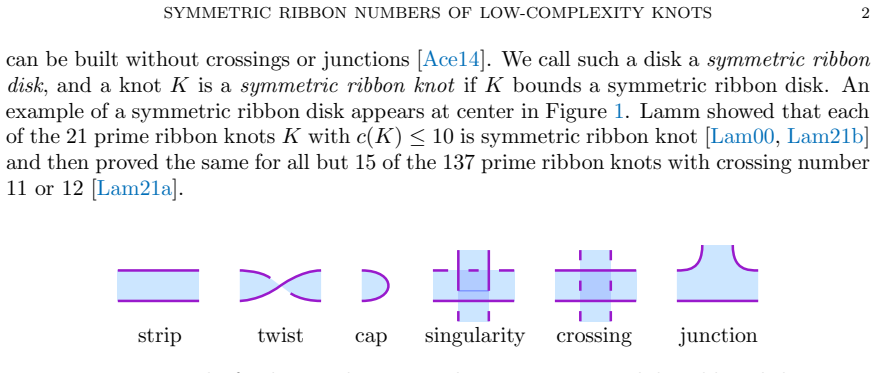
Figure 2. Figure 2: The fundamental pieces used to construct a modular ribbon disk. For a ribbon knot K, the ribbon number r(K) is defined to be the minimum number of ribbon singularities contained in any ribbon disk D bounded by K. Ribbon number was introduced in [Miz06] and tabulated for prime knots up to 11 crossings in [FMZ24] and for prime knots with 12 crossings in [AAC+25]. Aceto defined the analogue for a symmetric ri… view at source ↗
Figure 3
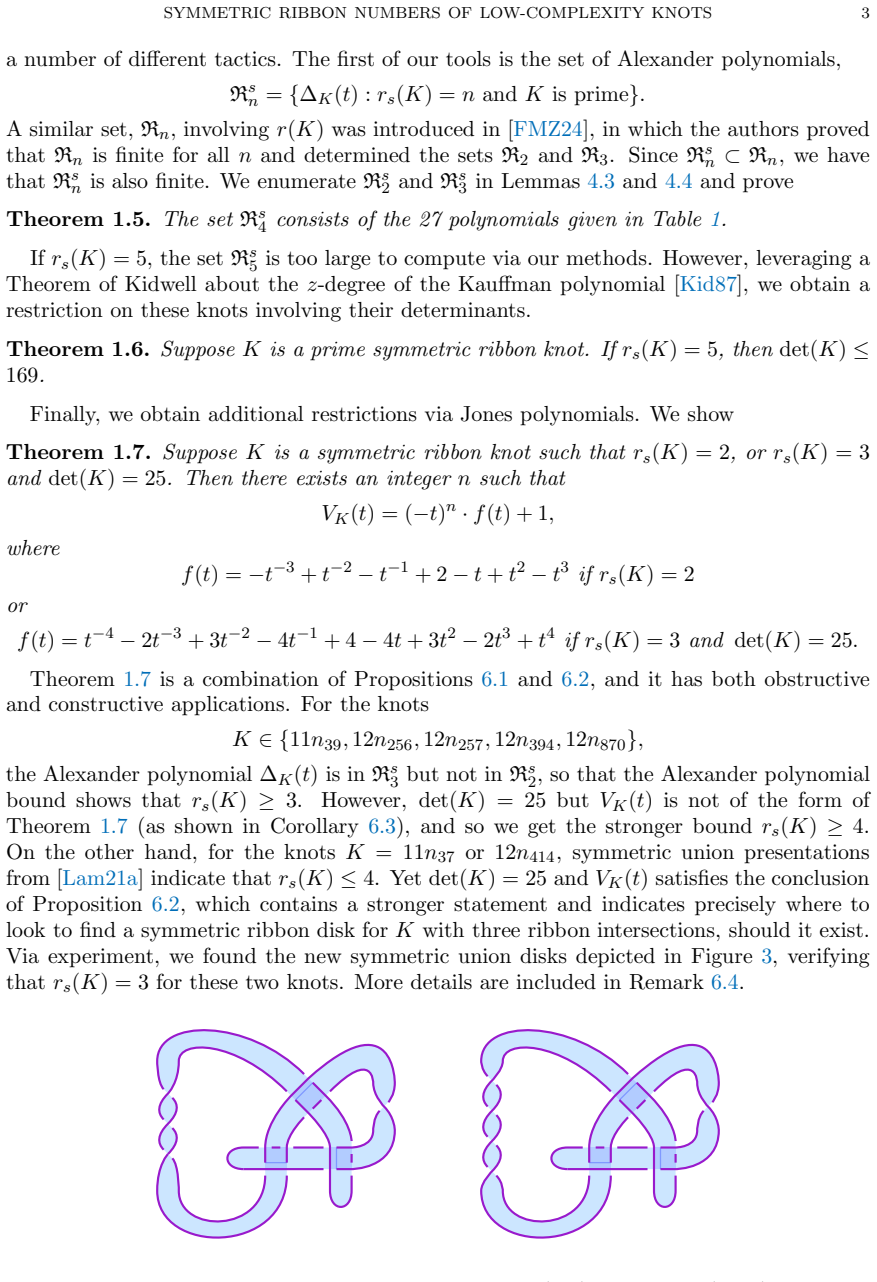
Figure 3. Figure 3: Symmetric ribbon disks for 11n37 (left) and 12n414 (right) [PITH_FULL_IMAGE:figures/full_fig_p003_3.png] view at source ↗
Figure 4
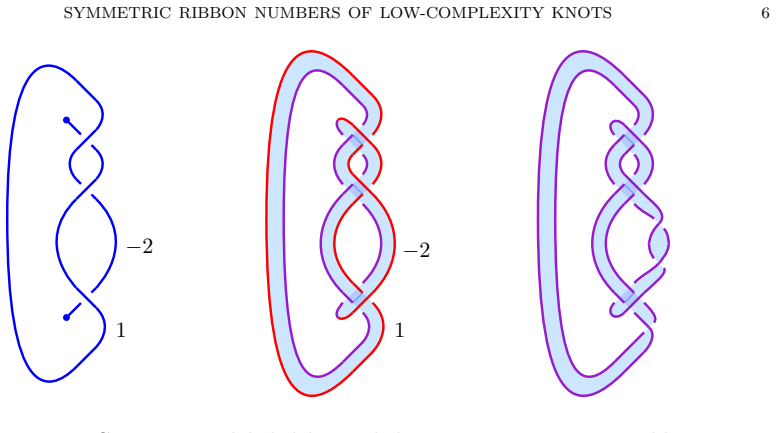
Figure 4. Figure 4: Converting a labeled knotoid diagram to a symmetric ribbon disk. In the middle, the red path traverses the diagram in a way that sat￾isfies the global consistency condition (it never passes through a singularity with two under-crossings). Note further that the knotoid diagram at left is equivalent to the one in [PITH_FULL_IMAGE:figures/full_fig_p006_4.png] view at source ↗
Figure 5
Figure 5. Figure 5: An example of the connected sum operation on knotoid dia￾grams. Near the aglet, we note several simplifications. First, the strand connected to the aglet need not be labeled, since any labeling yields twisting on the induced symmetric ribbon disk that can be eliminated via isotopy, as shown in [PITH_FULL_IMAGE:figures/full_fig_p006_5.png] view at source ↗
Figure 6
Figure 6. Figure 6: The labeling of the strand adjacent to the aglet can be changed via isotopy, and so we generally assume this strand is labeled zero [PITH_FULL_IMAGE:figures/full_fig_p006_6.png] view at source ↗
Figure 7
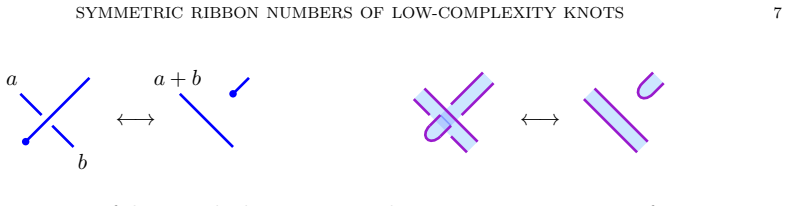
Figure 7. Figure 7: If the strand adjacent to an aglet meets an over-crossing of κ, we may eliminate the crossing (and its corresponding singularity) via an aglet move. It may be possible to simplify a given labeled knotoid diagram by performing Reidemeister moves. For example, if a knotoid diagram κ admits an R1 move, then the corresponding symmetric ribbon disk can be simplified by eliminating a singularity, as shown in [P… view at source ↗
Figure 8
Figure 8. Figure 8: An R1 move on a labeled knotoid diagram translates to a move on the corresponding symmetric ribbon disk. Labelings change as shown. ←→ a b 0 a + b ←→ [PITH_FULL_IMAGE:figures/full_fig_p007_8.png] view at source ↗
Figure 9
Figure 9. Figure 9: An R2 move on a labeled knotoid diagram translates to a move on the corresponding symmetric ribbon disk. The strand shown at left must be labeled zero for this move to be possible. If two labeled knotoid diagrams κ and κ ′ are related via a sequence of aglet moves, R1 moves, R2 moves, R3 moves, and planar isotopy, we say that κ and κ ′ are equivalent. We have demonstrated that if κ and κ ′ are equivalent, … view at source ↗
Figure 10
Figure 10. Figure 10: An R3 move on a labeled knotoid diagram translates to a move on the corresponding symmetric ribbon disk. The strand shown at left must be labeled zero for this move to be possible. Remark 2.5. Our construction differs slightly from that in [Lam21a] in our conventions reverse the signs of the crossings in the corresponding knotoid diagrams. The reason for this change involves the labeling of strands. With … view at source ↗
Figure 11
Figure 11. Figure 11: Twisting on the strip corresponding to an over-crossing of a labeled knotoid diagram can be pushed to either side of the associated sin￾gularity. We can use labeled knotoid diagrams to obtain upper bounds for symmetric ribbon numbers. Proposition 2.6 already appears as Lemma 2.1 in [FMZ24], but we include another proof here using labeled knotoid diagrams. Proposition 2.6. Suppose that K admits a symmetric… view at source ↗
Figure 12
Figure 12. Figure 12: Since λ is reduced, all remaining arcs must connect the two distinct crossings, and in S 2 , there is a unique way to make such connections up to isotopy, shown at right in [PITH_FULL_IMAGE:figures/full_fig_p009_12.png] view at source ↗
Figure 13
Figure 13. Figure 13: At top, possible connections between aglet crossings. At bot￾tom, completing the diagrams. Note that only the bottom left (31) and middle (32) are valid, since the bottom right diagram is disconnected. The case that c(λ) = 4 requires significantly more work. Proposition 3.3. Up to symmetry, there are eight reduced singular arc diagrams with four crossings, 41, 42, 43, 44, 45, 46, 47, and 48, shown in [PI… view at source ↗
Figure 14
Figure 14. Figure 14: The eight possible reduced singular arc diagrams with four crossings. interior crossing and one does not, with both endpoints connected to one of the structures shown in [PITH_FULL_IMAGE:figures/full_fig_p011_14.png] view at source ↗
Figure 15
Figure 15. Figure 15: The three structures from [PITH_FULL_IMAGE:figures/full_fig_p011_15.png] view at source ↗
Figure 16
Figure 16. Figure 16: At top, the addition of one arc to the first structure. At bottom, completing the diagrams by including another interior crossing and four more arcs. The completion at bottom left is disconnected, so we disregard it [PITH_FULL_IMAGE:figures/full_fig_p012_16.png] view at source ↗
Figure 17
Figure 17. Figure 17: At top, the addition of one arc to the second structure. At bottom, the completions, where the one at right is disconnected. crossing. Unless λ is disconnected, there is a unique configuration, shown at left in [PITH_FULL_IMAGE:figures/full_fig_p012_17.png] view at source ↗
Figure 18
Figure 18. Figure 18: At top, the addition of one arc to the third structure. At bottom, both completions are valid [PITH_FULL_IMAGE:figures/full_fig_p013_18.png] view at source ↗
Figure 19
Figure 19. Figure 19: At left, the two aglet arcs connect to the same interior crossing. At middle, one additional arc is added to this configuration. At right, the unique completion is valid. bottom aglet crossing to the top interior crossing. Up to symmetry, the diagram is uniquely determined, as shown at right in [PITH_FULL_IMAGE:figures/full_fig_p013_19.png] view at source ↗
Figure 20
Figure 20. Figure 20: At left, the two aglet arcs connect to different interior crossings. At right, the unique completion (up to symmetry) with all arcs connecting the top structure to the bottom structure and no arcs connecting the aglet crossings [PITH_FULL_IMAGE:figures/full_fig_p014_20.png] view at source ↗
Figure 21
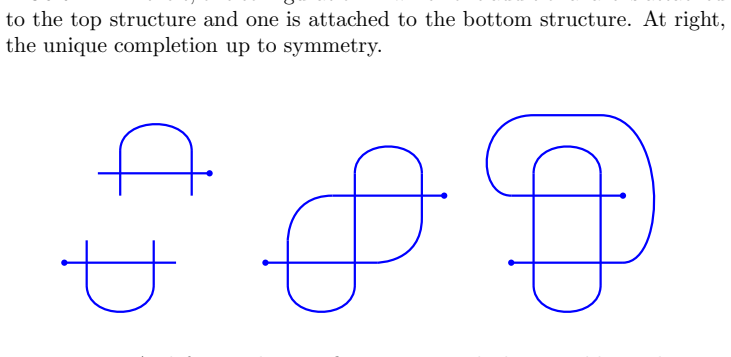
Figure 21. Figure 21: At left, one configuration in which one additional arc is attached to the top structure and one is attached to the bottom structure. At right, the unique completion up to symmetry [PITH_FULL_IMAGE:figures/full_fig_p014_21.png] view at source ↗
Figure 22
Figure 22. Figure 22: At left, another configuration in which one additional arc is attached to the top structure and one is attached to the bottom structure. At center and right, the two possible completions. The completion at right is disconnected [PITH_FULL_IMAGE:figures/full_fig_p014_22.png] view at source ↗
Figure 23
Figure 23. Figure 23: If only one arc connects the top structure to the bottom struc￾ture, then the diagram λ is not reduced. 4. Alexander polynomials and the sets Rs n In [FMZ24] and [AAC+25], the authors used Alexander polynomials to derive new lower bounds for ribbon numbers. In particular, they defined the set Rn = {∆K(t) : r(K) ≤ n} and proved that Proposition 4.1. For every n, the set Rn is finite and computable. In [FMZ… view at source ↗
Figure 24
Figure 24. Figure 24: L+ L− L0 [PITH_FULL_IMAGE:figures/full_fig_p015_24.png] view at source ↗
Figure 25
Figure 25. Figure 25: A leaf isotopy is a combination of an aglet move, an R3 move, and an R1 move as shown. The only relevant labeling is the zero-labeling of the under-strand in the R3 move occurring between the two middle frames [PITH_FULL_IMAGE:figures/full_fig_p016_25.png] view at source ↗
Figure 26
Figure 26. Figure 26: Converting a labeled knotoid diagram coming from λ1 to one coming from λ2 via a leaf isotopy. Next, we turn to Rs 4 . Theorem 1.5, stated in Section 1, asserts that the 27 elements of Rs 4 are given in [PITH_FULL_IMAGE:figures/full_fig_p017_26.png] view at source ↗
Figure 27
Figure 27. Figure 27: If both aglets of κ are inside of D1, we surger κ along c to obtain a knotoid κ ′ within D1. We have assembled all of the necessary ingredients to prove our next bound on symmetric ribbon number, Theorem 1.6, which asserts that if rs(K) = 5, then det(K) ≤ 169. Proof of Theorem 1.6. Suppose rs(K) = 5. Then K bounds a symmetric ribbon disk with associated labeled knotoid diagram κ such that c(κ) = 5. Let J … view at source ↗
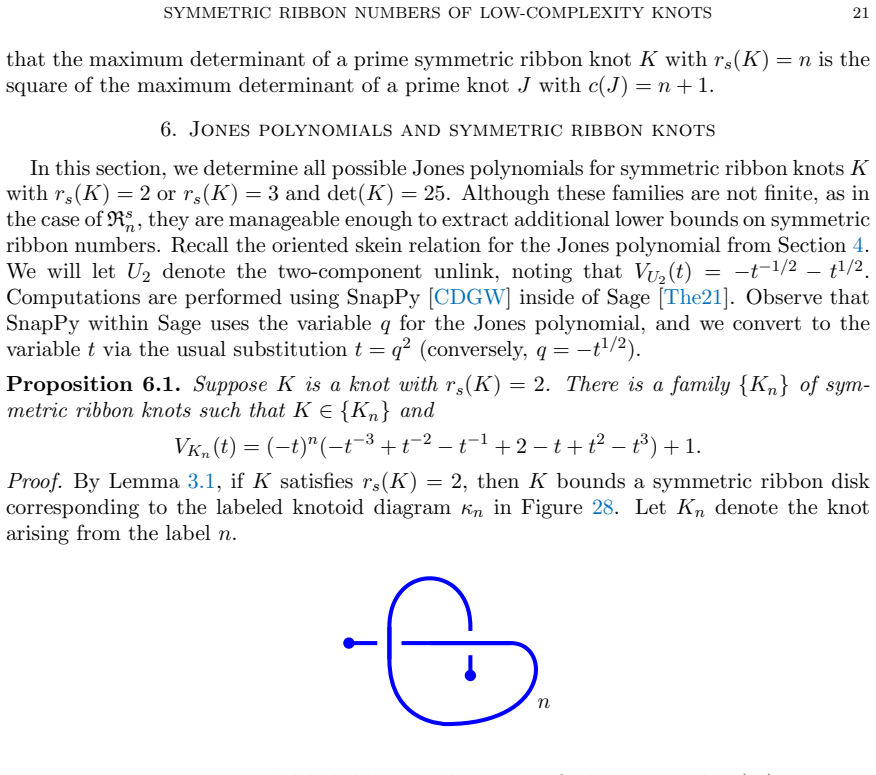
Figure 28
Figure 28. Figure 28: The only labeled knotoid diagram κn for knots K with rs(K) = 2. There are two cases to consider, whether n positive or negative. The proof proceeds by induction, and we verify the base cases for K0 and K1 by direction computation. First, let n > 1 and suppose the proposition holds for Kn−2. Choosing L+, L−, and L0 as in [PITH_FULL_IMAGE:figures/full_fig_p021_28.png] view at source ↗
Figure 29
Figure 29. Figure 29: m n m n [PITH_FULL_IMAGE:figures/full_fig_p022_29.png] view at source ↗
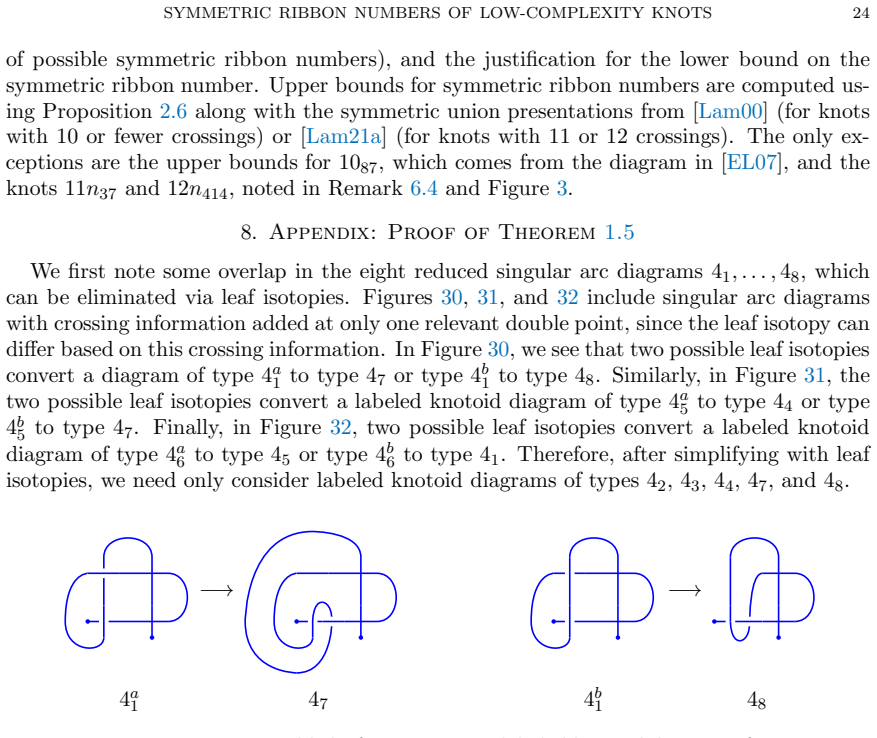
Figure 30
Figure 30. Figure 30: Two possible leaf isotopies on a labeled knotoid diagram of type 41. 4 a 5 44 4 b 5 47 −→ −→ [PITH_FULL_IMAGE:figures/full_fig_p024_30.png] view at source ↗
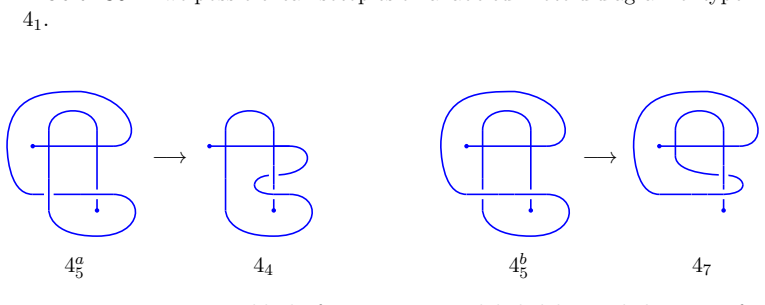
Figure 31
Figure 31. Figure 31: Two possible leaf isotopies on a labeled knotoid diagram of type 45. In the second frame, an arc of the diagram 44 has been redrawn via planar isotopy in S 2 . Proof of Theorem 1.5. In order to find all possible Alexander polynomials of knots K with rs(K) = 4, it suffices to compute Alexander polynomials for all mod 2 labeled knotoid diagrams of types 42, 43, 44, 47, and 48. Each type involves two choices… view at source ↗
Figure 32
Figure 32. Figure 32: Two possible leaf isotopies on a labeled knotoid diagram of type 46. 43 : 1 1 − 3t 2 + t 4 1 − t − t 2 + 3t 3 − t 4 − t 5 + t 6 1 − 2t + 3t 2 − 4t 3 + 5t 4 − 4t 5 + 3t 6 − 2t 7 + t 8 1 − 3t + 5t 2 − 7t 3 + 5t 4 − 3t 5 + t 6 1 − 4t + 6t 2 − 8t 3 + 11t 4 − 8t 5 + 6t 6 − 4t 7 + t 8 1 − 5t + 11t 2 − 15t 3 + 11t 4 − 5t 6 + t 6 1 − 6t + 11t 2 − 6t 3 + t 4 2 − 6t + 9t 2 − 6t 3 + 2t 4 2 − 12t + 21t 2 − 12t 3 + 2t… view at source ↗
read the original abstract

Every knot $K \subset S^3$ that admits a symmetric union presentation bounds an immersed ribbon disk in $S^3$, while the converse is an open problem due to Christoph Lamm. The symmetric ribbon number $r_s(K)$ of $K$ is the minimum number of ribbon singularities in any symmetric ribbon disk bounded by $K$. In this paper, we undertake a systematic investigation of symmetric ribbon numbers of knots with at most 12 crossings. Along the way, we exhibit novel lower bounds for $r_s(K)$ arising from knot determinants, Alexander polynomials, Jones polynomials, and Kauffman polynomials.

Editorial analysis

A structured set of objections, weighed in public.

Desk editor's note, referee report, simulated authors' rebuttal, and a circularity audit. Tearing a paper down is the easy half of reading it; the pith above is the substance, this is the friction.

Referee Report

0 major / 3 minor

Summary. The paper defines the symmetric ribbon number r_s(K) as the minimal number of ribbon singularities in any symmetric ribbon disk bounded by a knot K that admits a symmetric union presentation. It performs a systematic computation and tabulation of r_s(K) (or bounds thereon) for all knots with at most 12 crossings, and derives explicit lower bounds on r_s(K) from evaluations of the knot determinant, Alexander polynomial, Jones polynomial, and Kauffman polynomial.

Significance. If the claimed mappings from polynomial evaluations to lower bounds on r_s(K) are valid, the work supplies the first comprehensive data set for this invariant on low-crossing knots and supplies concrete, computable obstructions that may help address Lamm's open question on the existence of symmetric ribbon disks for all ribbon knots. The multi-invariant approach is a strength.

minor comments (3)
  1. §3: the precise functional dependence of each lower bound on the polynomial (e.g., whether the bound is |Δ_K(-1)|/2 or a more involved expression involving the degree or coefficients) should be stated as a numbered theorem or proposition rather than described only in prose.
  2. Table 1 (or equivalent tabulation): several entries list only an upper bound obtained from an explicit symmetric union diagram; it would be useful to indicate whether the matching lower bound is achieved or whether a gap remains.
  3. The Kauffman-polynomial bound is stated only for the F-polynomial; a brief remark on why the other two-variable versions were not used would clarify the choice.

Simulated Author's Rebuttal

0 responses · 0 unresolved

We thank the referee for their positive summary, recognition of the multi-invariant approach, and recommendation of minor revision. No specific major comments were provided in the report.

Circularity Check

0 steps flagged

No significant circularity in derivation chain

full rationale

The abstract states that lower bounds on r_s(K) arise from standard knot invariants (determinants, Alexander/Jones/Kauffman polynomials). No equations, self-citations, or fitted quantities are described that would make any bound equivalent to its input by construction. The mapping from polynomial evaluations to ribbon singularity counts is a conventional invariant-to-geometry bound and does not reduce to a self-definitional or fitted-input step. The paper is therefore self-contained against external knot-theory benchmarks; no load-bearing circular step is exhibited.

Axiom & Free-Parameter Ledger

0 free parameters · 0 axioms · 0 invented entities

Abstract-only review supplies no explicit free parameters, axioms, or invented entities.

pith-pipeline@v0.9.1-grok · 5643 in / 880 out tokens · 18238 ms · 2026-06-28T11:49:43.609531+00:00 · methodology

discussion (0)

Sign in with ORCID, Apple, or X to comment. Anyone can read and Pith papers without signing in.

Reference graph

Works this paper leans on

31 extracted references · 18 canonical work pages · 1 internal anchor

  1. [1]

    Lamm, Christoph , TITLE =. J. Knot Theory Ramifications , FJOURNAL =. 2021 , NUMBER =. doi:10.1142/S0218216521410091 , URL =

  2. [2]

    Topology , FJOURNAL =

    Murasugi, Kunio , TITLE =. Topology , FJOURNAL =. 1987 , NUMBER =. doi:10.1016/0040-9383(87)90058-9 , URL =

  3. [3]

    A systematic classification of knotoids on the plane and on the sphere

    A systematic classification of knotoids on the plane and on the sphere. arXiv e-prints , keywords =. doi:10.48550/arXiv.1902.07277 , archivePrefix =. 1902.07277 , primaryClass =

  4. [4]

    Eisermann, Michael , TITLE =. Geom. Topol. , FJOURNAL =. 2009 , NUMBER =. doi:10.2140/gt.2009.13.623 , URL =

  5. [5]

    , TITLE =

    Thistlethwaite, Morwen B. , TITLE =. Topology , FJOURNAL =. 1987 , NUMBER =. doi:10.1016/0040-9383(87)90003-6 , URL =

  6. [6]

    , TITLE =

    Stoimenow, A. , TITLE =. Pacific J. Math. , FJOURNAL =. 2003 , NUMBER =. doi:10.2140/pjm.2003.210.189 , URL =

  7. [7]

    , TITLE =

    Kidwell, Mark E. , TITLE =. Proc. Amer. Math. Soc. , FJOURNAL =. 1987 , NUMBER =. doi:10.2307/2046718 , URL =

  8. [8]

    Aceto, Paolo , TITLE =. J. Knot Theory Ramifications , FJOURNAL =. 2014 , NUMBER =. doi:10.1142/S0218216514500485 , URL =

  9. [9]

    An, Xianhao and Aronin, Matthew and Cates, David and Goh, Ansel and Kirn, Benjamin and Krienke, Josh and Liang, Minyi and Lowery, Samuel and Malkoc, Ege and Meier, Jeffrey and Natonson, Max and Radi\'c, Veljko and Rodoplu, Yavuz and Saha, Bhaswati and Scott, Evan and Simkins, Roman and Zupan, Alexander , TITLE =. J. Knot Theory Ramifications , FJOURNAL =....

  10. [10]

    Mizuma, Yoko , TITLE =. Osaka J. Math. , FJOURNAL =. 2006 , NUMBER =

  11. [11]

    Classification of ribbon 2-knots with ribbon crossing number up to four , year =

    Taizo Kanenobu , date-added =. Classification of ribbon 2-knots with ribbon crossing number up to four , year =

  12. [12]

    A survey of knot theory , year =

    Kawauchi, Akio , date-added =. A survey of knot theory , year =

  13. [13]

    Fox, R. H. , booktitle =. A quick trip through knot theory , year =

  14. [14]

    and Fox, Ralph H

    Crowell, Richard H. and Fox, Ralph H. , date-added =. Introduction to knot theory , volume =

  15. [15]

    and Stipsicz, Andr\'as I

    Gompf, Robert E. and Stipsicz, Andr. 1999 , bdsk-url-1 =. doi:10.1090/gsm/020 , isbn =

  16. [16]

    On the asphericity of ribbon disc complements , url =

    Howie, James , date-added =. On the asphericity of ribbon disc complements , url =. Trans. Amer. Math. Soc. , mrclass =. 1985 , bdsk-url-1 =. doi:10.2307/1999700 , fjournal =

  17. [17]

    Crosscap number, ribbon number and essential tangle decompositions of knots , url =

    Mizuma, Yoko and Tsutsumi, Yukihiro , fjournal =. Crosscap number, ribbon number and essential tangle decompositions of knots , url =. Osaka J. Math. , mrclass =. 2008 , bdsk-url-1 =

  18. [18]

    Symmetric unions and ribbon knots , url =

    Lamm, Christoph , fjournal =. Symmetric unions and ribbon knots , url =. Osaka J. Math. , mrclass =. 2000 , bdsk-url-1 =

  19. [19]

    Equivalence of symmetric union diagrams , url =

    Eisermann, Michael and Lamm, Christoph , doi =. Equivalence of symmetric union diagrams , url =. J. Knot Theory Ramifications , mrclass =. 2007 , bdsk-url-1 =

  20. [20]

    The search for nonsymmetric ribbon knots , url =

    Lamm, Christoph , doi =. The search for nonsymmetric ribbon knots , url =. Exp. Math. , mrclass =. 2021 , bdsk-url-1 =

  21. [21]

    Ribbon 2-knots of ribbon crossing number four , url =

    Yasuda, Tomoyuki , date-added =. Ribbon 2-knots of ribbon crossing number four , url =. J. Knot Theory Ramifications , mrclass =. 2018 , bdsk-url-1 =. doi:10.1142/S021821651850058X , fjournal =

  22. [22]

    Doubly slice knots with low crossing number , url =

    Livingston, Charles and Meier, Jeffrey , date-added =. Doubly slice knots with low crossing number , url =. New York J. Math. , mrclass =. 2015 , bdsk-url-1 =

  23. [23]

    Genera of the arborescent links , url =

    Gabai, David , date-added =. Genera of the arborescent links , url =. Mem. Amer. Math. Soc. , mrclass =. 1986 , bdsk-url-1 =. doi:10.1090/memo/0339 , fjournal =

  24. [24]

    Crosscap numbers of pretzel knots , url =

    Ichihara, Kazuhiro and Mizushima, Shigeru , date-added =. Crosscap numbers of pretzel knots , url =. Topology Appl. , mrclass =. 2010 , bdsk-url-1 =. doi:10.1016/j.topol.2009.04.031 , fjournal =

  25. [25]

    Almost positive links are strongly quasipositive , url =

    Feller, Peter and Lewark, Lukas and Lobb, Andrew , date-added =. Almost positive links are strongly quasipositive , url =. Math. Ann. , mrclass =. 2023 , bdsk-url-1 =. doi:10.1007/s00208-021-02328-x , fjournal =

  26. [26]

    Tagami, Keiji , date-added =. The. Canad. Math. Bull. , mrclass =. 2014 , bdsk-url-1 =. doi:10.4153/CMB-2014-005-7 , fjournal =

  27. [27]

    , date-added =

    Shumakovitch, Alexander N. , date-added =. Rasmussen invariant, slice-. J. Knot Theory Ramifications , mrclass =. 2007 , bdsk-url-1 =. doi:10.1142/S0218216507005889 , fjournal =

  28. [28]

    , howpublished =

    Livingston, Charles and Moore, Allison H. , howpublished =. KnotInfo: Table of Knot Invariants , Year =

  29. [29]

    arXiv , author =:2408.11618 , journal =

    doi:10.48550/arXiv.2408.11618 , eid =. arXiv , author =:2408.11618 , journal =

  30. [30]

    Bridge spectra of iterated torus knots , url =

    Zupan, Alexander , doi =. Bridge spectra of iterated torus knots , url =. Comm. Anal. Geom. , mrclass =. 2014 , bdsk-url-1 =

  31. [31]

    and Goerner, Matthias and Weeks, Jeffrey R

    Culler, Marc and Dunfield, Nathan M. and Goerner, Matthias and Weeks, Jeffrey R. , date-added =. Snap