Space-Filling One-Factor-At-A-Time Designs
Pith reviewed 2026-06-28 13:03 UTC · model grok-4.3
The pith
Space-filling one-factor-at-a-time designs combine screening and modeling capabilities for computer experiments.
A machine-rendered reading of the paper's core claim, the machinery that carries it, and where it could break.
Core claim
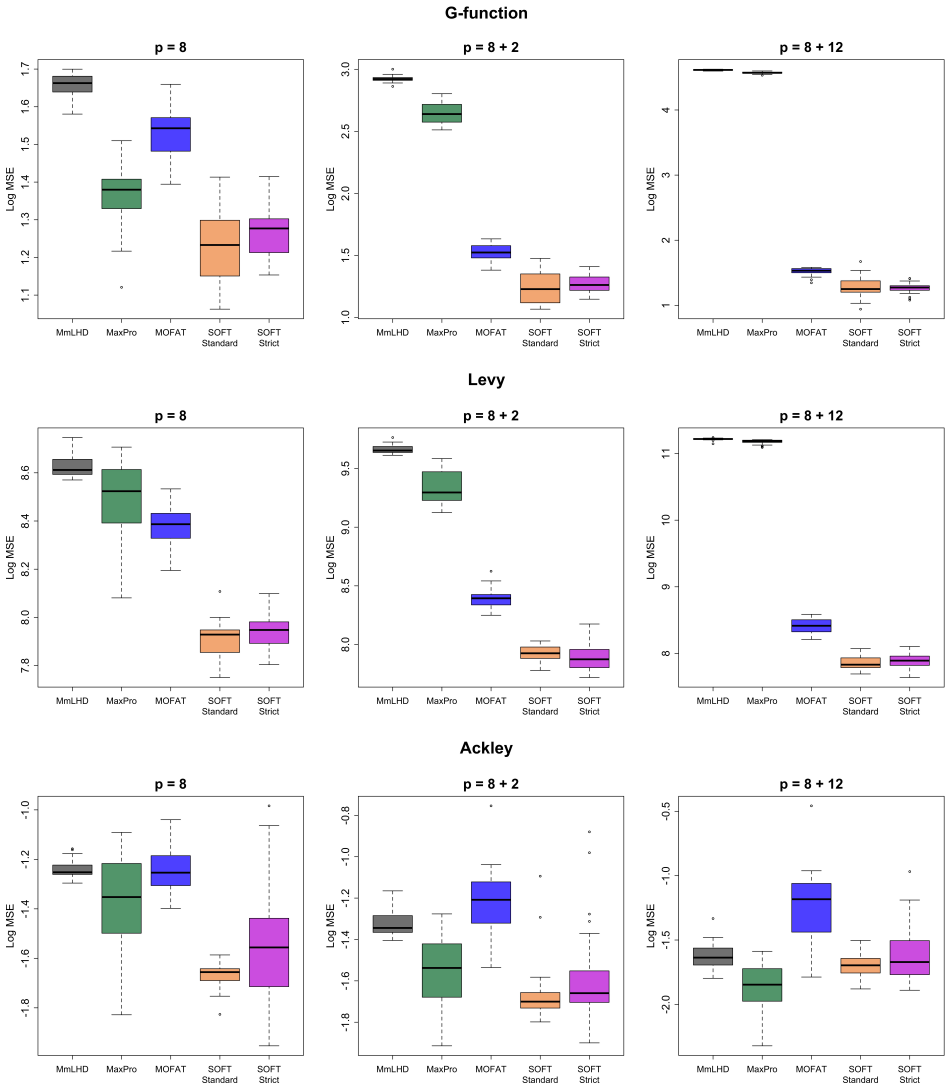
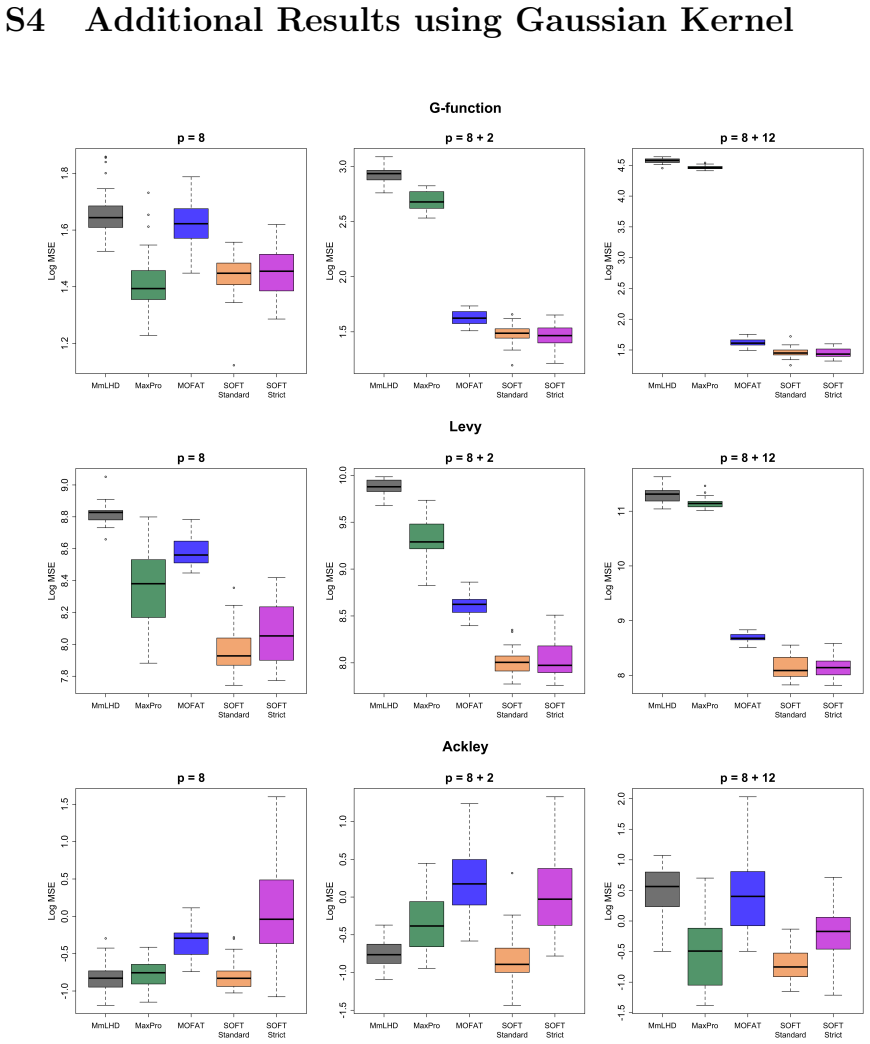
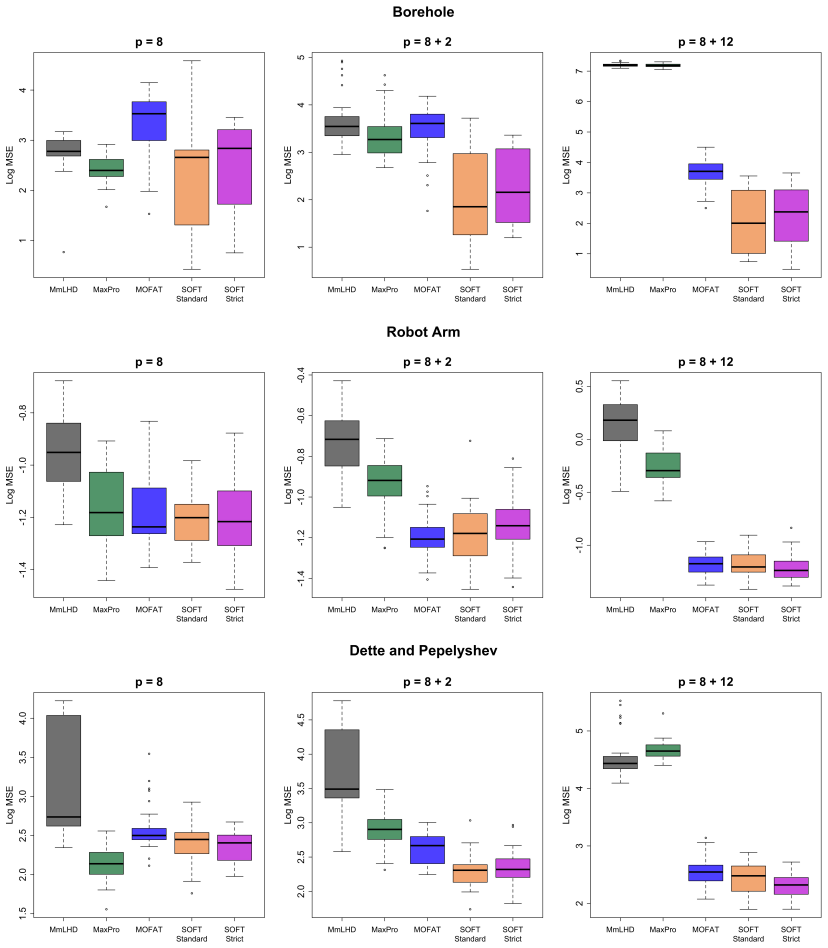
The paper claims that a new class of screening designs can be constructed to improve space-filling properties while retaining screening capability, as demonstrated through several numerical examples that show clear advantages over existing designs such as MOFAT and standard space-filling designs.
What carries the argument
Space-filling one-factor-at-a-time designs, which modify one-factor-at-a-time screening structures to distribute evaluation points more evenly across the input space.
If this is right
- The same set of runs can support both factor screening and accurate surrogate model construction.
- Computer experiments become more efficient when only a small subset of factors is influential.
- Overall workflow for deterministic simulation studies improves by avoiding separate screening and modeling phases.
- Performance gains appear in high-dimensional settings with sparse active effects.
Where Pith is reading between the lines
- Construction rules for the designs could be optimized for specific input dimensions or correlation structures.
- The designs might integrate with sequential or adaptive sampling strategies after initial screening.
- Similar modifications could be applied to other screening families beyond one-factor-at-a-time.
Load-bearing premise
The numerical examples used to show advantages are representative of general response surfaces and that the new designs retain screening capability without unexamined trade-offs.
What would settle it
A test function with known active factors and known response surface where the proposed designs fail to identify the active factors as accurately as MOFAT or produce higher surrogate model error than standard space-filling designs.
Figures



read the original abstract
Space-filling designs are commonly used in deterministic computer experiments. However, they are ineffective for factor screening, which makes them inefficient when only a small subset of input factors is influential to the output. Recently developed screening designs, such as MOFAT designs, are effective at identifying important factors but lack space-filling properties, limiting their usefulness for surrogate modeling. In this article, we propose a new class of screening designs that improves the space-fillingness while retaining their screening capability. Through several numerical examples, we demonstrate that the proposed designs offer clear advantages over existing designs.
Editorial analysis
A structured set of objections, weighed in public.
Referee Report
Summary. The manuscript proposes a new class of space-filling one-factor-at-a-time (SOFAT) designs that modify existing MOFAT screening designs to improve space-filling properties for deterministic computer experiments while aiming to retain screening capability for identifying influential factors. Advantages over existing designs are asserted via several numerical examples.
Significance. If the designs demonstrably retain screening power without meaningful trade-offs while improving space-filling metrics, the work would address a practical gap in computer experiments that require both factor screening and surrogate modeling under sparsity; the numerical-comparison approach is a standard way to support such claims when theoretical guarantees are unavailable.
major comments (2)
- [Numerical examples] Numerical examples section: the central claim that the designs 'retain their screening capability' while improving space-fillingness rests entirely on the chosen test functions and metrics; the manuscript must explicitly report screening performance (e.g., detection rates or effect-size recovery for active factors) in parallel with space-filling criteria, otherwise the examples cannot rule out loss of screening effectiveness on general response surfaces as noted in the stress-test concern.
- [Numerical examples] Numerical examples section: without details on dimension range, number of active factors per example, and whether post-hoc selection of test surfaces occurred, it is impossible to assess whether the reported 'clear advantages' generalize or are limited to low-dimensional or specially structured cases.
minor comments (1)
- [Abstract] Abstract: the phrase 'clear advantages' is vague; replace with reference to the specific metrics (e.g., maximin distance, projection properties) used in the comparisons.
Simulated Author's Rebuttal
We thank the referee for the constructive comments, which highlight important aspects of how the numerical examples support our claims. We agree that the examples section requires strengthening to make the retention of screening capability more explicit and to provide fuller context on the test cases. We will revise accordingly and address each point below.
read point-by-point responses
-
Referee: [Numerical examples] Numerical examples section: the central claim that the designs 'retain their screening capability' while improving space-fillingness rests entirely on the chosen test functions and metrics; the manuscript must explicitly report screening performance (e.g., detection rates or effect-size recovery for active factors) in parallel with space-filling criteria, otherwise the examples cannot rule out loss of screening effectiveness on general response surfaces as noted in the stress-test concern.
Authors: We agree that explicit reporting of screening performance metrics is necessary to substantiate the claim. In the revised manuscript we will add a new table (or subsection) in the numerical examples that reports, for each design and test function, screening metrics such as the proportion of active factors correctly identified and the accuracy of effect-size recovery, placed directly alongside the space-filling criteria. This will allow direct assessment of any trade-offs and address concerns about general response surfaces. revision: yes
-
Referee: [Numerical examples] Numerical examples section: without details on dimension range, number of active factors per example, and whether post-hoc selection of test surfaces occurred, it is impossible to assess whether the reported 'clear advantages' generalize or are limited to low-dimensional or specially structured cases.
Authors: We will expand the numerical examples section with a dedicated paragraph (or table) that states the dimension range examined (typically 6–20 factors), the number of active factors per test function (2–4 in the reported cases), and confirms that the test surfaces were drawn from standard benchmark functions in the computer-experiments literature without post-hoc selection. This information will clarify the scope of the comparisons. revision: yes
Circularity Check
No significant circularity; claims rest on external numerical comparisons
full rationale
The paper proposes a new class of screening designs and supports its central claim of improved space-fillingness while retaining screening capability solely through numerical examples on test functions. No derivation chain, equations, or first-principles results are invoked that reduce by construction to the inputs or to self-citations. The evaluation metrics and comparisons are independent of the design definitions themselves, making the work self-contained against external benchmarks.
Axiom & Free-Parameter Ledger
Reference graph
Works this paper leans on
-
[1]
I. M. Sobol' , title =. Matematicheskoe Modelirovanie , year =
-
[2]
I. M. Sobol' , title =. Mathematical Modeling and Computational Experiments , year =
-
[3]
Environmental modelling & software , volume=
An effective screening design for sensitivity analysis of large models , author=. Environmental modelling & software , volume=. 2007 , publisher=
2007
-
[4]
Computer Physics Communications , volume=
Analysis of variance designs for model output , author=. Computer Physics Communications , volume=. 1999 , publisher=
1999
-
[5]
Journal of Quality Technology , volume=
A class of three-level designs for definitive screening in the presence of second-order effects , author=. Journal of Quality Technology , volume=. 2011 , publisher=
2011
-
[6]
Quality Engineering , volume=
Space-filling designs for computer experiments: A review , author=. Quality Engineering , volume=. 2016 , publisher=
2016
-
[7]
Technometrics , volume=
Factorial sampling plans for preliminary computational experiments , author=. Technometrics , volume=. 1991 , publisher=
1991
-
[8]
Technometrics , volume=
Maximum one-factor-at-a-time designs for screening in computer experiments , author=. Technometrics , volume=. 2023 , publisher=
2023
-
[9]
Journal of Quality Technology , pages=
Automated analysis of experiments using hierarchical garrote , author=. Journal of Quality Technology , pages=. 2025 , publisher=
2025
-
[10]
Journal of the American Statistical Association , volume=
An efficient surrogate model for emulation and physics extraction of large eddy simulations , author=. Journal of the American Statistical Association , volume=. 2018 , publisher=
2018
-
[11]
IEEE Journal of Biomedical and Health Informatics , volume=
Digital twins in healthcare: an architectural proposal and its application in a social distancing case study , author=. IEEE Journal of Biomedical and Health Informatics , volume=. 2022 , publisher=
2022
-
[12]
2006 , publisher=
Gaussian processes for machine learning , author=. 2006 , publisher=
2006
-
[13]
nature , volume=
Deep learning , author=. nature , volume=. 2015 , publisher=
2015
-
[14]
European Journal of Operational Research , volume=
Sensitivity analysis: A review of recent advances , author=. European Journal of Operational Research , volume=. 2016 , publisher=
2016
-
[15]
Reliability Engineering & System Safety , volume=
Importance measures in global sensitivity analysis of nonlinear models , author=. Reliability Engineering & System Safety , volume=. 1996 , publisher=
1996
-
[16]
Technometrics , volume=
A quantitative model-independent method for global sensitivity analysis of model output , author=. Technometrics , volume=. 1999 , publisher=
1999
-
[17]
Mathematics and computers in simulation , volume=
Global sensitivity indices for nonlinear mathematical models and their Monte Carlo estimates , author=. Mathematics and computers in simulation , volume=. 2001 , publisher=
2001
-
[18]
Journal of the American statistical association , volume=
One-at-a-time plans , author=. Journal of the American statistical association , volume=. 1973 , publisher=
1973
-
[19]
Mathematics and Computers in Simulation , author =
Derivative based global sensitivity measures and their link with global sensitivity indices , volume =. Mathematics and Computers in Simulation , author =. 2009 , pages =. doi:10.1016/j.matcom.2009.01.023 , abstract =
-
[20]
Environmental modelling & software , volume=
VARS-TOOL: A toolbox for comprehensive, efficient, and robust sensitivity and uncertainty analysis , author=. Environmental modelling & software , volume=. 2019 , publisher=
2019
-
[21]
Wu, C. F. Jeff and Hamada, Michael S. , month = mar, year =. Experiments:
-
[22]
Technometrics , volume=
Comparison of Three Methods for Selecting Values of Input Variables in the Analysis of Output from a Computer Code , author=. Technometrics , volume=. 1979 , publisher=
1979
-
[23]
Journal of Quality Technology , volume=
Fractional Brownian fields for response surface metamodeling , author=. Journal of Quality Technology , volume=. 2014 , publisher=
2014
-
[24]
Nonlinear Dynamics , volume=
Particle swarm optimization with fractional-order velocity , author=. Nonlinear Dynamics , volume=. 2010 , publisher=
2010
-
[25]
Journal of Global Optimization , volume=
Experimental testing of advanced scatter search designs for global optimization of multimodal functions , author=. Journal of Global Optimization , volume=. 2005 , publisher=
2005
-
[26]
1993 , publisher=
Number-theoretic methods in statistics , author=. 1993 , publisher=
1993
-
[27]
Indagationes mathematicae , volume=
From van der Corput to modern constructions of sequences for quasi-Monte Carlo rules , author=. Indagationes mathematicae , volume=. 2015 , publisher=
2015
-
[28]
2012 , publisher=
Uniform distribution of sequences , author=. 2012 , publisher=
2012
-
[29]
Environmental modelling & software , volume=
Progressive Latin Hypercube Sampling: An efficient approach for robust sampling-based analysis of environmental models , author=. Environmental modelling & software , volume=. 2017 , publisher=
2017
-
[30]
Journal of statistical planning and inference , volume=
Exploratory designs for computational experiments , author=. Journal of statistical planning and inference , volume=. 1995 , publisher=
1995
-
[31]
Journal of statistical planning and inference , volume=
Minimax and maximin distance designs , author=. Journal of statistical planning and inference , volume=. 1990 , publisher=
1990
-
[32]
Journal of statistical planning and inference , volume=
Energy statistics: A class of statistics based on distances , author=. Journal of statistical planning and inference , volume=. 2013 , publisher=
2013
-
[33]
The Annals of Statistics , volume=
Support points , author=. The Annals of Statistics , volume=. 2018 , publisher=
2018
-
[34]
Journal of the American Statistical Association , volume=
Sliced Latin hypercube designs , author=. Journal of the American Statistical Association , volume=. 2012 , publisher=
2012
-
[35]
InterStat , volume=
Testing for equal distributions in high dimension , author=. InterStat , volume=. 2004 , publisher=
2004
-
[36]
2025 , note =
sensitivity: Global Sensitivity Analysis of Model Outputs and Importance Measures , author =. 2025 , note =
2025
-
[37]
2022 , note =
MOFAT: Maximum One-Factor-at-a-Time Designs , author =. 2022 , note =
2022
-
[38]
2018 , note =
Maximum Projection Designs , author =. 2018 , note =
2018
-
[39]
2025 , note =
SFDesign: Space-Filling Designs , author =. 2025 , note =
2025
-
[40]
2025 , note =
rkriging: Kriging Modeling , author =. 2025 , note =
2025
-
[41]
1987 , institution=
Deterministic uncertainty analysis , author=. 1987 , institution=
1987
-
[42]
Technometrics , volume=
Two-stage sensitivity-based group screening in computer experiments , author=. Technometrics , volume=. 2012 , publisher=
2012
-
[43]
Journal of the Royal Statistical Society Series B: Statistical Methodology , volume=
Probabilistic sensitivity analysis of complex models: a Bayesian approach , author=. Journal of the Royal Statistical Society Series B: Statistical Methodology , volume=. 2004 , publisher=
2004
-
[44]
Journal of mechanical design , volume=
Analytical variance-based global sensitivity analysis in simulation-based design under uncertainty , author=. Journal of mechanical design , volume=
-
[45]
Handbook of uncertainty quantification , pages=
Design of experiments for screening , author=. Handbook of uncertainty quantification , pages=. 2015 , publisher=
2015
-
[46]
Journal of Building Engineering , volume=
Sensitivity analysis of building energy performance: A simulation-based approach using OFAT and variance-based sensitivity analysis methods , author=. Journal of Building Engineering , volume=. 2018 , publisher=
2018
-
[47]
2003 , publisher=
The design and analysis of computer experiments , author=. 2003 , publisher=
2003
-
[48]
Uncertainty management in simulation-optimization of complex systems: algorithms and applications , pages=
A review on global sensitivity analysis methods , author=. Uncertainty management in simulation-optimization of complex systems: algorithms and applications , pages=. 2015 , publisher=
2015
-
[49]
Nature , volume=
Quantification of modelling uncertainties in a large ensemble of climate change simulations , author=. Nature , volume=. 2004 , publisher=
2004
-
[50]
Science , volume=
Mortality and greenhouse gas impacts of biomass and petroleum energy futures in Africa , author=. Science , volume=. 2005 , publisher=
2005
-
[51]
Science , volume=
Photosynthetic control of atmospheric carbonyl sulfide during the growing season , author=. Science , volume=. 2008 , publisher=
2008
-
[52]
Environmental Modelling & Software , volume=
How to avoid a perfunctory sensitivity analysis , author=. Environmental Modelling & Software , volume=. 2010 , publisher=
2010
-
[53]
2021 , publisher=
Basics and trends in sensitivity analysis: Theory and practice in R , author=. 2021 , publisher=
2021
-
[54]
Technometrics , volume=
A new class of supersaturated designs , author=. Technometrics , volume=. 1993 , publisher=
1993
-
[55]
Technometrics , volume=
Efficient active learning strategies for computer experiments , author=. Technometrics , volume=. 2026 , publisher=
2026
-
[56]
2008 , publisher=
Global sensitivity analysis: the primer , author=. 2008 , publisher=
2008
-
[57]
Predictability and nonlinear modelling in natural sciences and economics , pages=
Monte Carlo estimation of uncertainty contributions from several independent multivariate sources , author=. Predictability and nonlinear modelling in natural sciences and economics , pages=. 1994 , publisher=
1994
-
[58]
Owen , year = 2023, title =
Art B. Owen , year = 2023, title =
2023
-
[59]
Biometrika , volume=
Maximum projection designs for computer experiments , author=. Biometrika , volume=. 2015 , publisher=
2015
-
[60]
INFORMS Journal on Data Science , volume=
Adaptive exploration and optimization of materials crystal structures , author=. INFORMS Journal on Data Science , volume=. 2023 , publisher=
2023
-
[61]
Chemistry of Materials , volume=
Reaction--diffusion transport model to predict precursor uptake and spatial distribution in vapor-phase infiltration processes , author=. Chemistry of Materials , volume=. 2021 , publisher=
2021
-
[62]
Journal of Quality Technology , volume=
Uncertainty quantification of machining simulations using an in situ emulator , author=. Journal of Quality Technology , volume=. 2018 , publisher=
2018
-
[63]
2020 , publisher=
Surrogates: Gaussian process modeling, design, and optimization for the applied sciences , author=. 2020 , publisher=
2020
-
[64]
Technometrics , volume=
Choosing the sample size of a computer experiment: A practical guide , author=. Technometrics , volume=. 2009 , publisher=
2009
-
[65]
Technometrics , volume=
Distance-distributed design for Gaussian process surrogates , author=. Technometrics , volume=. 2021 , publisher=
2021
-
[66]
Advances in neural information processing systems , volume=
Gaussian processes for regression , author=. Advances in neural information processing systems , volume=
-
[67]
Technometrics , volume=
Variable selection for Gaussian process models in computer experiments , author=. Technometrics , volume=. 2006 , publisher=
2006
-
[68]
Statistical science: a review journal of the Institute of Mathematical Statistics , volume=
Variable selection for nonparametric Gaussian process priors: Models and computational strategies , author=. Statistical science: a review journal of the Institute of Mathematical Statistics , volume=
-
[69]
2007 , publisher=
Meshfree approximation methods with Matlab (With Cd-rom) , author=. 2007 , publisher=
2007
-
[70]
Statistical science , volume=
Design and analysis of computer experiments , author=. Statistical science , volume=. 1989 , publisher=
1989
-
[71]
2012 , publisher=
A connectionist machine for genetic hillclimbing , author=. 2012 , publisher=
2012
-
[72]
M. J. D. Powell , title =. 2009 , number =
2009
-
[73]
Johnson , year =
Steven G. Johnson , year =. The
-
[74]
Journal of complexity , volume=
Quasi-regression , author=. Journal of complexity , volume=. 2001 , publisher=
2001
-
[75]
Technometrics , volume=
Generalized Latin hypercube design for computer experiments , author=. Technometrics , volume=. 2010 , publisher=
2010
-
[76]
Journal of Global optimization , volume=
Efficient global optimization of expensive black-box functions , author=. Journal of Global optimization , volume=. 1998 , publisher=
1998
-
[77]
Journal of the American Statistical Association , pages=
Efficient Optimization of Plasma Radiation Detector Configurations using Imperfect Inference Models , author=. Journal of the American Statistical Association , pages=. 2026 , publisher=
2026
-
[78]
2026 , publisher=
Experimental Design for Data Science and Engineering , author=. 2026 , publisher=
2026
-
[79]
Technometrics , volume=
Sequential design and analysis of high-accuracy and low-accuracy computer codes , author=. Technometrics , volume=. 2013 , publisher=
2013
-
[80]
Journal of applied statistics , volume=
Maximum entropy sampling , author=. Journal of applied statistics , volume=. 1987 , publisher=
1987
discussion (0)
Sign in with ORCID, Apple, or X to comment. Anyone can read and Pith papers without signing in.