High-Dimensional Latents Should Be Diagnosed Through Phase Structure
Pith reviewed 2026-06-30 12:20 UTC · model grok-4.3
The pith
Latent spaces in autoencoders form spin-glass phases whose edge-of-stability regime improves generation and anomaly detection.
A machine-rendered reading of the paper's core claim, the machinery that carries it, and where it could break.
Core claim
By formalizing a latent-space spin-glass dictionary, the reconstruction term together with the hyperspherical prior induces a Hamiltonian on the latent sphere; latent coordinates play the role of continuous spins and the prior supplies an external field. This dictionary imports operational diagnostics—overlap distributions, susceptibility, and block-spin coarse-graining—to detect ordered, disordered, and edge-of-stability phases. Deliberately driving the latent system to the edge-of-stability of the topological trivialization regime improves the reconstruction-generation trade-off on CIFAR-10 and CelebA64 and raises accuracy in anomaly detection on CIFAR-10/100, Imagenette, Mars Rover, and G
What carries the argument
The latent-space spin-glass dictionary that converts the reconstruction term and hyperspherical prior into a Hamiltonian on the sphere, allowing overlap distributions, susceptibility, and block-spin coarse-graining to identify phases that affect downstream tasks.
If this is right
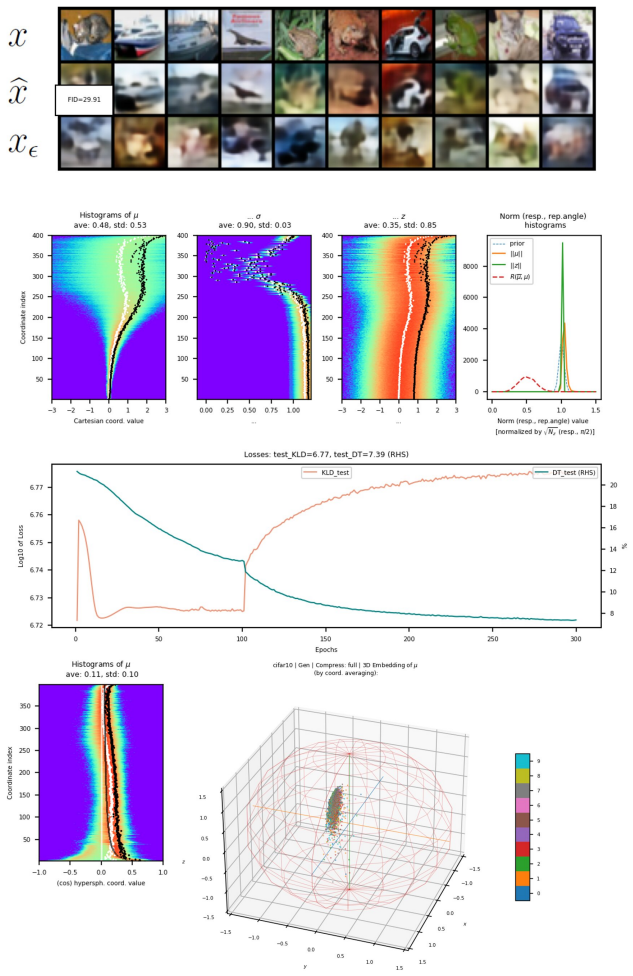
- Hyperspherical compression at the edge of stability lowers self-FID on CIFAR-10 and CelebA64 while preserving or improving reconstruction quality.
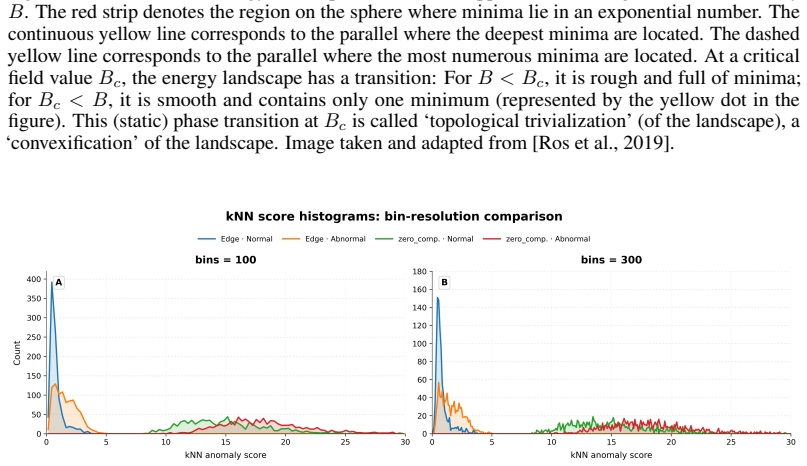
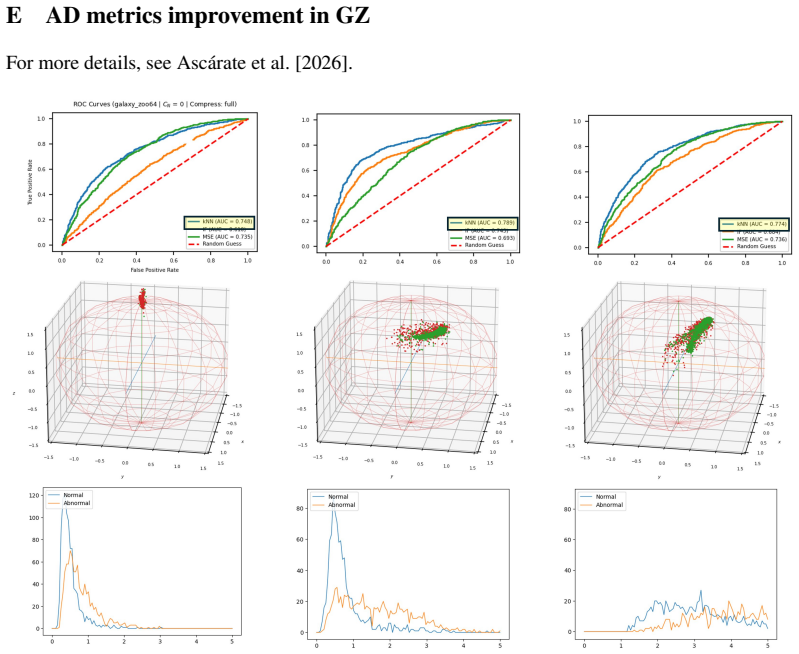
- The same semi-ordered latent geometry raises both fully unsupervised and conditional out-of-distribution detection performance on CIFAR-10/100, Imagenette, Mars Rover, and Galaxy Zoo benchmarks.
- Spin-glass observables can be used alongside standard reconstruction and generation metrics to evaluate whether a latent representation sits in a regime that supports or undermines task performance.
Where Pith is reading between the lines
- The same phase diagnostics could be tested on latent spaces of other generative models that use different priors or loss terms.
- Latent representations that remain stuck in fully disordered or fully trivialized phases may explain persistent failure modes in high-dimensional generation and detection tasks.
- Coarse-graining the latent sphere at multiple block sizes could reveal whether the identified phases persist or change across different length scales of the representation.
Load-bearing premise
The reconstruction term together with the hyperspherical prior induces a Hamiltonian on the latent sphere to which spin-glass diagnostics can be directly and meaningfully applied to identify phases that causally affect downstream performance.
What would settle it
Training an autoencoder or VAE, measuring its overlap distribution and susceptibility to locate the edge-of-stability regime, then observing that this regime produces no reduction in self-FID on CIFAR-10 or no gain in out-of-distribution detection accuracy.
Figures


read the original abstract
We study autoencoder and variational-autoencoder latent spaces through the lens of spin-glass theory. The paper has two components. First, we formalize a latent-space spin-glass dictionary: for a fixed decoder, the reconstruction term together with a hyperspherical coordinates prior induces a Hamiltonian on the latent sphere, where latent coordinates play the role of continuous spins and the prior acts as an external magnetic field. This allows us to import operational spin-glass diagnostics -- overlap distributions, susceptibility, and block-spin coarse-graining -- to detect ordered, disordered, and edge-of-stability phases in trained latent representations. Second, we show that deliberately driving the latent system toward the edge-of-stability of the topological trivialization regime has concrete downstream consequences. In generation, hyperspherical compression improves the reconstruction-generation trade-off on CIFAR-10 and CelebA64, yielding lower self-FID while preserving or improving reconstruction. In anomaly detection, the same semi-ordered latent geometry improves both fully unsupervised and conditional OOD detection, including real-world Mars Rover and Galaxy Zoo datasets, as well as CIFAR-10/100 and Imagenette-based OOD benchmarks. We therefore advocate a phase-aware evaluation paradigm for AEs/VAEs, in which spin-glass observables complement standard ML metrics and expose the latent regimes that underlie downstream success or failure in many cases.
Editorial analysis
A structured set of objections, weighed in public.
Referee Report
Summary. The manuscript proposes a spin-glass theory framework for diagnosing latent spaces in autoencoders and VAEs. It defines a Hamiltonian on the latent sphere induced by the reconstruction term (for fixed decoder) plus a hyperspherical prior, treats latent coordinates as continuous spins, and imports diagnostics such as overlap distributions, susceptibility, and block-spin coarse-graining to identify ordered, disordered, and edge-of-stability phases. The central claim is that deliberately operating at the edge-of-stability of the topological trivialization regime yields improved generation (lower self-FID on CIFAR-10 and CelebA64) and anomaly detection (across CIFAR, real-world Mars Rover and Galaxy Zoo datasets).
Significance. If the Hamiltonian construction validly maps to the empirical latent distribution and the identified phases are shown to causally drive the reported performance gains, the work would introduce a novel physics-inspired diagnostic paradigm for latent representations that complements standard ML metrics. The approach of importing operational spin-glass observables and demonstrating downstream consequences on multiple benchmarks would be a substantive contribution to understanding high-dimensional latent geometry.
major comments (2)
- [Abstract / latent-space spin-glass dictionary] The Hamiltonian H(z) is defined via the reconstruction term for a fixed decoder together with the hyperspherical prior (abstract and latent-space spin-glass dictionary section). Spin-glass diagnostics are then applied directly to the encoder outputs q(z|x). No derivation or argument is supplied showing that the measure induced by joint encoder-decoder optimization approximates the Boltzmann measure of this H; if the two measures differ due to encoder capacity or optimization dynamics, the diagnosed phases are not demonstrably those of the stated Hamiltonian, undermining the causal attribution of performance improvements to phase structure.
- [Experimental results on generation and anomaly detection] The central experimental claim—that driving the system to the edge-of-stability of the topological trivialization regime produces the reported gains in self-FID and OOD detection—rests on the phase identification step. Without evidence that the overlap distributions and susceptibility computed on q(z|x) correspond to equilibrium statistics of H, the correlation between these observables and downstream metrics could be an artifact of the training objective rather than a spin-glass phenomenon.
minor comments (2)
- [latent-space spin-glass dictionary] Notation for the hyperspherical prior and the mapping of latent coordinates to continuous spins should be introduced with explicit equations early in the dictionary section to avoid ambiguity when importing overlap and susceptibility formulas.
- The manuscript would benefit from a short table summarizing the spin-glass observables (overlap distribution, susceptibility, block-spin coarse-graining) and their precise definitions in the latent setting.
Simulated Author's Rebuttal
We thank the referee for the careful reading and constructive comments. We address the two major points below, clarifying the role of the effective Hamiltonian and the empirical nature of our diagnostics and results.
read point-by-point responses
-
Referee: [Abstract / latent-space spin-glass dictionary] The Hamiltonian H(z) is defined via the reconstruction term for a fixed decoder together with the hyperspherical prior (abstract and latent-space spin-glass dictionary section). Spin-glass diagnostics are then applied directly to the encoder outputs q(z|x). No derivation or argument is supplied showing that the measure induced by joint encoder-decoder optimization approximates the Boltzmann measure of this H; if the two measures differ due to encoder capacity or optimization dynamics, the diagnosed phases are not demonstrably those of the stated Hamiltonian, undermining the causal attribution of performance improvements to phase structure.
Authors: We appreciate the referee's emphasis on this theoretical link. The Hamiltonian is constructed as an effective model for a fixed decoder, with the reconstruction term supplying the energy and the hyperspherical prior the external field; latent coordinates are treated as continuous spins. The encoder-decoder training does not guarantee that the resulting q(z|x) is exactly the Boltzmann measure of this H, owing to finite model capacity and the dynamics of optimization. The spin-glass observables (overlap distributions, susceptibility, block-spin coarse-graining) are therefore applied operationally to the empirical distribution of latents actually produced by the trained encoder. These empirical statistics are what govern downstream generation and detection performance. The framework supplies a physically motivated language for characterizing latent geometry rather than a claim of exact equilibrium equivalence. We will add a short clarifying paragraph in the latent-space spin-glass dictionary section to make this effective-model status explicit. revision: partial
-
Referee: [Experimental results on generation and anomaly detection] The central experimental claim—that driving the system to the edge-of-stability of the topological trivialization regime produces the reported gains in self-FID and OOD detection—rests on the phase identification step. Without evidence that the overlap distributions and susceptibility computed on q(z|x) correspond to equilibrium statistics of H, the correlation between these observables and downstream metrics could be an artifact of the training objective rather than a spin-glass phenomenon.
Authors: The reported improvements in self-FID (CIFAR-10, CelebA64) and OOD detection (CIFAR, Mars Rover, Galaxy Zoo, Imagenette) are obtained by deliberately tuning hyperparameters so that the empirical overlap distribution and susceptibility on samples from q(z|x) reach the edge-of-stability regime. While we do not demonstrate that these statistics are precisely those of the equilibrium Boltzmann measure of H, the observables are computed directly on the latent distribution that the model actually uses at inference time. Across multiple datasets the same tuning procedure consistently yields better reconstruction-generation trade-offs and improved anomaly scores, indicating that the diagnosed phase structure serves as a practical control knob. We view the spin-glass diagnostics as complementary descriptors of latent geometry rather than a strict causal proof; the empirical correlation with performance is the primary evidence offered. No revision is required on this point, as the manuscript already presents the results as correlations between observable phase diagnostics and task metrics. revision: no
Circularity Check
No circularity: Hamiltonian is an explicit modeling choice; downstream claims are empirical.
full rationale
The paper defines a Hamiltonian on the latent sphere from the reconstruction term plus hyperspherical prior for a fixed decoder, then applies standard spin-glass observables (overlap distributions, susceptibility, block-spin coarse-graining) to the encoder outputs of trained models. It reports empirical improvements in self-FID and OOD detection on CIFAR-10, CelebA64, Mars Rover, Galaxy Zoo and other benchmarks when the latent geometry is driven toward a particular regime. These steps do not reduce any claimed result to its inputs by construction; the phase diagnostics are a proposed analysis tool whose correlation with performance is tested externally rather than derived tautologically from the training objective. No self-citation chain or fitted-input-as-prediction pattern appears in the load-bearing claims.
Axiom & Free-Parameter Ledger
axioms (1)
- domain assumption Spin-glass theory and its operational diagnostics apply to the Hamiltonian induced on the latent sphere by reconstruction loss plus hyperspherical prior
invented entities (1)
-
latent-space spin-glass dictionary
no independent evidence
Reference graph
Works this paper leans on
-
[1]
Spin Glass Theory and Beyond: An Introduction to the Replica Method and Its Applications , series =
Marc M. Spin Glass Theory and Beyond: An Introduction to the Replica Method and Its Applications , series =. 1987 , publisher =
1987
-
[2]
Cugliandolo and Jorge Kurchan , title =
Leticia F. Cugliandolo and Jorge Kurchan , title =. Physical Review Letters , volume =. 1993 , doi =
1993
-
[3]
Journal de Physique I , volume =
Silvio Franz and Giorgio Parisi , title =. Journal de Physique I , volume =
-
[4]
Fyodorov and C
Yan V. Fyodorov and C. Critical Behaviour of the Number of Minima of a Random Landscape at the Glass Transition Point and the Tracy--Widom Distribution , journal =. 2012 , doi =
2012
-
[5]
Fyodorov , title =
Yan V. Fyodorov , title =. Journal of Statistical Mechanics: Theory and Experiment , volume =. 2016 , doi =
2016
-
[6]
2011 , publisher =
Michel Talagrand , title =. 2011 , publisher =
2011
-
[7]
2013 , publisher =
Dmitry Panchenko , title =. 2013 , publisher =
2013
-
[8]
Random Matrices and Complexity of Spin Glasses , journal =
Antonio Auffinger and G. Random Matrices and Complexity of Spin Glasses , journal =. 2013 , doi =
2013
-
[9]
Complexity of Random Smooth Functions on the High-Dimensional Sphere , journal =
Antonio Auffinger and G. Complexity of Random Smooth Functions on the High-Dimensional Sphere , journal =. 2013 , doi =
2013
-
[10]
Inventiones mathematicae , volume =
Eliran Subag , title =. Inventiones mathematicae , volume =. 2017 , doi =
2017
-
[11]
Hopfield , title =
John J. Hopfield , title =. Proceedings of the National Academy of Sciences , volume =. 1982 , doi =
1982
-
[12]
Ackley and Geoffrey E
David H. Ackley and Geoffrey E. Hinton and Terrence J. Sejnowski , title =. Cognitive Science , volume =. 1985 , doi =
1985
-
[13]
Amit and Hanoch Gutfreund and Haim Sompolinsky , title =
Daniel J. Amit and Hanoch Gutfreund and Haim Sompolinsky , title =. Physical Review Letters , volume =. 1985 , doi =
1985
-
[14]
The Loss Surfaces of Multilayer Networks , booktitle =
Anna Choromanska and Mikael Henaff and Michael Mathieu and G. The Loss Surfaces of Multilayer Networks , booktitle =. 2015 , pages =
2015
-
[15]
Comparing Dynamics: Deep Neural Networks versus Glassy Systems , booktitle =
Marco Baity-Jesi and Levent Sagun and Mario Geiger and Stefano Spigler and G. Comparing Dynamics: Deep Neural Networks versus Glassy Systems , booktitle =. 2018 , pages =
2018
-
[16]
Comparing Dynamics: Deep Neural Networks versus Glassy Systems , journal =
Marco Baity-Jesi and Levent Sagun and Mario Geiger and Stefano Spigler and G. Comparing Dynamics: Deep Neural Networks versus Glassy Systems , journal =. 2019 , doi =
2019
-
[17]
Dauphin and Razvan Pascanu and Caglar Gulcehre and Kyunghyun Cho and Surya Ganguli and Yoshua Bengio , title =
Yann N. Dauphin and Razvan Pascanu and Caglar Gulcehre and Kyunghyun Cho and Surya Ganguli and Yoshua Bengio , title =. NeurIPS , year =
-
[18]
A Dynamic Programming Approach to the Parisi Functional
J. Jagannath and I. Tobasco , title =. arXiv preprint arXiv:1502.04398 , year =. 1502.04398 , archivePrefix =
work page internal anchor Pith review Pith/arXiv arXiv
-
[19]
J. M. Yeomans , title =. 1992 , isbn =
1992
-
[20]
Foundations and Trends in Machine Learning , volume =
Andrea Montanari and Subhabrata Sen , title =. Foundations and Trends in Machine Learning , volume =. 2024 , publisher =
2024
-
[21]
Complex Energy Landscapes in Spiked-Tensor and Simple Glassy Models: Ruggedness, Arrangements of Local Minima, and Phase Transitions , journal =
Valentina Ros and G. Complex Energy Landscapes in Spiked-Tensor and Simple Glassy Models: Ruggedness, Arrangements of Local Minima, and Phase Transitions , journal =. 2019 , doi =
2019
-
[22]
Wilson , title =
Kenneth G. Wilson , title =. Scientific American , year =
-
[23]
Why Are You Wrong? Coun- terfactual Explanations for Language Grounding with 3D Objects
Alejandro Asc. Improving the Generation of. 2025 International Joint Conference on Neural Networks (IJCNN) , year =. doi:10.1109/IJCNN64981.2025.11227651 , url =
-
[24]
Alejandro Asc. VAE with Hyperspherical Coordinates: Improving Anomaly Detection from Hypervolume-Compressed Latent Space , year =. doi:10.48550/arXiv.2601.18823 , url =. 2601.18823 , archivePrefix =
work page internal anchor Pith review Pith/arXiv arXiv doi:10.48550/arxiv.2601.18823
-
[25]
2009 , institution =
Alex Krizhevsky , title =. 2009 , institution =
2009
-
[26]
Advances in Neural Information Processing Systems 30 (NeurIPS 2017) , pages =
Heusel, Martin and Ramsauer, Hubert and Unterthiner, Thomas and Nessler, Bernhard and Hochreiter, Sepp , title =. Advances in Neural Information Processing Systems 30 (NeurIPS 2017) , pages =. 2017 , publisher =
2017
-
[27]
Fu, Hao and Li, Chunyuan and Liu, Xiaodong and Gao, Jianfeng and Celikyilmaz, Asli and Carin, Lawrence , title =. Proceedings of the 2019 Conference of the North American Chapter of the Association for Computational Linguistics: Human Language Technologies, Volume 1 (Long and Short Papers) , editor =. 2019 , month = jun, address =. doi:10.18653/v1/N19-102...
discussion (0)
Sign in with ORCID, Apple, or X to comment. Anyone can read and Pith papers without signing in.