Why Little Red Dots Disappear at z < 3: Evolution of Number Density and Halo Mass
Pith reviewed 2026-06-28 13:17 UTC · model grok-4.3
The pith
LRDs shift from underdense low-mass halos at high redshift to average environments with larger sizes by z~3.5
A machine-rendered reading of the paper's core claim, the machinery that carries it, and where it could break.
Core claim
The coherent evolution of LRDs' large-scale environments — as expressed by their overdensity and halo mass — points to a distinct evolutionary pathway from that of normal galaxies. The significantly increased halo masses of LRDs lead to larger galaxy sizes, driven primarily by the potential enhancement of halo spins. Consequently, these sources are no longer as compact as typical high-redshift LRDs. Meanwhile, the depletion of dense gas and/or elevated star formation in their host galaxies would also significantly alter the spectral energy distribution of LRDs.
What carries the argument
Halo mass growth inferred from large-scale clustering measurements, linked to galaxy size increase via enhanced halo spins and an empirical stellar-to-halo mass scaling relation.
If this is right
- At z>4 LRDs reside in under-dense regions relative to the general galaxy population.
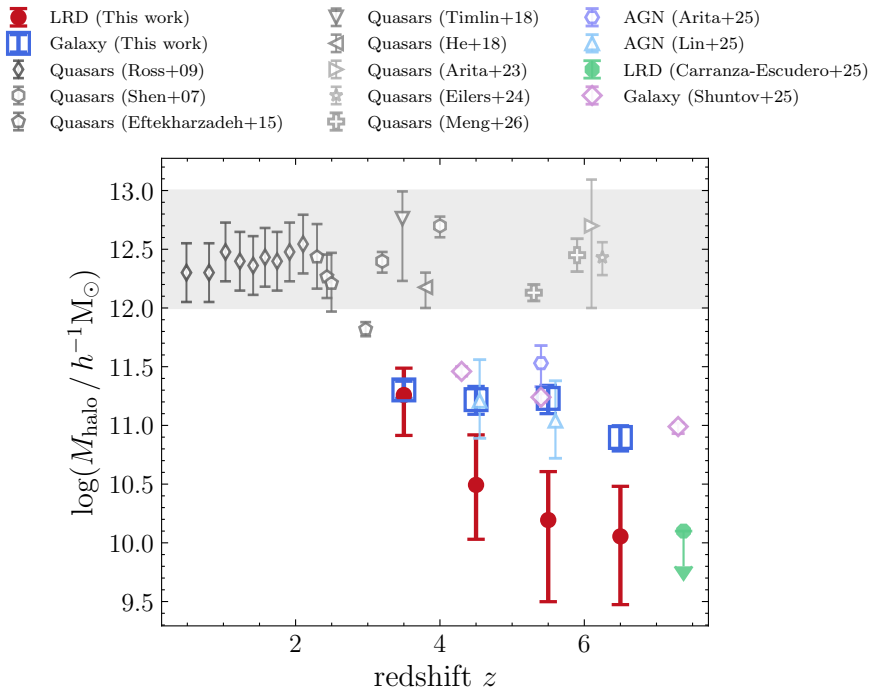
- Halo masses of LRDs grow rapidly from ≲10^10.1 M⊙ at z~7.5 to ~10^11.3 M⊙ at z~3.5.
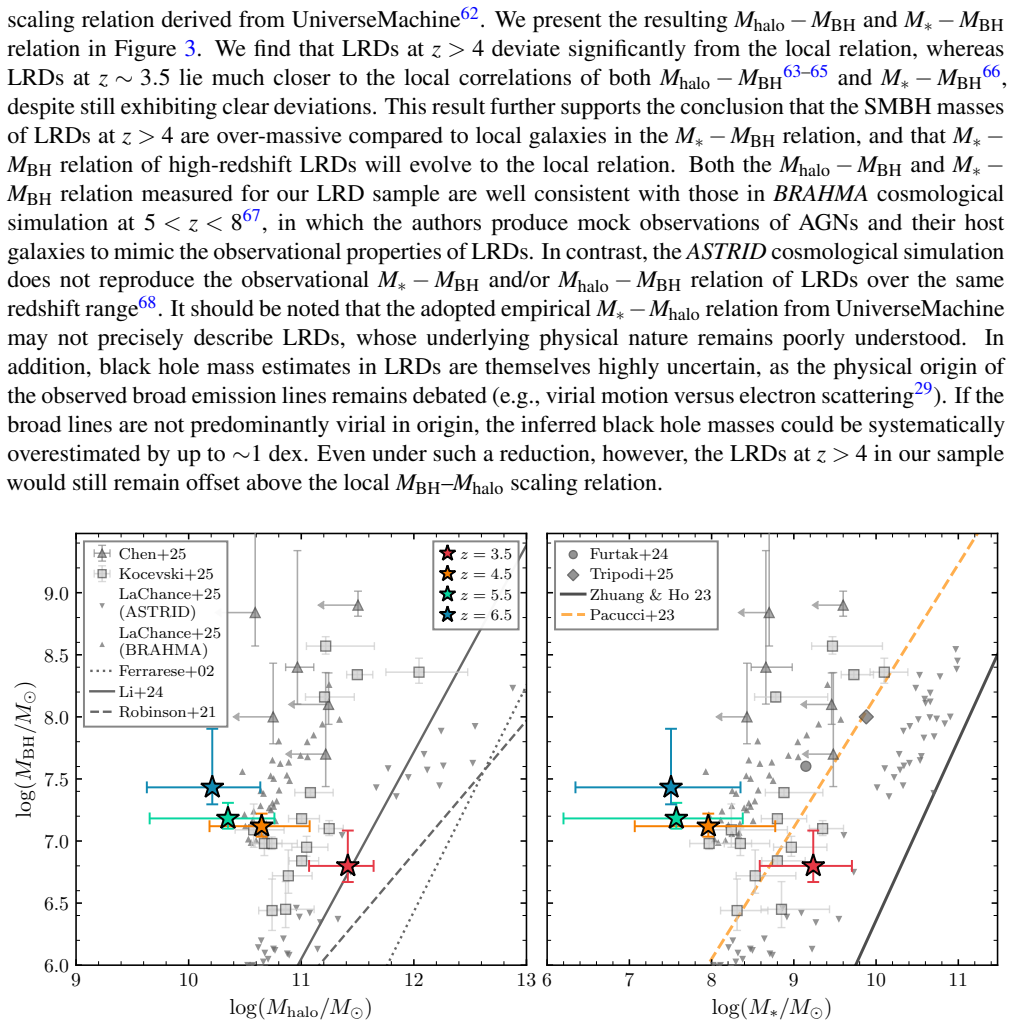
- Black hole masses remain over-massive relative to stellar mass at z>4 but converge toward the local relation by z~3.5.
- Increased halo masses drive larger galaxy sizes primarily through potential enhancement of halo spins.
- Depletion of dense gas or elevated star formation alters the SED of LRDs at lower redshifts.
Where Pith is reading between the lines
- Galaxy formation models may need to incorporate a transient compact phase tied to early low-mass halo assembly that ends around z=3.5.
- Targeted surveys at z~3 could measure the size and clustering evolution of LRDs to test whether the number density drop aligns with the halo mass threshold.
- The distinct pathway suggests LRDs are not direct progenitors of present-day compact galaxies but follow a separate evolutionary track.
- This evolution connects to the broader question of how black hole growth couples to halo mass assembly during the first few billion years.
Load-bearing premise
Halo masses are accurately inferred from large-scale clustering measurements at 3<z<7 and an empirical stellar-to-halo mass scaling relation can be applied without significant systematic bias.
What would settle it
Direct size measurements of LRDs at z~3.5 showing they remain as compact as at higher redshifts despite the inferred halo mass increase would falsify the proposed link between halo growth and loss of compactness.
Figures


read the original abstract
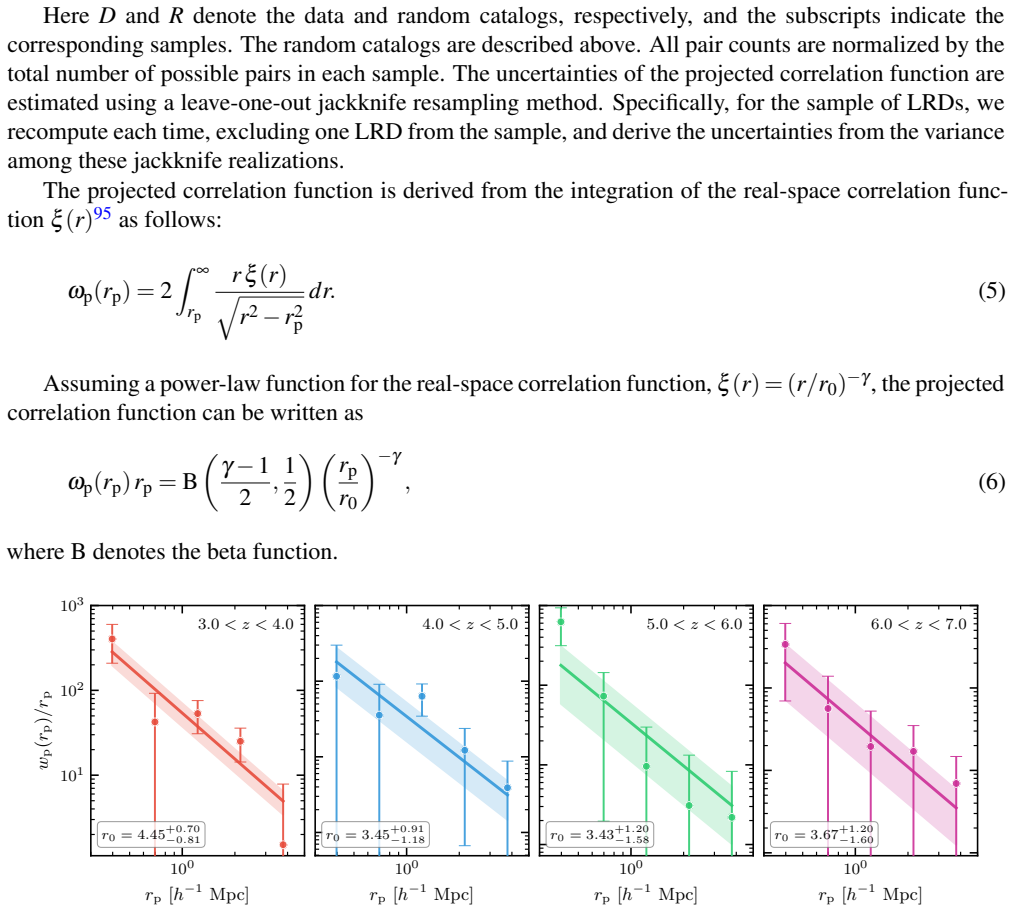
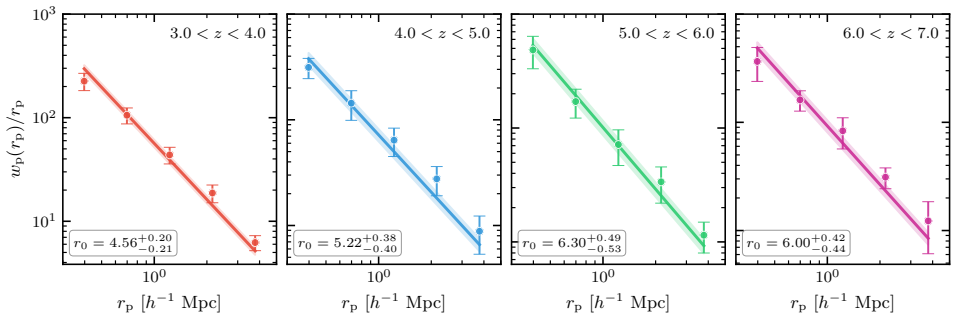
A significant puzzle in extragalactic astronomy is the scarcity of Little Red Dots (LRDs) at $z < 3$, compared to their higher abundance at earlier epochs. To understand this transition, we investigate the cosmic evolution of LRD environments. We measure the overdensity for LRDs and the general galaxy population at $3<z<7$, and find that at $z > 4$, LRDs predominantly reside in under-dense regions relative to the general galaxy population. By $z \sim 3.5$, however, this environmental contrast roughly diminishes, and LRDs are found in regions of comparable density to typical galaxies. Simultaneously, the dark matter halo masses of LRDs, inferred from large-scale clustering, grow rapidly from $\lesssim 10^{10.1} \, M_{\odot}$ at $z \sim 7.5$ to $\sim 10^{11.3} \, M_{\odot}$ at $z \sim 3.5$, where the halo mass becomes close to that of normal galaxies at lower redshift. Applying an empirical stellar-to-halo mass scaling relation, we derive stellar masses for LRDs; these show that black hole masses remain over-massive relative to stellar mass at $z > 4$, but converge toward the local $M_* - M_{\rm BH}$ scaling relation by $z \sim 3.5$. The coherent evolution of LRDs' large-scale environments $-$ as expressed by their overdensity and halo mass $-$ points to a distinct evolutionary pathway from that of normal galaxies. The significantly increased halo masses of LRDs lead to larger galaxy sizes, driven primarily by the potential enhancement of halo spins. Consequently, these sources are no longer as compact as typical high-redshift LRDs. Meanwhile, the depletion of dense gas and/or elevated star formation in their host galaxies would also significantly alter the spectral energy distribution of LRDs.
Editorial analysis
A structured set of objections, weighed in public.
Referee Report
Summary. The paper claims that the scarcity of Little Red Dots (LRDs) below z=3 arises from their environmental evolution: at z>4, LRDs reside in underdense regions relative to the general galaxy population, but by z~3.5 this contrast diminishes; simultaneously, their dark-matter halo masses (inferred from large-scale clustering) grow from ≲10^{10.1} M_⊙ at z~7.5 to ~10^{11.3} M_⊙ at z~3.5. Applying an empirical stellar-to-halo mass relation yields stellar masses showing that black-hole masses remain over-massive relative to M_* at z>4 but converge toward the local M_*-M_BH relation by z~3.5. The authors conclude that the increased halo masses drive larger galaxy sizes (via enhanced halo spins), removing the compact LRD signature and altering the SED, thereby explaining the drop in number density.
Significance. If the clustering-based halo-mass growth and the applicability of the empirical SHMR to AGN-dominated LRDs at 3<z<7 are robust, the work supplies a physically motivated explanation for the observed disappearance of LRDs, linking large-scale environment, halo assembly, and structural evolution. It would strengthen the case that LRDs follow a distinct pathway from typical high-z galaxies and would motivate targeted follow-up on spin and gas-depletion effects.
major comments (3)
- [§4] §4 (clustering and bias measurements): the reported halo-mass growth from ≲10^{10.1} to ~10^{11.3} M_⊙ rests on converting the measured large-scale bias to halo mass via the standard bias-mass relation at 3<z<7; without explicit quantification of sample-variance, redshift-error, or cosmic-variance systematics in the LRD sample, it is unclear whether the factor-of-~15 mass increase is secure enough to support the subsequent size-evolution claim.
- [§5] §5 (stellar-to-halo mass relation application): the empirical SHMR is extrapolated to derive M_* for LRDs that are AGN-dominated; the manuscript does not demonstrate that the relation (typically calibrated at lower z or on star-forming populations) remains unbiased for this population, which directly affects the claimed convergence to the local M_*-M_BH relation and the over-massive BH conclusion.
- [Discussion] Discussion section (halo-spin and size argument): the inference that higher halo masses produce larger galaxy sizes via enhanced halo spins is presented as the mechanism removing the compact LRD signature, yet no quantitative model or comparison to observed size distributions is provided to show that the mass increase is sufficient to erase the high-z compactness.
minor comments (2)
- [Abstract, §2] The abstract and §2 do not list the specific LRD catalogs, redshift ranges, or clustering estimator employed, making it difficult for readers to assess sample selection and error budgets.
- [Figures] Figure captions for the overdensity and halo-mass panels should explicitly state the error bars (Poisson, bootstrap, or jackknife) and the reference galaxy population used for comparison.
Simulated Author's Rebuttal
We thank the referee for their thorough review and valuable comments on our manuscript. We address each of the major comments point by point below. We have revised the manuscript to incorporate additional discussions where necessary to strengthen the presentation of our results.
read point-by-point responses
-
Referee: [§4] §4 (clustering and bias measurements): the reported halo-mass growth from ≲10^{10.1} to ~10^{11.3} M_⊙ rests on converting the measured large-scale bias to halo mass via the standard bias-mass relation at 3<z<7; without explicit quantification of sample-variance, redshift-error, or cosmic-variance systematics in the LRD sample, it is unclear whether the factor-of-~15 mass increase is secure enough to support the subsequent size-evolution claim.
Authors: The halo masses are inferred from the large-scale bias using the standard relation, and the measurements are based on the available photometric sample with redshift estimates. While we did not perform a full Monte Carlo simulation of cosmic variance due to the limited survey area, the trend in halo mass growth is supported by the independent measurement of decreasing overdensity contrast with decreasing redshift. In the revised manuscript, we will add a subsection quantifying the expected impact of sample variance using jackknife resampling on the correlation function and discuss the robustness of the mass increase. revision: yes
-
Referee: [§5] §5 (stellar-to-halo mass relation application): the empirical SHMR is extrapolated to derive M_* for LRDs that are AGN-dominated; the manuscript does not demonstrate that the relation (typically calibrated at lower z or on star-forming populations) remains unbiased for this population, which directly affects the claimed convergence to the local M_*-M_BH relation and the over-massive BH conclusion.
Authors: We used the Behroozi et al. (2019) SHMR, which incorporates high-redshift data including AGN hosts. However, we recognize that LRDs may have different star formation histories. The convergence result is presented as an indication rather than a definitive proof. We will revise the text to include a more explicit discussion of the assumptions and potential biases in applying the SHMR to AGN-dominated systems at these redshifts. revision: partial
-
Referee: [Discussion] Discussion section (halo-spin and size argument): the inference that higher halo masses produce larger galaxy sizes via enhanced halo spins is presented as the mechanism removing the compact LRD signature, yet no quantitative model or comparison to observed size distributions is provided to show that the mass increase is sufficient to erase the high-z compactness.
Authors: The argument relies on the known correlation from N-body simulations that more massive halos at fixed redshift tend to have higher spin parameters on average, leading to larger disk sizes. We do not introduce a new model as this is a standard expectation in galaxy formation theory. To address the comment, we will add references to observational studies of galaxy sizes at z~3-4 showing the mass-size relation and note that the halo mass increase from 10^{10} to 10^{11.3} solar masses corresponds to a factor of several in expected size, sufficient to transition from compact to more extended systems. revision: yes
Circularity Check
No circularity: halo masses derived from independent clustering measurements; SHMR application is external.
full rationale
The derivation chain begins with direct measurements of overdensity and large-scale clustering to infer halo masses at 3<z<7, which are standard observational steps independent of the target conclusion on LRD disappearance or size evolution. Stellar masses are then obtained via an empirical stellar-to-halo mass relation applied to those halo masses; this relation is not fitted or calibrated within the paper to the LRD data or the disappearance result. The subsequent arguments about spin-driven size growth and convergence to the local M*-MBH relation follow from these inputs rather than presupposing them. No self-citations, self-definitional loops, or fitted inputs renamed as predictions appear in the abstract or described methods. The paper is self-contained against external benchmarks for its core observational steps.
Axiom & Free-Parameter Ledger
axioms (2)
- standard math Standard Lambda-CDM cosmology and bias model for converting large-scale clustering to halo mass
- domain assumption Applicability of an existing empirical stellar-to-halo mass relation at z>3
Reference graph
Works this paper leans on
-
[1]
Labbé, I. et al. A population of red candidate massive galaxies 600 Myr after the Big Bang. Nature 616, 266–269, DOI: 10.1038/s41586-023-05786-2 (2023). 2207.12446
-
[2]
Harikane, Y . et al. A JWST/NIRSpec First Census of Broad-line AGNs at z = 4-7: Detection of 10 Faint AGNs with M BH 106-108 M ⊙ and Their Host Galaxy Properties. Astrophys. J. 959, 39, DOI: 10.3847/1538-4357/ad029e (2023). 2303.11946
-
[3]
Furtak, L. J. et al. A high black-hole-to-host mass ratio in a lensed AGN in the early Universe. Nature 628, 57–61, DOI: 10.1038/s41586-024-07184-8 (2024). 2308.05735
-
[4]
Greene, J. E. et al. UNCOVER Spectroscopy Confirms the Surprising Ubiquity of Active Galactic Nuclei in Red Sources at z > 5. Astrophys. J. 964, 39, DOI: 10.3847/1538-4357/ad1e5f (2024). 2309.05714
-
[5]
Matthee, J. et al. Little Red Dots: An Abundant Population of Faint Active Galactic Nuclei at z ∼ 5 Revealed by the EIGER and FRESCO JWST Surveys. Astrophys. J. 963, 129, DOI: 10.3847/ 1538-4357/ad2345 (2024). 2306.05448
arXiv 2024
-
[6]
Kokorev, V .et al. A Census of Photometrically Selected Little Red Dots at 4 < z < 9 in JWST Blank Fields. Astrophys. J. 968, 38, DOI: 10.3847/1538-4357/ad4265 (2024). 2401.09981
-
[8]
Setton, D. J. et al. Little Red Dots at an Inflection Point: Ubiquitous V -shaped Turnover Consistently Occurs at the Balmer Limit. Astrophys. J. 995, 118, DOI: 10.3847/1538-4357/ae1500 (2025). 2411. 03424
-
[9]
Wang, B. et al. RUBIES: Evolved Stellar Populations with Extended Formation Histories at z ∼ 7–8 in Candidate Massive Galaxies Identified with JWST/NIRSpec. Astrophys. J. Lett. 969, L13, DOI: 10.3847/2041-8213/ad55f7 (2024). 2405.01473
-
[10]
D’Eugenio, F. et al. BlackTHUNDER strikes twice: rest-frame Balmer-line absorption and high Eddington accretion rate in a Little Red Dot at z = 7.04. arXiv e-prints arXiv:2503.11752, DOI: 10.48550/arXiv.2503.11752 (2025). 2503.11752
work page internal anchor Pith review Pith/arXiv arXiv doi:10.48550/arxiv.2503.11752 2025
-
[11]
Ananna, T. T., Bogdán, Á., Kovács, O. E., Natarajan, P . & Hickox, R. C. X-Ray View of Little Red Dots: Do They Host Supermassive Black Holes? Astrophys. J. Lett. 969, L18, DOI: 10.3847/ 2041-8213/ad5669 (2024). 2404.19010
arXiv 2041
-
[12]
Y ue, M. et al. Stacking X-Ray Observations of “Little Red Dots”: Implications for Their Active Galactic Nucleus Properties. Astrophys. J. Lett. 974, L26, DOI: 10.3847/2041-8213/ad7eba (2024). 2404.13290
-
[13]
Inayoshi, K. & Maiolino, R. Extremely Dense Gas around Little Red Dots and High-redshift Active Galactic Nuclei: A Nonstellar Origin of the Balmer Break and Absorption Features. Astrophys. J. Lett. 980, L27, DOI: 10.3847/2041-8213/adaebd (2025). 2409.07805
-
[14]
Inayoshi, K. & Ho, L. C. A Critical Evaluation of the Physical Nature of the Little Red Dots. arXiv e-prints arXiv:2512.03130, DOI: 10.48550/arXiv.2512.03130 (2025). 2512.03130. 16
-
[15]
Ji, X. et al. BlackTHUNDER A non-stellar Balmer break in a black hole-dominated little red dot at z = 7.04. Mon. Not. R. Astron. Soc. 544, 3900–3935, DOI: 10.1093/mnras/staf1867 (2025). 2501.13082
-
[16]
Chen, K., Li, Z., Inayoshi, K. & Ho, L. C. Dust Budget Crisis in Little Red Dots. Astrophys. J. Lett. 994, L42, DOI: 10.3847/2041-8213/ae1955 (2025). 2505.22600
-
[17]
Delvecchio, I. et al. Active galactic nuclei-heated dust revealed in “little red dots”. Astron. Astrophys. 704, A313, DOI: 10.1051/0004-6361/202557164 (2025). 2509.07100
-
[18]
Li, Z., Inayoshi, K., Chen, K., Ichikawa, K. & Ho, L. C. Little Red Dots: Rapidly Growing Black Holes Reddened by Extended Dusty Flows. Astrophys. J. 980, 36, DOI: 10.3847/1538-4357/ada5fb (2025). 2407.10760
-
[19]
Xiao, M. et al. No [C II] or dust detection in two Little Red Dots at z spec> 7. Astron. Astrophys. 700, A231, DOI: 10.1051/0004-6361/202554361 (2025). 2503.01945
-
[20]
Setton, D. J. et al. A Confirmed Deficit of Hot and Cold Dust Emission in the Most Luminous Little Red Dots. Astrophys. J. Lett. 991, L10, DOI: 10.3847/2041-8213/ade78b (2025). 2503.02059
-
[21]
Zhang, C. et al. The composite spectrum of little red dots from a standard inner disk and an unstable outer disk. Nat. Astron. DOI: 10.1038/s41550-026-02785-x (2026). 2505.12719
-
[22]
Zwick, L., Tiede, C. & Mayer, L. Little Red Dots as self-gravitating discs accreting on supermassive stars: Spectral appearance and formation pathway of the progenitors to direct collapse black holes. arXiv e-prints arXiv:2507.22014, DOI: 10.48550/arXiv.2507.22014 (2025). 2507.22014
-
[23]
Chen, Y .-X. et al. Spectral Appearance of Self-gravitating AGN Disks Powered by Stellar Ob- jects: Universal Effective Temperature in the Optical Continuum and Application to Little Red Dots. arXiv e-prints arXiv:2602.06954, DOI: 10.48550/arXiv.2602.06954 (2026). 2602.06954
work page internal anchor Pith review Pith/arXiv arXiv doi:10.48550/arxiv.2602.06954 2026
-
[25]
Tripodi, R. et al. Extreme properties of a compact and massive accreting black hole host in the first 500 Myr. Nat. Commun. 16, 9830, DOI: 10.1038/s41467-025-65070-x (2025). 2412.04983
-
[26]
Zhang, Y . et al. Unveiling Extended Components of ’Little Red Dots’ in Rest-Frame Optical. arXiv e-prints arXiv:2510.25830, DOI: 10.48550/arXiv.2510.25830 (2025). 2510.25830
-
[27]
Chen, C.-H., Ho, L. C., Li, R. & Zhuang, M.-Y . The Host Galaxy (If Any) of the Little Red Dots. Astrophys. J. 983, 60, DOI: 10.3847/1538-4357/ada93a (2025). 2411.04446
-
[28]
Juodžbalis, I. et al. A direct black hole mass measurement in a Little Red Dot at the Epoch of Reionization. arXiv e-prints arXiv:2508.21748, DOI: 10.48550/arXiv.2508.21748 (2025). 2508. 21748
work page internal anchor Pith review Pith/arXiv arXiv doi:10.48550/arxiv.2508.21748 2025
-
[29]
Rusakov, V . et al. Little red dots as young supermassive black holes in dense ionized cocoons. Nature 649, 574–579, DOI: 10.1038/s41586-025-09900-4 (2026). 2503.16595
-
[30]
Ma, Y . et al. UNCOVER: 404 Error—Models Not Found for the Triply Imaged Little Red Dot A2744-QSO1. Astrophys. J. 981, 191, DOI: 10.3847/1538-4357/ada613 (2025). 2410.06257
-
[31]
Ji, X. et al. Lord of LRDs: insights into a ’Little Red Dot’ with a low-ionization spectrum at z = 0.1. Mon. Not. R. Astron. Soc. 545, staf2235, DOI: 10.1093/mnras/staf2235 (2026). 2507.23774. 17
-
[32]
Akins, H. B. et al. COSMOS-Web: The Overabundance and Physical Nature of “Little Red Dots”—Implications for Early Galaxy and SMBH Assembly. Astrophys. J. 991, 37, DOI: 10.3847/ 1538-4357/ade984 (2025). 2406.10341
arXiv 2025
-
[33]
McGreer, I. D. et al. The z = 5 quasar luminosity function from sdss stripe 82. Astrophys. J. 768, 105, DOI: 10.1088/0004-637X/768/2/105 (2013). 1212.4493
work page internal anchor Pith review Pith/arXiv arXiv doi:10.1088/0004-637x/768/2/105 2013
-
[34]
The Faint End of the z=5 Quasar Luminosity Function from the CFHTLS
McGreer, I. D., Fan, X., Jiang, L. & Cai, Z. The Faint End of the z = 5 Quasar Luminosity Function from the CFHTLS. Astron. J. 155, 131, DOI: 10.3847/1538-3881/aaaab4 (2018). 1710.09390
work page internal anchor Pith review Pith/arXiv arXiv doi:10.3847/1538-3881/aaaab4 2018
-
[35]
Y ang, J.et al. A Survey of Luminous High-redshift Quasars with SDSS and WISE. II. the Bright End of the Quasar Luminosity Function at z ≈ 5. Astrophys. J. 829, 33, DOI: 10.3847/0004-637X/ 829/1/33 (2016). 1607.04415
work page internal anchor Pith review Pith/arXiv arXiv doi:10.3847/0004-637x/ 2016
-
[36]
Jiang, L. et al. The Final SDSS High-redshift Quasar Sample of 52 Quasars at z>5.7. Astrophys. J. 833, 222, DOI: 10.3847/1538-4357/833/2/222 (2016). 1610.05369
work page internal anchor Pith review Pith/arXiv arXiv doi:10.3847/1538-4357/833/2/222 2016
-
[37]
Matsuoka, Y . et al. Subaru High-z Exploration of Low-luminosity Quasars (SHELLQs). X. Dis- covery of 35 Quasars and Luminous Galaxies at 5.7 ≤ z ≤ 7.0. Astrophys. J. 883, 183, DOI: 10.3847/1538-4357/ab3c60 (2019). 1908.07910
-
[38]
Schindler, J.-T. et al. The Pan-STARRS1 z > 5.6 Quasar Survey. III. The z ≈ 6 Quasar Luminosity Function. Astrophys. J. 943, 67, DOI: 10.3847/1538-4357/aca7ca (2023). 2212.04179
-
[39]
Wang, F. et al. Exploring Reionization-era Quasars. III. Discovery of 16 Quasars at 6.4 ≲ z ≲ 6.9 with DESI Legacy Imaging Surveys and the UKIRT Hemisphere Survey and Quasar Luminosity Function at z ∼ 6.7. Astrophys. J. 884, 30, DOI: 10.3847/1538-4357/ab2be5 (2019). 1810.11926
-
[40]
Matsuoka, Y . et al. Quasar Luminosity Function at z = 7. Astrophys. J. Lett. 949, L42, DOI: 10.3847/2041-8213/acd69f (2023). 2305.11225
-
[41]
Carranza-Escudero, M. et al. Lonely Little Red Dots: Challenges to the Active Galactic Nu- cleus Nature of Little Red Dots through Their Clustering and Spectral Energy Distributions. Astrophys. J. Lett. 989, L50, DOI: 10.3847/2041-8213/adf73d (2025). 2506.04004
-
[42]
Ma, Y . et al. Counting Little Red Dots at z < 4 with Ground-based Surveys and Spectroscopic Follow-up. Astrophys. J. 1000, 59, DOI: 10.3847/1538-4357/ae4596 (2026). 2504.08032
-
[43]
Little Red Dots as the V ery First Activity of Black Hole Growth
Inayoshi, K. Little Red Dots as the V ery First Activity of Black Hole Growth. Astrophys. J. Lett. 988, L22, DOI: 10.3847/2041-8213/adea66 (2025). 2503.05537
-
[44]
Zhang, Z., Jiang, L., Liu, W., Ho, L. C. & Inayoshi, K. JWST Insights into Narrow-line Little Red Dots. Astrophys. J. 998, 170, DOI: 10.3847/1538-4357/ae33c4 (2026). 2506.04350
-
[45]
de Graaff, A. et al. Little Red Dots host Black Hole Stars: A unified family of gas-reddened AGN revealed by JWST/NIRSpec spectroscopy. arXiv e-prints arXiv:2511.21820, DOI: 10.48550/arXiv. 2511.21820 (2025). 2511.21820
work page internal anchor Pith review doi:10.48550/arxiv 2025
-
[46]
Greene, J. E. & Ho, L. C. Estimating Black Hole Masses in Active Galaxies Using the H α Emission Line. Astrophys. J. 630, 122–129, DOI: 10.1086/431897 (2005). astro-ph/0508335
work page internal anchor Pith review Pith/arXiv arXiv doi:10.1086/431897 2005
-
[47]
Lin, X. et al. The Discovery of Little Red Dots in the Local Universe: Signatures of Cool Gas Envelopes. Astrophys. J. 997, 364, DOI: 10.3847/1538-4357/ae2bdf (2026). 2507.10659
-
[48]
Lin, X. et al. The Large-scale Environments of Low-luminosity AGNs at 3.9 < z < 6 and Im- plications for Their Host Dark Matter Halos from a Complete NIRCam Grism Redshift Survey. Astrophys. J. 997, 61, DOI: 10.3847/1538-4357/ae1eef (2026). 2505.02896. 18
-
[49]
Davis, M., Efstathiou, G., Frenk, C. S. & White, S. D. M. The evolution of large-scale structure in a universe dominated by cold dark matter. Astrophys. J. 292, 371–394, DOI: 10.1086/163168 (1985)
-
[50]
White, S. D. M. & Rees, M. J. Core condensation in heavy halos: a two-stage theory for galaxy formation and clustering. Mon. Not. R. Astron. Soc. 183, 341–358, DOI: 10.1093/mnras/183.3.341 (1978)
-
[51]
Peebles, P . J. E. The large-scale structure of the universe (Princeton Univercity Press, 1980)
1980
-
[52]
Clustering of High Redshift ($z\ge 2.9$) Quasars from the Sloan Digital Sky Survey
Shen, Y .et al. Clustering of High-Redshift (z >= 2.9) Quasars from the Sloan Digital Sky Survey. Astron. J. 133, 2222–2241, DOI: 10.1086/513517 (2007). astro-ph/0702214
work page internal anchor Pith review Pith/arXiv arXiv doi:10.1086/513517 2007
-
[53]
Clustering of Low-Redshift (z <= 2.2) Quasars from the Sloan Digital Sky Survey
Ross, N. P .et al. Clustering of Low-redshift (z <= 2.2) Quasars from the Sloan Digital Sky Survey. Astrophys. J. 697, 1634–1655, DOI: 10.1088/0004-637X/697/2/1634 (2009). 0903.3230
work page internal anchor Pith review Pith/arXiv arXiv doi:10.1088/0004-637x/697/2/1634 2009
-
[54]
Eftekharzadeh, S. et al. Clustering of intermediate redshift quasars using the final SDSS III-BOSS sample. Mon. Not. R. Astron. Soc. 453, 2779–2798, DOI: 10.1093/mnras/stv1763 (2015). 1507. 08380
-
[55]
Timlin, J. D. et al. The Clustering of High-redshift (2.9 ≤ z ≤ 5.1) Quasars in SDSS Stripe 82. Astrophys. J. 859, 20, DOI: 10.3847/1538-4357/aab9ac (2018). 1712.03128
work page internal anchor Pith review Pith/arXiv arXiv doi:10.3847/1538-4357/aab9ac 2018
-
[56]
He, W. et al. Clustering of quasars in a wide luminosity range at redshift 4 with Subaru Hy- per Suprime-Cam Wide-field imaging. Publ. Astron. Soc. Jpn 70, S33, DOI: 10.1093/pasj/psx129 (2018). 1704.08461
work page internal anchor Pith review Pith/arXiv arXiv doi:10.1093/pasj/psx129 2018
-
[57]
Arita, J. et al. Subaru High-z Exploration of Low-luminosity Quasars (SHELLQs). XVIII. The Dark Matter Halo Mass of Quasars at z 6. Astrophys. J. 954, 210, DOI: 10.3847/1538-4357/ace43a (2023). 2307.02531
-
[58]
Eilers, A.-C. et al. EIGER. VI. The Correlation Function, Host Halo Mass, and Duty Cycle of Luminous Quasars at z ≳ 6. Astrophys. J. 974, 275, DOI: 10.3847/1538-4357/ad778b (2024). 2403.07986
-
[59]
Meng, H., Zhang, H. & Y e, G. Probing The Dark Matter Halo of High-redshift Quasar from Wide- Field Clustering Analysis. arXiv e-prints arXiv:2602.02778 (2026). 2602.02778
Pith/arXiv arXiv 2026
-
[60]
Arita, J. et al. The nature of low-luminosity AGNs discovered by JWST based on clustering analysis: progenitors of low-z quasars? Mon. Not. R. Astron. Soc. 536, 3677–3688, DOI: 10.1093/mnras/ stae2765 (2025). 2410.08707
-
[61]
Shuntov, M. et al. Constraints on the early Universe star formation efficiency from galaxy clustering and halo modeling of H α and [O III] emitters. Astron. Astrophys. 699, A231, DOI: 10.1051/ 0004-6361/202554618 (2025). 2503.14280
arXiv 2025
-
[62]
UniverseMachine: The Correlation between Galaxy Growth and Dark Matter Halo Assembly from z=0-10
Behroozi, P ., Wechsler, R. H., Hearin, A. P . & Conroy, C. UNIVERSEMACHINE: The correlation between galaxy growth and dark matter halo assembly from z = 0-10. MNRAS 488, 3143–3194, DOI: 10.1093/mnras/stz1182 (2019). 1806.07893
work page internal anchor Pith review Pith/arXiv arXiv doi:10.1093/mnras/stz1182 2019
-
[63]
Beyond the Bulge: a Fundamental Relation Between Supermassive Black Holes and Dark Matter Halos
Ferrarese, L. Beyond the Bulge: A Fundamental Relation between Supermassive Black Holes and Dark Matter Halos. Astrophys. J. 578, 90–97, DOI: 10.1086/342308 (2002). astro-ph/0203469
work page internal anchor Pith review Pith/arXiv arXiv doi:10.1086/342308 2002
-
[64]
Robinson, J. H. et al. Tully-Fisher Distances and Dynamical Mass Constraints for 24 Host Galaxies of Reverberation-mapped AGNs. Astrophys. J. 912, 160, DOI: 10.3847/1538-4357/abedaa (2021). 2103.07000. 19
-
[65]
Li, Q. et al. Black Hole–Halo Mass Relation from UNIONS Weak Lensing. Astrophys. J. Lett. 969, L25, DOI: 10.3847/2041-8213/ad58b0 (2024). 2402.10740
-
[66]
Zhuang, M.-Y . & Ho, L. C. Evolutionary paths of active galactic nuclei and their host galaxies. Nat. Astron. 7, 1376–1389, DOI: 10.1038/s41550-023-02051-4 (2023). 2308.08603
-
[67]
LaChance, P . et al. From ASTRID to BRAHMA – The role of overmassive black holes in little red dots in cosmological simulations. arXiv e-prints arXiv:2512.13957, DOI: 10.48550/arXiv.2512. 13957 (2025). 2512.13957
-
[68]
LaChance, P . et al. The Properties of Little Red Dot Galaxies in the ASTRID Simulation. The Open J. Astrophys. 9, 55493, DOI: 10.33232/001c.155493 (2026). 2505.20439
-
[69]
Pacucci, F. & Loeb, A. Cosmic Outliers: Low-spin Halos Explain the Abundance, Com- pactness, and Redshift Evolution of the Little Red Dots. Astrophys. J. Lett. 989, L19, DOI: 10.3847/2041-8213/ade871 (2025). 2506.03244
-
[70]
Sijacki, D., Springel, V . & Haehnelt, M. G. Growing the first bright quasars in cosmological simula- tions of structure formation. Mon. Not. R. Astron. Soc. 400, 100–122, DOI: 10.1111/j.1365-2966. 2009.15452.x (2009). 0905.1689
-
[71]
Ward, E. et al. Evolution of the SizeMass Relation of Star-forming Galaxies Since z = 5.5 Revealed by CEERS. Astrophys. J. 962, 176, DOI: 10.3847/1538-4357/ad20ed (2024). 2311.02162
-
[72]
COSMOS-Web: Unraveling the Evolution of Galaxy Size and Related Properties at 2 < z < 10
Y ang, L.et al. COSMOS-Web: Unraveling the Evolution of Galaxy Size and Related Properties at 2 < z < 10. Astrophys. J. Suppl. Ser. 281, 68, DOI: 10.3847/1538-4365/ae0e1b (2025). 2504.07185
-
[73]
Jiang, F. et al. Formation of the Little Red Dots from the Core Collapse of Self-interacting Dark Matter Halos. Astrophys. J. Lett. 996, L19, DOI: 10.3847/2041-8213/ae247a (2026). 2503.23710
-
[75]
Finkelstein, S. L. et al. A Long Time Ago in a Galaxy Far, Far Away: A Candidate z ∼ 12 Galaxy in Early JWST CEERS Imaging. Astrophys. J. Lett. 940, L55, DOI: 10.3847/2041-8213/ac966e (2022). 2207.12474
-
[76]
Eisenstein, D. J. et al. Overview of the JWST Advanced Deep Extragalactic Survey (JADES). arXiv e-prints arXiv:2306.02465, DOI: 10.48550/arXiv.2306.02465 (2023). 2306.02465
work page internal anchor Pith review Pith/arXiv arXiv doi:10.48550/arxiv.2306.02465 2023
-
[77]
Dunlop, J. S. et al. PRIMER: Public Release IMaging for Extragalactic Research. JWST Proposal. Cycle 1, ID. #1837 (2021)
2021
-
[78]
An Atlas of Color-selected Quiescent Galaxies at z > 3 in Public JWST Fields
V alentino, F.et al. An Atlas of Color-selected Quiescent Galaxies at z > 3 in Public JWST Fields. Astrophys. J. 947, 20, DOI: 10.3847/1538-4357/acbefa (2023). 2302.10936
-
[79]
grizli (2023)
Brammer, G. grizli (2023). Zenodo identifier: 8370018
2023
-
[80]
msaexp: Nirspec analysis tools (2023)
Brammer, G. msaexp: Nirspec analysis tools (2023). Zenodo identifier: 8319596
2023
-
[81]
Brammer, G. B., van Dokkum, P . G. & Coppi, P . EAZY: A Fast, Public Photometric Redshift Code. Astrophys. J. 686, 1503–1513, DOI: 10.1086/591786 (2008). 0807.1533
work page internal anchor Pith review Pith/arXiv arXiv doi:10.1086/591786 2008
-
[82]
Furtak, L. J. et al. UNCOVERing the extended strong lensing structures of Abell 2744 with the deepest JWST imaging. Mon. Not. R. Astron. Soc. 523, 4568–4582, DOI: 10.1093/mnras/stad1627 (2023). 2212.04381. 20
-
[83]
Price, S. H. et al. The UNCOVER Survey: First Release of Ultradeep JWST/NIRSpec PRISM Spec- tra for ∼700 Galaxies from z ∼ 0.313 in A2744. Astrophys. J. 982, 51, DOI: 10.3847/1538-4357/ adaec1 (2025). 2408.03920
discussion (0)
Sign in with ORCID, Apple, or X to comment. Anyone can read and Pith papers without signing in.