Burklund-Lin-Wang-Xu Methods in the Cofiber-of-Tau Formalism and Applications to Equivariant Slice Differentials
Pith reviewed 2026-06-28 11:23 UTC · model grok-4.3
The pith
Hidden extensions along arbitrary maps of filtered spectra can be analyzed with generalized Leibniz and Mahowald rules, producing new exotic transfer differentials in C4-slice spectral sequences.
A machine-rendered reading of the paper's core claim, the machinery that carries it, and where it could break.
Core claim
By reinvestigating spectral sequences through the (∞,1)-category of filtered spectra in the cofiber-of-τ formalism, hidden extensions along arbitrary maps are defined and analyzed. This yields computational principles that extend the generalized Leibniz rule and generalized Mahowald trick of Lin-Wang-Xu as well as Burklund's Leibniz rule for total differentials, with a slightly sharpened layered formulation that applies even to the Adams spectral sequence. As an application, new families of exotic transfer differentials are obtained in the C4-slice spectral sequences for BP((C4))<m> for every m ≥ 1.
What carries the argument
The cofiber-of-τ formalism for the (∞,1)-category of filtered spectra, which carries the definition of hidden extensions along arbitrary maps and the associated layered computational principles.
Load-bearing premise
The cofiber-of-τ formalism provides a suitable framework for the (∞,1)-category of filtered spectra in which hidden extensions along arbitrary maps can be defined and analyzed with the stated computational principles.
What would settle it
An explicit computation showing that one of the claimed exotic transfer differentials does not occur in the C4-slice spectral sequence for BP((C4))<m> at some m, or a counterexample where the generalized Leibniz rule fails for a specific map of filtered spectra.
Figures

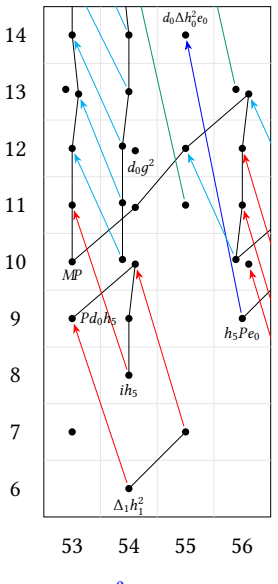
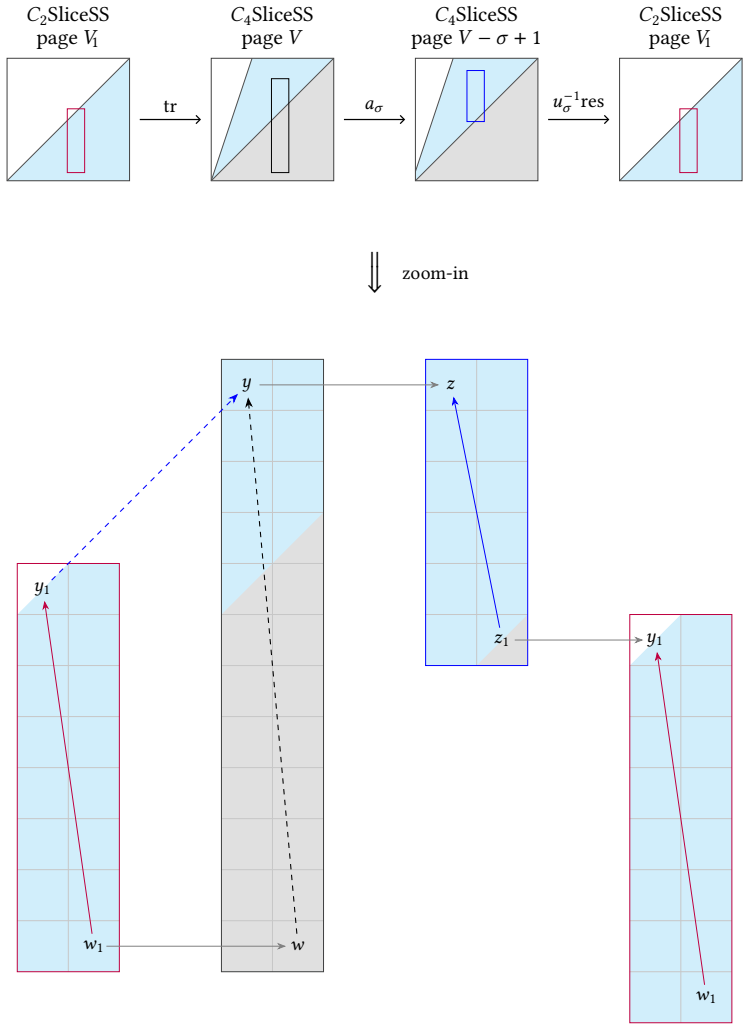
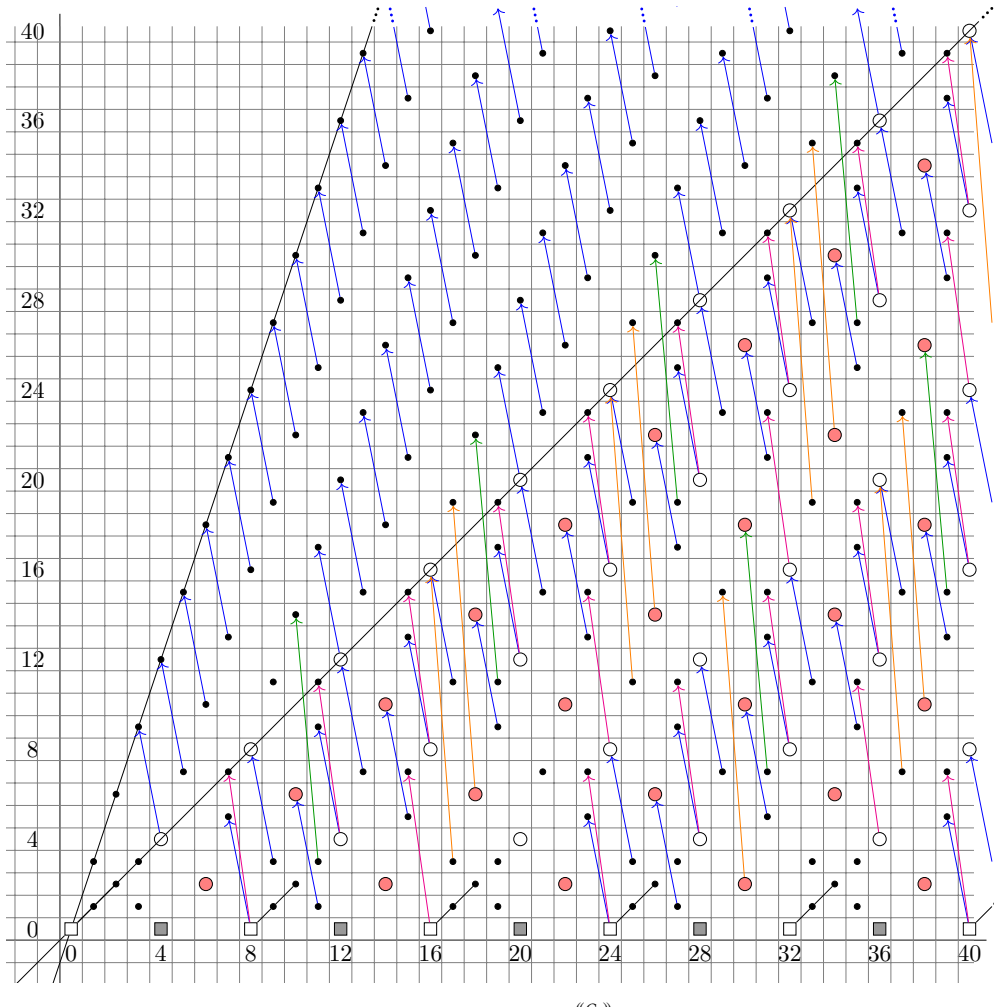
read the original abstract
We reinvestigate the theory of spectral sequences by studying the $(\infty,1)$-category of filtered spectra through the cofiber-of-$\tau$ formalism of Burklund-Isaksen-Pstragowski-Wang-Xu. In this framework, we define and analyze hidden extensions along arbitrary maps of filtered spectra, establishing computational principles that extend the generalized Leibniz rule and the generalized Mahowald trick of Lin-Wang-Xu, as well as Burklund's Leibniz rule for total differentials, from the Adams spectral sequence to this broader setup. Our formulation uses a more refined, layered notion of extension, which slightly sharpens these statements even for the Adams spectral sequence. As an application, we study equivariant slice spectral sequences and obtain new families of "exotic transfer" differentials in the $C_4$-slice spectral sequences for the Hill-Hopkins-Ravenel theories $\mathrm{BP}^{((C_4))}\langle m\rangle$ for every $m \ge 1$.
Editorial analysis
A structured set of objections, weighed in public.
Referee Report
Summary. The paper reinvestigates spectral sequences via the cofiber-of-τ formalism in the (∞,1)-category of filtered spectra. It defines hidden extensions along arbitrary maps of filtered spectra and extends the generalized Leibniz rule, generalized Mahowald trick (from Lin-Wang-Xu), and Burklund's Leibniz rule for total differentials from the Adams spectral sequence to this setting, using a refined layered notion of extension that sharpens even the Adams case. As an application, it derives new families of exotic transfer differentials in the C4-slice spectral sequences for the Hill-Hopkins-Ravenel theories BP((C4))⟨m⟩ for every m ≥ 1.
Significance. If the derivations hold, the work supplies a systematic framework for hidden extensions in filtered spectra that unifies and extends existing computational tools from the Adams spectral sequence, with direct consequences for equivariant slice spectral sequence computations. The new exotic transfer differentials for all BP((C4))⟨m⟩ provide concrete, falsifiable predictions in chromatic and equivariant homotopy theory. The approach is parameter-free and builds directly on prior formalism by overlapping authors, strengthening the case for broader applicability of these principles.
major comments (2)
- [§3] §3 (definition of hidden extensions): the refined layered notion of extension is introduced to sharpen the statements, but the interaction between layers and the cofiber-of-τ filtration is not shown to preserve the exactness properties needed for the generalized Leibniz rule to hold without additional hypotheses on the map of filtered spectra.
- [§5] §5 (application to C4-slice SS): the claim of new exotic transfer differentials for every m ≥ 1 relies on the extended Mahowald trick applying uniformly, but the manuscript does not exhibit an explicit check that the C4-action commutes with the layered extension data for m > 1; this is load-bearing for the 'for every m' statement.
minor comments (2)
- Notation for the cofiber-of-τ functor is introduced without a dedicated comparison table to the classical Adams filtration; this would clarify the extension of the rules.
- The abstract states the results apply to 'arbitrary maps,' but the body restricts to maps that are compatible with the slice filtration; a sentence reconciling these would help.
Simulated Author's Rebuttal
We thank the referee for their careful reading and constructive comments on the manuscript. We address each major comment below.
read point-by-point responses
-
Referee: [§3] §3 (definition of hidden extensions): the refined layered notion of extension is introduced to sharpen the statements, but the interaction between layers and the cofiber-of-τ filtration is not shown to preserve the exactness properties needed for the generalized Leibniz rule to hold without additional hypotheses on the map of filtered spectra.
Authors: The exactness properties are preserved by the compatibility of the layered extension with the cofiber-of-τ filtration, which follows directly from the definitions in §3 and the fact that the construction is functorial in the (∞,1)-category of filtered spectra. The generalized Leibniz rule is stated and proved for arbitrary maps without extra hypotheses. To make this compatibility fully explicit, we will add a short clarifying lemma in the revised §3. revision: yes
-
Referee: [§5] §5 (application to C4-slice SS): the claim of new exotic transfer differentials for every m ≥ 1 relies on the extended Mahowald trick applying uniformly, but the manuscript does not exhibit an explicit check that the C4-action commutes with the layered extension data for m > 1; this is load-bearing for the 'for every m' statement.
Authors: The C4-action commutes with the layered extension data for all m ≥ 1 by the naturality of the slice filtration and the equivariant construction of BP((C4))⟨m⟩. The uniform application of the extended Mahowald trick is justified in the text. We agree that an explicit verification for m > 1 would improve clarity and will include a brief check in the revised §5. revision: yes
Circularity Check
Minor self-citation to cofiber-of-τ formalism; central definitions and extensions are independent
specific steps
-
self citation load bearing
[Abstract]
"We reinvestigate the theory of spectral sequences by studying the (∞,1)-category of filtered spectra through the cofiber-of-τ formalism of Burklund-Isaksen-Pstragowski-Wang-Xu."
The central framework is adopted via citation to prior work whose author list overlaps the present paper's collaborators; while not reducing any new computational principle or differential to a tautology, this is the sole instance of self-overlap and warrants the minimal score adjustment.
full rationale
The paper defines hidden extensions along arbitrary maps in the cofiber-of-τ formalism and extends Leibniz/Mahowald rules to filtered spectra, with applications to slice differentials. The only potential issue is citation of the foundational formalism from Burklund-Isaksen-Pstragowski-Wang-Xu (overlapping authors with the present work). This is a standard setup citation and does not reduce the new definitions, refined layered extension notion, or the exotic transfer differentials to a self-referential fit or unverified premise. No equations reduce by construction, no fitted inputs are renamed as predictions, and no uniqueness theorem is imported to force choices. The derivation chain is self-contained beyond this minor, non-load-bearing reference.
Axiom & Free-Parameter Ledger
axioms (1)
- domain assumption The cofiber-of-τ formalism correctly models the (∞,1)-category of filtered spectra.
Reference graph
Works this paper leans on
-
[1]
An∞-categorical approach to𝑅-line bundles,𝑅-module Thom spectra, and twisted 𝑅-homology
[And+14] Matthew Ando, Andrew J. Blumberg, David Gepner, Michael J. Hopkins, and Charles Rezk (2014). “An∞-categorical approach to𝑅-line bundles,𝑅-module Thom spectra, and twisted 𝑅-homology”.J. Topol.7(3), 869–893.doi: 10.1112/jtopol/jtt035. [Ant24] Benjamin Antieau (2024).Spectral sequences, décalage, and the Beilinson𝑡-structure. To appear in Annales H...
-
[2]
Norms in motivic homotopy theory
1090/conm/718/14489. [BH21] Tom Bachmann and Marc Hoyois (2021). “Norms in motivic homotopy theory”.Astérisque (425), ix+207.doi: 10.24033/ast. [BJM84] M. G. Barratt, J. D. S. Jones, and M. E. Mahowald (1984). “Relations amongst Toda brackets and the Kervaire invariant in dimension 62”.J. London Math. Soc. (2)30(3), 533–550.doi: 10.1112/jlms/s2-30.3.533. ...
-
[3]
The Goodwillie tower and the EHP sequence
1016/j.aim.2021.108020. [Beh12] Mark Behrens (2012). “The Goodwillie tower and the EHP sequence”.Mem. Amer. Math. Soc. 218(1026), xii+90.doi: 10.1090/S0065-9266-2011-00645-3. [Bha22] Bhargav Bhatt (2022).Prismatic𝐹-Gauges. Available at the author’s homepage. [Boa99] J. Michael Boardman (1999). “Conditionally convergent spectral sequences”.Homotopy invari-...
-
[4]
The Kervaire invariant of framed manifolds and its generalization
Contemp. Math. Amer. Math. Soc., Prov- idence, RI, 49–84.doi: 10.1090/conm/239/03597. [Bro69] William Browder (1969). “The Kervaire invariant of framed manifolds and its generalization”. Ann. of Math. (2)90, 157–186.doi: 10.2307/1970686. [Bru78] R. Bruner (1978). “Algebraic and geometric connecting homomorphisms in the Adams spec- tral sequence”.Geometric...
-
[5]
An extension in the Adams spectral sequence in dimension 54
Lecture Notes in Math. Springer, Berlin-New York, 131–133. [Bur21] Robert Burklund (2021). “An extension in the Adams spectral sequence in dimension 54”.Bull. Lond. Math. Soc.53(2), 404–407.doi: 10.1112/blms.12428. [Bur22] Robert Burklund (2022).Synthetic Cookware. Available at the author’s homepage. [BHS20] Robert Burklund, Jeremy Hahn, and Andrew Senger...
-
[6]
[Cno23] Bastiaan Cnossen (2023).Twisted ambidexterity in equivariant homotopy theory. arXiv:
2023
-
[7]
Vanishing lines in chromatic ho- motopy theory
00736v2. [Cno26] Bastiaan Cnossen (2026).Stable Homotopy Theory and Higher Algebra. Available at the author’s homepage. [Dua+25] Zhipeng Duan, Michael A. Hill, Guchuan Li, Yutao Liu, XiaoLin Danny Shi, Guozhen Wang, and Zhouli Xu (2025).Periodicity and finite complexity in higher real𝐾-theories. arXiv: 2512.01161v2. [DLS25] Zhipeng Duan, Guchuan Li, and X...
-
[8]
An equivalence between enriched∞-categories and∞-categories with weak action
[Hei23] Hadrian Heine (2023). “An equivalence between enriched∞-categories and∞-categories with weak action”.Adv. Math.417, Paper No. 108941, 140.doi: 10.1016/j.aim.2023.108941. [HR19] Gard Olav Helle and John Rognes (2019). “Boardman’s whole-plane obstruction group for Cartan-Eilenberg systems”.Doc. Math.24, 1855–1878. [Hil22] Michael A. Hill (2022). “On...
-
[9]
$C_3$-equivariant stable stems
New Mathematical Monographs. Cambridge University Press, Cambridge, ix+870.doi: 10.1017/9781108917278. [HM17] Michael A. Hill and Lennart Meier (2017). “The𝐶 2-spectrum Tmf 1(3)and its invertible mod- ules”.Algebr. Geom. Topol.17(4), 1953–2011.doi: 10.2140/agt.2017.17.1953. [Hil+23] Michael A. Hill, XiaoLin Danny Shi, Guozhen Wang, and Zhouli Xu (2023). “...
work page internal anchor Pith review Pith/arXiv arXiv doi:10.1017/9781108917278 2017
-
[10]
Stable homotopy groups of spheres and motivic homotopy theory
1090/memo/1269. [Isa+23] Daniel C. Isaksen, Hana Jia Kong, Guchuan Li, Yangyang Ruan, and Heyi Zhu (2023).TheC- motivic Adams-Novikov spectral sequence for topological modular forms. arXiv: 2302.09123v1. [IWX23] Daniel C. Isaksen, Guozhen Wang, and Zhouli Xu (2023). “Stable homotopy groups of spheres and motivic homotopy theory”.ICM—International Congress...
-
[11]
Boundary homomorphisms in the generalized Adams spectral sequence and the nontriviality of infinitely many𝛾𝑡 in stable homotopy
Sections 5–8. EMS Press, Berlin, 2768–2790. [Joh+75] D. C. Johnson, H. R. Miller, W. S. Wilson, and R. S. Zahler (1975). “Boundary homomorphisms in the generalized Adams spectral sequence and the nontriviality of infinitely many𝛾𝑡 in stable homotopy”.Conference on homotopy theory (Evanston, Ill., 1974). Vol
1975
-
[12]
Notas Mat. Simpos. Soc. Mat. Mexicana, México, 47–63. [KM63] Michel A. Kervaire and John W. Milnor (1963). “Groups of homotopy spheres. I”.Ann. of Math. (2)77, 504–537.doi: 10.2307/1970128. [KR25] Adeel A. Khan and David Rydh (2025). “Virtual Cartier divisors and blow-ups”.Selecta Math. (N.S.)31(4), Paper No. 67, 28.doi: 10.1007/s00029-025-01060-7. [LL26]...
-
[13]
Annals of Mathematics Studies. Princeton University Press, Princeton, NJ, xviii+925.doi: 10.1515/9781400830558. [Lur15] Jacob Lurie (2015).Rotation Invariance in Algebraic K-Theory. Available at the author’s home- page. [Lur17] Jacob Lurie (2017).Higher Algebra. Available at the author’s homepage. [Ma22] Sihao Ma (2022).The Borel and genuine𝐶 2-equivarian...
-
[14]
A proof of the generalized geometric boundary theorem using filtered spec- tra
12883v5. [Ma24] Sihao Ma (2024). “A proof of the generalized geometric boundary theorem using filtered spec- tra”.Topology Appl.355, Paper No. 109006, 12.doi: 10.1016/j.topol.2024.109006. [MT67] Mark Mahowald and Martin Tangora (1967). “Some differentials in the Adams spectral se- quence”.Topology6, 349–369.doi: 10.1016/0040-9383(67)90023-7. [Mar25] Peter...
-
[15]
The localized slice spectral sequence, norms of real bordism, and the Segal conjecture
Mathematical Sur- veys and Monographs. American Mathematical Society, Providence, RI, x+441.doi: 10.1090/ surv/132. [MSZ23] Lennart Meier, XiaoLin Danny Shi, and Mingcong Zeng (2023). “The localized slice spectral sequence, norms of real bordism, and the Segal conjecture”.Adv. Math.412, Paper No. 108804, 74.doi: 10.1016/j.aim.2022.108804. [MSZ24] Lennart ...
-
[16]
Recollements and stratification
Pure and Applied Mathematics. Academic Press, Inc., Orlando, FL, xx+413. [Sha26] Jay Shah (2026). “Recollements and stratification”.Algebr. Geom. Topol.26, 1321–1384.doi: 10.2140/agt.2026.26.1321. [Ull13] John Ullman. “On the Regular Slice Spectral Sequence”. Available online. PhD thesis. Mas- sachusetts Institute of Technology,
-
[17]
[vNig25] Sven van Nigtevecht (2025).An introduction to filtered and synthetic spectra. arXiv: 2509.21127v2. [Wu26] Yuchen Wu (2026).Verification scripts for a𝐶 2-equivariant polynomial identity overF 2 (cases 𝑚=3,4). Zenodo. Version 1.0.0.doi: 10.5281/zenodo.18373311. 136
discussion (0)
Sign in with ORCID, Apple, or X to comment. Anyone can read and Pith papers without signing in.