The pseudogap in high-T_c superconductors from SU(2) gauge symmetry and dynamic correlation effects
Pith reviewed 2026-06-28 12:21 UTC · model grok-4.3
The pith
SU(2) gauge theory with DMFT and magnetic fluctuations accounts for Fermi arcs in underdoped high-Tc superconductors through asymmetric damping.
A machine-rendered reading of the paper's core claim, the machinery that carries it, and where it could break.
Core claim
Within the SU(2) gauge theory, dynamic mean-field theory supplemented by long-wavelength magnetic fluctuations is essential for describing the asymmetry in the damping between the inner and outer regions of the hole pockets and the resulting formation of Fermi arcs in the underdoped regime, especially at low hole doping. The underlying hole pockets in the chargon subsystem correspond to those observed in quantum oscillation measurements.
What carries the argument
The SU(2) gauge symmetry allowing separation of electronic degrees of freedom into spinon and chargon subsystems, with DMFT handling chargon magnetic order and additional treatment of spinon fluctuations.
If this is right
- The model produces Fermi arcs specifically at low hole doping due to damping differences.
- Hole pockets from the chargon subsystem match quantum oscillation data.
- This framework describes the pseudogap in high-Tc compounds.
- Asymmetry in damping is key to arc formation rather than other effects.
Where Pith is reading between the lines
- If the approach is correct, calculations omitting long-wavelength fluctuations should fail to produce the observed damping asymmetry.
- Similar gauge theory methods might apply to describing other aspects of the pseudogap phase.
- The link to quantum oscillations suggests a way to connect ARPES and quantum oscillation data in underdoped cuprates.
Load-bearing premise
The electronic degrees of freedom can be separated into spinon and chargon subsystems via SU(2) gauge symmetry, and DMFT accurately captures the magnetic long-range order in the chargon subsystem on top of which spinon fluctuations are treated.
What would settle it
A spectral function calculation without long-wavelength magnetic fluctuations that nonetheless exhibits the inner-outer damping asymmetry and Fermi arcs would show they are not essential.
Figures
read the original abstract
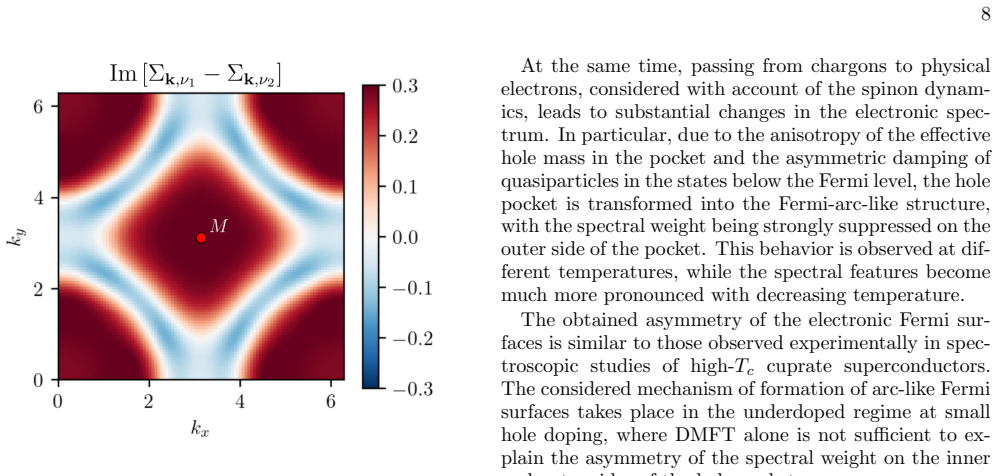
We consider the spectral properties of the two-dimensional Hubbard model, describing the electronic properties of high-$T_c$ compounds, within the SU(2) gauge theory, which assumes the separation of electronic degrees of freedom into those of spinon and chargon subsystems. We use the dynamic mean-field theory (DMFT) approach to describe magnetic long-range order in the chargon subsystem while also treating spinon fluctuations on top of this state. We show that DMFT supplemented by long-wavelength magnetic fluctuations is essential for describing the asymmetry in the damping between the inner and outer regions of the hole pockets and the resulting formation of Fermi arcs in the underdoped regime, especially at low hole doping. The underlying hole pockets in the chargon subsystem can be associated with those observed in quantum oscillation measurements.
Editorial analysis
A structured set of objections, weighed in public.
Referee Report
Summary. The paper claims that the spectral properties of the 2D Hubbard model for high-Tc cuprates can be described via an SU(2) gauge theory that separates electronic degrees of freedom into spinon and chargon subsystems; DMFT is used to capture magnetic long-range order in the chargon sector, with spinon fluctuations added on top, and this combination is essential to produce the inner/outer damping asymmetry of hole pockets that yields Fermi arcs in the underdoped regime (especially at low doping). The underlying chargon hole pockets are identified with those seen in quantum-oscillation experiments.
Significance. If the central approximation holds, the work would supply a concrete mechanism linking gauge-theory separation, DMFT magnetic order, and long-wavelength fluctuations to the pseudogap and Fermi-arc phenomenology, while also connecting to quantum-oscillation data. No machine-checked proofs, reproducible code, or parameter-free derivations are reported.
major comments (2)
- [Abstract / central claim] The central claim that DMFT plus spinon fluctuations is 'essential' for the damping asymmetry and Fermi arcs rests on the SU(2) gauge decomposition into decoupled spinon and chargon sectors. No derivation or error estimate is supplied showing that gauge-field fluctuations and the local constraint remain negligible at low doping; this is load-bearing for the reported spectral functions.
- [Abstract / method description] The manuscript asserts that DMFT accurately captures chargon magnetic long-range order in two dimensions, yet provides no comparison to methods that respect the Mermin-Wagner theorem or to exact diagonalization / quantum Monte Carlo benchmarks that would test whether the reported inner/outer damping asymmetry survives when the gauge ansatz is relaxed.
minor comments (1)
- Notation for the spinon and chargon Green's functions is introduced without an explicit definition of the gauge-fixing procedure or the form of the constraint term.
Simulated Author's Rebuttal
We thank the referee for the thoughtful review and constructive feedback on our manuscript. We address each major comment below, providing clarifications on the framework and approximations used while noting where revisions can strengthen the presentation.
read point-by-point responses
-
Referee: [Abstract / central claim] The central claim that DMFT plus spinon fluctuations is 'essential' for the damping asymmetry and Fermi arcs rests on the SU(2) gauge decomposition into decoupled spinon and chargon sectors. No derivation or error estimate is supplied showing that gauge-field fluctuations and the local constraint remain negligible at low doping; this is load-bearing for the reported spectral functions.
Authors: The SU(2) gauge theory provides an established framework for separating spin and charge degrees of freedom in the Hubbard model, with the local constraint enforced on average via the gauge structure (as in prior literature on this approach). Within this ansatz, gauge-field fluctuations are treated at the saddle-point level, and our calculations focus on the resulting chargon spectral functions supplemented by spinon fluctuations. We agree that an explicit discussion of the validity regime and references to error estimates from related gauge-theory studies would improve clarity. We will revise the manuscript to include such a discussion in the methods and conclusions sections. revision: partial
-
Referee: [Abstract / method description] The manuscript asserts that DMFT accurately captures chargon magnetic long-range order in two dimensions, yet provides no comparison to methods that respect the Mermin-Wagner theorem or to exact diagonalization / quantum Monte Carlo benchmarks that would test whether the reported inner/outer damping asymmetry survives when the gauge ansatz is relaxed.
Authors: DMFT is applied to the chargon sector to capture local correlations and the tendency toward magnetic order, consistent with its standard use as an approximation in Hubbard-model studies; the added long-wavelength spinon fluctuations are intended to incorporate effects beyond strict mean-field. We acknowledge that DMFT does not enforce the Mermin-Wagner theorem in 2D and will add a clarifying note on this point with references to related discussions in the literature. Comprehensive benchmarks relaxing the full gauge ansatz against ED or QMC are not feasible within the current scope due to computational demands but represent a valuable direction for future work. revision: partial
Circularity Check
No significant circularity in the derivation chain
full rationale
The paper applies an SU(2) gauge decomposition to separate electronic degrees of freedom into spinon and chargon subsystems, then employs DMFT to treat magnetic long-range order in the chargon sector while adding spinon fluctuations. The abstract and description present this as a calculational framework whose output (damping asymmetry and Fermi arcs) follows from the method rather than reducing to a fitted parameter or self-citation by construction. No load-bearing self-citations, self-definitional steps, or renamed known results are identifiable from the provided text; the central claim retains independent content from the chosen approximations.
Axiom & Free-Parameter Ledger
axioms (2)
- domain assumption SU(2) gauge symmetry permits clean separation of electronic degrees of freedom into spinon and chargon subsystems
- domain assumption DMFT provides an adequate description of magnetic long-range order in the chargon subsystem
Reference graph
Works this paper leans on
-
[1]
C. Berthier, M. H. Julien, M. Horvatić, Y. Berthier, NMR studies of the normal state of high temperature superconductors, J. Phys. I France 6, 2205 (1996) https://dx.doi.org/10.1051/jp1:1996209
-
[2]
K. Asayama, Y. Kitaoka, G. Q. Zheng, K. Ishida, NMR studies of high T_c superconductors, Prog. Nucl. Magn. Reson. Spectrosc. 28, 221 (1996) https://dx.doi.org/10.1016/0079-6565(95)01025-4
-
[3]
Plakida, High-Temperature Cuprate Superconductors (Springer, Heidelberg, 2010)
N. Plakida, High-Temperature Cuprate Superconductors (Springer, Heidelberg, 2010)
2010
-
[4]
Y. Ando, Y. Kurita, S. Komiya, S. Ono, K. Segawa, Evolution of the Hall coefficient and the peculiar electronic structure of the cuprate superconductors, Phys. Rev. Lett. 92, 197001 (2004) https://dx.doi.org/10.1103/PhysRevLett.92.197001
-
[5]
Y. Ando, S. Komiya, K. Segawa, S. Ono, Y. Kurita, Electronic phase diagram of high- T_c cuprate superconductors from a mapping of the in-plane resistivity curvature, Phys. Rev. Lett. 93, 267001 (2004) https://dx.doi.org/10.1103/PhysRevLett.93.267001
-
[6]
S. Ono, S. Komiya, Y. Ando, Strong charge fluctuations manifested in the high-temperature Hall coefficient of high- T_c cuprates, Phys. Rev. B 75, 024515 (2007) https://dx.doi.org/10.1103/PhysRevB.75.024515
-
[7]
A. Damascelli, Z.-X. Shen, and Z. Hussain, Angle-resolved photoemission studies of the cuprate superconductors, Rev. Mod. Phys. 75, 473 (2003) https://doi.org/10.1103/RevModPhys.75.473
-
[8]
M. Hashimoto, T. Yoshida, H. Yagi, M. Takizawa, A. Fujimori, M. Kubota, K. Ono, K. Tanaka, D. H. Lu, Z.-X. Shen, S. Ono, and Y. Ando, Doping evolution of the electronic structure in the single-layer cuprates Bi _2 Sr _ 2-x La _x CuO _ 6+ : Comparison with other single-layer cuprates, Phys. Rev. B 77, 094516 (2008) https://doi.org/10.1103/PhysRevB.77.094516
-
[9]
T. Yoshida, X. J. Zhou, K. Tanaka, W. L. Yang, Z. Hussain, Z.-X. Shen, A. Fujimori, S. Komiya, Y. Ando, H. Eisaki, T. Kakeshita, and S. Uchida, Systematic doping evolution of the underlying Fermi surface of La _ 2-x Sr _x CuO _4 , Phys. Rev. B 74, 224510 (2006) https://doi.org/10.1103/PhysRevB.74.224510
-
[10]
K. M. Shen, F. Ronning, D. H. Lu, F. Baumberger, N. J. C. Ingle, W. S. Lee, W. Meevasana, Y. Kohsaka, M. Azuma, M. Takano, H. Takagi, and Z.-X. Shen, Nodal quasiparticles and antinodal charge ordering in Ca _ 2-x Na _x CuO _2 Cl _2 , Science 307, 901 (2005) https://doi.org/10.1126/science.1103627
-
[11]
M. R. Norman, H. Ding, M. Randeria, J. C. Campuzano, T. Yokoya, T. Takeuchi, T. Takahashi, T. Mochiku, K. Kadowaki, P. Guptasarma, D. G. Hinks, Destruction of the Fermi surface in underdoped high- T_c superconductors, Nature 392, 157 (1998) https://dx.doi.org/10.1038/32366
-
[12]
A. Kanigel, M. R. Norman, M. Randeria, U. Chatterjee, S. Souma, A. Kaminski, H. M. Fretwell, S. Rosenkranz, M. Shi, T. Sato, et. al., Evolution of the pseudogap from Fermi arcs to the nodal liquid, Nature Physics 2, 447 (2006) https://dx.doi.org/10.1038/nphys334
-
[13]
N. Doiron-Leyraud, C. Proust, D. LeBoeuf, J. Levallois, J.-B. Bonnemaison, R. Liang, D. A. Bonn, W. N. Hardy, L. Taillefer, Quantum oscillations and the Fermi surface in an underdoped high- T_c superconductor, Nature 447, 565 (2007) https://dx.doi.org/10.1038/nature05872
-
[14]
D. LeBoeuf, N. Doiron-Leyraud, J. Levallois, R. Daou, J.-B. Bonnemaison, N. E. Hussey, L. Balicas, B. J. Ramshaw, R. Liang, D. A. Bonn, W. N. Hardy, S. Adachi, C. Proust, L. Taillefer, Electron pockets in the Fermi surface of hole-doped high- T_c superconductors, Nature 450, 533 (2007) https://dx.doi.org/10.1038/nature06332
-
[15]
N. Doiron-Leyraud, S. Badoux, S. René de Cotret, D. LeBoeuf, N. E. Hussey, H. Chang, B. J. Ramshaw, R. Liang, D. A. Bonn, W. N. Hardy, L. Taillefer, Evidence for a small hole pocket in the Fermi surface of underdoped YBa _2 Cu _3 O _y , Nature Communications 6, 6034 (2015) https://dx.doi.org/10.1038/ncomms7034
-
[16]
E. A. Yelland, J. Singleton, C. H. Mielke, N. Harrison, F. F. Balakirev, B. Dabrowski, J. R. Cooper, Quantum oscillations in the underdoped cuprate YBa _2 Cu _4 O _8 , Phys. Rev. Lett. 100, 047003 (2008) https://dx.doi.org/10.1103/PhysRevLett.100.047003
-
[17]
S. E. Sebastian, N. Harrison, M. M. Altarawneh, R. Liang, D. A. Bonn, W. N. Hardy, G. G. Lonzarich, Chemical potential oscillations from nodal Fermi surface pocket in the underdoped high-temperature superconductor YBa _2 Cu _3 O _ 6+x , Nature Communications 2, 471 (2011) https://dx.doi.org/10.1038/ncomms1468
-
[18]
N. Barišić, S. Badoux, M. K. Chan, C. Dorow, W. Tabis, B. Vignolle, G. Yu, J. Béard, X. Zhao, C. Proust, and M. Greven, Universal quantum oscillations in the underdoped cuprate superconductors, Nature Physics 9, 761 (2013) https://dx.doi.org/10.1038/nphys2792
-
[19]
M. K. Chan, N. Harrison, R. D. McDonald, B. J. Ramshaw, K. A. Modic, N. Barišić, M. Greven, Single reconstructed Fermi surface pocket in an underdoped single-layer cuprate superconductor, Nature Communications 7, 12244 (2016) https://dx.doi.org/10.1038/ncomms12244
-
[20]
S. E. Sebastian and C. Proust, Quantum oscillations in hole-doped cuprates, Annual Review of Condensed Matter Physics 6, 411 (2015) https://dx.doi.org/10.1146/annurev-conmatphys-030212-184305
-
[21]
H.-B. Yang, J. D. Rameau, Z.-H. Pan, G. D. Gu, P. D. Johnson, H. Claus, D. G. Hinks, and T. E. Kidd, Reconstructed Fermi Surface of Underdoped Bi _2 Sr _2 CaCu _2 O _ 8+ Cuprate Superconductors, http://dx.doi.org/10.1103/PhysRevLett.107.047003 Phys. Rev. Lett. 107 , 047003 (2011)
-
[22]
J. Meng, G. Liu, W. Zhang, L. Zhao, H. Liu, X. Jia, D. Mu, S. Liu, X. Dong, W. Lu, G. Wang, Y. Zhou, Y. Zhu, X. Wang, Z. Xu, C. Chen, and X. J. Zhou, Coexistence of Fermi arcs and Fermi pockets in a high- T_c copper oxide superconductor, Nature 462, 335 (2009) https://doi.org/10.1038/nature08521
-
[23]
S. E. Sebastian, N. Harrison, E. Palm, T. P. Murphy, C. H. Mielke, R. Liang, D. A. Bonn, W. N. Hardy, G. G. Lonzarich, A multi-component Fermi surface in the vortex state of an underdoped high- T_c superconductor, Nature 454, 200 (2008) https://doi.org/10.1038/nature07095
-
[24]
A. J. Millis, M. R. Norman, Antiphase stripe order as the origin of electron pockets observed in 1/8-hole-doped cuprates, Phys. Rev. B 76, 220503(R) (2007) https://doi.org/10.1103/PhysRevB.76.220503
-
[25]
S. Chakravarty, H.-Y. Kee, Fermi pockets and quantum oscillations of the Hall coefficient in high-temperature superconductors, PNAS 105, 8835 (2008) https://doi.org/10.1073/pnas.0804002105
-
[26]
A. J. Millis, H. Monien, and D. Pines, Phenomenological model of nuclear relaxation in the normal state of YBa _2 Cu _3 O _7 , https://doi.org/10.1103/PhysRevB.42.167 Phys.\ Rev.\ B 42, 167 (1990)
-
[27]
A. J. Millis, Spin fluctuations in high-temperature superconductors, https://doi.org/10.1103/PhysRevB.50.16052 Phys.\ Rev.\ B 50, 16052--16055 (1994)
-
[28]
Y. Zha, V. Barzykin, and D. Pines, NMR and neutron-scattering experiments on the cuprate superconductors: A critical reexamination, https://doi.org/10.1103/PhysRevB.54.7561 Phys.\ Rev.\ B 54, 7561--7574 (1996)
-
[29]
A. V. Chubukov, D. Pines, and B. P. Stojkovi\'c, Temperature crossovers in cuprates, https://doi.org/10.1088/0953-8984/8/48/021 J.\ Phys.: Condens.\ Matter 8, 10017--10036 (1996)
-
[30]
J. Schmalian, D. Pines, and B. Stojkovi\'c, Microscopic theory of weak pseudogap behavior in the underdoped cuprate superconductors: General theory and quasiparticle properties, https://doi.org/10.1103/PhysRevB.60.667 Phys.\ Rev.\ B 60, 667 (1999)
-
[31]
E. Z. Kuchinskii and M. V. Sadovskii, Models of the pseudogap state of two-dimensional systems, https://doi.org/10.1134/1.558879 JETP 88, 968 (1999)
-
[33]
A. Sokol and D. Pines, Toward a unified magnetic phase diagram of the cuprate superconductors, https://doi.org/10.1103/PhysRevLett.71.2813 Phys.\ Rev.\ Lett. 71, 2813 (1993)
-
[34]
A. V. Chubukov, D. Pines, and B. P. Stojkovi\'c, Crossover and scaling in a nearly antiferromagnetic Fermi liquid in two dimensions, https://doi.org/10.1103/PhysRevB.51.14874 Phys.\ Rev.\ B 51, 14874 (1995)
-
[35]
M. S. Scheurer, S. Chatterjee, W. Wu, M. Ferrero, A. Georges, and S. Sachdev, Topological order in the pseudogap metal, PNAS 115, E3665 (2018) https://doi.org/10.1073/pnas.1720580115
-
[37]
S. Iskakov, M. I. Katsnelson, A. I. Lichtenstein, Perturbative solution of fermionic sign problem in quantum Monte Carlo computations, https://doi.org/10.1038/s41524-024-01221-w npj Computational Materials 10 , 36 (2024)
-
[38]
E.A. Stepanov, S. Iskakov, M.I. Katsnelson, A.I. Lichtenstein, Superconductivity of Bad Fermions: Origin of Two Gaps in HTSC Cuprates, https://doi.org/10.1038/s42005-026-02532-8 Comm. Physics 9, 91 (2026)
-
[39]
A.-M. S. Tremblay, B. Kyung, and D. S\'en\'echal, Pseudogap and high-temperature superconductivity from weak to strong coupling. Towards a quantitative theory, https://doi.org/10.1063/1.2199446 Low Temp. Phys. 32 , 424 (2006)
-
[40]
E. Gull, O. Parcollet, and A. J. Millis, Superconductivity and the Pseudogap in the two-dimensional Hubbard model, https://doi.org/10.1103/PhysRevLett.110.216405 Phys. Rev. Lett. 110 , 216405 (2013)
-
[41]
O. Gunnarsson, T. Schäfer, J. P. F. LeBlanc, E. Gull, J. Merino, G. Sangiovanni, G. Rohringer, A. Toschi, Fluctuation diagnostics of the electron self-energy: Origin of the pseudogap physics, https://doi.org/10.1103/PhysRevLett.114.236402 Phys. Rev. Lett. 114 , 236402 (2015)
-
[42]
Y. Yu, S. Iskakov, E. Gull, K. Held, and F. Krien, Unambiguous Fluctuation Decomposition of the Self-Energy: Pseudogap Physics beyond Spin Fluctuations, Phys. Rev. Lett. 132, 216501 (2024) https://doi.org/10.1103/PhysRevLett.132.216501; Pairing boost from enhanced spin-fermion coupling in the pseudogap regime, Phys. Rev. B 112 , L041105 (2025)
-
[43]
W. Wu, M. S. Scheurer, S. Chatterjee, S. Sachdev, A. Georges, and M. Ferrero, Pseudogap and Fermi-Surface Topology in the Two-Dimensional Hubbard Model, Phys. Rev. X 8, 021048 (2018) https://doi.org/10.1103/PhysRevX.8.021048
-
[44]
F. Krien, P. Worm, P. Chalupa, A. Toschi, and K. Held, Explaining the pseudogap through damping and antidamping on the Fermi surface by imaginary spin scattering, 10.1038/s42005-022-01117-5 Commun. Phys. 5 , 336 (2022)
-
[45]
J.-M. Lihm, D. Kiese, S.-S. B. Lee, F. B. Kugler, The finite-difference parquet method: Enhanced electron-paramagnon scattering opens a pseudogap, https://doi.org/10.1073/pnas.2525308123 PNAS 123 , e2525308123 (2026)
-
[46]
E. Dagotto, Correlated electrons in high-temperature superconductors, https://doi.org/10.1103/RevModPhys.66.763 Rev. Mod. Phys. 66 , 763 (1994)
-
[47]
M. Imada, A. Fujimori, and Y. Tokura, Metal-insulator transitions, https://doi.org/10.1103/RevModPhys.70.1039 Rev. Mod. Phys. 70 , 1039 (1998)
-
[48]
P. A. Lee, N. Nagaosa, and X.-G. Wen, Doping a Mott insulator: Physics of high-temperature superconductivity, https://doi.org/10.1103/RevModPhys.78.17 Rev. Mod. Phys. 78 , 17 (2006)
-
[49]
A. I. Milstein and O. P. Sushkov, Effective action, magnetic excitations, and quantum fluctuations in lightly doped single-layer cuprates, Phys. Rev. B 78, 014501 https://doi.org/10.1103/PhysRevB.78.014501 (2008)
-
[50]
A. Nikolaenko, J. von Milczewski, D. G. Joshi, and S. Sachdev, Spin density wave, Fermi liquid, and fractionalized phases in a theory of antiferromagnetic metals using paramagnons and bosonic spinons, https://doi.org/10.1103/PhysRevB.108.045123 Phys. Rev. B 108 , 045123 (2023)
-
[51]
Y.-H. Zhang and S. Sachdev, Deconfined criticality and ghost Fermi surfaces at the onset of antiferromagnetism in a metal, https://doi.org/10.1103/PhysRevB.102.155124 Phys. Rev. B 102 , 155124 (2020)
-
[52]
S. Sachdev, H. D. Scammell, M. S. Scheurer, and G. Tarnopolsky, Gauge theory for the cuprates near optimal doping, https://doi.org/10.1103/PhysRevB.99.054516 Phys. Rev. B 99 , 054516 (2019)
-
[53]
S. Sachdev, E. Berg, S. Chatterjee, and Y. Schattner, Spin density wave order, topological order, and Fermi surface reconstruction, https://doi.org/10.1103/PhysRevB.94.115147 Phys. Rev. B 94 , 115147 (2016)
-
[54]
S. Sachdev, M. A. Metlitski, Y. Qi, and C. Xu, Fluctuating spin density waves in metals, Phys. Rev. B 80, 155129 (2009) https://doi.org/10.1103/PhysRevB.80.155129
-
[55]
Y. Qi and S. Sachdev, Effective theory of Fermi pockets in fluctuating antiferromagnets, https://doi.org/10.1103/PhysRevB.81.115129 Phys. Rev. B 81 , 115129 (2010)
-
[56]
D. Chowdhury and S. Sachdev, Higgs criticality in a two-dimensional metal, https://doi.org/10.1103/PhysRevB.91.115123 Phys. Rev. B 91 , 115123 (2015)
-
[57]
S. Chatterjee, S. Sachdev, and A. Eberlein, Thermal and electrical transport in metals and superconductors across antiferromagnetic and topological quantum transitions, https://doi.org/10.1103/PhysRevB.96.075103 Phys. Rev. B 96 , 075103 (2017)
-
[58]
S. Chatterjee, S. Sachdev, and M. Scheurer, Intertwining topological order and broken symmetry in a theory of fluctuating spin density waves, https://doi.org/10.1103/PhysRevLett.119.227002 Phys. Rev. Lett. 119 , 227002 (2017)
-
[59]
E. A. Stepanov, S. Brener, V. Harkov, M. I. Katsnelson, and A. I. Lichtenstein, Spin dynamics of itinerant electrons: local magnetic moment formation and Berry phase, https://doi.org/10.1103/PhysRevB.105.155151 Phys. Rev. B 105 , 155151 (2022)
-
[60]
D. Vilardi and P. M. Bonetti, SC ^* superconductivity and spin stiffnesses in the SU(2) gauge theory of the two-dimensional Hubbard model, arXiv:2511.03436 [cond-mat.str-el] (2025) https://doi.org/10.48550/arXiv.2511.03436
-
[61]
SU(2) gauge theory of fluctuating stripe order in the two-dimensional Hubbard model
H. M\"uller-Groeling, P. M. Bonetti, P. Forni, and W. Metzner, SU(2) gauge theory of fluctuating stripe order in the two-dimensional Hubbard model, arXiv:2603.13071 [cond-mat.str-el] (2026) https://doi.org/10.48550/arXiv.2603.13071
work page internal anchor Pith review Pith/arXiv arXiv doi:10.48550/arxiv.2603.13071 2026
-
[62]
D. Vilardi, P. M. Bonetti, and W. Metzner, Spin stiffnesses and stability of magnetic order in the lightly doped two-dimensional Hubbard model, https://doi.org/10.1103/x7qr-f6lm Phys. Rev. B 112 , 245149 (2025)
-
[63]
P. Forni, P. M. Bonetti, H. M\"uller-Groeling, D. Vilardi, and W. Metzner, Spin susceptibility in a pseudogap state with fluctuating spiral magnetic order, https://doi.org/10.1103/zm7b-jdzf Phys. Rev. B 113 , 045144 (2026)
-
[64]
P. M. Bonetti and W. Metzner, SU(2) gauge theory of the pseudogap phase in the two-dimensional Hubbard model, Phys. Rev. B 106, 205152 (2022) https://doi.org/10.1103/PhysRevB.106.205152
-
[65]
I. A. Goremykin and A. A. Katanin, Antiferromagnetic and spin spiral correlations in the doped two-dimensional Hubbard model: gauge symmetry, Ward identities, and dynamical mean-field theory analysis, https://dx.doi.org/10.1103/PhysRevB.110.085153 Phys. Rev. B 110 , 085153 (2024)
-
[66]
I. A. Goremykin and A. A. Katanin, Frequency dependence of temporal spin stiffness and short-range magnetic order in the doped two-dimensional Hubbard model, https://dx.doi.org/10.1103/w4vc-n5l6 Phys. Rev. B 112 , L060405 (2025)
-
[67]
I. A. Goremykin and A. A. Katanin, Commensurate and spiral magnetic order in the doped two-dimensional Hubbard model: Dynamical mean-field theory analysis, Phys. Rev. B 107, 245104 (2023) https://doi.org/10.1103/PhysRevB.107.245104
-
[68]
P. M. Bonetti, J. Mitscherling, D. Vilardi, and W. Metzner, Charge carrier drop at the onset of pseudogap behavior in the two-dimensional Hubbard model, https://doi.org/10.1103/PhysRevB.101.165142 Phys. Rev. B 101 , 165142 (2020)
-
[69]
H. J. Schulz, Effective action for strongly correlated fermions from functional integrals, Phys. Rev. Lett. 65, 2462 (1990) https://doi.org/10.1103/PhysRevLett.65.2462; H. J. Schulz, Functional Integrals for Correlated Electrons, Proceedings of NATO Advanced Research Workshop on the Physics and Mathematical Physics of the Hubbard Model (Springer, New York...
-
[70]
Z. Y. Weng, C. S. Ting, and T. K. Lee, Path-integral approach to the Hubbard model, Phys. Rev. B 43, 3790 (1991) https://doi.org/10.1103/PhysRevB.43.3790
-
[71]
K. Sengupta and N. Dupuis, Effective action and collective modes in quasi-one-dimensional spin-density-wave systems, Phys. Rev. B 61, 13493 (2000) https://doi.org/10.1103/PhysRevB.61.13493; Y. Tomio, N. Dupuis, and Y. Suzumura, Effect of nearest- and next-nearest neighbor interactions on the spin-wave velocity of one-dimensional quarter-filled spin-densit...
-
[72]
N. Dupuis, Spin fluctuations and pseudogap in the two-dimensional half-filled Hubbard model at weak coupling, Phys. Rev. B 65, 245118 (2002) https://doi.org/10.1103/PhysRevB.65.245118; K. Borejsza and N. Dupuis, Antiferromagnetism and single-particle properties in the two-dimensional half-filled Hubbard model: A nonlinear sigma model approach, Phys. Rev. ...
-
[73]
M. Fleck, A. I. Liechtenstein, A. M. Ole\'s, L. Hedin, and V. I. Anisimov, Dynamical Mean-Field Theory for Doped Antiferromagnets, https://dx.doi.org/10.1103/PhysRevLett.80.2393 Phys. Rev. Lett. 80 , 2393 (1998)
-
[74]
S. Goto, S. Kurihara, and D. Yamamoto, Incommensurate spiral magnetic order on anisotropic triangular lattice: Dynamical mean-field study in a spin-rotating frame, https://dx.doi.org/10.1103/PhysRevB.94.245145 Phys. Rev. B 94 , 245145 (2016)
-
[75]
J.M. Luttinger, Fermi Surface and Some Simple Equilibrium Properties of a System of Interacting Fermions, Phys. Rev. 119, 1153 (1960) https://doi.org/10.1103/PhysRev.119.1153
-
[76]
I. Dzyaloshinskii, Extended Van-Hove Singularity and Related Non-Fermi Liquids, https://dx.doi.org/10.1051/jp1:1996127 J. Phys. I France 6 119 (1996) ; Some consequences of the Luttinger theorem: The Luttinger surfaces in non-Fermi liquids and Mott insulators, https://doi.org/10.1103/PhysRevB.68.085113 Phys. Rev. B 68 , 085113 (2003)
-
[77]
M. Kitatani, Y. Nomura, S. Sakai, and R. Arita, Luttinger surface and exchange splitting induced by ferromagnetic fluctuations, arXiv:2509.21034 (2025) https://doi.org/10.48550/arXiv.2509.21034
-
[78]
P. Worm, M. Reitner, K. Held, and A. Toschi, Fermi and Luttinger Arcs: Two Concepts, Realized on One Surface, https://doi.org/10.1103/PhysRevLett.133.166501 Phys. Rev. Lett. 133 , 166501 (2024)
-
[79]
C. Watzenb\"ock, M. Fellinger, K. Held, and A. Toschi, Long-term memory magnetic correlations in the Hubbard model: A dynamical mean-field theory analysis, https://dx.doi.org/10.21468/SciPostPhys.12.6.184 SciPost Phys. 12 , 184 (2022)
-
[80]
J. J. Wagman, G. Van Gastel, K. A. Ross, Z. Yamani, Y
-
[81]
Cheong, G
S-W. Cheong, G. Aeppli, T. E. Mason, H. Mook, S. M. Hayden,
-
[82]
T. E. Mason, G. Aeppli, S. M. Hayden, A. P. Ramirez, and H
discussion (0)
Sign in with ORCID, Apple, or X to comment. Anyone can read and Pith papers without signing in.