Efficient Federated Estimation and Inference for High-Dimensional Tail Index Regression
Pith reviewed 2026-06-28 09:11 UTC · model grok-4.3
The pith
A personalized federated estimator for high-dimensional tail index regression recovers latent client groups via fusion penalties and yields more efficient inference through debiased aggregation.
A machine-rendered reading of the paper's core claim, the machinery that carries it, and where it could break.
Core claim
The estimator integrates sparsity regularization with nonconcave fusion penalties to perform coefficient estimation, variable selection, and group recovery simultaneously. It attains non-asymptotic convergence rates and an oracle property through consistent recovery of the underlying client grouping structure. Computation proceeds via an ADMM-based federated algorithm with adaptive gradient updates that converges, while the debiased federated inference procedure uses adaptive weighted aggregation across related clients to deliver valid confidence intervals and hypothesis tests with improved efficiency over target-only inference.
What carries the argument
Nonconcave fusion penalties that encourage coefficient similarity across clients to recover latent groups, combined with adaptive weighted aggregation in the debiased inference step.
If this is right
- The estimator simultaneously achieves variable selection and consistent group recovery in federated high-dimensional settings.
- Debiased inference produces valid confidence intervals and tests whose efficiency improves by incorporating information from similar clients.
- The ADMM algorithm converges under the proposed adaptive gradient updates for practical federated computation.
- Non-asymptotic convergence rates hold for the estimator under the framework's conditions.
- Simulation studies and real-data analyses confirm the methods work when client heterogeneity is present but groupable.
Where Pith is reading between the lines
- When true groups are absent the procedure falls back to separate client analyses without efficiency gains from aggregation.
- The same penalty-plus-aggregation structure could apply to other high-dimensional federated regression problems beyond tail indices.
- Practical use would require tuning the fusion penalties to match the degree of client similarity in a given application.
- Extensions might address settings where client relationships change over time or groups evolve dynamically.
Load-bearing premise
The framework assumes latent similarities across clients exist and can be recovered by the nonconcave fusion penalties.
What would settle it
A controlled simulation in which the true grouping structure is known but the estimator fails to recover it with high probability would falsify the oracle property.
Figures


read the original abstract
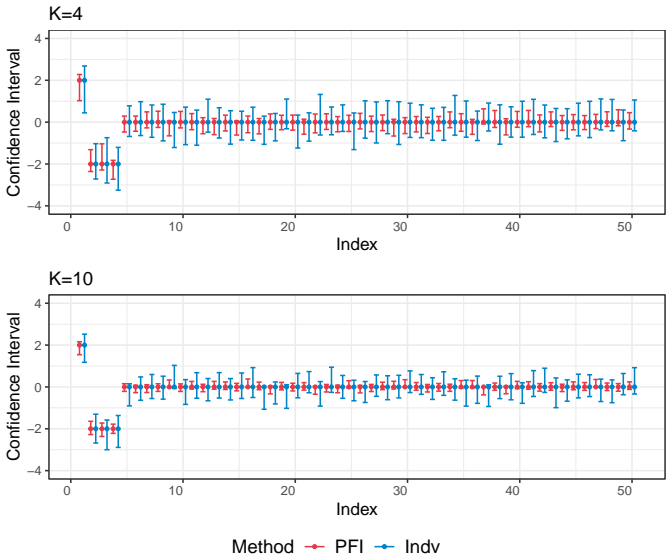
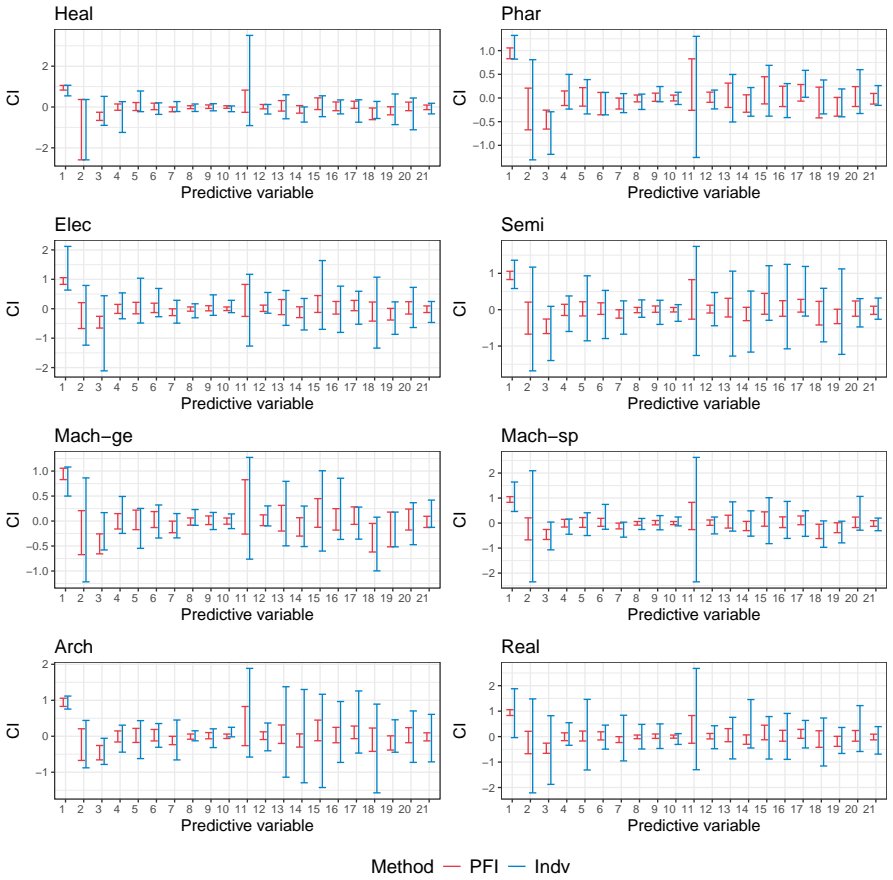
Tail index regression studies how covariates affect tail heaviness in heavy-tailed data. In many applications, data are distributed across heterogeneous sources, where direct pooling is infeasible due to privacy or regulatory constraints. Existing methods mainly focus on single-dataset analysis and do not address heterogeneous federated settings. We develop a personalized federated framework for high-dimensional tail index regression that accommodates client heterogeneity while exploiting latent similarities across clients. The proposed estimator combines sparsity regularization with nonconcave fusion penalties to perform coefficient estimation, variable selection, and group recovery. We establish non-asymptotic convergence rates and show that the estimator enjoys an oracle property by consistently recovering the underlying grouping structure. For computation, we develop an ADMM-based federated algorithm with adaptive gradient updates and establish its convergence guarantees. We further propose a debiased federated inference procedure based on adaptive weighted aggregation across related clients, yielding valid confidence intervals and hypothesis tests with improved efficiency over target-only inference. Simulation studies and real-data analysis demonstrate the effectiveness of the proposed methods.
Editorial analysis
A structured set of objections, weighed in public.
Referee Report
Summary. The paper proposes a personalized federated framework for high-dimensional tail index regression that uses sparsity regularization combined with nonconcave fusion penalties to perform simultaneous coefficient estimation, variable selection, and recovery of latent client groups. It claims non-asymptotic convergence rates for the estimator, an oracle property arising from consistent group recovery, convergence guarantees for an ADMM-based federated algorithm with adaptive gradients, and a debiased inference procedure via adaptive weighted aggregation across recovered groups that yields valid confidence intervals and tests with efficiency gains relative to target-only inference. These theoretical results are illustrated via simulations and a real-data example.
Significance. If the oracle property and group-recovery consistency hold under client heterogeneity, the work would provide a useful advance for privacy-constrained analysis of heavy-tailed data, extending extreme-value methods to federated regimes while exploiting latent similarities. The combination of nonconcave penalties with debiased weighted aggregation for inference, together with explicit ADMM convergence, would be a concrete methodological contribution if the supporting rates are non-vacuous.
major comments (2)
- [§3.2] §3.2 (Oracle property): The central claim that the estimator enjoys an oracle property 'by consistently recovering the underlying grouping structure' is load-bearing for both the estimation rates and the efficiency gain of the debiased inference. The manuscript must supply explicit conditions on the minimum signal separation, the tail-index-specific rates, the penalty parameters, and the heterogeneity level that guarantee group recovery with probability approaching 1 in the high-dimensional federated regime; without these, the reduction to the oracle estimator and the claimed improvement over target-only inference cannot be verified.
- [§4] §4 (Debiased inference): The efficiency gain of the adaptive weighted aggregation is asserted to follow from the recovered groups, yet the derivation of the asymptotic variance and the validity of the resulting confidence intervals appear to condition on perfect group recovery. A quantitative bound on the efficiency loss when recovery is only approximate (or a sensitivity analysis) is needed to substantiate the practical advantage over single-client inference.
minor comments (2)
- [§2] Notation for the fusion penalty and the adaptive weights should be introduced with explicit dependence on the number of clients and the dimension p to avoid ambiguity when reading the non-asymptotic bounds.
- [§5] The simulation section would benefit from a table reporting the empirical group-recovery rate alongside the estimation and inference metrics, so that readers can directly assess when the oracle property is realized.
Simulated Author's Rebuttal
We thank the referee for the constructive comments, which help clarify the conditions needed for our theoretical claims. We address each major point below and will revise the manuscript accordingly.
read point-by-point responses
-
Referee: [§3.2] §3.2 (Oracle property): The central claim that the estimator enjoys an oracle property 'by consistently recovering the underlying grouping structure' is load-bearing for both the estimation rates and the efficiency gain of the debiased inference. The manuscript must supply explicit conditions on the minimum signal separation, the tail-index-specific rates, the penalty parameters, and the heterogeneity level that guarantee group recovery with probability approaching 1 in the high-dimensional federated regime; without these, the reduction to the oracle estimator and the claimed improvement over target-only inference cannot be verified.
Authors: We agree that explicit conditions are required to make the oracle property verifiable. In the revision we will add a new theorem (or corollary to Theorem 3.2) that states the minimum group signal separation δ_n, the tail-index-dependent rates involving α, the admissible ranges for the sparsity and fusion penalty parameters λ_n and γ_n, and the bound on client heterogeneity, all scaled with p, n, and K, such that P(correct group recovery) → 1. These conditions are implicit in the current proof but will be extracted and stated explicitly so that the reduction to the oracle estimator and the inference gains can be directly checked. revision: yes
-
Referee: [§4] §4 (Debiased inference): The efficiency gain of the adaptive weighted aggregation is asserted to follow from the recovered groups, yet the derivation of the asymptotic variance and the validity of the resulting confidence intervals appear to condition on perfect group recovery. A quantitative bound on the efficiency loss when recovery is only approximate (or a sensitivity analysis) is needed to substantiate the practical advantage over single-client inference.
Authors: The current asymptotic variance derivation is stated on the event of exact recovery, which has probability approaching 1 under the conditions we will make explicit in §3.2. We will add a remark (or short subsection) that supplies a quantitative bound on the additional variance term arising from a small group-recovery error probability ε_n; the bound shows that the efficiency gain relative to target-only inference remains of the same order provided ε_n = o(1/√n). We will also augment the simulation section with a sensitivity study that varies the degree of group misclassification and reports the resulting coverage and length of the confidence intervals. revision: yes
Circularity Check
No circularity; derivation self-contained against external benchmarks
full rationale
The provided abstract states claims of oracle property via group recovery and efficiency gains from debiased aggregation, but contains no equations, fitted parameters, or derivation steps that reduce to inputs by construction. No self-definitional relations, fitted-input predictions, or load-bearing self-citations are identifiable. The framework relies on standard nonconcave penalties and ADMM convergence, which are externally verifiable and not shown to collapse into tautologies. Absent explicit reductions in the text, the central results do not exhibit circularity.
Axiom & Free-Parameter Ledger
Reference graph
Works this paper leans on
-
[1]
Journal of Econometrics , volume=
Tail index estimation in the presence of covariates: Stock returns’ tail risk dynamics , author=. Journal of Econometrics , volume=. 2023 , publisher=
2023
-
[2]
Computational Statistics & Data Analysis , volume=
Regression with response distributions of Pareto-type , author=. Computational Statistics & Data Analysis , volume=. 2003 , publisher=
2003
-
[3]
arXiv preprint arXiv:2510.10576 , year=
Robust clustered federated learning for heterogeneous high-dimensional data , author=. arXiv preprint arXiv:2510.10576 , year=
-
[4]
arXiv preprint arXiv:1910.03581 , year=
Fedmd: Heterogenous federated learning via model distillation , author=. arXiv preprint arXiv:1910.03581 , year=
-
[5]
Stat , volume=
Row-wise fusion regularization: an interpretable personalized federated learning framework in large-scale scenarios , author=. Stat , volume=. 2026 , publisher=
2026
-
[6]
Statistics and Computing , volume=
Personalized federated learning on large-scale association networks , author=. Statistics and Computing , volume=. 2025 , publisher=
2025
-
[7]
Federated Learning with Personalization Layers
Federated learning with personalization layers , author=. arXiv preprint arXiv:1912.00818 , year=
work page internal anchor Pith review Pith/arXiv arXiv 1912
-
[8]
IEEE Transactions on Neural Networks and Learning Systems , volume=
Clustered federated learning: model-agnostic distributed multitask optimization under privacy constraints , author=. IEEE Transactions on Neural Networks and Learning Systems , volume=
-
[9]
2007 , publisher=
Heavy-tail phenomena: probabilistic and statistical modeling , author=. 2007 , publisher=
2007
-
[10]
Advances in Neural Information Processing Systems , volume=
An efficient framework for clustered federated learning , author=. Advances in Neural Information Processing Systems , volume=
-
[11]
Proceedings of the AAAI Conference on Artificial Intelligence , volume=
Personalized cross-silo federated learning on non-iid data , author=. Proceedings of the AAAI Conference on Artificial Intelligence , volume=
-
[12]
Advances in Neural Information Processing Systems , volume=
Federated multi-task learning , author=. Advances in Neural Information Processing Systems , volume=
-
[13]
Advances in Neural Information Processing Systems , volume=
Personalized federated learning with theoretical guarantees: A model-agnostic meta-learning approach , author=. Advances in Neural Information Processing Systems , volume=
-
[14]
arXiv preprint arXiv:2407.20491 , year=
High dimensional inference for extreme value indices , author=. arXiv preprint arXiv:2407.20491 , year=
-
[15]
Statistica Neerlandica , volume=
Single-index models for extreme value index regression , author=. Statistica Neerlandica , volume=. 2025 , publisher=
2025
-
[16]
Statistical Papers , volume=
Hypothesis testing for varying coefficient models in tail index regression , author=. Statistical Papers , volume=. 2024 , publisher=
2024
-
[17]
Journal of Business & Economic Statistics , volume=
Semiparametric tail index regression , author=. Journal of Business & Economic Statistics , volume=. 2022 , publisher=
2022
-
[18]
Journal of Multivariate Analysis , volume=
High-dimensional integrative analysis with homogeneity and sparsity recovery , author=. Journal of Multivariate Analysis , volume=. 2019 , publisher=
2019
-
[19]
The Annals of Statistics , pages=
A simple general approach to inference about the tail of a distribution , author=. The Annals of Statistics , pages=. 1975 , publisher=
1975
-
[20]
The Annals of Statistics , pages=
Statistical inference using extreme order statistics , author=. The Annals of Statistics , pages=. 1975 , publisher=
1975
-
[21]
2006 , publisher=
Extreme value theory: an introduction , author=. 2006 , publisher=
2006
-
[22]
Journal of Machine Learning Research , volume=
Distributed statistical inference under heterogeneity , author=. Journal of Machine Learning Research , volume=
-
[23]
arXiv preprint arXiv:2403.01318v3 , year=
High-dimensional tail index regression , author=. arXiv preprint arXiv:2403.01318v3 , year=
-
[24]
1996 , publisher=
Weak convergence and empirical processes: with applications to statistics , author=. 1996 , publisher=
1996
-
[25]
Journal of Machine Learning Research , volume=
Regularized M-estimators with nonconvexity: Statistical and algorithmic theory for local optima , author=. Journal of Machine Learning Research , volume=. 2015 , publisher=
2015
-
[26]
Journal of Scientific Computing , volume=
A nonconvex model with minimax concave penalty for image restoration , author=. Journal of Scientific Computing , volume=. 2019 , publisher=
2019
-
[27]
Transactions on Machine Learning Research , volume=
Non-uniform smoothness for gradient descent , author=. Transactions on Machine Learning Research , volume=. 2024 , publisher=
2024
-
[28]
Journal of the American Statistical Association , volume=
Robust personalized federated learning with sparse penalization , author=. Journal of the American Statistical Association , volume=. 2025 , publisher=
2025
-
[29]
The Annals of Statistics , volume=
Nearly unbiased variable selection under minimax concave penalty , author=. The Annals of Statistics , volume=. 2010 , publisher=
2010
-
[30]
Journal of the American statistical Association , volume=
Variable selection via nonconcave penalized likelihood and its oracle properties , author=. Journal of the American statistical Association , volume=. 2001 , publisher=
2001
-
[31]
Introduction to the non-asymptotic analysis of random matrices
Introduction to the non-asymptotic analysis of random matrices , author=. arXiv preprint arXiv:1011.3027 , year=
work page internal anchor Pith review Pith/arXiv arXiv
-
[32]
2013 , publisher=
Probability in Banach Spaces: isoperimetry and processes , author=. 2013 , publisher=
2013
-
[33]
Journal of Machine Learning Research , volume=
Restricted eigenvalue properties for correlated Gaussian designs , author=. Journal of Machine Learning Research , volume=. 2010 , publisher=
2010
-
[34]
Foundations and Trends in Machine Learning , volume=
Advances and open problems in federated learning , author=. Foundations and Trends in Machine Learning , volume=. 2021 , publisher=
2021
-
[35]
Biometrika , volume=
Distributed inference for the extreme value index , author=. Biometrika , volume=. 2022 , publisher=
2022
-
[36]
Journal of the American Statistical Association , volume=
Tail index regression , author=. Journal of the American Statistical Association , volume=. 2009 , publisher=
2009
-
[37]
IEEE Access , volume=
Linearized ADMM for nonconvex nonsmooth optimization with convergence analysis , author=. IEEE Access , volume=. 2019 , publisher=
2019
-
[38]
IEEE Transactions on Neural Networks and Learning Systems , volume=
Towards personalized federated learning , author=. IEEE Transactions on Neural Networks and Learning Systems , volume=. 2022 , publisher=
2022
-
[39]
SIAM Journal on Optimization , volume=
Convergence analysis of alternating direction method of multipliers for a family of nonconvex problems , author=. SIAM Journal on Optimization , volume=. 2016 , publisher=
2016
-
[40]
Journal of Machine Learning Research , volume=
Convergence for nonconvex ADMM, with applications to CT imaging , author=. Journal of Machine Learning Research , volume=
-
[41]
Journal of Scientific Computing , volume=
Global convergence of ADMM in nonconvex nonsmooth optimization , author=. Journal of Scientific Computing , volume=. 2019 , publisher=
2019
-
[42]
International Conference on Machine Learning , pages=
A general analysis of the convergence of ADMM , author=. International Conference on Machine Learning , pages=. 2015 , publisher=
2015
-
[43]
Journal of the Royal Statistical Society: Series B (Methodological) , volume=
On some simple estimates of an exponent of regular variation , author=. Journal of the Royal Statistical Society: Series B (Methodological) , volume=. 1982 , publisher=
1982
-
[44]
Journal of Machine Learning Research , volume=
Confidence intervals and hypothesis testing for high-dimensional regression , author=. Journal of Machine Learning Research , volume=. 2014 , publisher=
2014
-
[45]
Journal of the American Statistical Association , volume=
A concave pairwise fusion approach to subgroup analysis , author=. Journal of the American Statistical Association , volume=. 2017 , publisher=
2017
-
[46]
Journal of Machine Learning Research , volume=
Fused lasso approach in regression coefficients clustering--learning parameter heterogeneity in data integration , author=. Journal of Machine Learning Research , volume=
discussion (0)
Sign in with ORCID, Apple, or X to comment. Anyone can read and Pith papers without signing in.