Recurrence and coefficient inequality for the partial Petrial polynomial of graphs
Pith reviewed 2026-06-28 09:43 UTC · model grok-4.3
The pith
The partial Petrial polynomial satisfies a three-term recurrence that forces its lowest coefficient to be at most its highest, with equality only for edgeless graphs.
A machine-rendered reading of the paper's core claim, the machinery that carries it, and where it could break.
Core claim
The partial Petrial polynomial of a graph obeys a three-term recurrence under local complementation and edge pivoting on an arbitrary edge; this relation implies that the lowest-degree coefficient is at most the highest-degree coefficient, with equality if and only if the graph has no edges.
What carries the argument
The three-term recurrence obtained by reducing the partial Petrial polynomial (defined via the rank-generating function of an adjacency matrix) under local complementation and edge pivoting on any edge.
If this is right
- The recurrence supplies an algorithmic way to evaluate the polynomial by repeated edge reductions.
- The coefficient comparison holds for every graph, including those with positive-degree vertices.
- Edgeless graphs are the only ones for which the two extreme coefficients coincide.
Where Pith is reading between the lines
- The recurrence may permit inductive proofs of other coefficient properties or evaluations at specific points.
- Similar reductions could be sought for related polynomials on the same class of graphs.
Load-bearing premise
The polynomial admits a reduction under local complementation and edge pivoting that yields the stated three-term recurrence for every edge.
What would settle it
Any graph with at least one edge in which the lowest-degree coefficient strictly exceeds the highest-degree coefficient, or any graph with edges in which the two coefficients are equal.
Figures
read the original abstract
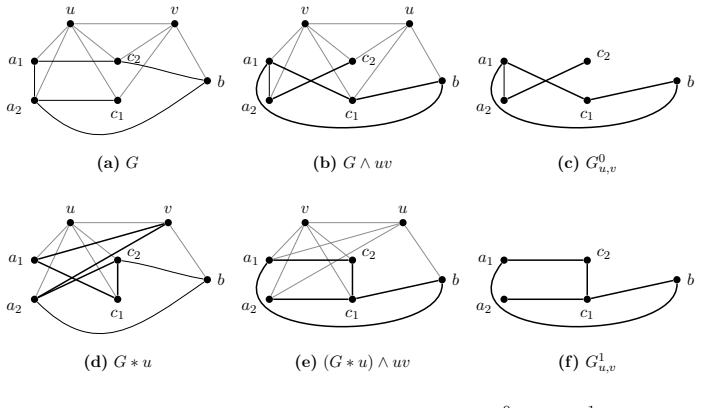
The partial Petrial polynomial of a ribbon graph, introduced by Gross, Mansour and Tucker, enumerates partial Petrials by Euler genus. Recently, Deng, Jin and Yan defined an analogue for grafts and showed that it can be expressed as a rank-generating function of an adjacency matrix. In this paper we first prove a recurrence relation that reduces the partial Petrial polynomial of a graph with respect to an arbitrary edge, expressing it as a sum of three terms involving graphs obtained by local complementation and edge pivoting. This recurrence extends the known leaf-reduction formula to vertices of any positive degree. Second, using this recurrence we compare the lowest and highest degree coefficients of the polynomial. We prove that the lowest coefficient is always at most the highest coefficient, and that equality holds if and only if the graph has no edges.
Editorial analysis
A structured set of objections, weighed in public.
Referee Report
Summary. The paper proves a three-term recurrence for the partial Petrial polynomial of a graft (defined via the rank-generating function of its adjacency matrix) that holds for an arbitrary edge and is obtained by local complementation and edge pivoting; this extends the known leaf-reduction formula. It then applies the recurrence inductively to show that the lowest-degree coefficient is at most the highest-degree coefficient, with equality if and only if the graph is edgeless.
Significance. If the proofs are correct, the recurrence supplies a practical reduction tool for arbitrary edges and enables inductive arguments on the polynomial, while the coefficient comparison gives a clean combinatorial characterization of edgeless graphs. The work directly extends the matrix-based definition of Deng, Jin and Yan and the ribbon-graph polynomial of Gross, Mansour and Tucker; the explicit case analysis on adjacency-matrix entries for the non-leaf case is a concrete strength.
minor comments (2)
- The introduction should explicitly restate the rank-generating-function definition of the partial Petrial polynomial (currently only referenced) before stating the recurrence, to make the manuscript self-contained for readers unfamiliar with Deng-Jin-Yan.
- In the statement of the recurrence (presumably Theorem 3.1 or equivalent), the three resulting graphs obtained by local complementation and pivoting should be labeled with a uniform notation (e.g., G^e, G_e, etc.) that is used consistently in the subsequent inductive proof of the coefficient inequality.
Simulated Author's Rebuttal
We thank the referee for the careful reading and positive assessment of the manuscript. The report correctly summarizes the main results: the three-term recurrence obtained via local complementation and edge pivoting, and the coefficient comparison characterizing edgeless graphs. We are pleased that the referee views the explicit case analysis and the extension of the leaf-reduction formula as strengths.
Circularity Check
No significant circularity
full rationale
The manuscript defines the partial Petrial polynomial via the rank-generating function of the adjacency matrix of the graft (external prior definition). It then derives the three-term recurrence explicitly from this matrix definition by direct computation on adjacency-matrix entries under local complementation and edge pivoting. The coefficient inequality is obtained by induction on the recurrence, with the equality case verified by separate explicit check on edgeless graphs. No equation reduces a claimed result to a fitted parameter, self-definition, or load-bearing self-citation chain; the derivation chain is self-contained against the matrix definition.
Axiom & Free-Parameter Ledger
axioms (1)
- domain assumption The partial Petrial polynomial of a graft is given by the rank-generating function of an adjacency matrix (Deng, Jin and Yan).
Reference graph
Works this paper leans on
-
[1]
Arratia, B
R. Arratia, B. Bollobás, G.B. Sorkin, The interlace polynomial: a new graph polynomial, Proceedings of the Eleventh Annual ACM-SIAM Symposium on Discrete Algorithms, ACM, New York, 2000, pp. 237– 245
2000
-
[2]
Arratia, B
R. Arratia, B. Bollobás, G.B. Sorkin, The interlace polynomial of a graph,J. Combin. Theory Ser. B92 (2004) 199–233
2004
-
[3]
Bollobás, O
B. Bollobás, O. Riordan, A polynomial of graphs on surfaces,Math. Ann.323 (2002) 81–96
2002
-
[4]
Bouchet, Graphic presentations of isotropic systems,J
A. Bouchet, Graphic presentations of isotropic systems,J. Combin. The- ory Ser. B45 (1988) 58–76
1988
-
[5]
Bouchet, Multimatroids
A. Bouchet, Multimatroids. III. Tightness and fundamental graphs,Eu- ropean J. Combin.22 (2001) 657–677
2001
-
[6]
Q. Deng, X. Jin, Q. Yan, Partial-twuality polynomials of matrices, arXiv:2604.12433, 2026
Pith/arXiv arXiv 2026
-
[7]
Ellis-Monaghan, I
J.A. Ellis-Monaghan, I. Moffatt, Twisted duality for embedded graphs, Trans. Amer. Math. Soc.364 (2012) 1529–1569
2012
-
[8]
R. Feng, Q. Yan, X. Zheng, Characterizing circle graphs with binomial partial Petrial polynomials,Discrete Appl. Math.382 (2026) 411–416
2026
-
[9]
Gross, T
J.L. Gross, T. Mansour, T.W. Tucker, Partial duality for ribbon graphs, II: Partial-twuality polynomials and monodromy computations,Euro- pean J. Combin.95 (2021) 103329. 14
2021
-
[10]
Kotzig, Eulerian lines in finite 4-valent graphs and their transforma- tions, Theory of Graphs , Academic Press, New York, 1968, pp
A. Kotzig, Eulerian lines in finite 4-valent graphs and their transforma- tions, Theory of Graphs , Academic Press, New York, 1968, pp. 219–230
1968
-
[11]
I.Moffatt, Delta-matroidsforgraphtheorists, SurveysinCombinatorics, 2019, London Math. Soc. Lecture Note Ser., vol. 456, Cambridge Univ. Press, Cambridge, 2019, pp. 167–220
2019
-
[12]
Moffatt, From matrix pivots to graphs in surfaces: Exploring com- binatorics through partial duals, European Congress of Mathematics, EMS Press, Berlin, 2023, pp
I. Moffatt, From matrix pivots to graphs in surfaces: Exploring com- binatorics through partial duals, European Congress of Mathematics, EMS Press, Berlin, 2023, pp. 825–856
2023
-
[13]
Wilson, Operators over regular maps,Pacific J
S.E. Wilson, Operators over regular maps,Pacific J. Math.81 (1979) 559–568
1979
-
[14]
Q. Yan, X. Jin, Partial-twuality polynomials of delta-matroids,Adv. Appl. Math.153 (2024) 102623
2024
-
[15]
Q. Yan, Y. Li, Partial Petrial polynomials for complete graphs and paths,Discrete Appl. Math.375 (2025) 281–289
2025
-
[16]
X.Yu, R.Hao, J.Liu, Z.Li, PartialPetrialpolynomialsofribbongraphs, arXiv:2604.21942, 2026. 15
Pith/arXiv arXiv 2026
discussion (0)
Sign in with ORCID, Apple, or X to comment. Anyone can read and Pith papers without signing in.