Post-Selection Free Generation of Multi-Photon Added Coherent States
Pith reviewed 2026-06-28 10:02 UTC · model grok-4.3
The pith
A driven Kerr nonlinear resonator produces high-fidelity multi-photon added coherent states by tuning drive power and interaction time.
A machine-rendered reading of the paper's core claim, the machinery that carries it, and where it could break.
Core claim
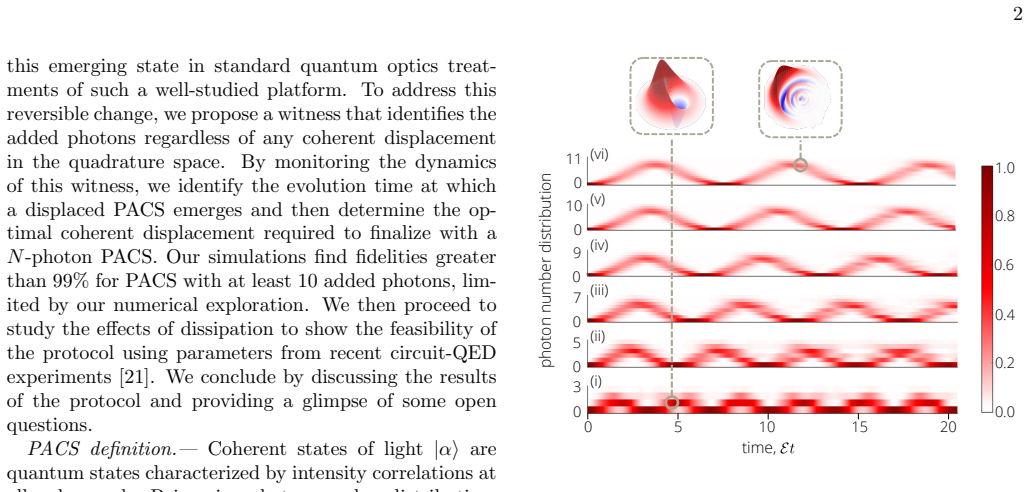
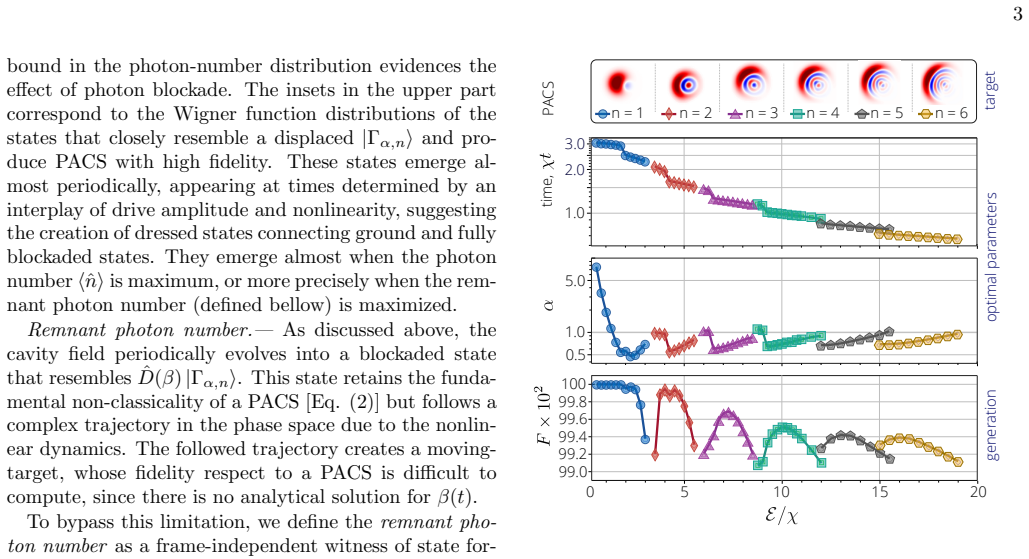
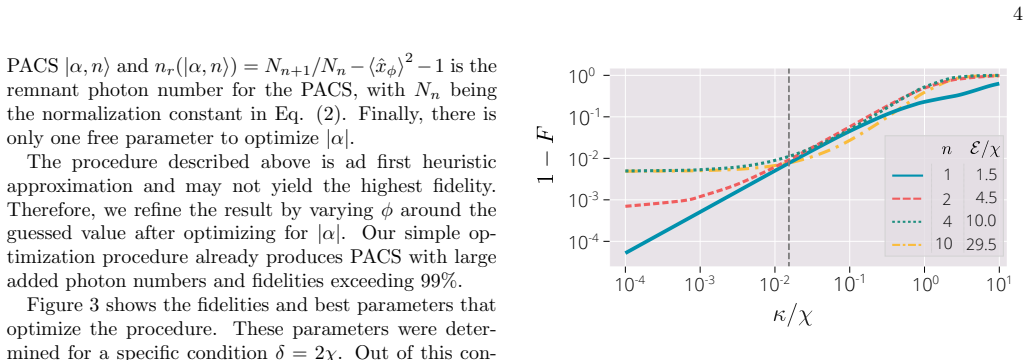
Multi-photon added coherent states emerge naturally in the dynamics of a driven Kerr nonlinear resonator through the photon blockade effect, enabling their post-selection-free generation at high fidelity by optimizing the external drive power and the interaction time, with fidelities of approximately 99 percent achievable under current experimental parameters and remaining robust to realistic conditions.
What carries the argument
The photon blockade effect in the driven Kerr nonlinear resonator, which restricts photon occupation and shapes the field evolution toward the target states during the driven dynamics.
If this is right
- Multi-photon added coherent states become available on demand rather than through low-probability heralding.
- The same platform yields states that remain close to ideal even when cavity decay and drive fluctuations are present.
- Complex non-Gaussian states can be reached using only standard driven-resonator hardware without added detectors for post-selection.
- The protocol extends the utility of Kerr resonators beyond blockade for single photons to structured multi-photon states.
Where Pith is reading between the lines
- Similar drive-and-wait protocols could be tested in other nonlinear cavities to generate different photon-added families without custom heralding optics.
- If the blockade mechanism scales with higher Kerr strengths, the method might reach states with larger photon additions while keeping fidelity high.
- Integration with existing circuit-QED or optomechanical setups would allow direct comparison of deterministic versus probabilistic generation rates for the same target state.
Load-bearing premise
The photon blockade in the driven resonator causes the desired states to form naturally in the time evolution without any measurement or selection.
What would settle it
Prepare the resonator with the reported optimal drive power and time, then measure the output state fidelity; a value consistently below 90 percent under the stated parameters would refute the high-fidelity claim.
Figures

read the original abstract
Non-Gaussian quantum states are essential resources for continuous-variable quantum information processing and for metrology. Among these, multi-photon added coherent states bridge classical and non-classical behaviors; however, their generation typically relies on small photon numbers and probabilistic heralding schemes. Here, we propose a protocol for the post-selection free generation of high fidelity multi-photon added coherent states using the photon blockade effect in a driven Kerr nonlinear resonator, where such states emerge naturally during the dynamics. We demonstrate that high-fidelity states can be prepared by optimizing the external drive power and the interaction time. Furthermore, we show that the protocol is robust under realistic experimental conditions, achieving fidelities of $\approx 99\%$ with current state-of-the-art parameters. Our results unlock a deterministic route to complex non-classical states using well-established quantum optical platforms.
Editorial analysis
A structured set of objections, weighed in public.
Referee Report
Summary. The manuscript proposes a protocol for the deterministic, post-selection-free generation of multi-photon added coherent states in a driven Kerr nonlinear resonator. The states are claimed to emerge naturally from the photon blockade effect during the open-system dynamics. High fidelities of approximately 99% are obtained by optimizing the external drive power and interaction time, with the protocol shown to remain robust under realistic experimental conditions and current state-of-the-art parameters.
Significance. If the numerical and analytic results hold, the work provides a deterministic route to non-Gaussian continuous-variable states without heralding or post-selection. This addresses a key limitation of probabilistic generation schemes and leverages standard driven Kerr platforms, which could facilitate more scalable preparation of resources for quantum information and metrology.
minor comments (1)
- The abstract states fidelities of ≈99% but does not specify the photon number of the target multi-photon added coherent state or the precise figure of merit used for optimization; clarifying this in the introduction would improve readability.
Simulated Author's Rebuttal
We thank the referee for their thorough review and positive recommendation to accept the manuscript. No major comments were raised in the report.
Circularity Check
No significant circularity
full rationale
The paper presents a forward protocol that optimizes external drive amplitude and evolution time in a standard driven Kerr resonator model to produce high-fidelity multi-photon-added coherent states via photon blockade. Fidelity is computed from the resulting density matrix under the Lindblad master equation; the target state is defined independently of the optimization outcome. No equation reduces a claimed prediction to a fitted parameter by construction, no load-bearing self-citation chain is invoked to justify uniqueness, and the derivation remains self-contained against external benchmarks of open-system quantum optics. The reader's supplied circularity score of 2.0 is consistent with this assessment.
Axiom & Free-Parameter Ledger
free parameters (2)
- external drive power
- interaction time
axioms (1)
- domain assumption Photon blockade occurs in a driven Kerr nonlinear resonator and shapes the state evolution
Reference graph
Works this paper leans on
-
[2]
A. E. B. Nielsen and K. Mølmer, Phys. Rev. A75, 043801 (2007)
2007
-
[3]
Sperling, W
J. Sperling, W. Vogel, and G. S. Agarwal, Phys. Rev. A 89, 043829 (2014)
2014
-
[4]
A. J. Pizzimenti, J. M. Lukens, H.-H. Lu, N. A. Peters, S. Guha, and C. N. Gagatsos, Phys. Rev. A104, 062437 (2021)
2021
-
[5]
R. J. Glauber, Physical Review130, 2529–2539 (1963)
1963
-
[6]
Haroche and J.-M
S. Haroche and J.-M. Raimond,Exploring the Quantum: Atoms, Cavities, and Photons(OUP Oxford, 2006)
2006
-
[8]
Laiho, M
K. Laiho, M. Avenhaus, K. N. Cassemiro, and C. Sil- berhorn, New Journal of Physics11, 043012 (2009)
2009
-
[9]
G. S. Agarwal and K. Tara, Phys. Rev. A43, 492 (1991)
1991
-
[10]
S. L. Braunstein and P. van Loock, Rev. Mod. Phys.77, 513 (2005)
2005
-
[11]
P. V. P. Pinheiro and R. V. Ramos, Quantum Informa- tion Processing12, 537–547 (2012)
2012
-
[12]
A. Chatterjee, K. Thapliyal, and A. Pathak, Annalen der Physik533(2021), 10.1002/andp.202100201
-
[13]
Kudra, M
M. Kudra, M. Jirlow, M. Kervinen, A. M. Eriksson, F. Quijandr´ ıa, P. Delsing, T. Abad, and S. Gasparinetti, Quantum Science and Technology10, 045037 (2025)
2025
-
[14]
Zavatta, S
A. Zavatta, S. Viciani, and M. Bellini, Science306, 660 (2004)
2004
-
[15]
Barbieri, N
M. Barbieri, N. Spagnolo, M. G. Genoni, F. Ferreyrol, R. Blandino, M. G. A. Paris, P. Grangier, and R. Tualle- Brouri, Phys. Rev. A82, 063833 (2010)
2010
-
[16]
Kumar, E
R. Kumar, E. Barrios, C. Kupchak, and A. I. Lvovsky, Phys. Rev. Lett.110, 130403 (2013)
2013
-
[17]
J. Fadrn´ y, M. Neset, M. Bielak, M. Jeˇ zek, J. B´ ılek, and J. Fiur´ aˇ sek, npj Quantum Information10(2024), 10.1038/s41534-024-00885-y
-
[18]
M. Uria, P. Solano, and C. Hermann-Avigliano, Phys. Rev. Lett.125, 093603 (2020)
2020
-
[19]
M. Kudra, M. Kervinen, I. Strandberg, S. Ahmed, M. Scigliuzzo, A. Osman, D. P. Lozano, M. O. Thol´ en, R. Borgani, D. B. Haviland, G. Ferrini, J. Bylander, A. F. Kockum, F. Quijandr´ ıa, P. Delsing, and S. Gasparinetti, PRX Quantum3(2022), 10.1103/prxquantum.3.030301
-
[21]
D. Iyama, T. Kamiya, S. Fujii, H. Mukai, Y. Zhou, T. Na- gase, A. Tomonaga, R. Wang, J.-J. Xue, S. Watabe, S. Kwon, and J.-S. Tsai, Nature Communications15 (2024), 10.1038/s41467-023-44496-1
-
[22]
G. S. Agarwal,Quantum Optics(Cambridge University Press, 2012)
2012
-
[23]
K. E. Cahill and R. J. Glauber, Physical Review177, 1857–1881 (1969)
1969
-
[24]
Sivakumar, International Journal of Theoretical Physics53(2014), 10.1007/s10773-013-1967-7
S. Sivakumar, International Journal of Theoretical Physics53(2014), 10.1007/s10773-013-1967-7
-
[25]
Imamo¯ glu, H
A. Imamo¯ glu, H. Schmidt, G. Woods, and M. Deutsch, Phys. Rev. Lett.79, 1467 (1997)
1997
-
[26]
A. J. Hoffman, S. J. Srinivasan, S. Schmidt, L. Spietz, J. Aumentado, H. E. T¨ ureci, and A. A. Houck, Phys. Rev. Lett.107, 053602 (2011)
2011
-
[27]
P. D. Drummond and D. F. Walls, Journal of Physics A: Mathematical and General13, 725 (1980)
1980
-
[28]
Miranowicz, M
A. Miranowicz, M. Paprzycka, Y.-x. Liu, J. c. v. Bajer, and F. Nori, Phys. Rev. A87, 023809 (2013)
2013
-
[29]
E. V. Anikin, N. S. Maslova, N. A. Gippius, and I. M. Sokolov, Phys. Rev. A104, 053106 (2021)
2021
-
[30]
See Supplemental Material at URL-will-be-inserted-by- publisher for more details
-
[31]
B. Yadin, F. C. Binder, J. Thompson, V. Narasimhachar, M. Gu, and M. S. Kim, Physical Review X8(2018), 10.1103/physrevx.8.041038
-
[32]
Hillery, Physical Review A39, 2994–3002 (1989)
M. Hillery, Physical Review A39, 2994–3002 (1989)
1989
-
[33]
K. C. Tan and H. Jeong, AVS Quantum Science1(2019), 10.1116/1.5126696
-
[34]
J. M. Raimond, C. Sayrin, S. Gleyzes, I. Dotsenko, M. Brune, S. Haroche, P. Facchi, and S. Pascazio, Physical Review Letters105(2010), 10.1103/phys- revlett.105.213601. 1 SUPPLEMENTARY MATERIAL: Post-Selection Free Generation of Multi-Photon Added Coherent States REMNANT PHOTON NUMBER In this section, we provide the derivation of theremnant photon number....
discussion (0)
Sign in with ORCID, Apple, or X to comment. Anyone can read and Pith papers without signing in.