Multi-Agent Framework Leveraging Knowledge Graphs for Virtual Commissioning Models
Pith reviewed 2026-06-28 08:13 UTC · model grok-4.3
The pith
A knowledge-graph multi-agent framework extracts data from PLC and simulation tools to semi-automate virtual commissioning model tasks.
A machine-rendered reading of the paper's core claim, the machinery that carries it, and where it could break.
Core claim
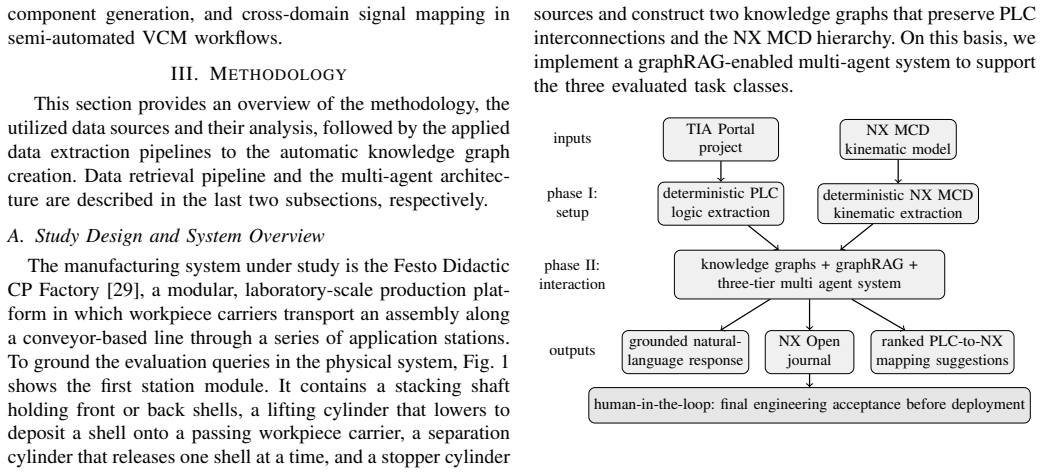
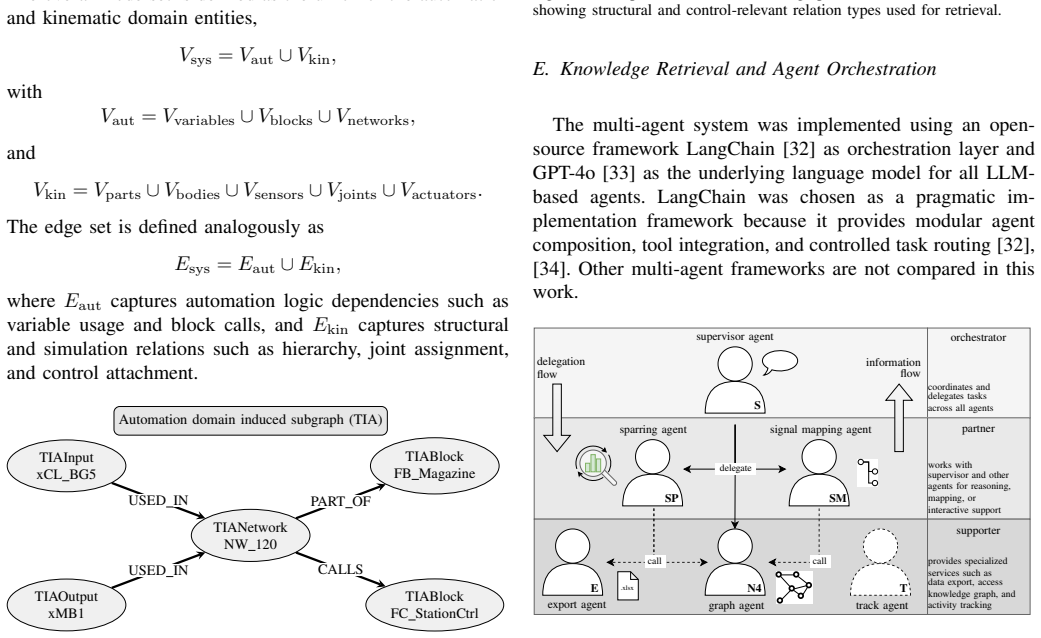
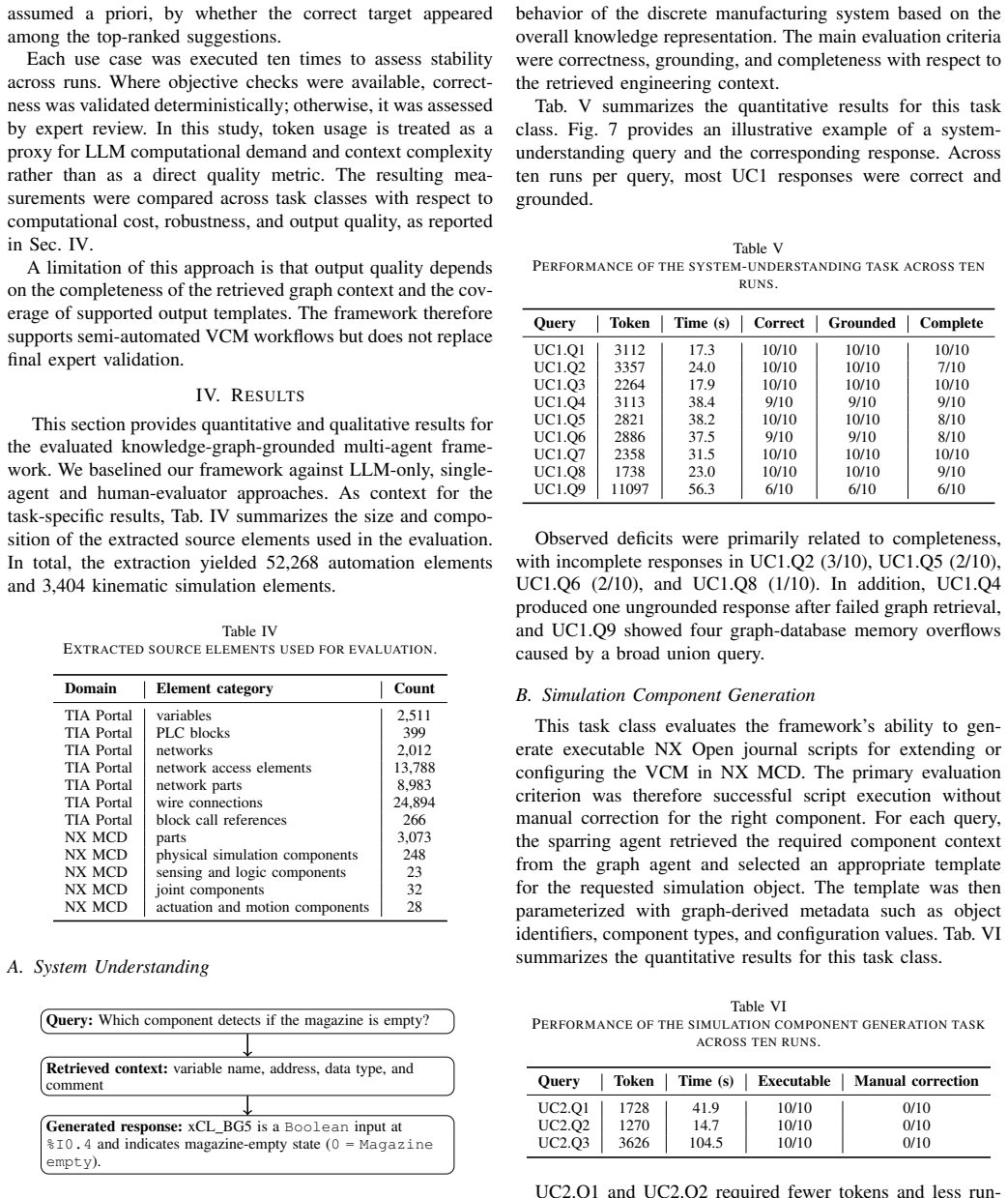
The paper's central claim is that a deterministic setup process can transform structured data from Siemens TIA Portal PLC projects and NX MCD kinematic models into a shared graph database, after which a hierarchical multi-agent architecture can deliver grounded natural-language queries, template-guided NX Open journal script generation, and ranked cross-domain mapping suggestions for virtual commissioning models.
What carries the argument
Hierarchical multi-agent architecture operating on a shared graph database built from extracted TIA Portal and NX MCD data.
If this is right
- Manual cross-domain interpretation effort for virtual commissioning models decreases.
- Recurring tasks of system understanding, simulation component generation, and signal mapping become more directly actionable.
- Engineers gain natural-language access to combined engineering knowledge without switching tools.
- Generation of executable NX Open journal scripts follows provided templates.
- Mapping suggestions between PLC variables and NX MCD objects are produced with ranking.
Where Pith is reading between the lines
- The extraction and graph construction steps could be adapted to other PLC or simulation platforms if similar structured exports exist.
- The same graph could later support additional automated checks such as consistency verification between control logic and kinematics.
- Scaling the multi-agent tasks to full production lines may require new agent coordination rules not tested in the laboratory case.
- Combining the graph with external data sources could extend the framework beyond initial model creation into ongoing maintenance.
Load-bearing premise
The deterministic setup process extracts complete and accurate structured data from Siemens TIA Portal and NX MCD and transforms both into a shared graph database without significant information loss or manual correction.
What would settle it
Apply the extraction process to a second laboratory or industrial system and check whether the resulting graph requires substantial manual fixes or loses critical PLC-to-simulation relationships before any agent tasks can run.
Figures
read the original abstract
Virtual commissioning models (VCMs) of discrete manufacturing systems are used to validate automation behavior before physical deployment, but creating and maintaining them remains labor-intensive. Relevant engineering information is distributed across programmable logic controller (PLC) engineering projects, such as Siemens TIA Portal, and kinematic simulation models, such as Siemens NX Mechatronics Concept Designer (NX MCD), where it is stored in incompatible, tool-specific data structures. In practice, IEC 61131-3-based PLC programs and variables are engineered separately from rigid-body and kinematic simulation objects such as parts, joints, sensors, and actuators. As a result, understanding system behavior, generating simulation components, and mapping PLC variables to corresponding simulation objects require cross-domain expertise and remain largely manual. This paper presents a knowledge-graph-grounded multi-agent framework for semi-automated VCM development. A deterministic setup process extracts structured data from Siemens TIA Portal and Siemens NX MCD and transforms both sources into graph-based representations within a shared graph database. The framework uses a hierarchical multi-agent architecture to support three task classes in early-stage VCM development: system understanding, simulation component generation, and cross-domain signal mapping. It provides grounded natural-language access to engineering knowledge, template-guided generation of executable NX Open journal scripts, and ranked mapping suggestions between PLC variables and NX MCD simulation objects. Evaluation on a laboratory-scale discrete manufacturing system shows that the approach reduces manual cross-domain interpretation effort and makes recurring VCM engineering tasks more actionable.
Editorial analysis
A structured set of objections, weighed in public.
Referee Report
Summary. The paper presents a knowledge-graph-grounded multi-agent framework for semi-automated virtual commissioning model (VCM) development. A deterministic setup process extracts structured data from Siemens TIA Portal PLC projects and Siemens NX MCD kinematic models into a shared graph database. A hierarchical multi-agent architecture then supports three task classes: system understanding via grounded natural-language queries, template-guided generation of executable NX Open scripts, and ranked cross-domain mapping of PLC variables to simulation objects. Evaluation on a laboratory-scale discrete manufacturing system is reported to reduce manual cross-domain interpretation effort and make recurring VCM tasks more actionable.
Significance. If the extraction process produces complete and accurate graphs and the agent tasks demonstrably reduce effort with measurable gains, the work could provide a practical bridge between incompatible engineering data sources in industrial automation. The combination of knowledge graphs with hierarchical agents for grounded access and script generation offers a concrete engineering application that could be extended to other multi-tool workflows. The manuscript supplies no quantitative metrics, error analysis, or protocol details, so the significance remains prospective rather than established.
major comments (1)
- [Abstract (setup process paragraph)] Abstract, paragraph on setup process: The central claim that the framework reduces manual cross-domain effort rests on the assertion that the deterministic extraction 'transforms both sources into graph-based representations without significant information loss.' No description is given of how custom blocks, user-defined types, or non-standard kinematic constraints in the proprietary TIA Portal and NX MCD formats are parsed or preserved; if such elements are dropped or mis-mapped, the downstream agent tasks operate on an incomplete model and the reported effort reduction does not follow.
Simulated Author's Rebuttal
Thank you for the opportunity to respond to the referee report. We have carefully considered the major comment and outline our planned revisions below.
read point-by-point responses
-
Referee: [Abstract (setup process paragraph)] Abstract, paragraph on setup process: The central claim that the framework reduces manual cross-domain effort rests on the assertion that the deterministic extraction 'transforms both sources into graph-based representations without significant information loss.' No description is given of how custom blocks, user-defined types, or non-standard kinematic constraints in the proprietary TIA Portal and NX MCD formats are parsed or preserved; if such elements are dropped or mis-mapped, the downstream agent tasks operate on an incomplete model and the reported effort reduction does not follow.
Authors: We thank the referee for this observation. The claim in the abstract regarding 'without significant information loss' is indeed not supported by a detailed description of the parsing logic for custom or non-standard elements in the current manuscript. The extraction is deterministic for the standard elements encountered in our laboratory-scale case study. To address this, we will revise the abstract to tone down the claim to 'into graph-based representations of the primary data structures' and add a new subsection in the methods describing the extraction rules for standard elements and explicitly stating the current limitations with custom blocks, user-defined types, and non-standard constraints. This will clarify the scope of the effort reduction achieved. revision: yes
Circularity Check
No circularity; descriptive framework with independent empirical evaluation
full rationale
The paper describes a practical multi-agent software framework for virtual commissioning that extracts data from TIA Portal and NX MCD into a shared graph database, then applies agents for system understanding, script generation, and mapping. No equations, fitted parameters, or predictions appear in the provided text. The central claim rests on an empirical evaluation on a laboratory-scale system rather than any derivation that reduces to its own inputs by construction. No self-citation chains, uniqueness theorems, or ansatzes are invoked. The extraction process is presented as a deterministic engineering step, not a self-definitional or fitted result. The derivation chain is therefore self-contained against external benchmarks.
Axiom & Free-Parameter Ledger
axioms (1)
- domain assumption Data from Siemens TIA Portal and NX MCD can be extracted and transformed into graph representations without significant loss.
invented entities (1)
-
Hierarchical multi-agent architecture
no independent evidence
Reference graph
Works this paper leans on
-
[1]
VDI/VDE 3693 Blatt 1: Virtuelle Inbetriebnahme - Modellarten und Begriffe,
Verein deutscher Ingenieure, “VDI/VDE 3693 Blatt 1: Virtuelle Inbetriebnahme - Modellarten und Begriffe,” 2025. [Online]. Available: https://www.vdi.de/mitgliedschaft/vdi-richtlinien/details/ vdivde-3693-blatt-1-virtuelle-inbetriebnahme-modellarten-und-begriffe
2025
-
[2]
Virtual Commissioning Of Manufacturing Systems A Review And New Approaches For Simplification,
P. Hoffmann, T. M. Maksoud, R. Schumann, and G. C. Premier, “Virtual Commissioning Of Manufacturing Systems A Review And New Approaches For Simplification,” inProceedings - 24th European Conference on Modelling and Simulation, ECMS, 2010, pp. 175–181. [Online]. Available: http://www.scs-europe.net/dlib/2010/ 2010-0175.htm
2010
-
[3]
Concepts and trends of virtual commissioning – A comprehensive review,
N. Striffler and T. V oigt, “Concepts and trends of virtual commissioning – A comprehensive review,”Journal of Manufacturing Systems, vol. 71, pp. 664–680, 2023. [Online]. Available: https://linkinghub.elsevier.com/ retrieve/pii/S0278612523002145
2023
-
[4]
D. Hartmann, “Real-time digital twins,”Zenodo, 2021. [Online]. Available: https://doi.org/10.5281/zenodo.5470479
-
[5]
A Survey on Digital Twin: Definitions, Characteristics, Applications, and Design Implications,
B. R. Barricelli, E. Casiraghi, and D. Fogli, “A Survey on Digital Twin: Definitions, Characteristics, Applications, and Design Implications,” IEEE Access, vol. 7, pp. 167 653–167 671, 2019. [Online]. Available: https://ieeexplore.ieee.org/document/8901113/
arXiv 2019
-
[6]
Digital Twins - a golden age for industrial mathematics,
D. Hartmann and H. Van Der Auweraer, “Digital Twins - a golden age for industrial mathematics,”Journal of Mathematics in Industry, vol. 15, p. 6, 2025. [Online]. Available: https://mathematicsinindustry. springeropen.com/articles/10.1186/s13362-025-00170-3
-
[7]
IEC 61131-3: Pro- grammable controllers - Part 3: Programming languages,
International Electrotechnical Commission, “IEC 61131-3: Pro- grammable controllers - Part 3: Programming languages,” 2025. [Online]. Available: https://webstore.iec.ch/en/publication/68533
2025
-
[8]
L. Yang, S. Luo, X. Cheng, and L. Yu, “Leveraging Large Language Models for Enhanced Digital Twin Modeling: Trends, Methods, and Challenges,” 2025. [Online]. Available: https://arxiv.org/abs/2503.02167
arXiv 2025
-
[9]
Knowledge Graphs as Enhancers of Intelligent Digital Twins,
N. Sahlab, S. Kamm, T. M ¨uller, N. Jazdi, and M. Weyrich, “Knowledge Graphs as Enhancers of Intelligent Digital Twins,” in4th International Conference on Industrial Cyber-Physical Systems, ICPS, 2021, pp. 19–
2021
-
[10]
Available: https://ieeexplore.ieee.org/document/9468219/
[Online]. Available: https://ieeexplore.ieee.org/document/9468219/
-
[11]
Multi-Agent Systems for Manufacturing Digital Twins: A Perspective on Agency and Large Language Models,
N. P. Greis, H. P. Cherukuri, and J. C. Outeiro, “Multi-Agent Systems for Manufacturing Digital Twins: A Perspective on Agency and Large Language Models,”IFAC-PapersOnLine, vol. 59, pp. 1612–1617,
-
[12]
Available: https://linkinghub.elsevier.com/retrieve/pii/ S2405896325010328
[Online]. Available: https://linkinghub.elsevier.com/retrieve/pii/ S2405896325010328
-
[13]
Digital Twin: Origin to Future,
M. Singh, E. Fuenmayor, E. Hinchy, Y . Qiao, N. Murray, and D. Devine, “Digital Twin: Origin to Future,”Applied System Innovation, vol. 4, p. 36, 2021. [Online]. Available: https://www.mdpi.com/2571-5577/4/ 2/36
2021
-
[14]
Design of a material sorting digital twin system based on NX MCD,
M. Li and D. Yang, “Design of a material sorting digital twin system based on NX MCD,”Manufacturing Review, vol. 11, p. 13,
-
[15]
Available: https://mfr.edp-open.org/10.1051/mfreview/ 2024010
[Online]. Available: https://mfr.edp-open.org/10.1051/mfreview/ 2024010
-
[16]
Towards Self-X cognitive manufacturing network: An industrial knowledge graph- based multi-agent reinforcement learning approach,
P. Zheng, L. Xia, C. Li, X. Li, and B. Liu, “Towards Self-X cognitive manufacturing network: An industrial knowledge graph- based multi-agent reinforcement learning approach,”Journal of Manufacturing Systems, vol. 61, pp. 16–26, 2021. [Online]. Available: https://linkinghub.elsevier.com/retrieve/pii/S0278612521001643
2021
-
[17]
A knowledge graph based construction method for Digital Twin Network,
Y . Zhu, D. Chen, C. Zhou, L. Lu, and X. Duan, “A knowledge graph based construction method for Digital Twin Network,” in1st International Conference on Digital Twins and Parallel Intelligence, DTPI. IEEE, 2021, pp. 362–365. [Online]. Available: https://ieeexplore.ieee.org/document/9540177/
arXiv 2021
-
[18]
Drath, Ed.,AutomationML: A Practical Guide
R. Drath, Ed.,AutomationML: A Practical Guide. De Gruyter, 2021. [Online]. Available: https://doi.org/10.1515/9783110746235
-
[19]
Asset Administration Shell for industrial applications - Part 1: Asset Administration Shell structure,
International Electrotechnical Commission, “Asset Administration Shell for industrial applications - Part 1: Asset Administration Shell structure,”
-
[20]
Available: https://webstore.iec.ch/en/publication/65628
[Online]. Available: https://webstore.iec.ch/en/publication/65628
-
[21]
An Architecture for Knowledge Graph based Simulation Support,
F. G. Listl, J. Fischer, and M. Weyrich, “An Architecture for Knowledge Graph based Simulation Support,” in28th International Conference on Emerging Technologies and Factory Automation, ETFA, 2023, pp. 1–8. [Online]. Available: https://ieeexplore.ieee.org/document/10275514/
arXiv 2023
-
[22]
LLM-Based Digital Twin Water Conservancy Knowledge Graph Construction,
Y . Yang, F. Ye, D. Xu, X. Zhang, and J. Xu, “LLM-Based Digital Twin Water Conservancy Knowledge Graph Construction,” in 36th International Conference on Tools with Artificial Intelligence, ICTAI. IEEE, 2024, pp. 656–662. [Online]. Available: https: //ieeexplore.ieee.org/document/10849426/
arXiv 2024
-
[23]
LLMasMMKG: LLM Assisted Synthetic Multi-Modal Knowledge Graph Creation For Smart City Cognitive Digital Twins,
S. Mandal and N. E. O’Connor, “LLMasMMKG: LLM Assisted Synthetic Multi-Modal Knowledge Graph Creation For Smart City Cognitive Digital Twins,”Proceedings of the AAAI Symposium Series, vol. 4, pp. 210–221, 2024. [Online]. Available: https: //ojs.aaai.org/index.php/AAAI-SS/article/view/31795
2024
-
[24]
php/AAAI/article/view/12028/11887
K. Shuster, S. Poff, M. Chen, D. Kiela, and J. Weston, “Retrieval Augmentation Reduces Hallucination in Conversation,” inFindings of the Association for Computational Linguistics: EMNLP, 2021, pp. 3787–3803. [Online]. Available: https://doi.org/10.18653/v1/2021. findings-emnlp.320
-
[25]
Retrieval-Augmented Generation for Knowledge- Intensive NLP Tasks,
P. Lewis, E. Perez, A. Piktus, F. Petroni, V . Karpukhin, N. Goyal, H. K ¨uttler, M. Lewis, W. tau Yih, T. Rockt ¨aschel, S. Riedel, and D. Kiela, “Retrieval-Augmented Generation for Knowledge- Intensive NLP Tasks,”Advances in neural information processing systems, NeurIPS, vol. 33, pp. 9459–9474, 2020. [Online]. Available: https://arxiv.org/abs/2005.11401
Pith/arXiv arXiv 2020
-
[26]
Retrieval-Augmented Generation for AI-Generated Content: A Survey,
P. Zhao, H. Zhang, Q. Yu, Z. Wang, Y . Geng, F. Fu, L. Yang, W. Zhang, J. Jiang, and B. Cui, “Retrieval-Augmented Generation for AI-Generated Content: A Survey,”Data Science and Engineering, pp. 1–29, 2026. [Online]. Available: https://doi.org/10.1007/s41019-025-00335-5
-
[27]
Graph-based Approaches and Functionalities in Retrieval-Augmented Generation: A Comprehensive Survey,
Z. Zhu, T. Huang, K. Wang, J. Ye, X. Chen, and S. Luo, “Graph-based Approaches and Functionalities in Retrieval-Augmented Generation: A Comprehensive Survey,”ACM Computing Surveys, vol. 58, pp. 1–38,
-
[28]
Available: https://dl.acm.org/doi/10.1145/3795880
[Online]. Available: https://dl.acm.org/doi/10.1145/3795880
-
[29]
From Local to Global: A Graph RAG Approach to Query-Focused Summarization,
D. Edge, H. Trinh, N. Cheng, J. Bradley, A. Chao, A. Mody, S. Truitt, D. Metropolitansky, R. O. Ness, and J. Larson, “From Local to Global: A Graph RAG Approach to Query-Focused Summarization,” 2024. [Online]. Available: https://arxiv.org/abs/2404.16130
Pith/arXiv arXiv 2024
-
[30]
MADTwin: a framework for multi-agent digital twin development: smart warehouse case study,
H. Marah and M. Challenger, “MADTwin: a framework for multi-agent digital twin development: smart warehouse case study,” Annals of Mathematics and Artificial Intelligence, vol. 92, pp. 975–1005, 2024. [Online]. Available: https://link.springer.com/10.1007/ s10472-023-09872-z
2024
-
[31]
Empowering digital twins with large language models for global temporal feature learning,
Y . Sun, Q. Zhang, J. Bao, Y . Lu, and S. Liu, “Empowering digital twins with large language models for global temporal feature learning,”Journal of Manufacturing Systems, vol. 74, pp. 83–99,
-
[32]
Available: https://linkinghub.elsevier.com/retrieve/pii/ S0278612524000372
[Online]. Available: https://linkinghub.elsevier.com/retrieve/pii/ S0278612524000372
-
[33]
Z. Liu, R. Zeng, D. Wang, and G. Peng, “Agents4PLC: Automating Closed-loop PLC Code Generation and Verification in Industrial Control Systems using LLM-based Agents,”IEEE Transactions on Software Engineering, TSE, 2026. [Online]. Available: https: //doi.org/10.1109/TSE.2026.3667895
-
[34]
Benchmarking and validation of prompting techniques for AI-assisted industrial PLC programming,
K. Adnyana and A. Schwung, “Benchmarking and validation of prompting techniques for AI-assisted industrial PLC programming,” Machine Learning with Applications, vol. 23, p. 100804, 2026. [Online]. Available: https://doi.org/10.1016/j.mlwa.2025.100804
-
[35]
Festo Didactic CP Factory Complete System 404-1
Festo, “Festo Didactic CP Factory Complete System 404-1.” [On- line]. Available: https://ip.festo-didactic.com/Infoportal/CPFactoryLab/ hardware/details.php?model=CP-L-404-1&lang=en
-
[36]
Neo4j Graph Database,
Neo4j, “Neo4j Graph Database,” 2026. [Online]. Available: https: //neo4j.com/
2026
-
[37]
P. Skavantzos and S. Link, “Normalizing Property Graphs,”Proceedings of the VLDB Endowment, vol. 16, pp. 3031–3043, 2023. [Online]. Available: https://dl.acm.org/doi/10.14778/3611479.3611506
-
[38]
LangChain framework,
LangChain, “LangChain framework,” 2026. [Online]. Available: https://www.langchain.com/
2026
-
[39]
OpenAI et al., “GPT-4 Technical Report,” Tech. Rep., 2023. [Online]. Available: https://arxiv.org/abs/2303.08774
Pith/arXiv arXiv 2023
-
[40]
M. Holland and K. Chaudhari,Manufacturing Letters, vol. 40, pp. 100–103, 2024. [Online]. Available: https://doi.org/10.1016/j.mfglet. 2024.03.010
-
[41]
Classification and Review of Multi-agents Systems in the Manufacturing Section,
G. Andreadis, P. Klazoglou, K. Niotaki, and K.-D. Bouzakis, “Classification and Review of Multi-agents Systems in the Manufacturing Section,”Procedia Engineering, vol. 69, pp. 282–290,
-
[42]
Available: https://doi.org/10.1016/j.proeng.2014.02.233
[Online]. Available: https://doi.org/10.1016/j.proeng.2014.02.233
discussion (0)
Sign in with ORCID, Apple, or X to comment. Anyone can read and Pith papers without signing in.