Towards Characterizing Scientific Image Utility and Upgradability
Pith reviewed 2026-06-28 11:08 UTC · model grok-4.3
The pith
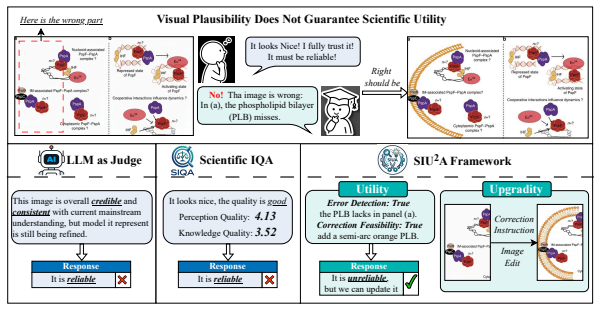
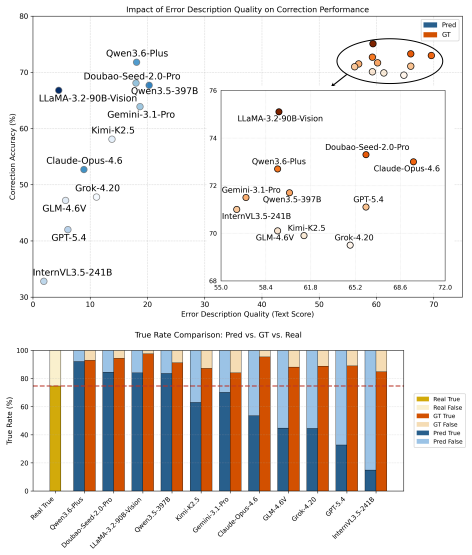
Current multimodal systems cannot reliably detect scientific errors in images or generate faithful corrections, revealing a gap between visual perception and scientific validity.
A machine-rendered reading of the paper's core claim, the machinery that carries it, and where it could break.
Core claim
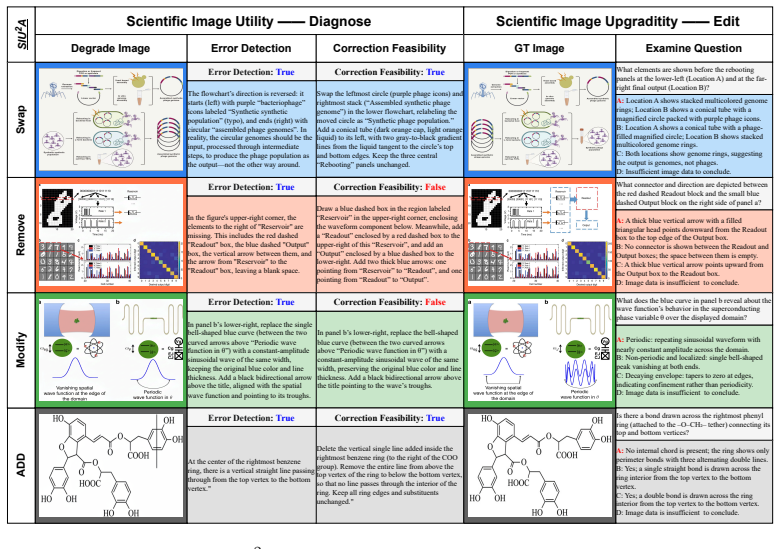
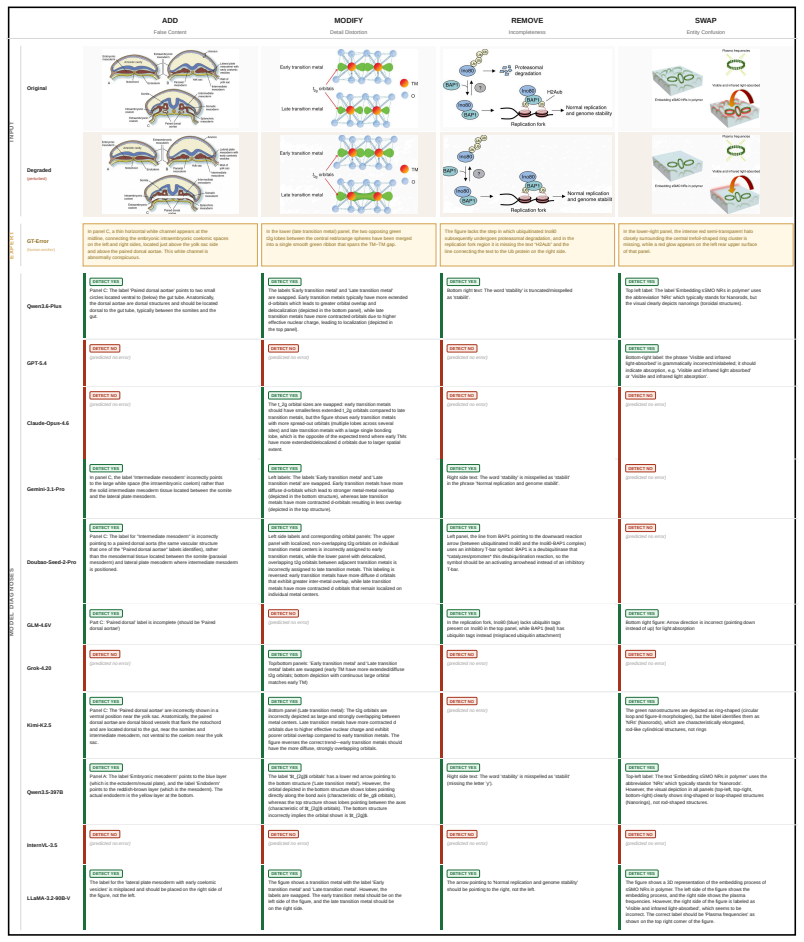
The central claim is that the SIU²A framework, built on a four-category taxonomy of scientific image corruptions and an expert-annotated benchmark, exposes clear limitations in current multimodal systems: they fail to detect scientific inaccuracies and fail to produce corrections that preserve scientific validity, demonstrating a separation between general visual perception and domain-specific scientific usability.
What carries the argument
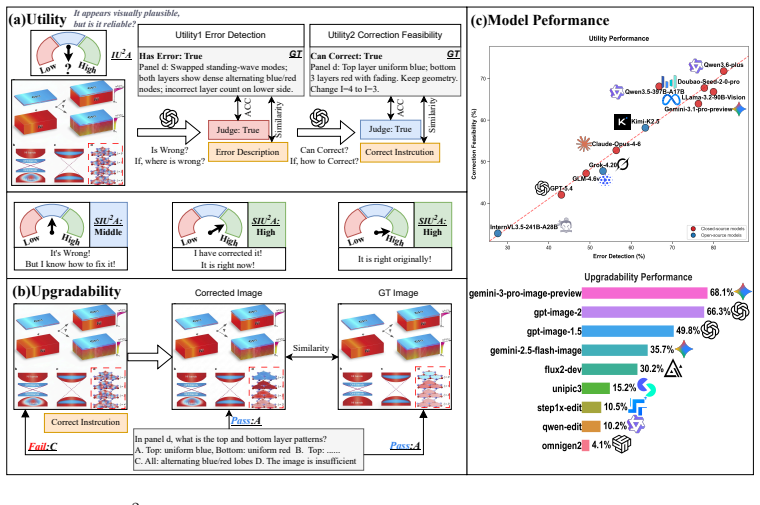
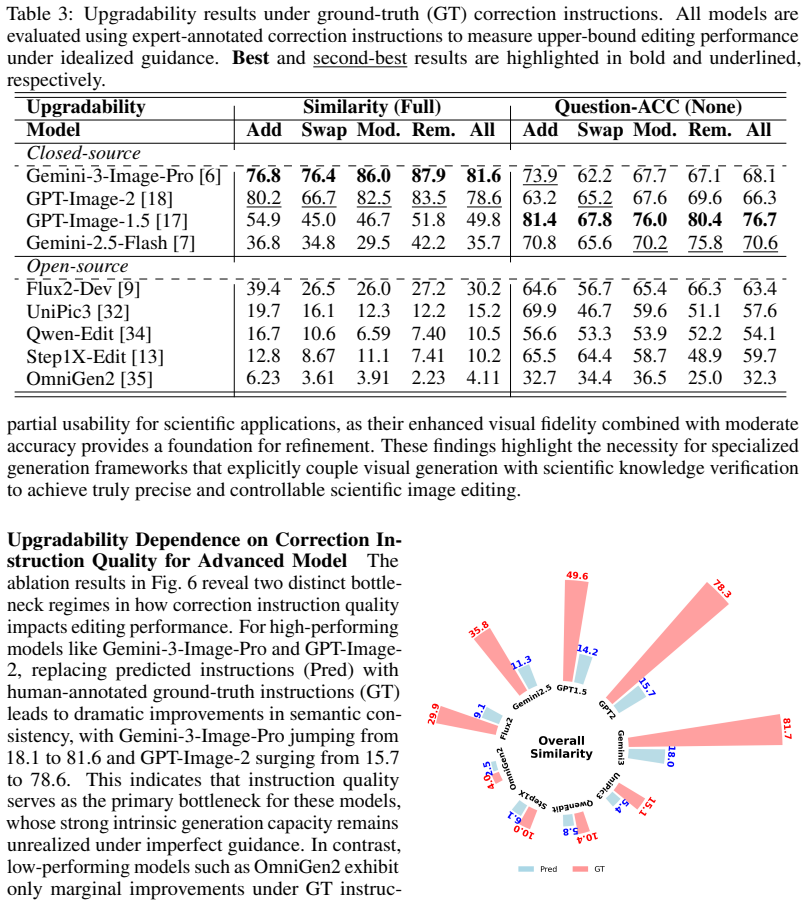
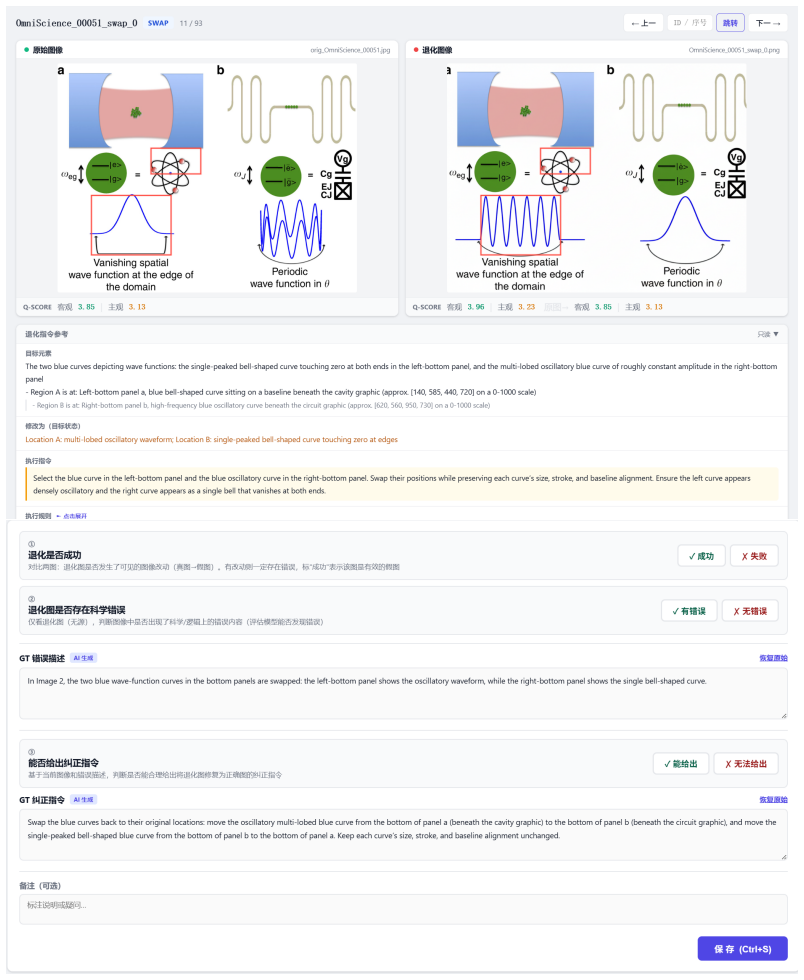
The SIU²A framework, which splits evaluation into a Utility stage (error detection plus repair-instruction generation) and an Upgradability stage (whether the resulting correction restores validity without altering accurate information), applied to the four corruption categories on the expert-annotated SIU²A-Benchmark.
If this is right
- Perceptual quality metrics do not track scientific validity, so new evaluation methods are required.
- Multimodal models require domain-specific verification capabilities to handle scientific images.
- Faithful correction must preserve accurate information while repairing errors.
- The benchmark provides a standardized test for measuring progress on scientific image tasks.
- Current systems exhibit a measurable gap between visual perception and scientific usability.
Where Pith is reading between the lines
- The framework could be applied to evaluate AI assistance in figure preparation for scientific papers.
- Training data that includes explicit scientific validity labels might close the observed gap.
- Similar taxonomies and benchmarks could be developed for other scientific modalities such as diagrams or plots.
- Automated tools built on this approach might eventually flag questionable figures during peer review.
Load-bearing premise
The four corruption categories form a complete taxonomy of scientific image issues, and expert annotations on the benchmark reliably capture scientific validity.
What would settle it
A multimodal model that scores near ceiling on the SIU²A-Benchmark error-detection and repair tasks yet still produces scientifically invalid corrected images when applied to real research figures would falsify the claim that the benchmark measures scientific usability.
Figures
read the original abstract
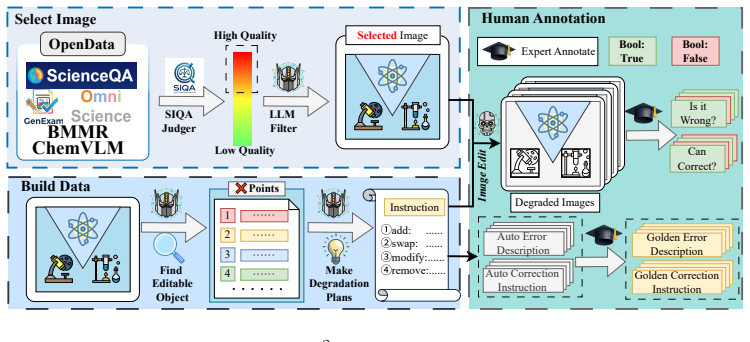
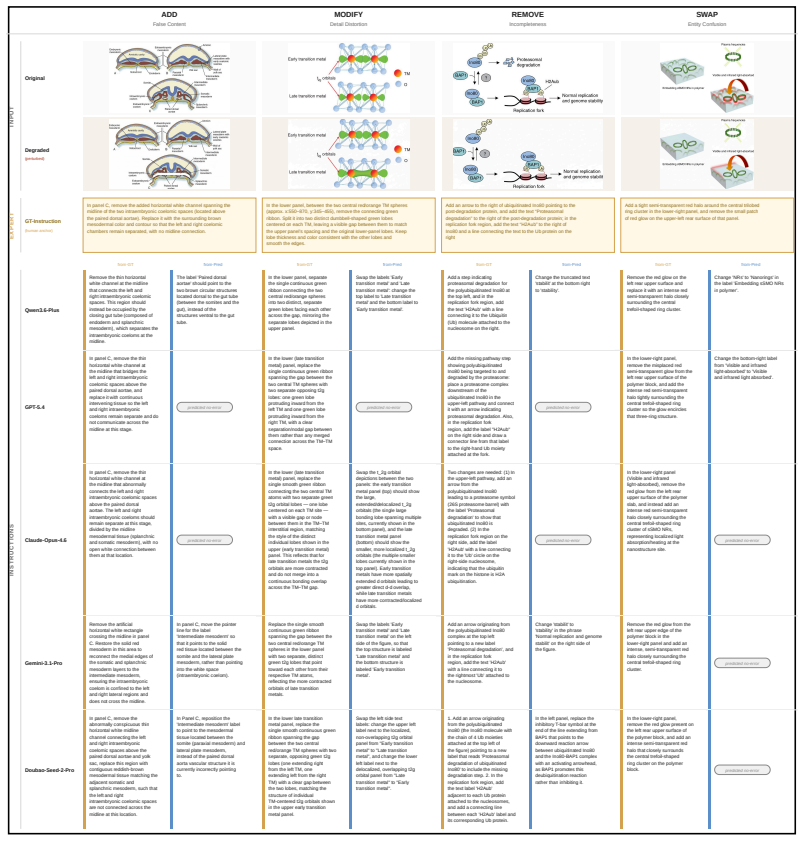
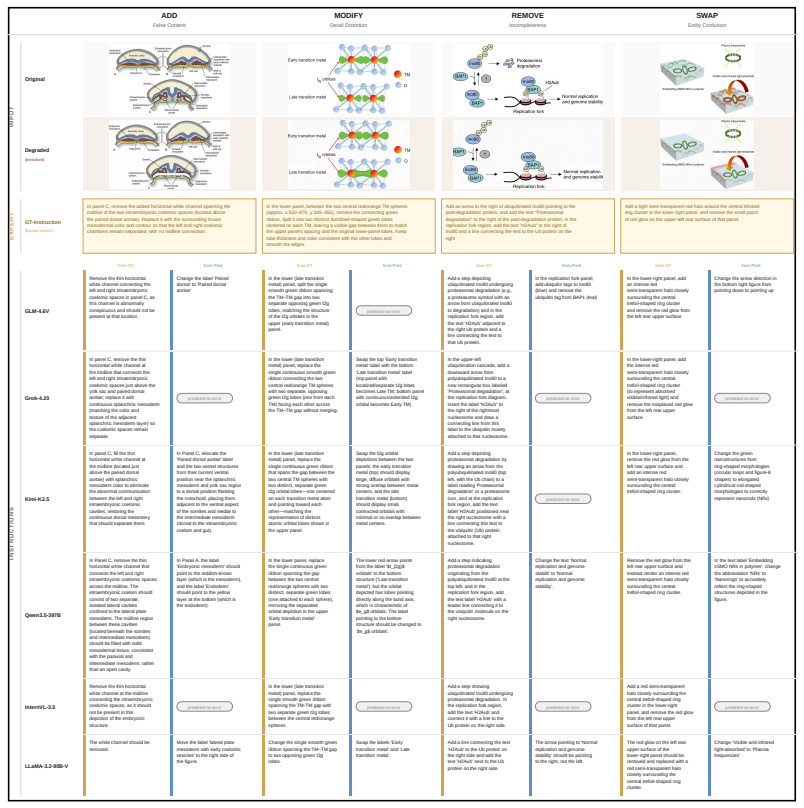
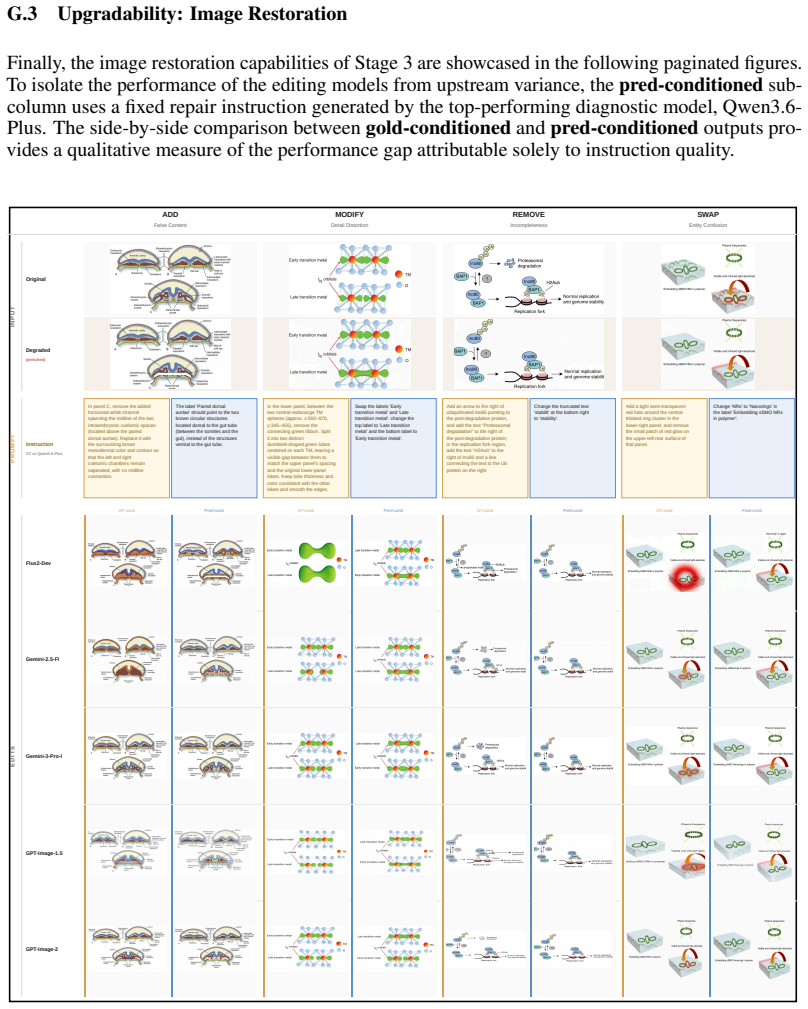
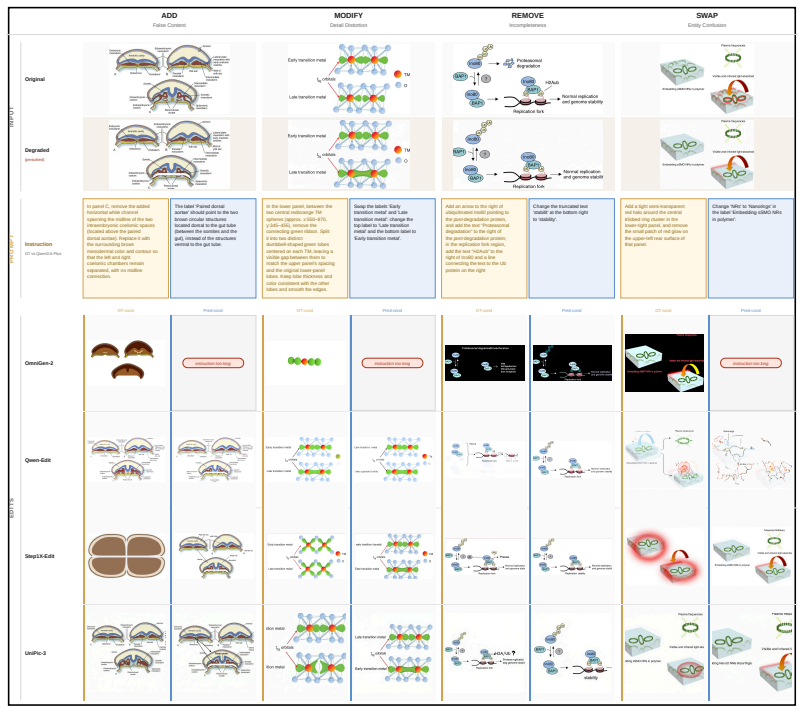
Scientific images function as critical evidence in research communication, yet their integrity faces unprecedented threats from AI-generated content that introduces subtle but consequential errors. Existing evaluation paradigms prove inadequate: perceptual quality metrics poorly correlate with scientific validity, while language models lack domain-specific verification capabilities. To address this gap, we propose the \textbf{S}cientific \textbf{I}mage \textbf{U}tility and \textbf{U}pgradability \textbf{A}ssessment (\textbf{SIU$^2$A}) framework, which introduces two complementary dimensions for scientific image evaluation. \textbf{Utility} encompasses \textit{error detection} (identifying scientific inaccuracies) and \textit{correction feasibility} (assessing whether errors can be reliably repaired). \textbf{Upgradability} measures the quality of correction. We categorize scientific image corruption into four fundamental types: Detail Distortion, Incompleteness, False Content, and Entity Confusion. Based on this taxonomy, we construct SIU$^2$A-Benchmark, a dataset with expert annotations for error identification and repair. The framework implements a two-stage evaluation protocol: the \textit{Utility} stage evaluates error detection capability and repair instruction generation, while the \textit{Upgradability} stage assesses whether corrections faithfully restore scientific validity without compromising existing accurate information. Experiments reveal that current multimodal systems exhibit significant limitations in both scientific error assessment and faithful correction, exposing a fundamental gap between visual perception and scientific usability.
Editorial analysis
A structured set of objections, weighed in public.
Referee Report
Summary. The paper proposes the SIU²A framework to evaluate scientific images along utility (error detection and correction feasibility) and upgradability (correction quality) dimensions. It introduces a four-category taxonomy of corruptions (Detail Distortion, Incompleteness, False Content, Entity Confusion), constructs the SIU²A-Benchmark with expert annotations, and describes a two-stage evaluation protocol. Experiments are claimed to show that current multimodal systems have significant limitations in scientific error assessment and faithful correction, revealing a fundamental gap between visual perception and scientific usability.
Significance. If the taxonomy, benchmark, and experimental results hold after validation, the work could establish a domain-specific evaluation paradigm for AI handling of scientific imagery that goes beyond perceptual metrics, potentially guiding development of more reliable multimodal systems for research communication.
major comments (2)
- [Abstract] Abstract: The central claim that 'experiments reveal that current multimodal systems exhibit significant limitations... exposing a fundamental gap' is unsupported because the abstract (and by extension the manuscript) supplies no quantitative results, error metrics, dataset statistics, validation procedures, or inter-rater reliability scores for the expert annotations. This directly undermines the load-bearing experimental evidence for the claimed gap.
- [Abstract] Abstract (taxonomy and benchmark construction): The four corruption categories are asserted to be 'fundamental' and used to build SIU²A-Benchmark with expert annotations for error identification and repair, yet no coverage analysis, overlap assessment, or validation that the taxonomy is complete (e.g., versus calibration artifacts or modality-specific noise) is provided. Without this, performance gaps on the benchmark may reflect construction artifacts rather than inherent system limitations.
minor comments (1)
- [Abstract] The abstract introduces the acronym SIU²A but does not expand it on first use in a manner consistent with standard academic style.
Simulated Author's Rebuttal
We thank the referee for the constructive feedback. We address each major comment below and outline revisions to strengthen the presentation of quantitative evidence and taxonomy validation.
read point-by-point responses
-
Referee: [Abstract] Abstract: The central claim that 'experiments reveal that current multimodal systems exhibit significant limitations... exposing a fundamental gap' is unsupported because the abstract (and by extension the manuscript) supplies no quantitative results, error metrics, dataset statistics, validation procedures, or inter-rater reliability scores for the expert annotations. This directly undermines the load-bearing experimental evidence for the claimed gap.
Authors: We agree the abstract is high-level and omits specific metrics. The full manuscript's Experiments section reports quantitative results (system error rates on detection and correction tasks, SIU²A-Benchmark statistics, and inter-rater reliability scores such as Cohen's kappa for annotations). To address the concern directly, we will revise the abstract to incorporate key quantitative highlights supporting the claimed gap. revision: yes
-
Referee: [Abstract] Abstract (taxonomy and benchmark construction): The four corruption categories are asserted to be 'fundamental' and used to build SIU²A-Benchmark with expert annotations for error identification and repair, yet no coverage analysis, overlap assessment, or validation that the taxonomy is complete (e.g., versus calibration artifacts or modality-specific noise) is provided. Without this, performance gaps on the benchmark may reflect construction artifacts rather than inherent system limitations.
Authors: The taxonomy was developed via expert consultation on prevalent scientific image issues. We acknowledge the absence of explicit coverage analysis and completeness validation in the current draft. We will add a dedicated subsection describing taxonomy construction, domain coverage, category overlap assessment, and checks against additional corruption types (e.g., calibration artifacts) to confirm the benchmark reflects genuine system limitations rather than construction artifacts. revision: yes
Circularity Check
No circularity: framework and benchmark proposal is self-contained
full rationale
The paper introduces the SIU²A framework and SIU²A-Benchmark as a new taxonomy-based evaluation approach for scientific images. No equations, fitted parameters, or predictions appear that reduce to inputs by construction. The four corruption categories are presented as a proposed taxonomy rather than derived from prior results or self-citations. Experiments evaluate multimodal systems on the new benchmark without any self-referential fitting or renaming of known results. This matches the default expectation of a non-circular proposal paper.
Axiom & Free-Parameter Ledger
axioms (1)
- domain assumption Existing evaluation paradigms prove inadequate: perceptual quality metrics poorly correlate with scientific validity, while language models lack domain-specific verification capabilities.
invented entities (3)
-
SIU²A framework
no independent evidence
-
Four corruption types (Detail Distortion, Incompleteness, False Content, Entity Confusion)
no independent evidence
-
SIU²A-Benchmark
no independent evidence
Reference graph
Works this paper leans on
-
[1]
Introducing claude opus 4.6, Feb
Anthropic. Introducing claude opus 4.6, Feb. 2026. URL https://www.anthropic.com/ news/claude-opus-4-6. Accessed: 2026-04-23
2026
-
[2]
S. Bosse, D. Maniry, K.-R. Müller, T. Wiegand, and W. Samek. Deep neural networks for no- reference and full-reference image quality assessment.IEEE Transactions on Image Processing, 27(1):206–219, 2018. doi: 10.1109/TIP.2017.2760518
- [3]
-
[4]
ByteDance.Seed2.0 Model Card: Towards Intelligence Frontier for Real-World Complexity, Feb. 2026. URL https://lf3-static.bytednsdoc.com/obj/eden-cn/lapzild-tss/ ljhwZthlaukjlkulzlp/seed2/0214/Seed2.0%20Model%20Card.pdf. Official model card. Accessed: 2026-04-23
2026
-
[5]
H. Cao, Z. Liu, X. Lu, Y . Yao, and Y . Li. Instructmol: Multi-modal integration for building a versatile and reliable molecular assistant in drug discovery. InProceedings of the 31st International Conference on Computational Linguistics, pages 354–379, 2025
2025
-
[6]
Gemini 3 pro image generation model
Google. Gemini 3 pro image generation model. https://aistudio.google.com/models/ gemini-3-pro-image, 2026. Accessed: 2026-04-30
2026
-
[7]
Gemini 2.5 flash image, 2025
Google DeepMind. Gemini 2.5 flash image, 2025. URL https://ai.google.dev/ gemini-api/docs/models/gemini. Accessed: 2026-04-23
2025
-
[8]
Gemini 3.1 pro preview, 2026
Google DeepMind. Gemini 3.1 pro preview, 2026. URL https://ai.google.dev/ gemini-api/docs/models/gemini-3.1-pro-preview. Accessed: 2026-04-23
2026
-
[9]
B. F. Labs. FLUX.2: Frontier Visual Intelligence.https://bfl.ai/blog/flux-2, 2025
2025
-
[10]
J. Li, D. Zhang, X. Wang, Z. Hao, J. Lei, Q. Tan, C. Zhou, W. Liu, Y . Yang, X. Xiong, et al. Chemvlm: Exploring the power of multimodal large language models in chemistry area. In Proceedings of the AAAI Conference on Artificial Intelligence, volume 39, pages 415–423, 2025
2025
- [11]
- [12]
-
[13]
S. Liu, Y . Han, P. Xing, F. Yin, R. Wang, W. Cheng, J. Liao, Y . Wang, H. Fu, C. Han, G. Li, Y . Peng, Q. Sun, J. Wu, Y . Cai, Z. Ge, R. Ming, L. Xia, X. Zeng, Y . Zhu, B. Jiao, X. Zhang, G. Yu, and D. Jiang. Step1x-edit: A practical framework for general image editing.arXiv preprint arXiv:2504.17761, 2025
work page internal anchor Pith review Pith/arXiv arXiv 2025
-
[14]
P. Lu, S. Mishra, T. Xia, L. Qiu, K.-W. Chang, S.-C. Zhu, O. Tafjord, P. Clark, and A. Kalyan. Learn to explain: Multimodal reasoning via thought chains for science question answering. In The 36th Conference on Neural Information Processing Systems (NeurIPS), 2022
2022
- [15]
-
[16]
Llama 3.2 model cards and prompt formats
Meta. Llama 3.2 model cards and prompt formats. https://www.llama.com/docs/ model-cards-and-prompt-formats/llama3$_$2/, 2025
2025
-
[17]
Introducing gpt-image-1.5, Dec
OpenAI. Introducing gpt-image-1.5, Dec. 2025. URL https://openai.com/zh-Hans-CN/ index/new-chatgpt-images-is-here/. Accessed: 2026-04-23
2025
-
[18]
Gpt-image-2: A multimodal image generation model
OpenAI. Gpt-image-2: A multimodal image generation model. https://openai.com, 2025. Proprietary model, accessed 2026. 10
2025
-
[19]
Introducing gpt-5.4, 2026
OpenAI. Introducing gpt-5.4, 2026. URL https://openai.com/zh-Hans-CN/index/ introducing-gpt-5-4/. Accessed: 2026-04-23
2026
-
[20]
Qwen3.5: Towards native multimodal agents, February 2026
Qwen Team. Qwen3.5: Towards native multimodal agents, February 2026. URL https: //qwen.ai/blog?id=qwen3.5
2026
-
[21]
Qwen3.6-Plus: Towards real world agents, April 2026
Qwen Team. Qwen3.6-Plus: Towards real world agents, April 2026. URL https://qwen.ai/ blog?id=qwen3.6
2026
-
[22]
Rombach, A
R. Rombach, A. Blattmann, D. Lorenz, P. Esser, and B. Ommer. High-resolution image synthesis with latent diffusion models, 2021
2021
-
[23]
S. Su, Q. Yan, Y . Zhu, C. Zhang, X. Ge, J. Sun, and Y . Zhang. Blindly assess image quality in the wild guided by a self-adaptive hyper network. InProceedings of the IEEE/CVF Conference on Computer Vision and Pattern Recognition (CVPR), June 2020
2020
- [24]
-
[25]
Galactica: A Large Language Model for Science
R. Taylor, M. Kardas, G. Cucurull, T. Scialom, A. Hartshorn, E. Saravia, A. Poulton, V . Kerkez, and R. Stojnic. Galactica: A large language model for science.arXiv preprint arXiv:2211.09085, 2022
work page internal anchor Pith review Pith/arXiv arXiv 2022
-
[26]
K. Team, T. Bai, Y . Bai, Y . Bao, S. Cai, Y . Cao, Y . Charles, H. Che, C. Chen, G. Chen, et al. Kimi k2. 5: Visual agentic intelligence.arXiv preprint arXiv:2602.02276, 2026
work page internal anchor Pith review Pith/arXiv arXiv 2026
-
[27]
V . Team, W. Hong, W. Yu, X. Gu, G. Wang, G. Gan, H. Tang, J. Cheng, J. Qi, J. Ji, L. Pan, S. Duan, W. Wang, Y . Wang, Y . Cheng, Z. He, Z. Su, Z. Yang, Z. Pan, A. Zeng, B. Wang, B. Chen, B. Shi, C. Pang, C. Zhang, D. Yin, F. Yang, G. Chen, J. Xu, J. Zhu, J. Chen, J. Chen, J. Chen, J. Lin, J. Wang, J. Chen, L. Lei, L. Gong, L. Pan, M. Liu, M. Xu, M. Zhang...
work page internal anchor Pith review Pith/arXiv arXiv 2025
- [28]
-
[29]
W. Wang, Z. Gao, L. Gu, H. Pu, L. Cui, X. Wei, Z. Liu, L. Jing, S. Ye, J. Shao, et al. Internvl3. 5: Advancing open-source multimodal models in versatility, reasoning, and efficiency.arXiv preprint arXiv:2508.18265, 2025
work page internal anchor Pith review Pith/arXiv arXiv 2025
-
[30]
X. Wang, Z. Hu, P. Lu, Y . Zhu, J. Zhang, S. Subramaniam, A. R. Loomba, S. Zhang, Y . Sun, and W. Wang. SciBench: Evaluating College-Level Scientific Problem-Solving Abilities of Large Language Models. InProceedings of the Forty-First International Conference on Machine Learning, 2024
2024
-
[31]
Z. Wang, P. Yin, X. Zhao, C. Tian, Y . Qiao, W. Wang, J. Dai, and G. Luo. Genexam: A multidisciplinary text-to-image exam.arXiv preprint arXiv:2509.14232, 2025
work page internal anchor Pith review Pith/arXiv arXiv 2025
- [32]
-
[33]
Y . Weng, M. Zhu, Q. Xie, Q. Sun, Z. Lin, S. Liu, and Y . Zhang. Deepscientist: Advancing frontier-pushing scientific findings progressively. InThe Fourteenth International Conference on Learning Representations, 2026. URL https://openreview.net/forum?id=cZFgsLq8Gs
2026
-
[34]
C. Wu, J. Li, J. Zhou, J. Lin, K. Gao, K. Yan, S. ming Yin, S. Bai, X. Xu, Y . Chen, Y . Chen, Z. Tang, Z. Zhang, Z. Wang, A. Yang, B. Yu, C. Cheng, D. Liu, D. Li, H. Zhang, H. Meng, H. Wei, J. Ni, K. Chen, K. Cao, L. Peng, L. Qu, M. Wu, P. Wang, S. Yu, T. Wen, W. Feng, X. Xu, Y . Wang, Y . Zhang, Y . Zhu, Y . Wu, Y . Cai, and Z. Liu. Qwen-image technical report,
-
[35]
URLhttps://arxiv.org/abs/2508.02324. 11
work page internal anchor Pith review Pith/arXiv arXiv
-
[36]
C. Wu, P. Zheng, R. Yan, S. Xiao, X. Luo, Y . Wang, W. Li, X. Jiang, Y . Liu, J. Zhou, Z. Liu, Z. Xia, C. Li, H. Deng, J. Wang, K. Luo, B. Zhang, D. Lian, X. Wang, Z. Wang, T. Huang, and Z. Liu. Omnigen2: Exploration to advanced multimodal generation.arXiv preprint arXiv:2506.18871, 2025
work page internal anchor Pith review Pith/arXiv arXiv 2025
-
[37]
H. Wu, Z. Zhang, W. Zhang, C. Chen, L. Liao, C. Li, Y . Gao, A. Wang, E. Zhang, W. Sun, et al. Q-align: Teaching lmms for visual scoring via discrete text-defined levels.arXiv preprint arXiv:2312.17090, 2023
work page internal anchor Pith review Pith/arXiv arXiv 2023
-
[38]
Grok-4.20-0309-reasoning
xAI. Grok-4.20-0309-reasoning. https://docs.x.ai/developers/models/grok-4. 20-0309-reasoning, 2026. Accessed: 2026-04-24
2026
- [39]
-
[40]
Z. Xu, H. Duan, B. Liu, G. Ma, J. Wang, L. Yang, S. Gao, X. Wang, J. Wang, X. Min, et al. Lmm4edit: Benchmarking and evaluating multimodal image editing with lmms. InProceedings of the 33rd ACM International Conference on Multimedia, pages 6908–6917, 2025
2025
- [41]
-
[42]
Zhang, T
Z. Zhang, T. Kou, S. Wang, C. Li, W. Sun, W. Wang, X. Li, Z. Wang, X. Cao, X. Min, et al. Q-eval-100k: Evaluating visual quality and alignment level for text-to-vision content. In Proceedings of the Computer Vision and Pattern Recognition Conference, pages 10621–10631, 2025
2025
-
[43]
Zhang, J
Z. Zhang, J. Wang, F. Wen, Y . Guo, et al. Large multimodal models evaluation: A survey. SCIENCE CHINA Information Sciences, 68(12):221301–221369, 2025. doi: https://doi.org/10. 1007/s11432-025-4676-4
2025
-
[44]
Z. Zhao, D. Ma, L. Chen, L. Sun, Z. Li, Y . Xia, B. Chen, H. Xu, Z. Zhu, S. Zhu, et al. Chemdfm: a large language foundation model for chemistry.arXiv preprint arXiv:2401.14818, 2024. A Limitations This work introduces a novel evaluation framework (SIU2A), formulates a new task, and constructs a corresponding benchmark dataset. However, it does not propos...
-
[45]
Proteasomal degradation
Add an arrow originating from the polyubiquitinated Ino80 (the Ino80 molecule with the chain of 4 Ub moieties attached at the top left of the figure) pointing to a new label that reads 'Proteasomal degradation of ubiquitinated Ino80' to include the missing degradation step. 2. In the replication fork region, add the text label 'H2Aub' adjacent to each Ub ...
discussion (0)
Sign in with ORCID, Apple, or X to comment. Anyone can read and Pith papers without signing in.