MeDxAgent: Multi-Agent Consultation for Interactive Medical Diagnosis
Pith reviewed 2026-06-28 07:57 UTC · model grok-4.3
The pith
A multi-agent consultation system improves interactive medical diagnosis accuracy by 10.3 percent on a benchmark of 4421 cases.
A machine-rendered reading of the paper's core claim, the machinery that carries it, and where it could break.
Core claim
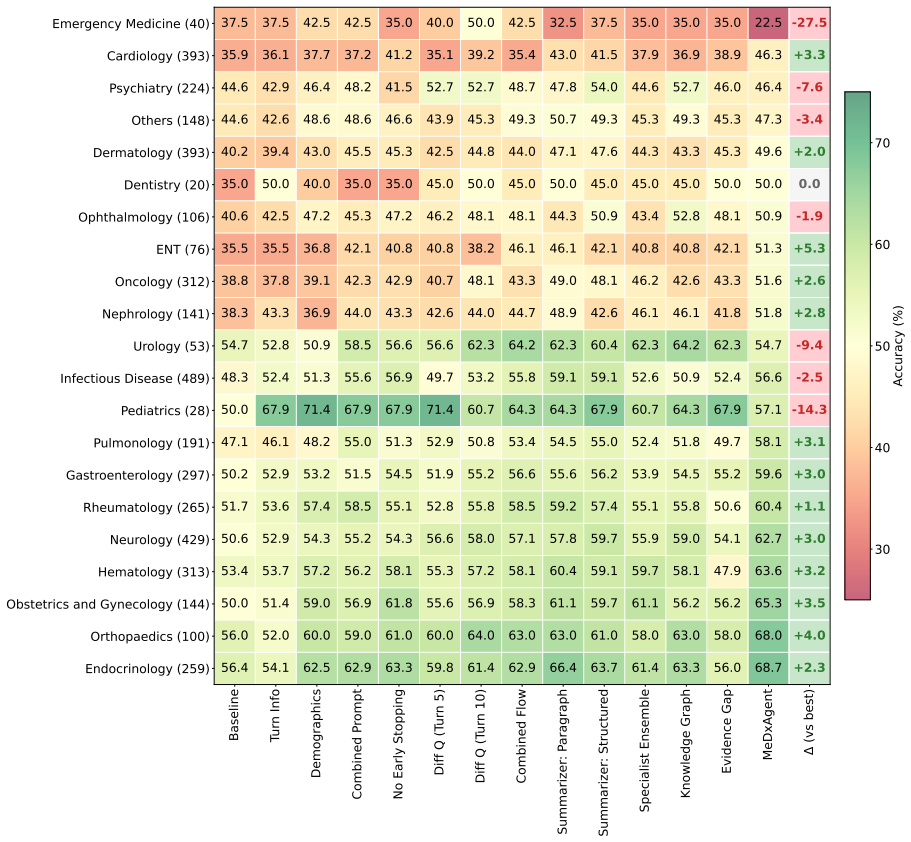
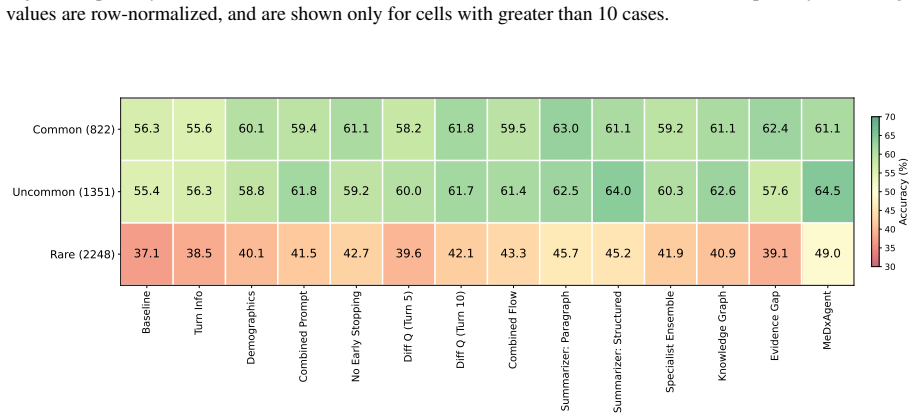
MeDxAgent is a multi-agent consultation system for interactive diagnosis. On MeDxBench it achieves a 10.3 percent accuracy gain over the baseline, closing 52.3 percent of the gap to a full-information oracle. Specific design choices—collecting demographics first, passing summarized dialogue for diagnosis, and feeding candidate diagnoses for targeted questioning—improve accuracy when combined and mirror how physicians reason.
What carries the argument
Multi-agent consultation system that coordinates prompt-level, flow-level, and agent-level choices to support sequential hypothesis refinement through targeted questioning.
If this is right
- Combining the three design choices produces accuracy gains that none of them achieves alone.
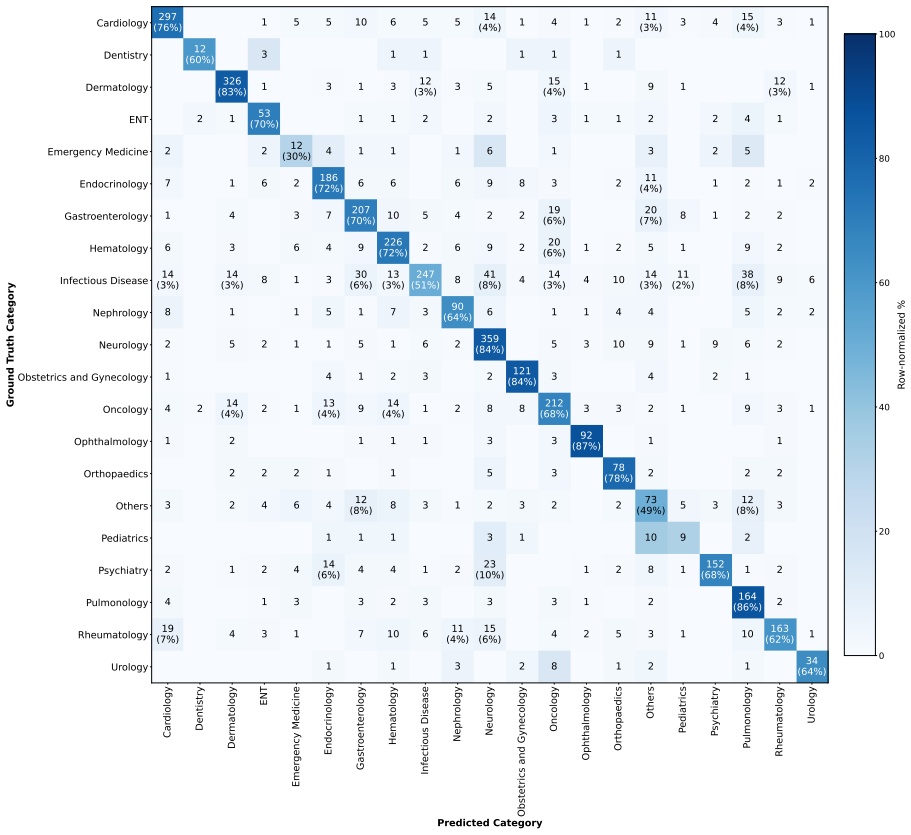
- The system works across 20 medical specialties in the benchmark.
- Summarized dialogue and candidate-diagnosis feedback reduce the performance gap to full-information systems.
- Releasing the benchmark and code allows direct comparison of future interactive diagnosis methods.
Where Pith is reading between the lines
- The same multi-agent structure could be tested on other sequential decision tasks such as legal case building or technical troubleshooting.
- Future work could replace the accuracy metric with measures of how well the questions reduce patient uncertainty or match expert questioning patterns.
- If the gains hold in live settings, the approach would shift medical AI evaluation from static question sets to recorded doctor-patient dialogues.
Load-bearing premise
The 4421 cases and accuracy metric in MeDxBench represent the interactive open-ended nature of real clinical diagnosis and the measured gains will translate outside the benchmark.
What would settle it
A follow-up test on new cases drawn from actual clinic records that shows the accuracy advantage of MeDxAgent over the baseline disappears or reverses under the same metric.
Figures


read the original abstract
Large language models (LLMs) are increasingly used for health-related decision support. Yet most evaluations treat diagnosis as a single-shot task with complete information provided upfront, often as a multiple-choice selection. This diverges from clinical practice, where diagnosis is interactive and open-ended, involving sequential hypothesis refinement through targeted questioning. We address this gap. We build MeDxBench, a large-scale benchmark of 4,421 clinical cases across 20 specialties. We further propose MeDxAgent, a multi-agent consultation system for interactive diagnosis, and systematically study its prompt-, flow- and agent-level design choices. MeDxAgent achieves a 10.3% accuracy gain over the baseline on MeDxBench, closing 52.3% of the gap to a full-information oracle. We find that specific design choices: collecting demographics first, passing summarized dialogue for diagnosis, and feeding candidate diagnoses for targeted questioning, improve accuracy, mirroring how physicians reason, though their effect emerges fully only in combination. Code and dataset will be released upon publication.
Editorial analysis
A structured set of objections, weighed in public.
Referee Report
Summary. The paper introduces MeDxBench, a benchmark of 4,421 clinical cases across 20 specialties for evaluating interactive, open-ended medical diagnosis, and proposes MeDxAgent, a multi-agent consultation framework. It reports that MeDxAgent achieves a 10.3% accuracy gain over a baseline on this benchmark, closing 52.3% of the gap to a full-information oracle, and identifies specific design choices (demographics first, summarized dialogue, candidate diagnoses for questioning) that improve performance when combined.
Significance. If the benchmark construction and evaluation protocol validly capture sequential hypothesis refinement and the reported gains are robust to case sourcing and metric definition, the work would supply a useful empirical testbed and design insights for multi-agent LLM systems in medicine, directly addressing the mismatch between single-shot LLM evaluations and clinical practice.
major comments (2)
- [MeDxBench construction] MeDxBench construction section: the manuscript must demonstrate that the 4,421 cases require targeted information-seeking (i.e., key data are absent until elicited by questions) rather than being solvable from static records; without such validation the 10.3% gain and 52.3% gap-closure claim does not establish progress on the stated interactive-diagnosis gap.
- [Evaluation protocol] Evaluation protocol and accuracy metric: the paper should report whether the metric penalizes inefficient or irrelevant questioning or scores only the final diagnosis; if the latter, the measured improvement may not reflect genuine sequential refinement.
minor comments (2)
- The statement that code and dataset will be released should be accompanied by licensing and de-identification details given the medical nature of the data.
- Figure captions and table headers should explicitly state the number of runs and statistical tests used for the reported accuracy figures.
Simulated Author's Rebuttal
We thank the referee for the constructive comments. We address each major point below and indicate where revisions will be made to strengthen the manuscript.
read point-by-point responses
-
Referee: [MeDxBench construction] MeDxBench construction section: the manuscript must demonstrate that the 4,421 cases require targeted information-seeking (i.e., key data are absent until elicited by questions) rather than being solvable from static records; without such validation the 10.3% gain and 52.3% gap-closure claim does not establish progress on the stated interactive-diagnosis gap.
Authors: We agree that explicit validation is needed to confirm the cases require interactive elicitation. MeDxBench was derived from clinical scenarios in which initial static records are insufficient for accurate diagnosis, necessitating targeted questions. To address the concern directly, we will add an analysis in the revised manuscript that compares oracle performance on static records alone versus with interactive access, quantifying how many cases cannot be solved without additional information-seeking. This will substantiate the interactive nature of the benchmark and the reported gains. revision: yes
-
Referee: [Evaluation protocol] Evaluation protocol and accuracy metric: the paper should report whether the metric penalizes inefficient or irrelevant questioning or scores only the final diagnosis; if the latter, the measured improvement may not reflect genuine sequential refinement.
Authors: The reported accuracy metric scores only the correctness of the final diagnosis produced after the full interaction sequence. It does not penalize the number or relevance of questions asked. We will revise the evaluation protocol section to state this explicitly. We will also add secondary analyses (e.g., average questions per case, correlation between question quality and accuracy) to better illustrate sequential refinement, while retaining final-diagnosis accuracy as the primary metric given the clinical emphasis on diagnostic outcome. revision: partial
Circularity Check
No circularity: purely empirical benchmark evaluation
full rationale
The paper constructs MeDxBench (4,421 cases) and evaluates MeDxAgent via direct accuracy measurements against a baseline and oracle. No equations, fitted parameters, self-referential quantities, or derivation chains exist. Claims rest on reported performance deltas (10.3% gain, 52.3% gap closure) rather than any reduction to inputs by construction. Self-citations, if present, are irrelevant as no load-bearing uniqueness theorems or ansatzes are invoked. This is a standard empirical report with independent content.
Axiom & Free-Parameter Ledger
Forward citations
Cited by 2 Pith papers
-
MedBench v5: A Dynamic, Process-Oriented, and Hallucination-Aware Benchmark for Clinical Multimodal Models
MedBench v5 is a new dynamic benchmark framework for clinical multimodal models that adds process auditing, factorized stressors, and hallucination propagation tracking across 63 tasks.
-
MedBench v5: A Dynamic, Process-Oriented, and Hallucination-Aware Benchmark for Clinical Multimodal Models
MedBench v5 is a dynamic benchmark with process auditing, information stressors, and hallucination monitoring for clinical multimodal models across 63 tasks.
Reference graph
Works this paper leans on
-
[1]
arXiv preprint arXiv:2503.13856v1 , year=
Holistic evaluation of large language models for medical tasks with medhelm.Nature Medicine, 32(3):943–951. Judith L. Bowen. 2006. Educational strategies to pro- mote clinical diagnostic reasoning.New England Journal of Medicine, 355(21):2217–2225. Ruey-Wen Chang, Georges Bordage, and Kathleen J. Connell. 1998. The importance of early problem representati...
-
[2]
It’s about time: The temporal and modal dynamics of copilot usage.Preprint, arXiv:2512.11879. Beatriz Costa-Gomes, Pavel Tolmachev, Eloise Taysom, Viknesh Sounderajah, Hannah Richardson, Philipp Schoenegger, Xiaoxuan Liu, Matthew M. Nour, Seth Spielman, Samuel F. Way, Yash Shah, Michael Bhaskar, Harsha Nori, Christopher Kelly, Peter Hames, Bay Gross, Must...
-
[3]
arXiv preprint arXiv:2405.02957 , year=
Ddo: Dual-decision optimization for llm- based medical consultation via multi-agent collab- oration. InProceedings of the 2025 Conference on Empirical Methods in Natural Language Processing, pages 26380–26397. Di Jin, Eileen Pan, Nassim Oufattole, Wei-Hung Weng, Hanyi Fang, and Peter Szolovits. 2021. What disease does this patient have? a large-scale open...
-
[4]
arXiv preprint arXiv:2506.22405 , year=
Sequential diagnosis with language models. Preprint, arXiv:2506.22405. Ankit Pal, Logesh Kumar Umapathi, and Malaikannan Sankarasubbu. 2022. Medmcqa: A large-scale multi- subject multi-choice dataset for medical domain ques- tion answering. InProceedings of the Conference on Health, Inference, and Learning, volume 174 of Proceedings of Machine Learning Re...
-
[5]
Universal abstraction: Harnessing frontier models to structure real-world data at scale.Preprint, arXiv:2502.00943. Yakun Zhu, Zhongzhen Huang, Linjie Mu, Yutong Huang, Wei Nie, Jiaji Liu, Shaoting Zhang, Pengfei Liu, and Xiaofan Zhang. 2025. Diagnosisarena: Benchmarking diagnostic reasoning for large lan- guage models.Preprint, arXiv:2505.14107. Appendix...
-
[6]
Chronic Obstructive Pulmonary Disease (COPD) (55%) – age and potential expo- sure to smoking or environmental pollutants in a confined setting
-
[7]
Hypertension (50%) – common in older males, especially in stressful environments like incarceration
-
[8]
Turn 2 Doctor:What is your chief complaint or main symptom that brought you to seek medical atten- tion? Patient:I have abdominal pain and jaundice
Type 2 Diabetes Mellitus (50%) – age and lifestyle factors associated with incarcera- tion. Turn 2 Doctor:What is your chief complaint or main symptom that brought you to seek medical atten- tion? Patient:I have abdominal pain and jaundice. Paragraph Summary:The patient is a 59-year- old male who is incarcerated. He reports abdom- inal pain and jaundice a...
-
[9]
Acute viral hepatitis (e.g., Hepatitis B or C) (85%) – hallmark abdominal pain + jaun- dice; incarcerated patient with bloodborne- pathogen exposure risk
-
[10]
Cholelithiasis with choledocholithiasis (70%) – bile duct obstruction from gallstones in an older male
-
[11]
Pancreatic cancer (55%) – jaundice + ab- dominal pain from possible bile duct ob- struction. Evidence Gap:Vital signs; pain characterisation; associated symptoms (nausea, vomiting, weight loss, fever, bowel habits); past medical history; current medications; allergies; family/social his- tory; physical exam; basic labs and imaging. Turn 3 Doctor:Can you d...
-
[12]
IgG4-related sclerosing cholangitis (85%) – history of IgG4-associated hepatic IPT and autoimmune pancreatitis combined with jaundice and abdominal pain
-
[13]
Pancreatic cancer (70%) – history of autoimmune pancreatitis raises concern; chronic inflammation a risk factor
-
[14]
HIV-associated cholangiopathy (55%) – HIV status with jaundice; less likely than IgG4-related disease given specific history. Evidence Gap:Detailed vital signs; specific ab- dominal pain characterisation; associated symp- toms; current medication dosing; allergies; fam- ily/social history; physical exam; basic labs and imaging. Turn 7 Doctor:Do you have a...
-
[15]
IgG4-related sclerosing cholangitis (85%) – history of IgG4-associated hepatic IPT and autoimmune pancreatitis strongly associ- ated with IgG4-RSC; jaundice and abdomi- nal pain align
-
[16]
Pancreatic cancer (70%) – history of au- toimmune pancreatitis and jaundice raise concern for pancreatic malignancy; chronic pancreatitis is a risk factor
-
[17]
Chronic hepatitis with cirrhosis (55%) – his- tory of hepatic pseudotumor and jaundice could indicate underlying chronic liver dis- ease; less likely but worth considering. Evidence Gap:Exact current vital signs; de- tailed abdominal pain characterisation; associ- ated symptoms (nausea, vomiting, weight loss, fever, bowel changes); complete medication lis...
-
[18]
IgG4-related sclerosing cholangitis (95%) – jaundice, cholestatic LFTs, elevated IgG4, mural thickening at hepatic hilum, biopsy with IgG4+ plasma cells and obliterative phlebitis; multiple specialists agree
-
[19]
Autoimmune pancreatitis (80%) – history + elevated IgG4 suggest recurrence or asso- ciated involvement
-
[20]
KB Diagnosis (top 3):
Cholangiocarcinoma (65%) – mass-like hi- lar thickening; malignancy cannot be fully excluded without further investigation. KB Diagnosis (top 3):
-
[23]
IgG4-associated hepatic inflammatory pseudotumor Selector (top 3):
-
[24]
IgG4-related sclerosing cholangitis (90%) – jaundice, cholestatic LFTs, elevated IgG4, mural thickening, biopsy with IgG4+ plasma cells and obliterative phlebitis
-
[25]
Autoimmune pancreatitis (75%) – history + elevated IgG4 suggest recurrence; primary findings still favor cholangitis
-
[26]
Cholangiocarcinoma (60%) – mass-like hi- lar thickening; biopsy favors IgG4-RD but malignancy not fully excluded. General Evidence Gap:Detailed vital signs; symptom timeline (onset, progression, triggers, relieving factors); family history of autoimmune or hepatic conditions; recent changes/adherence to the prednisone taper. Diagnosis-Specific Evidence Ga...
-
[27]
IgG4-related sclerosing cholangitis (95%) – jaundice, cholestatic LFTs, elevated IgG4, biopsy with IgG4+ plasma cells and oblit- erative phlebitis; agreed by General Physi- cian and Gastroenterology
-
[28]
Autoimmune pancreatitis (85%) – history + elevated IgG4 + systemic involvement; supported by General Physician, Gastroen- terology, Rheumatology
-
[29]
KB Diagnosis (top 3):
IgG4-related hepatic inflammatory pseu- dotumor(80%) – mass-like hilar lesion + biopsy; aligns with patient history and IgG4- RD spectrum. KB Diagnosis (top 3):
-
[30]
IgG4-associated cholangitis
-
[32]
IgG4-related hepatic inflammatory pseu- dotumor Selector (top 3):
-
[33]
IgG4-related sclerosing cholangitis (90%) – elevated IgG4, cholestatic LFTs, jaundice, biopsy with IgG4+ plasma cells and obliter- ative phlebitis
-
[34]
IgG4-related hepatic inflammatory pseu- dotumor(80%) – mass-like hilar lesion + dense lymphoplasmacytic infiltration + IgG4+ plasma cells
-
[35]
Autoimmune pancreatitis (70%) – history + elevated IgG4 + systemic involvement as part of IgG4-RD spectrum. General Evidence Gap:Vital signs; symptom timeline (onset, exacerbating/relieving factors); exact prednisone dosing and other medications; family history of autoimmune or IgG4-related dis- eases. Diagnosis-Specific Evidence Gap: • IgG4-related scler...
-
[36]
IgG4-related sclerosing cholangitis (95%) – elevated IgG4, cholestatic LFTs, biopsy with IgG4+ plasma cells and obliterative phlebitis; multiple specialists agree
-
[37]
Klatskin tumor (cholangiocarcinoma) (70%) – CT findings of mass-like mural thickening at hepatic hilum; biopsy did not confirm malignancy, but cannot fully exclude
-
[38]
KB Diagnosis (top 3):
Autoimmune pancreatitis-associated cholangitis (60%) – history of autoimmune pancreatitis and IgG4-related disease. KB Diagnosis (top 3):
-
[39]
IgG4-related sclerosing cholangitis
-
[40]
Autoimmune pancreatitis
-
[41]
Klatskin tumor (hilar cholangiocarcinoma) Selector (top 3):
-
[42]
IgG4-related sclerosing cholangitis (90%) – elevated IgG4, IgG4+ plasma cells, obliter- ative phlebitis, mural thickening at hepatic hilum
-
[43]
Klatskin tumor (hilar cholangiocarcinoma) (65%) – CT concern for malignancy; biopsy negative. 26
-
[44]
Autoimmune pancreatitis-associated cholangitis (55%) – history + IgG4-RD; evidence more strongly supports primary cholangitis. General Evidence Gap:Vital signs; symptom timeline and triggers for abdominal pain and jaun- dice; current medication adherence and recent changes; family history of liver, pancreatic, au- toimmune, or malignant disease. Diagnosis...
-
[45]
IgG4-related sclerosing cholangitis (95%) – jaundice, cholestatic LFTs, elevated IgG4, biopsy with IgG4+ plasma cells and oblit- erative phlebitis; agreed by General Physi- cian, Gastroenterology, Rheumatology
-
[46]
IgG4-associated hepatic inflammatory pseudotumor(85%) – mass-like hilar le- sion + biopsy + elevated IgG4; agreed by General Physician and Gastroenterology
-
[47]
KB Diagnosis (top 3):
Autoimmune pancreatitis with hepatic in- volvement (75%) – history + current hepatic findings as systemic IgG4-RD manifesta- tion. KB Diagnosis (top 3):
-
[48]
IgG4-associated hepatic inflammatory pseudotumor
-
[49]
Autoimmune pancreatitis Selector (top 3):
-
[50]
IgG4-associated hepatic inflammatory pseudotumor (90%)– elevated IgG4, IgG4+ plasma cells, mass-like hilar lesion; consistent with history of IgG4-related dis- ease
-
[51]
IgG4-related sclerosing cholangitis (80%) – cholestatic LFT pattern, jaundice, oblit- erative phlebitis and IgG4+ plasma cells; known IgG4-RD manifestation
-
[52]
Cholangiocarcinoma (60%) – imaging con- cern for Klatskin tumor; biopsy negative for malignancy but lower-confidence differen- tial. General Evidence Gap:Vital signs; progression, duration, and triggers of abdominal pain and jaun- dice; current medications and adherence; family history of liver or autoimmune disease. Diagnosis-Specific Evidence Gap: • IgG...
discussion (0)
Sign in with ORCID, Apple, or X to comment. Anyone can read and Pith papers without signing in.