The Attention-Aware Pipeline: Design Tensions from Making Attention Visible in XR
Pith reviewed 2026-06-28 08:30 UTC · model grok-4.3
The pith
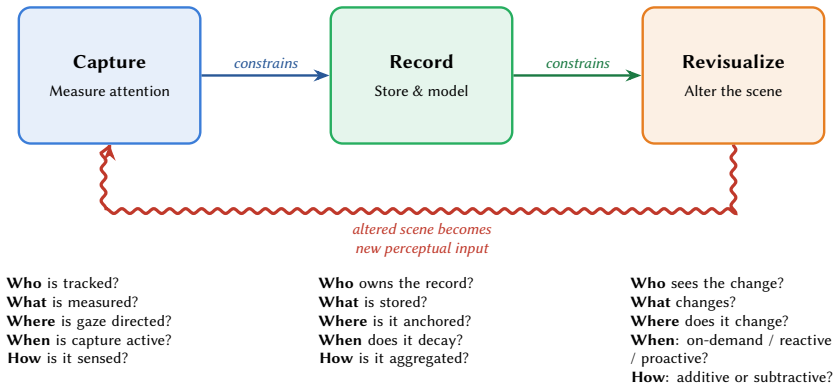
Making gaze visible in XR creates a feedback loop where visual responses alter what users attend to next and generate stage-specific design tensions.
A machine-rendered reading of the paper's core claim, the machinery that carries it, and where it could break.
Core claim
The Attention-Aware Pipeline (Capture, Record, Revisualize) generates design tensions whose form depends on each stage's configuration because the system's visual response alters what users attend to next, triggering further responses; tracing the pipeline through mirror, medium, and mediator systems reveals tensions that motivate subtractive diminished-reality intervention.
What carries the argument
The Attention-Aware Pipeline (Capture, Record, Revisualize) whose closed feedback loop turns each stage's output into the next stage's input.
If this is right
- Each choice of revisualization technique directly reshapes subsequent gaze patterns and must be evaluated for its effect on the loop.
- Casting attention as mirror, medium, or mediator surfaces distinct tensions that follow from the same feedback structure.
- Subtractive intervention through diminished reality offers one concrete way to reduce tunneling without adding new visual elements.
- Formative eye-tracking studies of shared tasks can surface disconnection problems before full system deployment.
Where Pith is reading between the lines
- The same loop logic could be used to anticipate attention problems in non-musical XR collaboration such as remote repair or education.
- Designers of any gaze-visible interface may need explicit tests for whether the revisualization itself narrows the user's field of view.
- The pipeline framing suggests that attention-aware systems should be evaluated on the stability of their feedback loop rather than on isolated accuracy metrics.
Load-bearing premise
The three-stage pipeline and its predicted tensions accurately capture the causal dynamics of attention feedback in real XR use rather than serving only as a post-hoc lens on observed behaviors.
What would settle it
A controlled XR study implementing the full pipeline in a new collaborative task that produces no measurable attentional tunneling, disconnection, or stage-specific tensions matching the three reported forms.
Figures
read the original abstract
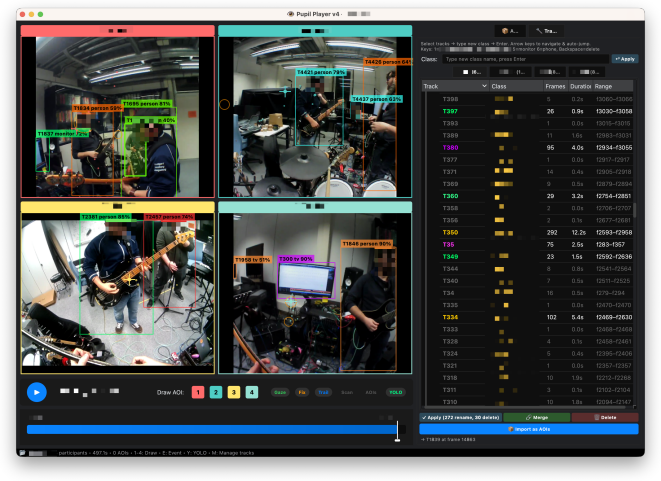
Where people look during shared activity carries coordination cues that speech and gesture cannot replace, but these patterns remain invisible to participants. XR headsets make gaze available as real-time input, yet few systems feed it back visually. We frame our work using the Attention-Aware Pipeline (Capture, Record, Revisualize), whose feedback loop means the systems visual response alters what users attend to next, triggering further responses. This generates design tensions whose form depends on each stages configuration. We trace the pipeline through three systems casting attention as a mirror (reflecting gaze history), a medium (sharing it across collaborators), and a mediator (intervening through diminished reality). Each encountered a tension the loop predicted, motivating the next. A formative eye-tracking study of four musicians surfaced attentional tunneling and near-total disconnection, confirming the need for intervention. We present these tensions and a next step: testing whether subtractive intervention reduces tunneling for a single sight-reader.
Editorial analysis
A structured set of objections, weighed in public.
Referee Report
Summary. The paper introduces the Attention-Aware Pipeline (Capture, Record, Revisualize) as a framework whose feedback loop causes visual responses to alter subsequent user attention, thereby generating design tensions whose form depends on each stage's configuration. It illustrates the pipeline by tracing three XR prototypes that cast attention as a mirror (reflecting gaze history), a medium (sharing across collaborators), and a mediator (intervening via diminished reality), each encountering a tension the loop predicted. A formative eye-tracking study with four musicians observed attentional tunneling and near-total disconnection, confirming the need for intervention and motivating a next step of testing subtractive intervention for sight-readers.
Significance. If the pipeline holds as a model of causal dynamics, it supplies a structured lens for anticipating configuration-dependent issues when visualizing attention in collaborative XR, with potential to guide designs that mitigate tunneling or disconnection. The work's strengths lie in its clear three-stage staging, the logical progression across the three prototypes, and the explicit identification of tensions arising from the feedback loop; these elements provide a reusable organizing device even if the predictive claims require further grounding.
major comments (3)
- [Abstract and Pipeline introduction] Abstract and the section introducing the Attention-Aware Pipeline: the claim that the feedback loop 'generates design tensions whose form depends on each stage's configuration' is presented as both descriptive and predictive, yet the only evidence consists of post-hoc tracing of three systems developed inside the same framing plus a formative study; no a priori predictions, controlled variation of stage parameters, or independent measures of attention change (separate from the visualization) are reported, so the loop risks functioning as a retrospective lens rather than a generator of falsifiable dynamics.
- [Formative eye-tracking study] Formative eye-tracking study section: the study with n=4 musicians is cited as confirming the need for intervention after observing tunneling and disconnection, but it supplies no quantitative results, error analysis, manipulation of Capture/Record/Revisualize parameters, or test of whether the observed behaviors were produced by the loop itself rather than other factors; this limits its support for the central predictive claim.
- [Tracing the three systems] Section tracing the three systems (mirror/medium/mediator): each is said to have 'encountered a tension the loop predicted,' but the manuscript does not specify how those tensions were anticipated before prototype development or how differing stage configurations were shown to produce distinct tension forms, leaving the configuration-dependence claim without direct empirical mapping.
minor comments (2)
- [Abstract and study description] The abstract and study description should clarify the exact quantitative or qualitative measures used to identify 'near-total disconnection' and 'attentional tunneling' so readers can assess the strength of the observational data.
- [Pipeline and prototype sections] Notation for the three stages (Capture, Record, Revisualize) is introduced without an accompanying diagram or table that explicitly maps each prototype's implementation choices onto the stages; adding such a mapping would improve traceability of the claimed configuration-dependent tensions.
Simulated Author's Rebuttal
We thank the referee for the detailed and constructive feedback. The work is exploratory and uses the Attention-Aware Pipeline as a conceptual organizing device derived from design practice rather than a validated predictive model. We address each major comment below with planned revisions to clarify scope and claims.
read point-by-point responses
-
Referee: The claim that the feedback loop 'generates design tensions whose form depends on each stage's configuration' is presented as both descriptive and predictive, yet the only evidence consists of post-hoc tracing of three systems developed inside the same framing plus a formative study; no a priori predictions, controlled variation of stage parameters, or independent measures of attention change are reported.
Authors: We agree the current phrasing risks implying predictive power. The pipeline was developed iteratively from our design process to surface and organize observed tensions; the three prototypes were not constructed to test a priori predictions from the framework. We will revise the abstract and pipeline introduction to frame it explicitly as a descriptive and generative lens for anticipating configuration-dependent issues in future XR attention systems, removing any suggestion of falsifiable dynamics without further empirical work. revision: yes
-
Referee: The study with n=4 musicians is cited as confirming the need for intervention after observing tunneling and disconnection, but it supplies no quantitative results, error analysis, manipulation of Capture/Record/Revisualize parameters, or test of whether the observed behaviors were produced by the loop itself.
Authors: The study is explicitly formative and was conducted to surface real attentional patterns in a music context that motivated our intervention designs. It does not claim to validate the pipeline's causal claims or manipulate its stages. We will expand the section to state its limitations and purpose more explicitly. No quantitative data or parameter manipulations exist to add. revision: partial
-
Referee: Each system is said to have 'encountered a tension the loop predicted,' but the manuscript does not specify how those tensions were anticipated before prototype development or how differing stage configurations were shown to produce distinct tension forms.
Authors: The tracing section is retrospective, documenting how the pipeline helped articulate tensions that emerged during sequential prototype development. No controlled mapping of configurations to tension forms was performed. We will revise the section to clarify the post-hoc nature of the analysis and remove language suggesting a priori prediction, while retaining the pipeline's value as a reusable organizing device. revision: yes
Circularity Check
No significant circularity; pipeline is a retrospective organizing lens on prototypes
full rationale
The manuscript introduces the Attention-Aware Pipeline (Capture-Record-Revisualize) as a framing device whose feedback loop is posited to generate configuration-dependent design tensions. Three prototype systems are then traced through this framing, with the text noting that each 'encountered a tension the loop predicted.' However, no equations, parameter fits, or self-citations are present that would reduce any claimed prediction to its own inputs by construction. The pipeline functions as a post-hoc conceptual organizer for observed prototype behaviors rather than a deductive chain whose outputs are definitionally equivalent to its premises. The small formative study (n=4) is presented separately as motivation for intervention and does not serve as a fitted input renamed as prediction. No load-bearing self-citation or uniqueness theorem is invoked. The derivation chain therefore remains self-contained as design research and does not meet the criteria for circularity.
Axiom & Free-Parameter Ledger
axioms (2)
- domain assumption Gaze patterns during shared activity carry coordination cues that speech and gesture cannot replace.
- domain assumption XR headsets make gaze available as real-time input that can be fed back visually.
invented entities (1)
-
Attention-Aware Pipeline (Capture, Record, Revisualize)
no independent evidence
Reference graph
Works this paper leans on
-
[1]
A. Srinivasan, J. Ellemose, P. W. S. Butcher, P. D. Ritsos, N. Elmqvist, Attention-aware visualization: Tracking and responding to user perception over time, IEEE Transactions on Visualization and Computer Graphics 31 (2025) 1017–1027. doi:10.1109/TVCG.2024.3456300
-
[2]
A. Srinivasan, N. Elmqvist, HeedVision: Attention awareness in collaborative immersive analytics environments, arXiv preprint arXiv:2505.07069 (2025)
Pith/arXiv arXiv 2025
-
[3]
S. Mori, S. Ikeda, H. Saito, A survey of diminished reality: Techniques for visually concealing, elim- inating, and seeing through real objects, IPSJ Transactions on Computer Vision and Applications 9 (2017) 1–14. doi:10.1186/s41074-017-0028-1
-
[4]
S. Shin, A. Batch, P. W. S. Butcher, P. D. Ritsos, N. Elmqvist, The Reality of the Situation: A Survey of Situated Analytics, IEEE TVCG (2023). doi:10.1109/TVCG.2023.3285546, to appear
-
[5]
K. Lebeck, K. Ruth, T. Kohno, F. Roesner, Towards security and privacy for multi-user augmented reality: Foundations with end users, in: Proc. IEEE Symposium on Security and Privacy, IEEE, 2018, pp. 392–408. doi:10.1109/SP.2018.00051
-
[6]
J. A. Easterbrook, The effect of emotion on cue utilization and the organization of behavior, Psychological Review 66 (1959) 183–201
1959
-
[7]
W. C. Hill, J. D. Hollan, D. Wroblewski, T. McCandless, Edit wear and read wear, in: Proc. ACM CHI, ACM, New York, NY, USA, 1992, pp. 3–9. doi:10.1145/142750.142751
-
[8]
L. E. Matzen, M. J. Haass, K. M. Divis, Z. Wang, A. T. Wilson, Data visualization saliency model: A tool for evaluating abstract data visualizations, IEEE TVCG 24 (2018) 563–573. doi: 10.1109/ TVCG.2017.2743939
arXiv 2018
-
[9]
B. Steichen, G. Carenini, C. Conati, User-adaptive information visualization: using eye gaze data to infer visualization tasks and user cognitive abilities, in: Proceedings of the 2013 International Conference on Intelligent User Interfaces, IUI ’13, ACM, New York, NY, USA, 2013, p. 317–328. doi:10.1145/2449396.2449439
-
[10]
P.-P. Grassé, La reconstruction du nid et les coordinations interindividuelles chez Bellicositermes natalensis et Cubitermes sp. la théorie de la stigmergie: essai d’interprétation du comportement des termites constructeurs, Insectes Sociaux 6 (1959) 41–80. doi:10.1007/BF02223791
-
[11]
J. Herling, W. Broll, Advanced self-contained object removal for realizing real-time diminished reality in unconstrained environments, in: Proc. IEEE ISMAR, IEEE, 2010, pp. 207–212. doi: 10. 1109/ISMAR.2010.5643572
arXiv 2010
-
[12]
Yolov8: A novel object detection algorithm with enhanced performance and robustness
R. Varghese, S. M., Yolov8: A novel object detection algorithm with enhanced performance and robustness, in: 2024 International Conference on Advances in Data Engineering and Intelligent Computing Systems (ADICS), 2024, pp. 1–6. doi:10.1109/ADICS58448.2024.10533619
-
[13]
N. Sato, et al., Gaze transition entropy as a measure of attention allocation in a dynamic workspace involving automation, Scientific Reports 14 (2024) 74244. doi: 10.1038/s41598-024-74244-4
-
[14]
G. R. Dirkin, Cognitive tunneling: Use of visual information under stress, Perceptual and Motor Skills 56 (1983) 191–198. doi:10.2466/pms.1983.56.1.191
-
[15]
R. Paprocki, A. Lenskiy, What does eye-blink rate variability dynamics tell us about cognitive performance?, Frontiers in Human Neuroscience 11 (2017) 620. doi: 10.3389/fnhum.2017. 00620
-
[16]
R. Kopiez, J. I. Lee, Towards a general model of skills involved in sight reading music, Music Education Research 10 (2008) 41–62. doi:10.1080/14613800701871363
-
[17]
J. Madell, S. Hébert, Eye movements and music reading: Where do we look next?, Music Perception 26 (2008) 157–170. doi:10.1525/mp.2008.26.2.157
discussion (0)
Sign in with ORCID, Apple, or X to comment. Anyone can read and Pith papers without signing in.