Competitive Information Design in Sequential Search
Pith reviewed 2026-06-28 08:05 UTC · model grok-4.3
The pith
Senders competing via information disclosure to a sequentially searching consumer have equilibria when priors lack atoms, with symmetric equilibria characterized for monotone densities.
A machine-rendered reading of the paper's core claim, the machinery that carries it, and where it could break.
Core claim
We establish the existence of an equilibrium in the game among senders when the prior distributions have no mass; we also illustrate that such equilibria may exhibit intricate behaviors. Finally, we meticulously characterize symmetric equilibria played by the senders for cases when the prior distributions have monotone increasing densities, while offering economic intuitions behind the insightful equilibrium structure.
What carries the argument
Duality arguments that certify whether a sender's information strategy is a best response to the others, applied to the game whose receiver follows Weitzman's Index Algorithm.
If this is right
- An equilibrium among the senders is guaranteed to exist whenever the priors have no atoms.
- Equilibria in this competitive setting can display intricate, non-monotone disclosure patterns.
- When priors have monotone increasing densities, the symmetric equilibria admit an explicit characterization.
- The equilibrium structure admits direct economic interpretations in terms of the senders' incentives to control the receiver's search order and stopping rule.
Where Pith is reading between the lines
- The duality verification method supplies a practical way to compute or test candidate equilibria numerically even when closed-form solutions are unavailable.
- The existence result suggests that atomless priors are a natural modeling assumption for guaranteeing well-behaved competitive disclosure games.
- The characterization under monotone densities may be used to compare welfare or search efficiency between monopoly and competitive advertising markets.
Load-bearing premise
The prior distributions have no atoms, or else have monotone increasing densities.
What would settle it
An explicit example with atomless priors in which no equilibrium exists among the senders, or with monotone densities in which the symmetric equilibrium fails to match the characterized structure.
Figures


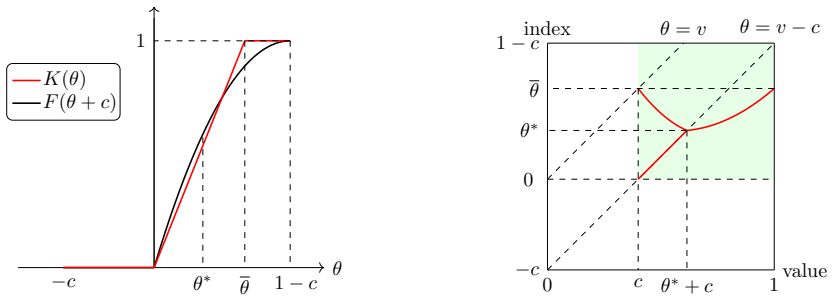

read the original abstract
Advertisements often strategically disclose information to consumers who make decisions on further information acquisition and eventual purchase. Anderson and Renault (2006) model this problem using an information design framework, where the advertiser acts as a sender and the consumer as a receiver. We extend this model to a competitive setting with horizontally differentiated senders competing for a unit-demand receiver. Under costly inspection, the receiver's optimal sequential search action is given by Weitzman's Index Algorithm. We give a method, based on duality arguments, to verify whether a sender's given information strategy constitutes a best response against his competitors (other senders). We establish the existence of an equilibrium in the game among senders when the prior distributions have no mass; we also illustrate that such equilibria may exhibit intricate behaviors. Finally, we meticulously characterize symmetric equilibria played by the senders for cases when the prior distributions have monotone increasing densities, while offering economic intuitions behind the insightful equilibrium structure.
Editorial analysis
A structured set of objections, weighed in public.
Referee Report
Summary. The paper extends the Anderson-Renault (2006) information-design model of advertising to a competitive setting with multiple horizontally differentiated senders and a unit-demand receiver who incurs inspection costs and follows Weitzman's index algorithm for sequential search. It supplies a duality-based test for whether a given information strategy is a best response, proves existence of (possibly asymmetric) equilibria when priors are atomless, exhibits examples of intricate equilibrium behavior, and fully characterizes symmetric equilibria when the priors have monotone-increasing densities, supplying economic interpretations of the resulting structure.
Significance. If the duality argument correctly handles the joint determination of indices and search order, the paper would supply the first general existence result and the first explicit symmetric-equilibrium characterization for competitive information design under sequential search. These tools could be used to analyze advertising competition, platform design, and consumer search markets; the monotone-density case yields clean comparative-statics predictions that are directly testable.
major comments (2)
- [existence proof] Existence argument (abstract and § on equilibrium existence): the claimed duality method for verifying unilateral best responses is stated for a fixed search order and fixed continuation values. A unilateral change in one sender's distribution alters every Weitzman index, which can reorder the search sequence and change the deviator's own continuation payoffs. The manuscript does not supply an explicit argument showing that the single-sender duality condition remains sufficient after the indices are recomputed at the new joint distribution; this interdependence must be addressed for the existence claim under atomless priors to be load-bearing.
- [symmetric equilibria] Symmetric-equilibrium characterization (monotone-density case): the paper asserts that the equilibrium information structures are fully characterized and economically intuitive, yet the abstract provides no indication of how the fixed-point interdependence among indices is resolved inside the symmetric construction. If the characterization relies on the same duality test, the same gap identified above applies directly to the main positive result.
minor comments (2)
- [introduction] The abstract invokes "standard duality arguments" without citing the precise reference or stating the exact form of the dual program used; a short paragraph in the introduction would clarify the technical starting point.
- [illustrations] No numerical example or figure is mentioned that would illustrate the "intricate behaviors" claimed for the general atomless case; adding one would help readers assess the practical relevance of the existence result.
Simulated Author's Rebuttal
We thank the referee for the careful and constructive report. The comments correctly identify that the current presentation of the duality argument is stated for a fixed search order, and we will revise the manuscript to supply the missing explicit argument showing robustness to re-computation of indices. We respond point by point below.
read point-by-point responses
-
Referee: [existence proof] Existence argument (abstract and § on equilibrium existence): the claimed duality method for verifying unilateral best responses is stated for a fixed search order and fixed continuation values. A unilateral change in one sender's distribution alters every Weitzman index, which can reorder the search sequence and change the deviator's own continuation payoffs. The manuscript does not supply an explicit argument showing that the single-sender duality condition remains sufficient after the indices are recomputed at the new joint distribution; this interdependence must be addressed for the existence claim under atomless priors to be load-bearing.
Authors: We agree that an explicit argument is required. In the revised manuscript we will add a new subsection after the duality lemma that establishes the following: under atomless priors, (i) the map from joint distributions to the vector of Weitzman indices is continuous in the weak topology, (ii) the set of unilateral deviations that induce a strict reordering has measure zero, and (iii) any candidate deviation that would reorder the sequence can be approximated by a nearby deviation that preserves the original order while yielding weakly lower payoff. Consequently the single-sender duality condition, once verified at the equilibrium continuation values, remains sufficient after re-computation. This will make the existence proof under atomless priors fully rigorous. revision: yes
-
Referee: [symmetric equilibria] Symmetric-equilibrium characterization (monotone-density case): the paper asserts that the equilibrium information structures are fully characterized and economically intuitive, yet the abstract provides no indication of how the fixed-point interdependence among indices is resolved inside the symmetric construction. If the characterization relies on the same duality test, the same gap identified above applies directly to the main positive result.
Authors: We acknowledge the need for an explicit resolution of the fixed-point interdependence in the symmetric case. The revised version will contain an additional paragraph in the symmetric-equilibria section that shows: under monotone-increasing densities the symmetric information structures induce identical indices for all senders, and any unilateral deviation that would alter the common index ordering yields a strictly lower payoff by the duality test (because the monotone-density assumption preserves the ordering for all distributions in a neighborhood of the equilibrium). This argument closes the gap for the main positive result without altering the economic interpretation already provided. revision: yes
Circularity Check
No circularity: derivation relies on external duality and Weitzman algorithm
full rationale
The paper applies standard duality arguments from Anderson and Renault (2006) and Weitzman's index algorithm to verify best responses and prove existence under atomless priors. No quoted equations or steps define a quantity in terms of itself, rename a fitted input as a prediction, or reduce the central claim to a self-citation chain. The interdependence of indices across senders is handled by the joint application of the external algorithm rather than by construction within the paper's own definitions. The derivation chain is therefore self-contained against external benchmarks.
Axiom & Free-Parameter Ledger
axioms (2)
- domain assumption The receiver follows Weitzman's Index Algorithm for optimal sequential search under costly inspection.
- domain assumption Senders play a Bayesian Nash equilibrium in which each chooses an information strategy to maximize payoff given rivals' strategies.
Reference graph
Works this paper leans on
-
[1]
Proceedings of the 2023 Annual ACM-SIAM Symposium on Discrete Algorithms (SODA) , pages=
Competitive information design for pandora's box , author=. Proceedings of the 2023 Annual ACM-SIAM Symposium on Discrete Algorithms (SODA) , pages=. 2023 , organization=
2023
-
[2]
American Economic Review , volume=
Advertising content , author=. American Economic Review , volume=. 2006 , publisher=
2006
-
[3]
1978 , publisher=
Optimal search for the best alternative , author=. 1978 , publisher=
1978
-
[4]
Journal of the European Economic Association , volume=
Ordered consumer search , author=. Journal of the European Economic Association , volume=. 2017 , publisher=
2017
-
[5]
American Economic Journal: Microeconomics , volume=
Grading standards and education quality , author=. American Economic Journal: Microeconomics , volume=. 2015 , publisher=
2015
-
[6]
Economic Theory , volume=
Limited capacity in project selection: Competition through evidence production , author=. Economic Theory , volume=. 2018 , publisher=
2018
-
[7]
arXiv preprint arXiv:1907.09255 , year=
Competing to Persuade a Rationally Inattentive Agent , author=. arXiv preprint arXiv:1907.09255 , year=
arXiv 1907
-
[8]
Games and Economic Behavior , volume=
Competitive information disclosure by multiple senders , author=. Games and Economic Behavior , volume=. 2020 , publisher=
2020
-
[9]
Economic Theory , volume=
Competitive disclosure of correlated information , author=. Economic Theory , volume=. 2021 , publisher=
2021
-
[10]
Emory University and University of Miami , year=
Competitive advertising and pricing , author=. Emory University and University of Miami , year=
-
[11]
American Economic Journal: Microeconomics , volume=
Reaping the informational surplus in Bayesian persuasion , author=. American Economic Journal: Microeconomics , volume=. 2022 , publisher=
2022
-
[12]
Economic Theory , volume=
Persuasion with ambiguous receiver preferences , author=. Economic Theory , volume=. 2024 , publisher=
2024
-
[13]
The Review of Economic Studies , volume=
Competition in persuasion , author=. The Review of Economic Studies , volume=. 2016 , publisher=
2016
-
[14]
Games and Economic Behavior , volume=
Bayesian persuasion with multiple senders and rich signal spaces , author=. Games and Economic Behavior , volume=. 2017 , publisher=
2017
-
[15]
arXiv preprint arXiv:2008.08517 , year=
Competing persuaders in zero-sum games , author=. arXiv preprint arXiv:2008.08517 , year=
arXiv 2008
-
[16]
International Conference on Machine Learning , pages=
Multi-Sender Persuasion: A Computational Perspective , author=. International Conference on Machine Learning , pages=. 2024 , organization=
2024
-
[17]
Theoretical Economics , volume=
Sequential persuasion , author=. Theoretical Economics , volume=. 2021 , publisher=
2021
-
[18]
American Economic Review , volume=
Consumer information and the limits to competition , author=. American Economic Review , volume=. 2022 , publisher=
2022
-
[19]
Games and Economic Behavior , volume=
Competitive information disclosure in random search markets , author=. Games and Economic Behavior , volume=. 2023 , publisher=
2023
-
[20]
Journal of Economic Theory , volume=
Information design for selling search goods and the effect of competition , author=. Journal of Economic Theory , volume=. 2023 , publisher=
2023
-
[21]
Journal of Political Economy , volume=
Attraction versus persuasion: Information provision in search markets , author=. Journal of Political Economy , volume=. 2023 , publisher=
2023
-
[22]
Proceedings of the 2019 ACM Conference on Economics and Computation , pages=
Pandora's problem with nonobligatory inspection , author=. Proceedings of the 2019 ACM Conference on Economics and Computation , pages=
2019
-
[23]
Proceedings of the 21st ACM Conference on Economics and Computation , pages=
Pandora's box problem with order constraints , author=. Proceedings of the 21st ACM Conference on Economics and Computation , pages=
-
[24]
2020 IEEE 61st Annual Symposium on Foundations of Computer Science (FOCS) , pages=
Pandora's box with correlations: Learning and approximation , author=. 2020 IEEE 61st Annual Symposium on Foundations of Computer Science (FOCS) , pages=. 2020 , organization=
2020
-
[25]
Journal of Economic Theory , volume=
Whether or not to open Pandora's box , author=. Journal of Economic Theory , volume=. 2018 , publisher=
2018
-
[26]
Available at SSRN 3130378 , year=
Two-stage pandora’s box for product ranking , author=. Available at SSRN 3130378 , year=
-
[27]
Mathematics of Operations Research , volume=
Approximation algorithms for optimal decision trees and adaptive TSP problems , author=. Mathematics of Operations Research , volume=. 2017 , publisher=
2017
-
[28]
Proceedings of the 2016 ACM Conference on Economics and Computation , pages=
Descending Price Optimally Coordinates Search , author=. Proceedings of the 2016 ACM Conference on Economics and Computation , pages=
2016
-
[29]
Journal of Economic Theory , volume=
A more general Pandora rule? , author=. Journal of Economic Theory , volume=. 2015 , publisher=
2015
-
[30]
Mathematics of Operations Research , volume=
Submodular stochastic probing on matroids , author=. Mathematics of Operations Research , volume=. 2016 , publisher=
2016
-
[31]
Journal of Political Economy , volume=
The simple economics of optimal persuasion , author=. Journal of Political Economy , volume=. 2019 , publisher=
2019
-
[32]
Theoretical Economics , volume=
Optimal information disclosure: A linear programming approach , author=. Theoretical Economics , volume=. 2018 , publisher=
2018
-
[33]
American Economic Review , volume=
Bayesian persuasion , author=. American Economic Review , volume=. 2011 , publisher=
2011
-
[34]
Journal of Economic Literature , volume=
Information design: A unified perspective , author=. Journal of Economic Literature , volume=. 2019 , publisher=
2019
-
[35]
ACM SIGecom Exchanges , volume=
Algorithmic information structure design: a survey , author=. ACM SIGecom Exchanges , volume=. 2017 , publisher=
2017
-
[36]
Annual Review of Economics , volume=
Bayesian persuasion and information design , author=. Annual Review of Economics , volume=. 2019 , publisher=
2019
-
[37]
Proceedings of the 25th ACM Conference on Economics and Computation , pages=
Competitive Information Design with Asymmetric Senders , author=. Proceedings of the 25th ACM Conference on Economics and Computation , pages=
-
[38]
Theoretical Economics , volume=
The persuasion duality , author=. Theoretical Economics , volume=. 2024 , publisher=
2024
-
[39]
1994 , author =
Informative advertising and product match , journal =. 1994 , author =
1994
-
[40]
Kihlstrom and Michael H
Richard E. Kihlstrom and Michael H. Riordan , journal =. Advertising as a Signal , volume =
-
[41]
Grossman and Carl Shapiro , journal =
Gene M. Grossman and Carl Shapiro , journal =. Informative Advertising with Differentiated Products , volume =
-
[42]
Journal of Political Economy , year=1986, volume=
Milgrom, Paul and Roberts, John , title=. Journal of Political Economy , year=1986, volume=
1986
-
[43]
Handbook of industrial organization , volume=
The economic analysis of advertising , author=. Handbook of industrial organization , volume=. 2007 , publisher=
2007
-
[44]
Journal of Political Economy , year=
Information and Consumer Behavior , author=. Journal of Political Economy , year=
-
[45]
Wilkens and Ruggiero Cavallo and Rad Niazadeh
Christopher A. Wilkens and Ruggiero Cavallo and Rad Niazadeh. GSP - The Cinderella of Mechanism Design. CoRR. 2017. 1701.05946
Pith/arXiv arXiv 2017
-
[46]
Wilkens and Ruggiero Cavallo and Rad Niazadeh
Christopher A. Wilkens and Ruggiero Cavallo and Rad Niazadeh. Mechanism Design for Value Maximizers. CoRR. 2016. 1607.04362
Pith/arXiv arXiv 2016
-
[47]
Pandora Box Problem with Nonobligatory Inspection: Hardness and Approximation Scheme , booktitle =
Hu Fu and Jiawei Li and Daogao Liu , editor =. Pandora Box Problem with Nonobligatory Inspection: Hardness and Approximation Scheme , booktitle =
-
[48]
Pandora's Problem with Nonobligatory Inspection: Optimal Structure and a
Hedyeh Beyhaghi and Linda Cai , editor =. Pandora's Problem with Nonobligatory Inspection: Optimal Structure and a. Proceedings of the 55th Annual
-
[49]
arXiv preprint arXiv:2504.04659 , year=
Competitive information disclosure with heterogeneous consumer search , author=. arXiv preprint arXiv:2504.04659 , year=
-
[50]
Balseiro, Santiago and Deng, Yuan and Mao, Jieming and Mirrokni, Vahab and Zuo, Song , title =. 2024 , isbn =. doi:10.1145/3670865.3673574 , booktitle =
-
[51]
Deng, Yuan and Mahdian, Mohammad and Mao, Jieming and Mirrokni, Vahab and Zhang, Hanrui and Zuo, Song , title =. 2024 , isbn =. doi:10.1145/3589334.3645360 , booktitle =
-
[52]
Hajiaghayi, Mohammad Taghi and Krysta, Piotr and Mahdavi, Mohammad and Shin, Suho , title =. 2025 , isbn =. doi:10.1145/3736252.3742640 , booktitle =
-
[53]
Banihashem, Kiarash and Hajiaghayi, Mohammad Taghi and Krysta, Piotr and Shin, Suho , title =. 2025 , isbn =. doi:10.1145/3736252.3742530 , pages =
-
[54]
Karlin and Ariana Tang , editor =
Ophir Friedler and Hu Fu and Anna R. Karlin and Ariana Tang , editor =. Price Stability and Improved Buyer Utility with Presentation Design:. Proceedings of the
-
[55]
Manshadi and Vahab Mirrokni , title =
Mahsa Derakhshan and Negin Golrezaei and Vahideh H. Manshadi and Vahab Mirrokni , title =. Manag. Sci. , volume =
discussion (0)
Sign in with ORCID, Apple, or X to comment. Anyone can read and Pith papers without signing in.