An analysis of the Type Ia SN 2024gy and a comparison of different host extinction estimation techniques
Pith reviewed 2026-06-28 09:15 UTC · model grok-4.3
The pith
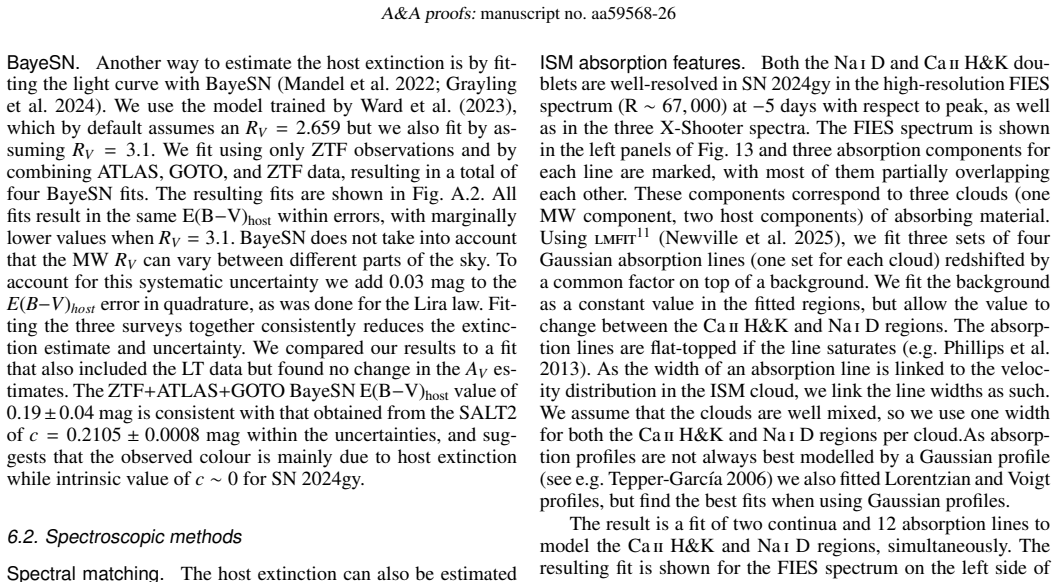
Host extinction estimates for SN 2024gy range from 0.12 to 0.24 magnitudes depending on the method used.
A machine-rendered reading of the paper's core claim, the machinery that carries it, and where it could break.
Core claim
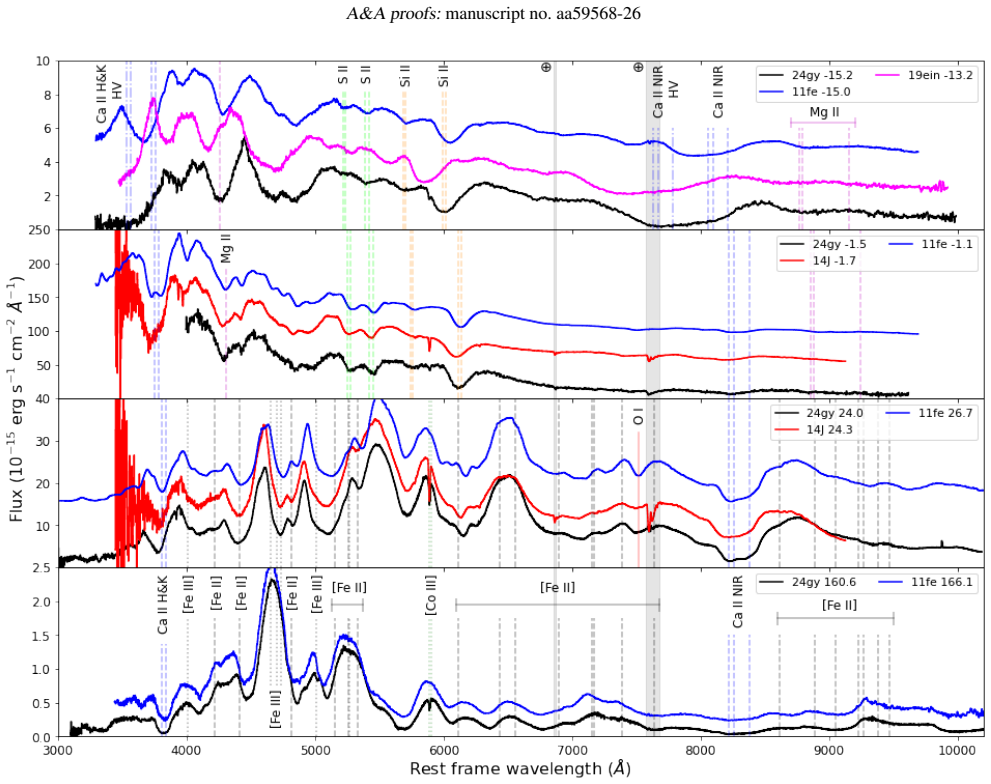
SN 2024gy is a normal Type Ia supernova that displays high-velocity components in Si II at early phases and an especially strong high-velocity feature in the Ca II near-infrared triplet. TARDIS spectral modeling reproduces the Ca II high-velocity component more closely under a double-detonation explosion model, yet the measured stable nickel-to-iron ratio points instead to a delayed-detonation origin. When the same photometric and spectroscopic data are used to estimate host-galaxy extinction, narrow interstellar lines give E(B-V)host equal to 0.12 plus or minus 0.02 magnitudes while the Lira law returns 0.24 plus or minus 0.06 magnitudes; the mean across methods is 0.22 plus or minus 0.04 m
What carries the argument
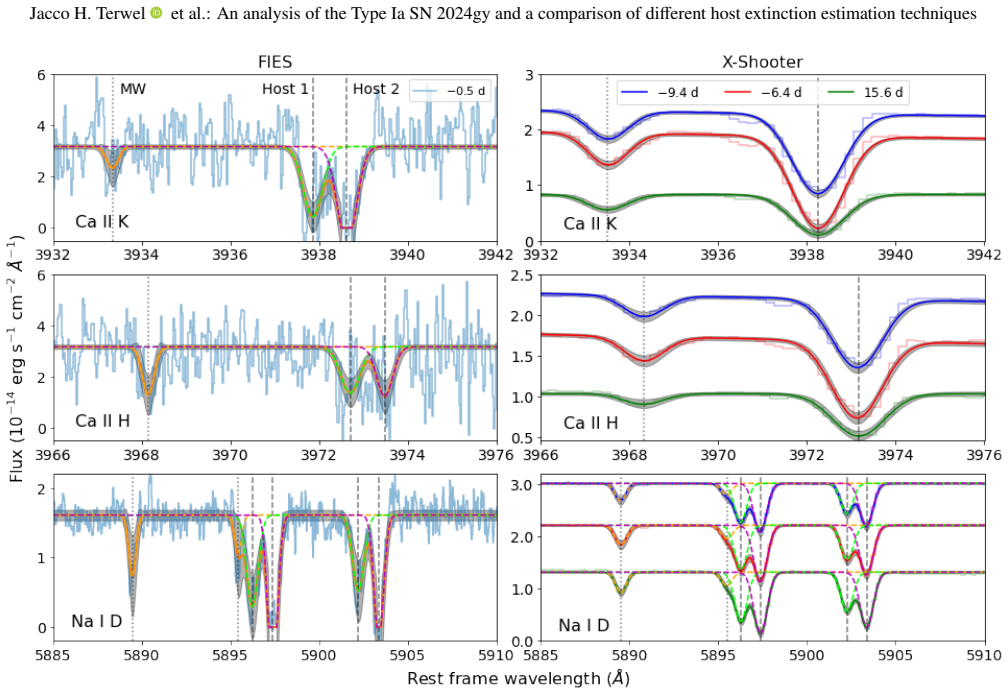
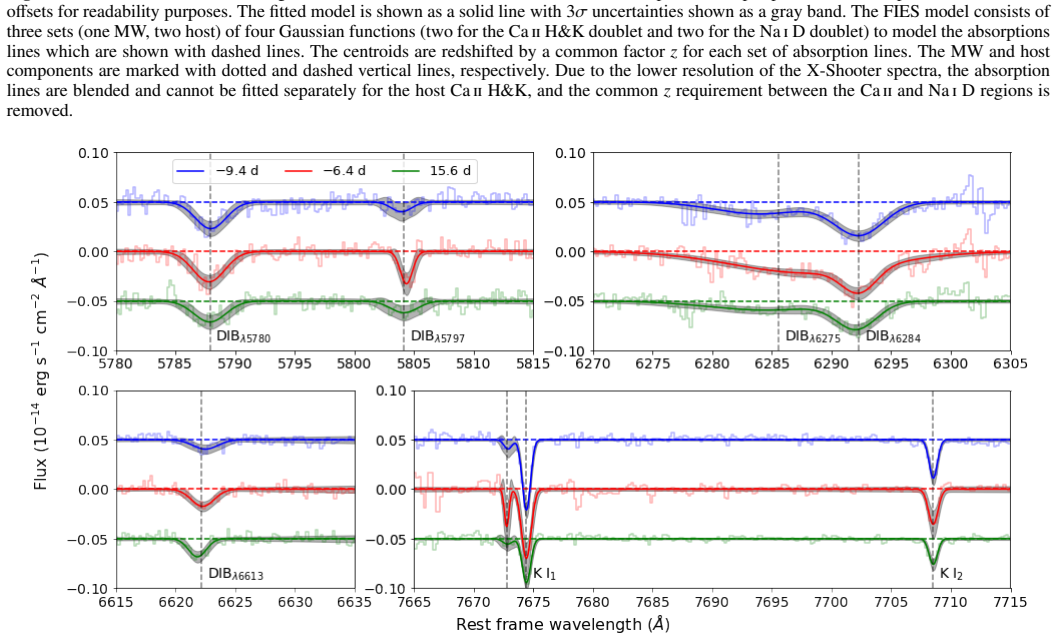
Comparison of host extinction estimators (narrow absorption lines, Lira law, photometric colors, polarimetry) applied to the same SN 2024gy data set.
If this is right
- The mean extinction value of 0.22 magnitudes supplies a practical correction for distance estimates to the host galaxy of SN 2024gy.
- Spectral modeling with TARDIS can favor one explosion scenario on the basis of the Ca II high-velocity feature while another indicator favors the opposite scenario.
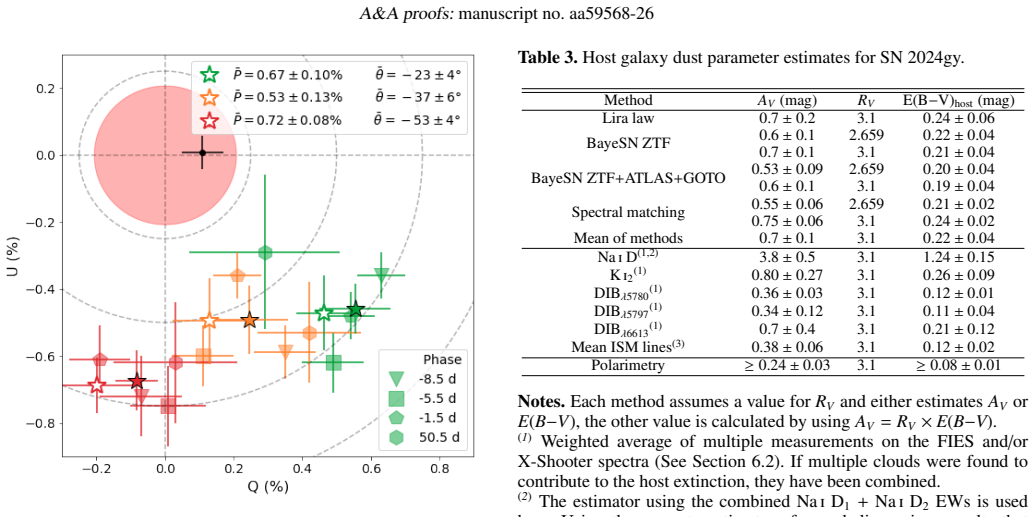
- Polarimetric measurements can be combined with line and color-based methods to constrain host extinction.
- Using any single estimator risks a systematic offset of up to 0.12 magnitudes in the derived extinction.
Where Pith is reading between the lines
- If similar spreads appear in other well-observed supernovae, cosmological analyses should propagate method-dependent uncertainties rather than adopt a single extinction value.
- A weighted average across techniques may reduce random error only if the dominant biases are not shared across all methods.
- Multi-method extinction campaigns on additional supernovae would test whether the observed spread is typical of host galaxies or particular to SN 2024gy.
Load-bearing premise
The extinction estimators draw on sufficiently independent information and do not share systematic biases introduced by the common data reduction steps.
What would settle it
An independent measurement of the host dust column, for instance through far-infrared dust emission maps or high-resolution spectroscopy of background sources, that falls clearly outside the reported 0.12 to 0.24 magnitude range.
Figures

read the original abstract
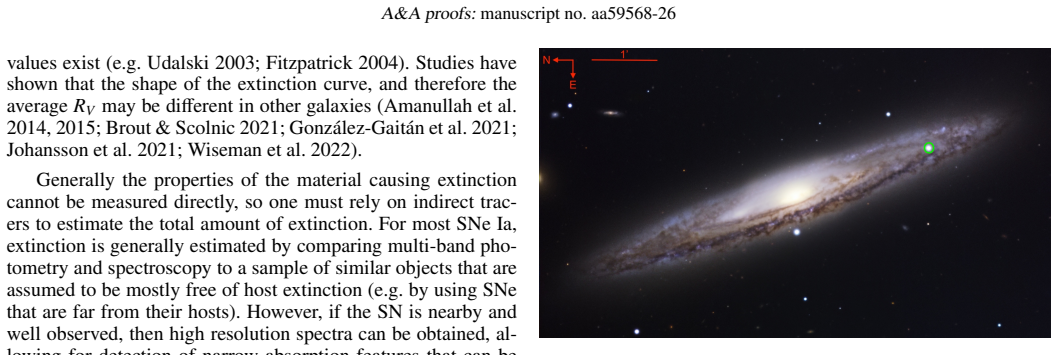
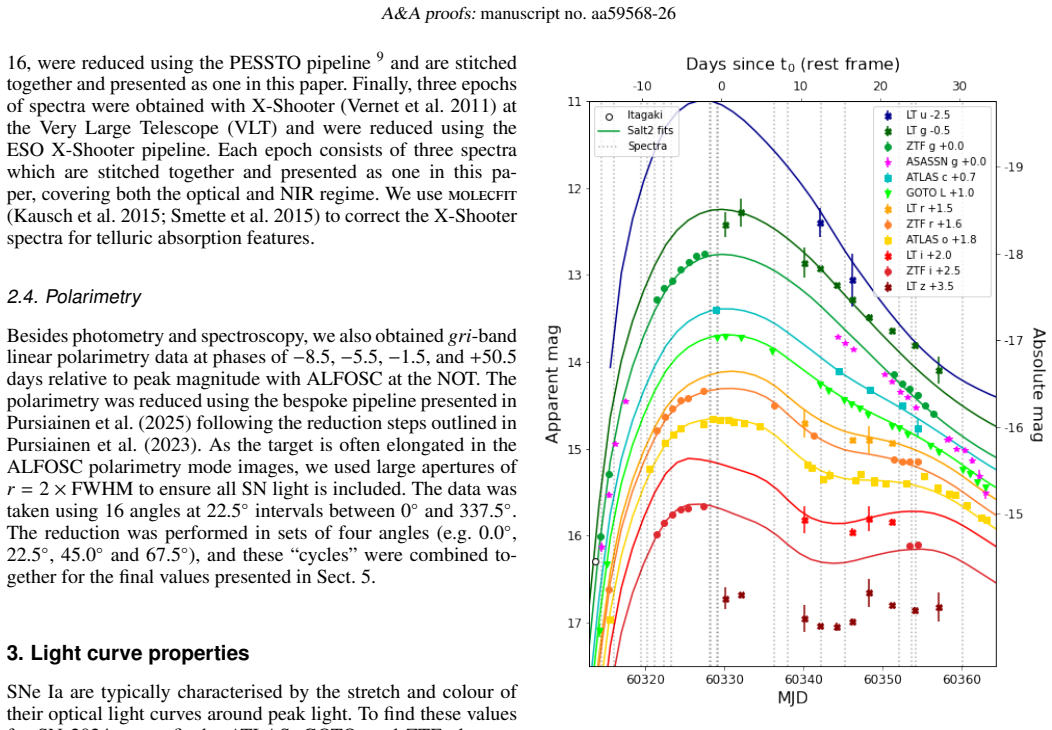
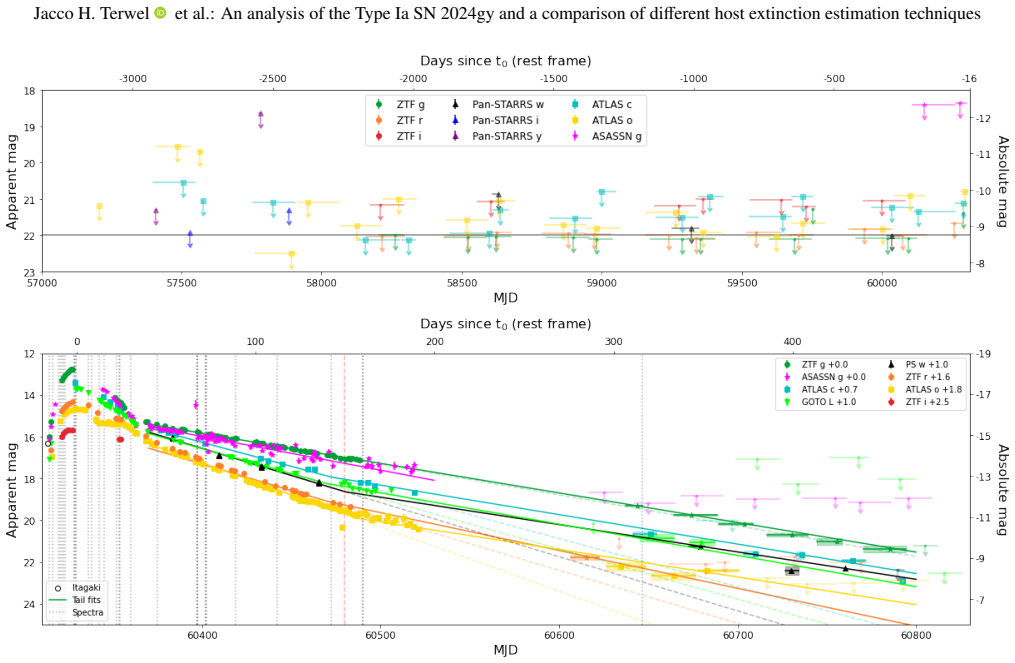
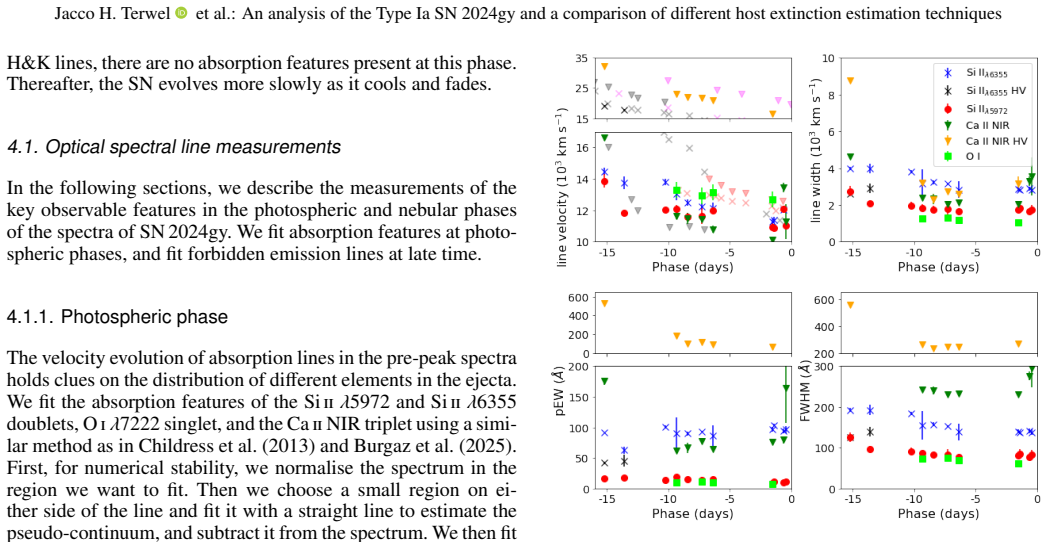
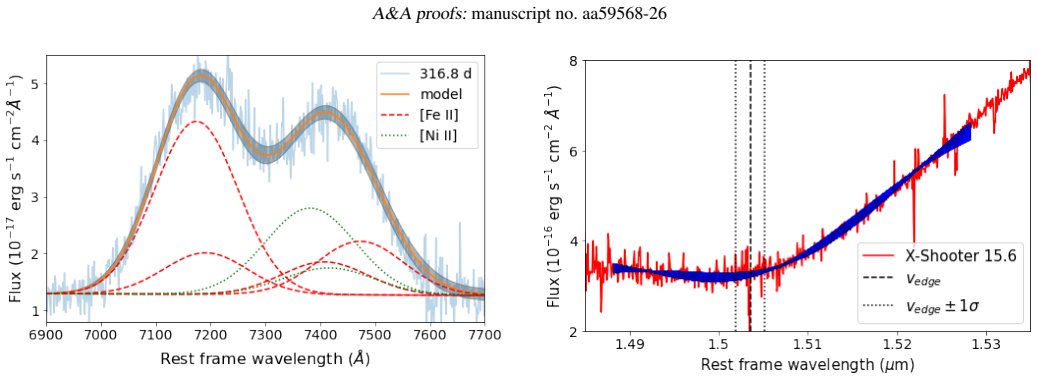
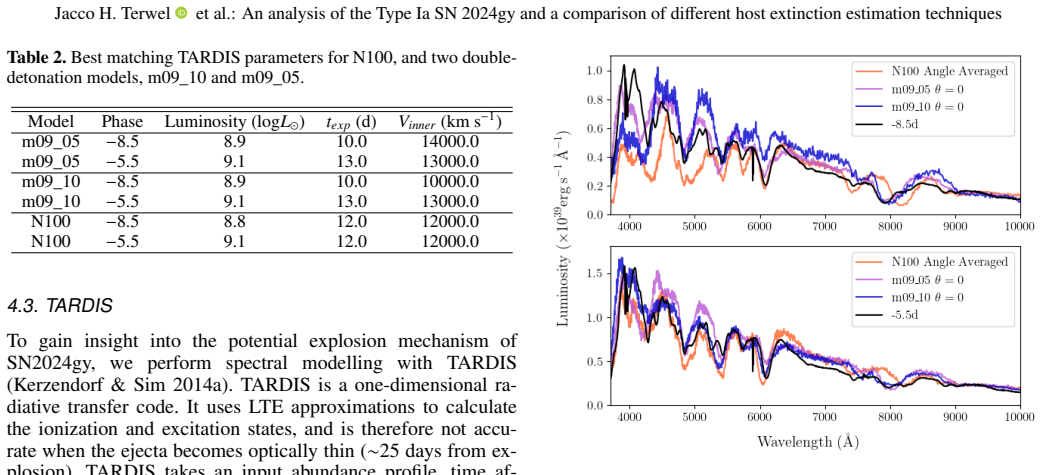
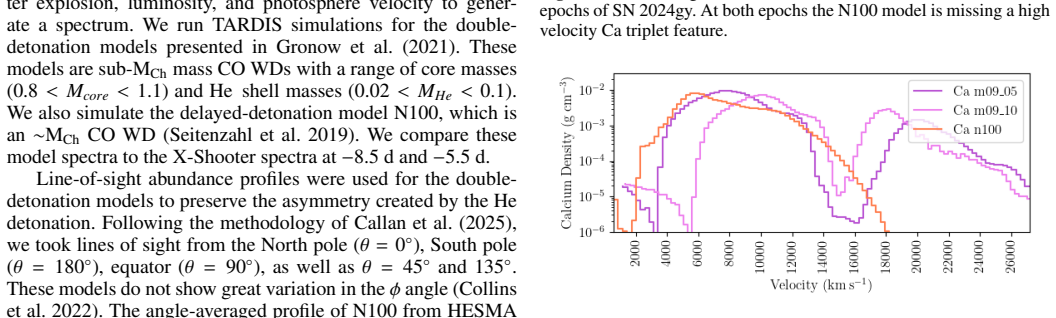
Type Ia supernovae (SNe Ia) are well-known standardisable candles, and are one of the main ways to measure the distance to their host galaxies. However, extinction due to interstellar dust causes objects to appear fainter and redder. Correcting for this requires estimating the amount of intervening material and how the extinction changes as a function of wavelength. We present and analyse optical and near-infrared data of the well-observed SN 2024gy and use these to compare different extinction estimation techniques, making use of photometric, spectroscopic, and polarimetric data. SN 2024gy is a normal SN Ia with high velocity (HV) components in Si II $\lambda6355$ (phase $<-10$ days) and a particularly strong HV feature in the Ca II near-infrared triplet (up to peak). Modelling SN 2024gy with TARDIS shows better matches with a double-detonation scenario compared to a delayed-detonation scenario due to a better match to the Ca II HV component. A measurement of the stable Ni/Fe ratio however favours a delayed-detonation scenario. Host extinction estimates range from $E(B-V)_{host}=0.12\pm0.02$ mag (narrow interstellar absorption lines) to $E(B-V)_{host}=0.24\pm0.06$ mag (Lira law) with a mean of $E(B-V)_{host}=0.22\pm0.04$ mag, assuming $R_V=3.1$. The spread between different methods highlights the challenge of accurately estimating the amount of extinction light suffers before being observed.
Editorial analysis
A structured set of objections, weighed in public.
Referee Report
Summary. The manuscript presents optical and NIR observations of the normal Type Ia SN 2024gy, which exhibits high-velocity Si II and especially strong HV Ca II features. TARDIS spectral modeling is used to compare double-detonation versus delayed-detonation explosion scenarios, with the former providing a better match to the Ca II HV component while the stable Ni/Fe ratio favors the latter. Multiple host-extinction estimators (narrow interstellar lines, Lira law, photometric colors, polarimetry) are applied to the same dataset, yielding E(B-V)_host values ranging from 0.12±0.02 mag to 0.24±0.06 mag (mean 0.22±0.04 mag for R_V=3.1); the spread is presented as evidence of the difficulty in accurately determining host extinction.
Significance. If the reported spread is shown to be free of shared systematics, the work would usefully illustrate the practical uncertainties that remain when correcting SNe Ia for host extinction, a key systematic for cosmological applications. The explicit TARDIS modeling and direct comparison of two explosion scenarios constitute a concrete, falsifiable contribution that can be tested with future data.
major comments (1)
- [Extinction estimation section (abstract and main text)] Extinction estimation section (abstract and main text): all quoted methods ultimately rely on the same optical/NIR photometry and spectra. No quantitative test (e.g., jackknife over reduction pipelines, comparison of independent flux-calibration choices, or telluric-removal variants) is presented to demonstrate that the methods are effectively independent; correlated errors from common data-reduction steps could therefore narrow the true uncertainty on the reported spread, which is load-bearing for the central claim that the range “highlights the challenge.”
minor comments (2)
- [TARDIS modeling paragraph] The TARDIS modeling paragraph should explicitly state the wavelength range, phase coverage, and number of free parameters used in each scenario comparison so that the goodness-of-fit statements can be reproduced.
- Table or figure presenting the individual E(B-V) values should include the exact data subsets (e.g., which filters or lines) entering each estimator to allow readers to assess possible shared systematics.
Simulated Author's Rebuttal
We thank the referee for their careful reading of the manuscript and for highlighting an important methodological point regarding the extinction estimates. We address the major comment below.
read point-by-point responses
-
Referee: Extinction estimation section (abstract and main text): all quoted methods ultimately rely on the same optical/NIR photometry and spectra. No quantitative test (e.g., jackknife over reduction pipelines, comparison of independent flux-calibration choices, or telluric-removal variants) is presented to demonstrate that the methods are effectively independent; correlated errors from common data-reduction steps could therefore narrow the true uncertainty on the reported spread, which is load-bearing for the central claim that the range “highlights the challenge.”
Authors: We agree that the methods are applied to the same underlying dataset and that no explicit quantitative test of independence across reduction variants has been included. The techniques nevertheless draw on distinct observables and physical assumptions (narrow-line column densities, color-evolution uniformity in the Lira relation, broadband SED fitting, and polarization properties), which limits the degree of correlation. We nevertheless accept that shared reduction steps could reduce the effective independence of the spread. In the revised manuscript we will insert a new paragraph in the extinction section that explicitly discusses this caveat, qualifies the interpretation of the reported range as a measure of uncertainty, and notes the absence of a formal jackknife or sensitivity test. If the available data permit, we will also add a brief sensitivity check by perturbing flux-calibration and telluric corrections within their estimated uncertainties and re-deriving the E(B-V) values. revision: yes
Circularity Check
No circularity: observational measurements from independent standard techniques
full rationale
The paper reports direct measurements of host extinction E(B-V) using several established methods (narrow absorption lines, Lira law, photometric colors, polarimetry) applied to the SN 2024gy dataset, along with TARDIS spectral modeling for explosion scenario comparison. None of the reported values are obtained by fitting a parameter to a subset and then relabeling it as a prediction, nor do any derivations reduce to self-definitional equations or load-bearing self-citations. The spread in estimates is presented as an empirical observation highlighting methodological differences, with all steps anchored to external codes and standard assumptions (RV=3.1) rather than internal redefinitions. The work is therefore self-contained against external benchmarks.
Axiom & Free-Parameter Ledger
free parameters (1)
- RV =
3.1
axioms (1)
- domain assumption Standard interstellar extinction curves and the Lira relation hold for host-galaxy dust around Type Ia supernovae.
Reference graph
Works this paper leans on
-
[1]
M., Aspin, C., Sorensen, A
Abbott, T. M., Aspin, C., Sorensen, A. N., et al. 2000, in Society of Photo-Optical Instrumentation Engineers (SPIE) Conference Series, V ol. 4008, Optical and IR Telescope Instrumentation and Detectors, ed. M. Iye & A. F. Moorwood, 714–719
2000
-
[2]
D., Allende Prieto, C., Almeida, A., et al
Albareti, F. D., Allende Prieto, C., Almeida, A., et al. 2017, ApJS, 233, 25
2017
-
[3]
2014, ApJ, 788, L21
Amanullah, R., Goobar, A., Johansson, J., et al. 2014, ApJ, 788, L21
2014
-
[4]
2015, MNRAS, 453, 3300
Amanullah, R., Johansson, J., Goobar, A., et al. 2015, MNRAS, 453, 3300
2015
-
[5]
Baron, D., Poznanski, D., Watson, D., Yao, Y ., & Prochaska, J. X. 2015, MN- RAS, 447, 545
2015
-
[6]
Bellm, E. C. & Sesar, B. 2016, pyraf-dbsp: Reduction pipeline for the Palo- mar Double Beam Spectrograph, Astrophysics Source Code Library, record ascl:1602.002
2016
-
[7]
D., Walters, R., et al
Blagorodnova, N., Neill, J. D., Walters, R., et al. 2018, PASP, 130, 035003
2018
-
[8]
R., Bershady, M
Blanton, M. R., Bershady, M. A., Abolfathi, B., et al. 2017, AJ, 154, 28
2017
-
[9]
L., Patat, F., et al
Blondin, S., Prieto, J. L., Patat, F., et al. 2009, ApJ, 693, 207
2009
-
[10]
J., Townsley, D
Boos, S. J., Townsley, D. M., & Shen, K. J. 2024, ApJ, 972, 200
2024
-
[11]
A., Hachinger, S., & Kerzendorf, W
Boyle, A., Sim, S. A., Hachinger, S., & Kerzendorf, W. 2017, A&A, 599, A46
2017
-
[12]
Brennan, S. J. & Fraser, M. 2022, A&A, 667, A62
2022
-
[13]
& Scolnic, D
Brout, D. & Scolnic, D. 2021, ApJ, 909, 26
2021
-
[14]
J., Hosseinzadeh, G., Jha, S
Brown, P. J., Hosseinzadeh, G., Jha, S. W., et al. 2019, ApJ, 877, 152
2019
-
[15]
M., Baliber, N., Bianco, F
Brown, T. M., Baliber, N., Bianco, F. B., et al. 2013, PASP, 125, 1031
2013
-
[16]
2025, A&A, 694, A9
Burgaz, U., Maguire, K., Dimitriadis, G., et al. 2025, A&A, 694, A9
2025
-
[17]
1984, The Messenger, 38, 9
Buzzoni, B., Delabre, B., Dekker, H., et al. 1984, The Messenger, 38, 9
1984
-
[18]
P., Collins, C
Callan, F. P., Collins, C. E., Sim, S. A., et al. 2025, MNRAS, 539, 1404 Article number, page 17 of 23 A&A proofs:manuscript no. aa59568-26
2025
-
[19]
A., Clayton, G
Cardelli, J. A., Clayton, G. C., & Mathis, J. S. 1989, ApJ, 345, 245
1989
-
[20]
B., Fox, D
Cenko, S. B., Fox, D. B., Moon, D.-S., et al. 2006, PASP, 118, 1396
2006
-
[21]
Chambers, K. C., Magnier, E. A., Metcalfe, N., et al. 2016, arXiv e-prints, arXiv:1612.05560
work page internal anchor Pith review Pith/arXiv arXiv 2016
-
[22]
1931, The London, Edinburgh, and Dublin Philosophical Magazine and Journal of Science, 11, 592
Chandrasekhar, S. 1931, The London, Edinburgh, and Dublin Philosophical Magazine and Journal of Science, 11, 592
1931
-
[23]
J., Scalzo, R
Childress, M. J., Scalzo, R. A., Sim, S. A., et al. 2013, ApJ, 770, 29
2013
-
[24]
H., Kenney, J
Chung, A., van Gorkom, J. H., Kenney, J. D. P., Crowl, H., & V ollmer, B. 2009, AJ, 138, 1741
2009
-
[25]
2016, ApJ, 819, 152
Cikota, A., Deustua, S., & Marleau, F. 2016, ApJ, 819, 152
2016
-
[26]
E., Gronow, S., Sim, S
Collins, C. E., Gronow, S., Sim, S. A., & Röpke, F. K. 2022, MNRAS, 517, 5289
2022
-
[27]
E., Sim, S
Collins, C. E., Sim, S. A., Shingles, L. J., et al. 2023, MNRAS, 524, 4447
2023
-
[28]
W., Bloom, J
Coughlin, M. W., Bloom, J. S., Nir, G., et al. 2023, ApJS, 267, 31
2023
-
[29]
1959, ZAp, 47, 59
Davis, Jr., L. 1959, ZAp, 47, 59
1959
-
[30]
& Greenstein, J
Davis, Jr., L. & Greenstein, J. L. 1951, ApJ, 114, 206 de Vaucouleurs, G., de Vaucouleurs, A., Corwin, Jr., H. G., et al. 1991, Third Reference Catalogue of Bright Galaxies
1951
-
[31]
2025, A&A, 694, A12
Deckers, M., Maguire, K., Shingles, L., et al. 2025, A&A, 694, A12
2025
-
[32]
M., Riddle, R., et al
Dekany, R., Smith, R. M., Riddle, R., et al. 2020, PASP, 132, 038001
2020
-
[33]
& Hillier, D
Dessart, L. & Hillier, D. J. 2015, MNRAS, 447, 1370
2015
-
[34]
2015, MNRAS, 448, 1345
Dhawan, S., Leibundgut, B., Spyromilio, J., & Maguire, K. 2015, MNRAS, 448, 1345
2015
-
[35]
2017, MNRAS, 468, 3798 Domínguez, A., Siana, B., Henry, A
Dimitriadis, G., Sullivan, M., Kerzendorf, W., et al. 2017, MNRAS, 468, 3798 Domínguez, A., Siana, B., Henry, A. L., et al. 2013, ApJ, 763, 145
2017
-
[36]
2024, ApJ, 974, 316
Dong, Y ., Valenti, S., Ashall, C., et al. 2024, ApJ, 974, 316
2024
-
[37]
J., Ackley, K., Jiménez-Ibarra, F., et al
Dyer, M. J., Ackley, K., Jiménez-Ibarra, F., et al. 2024, in Society of Photo- Optical Instrumentation Engineers (SPIE) Conference Series, V ol. 13094, Ground-based and Airborne Telescopes X, ed. H. K. Marshall, J. Spyromilio, & T. Usuda, 130941X
2024
-
[38]
M., Dahlstrom, J
Fan, H., Hobbs, L. M., Dahlstrom, J. A., et al. 2019, ApJ, 878, 151
2019
-
[39]
K., Hillebrandt, W., et al
Fink, M., Röpke, F. K., Hillebrandt, W., et al. 2010, A&A, 514, A53
2010
-
[40]
Fitzpatrick, E. L. 1999, PASP, 111, 63
1999
-
[41]
Fitzpatrick, E. L. 2004, in Astronomical Society of the Pacific Conference Series, V ol. 309, Astrophysics of Dust, ed. A. N. Witt, G. C. Clayton, & B. T. Draine, 33
2004
-
[42]
Fitzpatrick, E. L. & Massa, D. 2007, ApJ, 663, 320 Flörs, A., Spyromilio, J., Taubenberger, S., et al. 2020, MNRAS, 491, 2902
2007
-
[43]
L., Madore, B
Freedman, W. L., Madore, B. F., Gibson, B. K., et al. 2001, ApJ, 553, 47
2001
-
[44]
L., Madore, B
Freedman, W. L., Madore, B. F., Scowcroft, V ., et al. 2012, ApJ, 758, 24 González-Gaitán, S., de Jaeger, T., Galbany, L., et al. 2021, MNRAS, 508, 4656 González-Gaitán, S., Gutiérrez, C. P., Anderson, J. P., et al. 2024, A&A, 687, A108
2012
-
[45]
2014, ApJ, 784, L12
Goobar, A., Johansson, J., Amanullah, R., et al. 2014, ApJ, 784, L12
2014
-
[46]
J., Kulkarni, S
Graham, M. J., Kulkarni, S. R., Bellm, E. C., et al. 2019, PASP, 131, 078001
2019
-
[47]
L., Valenti, S., Fulton, B
Graham, M. L., Valenti, S., Fulton, B. J., et al. 2015, ApJ, 801, 136
2015
-
[48]
S., et al
Grayling, M., Thorp, S., Mandel, K. S., et al. 2024, MNRAS, 531, 953
2024
-
[49]
E., Sim, S
Gronow, S., Collins, C. E., Sim, S. A., & Röpke, F. K. 2021, A&A, 649, A155
2021
-
[50]
& Hosseinzadeh, G
Guevel, D. & Hosseinzadeh, G. 2017, dguevel/PyZOGY: Initial release
2017
-
[51]
Z., & Margutti, R
Guillochon, J., Parrent, J., Kelley, L. Z., & Margutti, R. 2017, ApJ, 835, 64
2017
-
[52]
E., Siegmund, W
Gunn, J. E., Siegmund, W. A., Mannery, E. J., et al. 2006, AJ, 131, 2332
2006
-
[53]
R., Kuhlmann, S., Kovacs, E., et al
Gupta, R. R., Kuhlmann, S., Kovacs, E., et al. 2016, AJ, 152, 154
2016
-
[54]
2007, A&A, 466, 11
Guy, J., Astier, P., Baumont, S., et al. 2007, A&A, 466, 11
2007
-
[55]
Hart, K., Shappee, B. J., Hey, D., et al. 2023, arXiv e-prints, arXiv:2304.03791
-
[56]
2025, A&A, 695, A264
Harvey, L., Maguire, K., Burgaz, U., et al. 2025, A&A, 695, A264
2025
-
[57]
T., Garnavich, P
Hayden, B. T., Garnavich, P. M., Kessler, R., et al. 2010, ApJ, 712, 350
2010
-
[58]
Herbig, G. H. 1995, ARA&A, 33, 19
1995
-
[59]
Hobbs, L. M. 1974, ApJ, 191, 381
1974
-
[60]
B., Ashall, C., Jones, D
Hoogendam, W. B., Ashall, C., Jones, D. O., et al. 2025, ApJ, 988, 209
2025
-
[61]
2017, ApJ, 836, 157
Huang, X., Raha, Z., Aldering, G., et al. 2017, ApJ, 836, 157
2017
-
[62]
& Tutukov, A
Iben, I., J. & Tutukov, A. V . 1984, ApJS, 54, 335
1984
-
[63]
2024, Transient Name Server Discovery Report, 2024-39, 1 Jacobson-Galán, W
Itagaki, K. 2024, Transient Name Server Discovery Report, 2024-39, 1 Jacobson-Galán, W. V ., Dessart, L., Jones, D. O., et al. 2022, ApJ, 924, 15
2024
-
[64]
J., Sollerman, J., et al
Jerkstrand, A., Smartt, S. J., Sollerman, J., et al. 2015, MNRAS, 448, 2482
2015
-
[65]
G., & Kirshner, R
Jha, S., Riess, A. G., & Kirshner, R. P. 2007, ApJ, 659, 122
2007
-
[66]
B., Fox, O
Johansson, J., Cenko, S. B., Fox, O. D., et al. 2021, ApJ, 923, 237
2021
-
[67]
& Woosley, S
Kasen, D. & Woosley, S. E. 2007, ApJ, 656, 661
2007
-
[68]
2015, A&A, 576, A78
Kausch, W., Noll, S., Smette, A., et al. 2015, A&A, 576, A78
2015
-
[69]
2020, ApJ, 893, 143
Kawabata, M., Maeda, K., Yamanaka, M., et al. 2020, ApJ, 893, 143
2020
-
[70]
2025, tardis-sn/tardis: TARDIS v2025.12.28
Kerzendorf, W., Sim, S., V ogl, C., et al. 2025, tardis-sn/tardis: TARDIS v2025.12.28
2025
-
[71]
Khokhlov, A. M. 1991, A&A, 245, L25
1991
-
[72]
D., et al
Kim, Y .-L., Rigault, M., Neill, J. D., et al. 2022, PASP, 134, 024505
2022
-
[73]
S., Shappee, B
Kochanek, C. S., Shappee, B. J., Stanek, K. Z., et al. 2017, PASP, 129, 104502
2017
-
[74]
Kromer, M., Ohlmann, S., & Röpke, F. K. 2017, Mem. Soc. Astron. Italiana, 88, 312
2017
-
[75]
Kwok, L. A., Liu, C., Jha, S. W., et al. 2025, arXiv e-prints, arXiv:2510.09760 Léget, P.-F., Gangler, E., Mondon, F., et al. 2020, A&A, 636, A46
work page internal anchor Pith review Pith/arXiv arXiv 2025
-
[76]
C., Li, W., Filippenko, A
Leonard, D. C., Li, W., Filippenko, A. V ., Foley, R. J., & Chornock, R. 2005, ApJ, 632, 450
2005
-
[77]
2026, ApJ, 996, 10
Li, L., Wang, Z., Liu, J., et al. 2026, ApJ, 996, 10
2026
-
[78]
S., Podsiadlowski, P., et al
Li, W., Bloom, J. S., Podsiadlowski, P., et al. 2011, Nature, 480, 348
2011
-
[79]
1995, Masters thesis (Univ
Lira, P. 1995, Masters thesis (Univ. Chile)
1995
-
[80]
& Miller, A
Liu, C. & Miller, A. A. 2026, PASP, 138, 024503
2026
discussion (0)
Sign in with ORCID, Apple, or X to comment. Anyone can read and Pith papers without signing in.