Set-Preserving Calibration from Conformal P-Values to E-Values
Pith reviewed 2026-06-28 08:08 UTC · model grok-4.3
The pith
A set-preserving calibrator converts conformal p-values to e-values while keeping identical prediction sets.
A machine-rendered reading of the paper's core claim, the machinery that carries it, and where it could break.
Core claim
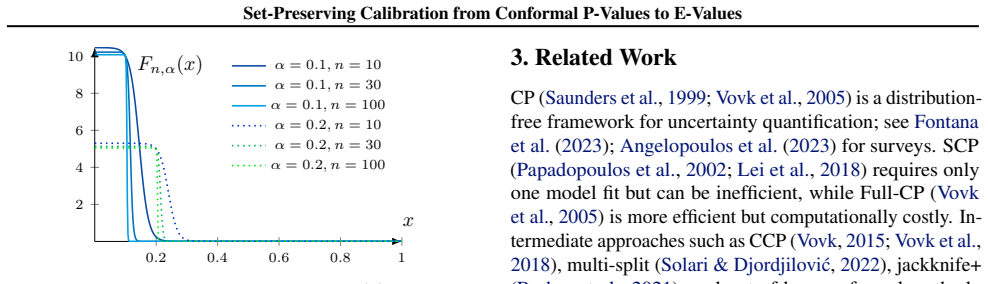
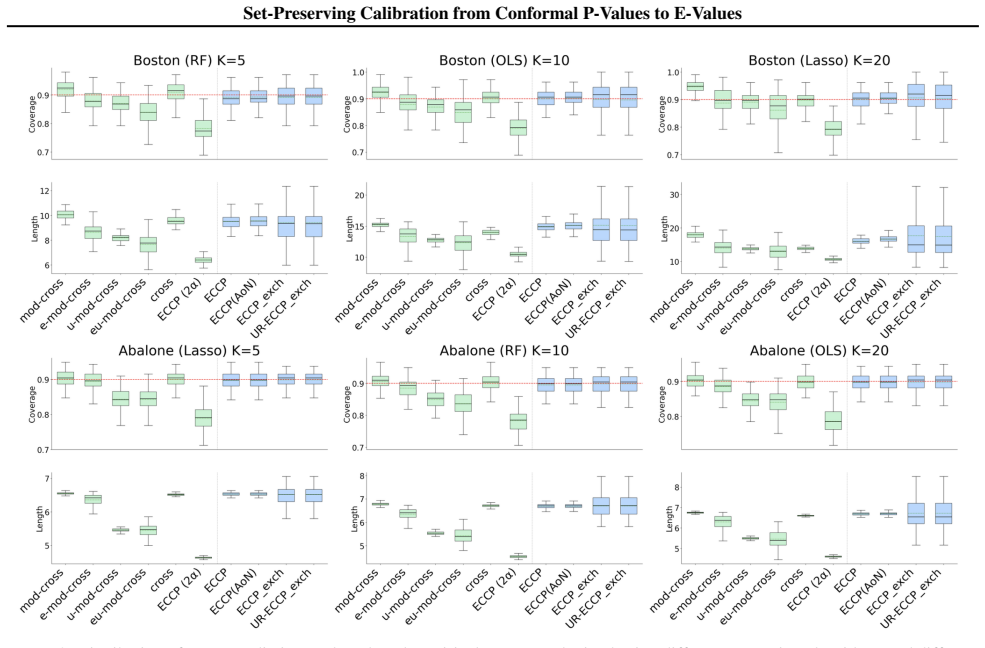
The authors introduce a P2E calibrator that maps valid conformal p-values to e-values such that the prediction set defined by thresholding the e-value at 1/alpha is identical to the one from the p-value at alpha. They prove this property holds and demonstrate through theory and experiments that it yields smaller or equal sets compared to prior calibrators, with applications to cross-conformal prediction achieving exact 1-alpha coverage and improved efficiency in conformal aggregation.
What carries the argument
The set-preserving P2E calibrator, a function that transforms p-values derived from nonconformity scores into e-values while ensuring the superlevel sets remain unchanged.
If this is right
- The e-value formulation permits direct application of e-value merging techniques to combine evidence from dependent conformal procedures.
- Cross-conformal prediction variants achieve the exact 1-alpha coverage guarantee rather than the approximate 1-2alpha.
- Conformal aggregation methods gain efficiency while maintaining validity.
- Randomization methods for e-values can be incorporated into conformal inference without losing set preservation.
Where Pith is reading between the lines
- This approach could be tested on nonconformity scores not covered in the experiments to check if set preservation generalizes.
- It suggests potential for sequential conformal methods where evidence accumulates over time.
- Connections to other calibration problems in multiple testing might be explored using similar preservation ideas.
Load-bearing premise
The conformal p-values are valid, which requires the data points to be exchangeable.
What would settle it
Running the calibrator on a dataset where the original conformal p-value produces a certain set size at level alpha, and checking if the e-value version produces a different set size or fails coverage.
Figures

read the original abstract
Standard conformal prediction (CP) procedures are typically formulated in terms of p-values, but reliance on p-values alone limits flexibility, for example, when combining dependent evidence across models or data splits. Recent work has explored e-value formulations for conformal inference, yet a direct connection between p- and e-value formulations in CP has been missing, especially regarding their statistical efficiency. We first identify limitations of classical p-to-e calibrators in the CP setting, showing that they are not set-preserving and can lead to overly conservative prediction sets. To address this, we propose a novel P2E calibrator that converts conformal p-values into e-values without altering the prediction set induced by the original conformal p-value. We establish both theoretically and empirically that our calibrator can yield significant efficiency gains over existing p-to-e calibrators. This e-value formulation enables principled use of recent advances in e-value merging and randomization, where we demonstrate its impact in two applications: cross-conformal prediction (CCP), whose variants typically provide only approximate $1-2\alpha$ coverage, and conformal aggregation (CA). In both cases, our e-value-based methods satisfy the desired $1-\alpha$ coverage guarantee while improving efficiency over standard baselines. More broadly, our approach expands the flexibility of CP and opens new directions for efficient, distribution-free uncertainty quantification.
Editorial analysis
A structured set of objections, weighed in public.
Referee Report
Summary. The paper introduces a novel p-to-e (P2E) calibrator for conformal p-values that is set-preserving, meaning the induced prediction sets remain identical to those from the original conformal procedure. It claims this calibrator produces valid e-values, yields efficiency gains over classical p-to-e maps, and enables exact 1-α coverage in applications such as cross-conformal prediction (CCP) and conformal aggregation (CA), where prior variants only achieve approximate coverage.
Significance. If the set-preserving construction is valid under standard exchangeability without additional score-specific restrictions, the work would meaningfully expand the toolkit for conformal inference by allowing direct use of e-value merging and randomization techniques while preserving coverage and improving efficiency. The empirical results on CCP and CA are a strength if they demonstrate gains without post-hoc tuning.
major comments (2)
- [Abstract and §3 (P2E calibrator construction)] Abstract and the section introducing the P2E calibrator: the set-preserving claim requires that f(p) be constant on (0,α] and on (α,1] with a jump at α to preserve {y : f(p(y)) > c} = {y : p(y) > α}. The manuscript must explicitly state which nonconformity score properties (continuity, strict monotonicity, or absence of ties) are needed for this equivalence to hold in general; the current statement that it holds 'for the scores used in the procedure' leaves the scope of the result unclear.
- [Theoretical section on validity (likely §4)] Theoretical results on validity and efficiency: the e-value property E[f(p)] ≤ 1 under the null must be shown without relying on fitted parameters or self-referential definitions; if the proof reduces the efficiency gain to quantities defined in terms of the same conformal scores, the claimed gains over existing calibrators need re-examination for circularity.
minor comments (2)
- [Notation and definitions] Clarify notation for the threshold c in the set-equivalence definition to avoid ambiguity with the original α.
- [Experiments on CCP and CA] The empirical sections should report the exact nonconformity scores and data splits used to allow reproduction of the efficiency comparisons.
Simulated Author's Rebuttal
We thank the referee for their careful reading of the manuscript and for the constructive comments. We address each major comment point by point below, indicating planned revisions where appropriate.
read point-by-point responses
-
Referee: [Abstract and §3 (P2E calibrator construction)] Abstract and the section introducing the P2E calibrator: the set-preserving claim requires that f(p) be constant on (0,α] and on (α,1] with a jump at α to preserve {y : f(p(y)) > c} = {y : p(y) > α}. The manuscript must explicitly state which nonconformity score properties (continuity, strict monotonicity, or absence of ties) are needed for this equivalence to hold in general; the current statement that it holds 'for the scores used in the procedure' leaves the scope of the result unclear.
Authors: We agree that the set-preserving property of the proposed calibrator relies on the nonconformity scores inducing p-values whose level sets align exactly with the original conformal sets. In the revised manuscript we will explicitly state in §3 (and the abstract) that the construction assumes continuous nonconformity scores with no ties, which is the standard setting ensuring distinct p-values and exact set preservation under exchangeability. This clarifies the scope without restricting the result beyond common conformal practice. revision: yes
-
Referee: [Theoretical section on validity (likely §4)] Theoretical results on validity and efficiency: the e-value property E[f(p)] ≤ 1 under the null must be shown without relying on fitted parameters or self-referential definitions; if the proof reduces the efficiency gain to quantities defined in terms of the same conformal scores, the claimed gains over existing calibrators need re-examination for circularity.
Authors: The e-value property E[f(p)] ≤ 1 is established directly from the uniform validity of conformal p-values under exchangeability and the explicit functional form of our calibrator; the proof in §4 uses only the marginal distribution of p and contains no fitted parameters or self-reference. Efficiency gains are shown by direct comparison of the resulting e-values to fixed classical p-to-e maps (e.g., 1/p-type calibrators) under the same scores; because the classical maps are external benchmarks, the comparison is not circular. We will add a short clarifying paragraph in §4 to emphasize this distinction. revision: partial
Circularity Check
No significant circularity; construction is self-contained
full rationale
The abstract presents a direct construction of a P2E calibrator that preserves the original conformal prediction set while producing valid e-values. No equations, self-citations, or fitted parameters are shown to reduce the central claims (set-preservation or efficiency gains) to tautologies or prior author results by definition. The derivation chain relies on standard exchangeability assumptions for conformal p-values, with theoretical and empirical validation claimed independently of the construction itself. This matches the default expectation of non-circularity for a methods paper introducing a new mapping.
Axiom & Free-Parameter Ledger
axioms (1)
- domain assumption Data points are exchangeable
Reference graph
Works this paper leans on
-
[1]
2005 , publisher=
Algorithmic learning in a random world , author=. 2005 , publisher=
2005
-
[2]
1999 , journal=
Transduction with confidence and credibility , author=. 1999 , journal=
1999
-
[3]
, author=
A tutorial on conformal prediction. , author=. Journal of Machine Learning Research , volume=
-
[4]
Foundations and trends
Conformal prediction: A gentle introduction , author=. Foundations and trends. 2023 , publisher=
2023
-
[5]
European conference on machine learning , pages=
Inductive confidence machines for regression , author=. European conference on machine learning , pages=. 2002 , organization=
2002
-
[6]
Journal of the American Statistical Association , volume=
Distribution-free predictive inference for regression , author=. Journal of the American Statistical Association , volume=. 2018 , publisher=
2018
-
[7]
Advances in neural information processing systems , volume=
Conformalized quantile regression , author=. Advances in neural information processing systems , volume=
-
[9]
Asian conference on machine learning , pages=
Conditional validity of inductive conformal predictors , author=. Asian conference on machine learning , pages=. 2012 , organization=
2012
-
[10]
Annals of Mathematics and Artificial Intelligence , volume=
Cross-conformal predictors , author=. Annals of Mathematics and Artificial Intelligence , volume=. 2015 , publisher=
2015
-
[11]
conformal and probabilistic prediction and applications , pages=
Cross-conformal predictive distributions , author=. conformal and probabilistic prediction and applications , pages=. 2018 , organization=
2018
-
[12]
The Annals of Statistics , volume=
Predictive inference with the jackknife+ , author=. The Annals of Statistics , volume=. 2021 , publisher=
2021
-
[13]
Statistics & Probability Letters , volume=
Multi split conformal prediction , author=. Statistics & Probability Letters , volume=. 2022 , publisher=
2022
-
[14]
Pattern Recognition , volume=
Nested conformal prediction and quantile out-of-bag ensemble methods , author=. Pattern Recognition , volume=. 2022 , publisher=
2022
-
[15]
Proceedings of the 42nd International Conference on Machine Learning , pages =
Improving the Statistical Efficiency of Cross-Conformal Prediction , author =. Proceedings of the 42nd International Conference on Machine Learning , pages =. 2025 , editor =
2025
-
[16]
Pattern Recognition , pages=
Conformal e-prediction , author=. Pattern Recognition , pages=. 2025 , publisher=
2025
-
[18]
2022 , eprint=
Estimating means of bounded random variables by betting , author=. 2022 , eprint=
2022
-
[19]
Electronic Journal of Statistics , volume=
Merging sequential e-values via martingales , author=. Electronic Journal of Statistics , volume=. 2024 , publisher=
2024
-
[20]
The Annals of Statistics , volume=
E-values: Calibration, combination and applications , author=. The Annals of Statistics , volume=. 2021 , publisher=
2021
-
[21]
Biometrika , volume=
The only admissible way of merging arbitrary e-values , author=. Biometrika , volume=. 2025 , publisher=
2025
-
[22]
The Annals of Statistics , volume=
Admissible ways of merging p-values under arbitrary dependence , author=. The Annals of Statistics , volume=. 2022 , publisher=
2022
-
[23]
Post-selection inference for e-value based confidence intervals , volume=
Xu, Ziyu and Wang, Ruodu and Ramdas, Aaditya , year=. Post-selection inference for e-value based confidence intervals , volume=. Electronic Journal of Statistics , publisher=. doi:10.1214/24-ejs2253 , number=
-
[24]
Journal of the Royal Statistical Society Series B: Statistical Methodology , volume=
False discovery rate control with e-values , author=. Journal of the Royal Statistical Society Series B: Statistical Methodology , volume=. 2022 , publisher=
2022
-
[26]
Advances in Neural Information Processing Systems , volume=
Backward conformal prediction , author=. Advances in Neural Information Processing Systems , volume=
-
[27]
Statistical Science , volume=
Randomized and exchangeable improvements of Markov’s, Chebyshev’s and Chernoff’s inequalities , author=. Statistical Science , volume=. 2026 , publisher=
2026
-
[29]
2025 , eprint=
Optimal Conformal Prediction, E-values, Fuzzy Prediction Sets and Subsequent Decisions , author=. 2025 , eprint=
2025
-
[30]
International Conference on Artificial Intelligence and Statistics , pages=
Online multiple testing with e-values , author=. International Conference on Artificial Intelligence and Statistics , pages=. 2024 , organization=
2024
-
[31]
Journal of the American Statistical Association , volume=
Selection and aggregation of conformal prediction sets , author=. Journal of the American Statistical Association , volume=. 2025 , publisher=
2025
-
[32]
Proceedings of the 42nd International Conference on Machine Learning , pages =
Conformity Score Averaging for Classification , author =. Proceedings of the 42nd International Conference on Machine Learning , pages =. 2025 , editor =
2025
-
[33]
2024 , eprint=
Merging uncertainty sets via majority vote , author=. 2024 , eprint=
2024
-
[34]
Advances in Neural Information Processing Systems , volume=
Conformal Prediction for Ensembles: Improving Efficiency via Score-Based Aggregation , author=. Advances in Neural Information Processing Systems , volume=
-
[35]
Journal of the Royal Statistical Society Series B: Statistical Methodology , volume=
Safe testing , author=. Journal of the Royal Statistical Society Series B: Statistical Methodology , volume=. 2024 , publisher=
2024
-
[36]
Statistical Papers , volume=
A small-sample Bayesian information criterion that does not overstate the evidence, with an application to calibrating p-values from likelihood-ratio tests , author=. Statistical Papers , volume=. 2025 , publisher=
2025
-
[37]
UCI Machine Learning Repository , volume=
Online news popularity , author=. UCI Machine Learning Repository , volume=
-
[38]
Conformal and probabilistic prediction and applications , pages=
On the calibration of aggregated conformal predictors , author=. Conformal and probabilistic prediction and applications , pages=. 2017 , organization=
2017
-
[39]
2025 , eprint=
Measuring Evidence against Exchangeability and Group Invariance with E-values , author=. 2025 , eprint=
2025
-
[41]
UC Irvine Machine Learning Repository , year=
Abalone data set , author=. UC Irvine Machine Learning Repository , year=
-
[42]
UCI Machine Learning Repository , volume=
Parkinsons telemonitoring , author=. UCI Machine Learning Repository , volume=
-
[43]
2002 , howpublished =
Redmond, Michael , title =. 2002 , howpublished =
2002
-
[45]
Proceedings of the AAAI Conference on Artificial Intelligence , volume=
Symmetric aggregation of conformity scores for efficient uncertainty sets , author=. Proceedings of the AAAI Conference on Artificial Intelligence , volume=
-
[46]
Proceedings of the Thirteenth Symposium on Conformal and Probabilistic Prediction with Applications , pages =
Enhancing Conformal Prediction Using E-Test Statistics , author =. Proceedings of the Thirteenth Symposium on Conformal and Probabilistic Prediction with Applications , pages =. 2024 , editor =
2024
-
[47]
Journal of environmental economics and management , volume=
Hedonic housing prices and the demand for clean air , author=. Journal of environmental economics and management , volume=. 1978 , publisher=
1978
-
[49]
ACM SIGKDD Explorations Newsletter , volume=
OpenML: networked science in machine learning , author=. ACM SIGKDD Explorations Newsletter , volume=. 2014 , publisher=
2014
-
[50]
Alami, N., Zakharia, J., and Taieb, S. B. Symmetric aggregation of conformity scores for efficient uncertainty sets. In Proceedings of the AAAI Conference on Artificial Intelligence, volume 40, pp.\ 19607--19614, 2026
2026
-
[51]
N., Bates, S., et al
Angelopoulos, A. N., Bates, S., et al. Conformal prediction: A gentle introduction. Foundations and trends in machine learning , 16 0 (4): 0 494--591, 2023
2023
-
[52]
Balinsky, A. A. and Balinsky, A. D. Enhancing conformal prediction using e-test statistics. In Vantini, S., Fontana, M., Solari, A., Boström, H., and Carlsson, L. (eds.), Proceedings of the Thirteenth Symposium on Conformal and Probabilistic Prediction with Applications, volume 230 of Proceedings of Machine Learning Research, pp.\ 65--72. PMLR, 09--11 Sep...
2024
-
[53]
F., Candes, E
Barber, R. F., Candes, E. J., Ramdas, A., and Tibshirani, R. J. Predictive inference with the jackknife+. The Annals of Statistics, 49 0 (1): 0 486--507, 2021
2021
-
[54]
Bickel, D. R. A small-sample bayesian information criterion that does not overstate the evidence, with an application to calibrating p-values from likelihood-ratio tests. Statistical Papers, 66 0 (3): 0 1--17, 2025
2025
-
[55]
Conformal prediction: A unified review of theory and new challenges
Fontana, M., Zeni, G., and Vantini, S. Conformal prediction: A unified review of theory and new challenges. Bernoulli, 29 0 (1), February 2023. ISSN 1350-7265. doi:10.3150/21-bej1447. URL http://dx.doi.org/10.3150/21-BEJ1447
-
[56]
Gasparin, M. and Ramdas, A. Merging uncertainty sets via majority vote, 2024. URL https://arxiv.org/abs/2401.09379
arXiv 2024
-
[57]
and Ramdas, A
Gasparin, M. and Ramdas, A. Improving the statistical efficiency of cross-conformal prediction. In Singh, A., Fazel, M., Hsu, D., Lacoste-Julien, S., Berkenkamp, F., Maharaj, T., Wagstaff, K., and Zhu, J. (eds.), Proceedings of the 42nd International Conference on Machine Learning, volume 267 of Proceedings of Machine Learning Research, pp.\ 18848--18867....
2025
-
[58]
Combining exchangeable p -values
Gasparin, M., Wang, R., and Ramdas, A. Combining exchangeable p -values. Proceedings of the National Academy of Sciences, 122 0 (11), March 2025. ISSN 1091-6490. doi:10.1073/pnas.2410849122. URL http://dx.doi.org/10.1073/pnas.2410849122
-
[59]
Gauthier, E., Bach, F., and Jordan, M. I. E-values expand the scope of conformal prediction. arXiv preprint arXiv:2503.13050, 2025
arXiv 2025
-
[60]
Backward conformal prediction
Gauthier, E., Bach, F., and Jordan, M. Backward conformal prediction. Advances in Neural Information Processing Systems, 38: 0 103897--103929, 2026
2026
-
[61]
K., and Ramdas, A
Gupta, C., Kuchibhotla, A. K., and Ramdas, A. Nested conformal prediction and quantile out-of-bag ensemble methods. Pattern Recognition, 127: 0 108496, 2022
2022
-
[62]
Koning, N. W. Post-hoc alpha hypothesis testing and the post-hoc p -value. arXiv preprint arXiv:2312.08040, 2023
arXiv 2023
-
[63]
Koning, N. W. Measuring evidence against exchangeability and group invariance with e-values, 2025. URL https://arxiv.org/abs/2310.01153
arXiv 2025
-
[64]
Koning, N. W. and van Meer, S. Optimal conformal prediction, e-values, fuzzy prediction sets and subsequent decisions, 2025. URL https://arxiv.org/abs/2509.13130
arXiv 2025
-
[65]
J., and Wasserman, L
Lei, J., G’Sell, M., Rinaldo, A., Tibshirani, R. J., and Wasserman, L. Distribution-free predictive inference for regression. Journal of the American Statistical Association, 113 0 (523): 0 1094--1111, 2018
2018
-
[66]
o m, H., Johansson, U., and L \
Linusson, H., Norinder, U., Bostr \"o m, H., Johansson, U., and L \"o fstr \"o m, T. On the calibration of aggregated conformal predictors. In Conformal and probabilistic prediction and applications, pp.\ 154--173. PMLR, 2017
2017
-
[67]
and Zhou, Z
Luo, R. and Zhou, Z. Conformity score averaging for classification. In Singh, A., Fazel, M., Hsu, D., Lacoste-Julien, S., Berkenkamp, F., Maharaj, T., Wagstaff, K., and Zhu, J. (eds.), Proceedings of the 42nd International Conference on Machine Learning, volume 267 of Proceedings of Machine Learning Research, pp.\ 41586--41603. PMLR, 13--19 Jul 2025. URL ...
2025
-
[68]
Martingale methods for sequential estimation of convex functionals and diver- gences
Manole, T. and Ramdas, A. Martingale methods for sequential estimation of convex functionals and divergences. IEEE Transactions on Information Theory, 69 0 (7): 0 4641–4658, July 2023. ISSN 1557-9654. doi:10.1109/tit.2023.3250099. URL http://dx.doi.org/10.1109/TIT.2023.3250099
-
[69]
Inductive confidence machines for regression
Papadopoulos, H., Proedrou, K., Vovk, V., and Gammerman, A. Inductive confidence machines for regression. In European conference on machine learning, pp.\ 345--356. Springer, 2002
2002
-
[70]
Conformal prediction for ensembles: Improving efficiency via score-based aggregation
Patel, Y., Ochoa Rivera, E., and Tewari, A. Conformal prediction for ensembles: Improving efficiency via score-based aggregation. Advances in Neural Information Processing Systems, 38: 0 172791--172820, 2026
2026
-
[71]
and Manole, T
Ramdas, A. and Manole, T. Randomized and exchangeable improvements of markov’s, chebyshev’s and chernoff’s inequalities. Statistical Science, 41 0 (1): 0 121--142, 2026
2026
-
[72]
Hypothesis Testing with E-values.Foundations and Trends in Statistics, Vol
Ramdas, A. and Wang, R. Hypothesis testing with e-values. Foundations and Trends® in Statistics, 1 0 (1–2): 0 1–390, 2025. ISSN 2978-4220. doi:10.1561/3600000002. URL http://dx.doi.org/10.1561/3600000002
-
[73]
Transduction with confidence and credibility
Saunders, C., Gammerman, A., and Vovk, V. Transduction with confidence and credibility. Sixteenth International Joint Conference on Artificial Intelligence (IJCAI), pp.\ 722–726, 1999
1999
-
[74]
and Vovk, V
Shafer, G. and Vovk, V. A tutorial on conformal prediction. Journal of Machine Learning Research, 9 0 (3), 2008
2008
-
[75]
and Djordjilovi \'c , V
Solari, A. and Djordjilovi \'c , V. Multi split conformal prediction. Statistics & Probability Letters, 184: 0 109395, 2022
2022
-
[76]
and Little, M
Tsanas, A. and Little, M. Parkinsons telemonitoring. UCI Machine Learning Repository, 10: 0 C5ZS3N, 2009
2009
-
[77]
N., Bischl, B., and Torgo, L
Vanschoren, J., van Rijn, J. N., Bischl, B., and Torgo, L. Openml: networked science in machine learning. ACM SIGKDD Explorations Newsletter, 15 0 (2): 0 49--60, 2014
2014
-
[78]
Cross-conformal predictors
Vovk, V. Cross-conformal predictors. Annals of Mathematics and Artificial Intelligence, 74 0 (1): 0 9--28, 2015
2015
-
[79]
Conformal e-prediction
Vovk, V. Conformal e-prediction. Pattern Recognition, pp.\ 111674, 2025
2025
-
[80]
and Wang, R
Vovk, V. and Wang, R. E-values: Calibration, combination and applications. The Annals of Statistics, 49 0 (3): 0 1736--1754, 2021
2021
-
[81]
and Wang, R
Vovk, V. and Wang, R. Merging sequential e-values via martingales. Electronic Journal of Statistics, 18 0 (1): 0 1185--1205, 2024
2024
-
[82]
Algorithmic learning in a random world
Vovk, V., Gammerman, A., and Shafer, G. Algorithmic learning in a random world. Springer, 2005
2005
-
[83]
Cross-conformal predictive distributions
Vovk, V., Nouretdinov, I., Manokhin, V., and Gammerman, A. Cross-conformal predictive distributions. In conformal and probabilistic prediction and applications, pp.\ 37--51. PMLR, 2018
2018
-
[84]
Admissible ways of merging p-values under arbitrary dependence
Vovk, V., Wang, B., and Wang, R. Admissible ways of merging p-values under arbitrary dependence. The Annals of Statistics, 50 0 (1): 0 351--375, 2022
2022
-
[85]
The only admissible way of merging arbitrary e-values
Wang, R. The only admissible way of merging arbitrary e-values. Biometrika, 112 0 (2): 0 asaf020, 2025
2025
-
[86]
Aggregating conformal prediction sets via \ alpha \ -allocation
Xu, C., Yu, Y., Ren, H., Wang, Z., and Zou, C. Aggregating conformal prediction sets via \ alpha \ -allocation. arXiv preprint arXiv:2511.12065, 2025
arXiv 2025
-
[87]
and Kuchibhotla, A
Yang, Y. and Kuchibhotla, A. K. Selection and aggregation of conformal prediction sets. Journal of the American Statistical Association, 120 0 (549): 0 435--447, 2025
2025
discussion (0)
Sign in with ORCID, Apple, or X to comment. Anyone can read and Pith papers without signing in.