Velocity space origins of pressure-strain interaction in multi-population distributions and its application to magnetic reconnection
Pith reviewed 2026-06-28 07:56 UTC · model grok-4.3
The pith
Phase-space diagnostics isolate the contributions of distinct particle populations to pressure-strain interaction near the electron diffusion region in magnetic reconnection.
A machine-rendered reading of the paper's core claim, the machinery that carries it, and where it could break.
Core claim
The phase space-based diagnostics isolate the roles of distinct populations in contributing to pressure-strain interaction near the electron diffusion region in two-dimensional particle-in-cell simulations of antiparallel symmetric magnetic reconnection. The work introduces the kinetic strain-rate tensor as the phase-space analog of the strain-rate tensor and develops phase-space analogs of pressure-strain decompositions to identify origins of normal versus sheared flow.
What carries the argument
The kinetic pressure-strain, a phase-space diagnostic whose velocity-space integral recovers the fluid pressure-strain interaction, together with the newly introduced kinetic strain-rate tensor.
If this is right
- The diagnostics disambiguate contributions to pressure-strain from disparate particle populations in any composite phase-space density.
- Phase-space analogs distinguish the origins of normal versus sheared flow contributions.
- The same quantities can be applied to processes beyond reconnection, including collisionless shocks and turbulence.
- The approach supplies velocity-resolved information on internal energy density evolution in non-LTE plasmas.
Where Pith is reading between the lines
- The method could be tested on one-dimensional analytic reconnection solutions to confirm population separation before full simulation use.
- Extension to three-dimensional or asymmetric reconnection geometries would check whether the population isolation persists.
- Linking the kinetic strain-rate tensor to observed velocity-space structures in spacecraft data could connect simulation diagnostics to measurements.
Load-bearing premise
The velocity-space decomposition developed for single populations remains valid and directly interpretable when applied to composite multi-population distributions.
What would settle it
A direct numerical check in which the velocity-space integral of the new diagnostics fails to recover the known fluid pressure-strain value for an analytic multi-population distribution would show the decomposition does not hold.
Figures

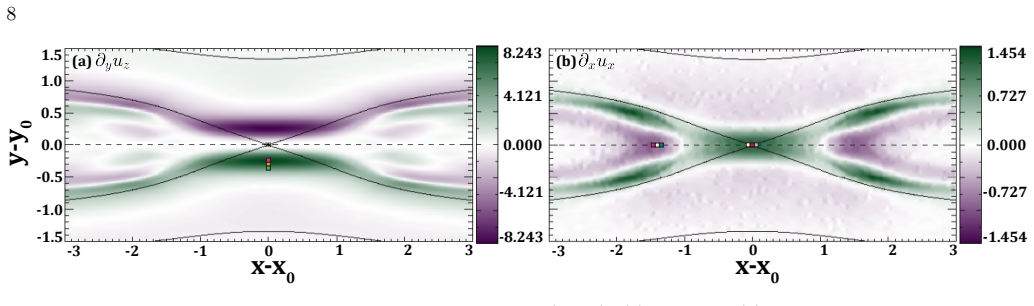
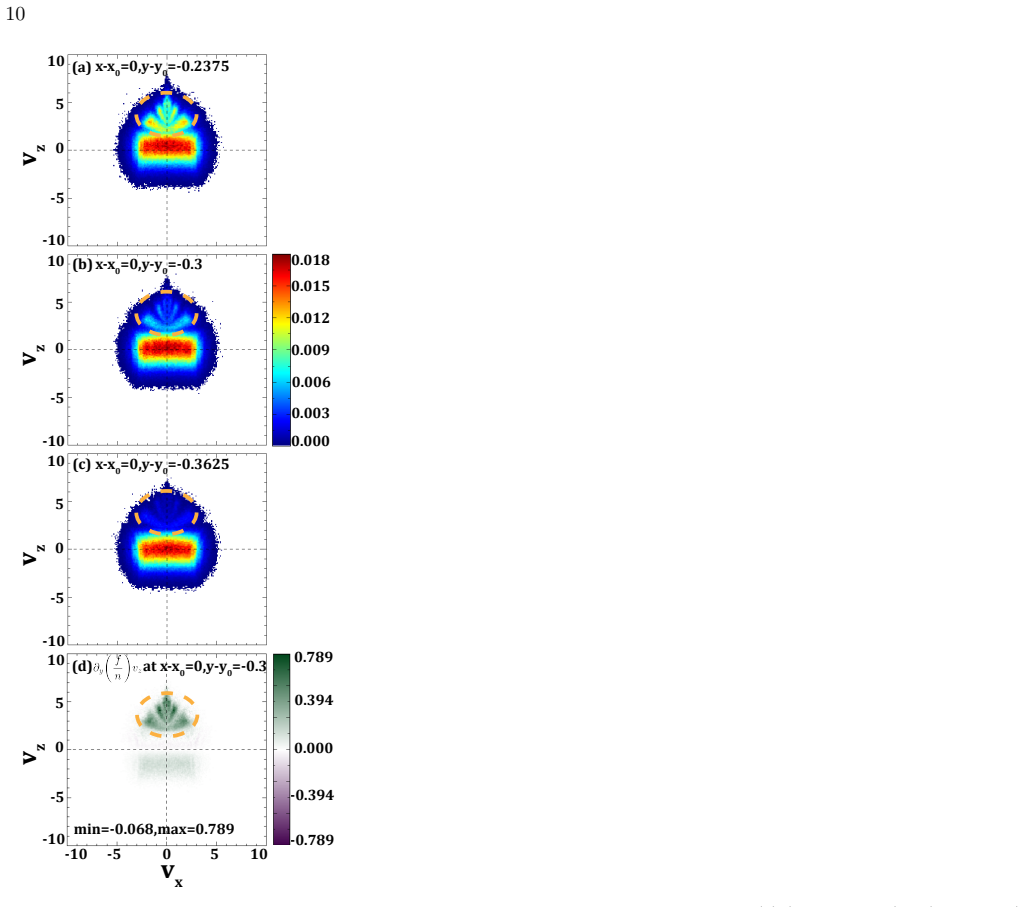
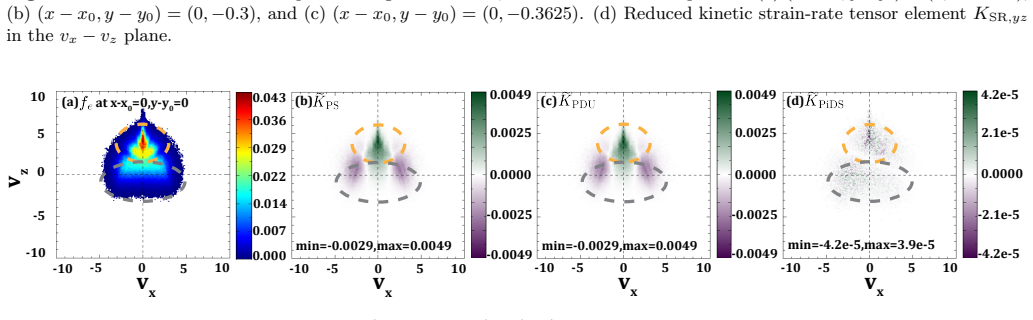


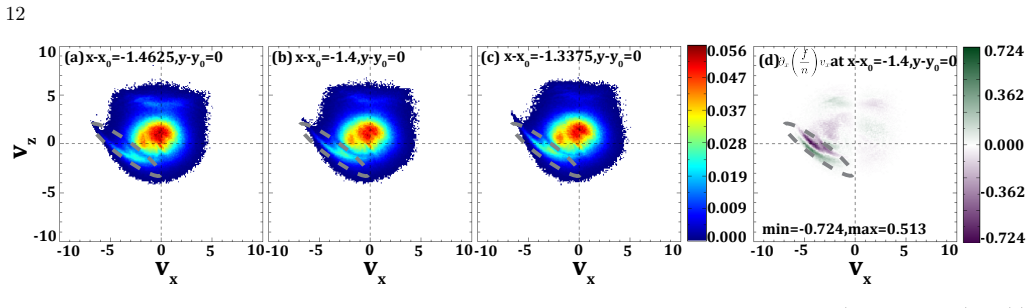

read the original abstract
A forefront research question is how energy evolves in weakly collisional plasmas for which departures from local thermodynamic equilibrium (LTE) are significant. The standard approach is studying the terms in the non-LTE energy evolution equation derived by taking the second moment of the Boltzmann equation, but the resultant fluid metrics do not retain information about which particles at which velocities drive energy evolution. A widely studied channel for internal energy density evolution is the pressure-strain interaction. Here we employ the kinetic pressure-strain [S. A. Conley et al., ${\it Phys. Plasmas,} {\bf 31}$, 122117 (2024)], a phase space diagnostic whose velocity-space integral recovers the pressure-strain interaction to disambiguate the contributions to pressure-strain interaction from disparate particle populations in composite phase-space densities. We develop phase-space analogs of the pressure-strain interaction decompositions to provide the phase-space origins of normal vs. sheared flow. We introduce the "kinetic strain-rate" tensor, the phase-space analog of strain-rate tensor, which we argue is needed to interpret phase-space origins of pressure-strain interaction. To demonstrate the utility of these quantities, we investigate them for composite electron distributions near the electron diffusion region in two-dimensional particle-in-cell simulations of antiparallel symmetric magnetic reconnection. We find that the phase space-based diagnostics isolate the roles of distinct populations. These results contribute to a growing body of work providing new methods for quantifying phase space energy evolution for a broad array of processes, from magnetic reconnection to collisionless shocks and turbulence, opening new pathways for answering longstanding problems of particle energization in weakly collisional plasmas.
Editorial analysis
A structured set of objections, weighed in public.
Referee Report
Summary. The paper introduces phase-space diagnostics derived from the kinetic pressure-strain interaction (building on Conley et al. 2024) to isolate contributions from distinct particle populations within composite velocity distributions. It develops phase-space analogs of normal vs. sheared flow decompositions, introduces a 'kinetic strain-rate' tensor, and applies these to electron distributions near the electron diffusion region in 2D PIC simulations of antiparallel symmetric magnetic reconnection, claiming that the diagnostics successfully disambiguate population roles in pressure-strain interaction.
Significance. If the decomposition remains valid and interpretable for composite distributions, the work provides a valuable extension of fluid energy evolution metrics into velocity space, enabling more precise identification of energization mechanisms in weakly collisional plasmas. This could impact studies of reconnection, shocks, and turbulence by linking phase-space features directly to pressure-strain without additional fitting parameters. The application to established PIC setups offers a concrete demonstration, though the strength depends on validation of the core decomposition property.
major comments (1)
- [Abstract] Abstract and introduction: the central claim that the velocity-space decomposition of kinetic pressure-strain interaction remains additive and unambiguous when applied to composite multi-population f(v) lacks any derivation, analytic test case, or validation against known superpositions. The abstract notes only that the integral recovers the fluid pressure-strain, but does not demonstrate that the phase-space partitioning (or the introduced kinetic strain-rate tensor) inherits this property without ambiguity for overlapping distributions, which is load-bearing for the claimed isolation of distinct populations.
Simulated Author's Rebuttal
We thank the referee for their constructive review. The major comment correctly notes that the manuscript does not explicitly derive or validate additivity of the kinetic pressure-strain decomposition (and the kinetic strain-rate tensor) for composite distributions. We address this below and will revise the manuscript to include the requested derivation and test case.
read point-by-point responses
-
Referee: [Abstract] Abstract and introduction: the central claim that the velocity-space decomposition of kinetic pressure-strain interaction remains additive and unambiguous when applied to composite multi-population f(v) lacks any derivation, analytic test case, or validation against known superpositions. The abstract notes only that the integral recovers the fluid pressure-strain, but does not demonstrate that the phase-space partitioning (or the introduced kinetic strain-rate tensor) inherits this property without ambiguity for overlapping distributions, which is load-bearing for the claimed isolation of distinct populations.
Authors: We agree that an explicit derivation is needed. The kinetic pressure-strain interaction is constructed so that its velocity integral recovers the fluid pressure-strain (Conley et al. 2024). For a composite distribution f = Σ f_i the definition is linear in f, so ∫ KPS(f) dv = Σ ∫ KPS(f_i) dv holds by direct substitution regardless of velocity-space overlap; the populations are isolated by partitioning f into the f_i before evaluating the diagnostic. The same linearity applies to the kinetic strain-rate tensor. We will add this derivation to Section 2 and include an analytic test case (superposed Maxwellians) in a new appendix to demonstrate the property for overlapping distributions. revision: yes
Circularity Check
No significant circularity; derivation self-contained
full rationale
The paper applies the kinetic pressure-strain diagnostic introduced in the cited Conley et al. (2024) work to multi-population distributions in PIC reconnection simulations, then defines phase-space analogs and a new 'kinetic strain-rate' tensor to interpret contributions. No equations or steps reduce by construction to fitted parameters, self-definitions, or load-bearing self-citations; the central results are obtained by direct application of the prior diagnostic to simulation data without statistical forcing or renaming of known results. The 2024 reference provides independent kinetic-theory grounding, and the present work adds no circular closure in its decomposition or application.
Axiom & Free-Parameter Ledger
axioms (2)
- standard math The second moment of the Boltzmann equation yields the fluid pressure-strain interaction whose kinetic analog is given by Conley et al. 2024.
- domain assumption Composite phase-space densities can be decomposed into distinct populations whose separate contributions to pressure-strain remain physically meaningful.
invented entities (1)
-
kinetic strain-rate tensor
no independent evidence
Reference graph
Works this paper leans on
-
[1]
Adhikari, S., Yang, Y., & Matthaeus, W. H. 2025, Physics of Plasmas, 32, 124502, doi: 10.1063/5.0295281
-
[2]
Afshari, A. S., Howes, G. G., Kletzing, C. A., Hartley, D. P., & Boardsen, S. A. 2021, Journal of Geophysical Research: Space Physics, 126, e2021JA029578, doi: 10.1029/2021JA029578
-
[3]
Afshari, A. S., Howes, G. G., Shuster, J. R., et al. 2024, Nature Communications, 15, 7870, doi: 10.1038/s41467-024-52125-8
-
[4]
Bandyopadhyay, R., Chasapis, A., Matthaeus, W. H., et al. 2021, Physics of Plasmas, 28, 112305, doi: 10.1063/5.0071015
-
[5]
H., Cassak, P., Shay, M., et al
Barbhuiya, M. H., Cassak, P., Shay, M., et al. 2022, Journal of Geophysical Research: Space Physics, 127, e2022JA030610, doi: https://doi.org/10.1029/2022JA030610
-
[6]
Barbhuiya, M. H., & Cassak, P. A. 2022, Physics of Plasmas, 29, 122308, doi: 10.1063/5.0125256
-
[7]
Barbhuiya, M. H., Cassak, P. A., Adhikari, S., et al. 2024, Physical Review E, 109, 015205, doi: 10.1103/PhysRevE.109.015205
-
[8]
Barbhuiya, M. H., Cassak, P. A., Chasapis, A., et al. 2025, Journal of Geophysical Research: Space Physics, 130, e2024JA033446, doi: 10.1029/2024JA033446
-
[9]
Bessho, N., Chen, L.-J., Shuster, J. R., & Wang, S. 2014, Geophysical Research Letters, 41, 8688, doi: 10.1002/2014GL062034
-
[10]
Bessho, N., Chen, L.-J., Wang, S., & Hesse, M. 2018, Geophysical Research Letters, 45, 12,142, doi: 10.1029/2018GL081216 Bharati Das, S., & Terres, M. 2025a, The Astrophysical Journal, 982, 96, doi: 10.3847/1538-4357/adb6a0 Bharati Das, S., & Terres, M. 2025b, The Astrophysical Journal, 996, 80, doi: 10.3847/1538-4357/ae1d71
-
[11]
K., & Langdon, A
Birdsall, C. K., & Langdon, A. B. 1991, Plasma Physics via Computer Simulation (Philadelphia: Institute of Physics Publishing) 19
1991
-
[12]
2023, Journal of Plasma Physics, 89, 905890308, doi: 10.1017/S0022377823000478
Constantinou, S. 2023, Journal of Plasma Physics, 89, 905890308, doi: 10.1017/S0022377823000478
-
[13]
Burch, J. L., Torbert, R. B., Phan, T. D., et al. 2016, Science, 352, 6290, doi: https://doi.org/10.1126/science.aaf2939
-
[14]
Burch, J. L., Genestreti, K. J., Heuer, S. V., et al. 2023, Physics of Plasmas, 30, 082903, doi: 10.1063/5.0153628
-
[15]
Cassak, P. A., & Barbhuiya, M. H. 2022, Physics of Plasmas, 29, 122306, doi: 10.1063/5.0125248
-
[16]
Chasapis, A., Yang, Y., Matthaeus, W. H., et al. 2018, The Astrophysical Journal, 862, 32, doi: 10.3847/1538-4357/aac775
-
[17]
Chen, C. H. K., Klein, K. G., & Howes, G. G. 2019, Nature Communications, 10, 740, doi: https://doi.org/10.1038/s41467-019-08435-3
-
[18]
Conley, S. A., Juno, J., TenBarge, J. M., et al. 2024, Physics of Plasmas, 31, 122117, doi: 10.1063/5.0231200 Del Sarto, D., Pegoraro, F., & Califano, F. 2016, Physical Review E, 93, 053203, doi: 10.1103/PhysRevE.93.053203
-
[19]
Du, S., Guo, F., Zank, G. P., Li, X., & Stanier, A. 2018, The Astrophysical Journal, 867, 16, doi: 10.3847/1538-4357/aae30e
-
[20]
Du, S., Zank, G. P., Li, X., & Guo, F. 2020, Phys. Rev. E, 101, 033208, doi: 10.1103/PhysRevE.101.033208
-
[21]
M., Crabtree, C., Ganguli, G., Malaspina, D
DuBois, A. M., Crabtree, C., Ganguli, G., Malaspina, D. M., & Amatucci, W. E. 2022, Physical Review Letters, 129, 105101, doi: https://doi.org/10.1103/PhysRevLett.129.105101
-
[22]
M., Crabtree, C., Lichko, E., & Ganguli, G
DuBois, A. M., Crabtree, C., Lichko, E., & Ganguli, G. 2026, Journal of Geophysical Research: Space Physics, 131, e2025JA034543, doi: https://doi.org/10.1029/2025JA034543
-
[23]
Dunlop, M. W., Balogh, A., Glassmeier, K. H., & Robert, P. 2002, Journal of Geophysical Research (Space Physics), 107, 1384, doi: 10.1029/2001JA005088
-
[24]
Edyvean, J., Parashar, T. N., Simpson, T., et al. 2024, The Astrophysical Journal, 972, 173, doi: https://doi.org/10.3847/1538-4357/ad5cf5
-
[25]
2013, Physics of Plasmas, 20, 061201, doi: 10.1063/1.4811092
Egedal, J., Le, A., & Daughton, W. 2013, Physics of Plasmas, 20, 061201, doi: 10.1063/1.4811092
-
[26]
1964, Elements of plasma physics (Holt, Rinehart and Winston, New York)
Gartenhaus, S. 1964, Elements of plasma physics (Holt, Rinehart and Winston, New York)
1964
-
[27]
Goldman, M. V., Newman, D. L., Eastwood, J. P., et al. 2021, Physics of Plasmas, 28, doi: https://doi.org/10.1063/5.0063431
-
[28]
Greess, S., Egedal, J., Stanier, A., et al. 2021, Journal of Geophysical Research: Space Physics, 126, e2021JA029316, doi: https://doi.org/10.1029/2021JA029316
-
[29]
Guzdar, P. N., Drake, J. F., McCarthy, D., Hassam, A. B., & Liu, C. S. 1993, Phys. Fluids B, 5, 3712, doi: https://doi.org/10.1063/1.860842
-
[30]
Harris, E. G. 1962, Nuovo Cimento, 23, 115, doi: https://doi.org/10.1007/BF02733547
-
[31]
1998, in ISSI Scientific Report Series, Vol
Harvey, C. 1998, in ISSI Scientific Report Series, Vol. SR1, Analysis Methods for Multi-Spacecraft Data, ed. G. Paschmann & P. W. Daly, 307–321
1998
-
[32]
Howes, G. G. 2017, Physics of Plasmas, 24, 055907, doi: 10.1063/1.4983993
-
[33]
Juno, J., Brown, C. R., Howes, G. G., et al. 2023, The Astrophysical Journal, 944, 15, doi: 10.3847/1538-4357/acaf53
-
[34]
Juno, J., Howes, G. G., TenBarge, J. M., et al. 2021, Journal of Plasma Physics, 87, doi: https://doi.org/10.1017/S0022377821000623
-
[35]
Klein, K. G., & Howes, G. G. 2016, The Astrophysical Journal Letters, 826, L30, doi: http://dx.doi.org/10.3847/2041-8205/826/2/L30
-
[36]
Klein, K. G., Howes, G. G., & TenBarge, J. M. 2017, Journal of Plasma Physics, 83, doi: https://doi.org/10.1017/S0022377817000563
-
[37]
Klein, K. G., Howes, G. G., TenBarge, J. M., & Valentini, F. 2020, Journal of Plasma Physics, 86, doi: https://doi.org/10.1017/S0022377820000689
-
[38]
G., Spence, H., Alexandrova, O., et al
Klein, K. G., Spence, H., Alexandrova, O., et al. 2023, Space Science Reviews, 219, 74, doi: 10.1007/s11214-023-01019-0
-
[39]
2018, in , Copernicus GmbH, 1607–1630, doi: https://doi.org/10.5194/angeo-36-1607-2018
Marsch, E. 2018, in , Copernicus GmbH, 1607–1630, doi: https://doi.org/10.5194/angeo-36-1607-2018
-
[40]
Matthaeus, W. H., Yang, Y., Wan, M., et al. 2020, The Astrophysical Journal, 891, 101, doi: 10.3847/1538-4357/ab6d6a
-
[41]
McCubbin, A. J., Howes, G. G., & TenBarge, J. M. 2022, Physics of plasmas, 29, doi: https://doi.org/10.1063/5.0082213
-
[42]
Montag, P., & Howes, G. G. 2022, Physics of Plasmas, 29, 032901, doi: https://doi.org/10.1063/5.0036825
-
[43]
Montag, P., Howes, G. G., McGinnis, D., et al. 2025, The Astrophysical Journal Letters, 980, L23, doi: 10.3847/2041-8213/adb0b2
-
[44]
2012, Physics of Plasmas, 19, 112108, doi: 10.1063/1.4766895
Ng, J., Egedal, J., Le, A., & Daughton, W. 2012, Physics of Plasmas, 19, 112108, doi: 10.1063/1.4766895
-
[45]
2011, Physical Review Letters, 106, 065002, doi: 10.1103/PhysRevLett.106.065002
Ng, J., Egedal, J., Le, A., Daughton, W., & Chen, L.-J. 2011, Physical Review Letters, 106, 065002, doi: 10.1103/PhysRevLett.106.065002
-
[46]
2025, Physics of Plasmas, 32, 052109, doi: 10.1063/5.0246402 20
Norgren, C., Hesse, M., Phan, T., et al. 2025, Physics of Plasmas, 32, 052109, doi: 10.1063/5.0246402 20
-
[47]
2016, Space Science Reviews, 199, 331, doi: 10.1007/s11214-016-0245-4
Pollock, C., Moore, T., Jacques, A., et al. 2016, Space Science Reviews, 199, 331, doi: 10.1007/s11214-016-0245-4
-
[48]
Ren, Y., Dai, L., Wang, C., et al. 2024, Geophysical Research Letters, 51, e2024GL112074, doi: 10.1029/2024GL112074 Retin` o, A., Khotyaintsev, Y., Le Contel, O., et al. 2022, Experimental Astronomy, 54, 427, doi: https://doi.org/10.1007/s10686-021-09797-7 San` o, B., Maes Anno, N. N., Newman, D. L., et al. 2025, Journal of Geophysical Research: Machine L...
-
[49]
Shi, P., Srivastav, P., Barbhuiya, M. H., et al. 2022, Physical Review Letters, 128, 025002, doi: 10.1103/PhysRevLett.128.025002
-
[50]
R., Bessho, N., Wang, S., & Ng, J
Shuster, J. R., Bessho, N., Wang, S., & Ng, J. 2021a, Physics of Plasmas, 28, 122902, doi: 10.1063/5.0069559
-
[51]
R., Chen, L.-J., Hesse, M., et al
Shuster, J. R., Chen, L.-J., Hesse, M., et al. 2015, Geophysical Research Letters, 42, 2586, doi: 10.1002/2015GL063601
-
[52]
Shuster, J. R., Chen, L.-J., Daughton, W. S., et al. 2014, Geophysical Research Letters, 41, 5389, doi: 10.1002/2014gl060608
-
[53]
Shuster, J. R., Gershman, D. J., Chen, L.-J., et al. 2019, Geophysical Research Letters, 46, 7862, doi: https://doi.org/10.1029/2019GL083549
-
[54]
Shuster, J. R., Gershman, D. J., Dorelli, J. C., et al. 2021b, Nature Phys., 17, 1056, doi: 10.1038/s41567-021-01280-6
-
[55]
Shuster, J. R., Gershman, D. J., Giles, B. L., et al. 2023, Journal of Geophysical Research: Space Physics, 128, e2022JA030949, doi: 10.1029/2022JA030949
-
[56]
Shuster, J. R., Bessho, N., Dorelli, J. C., et al. 2026, Communications Physics, doi: 10.1038/s42005-026-02489-8
-
[57]
2026, arXiv preprint arXiv:2601.05426
Singh, R., Banerjee, S., & Halder, A. 2026, arXiv preprint arXiv:2601.05426
arXiv 2026
-
[58]
2020, Journal of Geophysical Research: Space Physics, 125, e2020JA028278, doi: 10.1029/2020JA028278
Song, L., Zhou, M., Yi, Y., et al. 2020, Journal of Geophysical Research: Space Physics, 125, e2020JA028278, doi: 10.1029/2020JA028278
-
[59]
Speiser, T. W. 1965, Journal of Geophysical Research (1896-1977), 70, 4219, doi: https://doi.org/10.1029/JZ070i017p04219
-
[60]
W., & Schuller, A
Trottenberg, U., Oosterlee, C. W., & Schuller, A. 2000, Multigrid (Academic Press, San Diego)
2000
-
[61]
2019, Geophysical Research Letters, 46, 562, doi: https://doi.org/10.1029/2018GL080944
Wang, S., Chen, L.-J., Bessho, N., et al. 2019, Geophysical Research Letters, 46, 562, doi: https://doi.org/10.1029/2018GL080944
-
[62]
Yang, Y., Matthaeus, W. H., Roy, S., et al. 2022, The Astrophysical Journal, 929, 142, doi: 10.3847/1538-4357/ac5d3e
-
[63]
Yang, Y., Matthaeus, W. H., Parashar, T. N., et al. 2017a, Physics of Plasmas, 24, 072306, doi: 10.1063/1.4990421
-
[64]
Yang, Y., Matthaeus, W. H., Parashar, T. N., et al. 2017b, Physical Review E, 95, 061201, doi: 10.1103/PhysRevE.95.061201
-
[65]
Zeiler, A., Biskamp, D., Drake, J. F., et al. 2002, J. Geophys. Res., 107, 1230, doi: 10.1029/2001JA000287
-
[66]
2021, Geophysical Research Letters, 48, e2021GL096372, doi: 10.1029/2021GL096372
Zhou, M., Man, H., Yang, Y., Zhong, Z., & Deng, X. 2021, Geophysical Research Letters, 48, e2021GL096372, doi: 10.1029/2021GL096372
discussion (0)
Sign in with ORCID, Apple, or X to comment. Anyone can read and Pith papers without signing in.