Unveiling the Structure of Do-Calculus Reasoning via Derivation Graphs
Pith reviewed 2026-06-28 09:58 UTC · model grok-4.3
The pith
Derivation graphs show that do-calculus can transform any interventional query into an equivalent observational expression with at most four rule applications.
A machine-rendered reading of the paper's core claim, the machinery that carries it, and where it could break.
Core claim
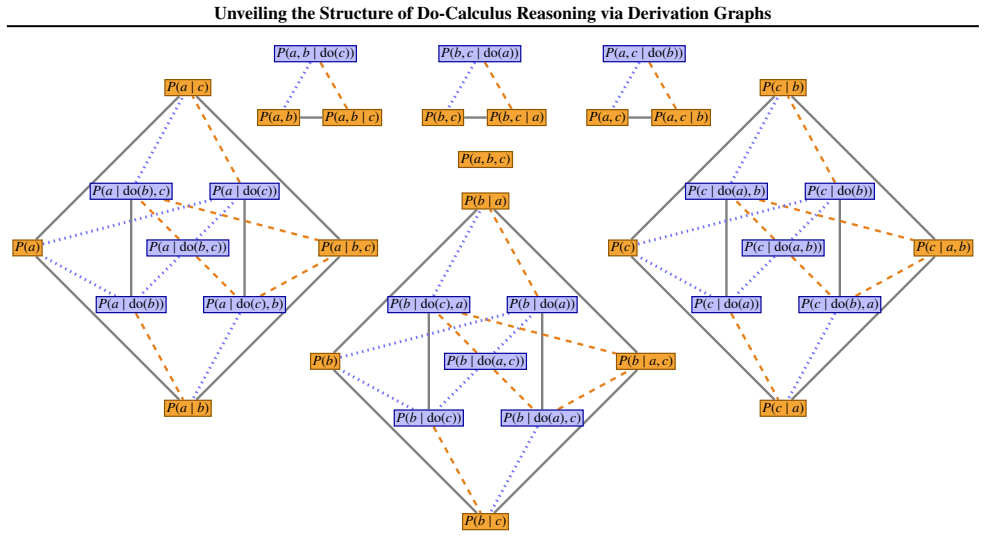
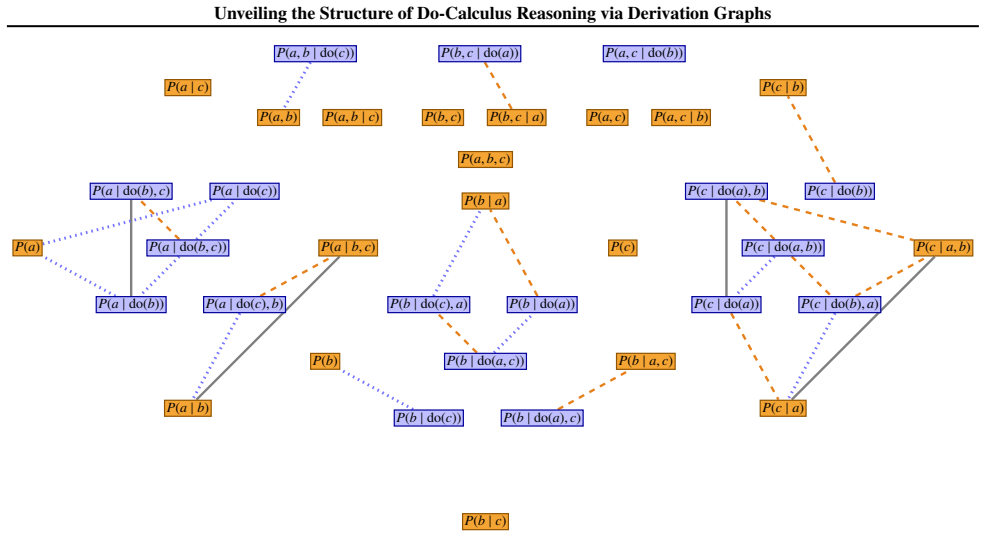
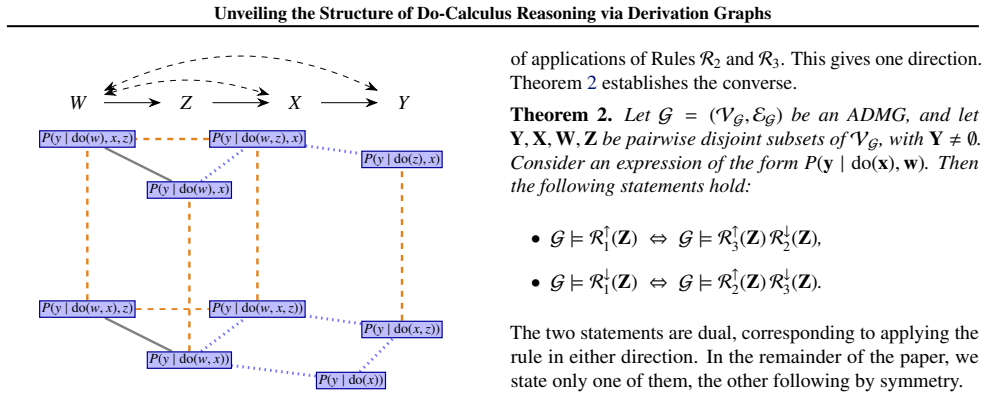
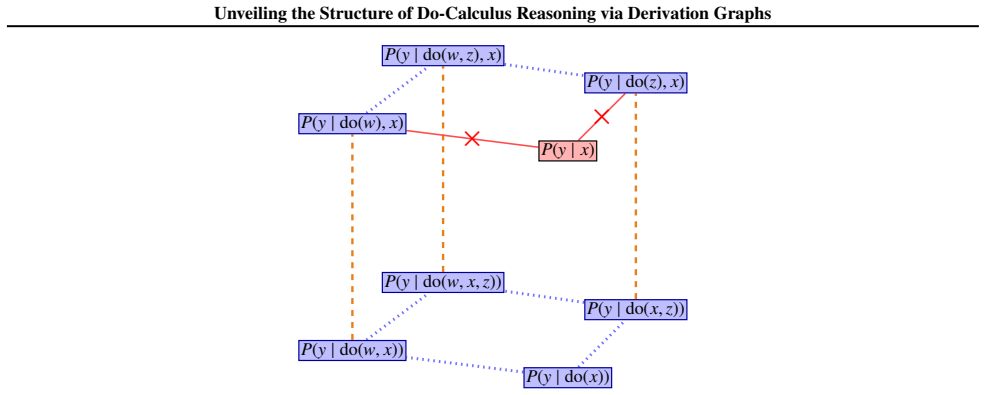
Derivation graphs represent how do-calculus rules are applied and combined, and they characterize the full space of observational and interventional probabilities which are equivalent under the do-calculus. The structure of these graphs yields a simple procedure that uses at most four applications of do-calculus rules. Applying identification algorithms to equivalent causal queries produces multiple valid estimands for the same causal quantity, eventually yielding more efficient estimators.
What carries the argument
Derivation graphs, which enumerate sequences of do-calculus rule applications to rewrite interventional expressions as observational ones.
If this is right
- Any identification of an interventional query can be completed in four or fewer rule steps.
- Running identification on each equivalent expression produces a set of distinct but correct estimands for the same target quantity.
- The collection of estimands can be combined to produce a single estimator with lower variance than any one of them alone.
- The graphs give a complete map of all observational expressions that the do-calculus can derive from a given interventional query.
Where Pith is reading between the lines
- Automated causal-identification software could limit its search to depth four without losing completeness for the queries covered by the graphs.
- Having several independent estimands for one quantity supplies a practical way to cross-check numerical results or to detect model misspecification.
- The same graph-construction idea might be applied to other rule-based causal systems to obtain similar bounded rewriting procedures.
Load-bearing premise
The graphs list every valid sequence of rule applications without missing any or including redundant ones, so the four-application bound holds for all cases considered.
What would settle it
A concrete causal query for which every valid identification path requires five or more do-calculus rule applications, or for which the graphs omit at least one valid sequence.
Figures




read the original abstract
The do-calculus defines a general system of inference for interventional queries, allowing causal quantities to be transformed through successive applications of its rules. This process induces a rich space of equivalent interventional expressions, but combining and ordering these rules remains challenging. In this work, we introduce derivation graphs, which represent how do-calculus rules are applied and combined, and characterize the full space of observational and interventional probabilities which are equivalent under the do-calculus. The structure of these graphs yields a simple procedure that uses at most four applications of do-calculus rules. Finally, we show how applying identification algorithms to equivalent causal queries produces multiple valid estimands for the same causal quantity, eventually yielding more efficient estimators.
Editorial analysis
A structured set of objections, weighed in public.
Referee Report
Summary. The paper introduces derivation graphs to represent sequences of do-calculus rule applications, claims these graphs fully characterize the space of equivalent interventional and observational expressions under the do-calculus, derives from their structure a simple procedure requiring at most four rule applications, and shows that identification algorithms applied to equivalent queries can produce multiple valid estimands for the same causal quantity, potentially yielding more efficient estimators.
Significance. If the derivation graphs are shown to be exhaustive and the four-application bound is tight and complete, the work would offer a structural tool for systematically enumerating do-calculus derivations and exploiting equivalence classes for estimator efficiency in causal inference.
major comments (2)
- [Abstract] The central claim of a procedure using at most four applications rests on the assertion that derivation graphs exhaustively enumerate all valid sequences of the three do-calculus rules without omission or duplication across equivalence classes. The abstract provides no indication of a completeness argument (e.g., induction on rule applications or exhaustive enumeration of sequences up to length 4), leaving the bound dependent on an unstated assumption.
- [Abstract (central claim on derivation graphs)] The weakest assumption identified—that the graph-construction procedure enumerates every admissible ordering—directly undermines the 'simple procedure' and 'full space' characterization if even one sequence is missed; this must be addressed with a formal proof or verification before the bound can be accepted as general.
minor comments (2)
- Define 'derivation graph' and its construction algorithm with explicit pseudocode or a small worked example in the main text rather than deferring to supplementary material.
- Clarify whether the four-application bound applies only to certain equivalence classes or holds for arbitrary interventional queries; state any restrictions explicitly.
Simulated Author's Rebuttal
We thank the referee for the careful review and for highlighting the need to make the completeness argument more visible. The manuscript contains a formal proof of exhaustiveness for derivation graphs (via induction on rule applications), but we agree the abstract does not reference it explicitly. We will revise the abstract accordingly.
read point-by-point responses
-
Referee: [Abstract] The central claim of a procedure using at most four applications rests on the assertion that derivation graphs exhaustively enumerate all valid sequences of the three do-calculus rules without omission or duplication across equivalence classes. The abstract provides no indication of a completeness argument (e.g., induction on rule applications or exhaustive enumeration of sequences up to length 4), leaving the bound dependent on an unstated assumption.
Authors: The full manuscript (Section 3) proves completeness by induction on the number of rule applications, establishing that the graph-construction procedure enumerates every admissible sequence without omission or duplication. The abstract summarizes the resulting bound but omits reference to this proof. We will revise the abstract to state that the four-application bound is supported by the completeness theorem. revision: yes
-
Referee: [Abstract (central claim on derivation graphs)] The weakest assumption identified—that the graph-construction procedure enumerates every admissible ordering—directly undermines the 'simple procedure' and 'full space' characterization if even one sequence is missed; this must be addressed with a formal proof or verification before the bound can be accepted as general.
Authors: The manuscript directly addresses this concern with a formal completeness proof (Section 3) showing that the construction enumerates all admissible orderings. We will update the abstract to explicitly reference this proof, making the support for the 'full space' characterization and the simple procedure clear. revision: yes
Circularity Check
No significant circularity; derivation is self-contained
full rationale
The paper introduces derivation graphs as a new representational tool to enumerate and structure do-calculus rule applications, then derives from their structure a bound of at most four applications and a method for multiple estimands. No quoted equations or definitions reduce the central claims to self-referential inputs, fitted parameters, or load-bearing self-citations; the exhaustiveness claim is presented as following from the graph construction itself rather than being presupposed by it. This is the normal case of an independent structural contribution.
Axiom & Free-Parameter Ledger
axioms (1)
- domain assumption The three rules of do-calculus are sound and complete for transforming interventional queries into observational ones under the usual causal assumptions.
invented entities (1)
-
derivation graph
no independent evidence
Reference graph
Works this paper leans on
-
[1]
Proceedings of the Thirty-Eighth Conference on Uncertainty in Artificial Intelligence , pages =
Discovery of extended summary graphs in time series , author =. Proceedings of the Thirty-Eighth Conference on Uncertainty in Artificial Intelligence , pages =. 2022 , editor =
2022
-
[2]
2022 , eprint=
Towards Computing an Optimal Abstraction for Structural Causal Models , author=. 2022 , eprint=
2022
-
[3]
Proceedings of the Fortieth Conference on Uncertainty in Artificial Intelligence , articleno =
Zennaro, Fabio Massimo and Bishop, Nicholas and Dyer, Joel and Felekis, Yorgos and Calinescu, Anisoara and Wooldridge, Michael and Damoulas, Theodoros , title =. Proceedings of the Fortieth Conference on Uncertainty in Artificial Intelligence , articleno =. 2024 , publisher =
2024
-
[4]
Zennaro, Fabio Massimo and Turrini, Paolo and Damoulas, Theodoros , title =. Proceedings of the Thirty-Second International Joint Conference on Artificial Intelligence , articleno =. 2023 , isbn =. doi:10.24963/ijcai.2023/638 , abstract =
-
[5]
Journal of Causal Inference , doi =
Foundations of causal discovery on groups of variables , author =. Journal of Causal Inference , doi =. 2024 , lastchecked =
2024
-
[6]
Learning structures of Bayesian networks for variable groups , journal =
Pekka Parviainen and Samuel Kaski , keywords =. Learning structures of Bayesian networks for variable groups , journal =. 2017 , issn =. doi:https://doi.org/10.1016/j.ijar.2017.05.006 , url =
-
[7]
Proceedings of the Thirty-Seventh Conference on Uncertainty in Artificial Intelligence , pages =
Compositional abstraction error and a category of causal models , author =. Proceedings of the Thirty-Seventh Conference on Uncertainty in Artificial Intelligence , pages =. 2021 , editor =
2021
-
[8]
Proceedings of the AAAI Conference on Artificial Intelligence , author=
Identifiability of Direct Effects from Summary Causal Graphs , volume=. Proceedings of the AAAI Conference on Artificial Intelligence , author=. 2024 , month=. doi:10.1609/aaai.v38i18.30021 , number=
-
[9]
Proceedings of the AAAI Conference on Artificial Intelligence , author=
Vector Causal Inference between Two Groups of Variables , volume=. Proceedings of the AAAI Conference on Artificial Intelligence , author=. 2023 , month=. doi:10.1609/aaai.v37i10.26450 , abstractNote=
-
[10]
2024 , eprint=
Targeted Reduction of Causal Models , author=. 2024 , eprint=
2024
-
[11]
Markov Properties for Acyclic Directed Mixed Graphs , volume=
Richardson, Thomas , year=. Markov Properties for Acyclic Directed Mixed Graphs , volume=. Scandinavian Journal of Statistics , publisher=. doi:10.1111/1467-9469.00323 , number=
-
[12]
Causality: Models, Rea- soning, and Inference
Pearl, Judea , year =. Causality , isbn =. doi:10.1017/CBO9780511803161 , file =
-
[13]
, title =
Shpitser, Ilya and VanderWeele, Tyler and Robins, James M. , title =. Proceedings of the Twenty-Sixth Conference on Uncertainty in Artificial Intelligence , pages =. 2010 , isbn =
2010
-
[14]
The 40th Conference on Uncertainty in Artificial Intelligence , year=
Targeted Reduction of Causal Models , author=. The 40th Conference on Uncertainty in Artificial Intelligence , year=
-
[15]
Proceedings of The First AAAI Bridge Program on Continual Causality , pages =
Continual Causal Abstractions , author =. Proceedings of The First AAAI Bridge Program on Continual Causality , pages =. 2023 , editor =
2023
-
[16]
Richard Guo and Emilija Perkovi\'c , title =
F. Richard Guo and Emilija Perkovi\'c , title =. Journal of Machine Learning Research , year =
-
[17]
and Didelez, Vanessa , title =
Witte, Janine and Henckel, Leonard and Maathuis, Marloes H. and Didelez, Vanessa , title =. J. Mach. Learn. Res. , month = jan, articleno =. 2020 , issue_date =
2020
-
[18]
Maathuis , title =
Emilija Perkovi\'c and Johannes Textor and Markus Kalisch and Marloes H. Maathuis , title =. Journal of Machine Learning Research , year =
-
[19]
Proceedings of the 36th Conference on Uncertainty in Artificial Intelligence (UAI) , pages =
Identifying causal effects in maximally oriented partially directed acyclic graphs , author =. Proceedings of the 36th Conference on Uncertainty in Artificial Intelligence (UAI) , pages =. 2020 , editor =
2020
-
[20]
Journal of Causal Inference , doi =
A note on efficient minimum cost adjustment sets in causal graphical models , author =. Journal of Causal Inference , doi =. 2022 , lastchecked =
2022
-
[21]
2025 , eprint=
Efficient adjustment for complex covariates: Gaining efficiency with DOPE , author=. 2025 , eprint=
2025
-
[22]
Henckel, Leonard and Perković, Emilija and Maathuis, Marloes H. , title =. Journal of the Royal Statistical Society Series B: Statistical Methodology , volume =. 2022 , month =. doi:10.1111/rssb.12451 , url =
-
[23]
Proceedings of the 35th International Conference on Neural Information Processing Systems , articleno =
Runge, Jakob , title =. Proceedings of the 35th International Conference on Neural Information Processing Systems , articleno =. 2021 , isbn =
2021
-
[24]
Guo, F Richard and Perković, Emilija and Rotnitzky, Andrea , title =. Biometrika , volume =. 2022 , month =. doi:10.1093/biomet/asac062 , url =
-
[25]
Mathur and Tyler J
Maya B. Mathur and Tyler J. VanderWeele and Ilya Shpitser , title =. The Annals of Statistics , number =. 2025 , doi =
2025
-
[26]
Journal of Machine Learning Research , year =
Andrea Rotnitzky and Ezequiel Smucler , title =. Journal of Machine Learning Research , year =
-
[27]
Tikka, Santtu and Karvanen, Juha , title =. J. Mach. Learn. Res. , month = jan, pages =. 2017 , issue_date =
2017
-
[28]
Identification of joint interventional distributions in recursive semi-
Shpitser, Ilya and Pearl, Judea , month = jul, year =. Identification of joint interventional distributions in recursive semi-. proceedings of the 21st national conference on
-
[29]
Identification of conditional interventional distributions , isbn =
Shpitser, Ilya and Pearl, Judea , month = jul, year =. Identification of conditional interventional distributions , isbn =. Proceedings of the
-
[30]
Pearl's calculus of intervention is complete , isbn =
Huang, Yimin and Valtorta, Marco , month = jul, year =. Pearl's calculus of intervention is complete , isbn =. Proceedings of the
-
[31]
Causal networks: semantics and expressiveness , isbn =
Verma, Thomas and Pearl, Judea , month = jan, year =. Causal networks: semantics and expressiveness , isbn =. Proceedings of the
-
[32]
Causal diagrams for empirical research , volume =. Biometrika , author =. 1995 , pages =. doi:10.1093/biomet/82.4.669 , abstract =
-
[33]
On the testable implications of causal models with hidden variables , isbn =
Tian, Jin and Pearl, Judea , month = aug, year =. On the testable implications of causal models with hidden variables , isbn =. Proceedings of the
-
[34]
Journal of Machine Learning Research , author =
Complete. Journal of Machine Learning Research , author =. 2018 , pages =. doi:10.3929/ethz-b-000278021 , abstract =
-
[35]
Journal of Machine Learning Research , author =
Causal. Journal of Machine Learning Research , author =. 2008 , pages =
2008
-
[36]
The Annals of Statistics , author =
Ancestral graph. The Annals of Statistics , author =. 2002 , note =. doi:10.1214/aos/1031689015 , abstract =
-
[38]
Artificial Intelligence , author=
On the completeness of orientation rules for causal discovery in the presence of latent confounders and selection bias , volume =. Artificial Intelligence , author =. 2008 , keywords =. doi:10.1016/j.artint.2008.08.001 , abstract =
-
[39]
Carnegie Mellon University , author =
Causal. Carnegie Mellon University , author =. 2006 , file =
2006
-
[40]
The Annals of Statistics , author =
Markov equivalence for ancestral graphs , volume =. The Annals of Statistics , author =. 2009 , file =. doi:10.1214/08-AOS626 , abstract =
-
[41]
Proceedings of the 2011 IEEE 11th International Conference on Data Mining Workshops , pages =
Pearl, Judea and Bareinboim, Elias , title =. Proceedings of the 2011 IEEE 11th International Conference on Data Mining Workshops , pages =. 2011 , isbn =. doi:10.1109/ICDMW.2011.169 , abstract =
-
[42]
Judea Pearl and Elias Bareinboim , editor =. External Validity: From. Probabilistic and Causal Inference: The Works of Judea Pearl , series =. 2022 , url =. doi:10.1145/3501714.3501741 , timestamp =
-
[43]
Eighteenth National Conference on Artificial Intelligence , pages =
Tian, Jin and Pearl, Judea , title =. Eighteenth National Conference on Artificial Intelligence , pages =. 2002 , isbn =
2002
-
[44]
Proceedings of the 19th International Conference on Artificial Intelligence and Statistics , pages =
Multi-Level Cause-Effect Systems , author =. Proceedings of the 19th International Conference on Artificial Intelligence and Statistics , pages =. 2016 , editor =
2016
-
[45]
Proceedings of the Thirty-First Conference on Uncertainty in Artificial Intelligence , pages =
Chalupka, Krzysztof and Perona, Pietro and Eberhardt, Frederick , title =. Proceedings of the Thirty-First Conference on Uncertainty in Artificial Intelligence , pages =. 2015 , publisher =
2015
-
[46]
Abstracting causal models, in: Proceedings of the AAAI Conference on Artificial Intelligence, pp
Beckers, Sander and Halpern, Joseph Y. , title =. Proceedings of the Thirty-Third AAAI Conference on Artificial Intelligence and Thirty-First Innovative Applications of Artificial Intelligence Conference and Ninth AAAI Symposium on Educational Advances in Artificial Intelligence , articleno =. 2019 , isbn =. doi:10.1609/aaai.v33i01.33012678 , abstract =
-
[47]
and Weichwald, Sebastian and Bongers, Stephan and Mooij, Joris and Janzing, Dominik and Grosse-Wentrup, Moritz and Sch
Rubenstein, Paul K. and Weichwald, Sebastian and Bongers, Stephan and Mooij, Joris and Janzing, Dominik and Grosse-Wentrup, Moritz and Sch. 2017 , booktitle =
2017
-
[48]
2024 , journal =
Foundations of causal discovery on groups of variables , author =. 2024 , journal =
2024
-
[49]
Toward Causal Representation Learning , year=
Schölkopf, Bernhard and Locatello, Francesco and Bauer, Stefan and Ke, Nan Rosemary and Kalchbrenner, Nal and Goyal, Anirudh and Bengio, Yoshua , journal=. Toward Causal Representation Learning , year=
-
[50]
Journal of Statistical Software , author=
Identifying Causal Effects with the R Package causaleffect , volume=. Journal of Statistical Software , author=. 2017 , pages=. doi:10.18637/jss.v076.i12 , abstract=
-
[51]
Proceedings of the AAAI Conference on Artificial Intelligence , author =
Causal. Proceedings of the AAAI Conference on Artificial Intelligence , author =. 2023 , keywords =. doi:10.1609/aaai.v37i10.26435 , abstract =
-
[52]
Causal Identification under Markov equivalence: Calculus, Algorithm, and Completeness , url =
Jaber, Amin and Ribeiro, Adele and Zhang, Jiji and Bareinboim, Elias , booktitle =. Causal Identification under Markov equivalence: Calculus, Algorithm, and Completeness , url =
-
[53]
Proceedings of the 33rd Conference on Uncertainty in Artificial Intelligence (UAI) , pages =
Causal Consistency of Structural Equation Models , author =. Proceedings of the 33rd Conference on Uncertainty in Artificial Intelligence (UAI) , pages =. 2017 , doi =
2017
-
[54]
NeurIPS 2024 Causal Representation Learning Workshop , year=
Interaction Asymmetry: A General Principle for Learning Composable Abstractions , author=. NeurIPS 2024 Causal Representation Learning Workshop , year=
2024
-
[55]
NeurIPS 2024 Causal Representation Learning Workshop , year=
Unsupervised Causal Abstraction , author=. NeurIPS 2024 Causal Representation Learning Workshop , year=
2024
-
[56]
The 40th Conference on Uncertainty in Artificial Intelligence , year=
Learning Causal Abstractions of Linear Structural Causal Models , author=. The 40th Conference on Uncertainty in Artificial Intelligence , year=
-
[57]
2024 , eprint=
Causal Abstraction: A Theoretical Foundation for Mechanistic Interpretability , author=. 2024 , eprint=
2024
-
[58]
Necessary and sufficient graphical conditions for optimal adjustment sets in causal graphical models with hidden variables , url =
Runge, Jakob , booktitle =. Necessary and sufficient graphical conditions for optimal adjustment sets in causal graphical models with hidden variables , url =
-
[59]
Confidence in causal inference under structure uncertainty in linear causal models with equal variances , title =
David Strieder and Mathias Drton , pages =. Confidence in causal inference under structure uncertainty in linear causal models with equal variances , title =. Journal of Causal Inference , doi =. 2023 , lastchecked =
2023
-
[60]
Proceedings of the Third Conference on Causal Learning and Reasoning , pages =
Dual Likelihood for Causal Inference under Structure Uncertainty , author =. Proceedings of the Third Conference on Causal Learning and Reasoning , pages =. 2024 , editor =
2024
-
[61]
Thirty-seventh Conference on Neural Information Processing Systems , year=
Causal Component Analysis , author=. Thirty-seventh Conference on Neural Information Processing Systems , year=
-
[62]
Thirty-seventh Conference on Neural Information Processing Systems , year=
Causal Effect Identification in Uncertain Causal Networks , author=. Thirty-seventh Conference on Neural Information Processing Systems , year=
-
[63]
Marginal Causal Consistency in Constraint-based Causal Learning , booktitle =
Anna Roumpelaki and Giorgos Borboudakis and Sofia Triantafillou and Ioannis Tsamardinos , editor =. Marginal Causal Consistency in Constraint-based Causal Learning , booktitle =. 2016 , url =
2016
-
[64]
Graph Structure and Monadic Second-Order Logic: A Language-Theoretic Approach , publisher=
Courcelle, Bruno and Engelfriet, Joost , year=. Graph Structure and Monadic Second-Order Logic: A Language-Theoretic Approach , publisher=
-
[65]
Proceedings of the AAAI Conference on Artificial Intelligence , author=
Identifying Macro Conditional Independencies and Macro Total Effects in Summary Causal Graphs with Latent Confounding , volume=. Proceedings of the AAAI Conference on Artificial Intelligence , author=. 2025 , month=. doi:10.1609/aaai.v39i25.34882 , abstractNote=
-
[66]
2025 , eprint=
Identifying Macro Causal Effects in C-DMGs , author=. 2025 , eprint=
2025
-
[67]
2024 , eprint=
Hierarchical Causal Models , author=. 2024 , eprint=
2024
-
[68]
and Devijver, Emilie and Gaussier, Eric and G\"
Assaad, Charles K. and Devijver, Emilie and Gaussier, Eric and G\". Identifiability of total effects from abstractions of time series causal graphs , year =. Proceedings of the Fortieth Conference on Uncertainty in Artificial Intelligence , articleno =
-
[69]
UAI2025 , articleno =
Yvernes, Clément and Devijver, Emilie and Gaussier, Eric , title =. UAI2025 , articleno =. 2025 , publisher =
2025
-
[70]
Sander Beckers and Joseph Y. Halpern , title =. CoRR , volume =. 2018 , url =. 1812.03789 , timestamp =
Pith/arXiv arXiv 2018
-
[71]
Causal Abstractions of Neural Networks , url =
Geiger, Atticus and Lu, Hanson and Icard, Thomas and Potts, Christopher , booktitle =. Causal Abstractions of Neural Networks , url =
-
[72]
2025 , eprint=
Causal Abstraction: A Theoretical Foundation for Mechanistic Interpretability , author=. 2025 , eprint=
2025
-
[73]
Napkin Graph
Causal Inference with the "Napkin Graph" , author=. 2025 , eprint=
2025
-
[74]
2018 , publisher =
The Book of Why: The New Science of Cause and Effect , author =. 2018 , publisher =
2018
-
[75]
Geiger, Dan and Verma, Thomas and Pearl, Judea , title =. Networks , volume =. doi:https://doi.org/10.1002/net.3230200504 , abstract =
-
[76]
2017 , author =
Elements of Causal Inference - Foundations and Learning Algorithms , series =. 2017 , author =
2017
-
[77]
International Conference on Machine Learning , pages=
DiscoBAX: Discovery of optimal intervention sets in genomic experiment design , author=. International Conference on Machine Learning , pages=. 2023 , organization=
2023
-
[78]
Nephrology , volume=
Evidence-based medicine—when observational studies are better than randomized controlled trials , author=. Nephrology , volume=. 2020 , publisher=
2020
-
[79]
stat , volume=
Efficient Real-world Testing of Causal Decision Making via Bayesian Experimental Design for Contextual Optimisation , author=. stat , volume=
-
[80]
Proceedings of the Fourth Annual Conference on Uncertainty in Artificial Intelligence , pages =
Geiger, Dan and Pearl, Judea , title =. Proceedings of the Fourth Annual Conference on Uncertainty in Artificial Intelligence , pages =. 1990 , isbn =
1990
-
[81]
Wright, Sewall , journal =
discussion (0)
Sign in with ORCID, Apple, or X to comment. Anyone can read and Pith papers without signing in.