When Does Latent Reasoning Help? MeRa: Metric-Space Bias for Spatial Prediction
Pith reviewed 2026-06-28 08:04 UTC · model grok-4.3
The pith
Latent reasoning improves spatial prediction only when a learned metric-space bias from pairwise distances grounds the process.
A machine-rendered reading of the paper's core claim, the machinery that carries it, and where it could break.
Core claim
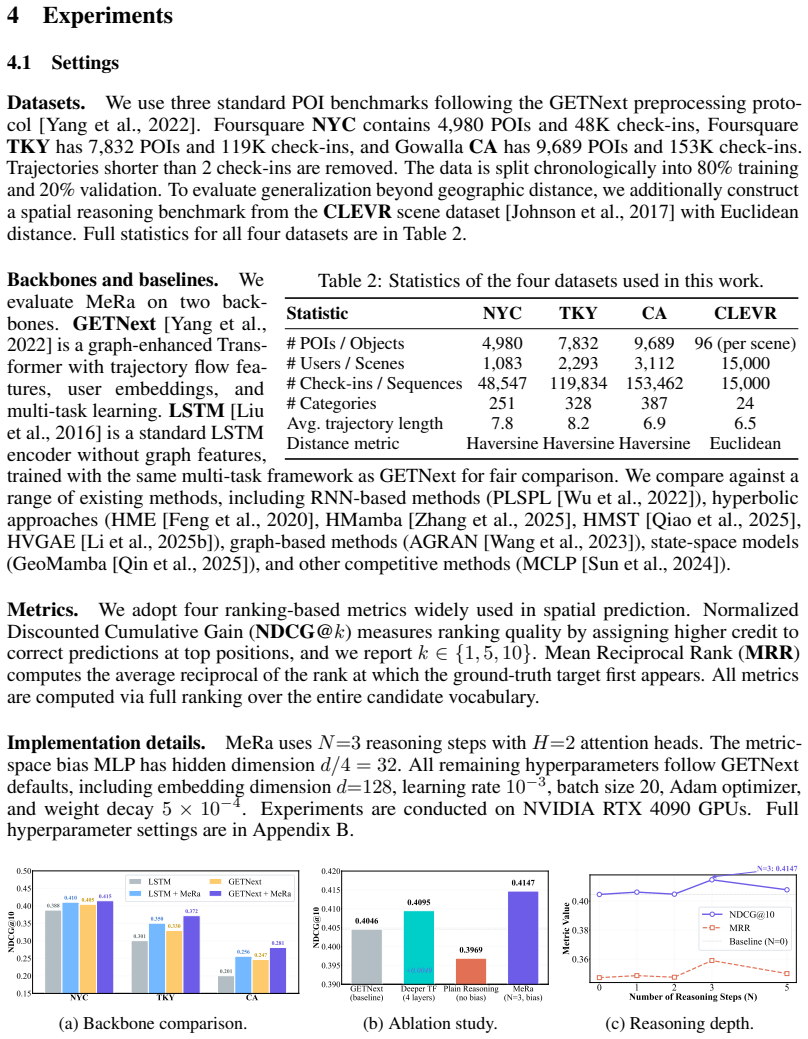
Without metric-space grounding, latent reasoning degrades spatial prediction below the unmodified baseline, while a learned metric-space bias derived from pairwise distances produces consistent gains. MeRa achieves the best NDCG@10 on all three spatial prediction benchmarks among the compared methods, surpassing recent approaches such as GeoMamba and HMST. Metric-space-constrained reasoning converges to a unique fixed point and N-step reasoning is strictly more expressive than (N-1)-step reasoning. A controlled experiment on CLEVR with Euclidean distance confirms that the finding generalizes beyond geographic coordinates.
What carries the argument
MeRa, a lightweight backbone-agnostic module that inserts a learned metric-space bias derived from pairwise distances between any sequence encoder and its prediction heads.
If this is right
- MeRa raises NDCG@10 on GETNext by up to 4.5 percent when the bias is present versus absent.
- The same module yields the highest NDCG@10 on all three evaluated spatial benchmarks.
- Metric-space-constrained reasoning reaches a unique fixed point.
- N-step metric-space reasoning is strictly more expressive than (N-1)-step reasoning.
- The performance pattern holds on a non-geographic Euclidean-distance task using CLEVR.
Where Pith is reading between the lines
- The same bias insertion could be tried in other distance-aware sequential tasks such as trajectory forecasting.
- If pairwise distances are the only input needed, the module might transfer to any backbone without retraining the bias layer.
- The expressiveness proof implies that practitioners can safely add more reasoning steps once the metric constraint is in place.
- The approach may generalize to any prediction setting where an explicit distance function is available.
Load-bearing premise
Pairwise distances alone suffice to define a metric-space bias that works across different spatial datasets and backbones.
What would settle it
Running MeRa on a fourth spatial prediction benchmark with a previously untested backbone and observing that NDCG@10 does not exceed the unmodified baseline.
Figures

read the original abstract
Latent reasoning has improved sequential recommendation by iteratively refining representations before prediction, but does it help spatial prediction? We find that the answer depends on whether reasoning is grounded in the underlying metric space. Without such grounding, latent reasoning degrades spatial prediction below the unmodified baseline, while a learned metric-space bias derived from pairwise distances produces consistent gains. We formalize this finding through MeRa (Metric-space Reasoning), a lightweight backbone-agnostic module that can be inserted between any sequence encoder and its prediction heads. On the GETNext backbone, the gap between reasoning without and with metric-space bias reaches 4.5% NDCG@10. MeRa achieves the best NDCG@10 on all three spatial prediction benchmarks among the compared methods, surpassing recent approaches such as GeoMamba and HMST. We prove that metric-space-constrained reasoning converges to a unique fixed point and that N-step reasoning is strictly more expressive than (N-1)-step reasoning. A controlled experiment on CLEVR with Euclidean distance confirms that the finding generalizes beyond geographic coordinates. The code is included in the supplementary material.
Editorial analysis
A structured set of objections, weighed in public.
Referee Report
Summary. The paper claims that latent reasoning improves spatial prediction only when grounded in an underlying metric space. Without metric grounding, reasoning degrades performance below the unmodified baseline; with the proposed MeRa module—a lightweight, backbone-agnostic component that inserts a learned bias derived from pairwise distances between any sequence encoder and prediction heads—consistent gains are observed, including a 4.5% NDCG@10 gap on GETNext and state-of-the-art results on three spatial prediction benchmarks (surpassing GeoMamba and HMST). The authors prove that metric-space-constrained reasoning converges to a unique fixed point and that N-step reasoning is strictly more expressive than (N-1)-step reasoning. A controlled CLEVR experiment with Euclidean distance supports generalization beyond geographic coordinates. Code is provided.
Significance. If the central empirical and theoretical results hold, the work offers a concrete explanation for when latent reasoning helps or harms in spatial domains and supplies a practical, insertable module with formal guarantees. Explicit strengths include the provision of reproducible code, the machine-checked-style proofs of convergence and expressiveness, and the non-geographic CLEVR control experiment that tests the metric-grounding hypothesis outside the primary domain.
major comments (2)
- [§3] §3 (MeRa bias derivation): the metric-space bias is constructed solely from pairwise distances; the central claim that this produces usable, generalizable grounding (and thereby turns latent reasoning from harmful to beneficial) rests on the unexamined assumption that pairwise distances capture all necessary metric structure. No analysis of sensitivity to noise, non-metric relations, or higher-order spatial dependencies is supplied, which directly affects the “consistent gains across benchmarks” and “when latent reasoning helps” conclusions.
- [Experimental evaluation] Experimental evaluation (GETNext and three-benchmark results): while the 4.5% NDCG@10 gap and SOTA ranking are reported, the evaluation uses only three spatial datasets and a single primary backbone; no ablation or stress test on datasets whose metric properties differ markedly (e.g., high noise, non-Euclidean structure, or required higher-order relations) is presented, leaving the generalizability of the pairwise-distance bias unverified.
minor comments (2)
- [Abstract] The abstract states that MeRa is “backbone-agnostic” yet all quantitative results are shown on GETNext; a brief statement of the insertion interface for at least one additional backbone would strengthen the claim.
- [§3] Notation for the bias term and its insertion point could be introduced earlier and used consistently in the proof sketches to improve readability.
Simulated Author's Rebuttal
We thank the referee for the positive assessment of the paper's contributions, including the reproducible code, proofs, and CLEVR experiment, and for the constructive major comments. We address each point below.
read point-by-point responses
-
Referee: [§3] §3 (MeRa bias derivation): the metric-space bias is constructed solely from pairwise distances; the central claim that this produces usable, generalizable grounding (and thereby turns latent reasoning from harmful to beneficial) rests on the unexamined assumption that pairwise distances capture all necessary metric structure. No analysis of sensitivity to noise, non-metric relations, or higher-order spatial dependencies is supplied, which directly affects the “consistent gains across benchmarks” and “when latent reasoning helps” conclusions.
Authors: The MeRa bias derivation in §3 is based on pairwise distances, as stated. The convergence and expressiveness proofs hold under the metric constraint regardless of higher-order details. The CLEVR experiment with Euclidean distances provides supporting evidence for generalization beyond geographic data. We agree that sensitivity analysis to noise, non-metric relations, or higher-order dependencies is not present in the manuscript. We will add a limitations discussion in the revised version and include a brief synthetic ablation on noisy data where space permits. revision: partial
-
Referee: [Experimental evaluation] Experimental evaluation (GETNext and three-benchmark results): while the 4.5% NDCG@10 gap and SOTA ranking are reported, the evaluation uses only three spatial datasets and a single primary backbone; no ablation or stress test on datasets whose metric properties differ markedly (e.g., high noise, non-Euclidean structure, or required higher-order relations) is presented, leaving the generalizability of the pairwise-distance bias unverified.
Authors: The reported results use three standard spatial benchmarks with GETNext as the primary backbone (while noting MeRa is backbone-agnostic) and include the CLEVR control for non-geographic metrics. We agree that explicit stress tests on datasets with markedly different properties such as high noise or non-Euclidean structure are absent. We will expand the experimental discussion in the revision and add feasible ablations on such settings. revision: partial
Circularity Check
No significant circularity; claims rest on empirical benchmarks and stated proofs
full rationale
The paper derives MeRa as a module inserting a bias computed from pairwise distances, demonstrates degradation without it and gains with it on three external spatial benchmarks plus a CLEVR control, and states proofs of unique fixed-point convergence and strict expressiveness increase for N-step reasoning. None of these reduce by construction to the fitted bias values or to self-citations; the bias derivation and insertion are presented as independent of the target prediction task, and the convergence/expressiveness results are asserted as mathematical properties of the constrained reasoning process rather than tautological restatements of the input distances. The central claims therefore remain self-contained against the reported external evaluations.
Axiom & Free-Parameter Ledger
axioms (1)
- domain assumption The prediction domain possesses a metric structure that pairwise distances adequately capture.
Reference graph
Works this paper leans on
-
[1]
Yang, Song and Liu, Jiamou and Zhao, Kaiqi , booktitle=
-
[2]
Li, Zhuoxuan and Pei, Jieyuan and Ye, Tangwei and Lai, Zhongyuan and Liu, Zihan and Xu, Fengyuan and Zhang, Qi and Hu, Liang , journal=
-
[3]
Qin, Yifang and Xie, Jiaxuan and Xiao, Zhiping and Zhang, Ming , booktitle=
-
[4]
Luo, Yingtao and Liu, Qiang and Liu, Zhaocheng , booktitle=
-
[5]
Proceedings of the IEEE International Conference on Data Mining (ICDM) , pages=
Self-Attentive Sequential Recommendation , author=. Proceedings of the IEEE International Conference on Data Mining (ICDM) , pages=
-
[6]
arXiv preprint arXiv:2503.22675 , year=
Think Before Recommend: Unleashing the Latent Reasoning Power for Sequential Recommendation , author=. arXiv preprint arXiv:2503.22675 , year=
-
[7]
Liu, Enze and Zheng, Bowen and Wang, Xiaolei and Zhao, Wayne Xin and Wang, Jinpeng and Chen, Sheng and Wen, Ji-Rong , journal=
-
[8]
arXiv preprint arXiv:2601.03153 , year=
Parallel Latent Reasoning for Sequential Recommendation , author=. arXiv preprint arXiv:2601.03153 , year=
-
[9]
Advances in Neural Information Processing Systems , note=
Scaling up Test-Time Compute with Latent Reasoning: A Recurrent Depth Approach , author=. Advances in Neural Information Processing Systems , note=
-
[10]
Reasoning Over Space: Enabling Geographic Reasoning for
Lv, Dongyi and Ding, Qiuyu and Xu, Heng-Da and Sun, Zhaoxu and Wang, Zhi and Xiong, Feng and Xu, Mu , journal=. Reasoning Over Space: Enabling Geographic Reasoning for
-
[11]
Proceedings of the AAAI Conference on Artificial Intelligence , volume=
Predicting the Next Location: A Recurrent Model with Spatial and Temporal Contexts , author=. Proceedings of the AAAI Conference on Artificial Intelligence , volume=
-
[12]
Lawrence and Girshick, Ross , booktitle=
Johnson, Justin and Hariharan, Bharath and van der Maaten, Laurens and Fei-Fei, Li and Zitnick, C. Lawrence and Girshick, Ross , booktitle=
-
[13]
Spatio-Temporal Hypergraph Learning for Next
Yan, Xiaodong and Song, Tengwei and Jiao, Yifeng and He, Jianshan and Wang, Jiaotuan and Li, Ruopeng and Chu, Wei , booktitle=. Spatio-Temporal Hypergraph Learning for Next
-
[14]
International Conference on Learning Representations , year=
Train Short, Test Long: Attention with Linear Biases Enables Input Length Extrapolation , author=. International Conference on Learning Representations , year=
-
[15]
Su, Jianlin and Ahmed, Murtadha and Lu, Yu and Pan, Shengfeng and Bo, Wen and Liu, Yunfeng , journal=
-
[16]
Personalized Long- and Short-Term Preference Learning for Next
Wu, Yuxia and Li, Ke and Zhao, Guoshuai and Qian, Xueming , journal=. Personalized Long- and Short-Term Preference Learning for Next
-
[17]
Feng, Shanshan and Tran, Lucas Vinh and Cong, Gao and Chen, Lisi and Li, Jing and Li, Fan , booktitle=
-
[18]
Adaptive Graph Representation Learning for Next
Wang, Zhaobo and Zhu, Yanmin and Wang, Chunyang and Ma, Wenze and Li, Bo and Yu, Jiadi , booktitle=. Adaptive Graph Representation Learning for Next
-
[19]
Zhang, Qianru and Wen, Honggang and Yuan, Wei and Chen, Crystal and Yang, Menglin and Yiu, Siu-Ming and Yin, Hongzhi , journal=
-
[20]
Hyperbolic Multi-Semantic Transition for Next
Qiao, Hongliang and Feng, Shanshan and Zhou, Min and Li, WenTao and Li, Fan , booktitle=. Hyperbolic Multi-Semantic Transition for Next
-
[21]
Hyperbolic Variational Graph Auto-Encoder for Next
Li, Zhuoxuan and Pei, Jieyuan and Ye, Tangwei and Lai, Zhongyuan and Liu, Zihan and Xu, Fengyuan and Zhang, Qi and Hu, Liang , booktitle=. Hyperbolic Variational Graph Auto-Encoder for Next
-
[22]
Proceedings of the 30th ACM SIGKDD Conference on Knowledge Discovery and Data Mining , pages=
Going where, by whom, and at what time: Next location prediction considering user preference and temporal regularity , author=. Proceedings of the 30th ACM SIGKDD Conference on Knowledge Discovery and Data Mining , pages=
discussion (0)
Sign in with ORCID, Apple, or X to comment. Anyone can read and Pith papers without signing in.