KRONOS I: The 1{-}2.8μm JWST Transmission Spectrum of the 23 Myr V1298 Tau c
Pith reviewed 2026-06-28 08:13 UTC · model grok-4.3
The pith
The 23-Myr-old exoplanet V1298 Tau c shows atmospheric metallicity lower than mature planets of similar mass.
A machine-rendered reading of the paper's core claim, the machinery that carries it, and where it could break.
Core claim
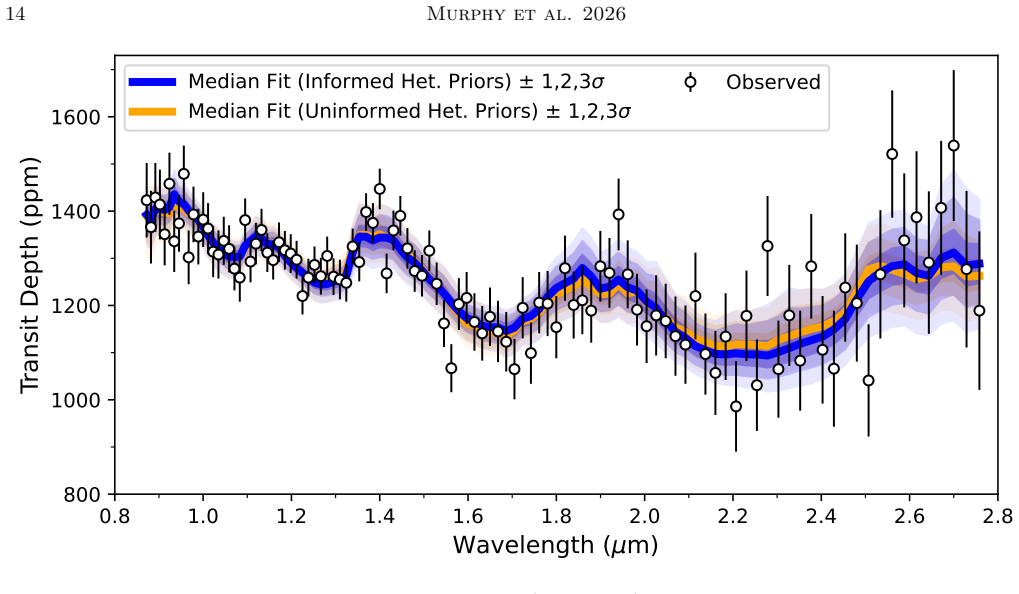
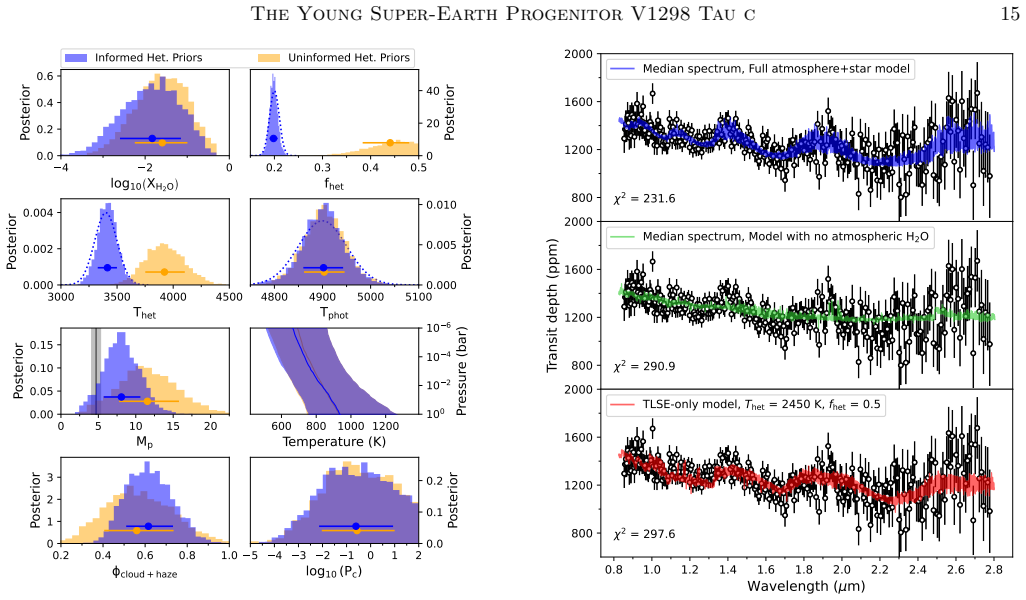
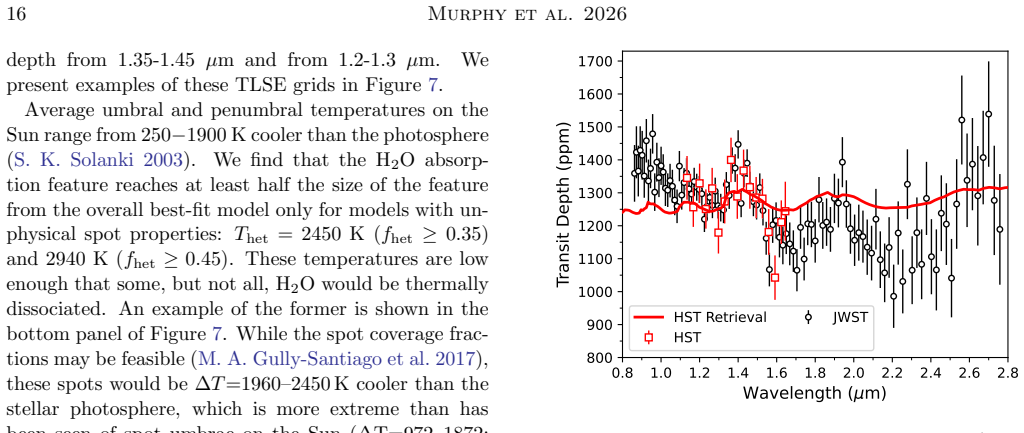
The authors obtain the 1-2.8 micron transmission spectrum of V1298 Tau c and detect H2O with a log10 volume mixing ratio of -1.83 +0.68/-0.77. Retrievals with and without stellar heterogeneity priors both yield an atmospheric metallicity [O/H] of 14.8 +56.0/-12.28 times solar. This metallicity matches values for other young planets, including the outer companion V1298 Tau b, but is systematically lower than metallicities reported for mature planets of similar mass and temperature. The paper therefore concludes that these results supply tentative but growing evidence that the exoplanet mass-metallicity relation evolves with planetary age.
What carries the argument
Atmospheric retrieval applied to the NIRISS/SOSS transmission spectrum, which extracts molecular volume mixing ratios and the metallicity [O/H] from the strength of absorption features.
If this is right
- Metallicities measured for young planets remain similar to one another even across a range of planet masses.
- Mature planets of comparable mass and temperature exhibit higher metallicities than the young sample.
- Atmospheric metallicity must change after the first few tens of millions of years through ongoing accretion, mixing, or escape.
- Further transmission spectra of young planets will be required to confirm whether the age trend is general.
Where Pith is reading between the lines
- Planet-formation models that tie metallicity only to core mass may need an explicit time dimension to match both young and mature observations.
- Uniform re-analysis of existing young- and mature-planet spectra with identical retrieval setups would test whether the apparent age offset survives removal of methodological differences.
- If the trend holds, it predicts that even younger planets should display still lower metallicities, a prediction testable with future observations of systems younger than 10 Myr.
Load-bearing premise
The retrieved [O/H] metallicity can be compared directly to literature values for mature planets without systematic offsets arising from differing retrieval assumptions, stellar activity corrections, or wavelength coverage.
What would settle it
A retrieval of the same spectrum that adopts the exact priors, activity corrections, and wavelength range used in a mature-planet study and returns a metallicity consistent with the mature sample would falsify the claimed age evolution.
Figures




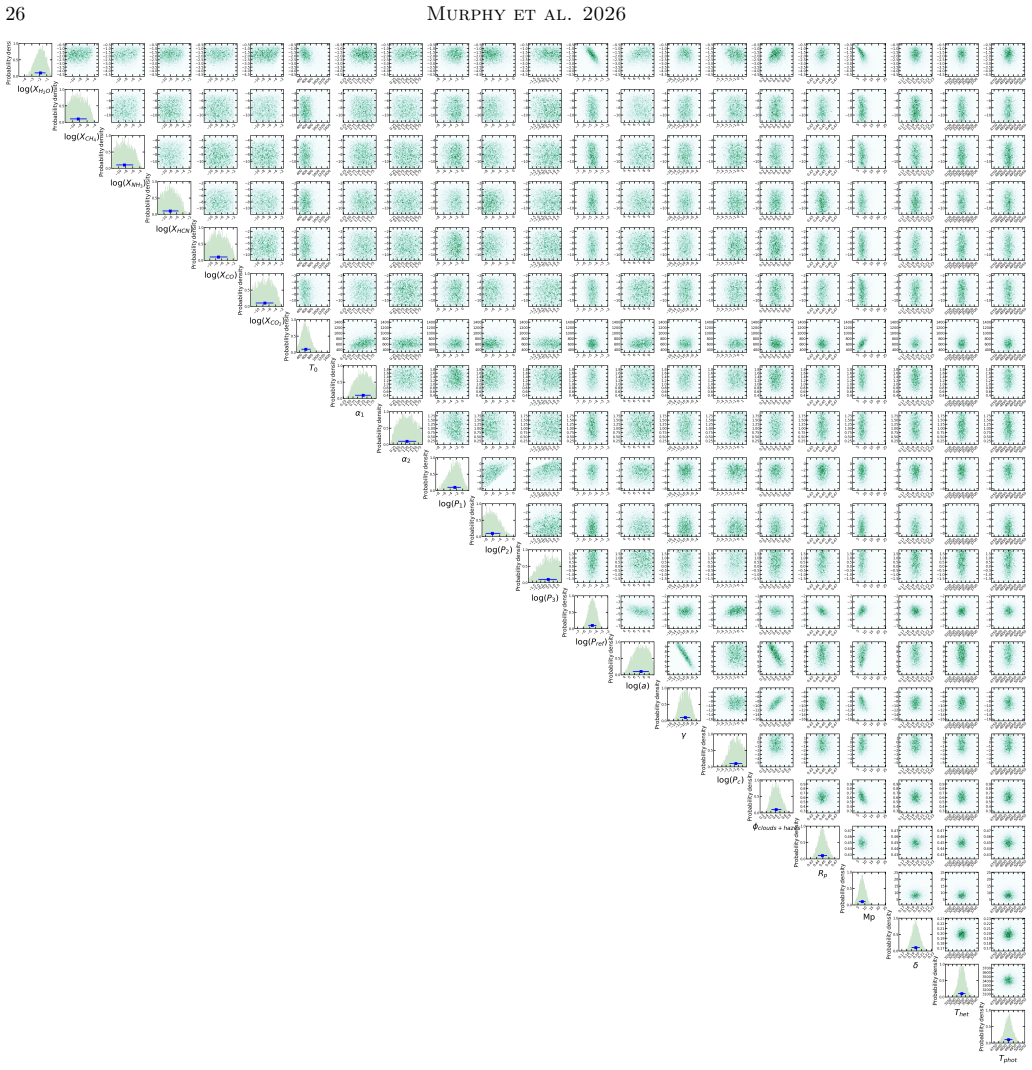

read the original abstract
While recent JWST observations of mature super-Earths and sub-Neptunes have frequently revealed featureless transmission spectra, their inflated progenitors offer a unique window into understanding their primordial compositions. As part of the Keys to Revealing the Origin and Nature Of sub-neptune Systems (KRONOS) JWST program, we present the NIRISS/SOSS transmission spectrum of V1298 Tau c, a $\sim$23 Myr super-Earth progenitor orbiting a young Solar analog. We detect H$_2$O in V1298 Tau c's atmosphere with a $\log_{10}$ volume mixing ratio of $-1.83^{+0.68}_{-0.77}$, but no additional molecules from these data alone. We find consistent results for the planetary atmospheric properties in both retrievals with and without informed priors on stellar heterogeneities based on the observed stellar spectrum. We infer an atmospheric metallicity [O/H] of $14.8^{+56.0}_{-12.28}\times$ the solar value. This metallicity is similar to literature measurements for other young planets, including its massive outer companion V1298~Tau~b. In contrast, this measured metallicity is systematically lower than the metallicities of mature planets of similar mass and temperature. Altogether, these results provide tentative but growing evidence that the exoplanet mass--metallicity relation evolves with planetary age.
Editorial analysis
A structured set of objections, weighed in public.
Referee Report
Summary. The manuscript presents the 1-2.8 μm JWST NIRISS/SOSS transmission spectrum of the ~23 Myr super-Earth progenitor V1298 Tau c. It reports a detection of H2O with log10 volume mixing ratio -1.83^{+0.68}_{-0.77}, no other molecules, and consistent atmospheric retrievals with and without informed stellar heterogeneity priors. The retrieved metallicity is [O/H] = 14.8^{+56.0}_{-12.28}×solar, stated to be similar to other young planets (including V1298 Tau b) but systematically lower than mature planets of comparable mass and T_eq, providing tentative evidence that the exoplanet mass-metallicity relation evolves with planetary age.
Significance. If the metallicity posterior is robust and the cross-study comparison holds, the result would supply useful constraints on atmospheric evolution or formation pathways as a function of age. A clear strength is the demonstration of consistent retrieval outcomes with and without stellar priors drawn from the observed stellar spectrum. The broad asymmetric uncertainties on [O/H], however, limit the strength of any evolutionary interpretation.
major comments (2)
- [Abstract] Abstract: The assertion that the metallicity is 'systematically lower' than literature values for mature planets of similar mass and temperature is not supported by the reported posterior 14.8^{+56.0}_{-12.28}×solar. The lower bound reaches only ~2.5×solar, which overlaps the range of many mature sub-Neptune metallicities; the 'systematically lower' statement therefore depends on the upper tail and requires a quantitative statistical comparison or explicit lower-bound test to remain load-bearing for the evolutionary claim.
- [Retrieval results] Retrieval results: The [O/H] value is derived from a single-molecule (H2O) detection over the limited 1-2.8 μm range with the paper's specific cloud/haze and stellar-heterogeneity parameterization. No section demonstrates that this setup produces metallicities on the same scale as the mature-planet retrievals being compared; differing forward-model assumptions, cloud treatments, or wavelength coverage could shift the inferred value by factors of several, directly affecting the central age-evolution claim.
minor comments (2)
- The asymmetric uncertainties on [O/H] should be tabulated alongside the young- and mature-planet comparison values to allow readers to assess overlap directly.
- Clarify in the text whether the 'informed priors on stellar heterogeneities' test fully addresses activity-induced offsets or only internal consistency.
Simulated Author's Rebuttal
We thank the referee for their careful reading and valuable comments on our manuscript. We respond to each major comment below and indicate where revisions will be made.
read point-by-point responses
-
Referee: [Abstract] Abstract: The assertion that the metallicity is 'systematically lower' than literature values for mature planets of similar mass and temperature is not supported by the reported posterior 14.8^{+56.0}_{-12.28}×solar. The lower bound reaches only ~2.5×solar, which overlaps the range of many mature sub-Neptune metallicities; the 'systematically lower' statement therefore depends on the upper tail and requires a quantitative statistical comparison or explicit lower-bound test to remain load-bearing for the evolutionary claim.
Authors: We agree that the broad and asymmetric uncertainties on the [O/H] posterior result in overlap with some mature-planet values at the lower bound. The abstract statement reflects that the median lies below typical literature values for mature planets of comparable mass and T_eq, supporting the tentative evolutionary interpretation already qualified in the text. We will revise the abstract to explicitly note the lower-bound overlap and qualify the phrasing as 'tentatively lower' while retaining the comparison to the median. A full statistical test across all literature posteriors lies beyond the scope of this work. revision: partial
-
Referee: [Retrieval results] Retrieval results: The [O/H] value is derived from a single-molecule (H2O) detection over the limited 1-2.8 μm range with the paper's specific cloud/haze and stellar-heterogeneity parameterization. No section demonstrates that this setup produces metallicities on the same scale as the mature-planet retrievals being compared; differing forward-model assumptions, cloud treatments, or wavelength coverage could shift the inferred value by factors of several, directly affecting the central age-evolution claim.
Authors: We acknowledge that the limited wavelength range and single-molecule constraint, combined with our specific cloud/haze and heterogeneity treatment, could introduce scale differences relative to other studies. Our retrieval follows standard forward-modeling practices used in the broader JWST sub-Neptune literature. We will add a dedicated discussion paragraph in the retrieval results section that explicitly addresses potential systematic offsets arising from wavelength coverage, cloud parameterization, and model assumptions, while reiterating the tentative nature of the age-evolution claim. This addition will qualify the comparison without requiring a full re-analysis of literature data. revision: partial
Circularity Check
No circularity in retrieval-based metallicity measurement
full rationale
The paper's central result is an observational retrieval of [O/H] from the JWST NIRISS/SOSS transmission spectrum of V1298 Tau c, yielding a posterior with large uncertainties. This metallicity is obtained via standard atmospheric retrieval forward modeling with external priors on stellar heterogeneities derived from the observed stellar spectrum; it is not defined in terms of itself, nor does any equation reduce the reported value to a fitted input by construction. The claim of tentative evidence for an evolving mass-metallicity relation rests on direct comparison to independent literature values for other planets, without self-citation chains, uniqueness theorems, or ansatzes that would force the outcome. No load-bearing step matches the enumerated circularity patterns.
Axiom & Free-Parameter Ledger
free parameters (2)
- H2O log10 volume mixing ratio =
-1.83
- atmospheric metallicity [O/H] =
14.8 x solar
axioms (1)
- domain assumption Standard 1D atmospheric retrieval models accurately recover volume mixing ratios and metallicity from NIRISS/SOSS data when stellar heterogeneities are accounted for.
Reference graph
Works this paper leans on
-
[1]
Adams Redai, J., Wogan, N., Wallack, N. L., et al. 2025, AJ, 170, 219, doi: 10.3847/1538-3881/adee92
-
[2]
Adibekyan, V., Sousa, S. G., Delgado Mena, E., et al. 2024, A&A, 683, A159, doi: 10.1051/0004-6361/202348549
-
[3]
2025a, ApJL, 985, L10, doi: 10.3847/2041-8213/add010
Ahrer, E.-M., Radica, M., Piaulet-Ghorayeb, C., et al. 2025a, ApJL, 985, L10, doi: 10.3847/2041-8213/add010
-
[4]
2025b, MNRAS, 543, 2442, doi: 10.1093/mnras/staf1535
Ahrer, E.-M., Fairman, C., Kirk, J., et al. 2025b, MNRAS, 543, 2442, doi: 10.1093/mnras/staf1535
-
[5]
2025c, MNRAS, 540, 2535, doi: 10.1093/mnras/staf819
Ahrer, E.-M., Gandhi, S., Alderson, L., et al. 2025c, MNRAS, 540, 2535, doi: 10.1093/mnras/staf819
-
[6]
K., Gao, P., Adams Redai, J., et al
Alam, M. K., Gao, P., Adams Redai, J., et al. 2025, AJ, 169, 15, doi: 10.3847/1538-3881/ad8eb5
-
[7]
2023, PASP, 135, 075001, doi: 10.1088/1538-3873/acd7a3
Albert, L., Lafreni` ere, D., Ren´ e, D., et al. 2023, PASP, 135, 075001, doi: 10.1088/1538-3873/acd7a3
-
[8]
Alderson, L., Wakeford, H. R., Alam, M. K., et al. 2023, Nature, 614, 664, doi: 10.1038/s41586-022-05591-3
-
[9]
Alderson, L., Batalha, N. E., Wakeford, H. R., et al. 2024, AJ, 167, 216, doi: 10.3847/1538-3881/ad32c9
-
[10]
H., Espinoza, N., Diamond-Lowe, H., et al
Allen, N. H., Espinoza, N., Diamond-Lowe, H., et al. 2025, AJ, 170, 240, doi: 10.3847/1538-3881/adfc51
-
[11]
Asplund, M., Grevesse, N., Sauval, A. J., & Scott, P. 2009, ARA&A, 47, 481, doi: 10.1146/annurev.astro.46.060407.145222
-
[12]
2006, A&A, 450, 1221, doi: 10.1051/0004-6361:20054040
Baraffe, I., Alibert, Y., Chabrier, G., & Benz, W. 2006, A&A, 450, 1221, doi: 10.1051/0004-6361:20054040
-
[13]
Barat, S., D´ esert, J.-M., Goyal, J. M., et al. 2024, A&A, 692, A198, doi: 10.1051/0004-6361/202451127
-
[14]
2024a, Nature Astronomy, 8, 899, doi: 10.1038/s41550-024-02257-0
Barat, S., D´ esert, J.-M., Vazan, A., et al. 2024, Nature Astronomy, 8, 899, doi: 10.1038/s41550-024-02257-0
-
[15]
2025, AJ, 170, 165, doi: 10.3847/1538-3881/adec89
Barat, S., D´ esert, J.-M., Mukherjee, S., et al. 2025, AJ, 170, 165, doi: 10.3847/1538-3881/adec89
-
[16]
Barber, M. G., Mann, A. W., Vanderburg, A., Boyle, A. W., & Lopez Murillo, A. I. 2025, AJ, 170, 32, doi: 10.3847/1538-3881/add7db
-
[17]
Barber, R. J., Strange, J. K., Hill, C., et al. 2014, MNRAS, 437, 1828, doi: 10.1093/mnras/stt2011
-
[18]
Barclay, T., Quintana, E. V., Col´ on, K., et al. 2025, arXiv e-prints, arXiv:2502.09730, doi: 10.48550/arXiv.2502.09730
-
[19]
Bean, J. L., Raymond, S. N., & Owen, J. E. 2021, Journal of Geophysical Research: Planets, 126, doi: 10.1029/2020je006639
-
[20]
G., Welbanks, L., Schlawin, E., et al
Beatty, T. G., Welbanks, L., Schlawin, E., et al. 2024, ApJL, 970, L10, doi: 10.3847/2041-8213/ad55e9
-
[21]
Bello-Arufe, A., Damiano, M., Bennett, K. A., et al. 2025, ApJL, 980, L26, doi: 10.3847/2041-8213/adaf22
-
[22]
Benneke, B., Roy, P.-A., Coulombe, L.-P., et al. 2024, JWST Reveals CH 4, CO2, and H 2O in a Metal-rich Miscible Atmosphere on a Two-Earth-Radius Exoplanet, https://arxiv.org/abs/2403.03325
arXiv 2024
-
[23]
Berdyugina, S. V. 2005, Living Reviews in Solar Physics, 2, 8, doi: 10.12942/lrsp-2005-8
-
[24]
2023, Monthly Notices of the Royal Astronomical Society, 523, 6282, doi: 10.1093/mnras/stad1873
Bloot, S., Miguel, Y., Bazot, M., & Howard, S. 2023, Monthly Notices of the Royal Astronomical Society, 523, 6282, doi: 10.1093/mnras/stad1873
-
[25]
Blunt, S., Carvalho, A., David, T. J., et al. 2023, The Astronomical Journal, 166, 62, doi: 10.3847/1538-3881/acde78
-
[26]
2021, The Exoplanet Characterization Toolkit (ExoCTK), 1.0.0 Zenodo, doi: 10.5281/zenodo.4556063
Bourque, M., Espinoza, N., Filippazzo, J., et al. 2021, The Exoplanet Characterization Toolkit (ExoCTK), 1.0.0 Zenodo, doi: 10.5281/zenodo.4556063
-
[27]
2014, Statistics and Computing, 26, 383–392, doi: 10.1007/s11222-014-9512-y
Buchner, J. 2014, Statistics and Computing, 26, 383–392, doi: 10.1007/s11222-014-9512-y
-
[28]
Buchner, J. 2019, Publications of the Astronomical Society of the Pacific, 131, 108005, doi: 10.1088/1538-3873/aae7fc
-
[29]
2021, Journal of Open Source Software, 6, 3001, doi: 10.21105/joss.03001
Buchner, J. 2021, The Journal of Open Source Software, 6, 3001, doi: 10.21105/joss.03001
-
[30]
Astronomy & Astrophysics , author =
Buchner, J., Georgakakis, A., Nandra, K., et al. 2014, A&A, 564, A125, doi: 10.1051/0004-6361/201322971 Ca˜ nas, C. I., Lustig-Yaeger, J., Tsai, S.-M., et al. 2026, AJ, 171, 260, doi: 10.3847/1538-3881/ae4976
work page internal anchor Pith review doi:10.1051/0004-6361/201322971 2014
-
[31]
Cadieux, C., Doyon, R., MacDonald, R. J., et al. 2024, ApJL, 970, L2, doi: 10.3847/2041-8213/ad5afa
-
[32]
Cardelli, J. A., Clayton, G. C., & Mathis, J. S. 1989, ApJ, 345, 245, doi: 10.1086/167900
-
[33]
Carter, A. L., May, E. M., Espinoza, N., et al. 2024, Nature Astronomy, 8, 1008–1019, doi: 10.1038/s41550-024-02292-x The Young Super-Earth Progenitor V1298 Tau c29
-
[34]
Chen, H., & Rogers, L. A. 2016, ApJ, 831, 180, doi: 10.3847/0004-637X/831/2/180
-
[35]
2023, Nature, 620, 292–298, doi: 10.1038/s41586-023-06230-1
Coulombe, L.-P., Benneke, B., Challener, R., et al. 2023, Nature, 620, 292–298, doi: 10.1038/s41586-023-06230-1
-
[36]
Davenport, B., Kempton, E. M.-R., Nixon, M. C., et al. 2025, ApJL, 984, L44, doi: 10.3847/2041-8213/adcd76
-
[37]
David, T. J., Petigura, E. A., Luger, R., et al. 2019a, ApJL, 885, L12, doi: 10.3847/2041-8213/ab4c99
-
[38]
David, T. J., Cody, A. M., Hedges, C. L., et al. 2019b, AJ, 158, 79, doi: 10.3847/1538-3881/ab290f
-
[39]
Davoudi, F., Rackham, B. V., Gillon, M., et al. 2024, ApJL, 970, L4, doi: 10.3847/2041-8213/ad5c6c de Wit, J., Seager, S., & Niraula, P. 2025, Combined Exoplanet Mass and Atmospheric Characterization for Accelerated Exoplanetology, arXiv, doi: 10.48550/arXiv.2509.25323
-
[40]
Buchhave, L. A. 2023, AJ, 165, 169, doi: 10.3847/1538-3881/acbf39
-
[41]
Doyon, R., Willott, C. J., Hutchings, J. B., et al. 2023, PASP, 135, 098001, doi: 10.1088/1538-3873/acd41b
-
[42]
Draine, B. T. 2003, ARA&A, 41, 241, doi: 10.1146/annurev.astro.41.011802.094840
work page internal anchor Pith review Pith/arXiv arXiv doi:10.1146/annurev.astro.41.011802.094840 2003
-
[43]
2021, AJ, 162, 165, doi: 10.3847/1538-3881/ac134d
Espinoza, N., & Jones, K. 2021, AJ, 162, 165, doi: 10.3847/1538-3881/ac134d
-
[44]
2016, Monthly Notices of the Royal Astronomical Society, 457, 3573–3581, doi: 10.1093/mnras/stw224
Espinoza, N., & Jord´ an, A. 2016, Monthly Notices of the Royal Astronomical Society, 457, 3573–3581, doi: 10.1093/mnras/stw224
-
[45]
Espinoza, N., Steinrueck, M. E., Kirk, J., et al. 2024, Nature, 632, 1017, doi: 10.1038/s41586-024-07768-4
-
[46]
2024, Continuing the Legacy of AU Mic: Simultaneous FUV and NIR Observations of AU Mic b,, JWST Proposal
Feinstein, A., Welbanks, L., Ahrer, E.-M., et al. 2024, Continuing the Legacy of AU Mic: Simultaneous FUV and NIR Observations of AU Mic b,, JWST Proposal. Cycle 3, ID. #5311
2024
-
[47]
2025, Measuring the Bulk Properties of a 3 Myr Transiting Exoplanet and its Original Protoplanetary Disk,, JWST Proposal
Feinstein, A., Bergner, J., Barber, M., et al. 2025, Measuring the Bulk Properties of a 3 Myr Transiting Exoplanet and its Original Protoplanetary Disk,, JWST Proposal. Cycle 4, ID. #8597
2025
-
[48]
Feinstein, A. D., David, T. J., Montet, B. T., et al. 2022, ApJL, 925, L2, doi: 10.3847/2041-8213/ac4745
-
[49]
Feinstein, A. D., Montet, B. T., Ansdell, M., et al. 2020, AJ, 160, 219, doi: 10.3847/1538-3881/abac0a
-
[50]
Feinstein, A. D., Montet, B. T., Johnson, M. C., et al. 2021, AJ, 162, 213, doi: 10.3847/1538-3881/ac1f24
-
[51]
D., Radica, M., Welbanks, L., et al
Feinstein, A. D., Radica, M., Welbanks, L., et al. 2023, Nature, 614, 670, doi: 10.1038/s41586-022-05674-1
-
[52]
Feroz, F., & Hobson, M. P. 2008, MNRAS, 384, 449, doi: 10.1111/j.1365-2966.2007.12353.x
-
[53]
Feroz, F., Hobson, M. P., & Bridges, M. 2009, MNRAS, 398, 1601, doi: 10.1111/j.1365-2966.2009.14548.x
-
[54]
2010, AJ, 139, 1338, doi: 10.1088/0004-6256/139/4/1338
Findeisen, K., & Hillenbrand, L. 2010, AJ, 139, 1338, doi: 10.1088/0004-6256/139/4/1338
-
[55]
Finociety, B., Donati, J.-F., Cristofari, P. I., et al. 2023, MNRAS, 526, 4627, doi: 10.1093/mnras/stad3012
-
[56]
2017, AJ, 154, 220, doi: 10.3847/1538-3881/aa9332
Foreman-Mackey, D., Agol, E., Ambikasaran, S., & Angus, R. 2017, AJ, 154, 220, doi: 10.3847/1538-3881/aa9332
work page internal anchor Pith review doi:10.3847/1538-3881/aa9332 2017
-
[57]
Foreman-Mackey, D., Hogg, D. W., Lang, D., & Goodman, J. 2013, Publications of the Astronomical Society of the Pacific, 125, 306–312, doi: 10.1086/670067
-
[58]
France, K., Loyd, R. O. P., Youngblood, A., et al. 2016, ApJ, 820, 89, doi: 10.3847/0004-637X/820/2/89
-
[59]
2013, ApJ, 766, 81, doi: 10.1088/0004-637X/766/2/81
Fressin, F., Torres, G., Charbonneau, D., et al. 2013, ApJ, 766, 81, doi: 10.1088/0004-637X/766/2/81
-
[60]
Fu, G., Mukherjee, S., Stevenson, K. B., et al. 2025, ApJL, 989, L17, doi: 10.3847/2041-8213/adf20f
-
[61]
Fulton, B. J., Petigura, E. A., Howard, A. W., et al. 2017, AJ, 154, 109, doi: 10.3847/1538-3881/aa80eb Gaia Collaboration, Brown, A. G. A., Vallenari, A., et al. 2018, A&A, 616, A1, doi: 10.1051/0004-6361/201833051
-
[62]
Ginzburg, S., Schlichting, H. E., & Sari, R. 2016, ApJ, 825, 29, doi: 10.3847/0004-637X/825/1/29
-
[63]
Grankin, K. N. 1999, Astronomy Letters, 25, 526
1999
-
[64]
N., Bouvier, J., Herbst, W., & Melnikov, S
Grankin, K. N., Bouvier, J., Herbst, W., & Melnikov, S. Y. 2008, A&A, 479, 827, doi: 10.1051/0004-6361:20078476
-
[65]
Gressier, A., Espinoza, N., Allen, N. H., et al. 2024, ApJL, 975, L10, doi: 10.3847/2041-8213/ad73d1
-
[66]
Gressier, A., Batalha, N. E., Wogan, N., et al. 2025, AJ, 170, 292, doi: 10.3847/1538-3881/ae0929
-
[67]
Gully-Santiago, M. A., Herczeg, G. J., Czekala, I., et al. 2017, ApJ, 836, 200, doi: 10.3847/1538-4357/836/2/200
-
[68]
Gupta, A., & Schlichting, H. E. 2019, MNRAS, 487, 24, doi: 10.1093/mnras/stz1230
-
[69]
Gupta, A., & Schlichting, H. E. 2020, MNRAS, 493, 792, doi: 10.1093/mnras/staa315
-
[70]
Harris, C. R., Millman, K. J., van der Walt, S. J., et al. 2020, Nature, 585, 357, doi: 10.1038/s41586-020-2649-2
-
[71]
H., Barman, T., Baron, E., Aufdenberg, J
Hauschildt, P. H., Barman, T., Baron, E., Aufdenberg, J. P., & Schweitzer, A. 2025, A&A, 698, A47, doi: 10.1051/0004-6361/202554171
-
[72]
2021, AJ, 162, 54, doi: 10.3847/1538-3881/ac06cd
Hedges, C., Hughes, A., Zhou, G., et al. 2021, AJ, 162, 54, doi: 10.3847/1538-3881/ac06cd
-
[73]
2022, AJ, 163, 143, doi: 10.3847/1538-3881/ac4477
Hedges, C., Hughes, A., Zhou, G., et al. 2022, AJ, 163, 143, doi: 10.3847/1538-3881/ac4477
-
[74]
Howard, A. W., Marcy, G. W., Bryson, S. T., et al. 2012, ApJS, 201, 15, doi: 10.1088/0067-0049/201/2/15
-
[75]
W., Sinukoff, E., Blunt, S., et al
Howard, A. W., Sinukoff, E., Blunt, S., et al. 2025, ApJS, 278, 52, doi: 10.3847/1538-4365/adc5e4
-
[76]
Hunter, J. D. 2007, Computing in Science & Engineering, 9, 90, doi: 10.1109/MCSE.2007.55 30Murphy et al. 2026
-
[77]
Inamdar, N. K., & Schlichting, H. E. 2016, ApJL, 817, L13, doi: 10.3847/2041-8205/817/2/L13
-
[78]
Monthly Notices of the Royal Astronomical Society , author =
Jackson, A. P., Davis, T. A., & Wheatley, P. J. 2012, MNRAS, 422, 2024, doi: 10.1111/j.1365-2966.2012.20657.x
-
[79]
Y., Sohier, O., Venot, O., & Carrasco, N
Jaziri, A. Y., Sohier, O., Venot, O., & Carrasco, N. 2025, A&A, 701, A33, doi: 10.1051/0004-6361/202555496
-
[80]
M., Lee, J., Kurtz, C., et al
Jennewein, D. M., Lee, J., Kurtz, C., et al. 2023, in Practice and Experience in Advanced Research
2023
discussion (0)
Sign in with ORCID, Apple, or X to comment. Anyone can read and Pith papers without signing in.