TGSD: Topology-Guided State-Space Diffusion Framework for EEG Spatial Super-Resolution
Pith reviewed 2026-06-30 15:21 UTC · model grok-4.3
The pith
Topology-guided diffusion recovers dense EEG channels from sparse low-density recordings by encoding full electrode layout priors.
A machine-rendered reading of the paper's core claim, the machinery that carries it, and where it could break.
Core claim
TGSD first employs a Hierarchical Spatial Prior Encoder to learn topology-aware priors over the complete electrode layout by integrating local geometric relationships with region-level contextual information. Based on these priors and sparse observations, a Conditional State-Space Diffusion Reconstructor progressively generates missing-channel signals through reverse diffusion, while alternating temporal and channel-wise state-space modeling captures long-range temporal dynamics and inter-channel dependencies in a unified framework.
What carries the argument
Hierarchical Spatial Prior Encoder for topology-aware priors over the full electrode layout, paired with Conditional State-Space Diffusion Reconstructor that alternates temporal and channel state-space modeling inside conditional diffusion.
If this is right
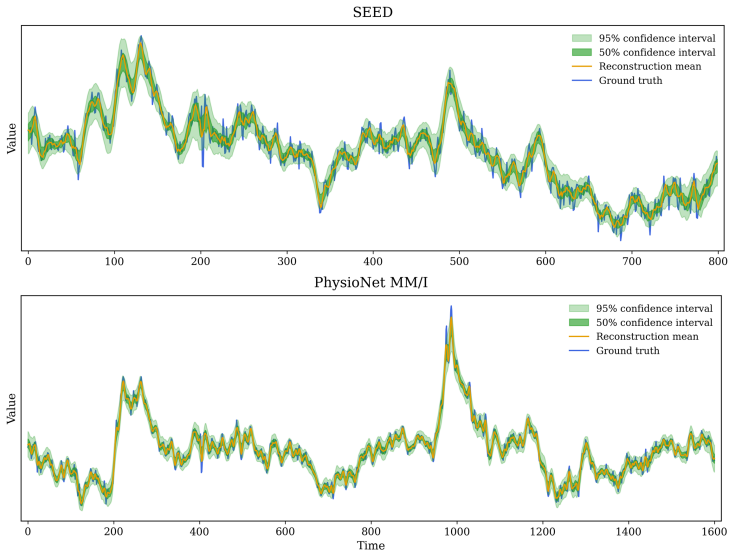
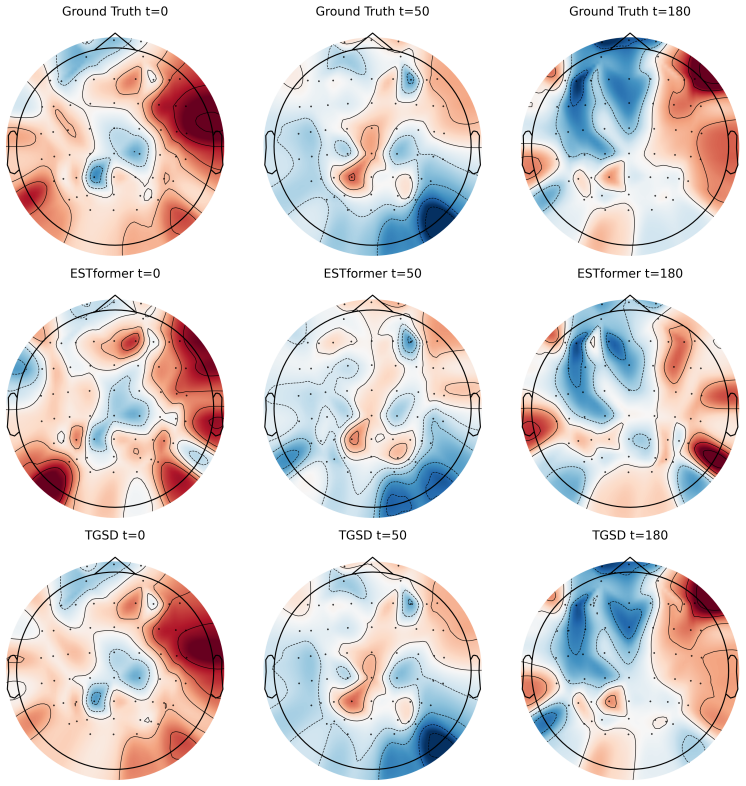
- Reconstruction fidelity improves consistently across different super-resolution factors on SEED and PhysioNet MM/I data.
- Downstream classification tasks show measurable gains when using the reconstructed signals instead of the original sparse inputs.
- Low-density EEG becomes more viable for wearable and IoT scenarios without sacrificing cross-regional spatial information.
- The combination of layout priors and diffusion handles whole-channel missingness better than methods that treat channels independently.
Where Pith is reading between the lines
- The same prior-plus-diffusion pattern could apply to other fixed-geometry sensor arrays such as multi-lead ECG or distributed acoustic arrays.
- If electrode layouts vary across recording sessions, the framework would require an explicit alignment step before the spatial prior encoder can be used.
- Faster sampling schedules for the diffusion process would be needed before the method supports online, low-latency reconstruction in wearable devices.
Load-bearing premise
The mapping from sparse to dense EEG signals can be resolved by learning topology-aware priors over the complete electrode layout and alternating temporal and channel state-space modeling inside a conditional diffusion process.
What would settle it
If removing the topology encoder or the alternating state-space blocks produces reconstruction error and classification accuracy statistically indistinguishable from standard conditional diffusion or linear interpolation on the same SEED and PhysioNet test splits, the central claim would not hold.
Figures

read the original abstract
Low-density EEG is more suitable for wearable and IoT-based brain sensing, but sparse electrode sampling often lacks sufficient spatial information to characterize cross-regional neural activity. EEG spatial super-resolution aims to recover dense-channel EEG from sparse recordings, yet remains challenging because channel missingness typically occurs at the whole-channel level, spatiotemporal dependencies over the full electrode layout are often underexplored, and the mapping from sparse to dense signals is inherently ambiguous. To address these issues, we propose TGSD, a topology-guided state-space diffusion framework for EEG spatial super-resolution. TGSD first employs a Hierarchical Spatial Prior Encoder to learn topology-aware priors over the complete electrode layout by integrating local geometric relationships with region-level contextual information. Based on these priors and sparse observations, a Conditional State-Space Diffusion Reconstructor progressively generates missing-channel signals through reverse diffusion, while alternating temporal and channel-wise state-space modeling captures long-range temporal dynamics and inter-channel dependencies in a unified framework. Experiments on the SEED and PhysioNet MM/I datasets show that TGSD consistently outperforms representative baselines under different super-resolution factors in both reconstruction fidelity and downstream classification performance. These results demonstrate the effectiveness of combining topology-aware spatial priors with conditional diffusion for enhancing practical low-density EEG sensing in wearable and IoT scenarios. The official implementation code is available at https://github.com/jtggz/TGSD.
Editorial analysis
A structured set of objections, weighed in public.
Referee Report
Summary. The paper presents TGSD, a topology-guided state-space diffusion framework for EEG spatial super-resolution. It consists of a Hierarchical Spatial Prior Encoder that integrates local geometric relationships with region-level contextual information to learn topology-aware priors over the complete electrode layout, and a Conditional State-Space Diffusion Reconstructor that generates missing-channel signals via reverse diffusion while alternating temporal and channel-wise state-space modeling. Experiments on the SEED and PhysioNet MM/I datasets demonstrate that TGSD consistently outperforms representative baselines under different super-resolution factors in both reconstruction fidelity and downstream classification performance.
Significance. If the empirical results hold under rigorous verification, the work could meaningfully advance low-density EEG applications in wearables and IoT by recovering dense spatial information from sparse electrode layouts, thereby improving characterization of cross-regional neural activity without requiring additional hardware.
major comments (1)
- [Experiments] Experiments section: the central claim of consistent outperformance over baselines on SEED and PhysioNet under varying super-resolution factors is load-bearing for the contribution, yet the abstract (and by extension the reported results) provides no information on error bars, multiple random seeds, statistical tests, or confirmation of equivalent hyperparameter tuning and identical data splits/preprocessing for baselines; this leaves open the possibility that reported gains arise from implementation discrepancies rather than the topology-guided diffusion components.
minor comments (1)
- The GitHub link for code is a positive step for reproducibility, but the manuscript should explicitly state the number of subjects, exact preprocessing pipeline, and quantitative metrics (e.g., MSE, correlation) used in the experiments section for clarity.
Simulated Author's Rebuttal
We thank the referee for the constructive comment on experimental rigor. We agree that additional reporting is required to substantiate the central claims and will revise the manuscript accordingly.
read point-by-point responses
-
Referee: [Experiments] Experiments section: the central claim of consistent outperformance over baselines on SEED and PhysioNet under varying super-resolution factors is load-bearing for the contribution, yet the abstract (and by extension the reported results) provides no information on error bars, multiple random seeds, statistical tests, or confirmation of equivalent hyperparameter tuning and identical data splits/preprocessing for baselines; this leaves open the possibility that reported gains arise from implementation discrepancies rather than the topology-guided diffusion components.
Authors: We acknowledge that the abstract is concise and that the reported results in the current manuscript lack explicit error bars, details on multiple random seeds, statistical tests, and confirmation of baseline implementation parity. In the revised version we will augment the Experiments section with mean ± standard deviation computed over five independent runs using different random seeds for every method and metric. We will also report p-values from paired t-tests comparing TGSD against each baseline. A new subsection will explicitly document that all baselines were re-evaluated from their official implementations (or re-implemented following the original papers) using identical data splits, preprocessing pipelines, and hyperparameter search ranges as TGSD, thereby ruling out implementation discrepancies as the source of observed gains. revision: yes
Circularity Check
No circularity: empirical claims rest on external datasets and baselines
full rationale
The paper introduces TGSD with components (Hierarchical Spatial Prior Encoder, Conditional State-Space Diffusion Reconstructor) whose design is described at the architectural level without equations that reduce a claimed prediction or result to fitted inputs by construction. The central performance claim is supported by experiments on public external datasets (SEED, PhysioNet) against representative baselines under varying super-resolution factors. No self-citations, uniqueness theorems, or ansatzes are invoked in the provided text to justify load-bearing steps, and no renaming of known results or fitted-input-as-prediction patterns appear. The derivation chain is therefore self-contained against external benchmarks.
Axiom & Free-Parameter Ledger
Reference graph
Works this paper leans on
-
[1]
Electroencephalography.Current Biology, 29(3):R80–R85, 2019
Andrea Biasiucci, Benedetta Franceschiello, and Micah M Murray. Electroencephalography.Current Biology, 29(3):R80–R85, 2019
2019
-
[2]
Linguistics and Human Brain: A Perspective of Computational Neuroscience
Fudong Zhang, Bo Chai, Yujie Wu, Wai Ting Siok, and Nizhuan Wang. Linguistics and human brain: A perspective of computational neuroscience.arXiv preprint arXiv:2602.08275, 2026
work page internal anchor Pith review Pith/arXiv arXiv 2026
-
[3]
Imagined speech brain–computer interface: A task-oriented review of neural decoding.Sensors, 26(10), 2026
Haodong Zhang, Wai Ting Siok, and Nizhuan Wang. Imagined speech brain–computer interface: A task-oriented review of neural decoding.Sensors, 26(10), 2026
2026
-
[4]
Feature extraction and selection for emotion recognition from eeg
Robert Jenke, Angelika Peer, and Martin Buss. Feature extraction and selection for emotion recognition from eeg. IEEE Transactions on Affective computing, 5(3):327–339, 2014
2014
-
[5]
Review on portable eeg technology in educational research.Computers in Human Behavior, 81:340–349, 2018
Jiahui Xu and Baichang Zhong. Review on portable eeg technology in educational research.Computers in Human Behavior, 81:340–349, 2018
2018
-
[6]
How many electrodes are really needed for eeg-based mobile brain imaging.Journal of Behavioral and Brain Science, 2(3):387–393, 2012
Troy M Lau, Joseph T Gwin, and Daniel P Ferris. How many electrodes are really needed for eeg-based mobile brain imaging.Journal of Behavioral and Brain Science, 2(3):387–393, 2012
2012
-
[7]
Comparison between a wireless dry electrode eeg system with a conventional wired wet electrode eeg system for clinical applications.Scientific reports, 10(1):5218, 2020
Hermann Hinrichs, Michael Scholz, Anne Katrin Baum, Julia WY Kam, Robert T Knight, and Hans-Jochen Heinze. Comparison between a wireless dry electrode eeg system with a conventional wired wet electrode eeg system for clinical applications.Scientific reports, 10(1):5218, 2020
2020
-
[8]
Yueyang Li, Weiming Zeng, Wenhao Dong, Di Han, Lei Chen, Hongyu Chen, Zijian Kang, Shengyu Gong, Hongjie Yan, Wai Ting Siok, et al. A tale of single-channel electroencephalogram: Devices, datasets, signal processing, applications, and future directions.IEEE Transactions on Instrumentation and Measurement, pages 1–20, 2025
2025
-
[9]
Super-resolution techniques for biomedical applications and challenges.Biomedical Engineering Letters, 14(3):465–496, 2024
Minwoo Shin, Minjee Seo, Kyunghyun Lee, and Kyungho Yoon. Super-resolution techniques for biomedical applications and challenges.Biomedical Engineering Letters, 14(3):465–496, 2024
2024
-
[10]
Deep learning for image super-resolution: A survey.IEEE transactions on pattern analysis and machine intelligence, 43(10):3365–3387, 2020
Zhihao Wang, Jian Chen, and Steven CH Hoi. Deep learning for image super-resolution: A survey.IEEE transactions on pattern analysis and machine intelligence, 43(10):3365–3387, 2020
2020
-
[11]
Eeg channel interpolation using ellipsoid geodesic length
Hristos S Courellis, John R Iversen, Howard Poizner, and Gert Cauwenberghs. Eeg channel interpolation using ellipsoid geodesic length. In2016 IEEE Biomedical Circuits and Systems Conference (BioCAS), pages 540–543. IEEE, 2016
2016
-
[12]
Super-resolution for improving eeg spatial resolution using deep convolutional neural network—feasibility study.Sensors, 19(23):5317, 2019
Moonyoung Kwon, Sangjun Han, Kiwoong Kim, and Sung Chan Jun. Super-resolution for improving eeg spatial resolution using deep convolutional neural network—feasibility study.Sensors, 19(23):5317, 2019. 11
2019
-
[13]
Eeg emotion recognition using dynamical graph convolutional neural networks.IEEE Transactions on Affective Computing, 11(3):532–541, 2018
Tengfei Song, Wenming Zheng, Peng Song, and Zhen Cui. Eeg emotion recognition using dynamical graph convolutional neural networks.IEEE Transactions on Affective Computing, 11(3):532–541, 2018
2018
-
[14]
Spherical spline interpolation—basic theory and computational aspects.Journal of computational and applied mathematics, 11(3):367–375, 1984
Willi Freeden. Spherical spline interpolation—basic theory and computational aspects.Journal of computational and applied mathematics, 11(3):367–375, 1984
1984
-
[15]
Enhancing eeg surface resolution by using a combination of kalman filter and interpolation method
Ibtissem Khouaja, Ibtihel Nouira, M Hedi Bedoui, and Mohamed Akil. Enhancing eeg surface resolution by using a combination of kalman filter and interpolation method. In2016 13th International Conference on Computer Graphics, Imaging and Visualization (CGiV), pages 353–357. IEEE, 2016
2016
-
[16]
Feasibility study of eeg super-resolution using deep convolutional networks
Sangjun Han, Moonyoung Kwon, Sunghan Lee, and Sung Chan Jun. Feasibility study of eeg super-resolution using deep convolutional networks. In2018 IEEE International Conference on Systems, Man, and Cybernetics (SMC), pages 1033–1038. IEEE, 2018
2018
-
[17]
Deep eeg super-resolution: Upsampling eeg spatial resolution with generative adversarial networks
Isaac A Corley and Yufei Huang. Deep eeg super-resolution: Upsampling eeg spatial resolution with generative adversarial networks. In2018 IEEE EMBS International Conference on Biomedical & Health Informatics (BHI), pages 100–103. IEEE, 2018
2018
-
[18]
Estformer: Transformer utilising spatiotemporal dependencies for electroencephalogram super-resolution.Knowledge-Based Systems, 317:113345, 2025
Dongdong Li, Zhongliang Zeng, Zhe Wang, and Hai Yang. Estformer: Transformer utilising spatiotemporal dependencies for electroencephalogram super-resolution.Knowledge-Based Systems, 317:113345, 2025
2025
-
[19]
Deep eeg superresolution via correlating brain structural and functional connectivities.IEEE Transactions on Cybernetics, 53(7):4410–4422, 2022
Yunbo Tang, Dan Chen, Honghai Liu, Chang Cai, and Xiaoli Li. Deep eeg superresolution via correlating brain structural and functional connectivities.IEEE Transactions on Cybernetics, 53(7):4410–4422, 2022
2022
-
[20]
Virtual eeg-electrodes: Convolutional neural networks as a method for upsampling or restoring channels.Journal of Neuroscience Methods, 355:109126, 2021
Mats Svantesson, Håkan Olausson, Anders Eklund, and Magnus Thordstein. Virtual eeg-electrodes: Convolutional neural networks as a method for upsampling or restoring channels.Journal of Neuroscience Methods, 355:109126, 2021
2021
-
[21]
Yunbo Tang, Qifeng Lin, Yuanlong Yu, and Dan Chen. Eeg super-resolution with laplacian regularized coupled matrix decomposition: A case study of autism spectrum disorder eeg enhancement.Artificial Intelligence in Medicine, page 103284, 2025
2025
-
[22]
Brain topology modeling with eeg-graphs for auditory spatial attention detection.IEEE Transactions on Biomedical Engineering, 71(1):171–182, 2023
Siqi Cai, Tanja Schultz, and Haizhou Li. Brain topology modeling with eeg-graphs for auditory spatial attention detection.IEEE Transactions on Biomedical Engineering, 71(1):171–182, 2023
2023
-
[23]
Effective emotion recognition by learning discriminative graph topologies in eeg brain networks.IEEE Transactions on Neural Networks and Learning Systems, 35(8):10258–10272, 2023
Cunbo Li, Peiyang Li, Yangsong Zhang, Ning Li, Yajing Si, Fali Li, Zehong Cao, Huafu Chen, Badong Chen, Dezhong Yao, et al. Effective emotion recognition by learning discriminative graph topologies in eeg brain networks.IEEE Transactions on Neural Networks and Learning Systems, 35(8):10258–10272, 2023
2023
-
[24]
Pgcn: Pyramidal graph convolutional network for eeg emotion recognition.IEEE Transactions on Multimedia, 26:9070–9082, 2024
Ming Jin, Changde Du, Huiguang He, Ting Cai, and Jinpeng Li. Pgcn: Pyramidal graph convolutional network for eeg emotion recognition.IEEE Transactions on Multimedia, 26:9070–9082, 2024
2024
- [25]
-
[26]
Rdpi: a refine diffusion probability generation method for spatiotemporal data imputation
Zijin Liu, Xiang Zhao, and You Song. Rdpi: a refine diffusion probability generation method for spatiotemporal data imputation. InProceedings of the AAAI Conference on Artificial Intelligence, volume 39, pages 12255–12263, 2025
2025
-
[27]
Generating realistic neurophysiological time series with denoising diffusion probabilistic models.Patterns, 5(9), 2024
Julius Vetter, Jakob H Macke, and Richard Gao. Generating realistic neurophysiological time series with denoising diffusion probabilistic models.Patterns, 5(9), 2024
2024
-
[28]
Generative ai enables eeg super-resolution via spatio-temporal adaptive diffusion learning.IEEE Transactions on Consumer Electronics, 71(1):1034–1045, 2025
Shuqiang Wang, Tong Zhou, Yanyan Shen, Ye Li, Guoheng Huang, and Yong Hu. Generative ai enables eeg super-resolution via spatio-temporal adaptive diffusion learning.IEEE Transactions on Consumer Electronics, 71(1):1034–1045, 2025
2025
-
[29]
Hongjun Liu, Leyu Zhou, Zijianghao Yang, and Chao Yao. Step-aware residual-guided diffusion for eeg spatial super-resolution.arXiv preprint arXiv:2510.19166, 2025
-
[30]
State-space models.Handbook of econometrics, 4:3039–3080, 1994
James D Hamilton. State-space models.Handbook of econometrics, 4:3039–3080, 1994
1994
-
[31]
Efficiently Modeling Long Sequences with Structured State Spaces
Albert Gu, Karan Goel, and Christopher Ré. Efficiently modeling long sequences with structured state spaces. arXiv preprint arXiv:2111.00396, 2021
work page internal anchor Pith review Pith/arXiv arXiv 2021
-
[32]
Transformers are ssms: Generalized models and efficient algorithms through structured state space duality
Tri Dao and Albert Gu. Transformers are ssms: Generalized models and efficient algorithms through structured state space duality. InInternational Conference on Machine Learning, pages 10041–10071. PMLR, 2024
2024
-
[33]
Ssd-ts: Exploring the potential of linear state space models for diffusion models in time series imputation
Hongfan Gao, Wangmeng Shen, Xiangfei Qiu, Ronghui Xu, Bin Yang, and Jilin Hu. Ssd-ts: Exploring the potential of linear state space models for diffusion models in time series imputation. InProceedings of the 31st ACM SIGKDD Conference on Knowledge Discovery and Data Mining V . 2, pages 649–660, 2025. 12
2025
-
[34]
Wei-Long Zheng and Bao-Liang Lu. Investigating critical frequency bands and channels for eeg-based emotion recognition with deep neural networks.IEEE Transactions on autonomous mental development, 7(3):162–175, 2015
2015
-
[35]
Physiobank, physiotoolkit, and physionet: components of a new research resource for complex physiologic signals.circulation, 101(23):e215–e220, 2000
Ary L Goldberger, Luis AN Amaral, Leon Glass, Jeffrey M Hausdorff, Plamen Ch Ivanov, Roger G Mark, Joseph E Mietus, George B Moody, Chung-Kang Peng, and H Eugene Stanley. Physiobank, physiotoolkit, and physionet: components of a new research resource for complex physiologic signals.circulation, 101(23):e215–e220, 2000
2000
-
[36]
Bci2000: a general-purpose brain-computer interface (bci) system.IEEE Transactions on biomedical engineering, 51(6):1034– 1043, 2004
Gerwin Schalk, Dennis J McFarland, Thilo Hinterberger, Niels Birbaumer, and Jonathan R Wolpaw. Bci2000: a general-purpose brain-computer interface (bci) system.IEEE Transactions on biomedical engineering, 51(6):1034– 1043, 2004
2004
-
[37]
Zhige Chen, Chengxuan Qin, Wenlong You, Rui Liu, Congying Chu, Rui Yang, Kay Chen Tan, and Jibin Wu. Hear: An eeg foundation model with heterogeneous electrode adaptive representation.arXiv preprint arXiv:2510.12515, 2025. 6 Supplementary Materials 6.1 Detailed Dataset Description 6.1.1 SEED Dataset The SEED dataset is a public benchmark for EEG-based emo...
discussion (0)
Sign in with ORCID, Apple, or X to comment. Anyone can read and Pith papers without signing in.