Forman--Ricci Curvature for Irregular Convex Mosaics
Pith reviewed 2026-06-29 00:40 UTC · model grok-4.3
The pith
A modification of Forman-Ricci curvature for irregular convex mosaics distinguishes various natural fracture patterns.
A machine-rendered reading of the paper's core claim, the machinery that carries it, and where it could break.
Core claim
We define a modification of the classical Forman--Ricci curvature for irregular convex mosaics and demonstrate how they can be used to distinguish between various fractures or cracking patterns appearing in nature.
What carries the argument
The modified Forman-Ricci curvature for irregular convex mosaics, which incorporates irregularity to extend the discrete curvature to non-regular cases.
Load-bearing premise
The irregularity measure supplies the structural information needed to make the adapted Forman-Ricci curvature useful for distinguishing real fracture patterns.
What would settle it
Computing the modified curvature on a set of known distinct fracture patterns and finding that the values do not differ or fail to group them separately.
Figures
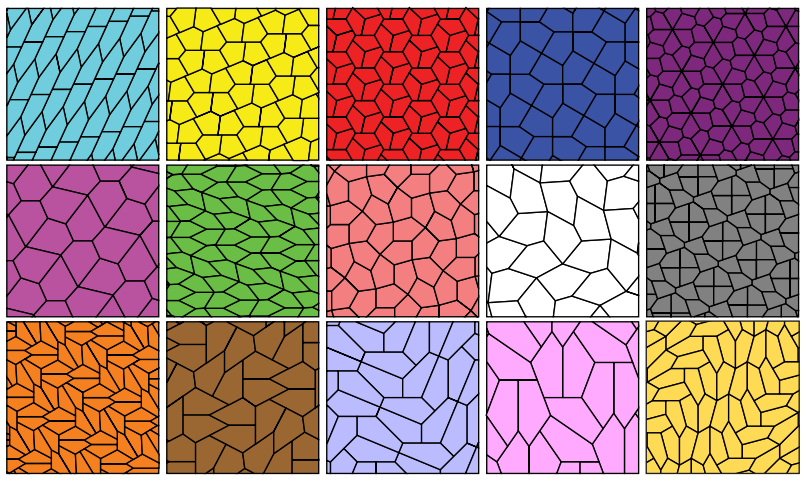
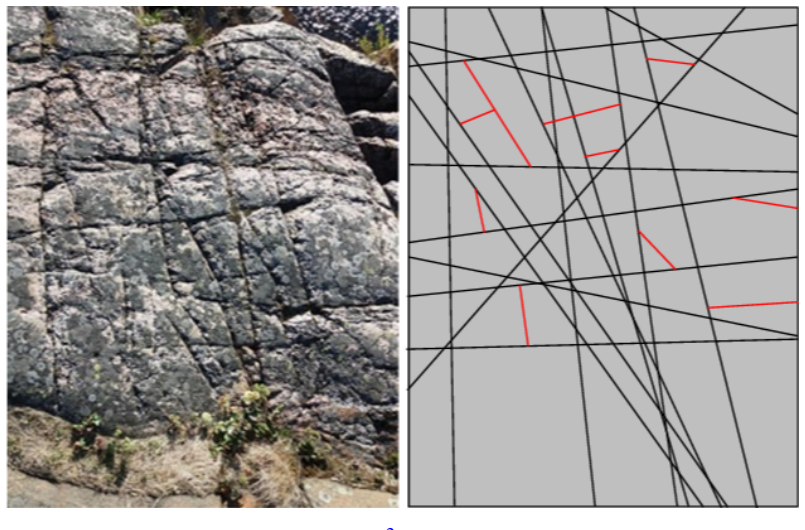
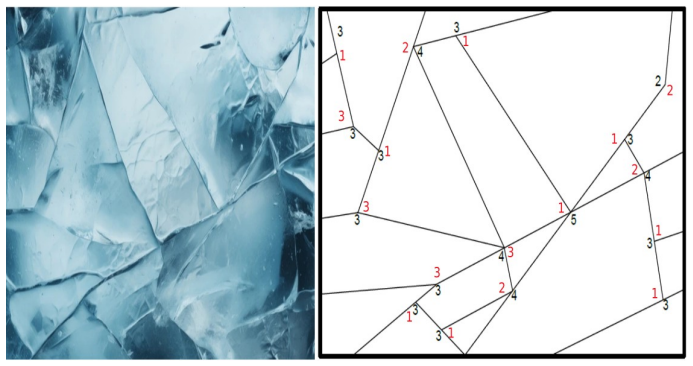
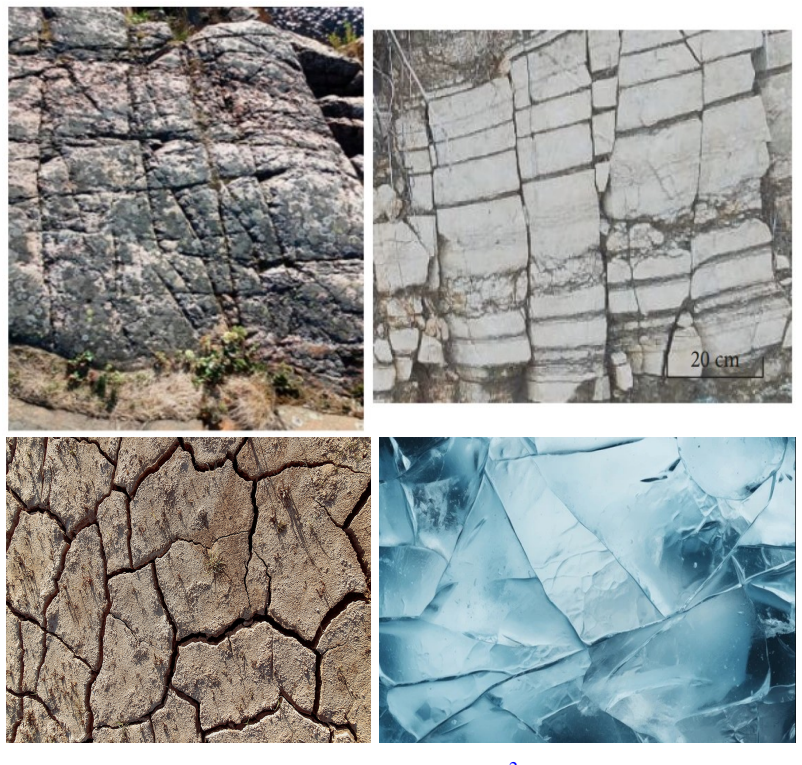

read the original abstract
Forman has defined a discrete version of the Ricci curvature on Riemannian manifolds, known as the Forman--Ricci curvature. The Forman--Ricci curvature has found significant applications in several pattern recognition problems occurring in natural sciences. Domokos and Langi, on the other hand, have defined a notion of irregularity for convex mosaics, which has also found remarkable applications to the geological problem of fractures in rocks. We define a modification of the classical Forman--Ricci curvature for irregular convex mosaics and demonstrate how they can be used to distinguish between various fractures or cracking patterns appearing in nature.
Editorial analysis
A structured set of objections, weighed in public.
Referee Report
Summary. The paper defines a modification of the classical Forman-Ricci curvature adapted to irregular convex mosaics by incorporating the Domokos-Langi irregularity measure. It provides an explicit construction via weight assignments on cells and demonstrates the modified curvature's ability to distinguish various natural fracture and cracking patterns through illustrative computations on mosaics.
Significance. If the construction holds, the work supplies a concrete bridge between discrete curvature and irregularity measures with direct applicability to geological pattern analysis. The explicit weight assignment on cells and the reduction to the classical Forman-Ricci case when irregularity vanishes are strengths that support reproducibility and further use.
minor comments (3)
- [§2] §2 (definition of modified curvature): the precise formula for the cell weights derived from the Domokos-Langi measure should be stated as an equation rather than described in prose only, to facilitate direct comparison with the classical Forman-Ricci expression.
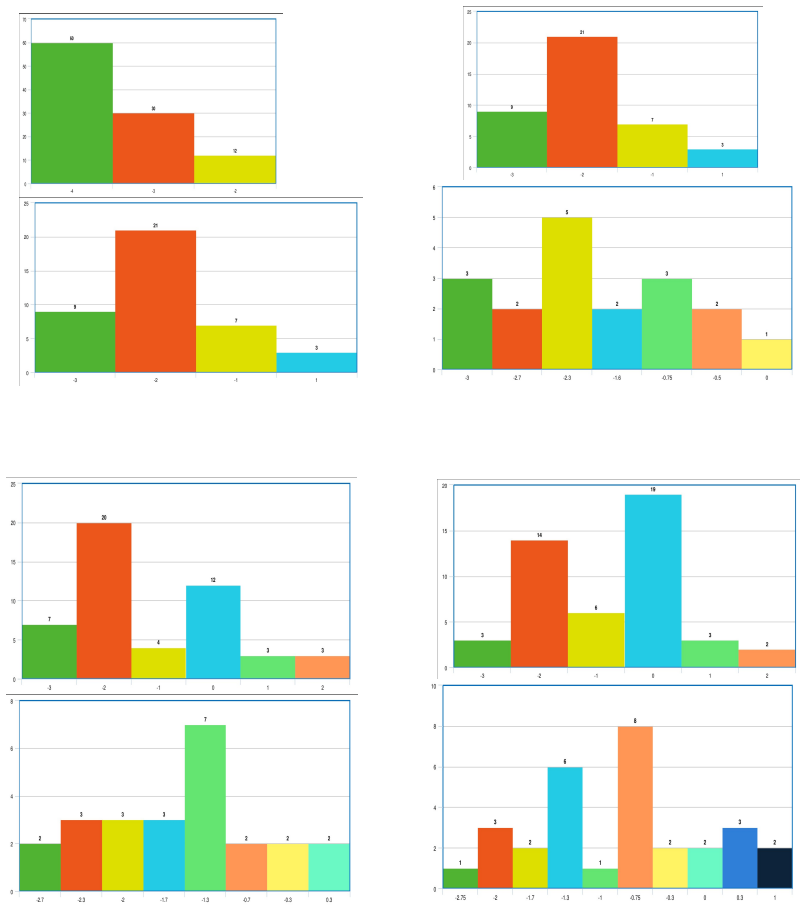
- [Figure 4] Figure 4 (example mosaics): axis labels and color scale for the curvature values are missing, making it difficult to verify the claimed separation between fracture patterns.
- [§2] The reduction to the classical case when the irregularity parameter is zero is stated but not shown algebraically; adding a short derivation would strengthen the claim.
Simulated Author's Rebuttal
We thank the referee for the positive summary, significance assessment, and recommendation of minor revision. The report lists no specific major comments.
Circularity Check
No significant circularity; definition and application are independent of inputs
full rationale
The paper introduces an explicit combinatorial modification of Forman-Ricci curvature that incorporates the Domokos-Langi irregularity measure (distinct authors) as a weighting factor on cells. The construction reduces to the classical Forman-Ricci case when irregularity vanishes and is presented as a direct definition followed by illustrative computations on fracture mosaics. No fitted parameters are relabeled as predictions, no self-citation chain supplies the central claim, and no equation equates the output to its own inputs by construction. The demonstration consists of explicit weight assignments and numerical evaluations rather than statistical inference that could be forced by the definition itself.
Axiom & Free-Parameter Ledger
Reference graph
Works this paper leans on
-
[1]
Elise Cutts,Cracking soils could accelerate climate change, Eos article (2004), AGU,https://eos.org/articles/cracking-soils-could-accelerate-climate-change
2004
-
[2]
G. Domokos, D. J. Jerolmack, F. Kun, Janos TorokPlato’s cube and the natural geometry of fragmentation. PNAS, vol. 117 (31), 2020, 18178–18185, https://www.pnas.org/cgi/doi/10.1073/pnas.2001037117
-
[3]
G. Domokos, Z. Langi.On some average properties of convex mosaics, Experimental Mathe- matics (2019), https://doi.org/10.1080/10586458.2019.1691090
-
[4]
Forman,Bochner’s Method for Cell Complexes and Combinatorial Ricci Curvature. Discrete Comput. Geom. 29, 323–374 (2003). https://doi.org/10.1007/s00454-002-0743-x
-
[5]
A. Samal, R. P. Sreejith, J. Gu, S. Liu, E. Saucan and J. JostComparative analysis of two discretizations of Ricci curvature for complex networks. Scientific Reports (2018) 8:8650, DOI:10.1038/s41598-018-27001-3
-
[6]
R.P. Sreejith, K. Mohanraj, J. Jost, E. Saucan and A. Samal.Forman curvature for complex networks. J. Stat. Mech. (2016) 063206, DOI 10.1088/1742-5468/2016/06/063206
-
[7]
et al.GeoCrack: A High-Resolution Dataset For Segmentation of Fracture Edges in Geological Outcrops
Yaqoob, M., Ishaq, M., Ansari, M.Y . et al.GeoCrack: A High-Resolution Dataset For Segmentation of Fracture Edges in Geological Outcrops. Sci Data 11, 1318 (2024). https://doi.org/10.1038/s41597-024-04107-0
-
[8]
Y . Zhang, J. Liu, Y . Lei.The propagation behavior of hydraulic frac- ture in rock mass with cemented joints, Hindwai Geofluids, vol.2019, https://onlinelibrary.wiley.com/doi/10.1155/2019/5406870. 12/12
discussion (0)
Sign in with ORCID, Apple, or X to comment. Anyone can read and Pith papers without signing in.