CaloTrilogy: Toward a Breakthrough in One-Step, End-to-End, Physics-Guided Shower Generation for Modern Calorimeters
Pith reviewed 2026-06-28 07:39 UTC · model grok-4.3
The pith
A new framework generates calorimeter showers competitively with diffusion models using only one or a few steps and physics-guided training losses.
A machine-rendered reading of the paper's core claim, the machinery that carries it, and where it could break.
Core claim
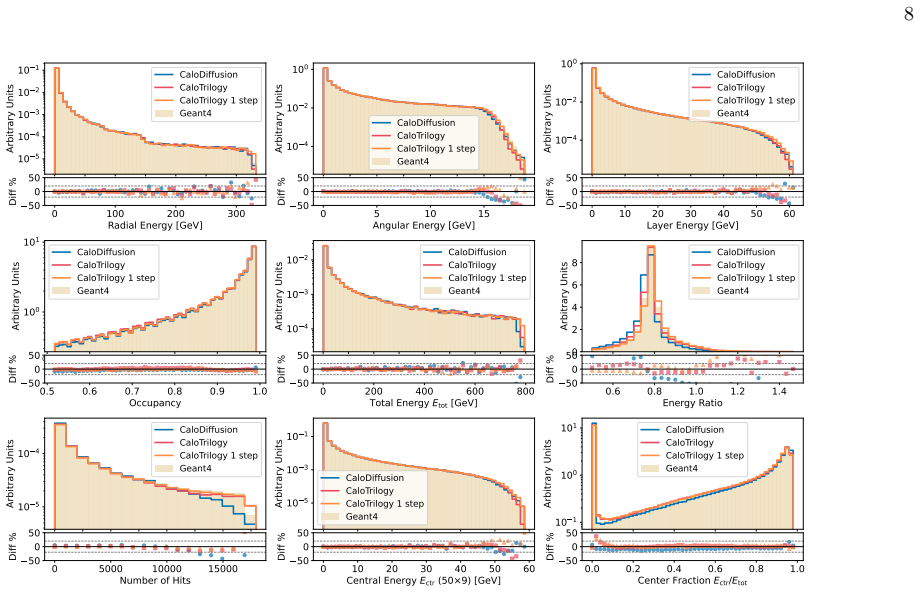
The CaloTrilogy framework achieves shower quality competitive with state-of-the-art flow and diffusion models on multiple public high-granularity calorimeter datasets by sampling in one or a few steps, while the inter-layer structure remains consistent with the underlying physics.
What carries the argument
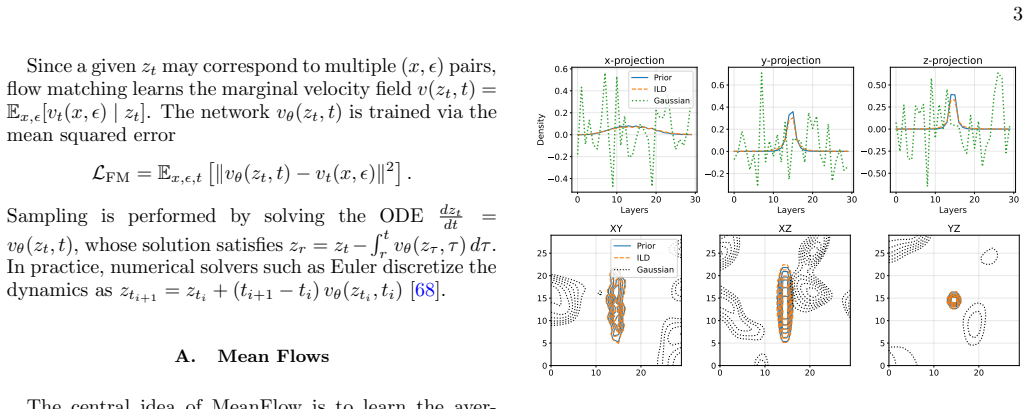
The unified framework that combines an average velocity field integrator for few-step sampling, a learned generative prior built from data, and physics-guided loss terms applied only during training.
If this is right
- Shower generation runs in one or a few evaluations while remaining competitive in quality with flow and diffusion baselines.
- Inter-layer shower structure stays consistent with the underlying physics without post-processing.
- End-to-end inference requires no auxiliary networks or extra computational overhead at sampling time.
- The method applies across several public high-granularity calorimeter datasets.
Where Pith is reading between the lines
- The separation of physics constraints to training time could extend to other high-dimensional generative tasks where inference speed matters.
- Replacing random noise with a data-derived prior may improve sample quality in related simulation domains.
- Scaling tests on full detector geometries would reveal whether the few-step property holds under more complex conditions.
Load-bearing premise
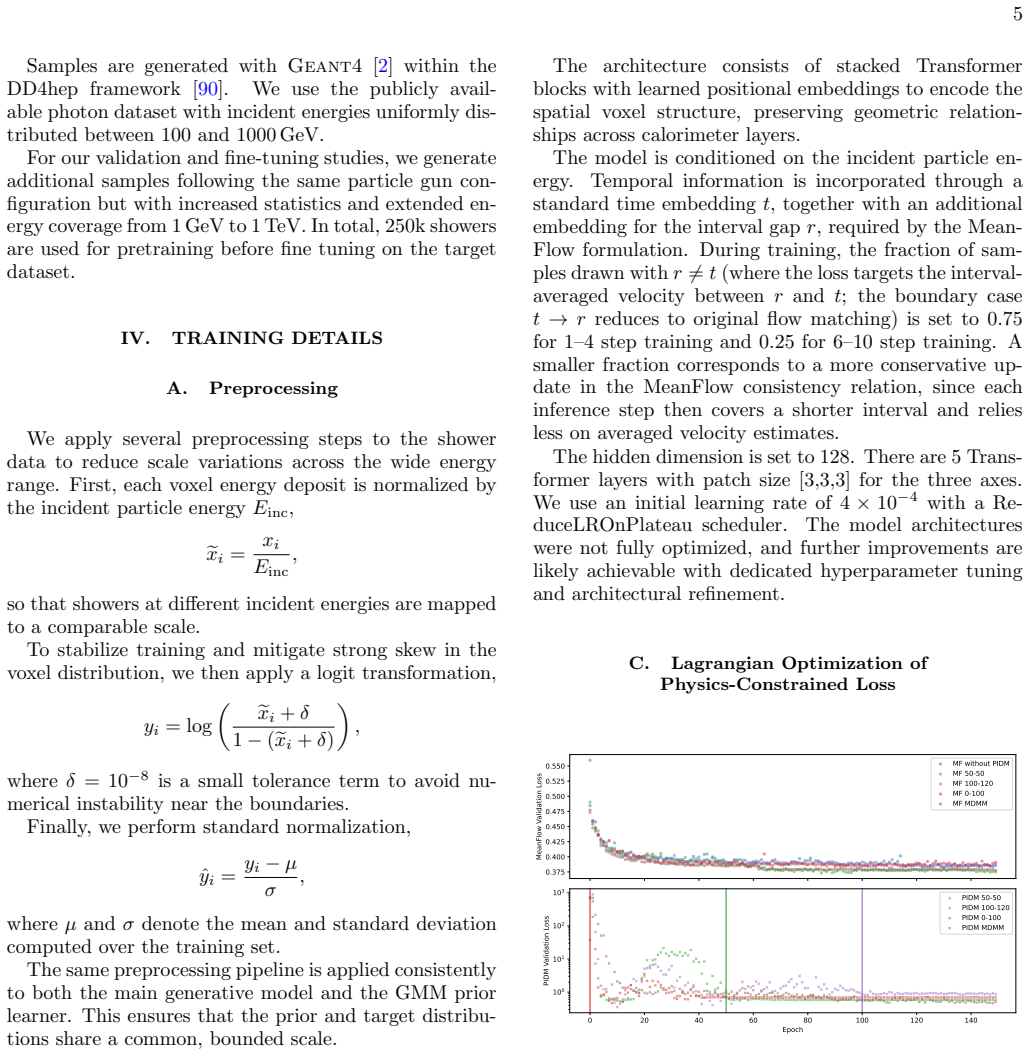
Physics-guided loss terms can impose inductive biases on key observables at training time without needing extra networks or added cost during end-to-end sampling.
What would settle it
Run the model on a new high-granularity calorimeter dataset and check whether energy deposition patterns and shower shapes per layer deviate systematically from Geant4 reference distributions.
Figures






read the original abstract
High-precision calorimeter simulation at current and future colliders imposes rapidly growing computational demands, motivating the development of machine-learning surrogates for traditional Monte Carlo tools such as Geant4. Flow matching and diffusion-based generative models have become leading approaches for high-dimensional fast simulation because of their sample quality, but typically require ${\cal O}(100)$ function evaluations at inference and often rely on auxiliary networks to constrain global observables, compromising streamlined end-to-end generation. We introduce a unified framework that improves the balance between speed, shower quality, and physics fidelity. The method combines: (i) an average velocity field integrator that enables sampling in one or a few evaluations; (ii) a learned generative prior in shower space, constructed from data rather than random noise; and (iii) physics-guided loss terms that impose inductive biases on key observables during training. These elements are training time regularizers, preserving end-to-end inference with no additional cost. With only one or a few evaluation steps, the model achieves shower quality competitive with state-of-the-art flow and diffusion approaches, tested on several public high granularity calorimeter datasets. The results demonstrate inter-layer shower structure consistent with the underlying physics, providing a strong candidate for future fast simulation workflows.
Editorial analysis
A structured set of objections, weighed in public.
Referee Report
Summary. The manuscript introduces CaloTrilogy, a unified framework for fast calorimeter shower generation. It combines (i) an average velocity field integrator for sampling in one or a few evaluations, (ii) a learned generative prior constructed from data rather than random noise, and (iii) physics-guided loss terms applied only at training time. The approach is tested on several public high-granularity calorimeter datasets and claims to achieve shower quality competitive with state-of-the-art flow and diffusion models while producing inter-layer structures consistent with underlying physics, all while preserving end-to-end inference without auxiliary networks or extra sampling cost.
Significance. If the central claims are substantiated, the work could meaningfully advance fast simulation techniques in high-energy physics by addressing the O(100) evaluation cost of current flow/diffusion models. Confining physics constraints to training-time regularizers is a design strength that supports streamlined deployment. Testing on multiple public datasets supports potential reproducibility. The emphasis on end-to-end generation without inference overhead aligns with practical needs for collider workflows.
major comments (2)
- [Abstract / §3] Abstract / §3 (average velocity field integrator): The headline result—that competitive shower quality is achieved with one or a few evaluations—depends on this integrator reducing function evaluations while the learned prior and physics losses act only at training time. The provided text supplies neither the integrator's mathematical definition, its explicit relation to standard flow-matching velocity fields, nor quantitative ablations of quality metrics (e.g., shower shape or energy resolution) across step counts. This is load-bearing for separating integrator performance from dataset-specific effects.
- [Results section] Results section / tables or figures: The abstract asserts competitive quality and physics-consistent inter-layer structure on public datasets, but the text contains no referenced quantitative metrics, tables, or ablation studies. Without these, the competitiveness claim and the assertion that physics-guided losses impose inductive biases without compromising end-to-end inference cannot be evaluated.
minor comments (2)
- [Abstract] Abstract: The title uses 'CaloTrilogy' but the abstract does not define or expand the term; a short parenthetical explanation would aid readers unfamiliar with the framework.
- [Abstract] Abstract: Consider citing the specific public datasets (e.g., by name or reference) used for testing to strengthen the reproducibility statement.
Simulated Author's Rebuttal
We thank the referee for their careful reading and constructive comments. We address each major comment point by point below.
read point-by-point responses
-
Referee: [Abstract / §3] Abstract / §3 (average velocity field integrator): The headline result—that competitive shower quality is achieved with one or a few evaluations—depends on this integrator reducing function evaluations while the learned prior and physics losses act only at training time. The provided text supplies neither the integrator's mathematical definition, its explicit relation to standard flow-matching velocity fields, nor quantitative ablations of quality metrics (e.g., shower shape or energy resolution) across step counts. This is load-bearing for separating integrator performance from dataset-specific effects.
Authors: We agree that the mathematical definition of the average velocity field integrator, its explicit relation to standard flow-matching velocity fields, and quantitative ablations across step counts are necessary to substantiate the headline claims. In the revised manuscript we expand §3 with the full derivation of the averaged velocity field (including its closed-form relation to the flow-matching ODE) and add new ablation tables and figures reporting shower-shape and energy-resolution metrics as a function of evaluation count, with direct comparisons to multi-step baselines. revision: yes
-
Referee: [Results section] Results section / tables or figures: The abstract asserts competitive quality and physics-consistent inter-layer structure on public datasets, but the text contains no referenced quantitative metrics, tables, or ablation studies. Without these, the competitiveness claim and the assertion that physics-guided losses impose inductive biases without compromising end-to-end inference cannot be evaluated.
Authors: We acknowledge that the results section lacks explicit references to quantitative metrics, tables, and ablations. The revised manuscript adds a dedicated results table summarizing shower-shape, energy-resolution, and inter-layer correlation metrics on all tested public datasets, together with side-by-side comparisons to state-of-the-art flow and diffusion models. Additional ablation studies on the physics-guided losses are included to demonstrate their training-time effect on fidelity while preserving end-to-end inference. revision: yes
Circularity Check
No significant circularity; claims rest on proposed architectural components without evident self-referential definitions or fitted predictions
full rationale
The abstract describes a unified framework combining an average velocity field integrator, a learned generative prior, and physics-guided loss terms for calorimeter shower simulation. No equations, derivations, or self-citations are provided that would allow any performance claim to reduce by construction to fitted inputs, self-definitions, or load-bearing prior work by the same authors. The results are presented as empirical outcomes on public datasets, with the method's elements acting as training regularizers that preserve end-to-end inference. This structure is self-contained against external benchmarks and does not trigger any of the enumerated circularity patterns.
Axiom & Free-Parameter Ledger
Reference graph
Works this paper leans on
-
[1]
CMS Collaboration,The Phase-2 Upgrade of the CMS Endcap Calorimeter, Tech. Rep. CERN-LHCC-2017-023, CMS-TDR-019 (CERN, 2017)
2017
-
[2]
Agostinelliet al.(GEANT4 Collaboration), GEANT4—a simulation toolkit, Nucl
S. Agostinelliet al.(GEANT4 Collaboration), GEANT4—a simulation toolkit, Nucl. Instrum. Meth. A506, 250 (2003)
2003
-
[3]
Allisonet al., Recent developments in Geant4, Nucl
J. Allisonet al., Recent developments in Geant4, Nucl. Instrum. Meth. A835, 186 (2016)
2016
-
[4]
Allisonet al., Geant4 developments and applications, IEEE Trans
J. Allisonet al., Geant4 developments and applications, IEEE Trans. Nucl. Sci.53, 270 (2006)
2006
-
[5]
K. Pedroet al.(CMS Collaboration), Integration and performance of new technologies in the CMS simulation, EPJ Web Conf.245, 02020 (2020), arXiv:2004.02327 [hep-ex]
arXiv 2020
-
[6]
M. Paganini, L. de Oliveira, and B. Nachman, Ac- celerating science with generative adversarial networks: An application to 3D particle showers in multilayer calorimeters, Phys. Rev. Lett.120, 042003 (2018), arXiv:1705.02355 [hep-ex]
Pith/arXiv arXiv 2018
-
[7]
M. Paganini, L. de Oliveira, and B. Nachman, Calo- GAN: Simulating 3D high energy particle showers in multilayer electromagnetic calorimeters with generative adversarial networks, Phys. Rev. D97, 014021 (2018), arXiv:1712.10321 [hep-ex]
Pith/arXiv arXiv 2018
-
[8]
L. de Oliveira, M. Paganini, and B. Nachman, Control- ling physical attributes in GAN-accelerated simulation of electromagnetic calorimeters, J. Phys. Conf. Ser.1085, 042017 (2018), arXiv:1711.08813 [hep-ex]
Pith/arXiv arXiv 2018
-
[9]
M. Erdmann, L. Geiger, J. Glombitza, and D. Schmidt, Generating and refining particle detector simulations us- ing the Wasserstein distance in adversarial networks, Comput. Softw. Big Sci.2, 4 (2018), arXiv:1802.03325 [physics.ins-det]
Pith/arXiv arXiv 2018
-
[11]
M. Erdmann, J. Glombitza, and T. Quast, Precise sim- ulation of electromagnetic calorimeter showers using a wasserstein generative adversarial network, Comput. Softw. Big Sci.3, 4 (2019), arXiv:1807.01954 [physics.ins- det]
arXiv 2019
-
[12]
P. Musella and F. Pandolfi, Fast and accurate simu- lation of particle detectors using generative adversar- ial networks, Comput. Softw. Big Sci.2, 8 (2018), arXiv:1805.00850 [hep-ex]
Pith/arXiv arXiv 2018
-
[13]
D. Belaynehet al., Calorimetry with deep learning: Par- ticle simulation and reconstruction for collider physics, Eur. Phys. J. C80, 688 (2020), arXiv:1912.06794 [physics.ins-det]
arXiv 2020
- [14]
-
[15]
ATLAS Collaboration,Fast Simulation of the ATLAS Calorimeter System with Generative Adversarial Net- works, Tech. Rep. ATL-SOFT-PUB-2020-006 (CERN, 2020)
2020
-
[16]
Ghosh, Deep generative models for fast shower simula- tion in ATLAS, J
A. Ghosh, Deep generative models for fast shower simula- tion in ATLAS, J. Phys. Conf. Ser.1525, 012077 (2020)
2020
-
[17]
Aadet al.(ATLAS), AtlFast3: The next generation of fast simulation in ATLAS, Comput
G. Aadet al.(ATLAS), AtlFast3: The next generation of fast simulation in ATLAS, Comput. Softw. Big Sci.6, 7 (2022), arXiv:2109.02551 [hep-ex]
arXiv 2022
-
[18]
M. Faucci Giannelli and R. Zhang, CaloShowerGAN, a generative adversarial network model for fast calorimeter shower simulation, Eur. Phys. J. Plus139, 597 (2024), arXiv:2309.06515 [hep-ex]
arXiv 2024
- [19]
-
[20]
J. Birk, F. Gaede, A. Hallin, G. Kasieczka, M. Mozzan- ica, and H. Rose, OmniJet-α C: Learning point cloud calorimeter simulations using generative transformers, JINST20(07), P07007, arXiv:2501.05534 [physics.ins- det]
-
[21]
J. C. Cresswell, B. L. Ross, G. Loaiza-Ganem, H. Reyes- Gonz´ alez, M. Letizia, and A. L. Caterini, CaloMan: Fast generation of calorimeter showers with density estima- tion on learned manifolds, inNeurIPS 2022 Workshop on Machine Learning and the Physical Sciences(2022) arXiv:2211.15380 [cs.LG]
arXiv 2022
-
[22]
S. Hoque, H. Jia, A. Abhishek, M. Fadaie, J. Q. Toledo- Mar´ ın, T. Vale, R. G. Melko, M. Swiatlowski, and W. T. Fedorko, CaloQVAE: Simulating high-energy particle- calorimeter interactions using hybrid quantum-classical generative models, Eur. Phys. J. C84, 1244 (2024), arXiv:2312.03179 [hep-ph]
arXiv 2024
-
[23]
Q. Liu, C. Shimmin, X. Liu, E. Shlizerman, S.-C. Li, and S.-C. Hsu, Calo-VQ: Vector-quantized two-stage generative model in calorimeter simulation, (2024), arXiv:2405.06605 [cs.LG]
arXiv 2024
-
[24]
R. Kansal, J. Duarte, K. Duarte, and M. Pierini, Graph generative models for fast detector simulations in high energy physics 10.48550/arXiv.2106.11535 (2021), arXiv:2106.11535 [hep-ex]
-
[25]
B. Hashemi, Deep Generative Models for Ultra- High Granularity Particle Physics Detector Simu- lation: A Voyage From Emulation to Extrap- olation 10.5282/edoc.34137 (2023), arXiv:2403.13825 [physics.ins-det]
-
[26]
M. Mazurek (LHCb), Machine learning in LHCb Simu- lation: From fast to flash, PoSLHCP2025, 125 (2026), arXiv:2511.02020 [hep-ex]
arXiv 2026
-
[27]
Krause and D
C. Krause and D. Shih, CaloFlow: Fast and accurate generation of calorimeter showers with normalizing flows, Phys. Rev. D107, 113003 (2021)
2021
-
[28]
Krause and D
C. Krause and D. Shih, CaloFlow II: Even faster and still accurate generation of calorimeter showers with normal- izing flows, Phys. Rev. D107, 113004 (2021)
2021
- [29]
-
[30]
C. Krause, B. Nachman, I. Pang, D. Shih, and Y. Zhu, Anomaly detection with flow-based fast calorimeter simu- lators, Phys. Rev. D110, 10.1103/PhysRevD.110.0c5036 (2024), arXiv:2312.11618 [hep-ph]
- [31]
-
[32]
C. Gao, J. Isaacson, and C. Krause, i-flow: High- dimensional integration and sampling with normalizing flows, Mach. Learn. Sci. Technol.4, 045023 (2020)
2020
-
[33]
M. R. Buckley, C. Krause, I. Pang, and D. Shih, Inductive simulation of calorimeter showers with normalizing flows, Phys. Rev. D109, 033006 (2024), arXiv:2305.11934 [cs.LG]
arXiv 2024
- [34]
-
[35]
S. Diefenbacher, E. Eren, F. Gaede, G. Kasieczka, C. Krause, I. Shekhzadeh, and D. Shih, L2LFlows: Gen- erating high-fidelity 3D calorimeter images, JINST18 (10), P10017, arXiv:2302.11594 [cs.LG]
- [36]
-
[37]
Heimel, N
T. Heimel, N. Huetsch, R. Winterhalder, A. Butter, O. Mattelaer, and T. Plehn, The MadNIS reloaded, Sci- Post Phys.17, 023 (2024)
2024
- [38]
- [39]
-
[40]
I. Pang, D. Shih, and J. A. Raine, Calorimeter shower super-resolution, Phys. Rev. D109, 092009 (2024)
2024
-
[41]
T. Buss, F. Gaede, G. Kasieczka, C. Krause, and D. Shih, Convolutional L2LFlows: generating accurate showers in highly granular calorimeters using convolutional normal- izing flows, JINST19(09), P09003, arXiv:2405.20407 [physics.ins-det]
-
[42]
H. Bahl, S. Diefenbacher, N. Elmer, T. Plehn, and J. Spinner, Forecasting generative amplification 10.48550/arXiv.2509.08048 (2025), arXiv:2509.08048 [hep-ph]
work page internal anchor Pith review Pith/arXiv arXiv doi:10.48550/arxiv.2509.08048 2025
-
[43]
S. Schnake, D. Kr¨ ucker, and K. Borras, CaloPointFlow II: Generating calorimeter showers as point clouds 10.48550/arXiv.2403.15782 (2024), arXiv:2403.15782 [physics.ins-det]
-
[44]
J. Erdmann, J. Kann, F. Mausolf, and P. Wissmann, ParaFlow: Fast calorimeter simulations parameterized in upstream material configurations, Eur. Phys. J. C85, 857 (2025), arXiv:2503.21461 [hep-ph]
arXiv 2025
-
[45]
O. Amram and K. Pedro, Denoising diffusion models with geometry adaptation for high fidelity calorime- ter simulation, Physical Review D108, 072014 (2023), arXiv:2308.03876 [physics.ins-det]
arXiv 2023
-
[46]
V. Mikuni and B. Nachman, Score-based generative mod- els for calorimeter shower simulation, Phys. Rev. D106, 092009 (2022), arXiv:2206.11898 [hep-ex]
arXiv 2022
-
[47]
F. T. Acosta, V. Mikuni, B. Nachman, M. Arratia, B. Karki, R. Milton, P. Karande, and A. Angerami, Comparison of point cloud and image-based models for calorimeter fast simulation, JINST19(05), P05003, arXiv:2307.04780 [hep-ex]
-
[48]
V. Mikuni and B. Nachman, CaloScore v2: Single- shot calorimeter shower simulation with diffusion models, JINST19(02), P02001, arXiv:2308.03847 [hep-ex]
- [49]
-
[50]
D. Kobylianskii, N. Soybelman, E. Dreyer, and E. Gross, Graph-based diffusion model for fast shower generation in calorimeters with irregular geometry, Phys. Rev. D 110, 072003 (2024), arXiv:2402.11575 [hep-ex]
arXiv 2024
-
[51]
C. Jiang, S. Qian, and H. Qu, BUFF: Boosted decision tree based ultra-fast flow matching 10.48550/arXiv.2404.18219 (2024), arXiv:2404.18219 [hep-ex]
-
[52]
J. Brehmer, V. Bres´ o, P. de Haan, T. Plehn, H. Qu, J. Spinner, and J. Thaler, A lorentz-equivariant trans- former for all of the LHC, SciPost Phys.19, 108 (2025), arXiv:2411.00446 [hep-ph]
arXiv 2025
- [53]
- [54]
- [55]
-
[56]
F. Vaselli, C. Sun, T. Aarrestad, D. Danopoulos, R. Os- kari Niemi, M. M. Glowacki, K. Govorkova, V. Loncar, F. Pantaleo, and M. Pierini, It’s not a FAD: first demon- stration of flows for unsupervised anomaly detection at 40 MHz for use at the Large Hadron Collider, Mach. Learn. Sci. Tech.7, 025052 (2026), arXiv:2508.11594 [hep-ex]
arXiv 2026
-
[57]
L. Favaro, A. Giammanco, and C. Krause, Fast, accurate, and precise detector simulation with vision transform- ers 10.48550/arXiv.2509.25169 (2025), arXiv:2509.25169 [hep-ph]
-
[58]
T. Buss, H. Day-Hall, F. Gaede, G. Kasieczka, K. Kr¨ uger, A. Korol, T. Madlener, P. McKeown, M. Mozzanica, and L. Valente, CaloClouds3: Ultra- fast geometry-independent highly-granular calorimeter simulation, JINST21(03), P03018, arXiv:2511.01460 [physics.ins-det]
-
[59]
T. Buss, F. Gaede, G. Kasieczka, A. Korol, K. Kr¨ uger, P. McKeown, and M. Mozzanica, CaloHadronic: A diffusion model for the generation of hadronic show- ers 10.48550/arXiv.2506.21720 (2025), arXiv:2506.21720 [physics.ins-det]
-
[60]
E. Buhmann, S. Diefenbacher, E. Eren, F. Gaede, G. Kasieczka, A. Korol, W. Korcari, K. Kr¨ uger, and P. McKeown, CaloClouds: Fast geometry-independent highly-granular calorimeter simulation, JINST18(11), P11025, arXiv:2305.04847 [physics.ins-det]
-
[61]
E. Buhmann, F. Gaede, G. Kasieczka, A. Korol, W. Kor- cari, K. Kr¨ uger, and P. McKeown, CaloClouds II: Ultra- fast geometry-independent highly-granular calorimeter simulation, JINST19(04), P04020, arXiv:2309.05704 [physics.ins-det]
-
[62]
P. Raikwar, A. Zaborowska, P. McKeown, R. Cardoso, M. Piorczynski, and K. Yeo, A generalisable genera- tive model for multi-detector calorimeter simulation 10.48550/arXiv.2509.07700 (2025), arXiv:2509.07700 [physics.ins-det]
-
[63]
F. Gaede, G. Kasieczka, and L. Valente, Cross- 13 geometry transfer learning in fast electromagnetic shower simulation 10.48550/arXiv.2512.00187 (2025), arXiv:2512.00187 [physics.ins-det]
-
[64]
T. Buss, H. Day-Hall, F. Gaede, G. Kasieczka, and K. Kr¨ uger, AllShowers: One model for all calorimeter showers 10.48550/arXiv.2601.11716 (2026), arXiv:2601.11716 [physics.ins-det]
-
[65]
O. Ronneberger, P. Fischer, and T. Brox, U-net: Convo- lutional networks for biomedical image segmentation, in Medical Image Computing and Computer-Assisted Inter- vention – MICCAI 2015, edited by N. Navab, J. Horneg- ger, W. M. Wells, and A. F. Frangi (Springer Interna- tional Publishing, Cham, 2015) p. 234, arXiv:1505.04597 [cs.CV]
Pith/arXiv arXiv 2015
-
[66]
A. Vaswani, N. Shazeer, N. Parmar, J. Uszkoreit, L. Jones, A. N. Gomez, L. Kaiser, and I. Polosukhin, Attention Is All You Need, in31st International Confer- ence on Neural Information Processing Systems(2017) arXiv:1706.03762 [cs.CL]
Pith/arXiv arXiv 2017
-
[67]
Y. Song, P. Dhariwal, M. Chen, and I. Sutskever, Consistency models 10.48550/arXiv.2303.01469 (2023), arXiv:2303.01469 [cs.LG]
work page internal anchor Pith review Pith/arXiv arXiv doi:10.48550/arxiv.2303.01469 2023
-
[68]
Z. Geng, M. Deng, X. Bai, J. Z. Kolter, and K. He, Mean flows for one-step generative model- ing 10.48550/arXiv.2505.13447 (2025), arXiv:2505.13447 [cs.LG]
work page internal anchor Pith review Pith/arXiv arXiv doi:10.48550/arxiv.2505.13447 2025
-
[69]
CaloChallenge Collaboration, CaloChallenge dataset 2: Electromagnetic showers in a high-granularity calorime- ter, (2022)
2022
-
[70]
CaloChallenge Collaboration, CaloChallenge dataset 3: Highly granular calorimeter geometry, (2022)
2022
-
[71]
Amramet al., CaloChallenge 2022: a community chal- lenge for fast calorimeter simulation, Rept
O. Amramet al., CaloChallenge 2022: a community chal- lenge for fast calorimeter simulation, Rept. Prog. Phys. 88, 116201 (2025), arXiv:2410.21611 [physics.ins-det]
arXiv 2022
-
[72]
H. Abramowiczet al., International large detector: In- terim design report 10.48550/arXiv.2003.01116 (2020), arXiv:2003.01116 [physics.ins-det]
-
[73]
J. Repondet al., Design and electronics commission- ing of the physics prototype of a Si-W electromagnetic calorimeter for the international linear collider, JINST 3, P08001, arXiv:0805.4833 [physics.ins-det]
-
[74]
J. Ho, A. Jain, and P. Abbeel, Denoising diffusion probabilistic models 10.48550/arXiv.2006.11239 (2020), arXiv:2006.11239 [cs.LG]
work page internal anchor Pith review Pith/arXiv arXiv doi:10.48550/arxiv.2006.11239 2006
-
[75]
Y. Song, J. Sohl-Dickstein, D. P. Kingma, A. Kumar, S. Ermon, and B. Poole, Score-based generative modeling through stochastic differential equations, ICLR (2021), arXiv:2011.13456 [cs.LG]
Pith/arXiv arXiv 2021
-
[76]
Elucidating the Design Space of Diffusion-Based Generative Models
T. Karras, M. Aittala, T. Aila, and S. Laine, Elu- cidating the design space of diffusion-based genera- tive models, NeurIPS 10.48550/arXiv.2206.00364 (2022), arXiv:2206.00364 [cs.CV]
work page internal anchor Pith review Pith/arXiv arXiv doi:10.48550/arxiv.2206.00364 2022
-
[77]
Y. Xu, Z. Zhang, Y. Song, and S. Ermon, Restart sampling for improving generative processes 10.48550/arXiv.2306.14878 (2023), arXiv:2306.14878 [cs.LG]
-
[78]
Flow Matching for Generative Modeling
Y. Lipman, R. T. Q. Chen, H. Ben-Hamu, M. Nickel, and M. Le, Flow matching for generative model- ing 10.48550/arXiv.2210.02747 (2023), arXiv:2210.02747 [cs.LG]
work page internal anchor Pith review Pith/arXiv arXiv doi:10.48550/arxiv.2210.02747 2023
-
[79]
A. Tong, Y. Lipman, R. T. Q. Chen, M. Nickel, and M. Le, Improving and generalizing flow-based generative models with minibatch optimal transport 10.48550/arXiv.2302.00482 (2023), arXiv:2302.00482 [cs.LG]
work page internal anchor Pith review Pith/arXiv arXiv doi:10.48550/arxiv.2302.00482 2023
-
[80]
H. Zhang, A. Siarohin, W. Menapace, M. Vasilkovsky, S. Tulyakov, Q. Qu, and I. Skorokhodov, Al- phaFlow: Understanding and improving meanflow mod- els 10.48550/arXiv.2510.20771 (2025), arXiv:2510.20771 [cs.LG]
-
[81]
H. You, B. Liu, and H. He, Modular MeanFlow: To- wards stable and scalable one-step generative model- ing 10.48550/arXiv.2508.17426 (2025), arXiv:2508.17426 [cs.LG]
discussion (0)
Sign in with ORCID, Apple, or X to comment. Anyone can read and Pith papers without signing in.