Continuous-Variable Quantum State Tomography Enabled by Quantum Mirrors
Pith reviewed 2026-06-28 09:23 UTC · model grok-4.3
The pith
Quantum mirrors transfer complete information from photonic states to a control atom, enabling full tomography via atomic measurements alone.
A machine-rendered reading of the paper's core claim, the machinery that carries it, and where it could break.
Core claim
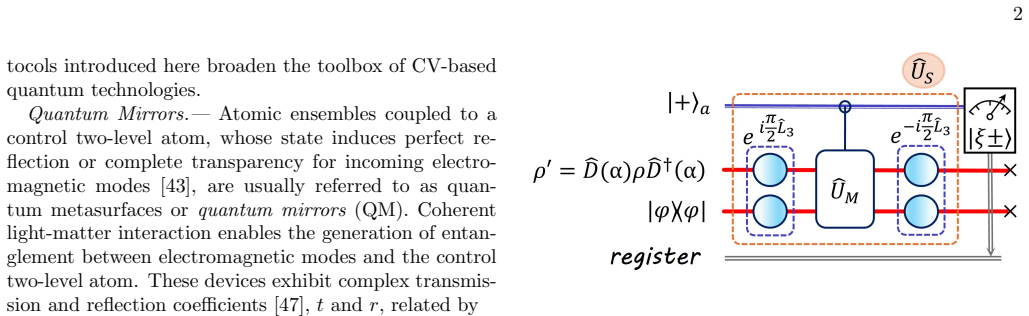
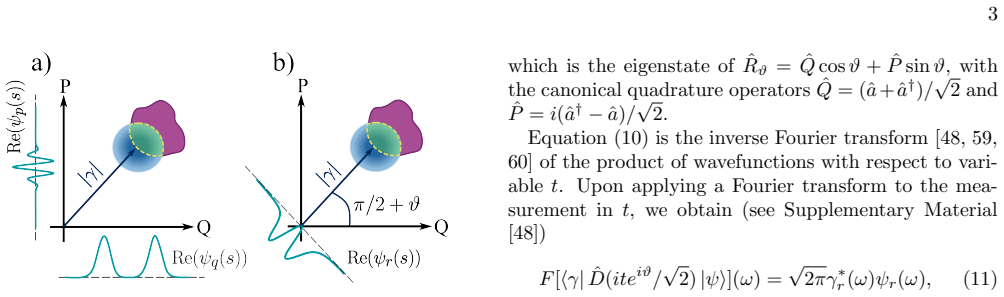
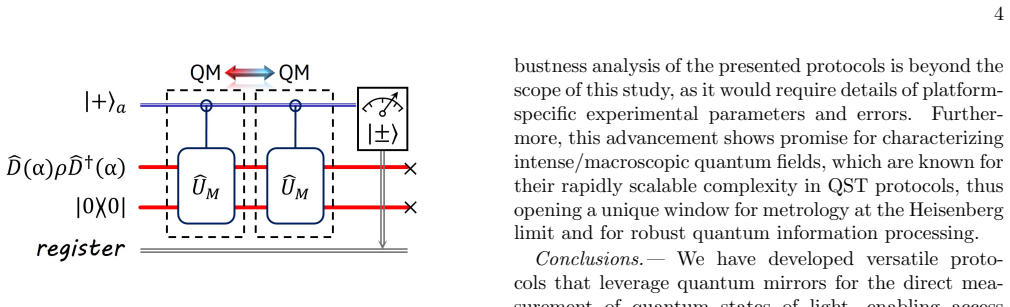
The central claim is that quantum-mirror protocols can copy the entire information content of incident photonic states onto a control atomic system, after which full state characterization is achieved solely by measurements performed on that atom, realized through kernel functions, direct wavefunction reconstruction, and pointwise Wigner-function measurements.
What carries the argument
Quantum mirrors that transfer the complete information of incident photonic states onto a control atomic system, so that all subsequent reconstruction occurs via atomic measurements.
If this is right
- Full photonic state characterization becomes possible through measurements performed only on the control atom.
- Reconstruction can be carried out with kernel functions applied to atomic data.
- Direct wavefunction reconstruction is obtained from the same atomic measurements.
- Pointwise sampling of the Wigner function is enabled without photon counting.
- The approach supplies a framework for benchmarking and verifying non-Gaussian continuous-variable states.
Where Pith is reading between the lines
- The method could lower the sample complexity that currently limits verification of multi-mode non-Gaussian states.
- It suggests a route to hybrid light-matter protocols in which atomic control systems serve as universal readouts for photonic networks.
- If the mirrors can be realized with current technology, the same transfer step might be tested on Gaussian states first to isolate the transfer fidelity before moving to non-Gaussian cases.
Load-bearing premise
Quantum mirrors exist and transfer the full photonic state information to the atomic system without loss or decoherence.
What would settle it
An experiment that sends a known non-Gaussian photonic state through the quantum-mirror setup and obtains an atomic-measurement reconstruction whose Wigner function or wavefunction deviates from the independently verified input state.
Figures

read the original abstract
In quantum technologies, continuous-variable systems offer advantages over their discrete counterparts. However, continuous-variable tomography suffers from exponentially growing sample complexity. We propose protocols using quantum mirrors to transfer the complete information of incident photonic states onto a control atomic system. This enables full photonic state characterization through measurements on the control atom alone, realized via kernel functions, direct wavefunction reconstruction, and pointwise Wigner function measurements. Our approach overcomes the limitations of conventional photon counting, statistical inference, and inverse transformation, providing a robust framework for benchmarking and verifying non-Gaussian states in continuous-variable quantum optics.
Editorial analysis
A structured set of objections, weighed in public.
Referee Report
Summary. The paper proposes protocols in which quantum mirrors transfer the complete information of arbitrary continuous-variable photonic states onto a control atomic system, after which photonic state tomography is performed exclusively via measurements on the atom. The claimed reconstruction methods include kernel-function approaches, direct wavefunction recovery, and pointwise Wigner-function sampling; the work asserts that this framework bypasses the exponential sample complexity of conventional CV tomography and the limitations of photon counting or inverse transforms.
Significance. If the ideal transfer step can be realized, the proposal would offer a conceptually new route to efficient, atom-only characterization of non-Gaussian CV states with potential utility for benchmarking in quantum optics. The manuscript, however, supplies no derivations, Hamiltonians, or performance bounds for the transfer operation itself.
major comments (2)
- The central claim rests on the unexamined assumption that quantum mirrors implement a perfect, lossless, infinite-dimensional state transfer from the photonic mode to the atomic system. No section derives the required interaction Hamiltonian, coupling regime, or error bounds; consequently the kernel, wavefunction, and Wigner reconstruction formulas inherit this unverified isomorphism.
- The abstract and proposal contain no explicit reconstruction formulas, sample-complexity scalings, or comparison with existing CV tomography protocols. Without these, it is impossible to assess whether the claimed reduction in sample complexity is realized once the transfer step is made explicit.
minor comments (1)
- The abstract is dense and would benefit from a single-sentence statement of the key technical assumption (ideal quantum-mirror transfer) to orient readers.
Simulated Author's Rebuttal
We thank the referee for their thorough review and valuable feedback on our manuscript. The comments identify key areas where additional detail will strengthen the presentation. We address each major comment below and will incorporate the suggested revisions.
read point-by-point responses
-
Referee: The central claim rests on the unexamined assumption that quantum mirrors implement a perfect, lossless, infinite-dimensional state transfer from the photonic mode to the atomic system. No section derives the required interaction Hamiltonian, coupling regime, or error bounds; consequently the kernel, wavefunction, and Wigner reconstruction formulas inherit this unverified isomorphism.
Authors: We acknowledge that the manuscript does not derive the quantum-mirror transfer operation in detail. The focus was on the tomography protocols that become possible once the transfer is available. In the revised manuscript we will add a new section that specifies the interaction Hamiltonian, identifies the strong-coupling regime required for near-unit fidelity, and supplies error bounds on the transferred state as a function of coupling strength and decoherence rates. These additions will make the assumed isomorphism explicit and allow the reconstruction formulas to rest on a concrete physical model. revision: yes
-
Referee: The abstract and proposal contain no explicit reconstruction formulas, sample-complexity scalings, or comparison with existing CV tomography protocols. Without these, it is impossible to assess whether the claimed reduction in sample complexity is realized once the transfer step is made explicit.
Authors: We agree that explicit formulas and quantitative comparisons are necessary for a complete evaluation. Although the manuscript describes the three reconstruction routes (kernel functions, direct wave-function recovery, and pointwise Wigner sampling), the explicit expressions and scaling arguments were only sketched. The revised version will include the full reconstruction formulas, derive the sample-complexity scaling (showing the reduction from exponential in the number of modes to polynomial once the atomic measurements are used), and add a comparison table against homodyne tomography and direct photon-counting methods. These changes will allow the claimed advantage to be assessed directly. revision: yes
Circularity Check
No circularity: conceptual proposal with external assumption on quantum mirrors
full rationale
The paper is a protocol proposal that assumes quantum mirrors can perform ideal state transfer from photonic CV states to an atomic control system, after which standard atomic measurements enable kernel, wavefunction, or Wigner reconstructions. No equations, fitted parameters, self-citations, or derivations are shown that reduce any claimed result to an input by construction. The central step (perfect transfer) is presented as an enabling black-box capability rather than a self-derived or tautological quantity, leaving the work self-contained as a high-level framework whose validity rests on external realization of the mirrors.
Axiom & Free-Parameter Ledger
axioms (1)
- standard math Standard quantum mechanics governs the interaction between photonic states and the atomic control system.
invented entities (1)
-
quantum mirrors
no independent evidence
Reference graph
Works this paper leans on
-
[1]
H. Wang, T. C. Ralph, J. J. Renema, C.-Y. Lu, and J.-W. Pan, Nature Materials24, 1883–1897 (2025)
2025
-
[2]
Alexander, A
K. Alexander, A. Benyamini, D. Black, D. Bonneau, S. Burgos, B. Burridge, H. Cable, G. Campbell, G. Cata- lano, A. Ceballos,et al., Nature641, 876 (2025)
2025
-
[3]
L. S. Madsen, F. Laudenbach, M. F. Askarani, F. Rortais, T. Vincent, J. F. F. Bulmer, F. M. Miatto, L. Neuhaus, L. G. Helt,et al., Nature606, 75 (2022)
2022
-
[4]
Zhong, H
H.-S. Zhong, H. Wang, Y.-H. Deng, M.-C. Chen, L.-C. Peng, Y.-H. Luo, J. Qin, D. Wu, X. Ding, Y. Hu, P. Hu, et al., Science370, 1460 (2020)
2020
-
[5]
F. A. Mele, L. Lami, and V. Giovannetti, Nature Pho- tonics19, 329 (2025)
2025
-
[6]
J. Aasi, J. Abadie, B. P. Abbott, R. Abbott, T. D. Ab- bott, M. R. Abernathy, C. Adams, T. Adams, P. Ad- desso,et al., Nature Photonics7, 613 (2013)
2013
-
[7]
A. I. Lvovsky and M. G. Raymer, Rev. Mod. Phys.81, 5 299 (2009)
2009
-
[8]
Banaszek, C
K. Banaszek, C. Radzewicz, K. W´ odkiewicz, and J. S. Krasi´ nski, Physical Review A60, 674–677 (1999)
1999
-
[9]
Kirchmair, B
G. Kirchmair, B. Vlastakis, Z. Leghtas, S. E. Nigg, H. Paik, E. Ginossar, M. Mirrahimi, L. Frunzio, S. M. Girvin, and R. J. Schoelkopf, Nature495, 205 (2013)
2013
-
[10]
H. Wang, M. Hofheinz, M. Ansmann, R. C. Bialczak, E. Lucero, M. Neeley, A. D. O’Connell, D. Sank, M. Wei- des, J. Wenner, A. N. Cleland, and J. M. Martinis, Phys. Rev. Lett.103, 200404 (2009)
2009
-
[11]
Vlastakis, G
B. Vlastakis, G. Kirchmair, Z. Leghtas, S. E. Nigg, L. Frunzio, S. M. Girvin, M. Mirrahimi, M. H. Devoret, and R. J. Schoelkopf, Science342, 607 (2013)
2013
-
[12]
Bertet, A
P. Bertet, A. Auffeves, P. Maioli, S. Osnaghi, T. Meunier, M. Brune, J. M. Raimond, and S. Haroche, Phys. Rev. Lett.89, 200402 (2002)
2002
-
[13]
Del´ eglise, I
S. Del´ eglise, I. Dotsenko, C. Sayrin, J. Bernu, M. Brune, J.-M. Raimond, and S. Haroche, Nature455, 510 (2008)
2008
-
[14]
Hofheinz, H
M. Hofheinz, H. Wang, M. Ansmann, R. C. Bialczak, E. Lucero, M. Neeley, A. D. O’Connell, D. Sank, J. Wen- ner, J. M. Martinis, and A. N. Cleland, Nature459, 546 (2009)
2009
-
[15]
C. Wang, Y. Y. Gao, P. Reinhold, R. W. Heeres, N. Ofek, K. Chou, C. Axline, M. Reagor, J. Blumoff, K. M. Sliwa, L. Frunzio, S. M. Girvin, L. Jiang, M. Mirrahimi, M. H. Devoret, and R. J. Schoelkopf, Science352, 1087 (2016)
2016
-
[16]
Landon-Cardinal, L
O. Landon-Cardinal, L. C. G. Govia, and A. A. Clerk, Phys. Rev. Lett.120, 090501 (2018)
2018
-
[18]
F. A. Mele, A. A. Mele, L. Bittel, J. Eisert, V. Giovan- netti, L. Lami, L. Leone, and S. F. E. Oliviero, Nature Physics21, 2002 (2025)
2002
-
[19]
O’Donnell and J
R. O’Donnell and J. Wright, inProceedings of the Forty- Eighth Annual ACM Symposium on Theory of Comput- ing, STOC ’16 (Association for Computing Machinery, New York, NY, USA, 2016) p. 899–912
2016
-
[20]
J. Haah, A. W. Harrow, Z. Ji, X. Wu, and N. Yu, IEEE Transactions on Information Theory63, 5628 (2017)
2017
-
[21]
Leonhardt,Measuring the Quantum State of Light, Cambridge Studies in Modern Optics (Cambridge Uni- versity Press, 1997)
U. Leonhardt,Measuring the Quantum State of Light, Cambridge Studies in Modern Optics (Cambridge Uni- versity Press, 1997)
1997
-
[22]
Vogel and H
K. Vogel and H. Risken, Physical Review A40, 2847–2849 (1989)
1989
-
[23]
Strandberg, Physical Review Applied18, 10.1103/physrevapplied.18.044041 (2022)
I. Strandberg, Physical Review Applied18, 10.1103/physrevapplied.18.044041 (2022)
-
[25]
L. G. Lutterbach and L. Davidovich, Physical Review Letters78, 2547–2550 (1997)
1997
-
[26]
C. Shen, R. W. Heeres, P. Reinhold, L. Jiang, Y.-K. Liu, R. J. Schoelkopf, and L. Jiang, Physical Review A94, 10.1103/physreva.94.052327 (2016)
-
[27]
C. J. Villas-Bˆ oas, G. A. Prataviera, and M. H. Y. Moussa, Physical Review A64, 10.1103/physreva.64.065801 (2001)
-
[28]
E. Solano, Physical Review A71, 10.1103/phys- reva.71.013813 (2005)
-
[29]
Leibfried, D
D. Leibfried, D. M. Meekhof, B. E. King, C. Monroe, W. M. Itano, and D. J. Wineland, Physical Review Let- ters77, 4281–4285 (1996)
1996
-
[30]
J. S. Lundeen, B. Sutherland, A. Patel, C. Stewart, and C. Bamber, Nature474, 188–191 (2011)
2011
-
[31]
Andersen, G
U. Andersen, G. Leuchs, and C. Silberhorn, Laser & Pho- tonics Reviews4, 337–354 (2010)
2010
-
[32]
U. L. Andersen, J. S. Neergaard-Nielsen, P. van Loock, and A. Furusawa, Nature Physics11, 713–719 (2015)
2015
-
[33]
C. M. Caves, Physical Review D23, 1693–1708 (1981)
1981
-
[34]
B. M. Escher, R. L. de Matos Filho, and L. Davidovich, Brazilian Journal of Physics41, 229–247 (2011)
2011
-
[35]
E. Polino, M. Valeri, N. Spagnolo, and F. Sciarrino, AVS Quantum Science2, 10.1116/5.0007577 (2020)
-
[36]
D. Gottesman, A. Kitaev, and J. Preskill, Physical Re- view A64, 10.1103/physreva.64.012310 (2001)
-
[37]
J. Guillaud and M. Mirrahimi, Physical Review X9, 10.1103/physrevx.9.041053 (2019)
-
[38]
A. Gorlach, S. Malka, A. Karnieli, R. Dahan, E. Cohen, A. Pe’er, and I. Kaminer, Physical Review Letters133, 10.1103/physrevlett.133.250801 (2024)
-
[39]
H. Jeon, J. Kang, W. Choi, K. Kim, J. You, and T. Kim, PRX Quantum6, 10.1103/wsqr-j9f4 (2025)
-
[40]
C. Fl¨ uhmann and J. P. Home, Physical Review Letters 125, 10.1103/physrevlett.125.043602 (2020)
-
[41]
B˘ az˘ avan, S
O. B˘ az˘ avan, S. Saner, D. J. Webb, E. M. Ainley, P. Dr- mota, D. P. Nadlinger, G. Araneda, D. M. Lucas, C. J. Ballance, and R. Srinivas, Nature Physics22, 757–762 (2026)
2026
-
[42]
Strong-to-weak spontaneous symmetry breaking in mixed quantum states,
T. Krisnanda, C. Y. Fontaine, A. Copetudo, P. Song, K. X. Lee, N.-N. Huang, F. Valadares, T. C. Liew, and Y. Y. Gao, PRX Quantum6, 10.1103/prxquan- tum.6.010303 (2025)
-
[43]
Bekenstein, I
R. Bekenstein, I. Pikovski, H. Pichler, E. Shahmoon, S. F. Yelin, and M. D. Lukin, Nature Physics16, 676–681 (2020)
2020
-
[44]
Shahmoon, D
E. Shahmoon, D. S. Wild, M. D. Lukin, and S. F. Yelin, Physical Review Letters118, 113601 (2017)
2017
-
[45]
Srakaew, P
K. Srakaew, P. Weckesser, S. Hollerith, D. Wei, D. Adler, I. Bloch, and J. Zeiher, Nature Physics19, 714–719 (2023)
2023
-
[46]
J. Rui, D. Wei, A. Rubio-Abadal, S. Hollerith, J. Zeiher, D. M. Stamper-Kurn, C. Gross, and I. Bloch, Nature 583, 369–374 (2020)
2020
-
[47]
R. A. Campos, B. E. A. Saleh, and M. C. Teich, Physical Review A40, 1371–1384 (1989)
1989
-
[48]
See Supplemental Material at URL-will-be-inserted-by- publisher for more details
-
[49]
M. Uria, C. Hermann-Avigliano, P. Solano, and A. Del- gado, Alice and bob through a quantum mirror (2026)
2026
-
[50]
G. S. Agarwal,Quantum Optics(Cambridge University Press, 2012)
2012
-
[51]
Leonhardt and H
U. Leonhardt and H. Paul, Phys. Rev. A47, R2460 (1993)
1993
-
[52]
H. Buhrman, R. Cleve, J. Watrous, and R. de Wolf, Phys- ical Review Letters87, 10.1103/physrevlett.87.167902 (2001)
work page Pith review doi:10.1103/physrevlett.87.167902 2001
-
[53]
J. C. Garcia-Escartin and P. Chamorro-Posada, Physical Review A87, 10.1103/physreva.87.052330 (2013)
-
[54]
T. J. Volkoff and Y. Suba¸ sı, Quantum6, 800 (2022)
2022
-
[55]
C. L. Mehta, Physical Review Letters18, 752–754 (1967)
1967
-
[56]
A. A. Semenov, D. Y. Vasylyev, and B. I. Lev, Journal of Physics B: Atomic, Molecular and Optical Physics39, 905–916 (2006)
2006
-
[57]
Richter, Journal of Modern Optics48, 1881–1886 (2001)
T. Richter, Journal of Modern Optics48, 1881–1886 (2001)
2001
-
[58]
T. Kiesel, W. Vogel, V. Parigi, A. Zavatta, and M. Bellini, Physical Review A78, 10.1103/physreva.78.021804 6 (2008)
-
[59]
K. B. Wolf,Integral Transforms in Science and Engineer- ing(Springer US, Boston, MA, 1979) p. 256–320
1979
-
[60]
Namias, IMA Journal of Applied Mathematics25, 241–265 (1980)
V. Namias, IMA Journal of Applied Mathematics25, 241–265 (1980)
1980
-
[61]
Moya-Cessa and P
H. Moya-Cessa and P. L. Knight, Physical Review A48, 2479–2481 (1993)
1993
-
[62]
K. E. Ballantine and J. Ruostekoski, Nanophotonics10, 1901–1909 (2021)
1901
-
[63]
C. D. Parmee and J. Ruostekoski, Physical Review A 103, 10.1103/physreva.103.033706 (2021)
-
[64]
K. E. Ballantine, D. Wilkowski, and J. Ruostekoski, Physical Review Research4, 10.1103/physrevre- search.4.033242 (2022)
-
[65]
R. Ben-Maimon, Y. Solomons, N. Davidson, O. Firsten- berg, and E. Shahmoon, Physical Review Letters135, 10.1103/yw5w-j13k (2025)
- [66]
-
[67]
J. Vaneecloo, S. Garcia, and A. Ourjoumtsev, Physical Review X12, 10.1103/physrevx.12.021034 (2022)
-
[68]
Sinha, J
K. Sinha, J. Parra-Contreras, A. Das, and P. Solano, New Journal of Physics27, 054101 (2025)
2025
-
[69]
D. E. Chang, L. Jiang, A. V. Gorshkov, and H. J. Kimble, New Journal of Physics14, 063003 (2012)
2012
-
[70]
D. E. Chang, A. S. Sørensen, E. A. Demler, and M. D. Lukin, Nature Physics3, 807–812 (2007)
2007
-
[71]
H´ etet, L
G. H´ etet, L. Slodiˇ cka, M. Hennrich, and R. Blatt, Phys- ical Review Letters107, 133002 (2011)
2011
-
[72]
Reiserer, S
A. Reiserer, S. Ritter, and G. Rempe, Science342, 1349–1351 (2013)
2013
-
[73]
Su-Zhen, X
Z. Su-Zhen, X. Xiao-Tao, and Y. Wen-Xing, Communi- cations in Theoretical Physics46, 306–308 (2006)
2006
-
[74]
Banaszek and K
K. Banaszek and K. W´ odkiewicz, Physical Review Let- ters76, 4344–4347 (1996)
1996
-
[75]
N. W. M. Ritchie, J. G. Story, and R. G. Hulet, Physical Review Letters66, 1107–1110 (1991). 1 SUPPLEMENTARY MATERIAL: Continuous-Variable Quantum State Tomography Enabled by Quantum Mirrors MODE-INDEPENDENT BEAM SPLITTER FORMALISM Consider a device in which the transmission and reflection coefficients are identical for both input ports (or equiv- alently...
1991
discussion (0)
Sign in with ORCID, Apple, or X to comment. Anyone can read and Pith papers without signing in.