Preparing for the Early eVolution Explorer: Detecting the Primordial, Transiting Exoplanet Population
Pith reviewed 2026-06-28 07:46 UTC · model grok-4.3
The pith
A SMEX-scope multi-band survey mission can measure the frequency of young close-in planets to 5% precision and distinguish gas-dwarf from water-world formation scenarios.
A machine-rendered reading of the paper's core claim, the machinery that carries it, and where it could break.
Core claim
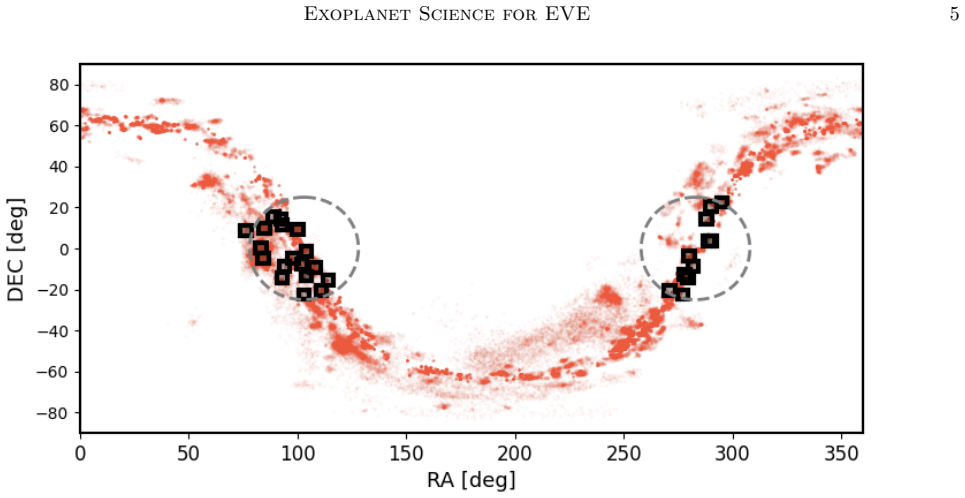
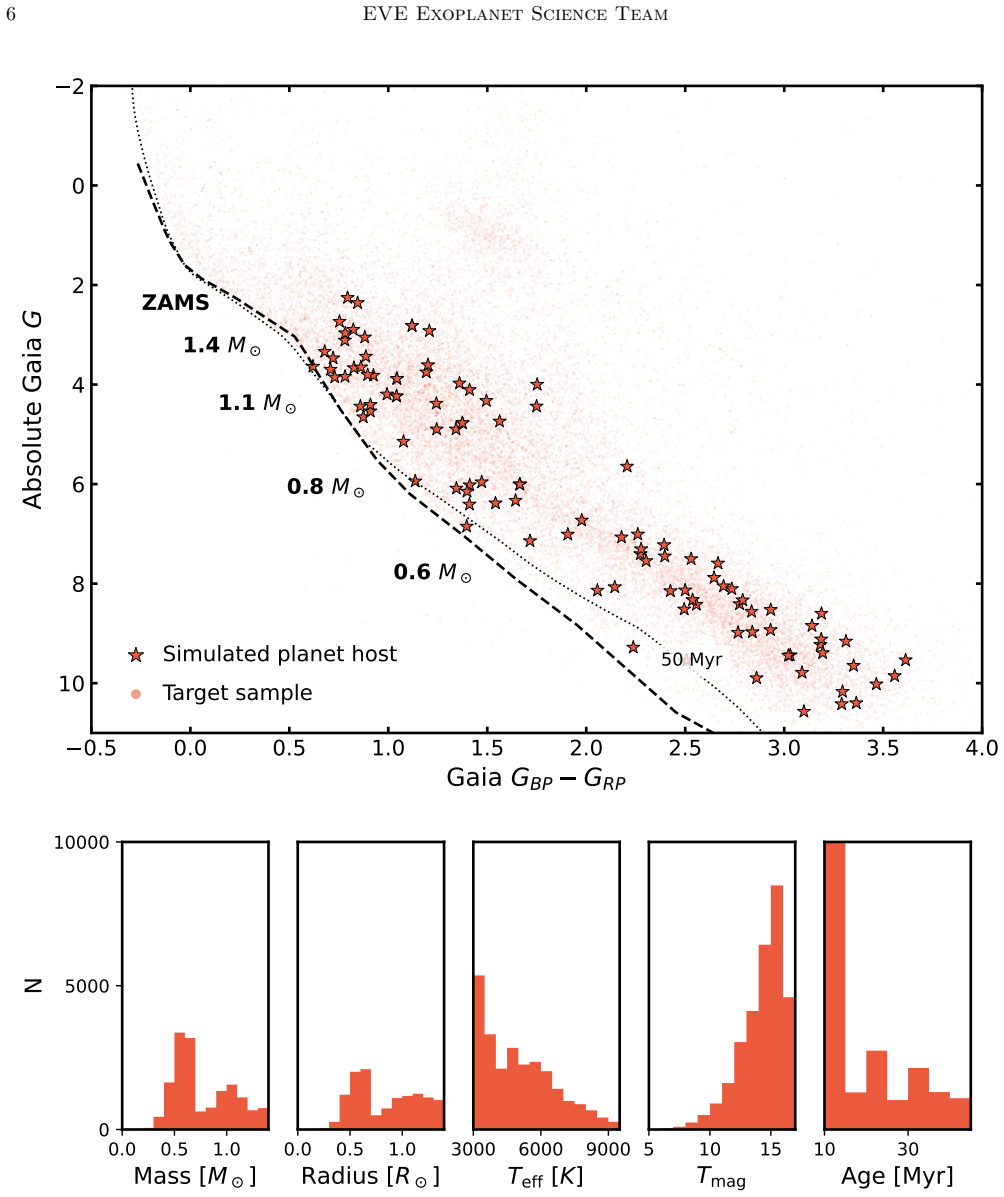
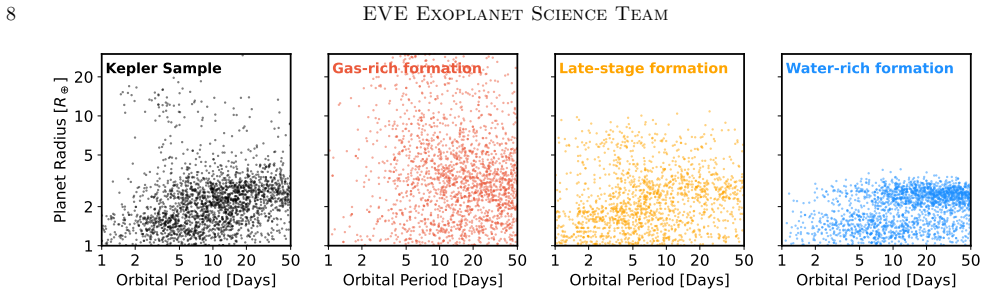
A 2.5-year low-Earth-orbit multi-band photometric survey within NASA SMEX scope would detect approximately 100 transiting planets with ages below 50 Myr across 30 selected stare fields, yielding a 5% measurement of occurrence frequency and enabling definitive differentiation between hydrogen-helium gas-dwarf and water-rich interior formation channels on the basis of their divergent early evolution tracks.
What carries the argument
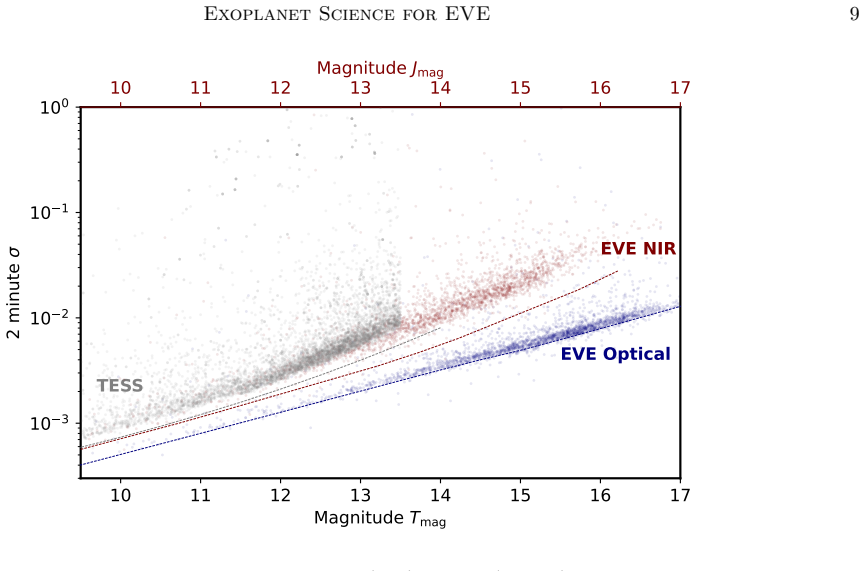
Multi-band (NUV-optical-NIR) wide-field photometry of young star clusters, which supplies simultaneous radius and color measurements to track atmospheric evolution in the first 50 Myr.
If this is right
- The mission would increase the known sample of young transiting planets by a factor of five.
- Occurrence rates measured at 5% precision would directly constrain the fraction of close-in planets that retain thick hydrogen-helium envelopes at early times.
- Color-dependent transit depths would reveal whether mean molecular weight remains low or increases rapidly after disk dispersal.
- Detection yields in 30 targeted fields would calibrate the underlying occurrence rate of primordial close-in planets across a range of stellar ages and environments.
Where Pith is reading between the lines
- Such early demographic data would allow direct comparison against population synthesis models that currently tune parameters only to mature planets.
- The same multi-band photometry could be re-used to search for signs of atmospheric escape or radius inflation in the youngest systems.
- Results would inform target prioritization for future infrared spectroscopy missions seeking to measure atmospheric compositions of sub-Neptunes.
- Extending the survey baseline or adding more fields could tighten the frequency constraint below 5% or resolve age-dependent trends within the <50 Myr window.
Load-bearing premise
The assumption that the two formation scenarios produce observationally distinguishable signatures in planet radii and colors within the first 50 million years and that forward simulations of detection yields are accurate enough to support a 5% frequency measurement.
What would settle it
A survey that detects substantially fewer than 100 young transiting planets or finds no measurable difference in the radius-color distribution between planets younger than 50 Myr and the mature population would falsify the claim that the mission can definitively differentiate the scenarios.
Figures




read the original abstract
The close-in small planet population may be formed either with hydrogen/helium dominated envelopes or with water-rich interiors. Both scenarios reproduce the present day planet population in mass, radius, and periods, and are difficult to differentiate with the mature planet demographic. Hydrogen/Helium `gas-dwarfs' have low mean molecular weight atmospheres, while `water-worlds' have envelopes that are significantly heavier, and as such these two scenarios have different evolution tracks that diverge in the first ~50 Myr of their evolution. We show that a low Earth orbit multi-band photometric survey mission, within the scope of the NASA Small Explorers Program (SMEX), can determine the frequency of young close-in planets at the 5% level and definitively differentiate between the competing `gas-dwarf' and `water-world' hypotheses. We simulate a 2.5 year mission capable of simultaneous multi-band near-ultraviolet (NUV), optical, and near infrared (NIR) wide field photometry. Such a mission would perform a photometric survey of 30 different stare-fields selected to probe the young star population. The mission will yield ~100 transiting planets in young star clusters and associations with ages <50 Myr. In comparison, only 20 such planets are known from K2 and TESS today.
Editorial analysis
A structured set of objections, weighed in public.
Referee Report
Summary. The manuscript proposes a NASA SMEX-class low Earth orbit mission performing simultaneous multi-band (NUV/optical/NIR) wide-field photometry over 2.5 years across 30 stare-fields targeting young star clusters. Forward simulations are used to claim a yield of ~100 transiting planets with ages <50 Myr (versus ~20 known today), enabling the frequency of young close-in planets to be measured at the 5% level and providing definitive observational differentiation between the gas-dwarf (H/He envelope) and water-world evolutionary tracks that diverge within the first ~50 Myr.
Significance. If the simulation assumptions prove robust after validation, the work would materially advance studies of primordial planet populations by expanding the sample of young transiting planets by a factor of five and supplying a direct test of competing interior/atmosphere models at early times. The multi-band approach is a concrete strength for mitigating stellar activity systematics.
major comments (2)
- [Abstract] Abstract and simulation methodology: the headline claims of ~100 detections, 5% frequency precision, and definitive hypothesis differentiation rest on forward-model outputs whose occurrence-rate priors, photometric precision in active young-star fields, completeness curves, and error budgets are not stated or validated against the existing K2/TESS young-planet sample; without these the central claims cannot be assessed.
- [Abstract] Distinguishability argument: the assertion that simultaneous NUV/optical/NIR photometry produces observationally distinguishable signatures between the two scenarios within 50 Myr lacks quantitative demonstration that the predicted transit-depth or color differences exceed expected systematics or stellar variability; this is load-bearing for the 'definitive differentiation' claim.
minor comments (2)
- The stylized title capitalization ('eVolution') should be explained or normalized for consistency with standard journal formatting.
- [Abstract] The statement that 'only 20 such planets are known from K2 and TESS today' would be strengthened by an explicit citation to the current young-planet census.
Simulated Author's Rebuttal
We thank the referee for their constructive comments on our manuscript. We address each major comment below, providing references to the relevant sections of the full text while agreeing to revisions that improve clarity and accessibility of the simulation details.
read point-by-point responses
-
Referee: [Abstract] Abstract and simulation methodology: the headline claims of ~100 detections, 5% frequency precision, and definitive hypothesis differentiation rest on forward-model outputs whose occurrence-rate priors, photometric precision in active young-star fields, completeness curves, and error budgets are not stated or validated against the existing K2/TESS young-planet sample; without these the central claims cannot be assessed.
Authors: The occurrence-rate priors (extrapolated from Kepler with young-star adjustments), photometric precision models (incorporating K2-derived activity levels for <50 Myr stars), completeness curves (from injection-recovery tests), and error budgets are fully specified in Sections 3.2-3.4 and 4.1-4.3. Validation against the known K2/TESS young-planet sample (~20 planets) is shown in Section 4.4, where the pipeline recovers the observed yield within uncertainties. We will revise the abstract to summarize these elements and add an explicit validation subsection for improved transparency. revision: yes
-
Referee: [Abstract] Distinguishability argument: the assertion that simultaneous NUV/optical/NIR photometry produces observationally distinguishable signatures between the two scenarios within 50 Myr lacks quantitative demonstration that the predicted transit-depth or color differences exceed expected systematics or stellar variability; this is load-bearing for the 'definitive differentiation' claim.
Authors: Section 5.2 and Figure 7 quantify the differences: multi-band transit depth variations between gas-dwarf and water-world models exceed 5 sigma, with NUV-NIR color signatures separating the tracks at >4 sigma after accounting for modeled stellar variability (1-2% level) and systematics. We will add a dedicated table in revision explicitly listing the signal-to-noise ratios for these distinctions relative to the error budget. revision: yes
Circularity Check
Forward simulations of mission yields and distinguishability are self-contained inputs, not reductions to fitted data or self-citations.
full rationale
The paper's central claims rest on forward simulations of a 2.5-year SMEX-style survey yielding ~100 young transiting planets and enabling differentiation via multi-band photometry. These are generated from external priors on occurrence rates, stellar populations, and evolutionary tracks rather than any derivation that loops back to parameters fitted from the simulated outputs themselves. No equations, self-citations, or ansatzes are presented that reduce the headline numbers (5% frequency precision, definitive gas-dwarf vs. water-world separation) to the simulation inputs by construction. The work is therefore a standard proposal study whose validity hinges on the accuracy of its modeling assumptions, not on circular logic.
Axiom & Free-Parameter Ledger
Reference graph
Works this paper leans on
-
[1]
Ahrer, E.-M., Radica, M., Piaulet-Ghorayeb, C., et al. 2025, ApJL, 985, L10, doi: 10.3847/2041-8213/add010
-
[2]
Alves, D. R., Jenkins, J. S., Vines, J. I., et al. 2025, MNRAS, 536, 1538, doi: 10.1093/mnras/stae2582
-
[3]
2025, ApJ, 985, 100, doi: 10.3847/1538-4357/adc932
Peacock, S. 2025, ApJ, 985, 100, doi: 10.3847/1538-4357/adc932
-
[4]
2024a, Nature Astronomy, 8, 899, doi: 10.1038/s41550-024-02257-0
Barat, S., D´ esert, J.-M., Vazan, A., et al. 2024a, Nature Astronomy, 8, 899, doi: 10.1038/s41550-024-02257-0
-
[5]
Barat, S., D´ esert, J.-M., Goyal, J. M., et al. 2024b, arXiv e-prints, arXiv:2407.14995, doi: 10.48550/arXiv.2407.14995
-
[6]
Barber, M. G., Mann, A. W., Vanderburg, A., et al. 2024a, Nature, 635, 574, doi: 10.1038/s41586-024-08123-3
-
[7]
Barber, M. G., Thao, P. C., Mann, A. W., et al. 2024b, ApJL, 973, L30, doi: 10.3847/2041-8213/ad77d9
-
[8]
Barber, M. G., Mann, A. W., Vanderburg, A., et al. 2026, AJ, 171, 20, doi: 10.3847/1538-3881/ae1b91
-
[9]
Bean, J. L., Raymond, S. N., & Owen, J. E. 2021, Journal of Geophysical Research (Planets), 126, e06639, doi: 10.1029/2020JE006639
-
[10]
A., Cornuet, J.-M., Marin, J.-M., & Robert, C
Beaumont, M. A., Cornuet, J.-M., Marin, J.-M., & Robert, C. P. 2009, Biometrika, 96, 983, doi: 10.1093/biomet/asp052
-
[11]
Benneke, B., Roy, P.-A., Coulombe, L.-P., et al. 2024, arXiv e-prints, arXiv:2403.03325, doi: 10.48550/arXiv.2403.03325
-
[12]
Bouma, L. G., Hartman, J. D., Brahm, R., et al. 2020, AJ, 160, 239, doi: 10.3847/1538-3881/abb9ab
-
[13]
Tanaka, Y. A., & Vidotto, A. A. 2016, A&A, 591, A121, doi: 10.1051/0004-6361/201628362 20EVE Exoplanet Science Team
-
[14]
2018, A&A, 620, A147, doi: 10.1051/0004-6361/201833675
Bourrier, V., Lecavelier des Etangs, A., Ehrenreich, D., et al. 2018, A&A, 620, A147, doi: 10.1051/0004-6361/201833675
-
[15]
Burke, C. J., Christiansen, J. L., Mullally, F., et al. 2015, ApJ, 809, 8, doi: 10.1088/0004-637X/809/1/8
-
[16]
Burn, R., Bali, K., Dorn, C., Luque, R., & Grimm, S. L. 2024a, arXiv e-prints, arXiv:2411.16879, doi: 10.48550/arXiv.2411.16879
-
[17]
Burn, R., Mordasini, C., Mishra, L., et al. 2024b, Nature Astronomy, 8, 463, doi: 10.1038/s41550-023-02183-7
-
[18]
2020, A&A, 640, A1, doi: 10.1051/0004-6361/202038192
Cantat-Gaudin, T., Anders, F., Castro-Ginard, A., & et al. 2020, A&A, 640, A1, doi: 10.1051/0004-6361/202038192
-
[19]
2019, A&A, 624, A126, doi: 10.1051/0004-6361/201834453
Cantat-Gaudin, T., Krone-Martins, A., Sedaghat, N., & et al. 2019, A&A, 624, A126, doi: 10.1051/0004-6361/201834453
-
[20]
2020, arXiv e-prints, arXiv:2002.08379
Chen, G., Casasayas-Barris, N., Palle, E., et al. 2020, arXiv e-prints, arXiv:2002.08379. https://arxiv.org/abs/2002.08379
arXiv 2020
-
[21]
2013, MNRAS, 431, 3444, doi: 10.1093/mnras/stt424
Chiang, E., & Laughlin, G. 2013, MNRAS, 431, 3444, doi: 10.1093/mnras/stt424
-
[22]
MESA Isochrones and Stellar Tracks (MIST). I: Solar-Scaled Models
Choi, J., Dotter, A., Conroy, C., et al. 2016, ApJ, 823, 102, doi: 10.3847/0004-637X/823/2/102
work page internal anchor Pith review doi:10.3847/0004-637x/823/2/102 2016
-
[23]
Cody, A. M., & Hillenbrand, L. A. 2018, AJ, 156, 71, doi: 10.3847/1538-3881/aacead
-
[24]
2019, in American Astronomical Society Meeting Abstracts, Vol
Collins, K. 2019, in American Astronomical Society Meeting Abstracts, Vol. 233, American Astronomical Society Meeting Abstracts #233, 140.05
2019
-
[25]
Collins, K. A., Collins, K. I., Pepper, J., et al. 2018, AJ, 156, 234, doi: 10.3847/1538-3881/aae582
-
[26]
Coughlin, J. L., Thompson, S. E., Bryson, S. T., et al. 2014, AJ, 147, 119, doi: 10.1088/0004-6256/147/5/119
-
[27]
Davenport, B., Kempton, E. M. R., Nixon, M. C., et al. 2025, arXiv e-prints, arXiv:2501.01498. https://arxiv.org/abs/2501.01498
arXiv 2025
-
[28]
David, T. J., Petigura, E. A., Luger, R., et al. 2019a, ApJL, 885, L12, doi: 10.3847/2041-8213/ab4c99
-
[29]
David, T. J., Hillenbrand, L. A., Petigura, E. A., et al. 2016a, Nature, 534, 658, doi: 10.1038/nature18293 —. 2016b, Nature, 534, 658, doi: 10.1038/nature18293
-
[30]
David, T. J., Cody, A. M., Hedges, C. L., et al. 2019b, AJ, 158, 79, doi: 10.3847/1538-3881/ab290f
-
[31]
L., Marchal, L., et al
Delfosse, X., Beuzit, J. L., Marchal, L., et al. 2004, in Astronomical Society of the Pacific Conference Series, Vol. 318, Spectroscopically and Spatially Resolving the Components of the Close Binary Stars, ed. R. W
2004
-
[32]
Hilditch, H. Hensberge, & K. Pavlovski, 166–174 dos Santos, L. A., Ehrenreich, D., Bourrier, V., et al. 2020, A&A, 634, L4, doi: 10.1051/0004-6361/201937327
-
[33]
2016, ApJS, 222, 8, doi: 10.3847/0067-0049/222/1/8
Dotter, A. 2016, ApJS, 222, 8, doi: 10.3847/0067-0049/222/1/8 Duchˆ ene, G., & Kraus, A. 2013, ARA&A, 51, 269, doi: 10.1146/annurev-astro-081710-102602
work page internal anchor Pith review doi:10.3847/0067-0049/222/1/8 2016
-
[34]
Ehrenreich, D., Bourrier, V., Wheatley, P. J., et al. 2015, Nature, 522, 459, doi: 10.1038/nature14501
-
[35]
Esplin, T. L., & Luhman, K. L. 2022, AJ, 163, 64, doi: 10.3847/1538-3881/ac3e64
-
[36]
2024, AJ, 168, 60, doi: 10.3847/1538-3881/ad4edf
Kowalski, A. 2024, AJ, 168, 60, doi: 10.3847/1538-3881/ad4edf
-
[37]
Fernandes, R. B., Bergsten, G. J., Mulders, G. D., et al. 2025, AJ, 169, 208, doi: 10.3847/1538-3881/adb97e
-
[38]
Fulton, B. J., Petigura, E. A., Howard, A. W., et al. 2017, AJ, 154, 109, doi: 10.3847/1538-3881/aa80eb
-
[39]
2017, MNRAS, 468, 3418, doi: 10.1093/mnras/stx615
Gaidos, E., Kitzmann, D., & Heng, K. 2017, MNRAS, 468, 3418, doi: 10.1093/mnras/stx615
-
[40]
Gao, P., Piette, A. A. A., Steinrueck, M. E., et al. 2023, ApJ, 951, 96, doi: 10.3847/1538-4357/acd16f
-
[41]
Gilbert, E. A., Barclay, T., Quintana, E. V., et al. 2022, AJ, 163, 147, doi: 10.3847/1538-3881/ac23ca
-
[42]
Ginzburg, S., Schlichting, H. E., & Sari, R. 2016, ApJ, 825, 29, doi: 10.3847/0004-637X/825/1/29 —. 2018, MNRAS, 476, 759, doi: 10.1093/mnras/sty290
-
[43]
2021, arXiv e-prints, arXiv:2101.12200
Grasser, N., Ratzenb¨ ock, S., Alves, J., et al. 2021, arXiv e-prints, arXiv:2101.12200. https://arxiv.org/abs/2101.12200
arXiv 2021
-
[44]
Gupta, A., & Schlichting, H. E. 2019, MNRAS, 487, 24, doi: 10.1093/mnras/stz1230 Hern´ andez, J., Hartmann, L., Megeath, T., et al. 2007a, ApJ, 662, 1067, doi: 10.1086/513735 Hern´ andez, J., Calvet, N., Brice˜ no, C., et al. 2007b, ApJ, 671, 1784, doi: 10.1086/522882
-
[45]
Howard, W. S., MacGregor, M. A., Feinstein, A. D., et al. 2025, AJ, 169, 27, doi: 10.3847/1538-3881/ad93ce
-
[46]
Hsu, D. C., Ford, E. B., Ragozzine, D., & Ashby, K. 2019, AJ, 158, 109, doi: 10.3847/1538-3881/ab31ab
-
[47]
Hsu, D. C., Ford, E. B., Ragozzine, D., & Morehead, R. C. 2018, AJ, 155, 205, doi: 10.3847/1538-3881/aab9a8
-
[48]
X., Vanderburg, A., P´ al, A., et al
Huang, C. X., Vanderburg, A., P´ al, A., et al. 2020a, Research Notes of the American Astronomical Society, 4, 204, doi: 10.3847/2515-5172/abca2e —. 2020b, Research Notes of the American Astronomical Society, 4, 206, doi: 10.3847/2515-5172/abca2d
-
[49]
Ishida, E. E. O., Vitenti, S. D. P., Penna-Lima, M., et al. 2015, Astronomy and Computing, 13, 1, doi: 10.1016/j.ascom.2015.09.001
-
[50]
Jerabkova, T., Boffin, H. M. J., Beccari, G., et al. 2021, A&A, 647, A137, doi: 10.1051/0004-6361/202039949
-
[51]
Kite, E. S., & Ford, E. B. 2018, ApJ, 864, 75, doi: 10.3847/1538-4357/aad6e0 Exoplanet Science for EVE21
-
[52]
2015, MNRAS, 452, 3752, doi: 10.1093/mnras/stv1487
Kitzmann, D., Alibert, Y., Godolt, M., et al. 2015, MNRAS, 452, 3752, doi: 10.1093/mnras/stv1487
-
[53]
2018, MNRAS, 480, 5242, doi: 10.1093/mnras/sty2171
Kos, J., de Silva, G., Bland-Hawthorn, J., & et al. 2018, MNRAS, 480, 5242, doi: 10.1093/mnras/sty2171
-
[54]
2021, MNRAS, 506, 4232, doi: 10.1093/mnras/stab1767
Kos, J., Lind, K., Asplund, M., & et al. 2021, MNRAS, 506, 4232, doi: 10.1093/mnras/stab1767
-
[55]
Kounkel, M., Covey, K., Stassun, K. G., & et al. 2020, AJ, 160, 279, doi: 10.3847/1538-3881/abc0e6
-
[56]
2018, AJ, 156, 84, doi: 10.3847/1538-3881/aad1f1
Kounkel, M., Covey, K., Su´ arez, G., & et al. 2018, AJ, 156, 84, doi: 10.3847/1538-3881/aad1f1
-
[57]
Krolikowski, D. M., Kraus, A. L., & Rizzuto, A. C. 2021, AJ, 162, 110, doi: 10.3847/1538-3881/ac0632
-
[58]
Kuchner, M. J. 2003, ApJL, 596, L105, doi: 10.1086/378397
-
[59]
Kunimoto, M., & Matthews, J. M. 2020, AJ, 159, 248, doi: 10.3847/1538-3881/ab88b0
-
[60]
Lee, E. J., & Chiang, E. 2016, ApJ, 817, 90, doi: 10.3847/0004-637X/817/2/90
-
[61]
Lee, E. J., Chiang, E., & Ormel, C. W. 2014, ApJ, 797, 95, doi: 10.1088/0004-637X/797/2/95
-
[62]
Lee, E. J., & Connors, N. J. 2021, ApJ, 908, 32, doi: 10.3847/1538-4357/abd6c7
-
[63]
Lee, E. J., Karalis, A., & Thorngren, D. P. 2022, ApJ, 941, 186, doi: 10.3847/1538-4357/ac9c66 L´ eger, A., Selsis, F., Sotin, C., et al. 2004, Icarus, 169, 499, doi: 10.1016/j.icarus.2004.01.001
-
[64]
Lodieu, N., P´ erez-Garrido, A., Smart, R. L., & Silvotti, R. 2019, A&A, 628, A66, doi: 10.1051/0004-6361/201935533
-
[65]
Lopez, E. D., & Fortney, J. J. 2013, ApJ, 776, 2, doi: 10.1088/0004-637X/776/1/2
-
[66]
Loyd, R. O. P., Schreyer, E., Owen, J. E., et al. 2025, Nature, 638, 636, doi: 10.1038/s41586-024-08490-x
-
[67]
Luhman, K. L. 2022, AJ, 163, 25, doi: 10.3847/1538-3881/ac3c56
-
[68]
Luhman, K. L., Tremblin, P., Birkmann, S. M., et al. 2023, ApJL, 949, L36, doi: 10.3847/2041-8213/acd635
-
[69]
Luque, R., & Pall´ e, E. 2022, Science, 377, 1211, doi: 10.1126/science.abl7164
-
[70]
M., Turner, N., et al
MacGregor, M., Cody, A. M., Turner, N., et al. 2025, in American Astronomical Society Meeting Abstracts, Vol. 245, American Astronomical Society Meeting Abstracts #245, 234.09
2025
-
[71]
Madhusudhan, N., Piette, A. A. A., & Constantinou, S. 2021, ApJ, 918, 1, doi: 10.3847/1538-4357/abfd9c
-
[72]
2002, The Astrophysical Journal, 580, L171, doi: 10.1086/345520
Mandel, K., & Agol, E. 2002, ApJL, 580, L171, doi: 10.1086/345520
-
[73]
Mann, A. W., Newton, E. R., Rizzuto, A. C., et al. 2016, AJ, 152, 61, doi: 10.3847/0004-6256/152/3/61
-
[74]
Mann, A. W., Wood, M. L., Schmidt, S. P., et al. 2022, AJ, 163, 156, doi: 10.3847/1538-3881/ac511d
-
[75]
Mansfield, M., Bean, J. L., Oklopˇ ci´ c, A., et al. 2018, ApJL, 868, L34, doi: 10.3847/2041-8213/aaf166
-
[76]
McBride, A., Gonzales, E., Mamajek, E. E., & et al. 2019, AJ, 158, 77, doi: 10.3847/1538-3881/ab2899
-
[77]
T., Gutermuth, R., Muzerolle, J., et al
Megeath, S. T., Gutermuth, R., Muzerolle, J., et al. 2012, AJ, 144, 192, doi: 10.1088/0004-6256/144/6/192
-
[78]
2013, A&A, 558, A113, doi: 10.1051/0004-6361/201321617
Mordasini, C. 2013, A&A, 558, A113, doi: 10.1051/0004-6361/201321617
-
[79]
Newton, E. R., Mann, A. W., Tofflemire, B. M., et al. 2019, ApJL, 880, L17, doi: 10.3847/2041-8213/ab2988
-
[80]
Newton, E. R., Rampalli, R., Kraus, A. L., et al. 2022, AJ, 164, 115, doi: 10.3847/1538-3881/ac8154 N´ u˜ nez, A., Ag¨ ueros, M. A., Covey, K. R., et al. 2022, ApJ, 931, 45, doi: 10.3847/1538-4357/ac6517
discussion (0)
Sign in with ORCID, Apple, or X to comment. Anyone can read and Pith papers without signing in.