Organizational Control Layer: Governance Infrastructure at the Execution Boundary of LLM Agent Systems
Pith reviewed 2026-06-28 04:14 UTC · model grok-4.3
The pith
An Organizational Control Layer intercepts LLM agent actions before execution to enforce policies without altering the models.
A machine-rendered reading of the paper's core claim, the machinery that carries it, and where it could break.
Core claim
The Organizational Control Layer separates proposal generation from environment-facing execution by intercepting generated actions, enforcing policies, and triggering escalation when violations occur, delivering these safety and performance gains without any modification to the underlying LLM generator.
What carries the argument
The Organizational Control Layer (OCL), which serves as an intermediary governance infrastructure applying policy checks and escalation to actions at the boundary between language output and executable state changes.
If this is right
- LLM agent systems for real tasks need explicit separation of generation from execution with governance infrastructure at the boundary.
- Strict policy enforcement at this boundary improves compliance and reliability but creates a measurable safety-utility tradeoff in tightly constrained settings.
- The governance approach applies across different frontier LLM backends without requiring changes to the generator models themselves.
Where Pith is reading between the lines
- Similar boundary control could be applied to agent interactions with code execution or web APIs where direct action carries comparable risks.
- Agent architectures may need to treat external governance layers as standard components rather than depending only on internal model training for safety.
- Expanding evaluation beyond negotiation simulations to other workflow types would test whether the reported gains hold in broader deployment contexts.
Load-bearing premise
The specific adversarial buyer-seller negotiation environments capture the execution-boundary risks that appear when LLM agents operate in real consequential workflows.
What would settle it
Deploying the same agents with OCL on live transaction systems and finding that unsafe executions do not stay near zero or that valid success rates fall substantially below the reported levels.
Figures

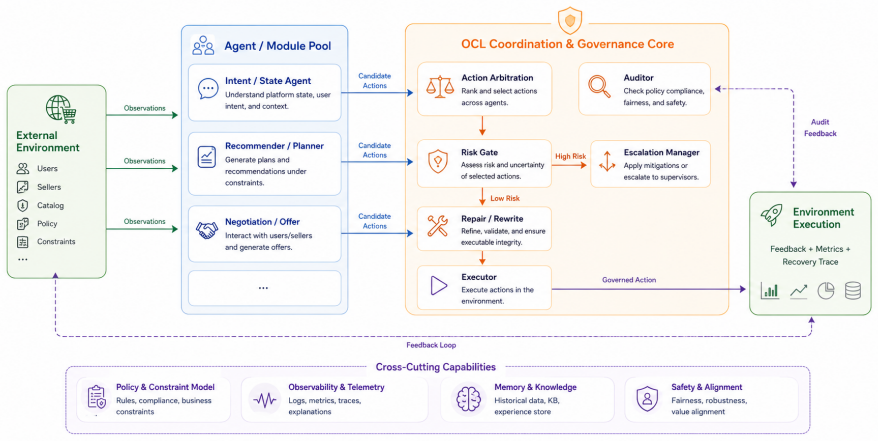
read the original abstract
LLM-based agents are increasingly deployed in workflows where generated outputs may directly trigger state-changing actions. This creates an execution-boundary problem: proposed actions must be governed before they are executed. We study this problem through economically consequential multi-agent interactions and argue that deployment-grade agent systems should separate proposal generation from environment-facing execution. To operationalize this principle, we introduce the Organizational Control Layer (OCL), a model-agnostic governance infrastructure that intercepts generated actions before execution through policy enforcement and escalation, without modifying the underlying LLM generator. We evaluate OCL on adversarial buyer--seller negotiation environments adapted from AgenticPay. Across multiple frontier LLM backends, OCL reduces unsafe executions from 88% to near-zero while increasing valid success from 12% to 96%. Results further reveal a safety--utility tradeoff: strict governance improves compliance and reliability against policy and constraint violations, but can reduce flexibility in tightly constrained markets. These findings suggest that deployment-grade LLM agent systems require explicit governance at the boundary between language generation and executable actions. The source code is available at: https://github.com/SHITIANYU-hue/amai_ocl
Editorial analysis
A structured set of objections, weighed in public.
Referee Report
Summary. The paper introduces the Organizational Control Layer (OCL), a model-agnostic infrastructure that intercepts LLM-generated actions prior to execution for policy enforcement and escalation handling. It evaluates OCL in adversarial buyer-seller negotiation environments adapted from AgenticPay, claiming that OCL reduces unsafe executions from 88% to near-zero and raises valid success rates from 12% to 96% across multiple frontier LLM backends, while identifying a safety-utility tradeoff. The work argues that deployment-grade LLM agent systems require explicit governance separating proposal generation from executable actions, with source code released.
Significance. If the quantitative results hold under broader conditions, the paper supplies a practical, model-agnostic mechanism for governing execution boundaries in multi-agent LLM systems and demonstrates measurable gains in compliance and reliability within the tested setting. Public code availability aids reproducibility and allows direct inspection of the policy and escalation logic.
major comments (1)
- [Evaluation] Evaluation section: the reported performance gains (unsafe executions 88%→near-zero; valid success 12%→96%) are obtained exclusively in adversarial buyer-seller negotiation environments adapted from AgenticPay. No results or analysis are provided for other action spaces, constraint structures, or observability regimes (e.g., code execution, financial APIs, or physical control), which is load-bearing for the central claim that OCL constitutes deployment-grade governance infrastructure.
minor comments (1)
- [Abstract] Abstract: large effect sizes are stated without accompanying details on environment construction, policy definitions, statistical tests, or error bars; the full manuscript should supply these in the evaluation section for verification.
Simulated Author's Rebuttal
We thank the referee for the constructive feedback on the evaluation scope. We address the major comment below, acknowledging the limitation while clarifying the paper's focus and proposed revisions.
read point-by-point responses
-
Referee: [Evaluation] Evaluation section: the reported performance gains (unsafe executions 88%→near-zero; valid success 12%→96%) are obtained exclusively in adversarial buyer-seller negotiation environments adapted from AgenticPay. No results or analysis are provided for other action spaces, constraint structures, or observability regimes (e.g., code execution, financial APIs, or physical control), which is load-bearing for the central claim that OCL constitutes deployment-grade governance infrastructure.
Authors: We agree that all quantitative results are confined to the adversarial buyer-seller negotiation environments adapted from AgenticPay. This domain was deliberately selected because it features economically consequential, policy-constrained multi-agent interactions with clear definitions of unsafe and invalid actions, providing a rigorous testbed for the execution-boundary governance problem. The OCL is presented as a model-agnostic infrastructure whose core mechanisms (policy interception, enforcement, and escalation) are intended to generalize by allowing domain-specific policy definitions. However, the manuscript does not include results or analysis for other action spaces. We will make a partial revision by (1) adding a dedicated Limitations section that states the evaluated scope, justifies the negotiation setting as an initial high-stakes case, and sketches application to other regimes (e.g., code execution via sandbox policies or financial APIs via transaction rules), and (2) moderating language in the abstract and conclusion from implying broad 'deployment-grade' status to 'evidence supporting the need for explicit governance at the execution boundary in this class of systems.' We cannot supply new empirical results across additional domains without further experiments. revision: partial
- Empirical results or analysis of OCL performance in action spaces other than adversarial buyer-seller negotiations (e.g., code execution, financial APIs, physical control).
Circularity Check
No circularity: empirical measurements on fixed test environments
full rationale
The paper introduces the Organizational Control Layer (OCL) as a model-agnostic governance infrastructure and reports its effects via direct experimental measurements on adversarial buyer-seller negotiation environments adapted from AgenticPay. The headline metrics (unsafe executions 88%→near-zero; valid success 12%→96%) are presented as observed outcomes across frontier LLM backends rather than quantities derived from equations, fitted parameters, or self-referential definitions inside the paper. No load-bearing self-citations, ansatzes, or uniqueness theorems are invoked to generate the results; the evaluation is self-contained against the chosen testbed. This matches the default expectation for non-circular empirical system papers.
Axiom & Free-Parameter Ledger
invented entities (1)
-
Organizational Control Layer (OCL)
no independent evidence
Reference graph
Works this paper leans on
-
[1]
Langley , title =
P. Langley , title =. Proceedings of the 17th International Conference on Machine Learning (ICML 2000) , address =. 2000 , pages =
2000
-
[2]
arXiv preprint arXiv:2504.02463 , year=
Evaluating AI Recruitment Sourcing Tools by Human Preference , author=. arXiv preprint arXiv:2504.02463 , year=
-
[3]
2025 , month = dec, howpublished =
Introducing Exa's People Search Benchmarks , author =. 2025 , month = dec, howpublished =
2025
-
[4]
Human and LLM -Based Resume Matching: An Observational Study
Vaishampayan, Swanand and Leary, Hunter and Alebachew, Yoseph Berhanu and Hickman, Louis and Stevenor, Brent and Beck, Weston and Brown, Chris. Human and LLM -Based Resume Matching: An Observational Study. Findings of the Association for Computational Linguistics: NAACL 2025. 2025
2025
-
[5]
Human and LLM -Based Resume Matching: An Observational Study
Vaishampayan, Swanand and Leary, Hunter and Alebachew, Yoseph Berhanu and Hickman, Louis and Stevenor, Brent and Beck, Weston and Brown, Chris. Human and LLM -Based Resume Matching: An Observational Study. Findings of the Association for Computational Linguistics: NAACL 2025. 2025. doi:10.18653/v1/2025.findings-naacl.270
-
[6]
Foundations and Trends in Information Retrieval , volume=
Expertise Retrieval , author=. Foundations and Trends in Information Retrieval , volume=. 2012 , publisher=
2012
-
[7]
Proceedings of the 29th Annual International ACM SIGIR Conference on Research and Development in Information Retrieval , pages=
Formal Models for Expert Finding in Enterprise Corpora , author=. Proceedings of the 29th Annual International ACM SIGIR Conference on Research and Development in Information Retrieval , pages=. 2006 , organization=
2006
-
[8]
The Probabilistic Relevance Framework:
Robertson, Stephen and Zaragoza, Hugo , journal=. The Probabilistic Relevance Framework:. 2009 , publisher=
2009
-
[9]
Proceedings of the 2020 Conference on Empirical Methods in Natural Language Processing (EMNLP) , pages=
Dense Passage Retrieval for Open-Domain Question Answering , author=. Proceedings of the 2020 Conference on Empirical Methods in Natural Language Processing (EMNLP) , pages=
2020
-
[10]
European Conference on Information Retrieval , pages=
Learning to Select a Ranking Function , author=. European Conference on Information Retrieval , pages=. 2011 , organization=
2011
-
[11]
and Zhang, Hao and Gonzalez, Joseph E
Zheng, Lianmin and Chiang, Wei-Lin and Sheng, Ying and Zhuang, Siyuan and Wu, Zhanghao and Zhuang, Yonghao and Lin, Zi and Li, Zhuohan and Li, Dacheng and Xing, Eric P. and Zhang, Hao and Gonzalez, Joseph E. and Stoica, Ion , booktitle=. Judging
-
[12]
Proceedings of the 2020 Conference on Empirical Methods in Natural Language Processing (EMNLP) , pages=
Unsupervised Question Decomposition for Question Answering , author=. Proceedings of the 2020 Conference on Empirical Methods in Natural Language Processing (EMNLP) , pages=
2020
-
[13]
Khattab, Omar and Zaharia, Matei , booktitle=
-
[14]
1993 , publisher=
Decisions with Multiple Objectives: Preferences and Value Trade-Offs , author=. 1993 , publisher=
1993
-
[15]
arXiv preprint arXiv:2311.12983 , year=
Mialon, Gr. arXiv preprint arXiv:2311.12983 , year=
-
[16]
Chen, Kaiyuan and Ren, Yixin and Liu, Yang and Hu, Xiaobo and Tian, Haotong and Xie, Tianbao and Liu, Fangfu and Zhang, Haoye and Liu, Hongzhang and Gong, Yuan and others , journal=
-
[17]
Computation , volume =
Liu, Dingyuan and Shen, Qiannan and Liu, Jiaci , title =. Computation , volume =. 2026 , doi =
2026
-
[18]
Computation , volume =
Sun, Wenxi and Shen, Qiannan and Gao, Yijun and Mao, Qinkai and Qi, Tongsong and Xu, Shuo , title =. Computation , volume =. 2025 , doi =
2025
-
[19]
Sun, Wenxi and Qi, Zhichun and Shen, Qiannan , title =. 2025 , howpublished =. doi:10.21203/rs.3.rs-8136120 , url =
-
[20]
Shen, Qiannan and Zhang, Jing , title =. 2025 , month =. doi:10.21203/rs.3.rs-8437180/v1 , url =
-
[21]
T. M. Mitchell. The Need for Biases in Learning Generalizations. 1980
1980
-
[22]
M. J. Kearns , title =
-
[23]
Machine Learning: An Artificial Intelligence Approach, Vol. I. 1983
1983
-
[24]
R. O. Duda and P. E. Hart and D. G. Stork. Pattern Classification. 2000
2000
-
[25]
Suppressed for Anonymity , author=
-
[26]
Newell and P
A. Newell and P. S. Rosenbloom. Mechanisms of Skill Acquisition and the Law of Practice. Cognitive Skills and Their Acquisition. 1981
1981
-
[27]
A. L. Samuel. Some Studies in Machine Learning Using the Game of Checkers. IBM Journal of Research and Development. 1959
1959
-
[28]
2008 , publisher=
Introduction to information retrieval , author=. 2008 , publisher=
2008
-
[29]
ACM Transactions on Information Systems (TOIS) , volume=
Cumulated gain-based evaluation of IR techniques , author=. ACM Transactions on Information Systems (TOIS) , volume=. 2002 , publisher=
2002
-
[30]
arXiv preprint arXiv:2303.16634 , year=
G-eval: NLG evaluation using gpt-4 with better human alignment , author=. arXiv preprint arXiv:2303.16634 , year=
-
[31]
The Twelfth International Conference on Learning Representations , year=
Prometheus: Inducing fine-grained evaluation capability in language models , author=. The Twelfth International Conference on Learning Representations , year=
-
[32]
arXiv preprint arXiv:2405.01535 , year=
Prometheus 2: An open source language model specialized in evaluating other language models , author=. arXiv preprint arXiv:2405.01535 , year=
-
[33]
Findings of the association for computational linguistics ACL 2024 , pages=
Prometheus-vision: Vision-language model as a judge for fine-grained evaluation , author=. Findings of the association for computational linguistics ACL 2024 , pages=
2024
-
[34]
arXiv preprint arXiv:2412.05579 , year=
Llms-as-judges: a comprehensive survey on llm-based evaluation methods , author=. arXiv preprint arXiv:2412.05579 , year=
-
[35]
arXiv preprint arXiv:2511.20604 , year=
On Evaluating LLM Alignment by Evaluating LLMs as Judges , author=. arXiv preprint arXiv:2511.20604 , year=
-
[36]
Attribute-Guided Pedestrian Retrieval: Bridging Person Re-ID with Internal Attribute Variability , year=
Huang, Yan and Zhang, Zhang and Wu, Qiang and Zhong, Yi and Wang, Liang , booktitle=. Attribute-Guided Pedestrian Retrieval: Bridging Person Re-ID with Internal Attribute Variability , year=
-
[37]
Proceedings of the 2025 Conference on Empirical Methods in Natural Language Processing , pages=
Chat-driven text generation and interaction for person retrieval , author=. Proceedings of the 2025 Conference on Empirical Methods in Natural Language Processing , pages=
2025
-
[38]
arXiv preprint arXiv:2601.16155 , year=
HVD: Human Vision-Driven Video Representation Learning for Text-Video Retrieval , author=. arXiv preprint arXiv:2601.16155 , year=
-
[39]
arXiv preprint arXiv:2601.18625 , year=
CONQUER: Context-Aware Representation with Query Enhancement for Text-Based Person Search , author=. arXiv preprint arXiv:2601.18625 , year=
-
[40]
Proceedings of the AAAI Conference on Artificial Intelligence , volume=
Scene-Aware Spatiotemporal Generalization: Towards Robust Temporal Action Detection Across Domains , author=. Proceedings of the AAAI Conference on Artificial Intelligence , volume=
-
[41]
Chinese Journal of Electronics , year =
Gong, Tianxiang and Gao, Shiqi and Song, Qi and Sun, Qingyun and Zhou, Haoyi and Li, Jianxin , title =. Chinese Journal of Electronics , year =. doi:10.23919/cje.2025.00.215 , note =
-
[42]
arXiv preprint arXiv:2505.06566 , year=
Dynamic uncertainty learning with noisy correspondence for text-based person search , author=. arXiv preprint arXiv:2505.06566 , year=
-
[43]
arXiv preprint arXiv:2601.12768 , year=
Delving deeper: Hierarchical visual perception for robust video-text retrieval , author=. arXiv preprint arXiv:2601.12768 , year=
-
[44]
2025 , eprint=
Qwen2.5-VL Technical Report , author=. 2025 , eprint=
2025
-
[45]
2025 , eprint=
InternVL3.5: Advancing Open-Source Multimodal Models in Versatility, Reasoning, and Efficiency , author=. 2025 , eprint=
2025
-
[46]
2025 , eprint=
Qwen3-VL Technical Report , author=. 2025 , eprint=
2025
-
[47]
arXiv preprint arXiv:2407.00840 , year=
MUSE-Net: Missingness-aware mUlti-branching Self-attention Encoder for Irregular Longitudinal Electronic Health Records , author=. arXiv preprint arXiv:2407.00840 , year=
-
[48]
ICCV , year=
Beyond Walking: A Large-Scale Image-Text Benchmark for Text-based Person Anomaly Search , author=. ICCV , year=
-
[49]
Proceedings of the 32nd ACM International Conference on Multimedia , pages=
Boosting Speech Recognition Robustness to Modality-Distortion with Contrast-Augmented Prompts , author=. Proceedings of the 32nd ACM International Conference on Multimedia , pages=
-
[50]
arXiv preprint arXiv:2501.01384 , year=
OmniChat: Enhancing Spoken Dialogue Systems with Scalable Synthetic Data for Diverse Scenarios , author=. arXiv preprint arXiv:2501.01384 , year=
-
[51]
arXiv preprint arXiv:2503.00528 , year=
Efficient prompting for continual adaptation to missing modalities , author=. arXiv preprint arXiv:2503.00528 , year=
-
[52]
Proceedings of the 32nd ACM International Conference on Multimedia , pages=
Calibrating prompt from history for continual vision-language retrieval and grounding , author=. Proceedings of the 32nd ACM International Conference on Multimedia , pages=
-
[53]
2025 , eprint=
Observe-R1: Unlocking Reasoning Abilities of MLLMs with Dynamic Progressive Reinforcement Learning , author=. 2025 , eprint=
2025
-
[54]
2025 , eprint=
Open-set Cross Modal Generalization via Multimodal Unified Representation , author=. 2025 , eprint=
2025
-
[55]
2024 , eprint=
OmniBind: Large-scale Omni Multimodal Representation via Binding Spaces , author=. 2024 , eprint=
2024
-
[56]
Yang, Bo and Wang, Chen and Ma, Xiaoshuang and Song, Beiping and Liu, Zhuang and Sun, Fangde , year=. Zero-Shot Sketch-Based Remote-Sensing Image Retrieval Based on Multi-Level and Attention-Guided Tokenization , volume=. Remote Sensing , publisher=. doi:10.3390/rs16101653 , number=
-
[57]
2023 , url =
OpenAI , title =. 2023 , url =
2023
-
[58]
Toward Video Anomaly Retrieval From Video Anomaly Detection: New Benchmarks and Model , year=
Wu, Peng and Liu, Jing and He, Xiangteng and Peng, Yuxin and Wang, Peng and Zhang, Yanning , journal=. Toward Video Anomaly Retrieval From Video Anomaly Detection: New Benchmarks and Model , year=
-
[59]
Context Recovery and Knowledge Retrieval: A Novel Two-Stream Framework for Video Anomaly Detection , year=
Cao, Congqi and Lu, Yue and Zhang, Yanning , journal=. Context Recovery and Knowledge Retrieval: A Novel Two-Stream Framework for Video Anomaly Detection , year=
-
[60]
SG\_161222 , title =
-
[61]
ECCV , pages=
PLOT: Text-Based Person Search with Part Slot Attention for Corresponding Part Discovery , author=. ECCV , pages=. 2024 , organization=
2024
-
[62]
CVPR , pages=
Towards surveillance video-and-language understanding: New dataset baselines and challenges , author=. CVPR , pages=
-
[63]
ICCV , month =
Zheng, Liang and Shen, Liyue and Tian, Lu and Wang, Shengjin and Wang, Jingdong and Tian, Qi , title =. ICCV , month =
-
[64]
Computer Vision--ECCV 2016 Workshops: Amsterdam, The Netherlands, October 8-10 and 15-16, 2016, Proceedings, Part II , pages=
Performance measures and a data set for multi-target, multi-camera tracking , author=. Computer Vision--ECCV 2016 Workshops: Amsterdam, The Netherlands, October 8-10 and 15-16, 2016, Proceedings, Part II , pages=. 2016 , organization=
2016
-
[65]
CVPR , pages=
Oops! predicting unintentional action in video , author=. CVPR , pages=
-
[66]
Qwen-vl: A frontier large vision-language model with versatile abilities , author=. arXiv:2308.12966 , year=
-
[67]
Shikra: Unleashing multimodal llm's referential dialogue magic , author=. arXiv:2306.15195 , year=
-
[68]
Object Re-identification: Problems, Algorithms and Responsible Research Practice , author=
2. Object Re-identification: Problems, Algorithms and Responsible Research Practice , author=. The Boundaries of Data , pages=
-
[69]
Text-based person search with limited data , author=. arXiv:2110.10807 , year=
-
[70]
ICML , year=
Multi-Grained Vision Language Pre-Training: Aligning Texts with Visual Concepts , author=. ICML , year=
-
[71]
ICCV , pages=
Unlabeled samples generated by gan improve the person re-identification baseline in vitro , author=. ICCV , pages=
-
[72]
CVPR , pages=
Joint discriminative and generative learning for person re-identification , author=. CVPR , pages=
-
[73]
ACM MM , pages=
Hierarchical gumbel attention network for text-based person search , author=. ACM MM , pages=
-
[74]
, author=
Text-based Person Search via Multi-Granularity Embedding Learning. , author=. IJCAI , pages=
-
[75]
IEEE Transactions on Image Processing , volume=
Improving description-based person re-identification by multi-granularity image-text alignments , author=. IEEE Transactions on Image Processing , volume=. 2020 , publisher=
2020
-
[76]
World Wide Web , pages=
Relation-aware aggregation network with auxiliary guidance for text-based person search , author=. World Wide Web , pages=. 2021 , publisher=
2021
-
[77]
ICML , pages=
Learning transferable visual models from natural language supervision , author=. ICML , pages=. 2021 , organization=
2021
-
[78]
Advances in neural information processing systems , volume=
Align before fuse: Vision and language representation learning with momentum distillation , author=. Advances in neural information processing systems , volume=
-
[79]
Proceedings of the 32nd ACM International Conference on Multimedia , pages=
Low-rank prompt interaction for continual vision-language retrieval , author=. Proceedings of the 32nd ACM International Conference on Multimedia , pages=
-
[80]
The Thirteenth International Conference on Learning Representations , year=
Diff-Prompt: Diffusion-driven Prompt Generator with Mask Supervision , author=. The Thirteenth International Conference on Learning Representations , year=
discussion (0)
Sign in with ORCID, Apple, or X to comment. Anyone can read and Pith papers without signing in.