A High-Likelihood Polar Interstellar Meteor Candidate
Pith reviewed 2026-06-28 04:45 UTC · model grok-4.3
The pith
A meteor detected in 2026 reaches 51.73 km/s heliocentric speed, exceeding solar escape velocity in every error realization.
A machine-rendered reading of the paper's core claim, the machinery that carries it, and where it could break.
Core claim
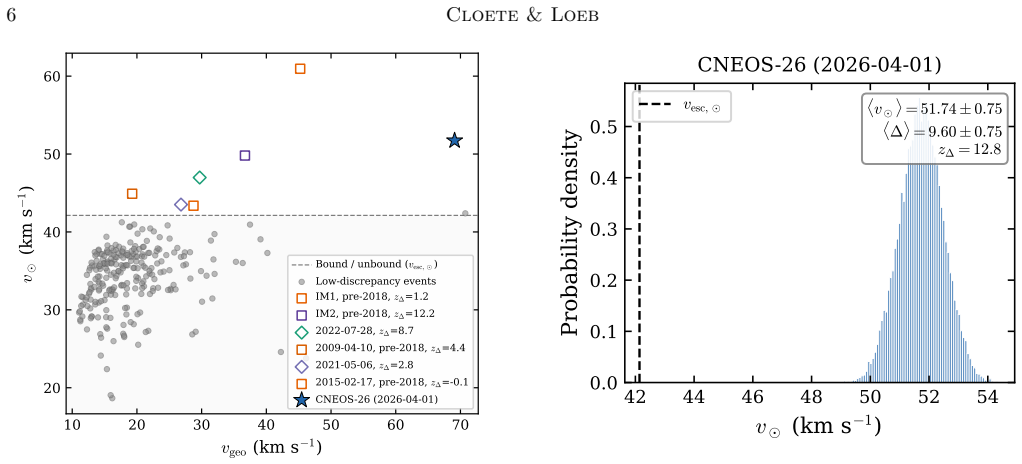
The meteor candidate polarIM, observed on 2026-04-01 02:13:14 UTC at 90.5 km altitude over the South Atlantic, transforms to a heliocentric velocity of 51.73 km/s and specific energy +450.1 km² s^{-2}. Its polar velocity component of +47.09 km/s exceeds the local solar escape speed of 42.14 km/s by itself. One million Monte Carlo realizations under the empirical post-2018 CNEOS error model produce no bound heliocentric orbits, establishing an interstellar fraction confidence above 99.9997 percent and identifying the event as the highest-margin post-2018 candidate.
What carries the argument
Velocity transformation from Earth-fixed coordinates to inertial geocentric state, removal of Earth's gravity via two-body hyperbolic escape, addition of Earth's heliocentric velocity, followed by Monte Carlo sampling of velocity, right-ascension, and declination errors.
If this is right
- The event supplies a new high-confidence data point for the flux of interstellar objects entering the inner solar system.
- Its near-polar inclination indicates that the incoming direction is nearly perpendicular to the ecliptic plane.
- The same Monte Carlo procedure can be applied to other CNEOS events to rank additional interstellar candidates by margin above escape.
- Confirmed interstellar meteors allow direct comparison of entry speeds and trajectories with those of known solar-system objects.
Where Pith is reading between the lines
- If the error model holds, repeated detections of this type would raise the estimated interstellar meteor rate above current upper limits.
- Cross-checking the reported velocity against optical or radar records from other networks could test whether the high speed persists under different instrumentation.
- A population of polar interstellar meteors would imply that some extrasolar material arrives from directions decoupled from the solar system's orbital plane.
Load-bearing premise
The post-2018 CNEOS error model with given sigmas accurately describes the uncertainties for this particular detection.
What would settle it
An independent sensor measurement of the same event that yields a heliocentric speed below 42.14 km/s after identical frame transformation would place at least one realization inside a bound orbit.
Figures

read the original abstract
We report a newly identified polar interstellar meteor candidate, labeled polarIM, detected on 2026-04-01 02:13:14 UTC at latitude $-41.9^\circ$, longitude $-54.7^\circ$, and altitude 90.5 km over the South Atlantic Ocean, east of Argentina. We transform the reported Earth-fixed velocity vector $(+3.6,\,-34.6,\,+59.8)~\mathrm{km\,s^{-1}}$ to an inertial geocentric state, remove Earth's gravitational acceleration with a two-body hyperbolic model, add the JPL Horizons heliocentric velocity of Earth, and test the resulting heliocentric orbit against solar escape speed. The final velocity component in the polar ($z$) direction of $+47.09~\mathrm{km\,s^{-1}}$ exceeds by itself the local solar escape speed $v_{\rm esc,\odot}=42.14~\mathrm{km\,s^{-1}}$. The full heliocentric speed is $v_{\rm hel}=51.73~\mathrm{km\,s^{-1}}$, corresponding to positive heliocentric specific energy $\varepsilon_\odot=+450.1~\mathrm{km^2\,s^{-2}}$, heliocentric excess speed $v_{\infty,\odot}=30.00~\mathrm{km\,s^{-1}}$, and a two-body inclination $i=89.4^\circ$. We propagate measurement uncertainty through 1,000,000 Monte Carlo realizations using the empirical post-2018 low-discrepancy CNEOS error model of Pena-Asensio et al. (2025), with $\sigma_v=0.55~\mathrm{km\,s^{-1}}$, $\sigma_{\rm RA}=1.35^\circ$, and $\sigma_{\rm Dec}=0.84^\circ$. No realization yields a bound heliocentric orbit, giving a statistical confidence on the interstellar fraction of $>99.9997\%$. The Monte Carlo margin above escape is $\langle\Delta\rangle=9.60\pm0.75~\mathrm{km\,s^{-1}}$, corresponding to a $12.82\sigma$ margin-to-scatter ratio under the adopted perturbation model. The result identifies polarIM as the highest-margin post-2018 candidate in the CNEOS catalog.
Editorial analysis
A structured set of objections, weighed in public.
Referee Report
Summary. The manuscript identifies a polar interstellar meteor candidate (polarIM) from CNEOS data detected on 2026-04-01 at 90.5 km altitude over the South Atlantic. It transforms the reported Earth-fixed velocity to a heliocentric state via two-body hyperbolic correction and JPL Earth velocity, yielding v_hel = 51.73 km s^{-1}, ε_⊙ = +450.1 km² s^{-2}, and i = 89.4°. A 1,000,000-realization Monte Carlo using the Pena-Asensio et al. (2025) post-2018 error model (σ_v = 0.55 km s^{-1}, σ_RA = 1.35°, σ_Dec = 0.84°) finds zero bound orbits, implying >99.9997% confidence of interstellar origin with a 12.82σ margin.
Significance. If the adopted error model is accurate for this event, the result would establish polarIM as the highest-margin post-2018 CNEOS interstellar candidate, with a clear quantitative statistical assessment from the large Monte Carlo ensemble and explicit margin-to-scatter ratio. This adds to the small sample of confirmed interstellar meteors and underscores the value of empirical uncertainty modeling for CNEOS events.
major comments (2)
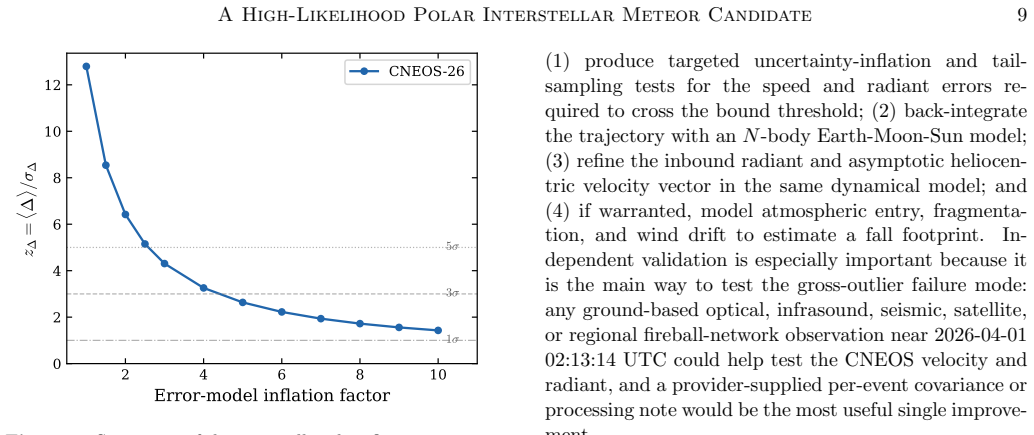
- [Monte Carlo analysis] Monte Carlo analysis section: The >99.9997% interstellar fraction and zero bound realizations are obtained exclusively under the Pena-Asensio et al. (2025) low-discrepancy model; the manuscript provides no sensitivity tests against alternative error distributions (e.g., heavier-tailed or event-specific inflated uncertainties for polar geometry or South Atlantic location), which is load-bearing for the central statistical claim.
- [Velocity transformation] Velocity transformation paragraph: The reported z-component of +47.09 km s^{-1} (exceeding v_esc,⊙ = 42.14 km s^{-1} by 4.95 km s^{-1}) and final v_hel = 51.73 km s^{-1} depend on the specific two-body hyperbolic correction plus JPL Horizons Earth velocity; full intermediate vectors and code for the transformation are not supplied, limiting independent verification of the 12.82σ margin.
minor comments (2)
- [Abstract] Abstract: Notation mixes v_hel and v_{\rm hel}; consistent use of mathrm throughout would improve readability.
- [Abstract] Abstract: The Monte Carlo reports a margin of ⟨Δ⟩ = 9.60 ± 0.75 km s^{-1}; clarify whether this is the mean excess over escape or another quantity.
Simulated Author's Rebuttal
We thank the referee for their thorough review and for recognizing the potential significance of the polarIM candidate. Below we provide point-by-point responses to the major comments. We will incorporate revisions as indicated to address the concerns raised.
read point-by-point responses
-
Referee: [Monte Carlo analysis] Monte Carlo analysis section: The >99.9997% interstellar fraction and zero bound realizations are obtained exclusively under the Pena-Asensio et al. (2025) low-discrepancy model; the manuscript provides no sensitivity tests against alternative error distributions (e.g., heavier-tailed or event-specific inflated uncertainties for polar geometry or South Atlantic location), which is load-bearing for the central statistical claim.
Authors: The referee correctly notes that our statistical conclusion relies on the specific error model from Pena-Asensio et al. (2025) without testing alternatives. This model is the most appropriate empirical description available for post-2018 CNEOS events, but to strengthen the result we will add sensitivity analyses in the revised manuscript. Specifically, we will repeat the Monte Carlo with (i) uncertainties inflated by a factor of 2 and (ii) a heavier-tailed distribution such as a multivariate t-distribution with 3 degrees of freedom. These tests will demonstrate whether the zero bound realizations persist under more conservative assumptions. revision: yes
-
Referee: [Velocity transformation] Velocity transformation paragraph: The reported z-component of +47.09 km s^{-1} (exceeding v_esc,⊙ = 42.14 km s^{-1} by 4.95 km s^{-1}) and final v_hel = 51.73 km s^{-1} depend on the specific two-body hyperbolic correction plus JPL Horizons Earth velocity; full intermediate vectors and code for the transformation are not supplied, limiting independent verification of the 12.82σ margin.
Authors: We agree that the absence of explicit intermediate vectors and code hinders verification. The initial Earth-fixed velocity is provided in the manuscript as (+3.6, -34.6, +59.8) km s^{-1}. The transformation proceeds by first converting to an inertial geocentric frame using the event time and location, then subtracting the gravitational deflection via the two-body hyperbolic orbit solution, and finally adding the JPL Horizons heliocentric velocity of Earth at the epoch. In the revised version, we will tabulate the intermediate geocentric velocity vector post-correction and provide the Python script used for both the orbit calculation and the Monte Carlo sampling as supplementary material or via a public repository link. revision: yes
Circularity Check
No significant circularity; derivation is direct orbital-mechanics computation from external inputs
full rationale
The central claim follows from transforming the reported Earth-fixed velocity vector using standard two-body hyperbolic correction plus JPL Earth velocity, then comparing the resulting heliocentric speed and z-component to solar escape velocity. This is a direct calculation with no fitted parameters, no self-referential definitions, and no renaming of known results. The Monte Carlo propagation relies on the empirical error model from Pena-Asensio et al. (2025), a citation to independent prior work by non-overlapping authors. No load-bearing self-citation chain or ansatz smuggling is present. The result is self-contained against external benchmarks and does not reduce to its inputs by construction.
Axiom & Free-Parameter Ledger
axioms (1)
- standard math Two-body hyperbolic trajectory model suffices to remove Earth's gravitational acceleration from the reported geocentric velocity.
Reference graph
Works this paper leans on
-
[1]
Cloete, R., & Loeb, A. 2026, Two Robust Interstellar Meteor Candidates in the Post-2018 CNEOS Fireball Database, doi: 10.48550/arXiv.2602.08956
-
[2]
M., Lim, P
Collaboration, A., Price-Whelan, A. M., Lim, P. L., et al. 2022, The Astrophysical Journal, 935, 167
2022
-
[3]
A., Bland, P
Devillepoix, H. A., Bland, P. A., Sansom, E. K., et al. 2019, Monthly Notices of the Royal Astronomical Society, 483, 5166
2019
-
[4]
Do, A., Tucker, M. A., & Tonry, J. L. 2018, The Astrophysical Journal Letters, 855, L10, doi: 10.3847/2041-8213/aaae67
-
[5]
M., Brasseur, C., et al
Ginsburg, A., Sip˝ ocz, B. M., Brasseur, C., et al. 2019, The Astronomical Journal, 157, 98
2019
-
[6]
1996, in AAS/Division for Planetary Sciences Meeting Abstracts# 28, Vol
Giorgini, J., Yeomans, D., Chamberlin, A., et al. 1996, in AAS/Division for Planetary Sciences Meeting Abstracts# 28, Vol. 28, 25–04
1996
-
[7]
2020, Nature Astronomy, 4, 53
Guzik, P., Drahus, M., Rusek, K., et al. 2020, Nature Astronomy, 4, 53
2020
-
[8]
R., Millman, K
Harris, C. R., Millman, K. J., Van Der Walt, S. J., et al. 2020, nature, 585, 357
2020
-
[9]
Jewitt, D., & Seligman, D. Z. 2023, Annual Review of Astronomy and Astrophysics, 61, 197, doi: 10.1146/annurev-astro-071221-054221
-
[10]
Loeb, A., Jacobsen, S. B., Tagle, R., et al. 2024, Chemical Geology, 670, 122415, doi: 10.1016/j.chemgeo.2024.122415
-
[11]
The Astronomical Journal 164, 76,10.3847/1538-3881/ac75d2
Meech, K. J., Weryk, R., Micheli, M., et al. 2017, Nature, 552, 378 NASA/JPL Center for Near Earth Object Studies. 2026, Fireballs,, https://cneos.jpl.nasa.gov/fireballs/ NASA/JPL Solar System Dynamics. 2025, Fireball Data API,, https://ssd-api.jpl.nasa.gov/doc/fireball.html Pe˜ na-Asensio, E., Trigo-Rodr´ ıguez, J. M., & Rimola, A. 2022, AJ, 164, 76, doi...
-
[12]
Z., Micheli, M., Farnocchia, D., et al
Seligman, D. Z., Micheli, M., Farnocchia, D., et al. 2025, The Astrophysical Journal Letters, 989, L36
2025
-
[13]
2022a, ApJ, 939, 53, doi: 10.3847/1538-4357/ac8eac
Siraj, A., & Loeb, A. 2022a, ApJ, 939, 53, doi: 10.3847/1538-4357/ac8eac
-
[14]
Socas-Navarro, H. 2024, How likely is the interstellar origin of CNEOS14? On the reliability of the CNEOS database, doi: 10.48550/arXiv.2405.17219
-
[15]
E., et al
Virtanen, P., Gommers, R., Oliphant, T. E., et al. 2020, Nature methods, 17, 261
2020
discussion (0)
Sign in with ORCID, Apple, or X to comment. Anyone can read and Pith papers without signing in.