What Can Verifiable Decapsulation Tests Certify? Pass Bounds and Fault-Recognition Limits for FO-Based KEMs
Pith reviewed 2026-06-28 06:05 UTC · model grok-4.3
The pith
Black-box decapsulation tests for FO KEMs admit coupled erasures outside support-active cones, implying soundness and completeness errors sum to at least 1.
A machine-rendered reading of the paper's core claim, the machinery that carries it, and where it could break.
Core claim
When the black-box observation of an honest-support harness factors through the confirmation-observable final-key target, every operation outside the support-active cone has a coupled erasure implementation with the same transcript distribution; over any implementation class containing that erasure, soundness and completeness errors of an execution certifier satisfy α+β≥1. The list-hit term is bounded either by a cUP-faithful harness certificate, which transfers source confirmation-code unpredictability with a q-loss, or by an average conditional min-entropy bound.
What carries the argument
The confirmation-observable final-key target through which harness observations factor, enabling the construction of coupled erasure implementations for operations outside the support-active cone.
If this is right
- Acceptance for a q-localized system is bounded by honest correctness error, adversarial aliasing, final-key freshness defects, a hit on the localized suffix list, and 2 to the minus kappa.
- A one-query construction from any predictor of the confirmation witness matches the acceptance bound up to the fresh-key coincidence term.
- The list-hit obstruction is bounded by cUP-faithful certificates with q-loss or by separate RawEnt and TailEnt hypotheses for short and truncation-tail codes.
- The same model yields a dependency-cone lower bound for non-certification claims.
Where Pith is reading between the lines
- Effective black-box testing must therefore be restricted to the support-active cone to escape the erasure equivalence.
- The factoring argument may extend to other verifiable computations whose observations are limited to a designated output target.
- Relaxing the q-localized premise could permit stronger certification statements in broader implementation classes.
Load-bearing premise
The analysis assumes an honest-reference harness in which the reference encapsulation fixes a hidden final-key point with confirmation witness and that the system under test is q-localized.
What would settle it
Constructing an implementation class containing a transcript-preserving erasure for some operation outside the support-active cone together with an execution certifier achieving soundness error α and completeness error β where α + β is strictly less than 1 would falsify the claim.
Figures
read the original abstract
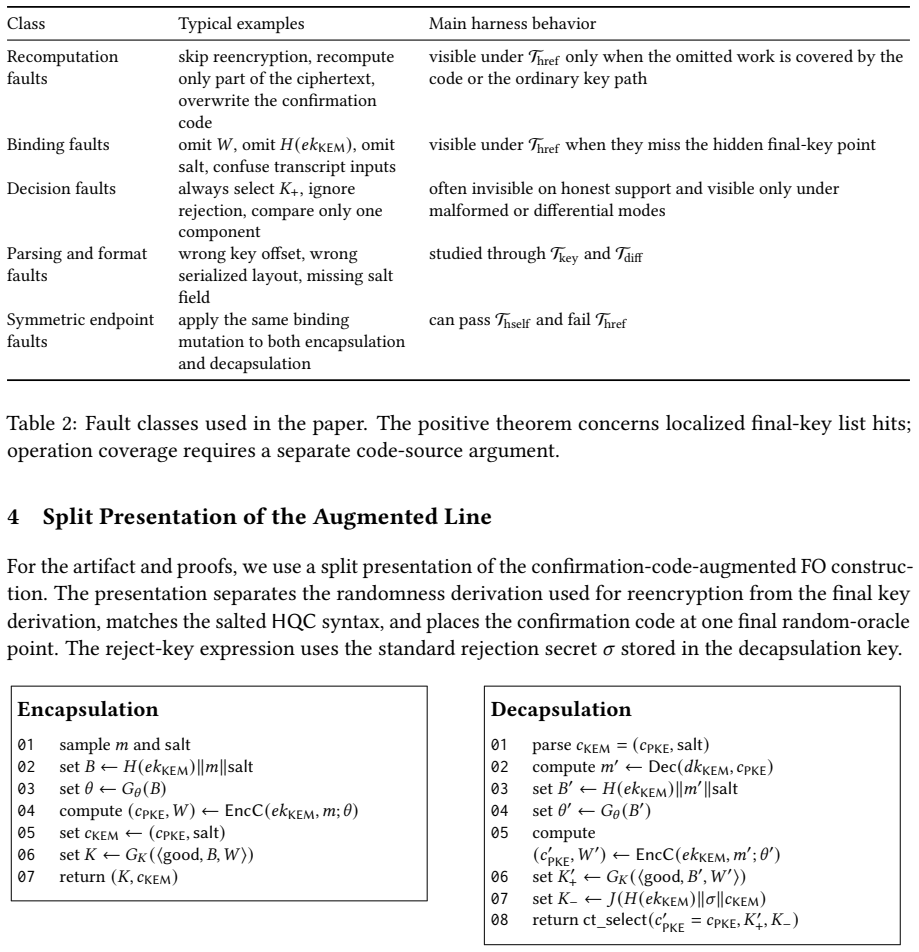
Black-box tests for Fujisaki-Okamoto decapsulation observe the sampled execution seen by the harness, whereas the reencryption computation itself is visible only through the values that reach final key derivation. We study confirmation-code-augmented KEM variants under an honest-reference harness in which the reference encapsulation fixes a hidden final-key point $\langle good,B,W\rangle$, with $W$ the confirmation witness. For a $q$-localized system under test, acceptance is bounded by honest correctness error, adversarial aliasing, final-key freshness defects, a hit on the localized suffix list $Q_G(B)$, and $2^{-\kappa}$. A one-query construction from any predictor of $W$ matches this bound up to the fresh-key coincidence term, so the list-hit event is the black-box obstruction measured by the harness. The list-hit term is bounded either by a cUP-faithful harness certificate, which transfers source confirmation-code unpredictability with a $q$-loss, or by an average conditional min-entropy bound, with separate RawEnt and TailEnt hypotheses for short diagnostic and truncation-tail codes. The same model proves a dependency-cone lower bound for non-certification claims. When the black-box observation of an honest-support harness factors through the confirmation-observable final-key target, every operation outside the support-active cone has a coupled erasure implementation with the same transcript distribution; over any implementation class containing that erasure, soundness and completeness errors of an execution certifier satisfy $\alpha+\beta\ge 1$. The ML-KEM and HQC case studies distinguish theorem-covered positive rows, finite-catalog artifact rows, and non-certification rows that carry a cone-inactivity certificate. The security of the standard KEM lines is the construction-level security supplied by the cited source analyses.
Editorial analysis
A structured set of objections, weighed in public.
Referee Report
Summary. The paper analyzes black-box verifiable decapsulation tests for Fujisaki-Okamoto KEMs under an honest-reference harness fixing a hidden final-key point ⟨good, B, W⟩. For q-localized systems under test, it derives acceptance bounds incorporating honest correctness error, adversarial aliasing, final-key freshness defects, hits on the localized suffix list Q_G(B), and 2^{-κ}. The list-hit term is bounded via cUP-faithful certificates (with q-loss) or average conditional min-entropy (RawEnt/TailEnt hypotheses). It proves a dependency-cone lower bound implying that, when black-box observations factor through the confirmation-observable final-key target, any execution certifier over implementation classes containing the coupled erasure implementation satisfies α + β ≥ 1. ML-KEM and HQC case studies classify rows as theorem-covered, finite-catalog artifacts, or non-certification (with cone-inactivity certificates).
Significance. If the central α + β ≥ 1 result holds, the work establishes a concrete impossibility result for simultaneous low soundness and completeness error in execution certifiers under the stated model, using standard indistinguishability and simulation arguments. This supplies a theoretical limit on fault-recognition power of black-box tests for FO-based KEMs and clarifies the certification status of standard constructions via the case-study distinctions. The explicit conditioning on the honest-support harness and q-localization avoids hidden assumptions.
minor comments (3)
- [Abstract] Abstract, paragraph on acceptance bounds: the phrase 'a one-query construction from any predictor of W matches this bound up to the fresh-key coincidence term' would benefit from an explicit statement of the construction (even if deferred to a later section) to make the matching claim self-contained.
- [Case studies] The distinction between 'theorem-covered positive rows', 'finite-catalog artifact rows', and 'non-certification rows' in the ML-KEM/HQC case studies is useful but would be clearer if the criteria for each category were listed in a short table or enumerated list.
- [Abstract] Notation: the symbol Q_G(B) for the localized suffix list is introduced without an immediate forward reference to its definition; adding the defining equation number in the first use would reduce reader effort.
Simulated Author's Rebuttal
We thank the referee for the careful and accurate summary of the manuscript, for recognizing the significance of the α + β ≥ 1 lower bound under the honest-support harness, and for the recommendation of minor revision. No major comments requiring point-by-point rebuttal were raised.
Circularity Check
No significant circularity identified
full rationale
The derivation of the central α+β≥1 bound proceeds from the honest-support harness model (with fixed ⟨good,B,W⟩) and the explicit construction of a coupled erasure implementation that preserves transcript distribution when observations factor through the final-key target; this uses standard simulation and indistinguishability arguments without reducing the result to a fitted parameter or self-defined quantity. The list-hit bounds are obtained either via cUP-faithful certificates (transferring unpredictability from cited source analyses with q-loss) or via stated RawEnt/TailEnt hypotheses on conditional min-entropy; both are presented as external modeling inputs rather than quantities defined inside the paper. The one-query construction is shown to match the bound up to a coincidence term, not derived from it. Security of ML-KEM/HQC lines is explicitly delegated to cited source analyses. No step equates a claimed prediction to its inputs by construction, and the paper is self-contained against the stated modeling assumptions.
Axiom & Free-Parameter Ledger
Reference graph
Works this paper leans on
-
[1]
NIST Special Publication NIST SP 800-227
Gorjan Alagic et al.Recommendations for Key-Encapsulation Mechanisms. NIST Special Publication NIST SP 800-227. National Institute of Standards and Technology, Sept. 2025.doi: 10.6028/NIST. SP.800-227.url:https://csrc.nist.gov/pubs/sp/800/227/final
-
[2]
Cryptology ePrint Archive, Paper 2023/755
Manuel Barbosa and Andreas H"ulsing.The security of Kyber’s FO-transform. Cryptology ePrint Archive, Paper 2023/755. 2023.url:https://eprint.iacr.org/2023/755
2023
-
[3]
Tighter Proofs of CCA Security in the Quantum Random Oracle Model
Nina Bindel et al. “Tighter Proofs of CCA Security in the Quantum Random Oracle Model”. In: Theory of Cryptography – 17th International Conference, TCC 2019, Nuremberg, Germany, December 1–5, 2019, Proceedings, Part II. Ed. by Dennis Hofheinz and Alon Rosen. Vol. 11892. Lecture Notes in Computer Science. Springer, 2019, pp. 61–90.doi: 10.1007/978-3-030-36...
-
[4]
An Injectivity Analysis of Crystals-Kyber and Implications on Quantum Secu- rity
Xiaohui Ding et al. “An Injectivity Analysis of Crystals-Kyber and Implications on Quantum Secu- rity”. In:Information Security and Privacy – 27th Australasian Conference, ACISP 2022, Wollongong, NSW, Australia, November 28–30, 2022, Proceedings. Ed. by Khoa Nguyen et al. Vol. 13494. Lecture Notes in Computer Science. Springer, 2022, pp. 332–351.doi: 10.1...
-
[6]
Faster Lattice-Based KEMs via a Generic Fujisaki-Okamoto Transform Using Prefix Hashing
Julien Duman et al. “Faster Lattice-Based KEMs via a Generic Fujisaki-Okamoto Transform Using Prefix Hashing”. In:Proceedings of the 2021 ACM SIGSAC Conference on Computer and Communications Security. Association for Computing Machinery, 2021, pp. 2722–2737.doi: 10.1145/3460120.3484819.url:https://doi.org/10.1145/3460120.3484819
work page doi:10.1145/3460120.3484819.url:https://doi.org/10.1145/3460120.3484819 2021
-
[7]
Do users write more insecure code with ai assistants?
Marc Fischlin and Felix G"unther. “Verifiable Verification in Cryptographic Protocols”. In:Proceed- ings of the 2023 ACM SIGSAC Conference on Computer and Communications Security. Association for Computing Machinery, 2023, pp. 3239–3253.doi: 10.1145/3576915.3623151.url: https: //doi.org/10.1145/3576915.3623151
-
[8]
HQC specifications
Philippe Gaborit et al.Hamming Quasi-Cyclic (HQC). HQC specifications. Aug. 2025.url: https: //pqc-hqc.org/doc/hqc_specifications_2025_08_22.pdf
2025
-
[9]
Jiangxia Ge, Heming Liao, and Rui Xue. “Measure-Rewind-Extract: Tighter Proofs of One-Way to Hiding and CCA Security in the Quantum Random Oracle Model”. In:Advances in Cryptology – ASIACRYPT 2024 – 30th International Conference on the Theory and Application of Cryptology and Information Security, Kolkata, India, December 9–13, 2024, Proceedings, Part IV....
work page doi:10.1007/978-981-96-0894-2_1.url:https://doi.org/10.1007/978-981-96-0894-2_1 2024
-
[10]
Cryptology ePrint Archive, Paper 2023/792
Jiangxia Ge, Tianshu Shan, and Rui Xue.On the Fujisaki-Okamoto transform: from Classical CCA Security to Quantum CCA Security. Cryptology ePrint Archive, Paper 2023/792. 2023.url: https://eprint.iacr.org/2023/792. 39
2023
-
[12]
Cryptology ePrint Archive, Paper 2025/343
Lewis Glabush, Kathrin H"ovelmanns, and Douglas Stebila.Tight Multi-challenge Security Reduc- tions for Key Encapsulation Mechanisms. Cryptology ePrint Archive, Paper 2025/343. 2025.url: https://eprint.iacr.org/2025/343
2025
-
[13]
Verifiable Decapsulation: Recognizing Faulty Implementations of Post- quantum KEMs
Lewis Glabush et al. “Verifiable Decapsulation: Recognizing Faulty Implementations of Post- quantum KEMs”. In:Advances in Cryptology – CRYPTO 2025 – 45th Annual International Cryptology Conference, Santa Barbara, CA, USA, August 17–21, 2025, Proceedings, Part III. Ed. by Yael Tauman Kalai and Seny F. Kamara. Vol. 16002. Lecture Notes in Computer Science. ...
-
[15]
Kathrin H"ovelmanns and Mikhail A. Kudinov. “Treating Dishonest Ciphertexts in Post-quantum KEMs – Explicit vs. Implicit Rejection in the FO Transform”. In:Post-Quantum Cryptography – 16th International Workshop, PQCrypto 2025, Taipei, Taiwan, April 8–10, 2025, Proceedings, Part II. Ed. by Ruben Niederhagen and Markku-Juhani O. Saarinen. Vol. 15578. Lectu...
-
[18]
Dennis Hofheinz, Kathrin H"ovelmanns, and Eike Kiltz. “A Modular Analysis of the Fujisaki- Okamoto Transformation”. In:Theory of Cryptography – 15th International Conference, TCC 2017, Baltimore, MD, USA, November 12–15, 2017, Proceedings, Part I. Ed. by Yael Kalai and Leonid Reyzin. Vol. 10677. Lecture Notes in Computer Science. Springer, 2017, pp. 341–3...
-
[19]
Key Encapsulation Mechanism with Explicit Rejection in the Quantum Random Oracle Model
Haodong Jiang, Zhenfeng Zhang, and Zhi Ma. “Key Encapsulation Mechanism with Explicit Rejection in the Quantum Random Oracle Model”. In:Public-Key Cryptography – PKC 2019 – 22nd IACR International Conference on Practice and Theory of Public-Key Cryptography, Beijing, China, April 14–17, 2019, Proceedings, Part II. Ed. by Dongdai Lin and Kazue Sako. Vol. 1...
-
[20]
Provable Security Against Decryption Failure Attacks from LWE
Christian Majenz and Fabrizio Sisinni. “Provable Security Against Decryption Failure Attacks from LWE”. In:Advances in Cryptology – CRYPTO 2024 – 44th Annual International Cryptology Conference, Santa Barbara, CA, USA, August 18–22, 2024, Proceedings, Part II. Ed. by Leonid Reyzin and Douglas Stebila. Vol. 14921. Lecture Notes in Computer Science. Springe...
-
[21]
Federal Information Processing Standards Publication NIST FIPS 203
National Institute of Standards and Technology.Module-Lattice-Based Key-Encapsulation Mecha- nism Standard. Federal Information Processing Standards Publication NIST FIPS 203. National Institute of Standards and Technology, Aug. 2024.doi: 10.6028/NIST.FIPS.203.url: https: //csrc.nist.gov/pubs/fips/203/final
-
[22]
QCCA-Secure Generic Transformations in the Quantum Random Oracle Model
Tianshu Shan, Jiangxia Ge, and Rui Xue. “QCCA-Secure Generic Transformations in the Quantum Random Oracle Model”. In:Public-Key Cryptography – PKC 2023 – 26th IACR International Conference on Practice and Theory of Public-Key Cryptography, Atlanta, GA, USA, May 7–10, 2023, Proceedings, Part I. Ed. by Alexandra Boldyreva and Vladimir Kolesnikov. Vol. 13940...
discussion (0)
Sign in with ORCID, Apple, or X to comment. Anyone can read and Pith papers without signing in.