SAILRec: Steering LLM Attention to Dual-Side Semantically Aligned Collaborative Embeddings for Recommendation
Pith reviewed 2026-06-28 04:30 UTC · model grok-4.3
The pith
SAILRec aligns collaborative embeddings on both sides and steers LLM attention by depth to balance internal semantics with external interaction data.
A machine-rendered reading of the paper's core claim, the machinery that carries it, and where it could break.
Core claim
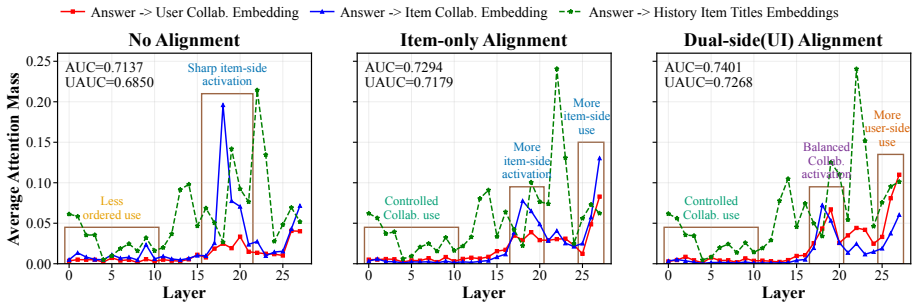
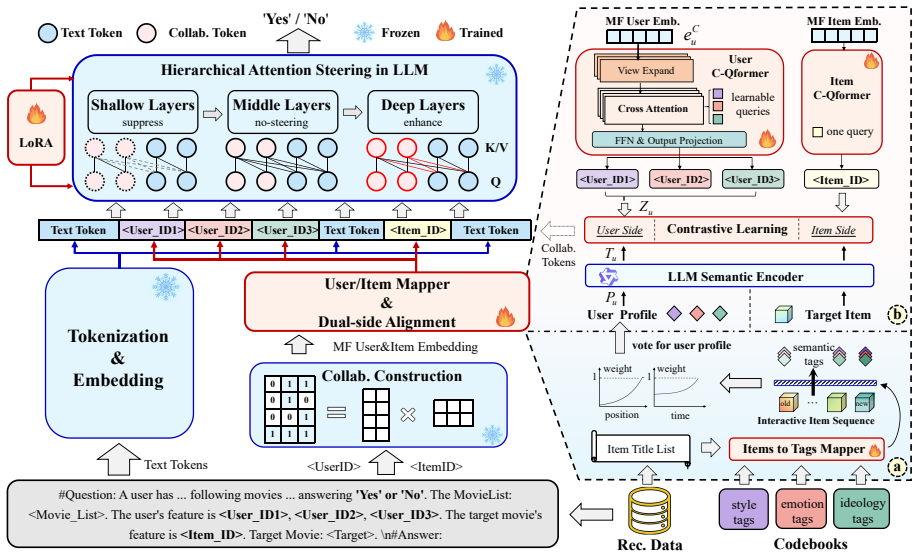
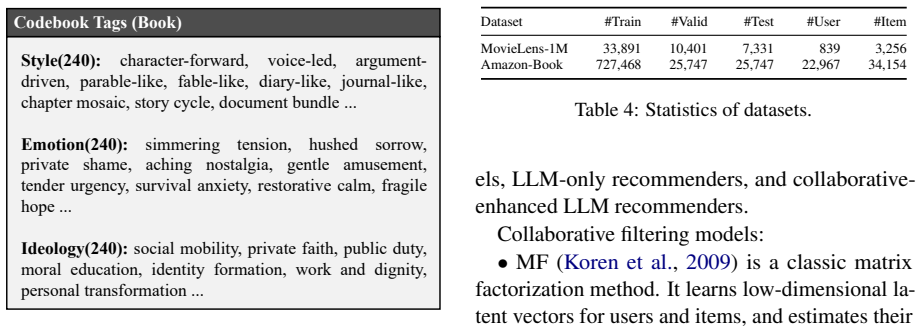
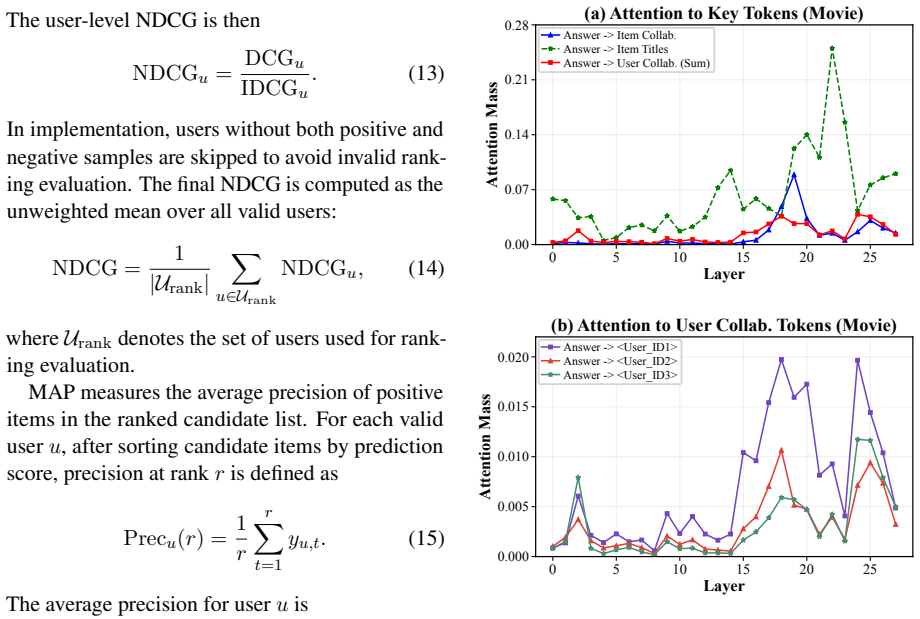
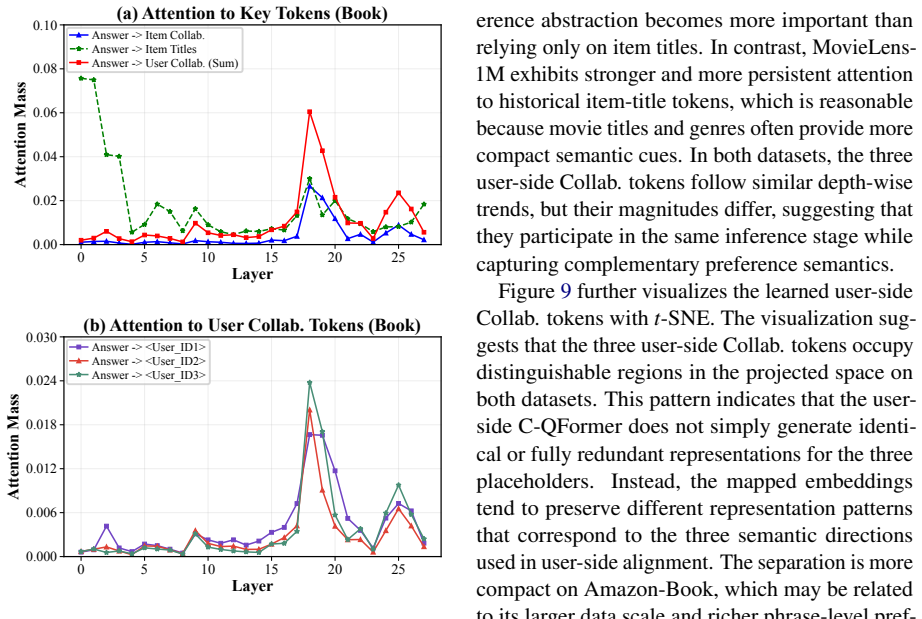
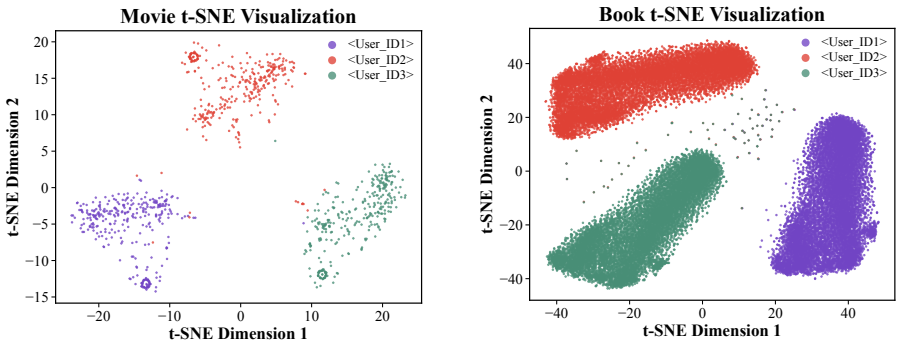
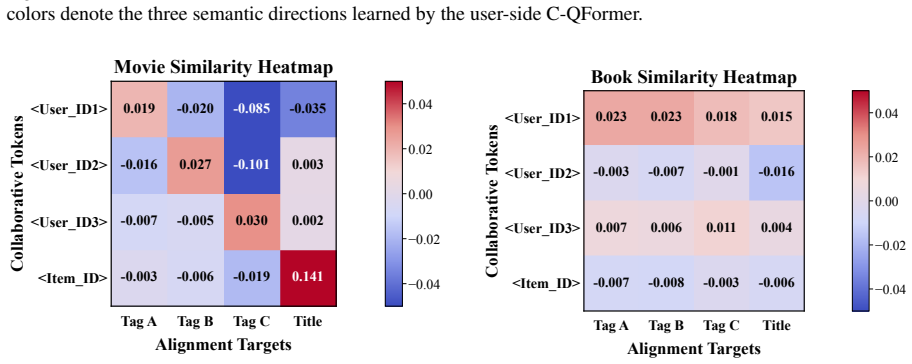
Through diagnostic attention analysis the authors establish that collaborative embedding utilization in LLMs is depth-dependent and alignment-sensitive; they therefore introduce dual-side semantic alignment (item embeddings aligned to item-text semantics, user embeddings aligned to codebook semantic profiles) together with hierarchical attention steering (suppressing premature shallow-layer collaborative signals while reinforcing evidence in deeper decision layers) to achieve a better balance between the model's internal semantic knowledge and external collaborative knowledge.
What carries the argument
Dual-side semantic alignment combined with hierarchical attention steering, which aligns embeddings to semantic references and modulates attention weights across layers to control when collaborative information is used.
If this is right
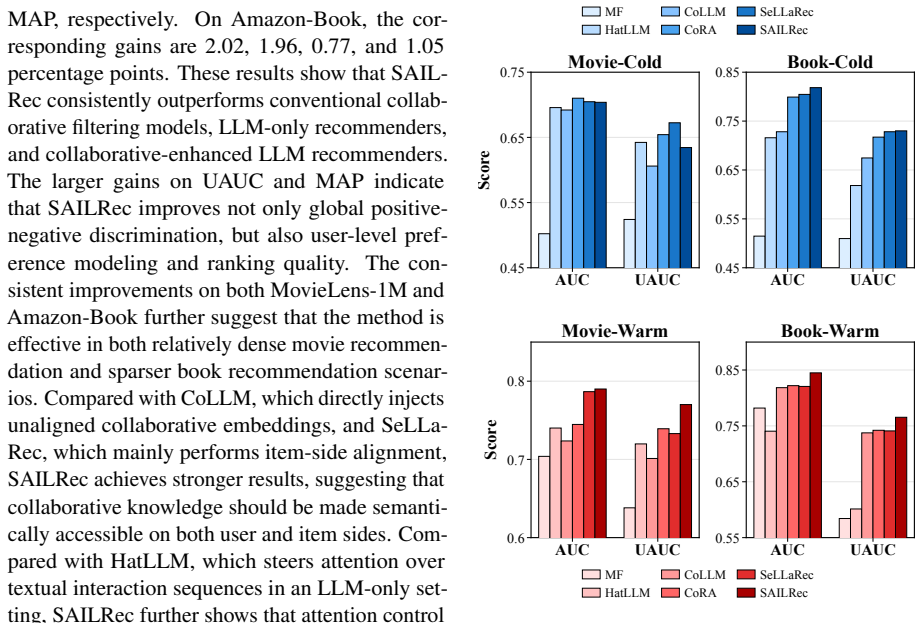
- The method produces measurable gains on standard recommendation benchmarks when both alignment and steering are applied together.
- Removing either the dual-side alignment or the depth-specific steering reduces performance, according to the ablation studies.
- Masking analyses show that the steered deeper layers carry more of the collaborative evidence used for final predictions.
- The approach generalizes across the two evaluated datasets without requiring changes to the underlying LLM architecture.
Where Pith is reading between the lines
- The same layer-wise steering idea could be tested on other embedding types such as knowledge-graph or multimodal features.
- If the depth-dependent pattern holds in larger LLMs, the steering mechanism may become more important as model scale increases.
- The codebook-based user profile alignment suggests a path for incorporating discrete semantic clusters into continuous embedding spaces.
Load-bearing premise
The diagnostic result that collaborative embedding use is both depth-dependent and sensitive to alignment must be correct, otherwise the alignment and steering steps are not needed.
What would settle it
Retraining the same base LLM on the same datasets but without the dual-side alignment or the hierarchical steering layers, then measuring whether recommendation metrics on MovieLens-1M and Amazon-Book remain below the full SAILRec model.
Figures

read the original abstract
Recent LLM-based recommenders enhance language models with collaborative embeddings from user-item interactions, but making such embeddings available does not ensure their proper use during inference. Through a diagnostic attention analysis, we find that the utilization of collaborative embeddings is depth-dependent and alignment-sensitive, suggesting that LLMs need to balance their internal semantic knowledge with external collaborative knowledge. To address this issue, we propose SAILRec, an LLM-based recommender that improves this balance through dual-side semantic alignment and hierarchical attention steering. The former aligns item-side embeddings with item-text semantics and user-side embeddings with codebook-based semantic profiles, while the latter suppresses premature shallow-layer collaborative interference and strengthens collaborative evidence in deeper decision layers. Experiments on MovieLens-1M and Amazon-Book show that SAILRec consistently outperforms representative baselines, with ablation and masking analyses validating its key designs.
Editorial analysis
A structured set of objections, weighed in public.
Referee Report
Summary. The manuscript presents SAILRec, an LLM-based recommender that addresses improper utilization of collaborative embeddings from user-item interactions. A diagnostic attention analysis reveals that such utilization is depth-dependent and alignment-sensitive, motivating dual-side semantic alignment (item embeddings aligned to item-text semantics; user embeddings aligned to codebook-based semantic profiles) and hierarchical attention steering (suppressing shallow-layer collaborative interference while strengthening evidence in deeper layers). Experiments on MovieLens-1M and Amazon-Book report consistent outperformance over baselines, with ablation and masking analyses supporting the designs.
Significance. If the diagnostic analysis robustly establishes the claimed depth/alignment sensitivity and the mechanisms demonstrably improve the semantic-collaborative balance without introducing confounding factors, the work could meaningfully advance LLM-based recommendation by offering targeted, interpretable interventions for knowledge integration. The inclusion of ablation studies and masking analyses is a strength for validating the key designs.
major comments (2)
- [Diagnostic Attention Analysis section] Diagnostic Attention Analysis section: The claim that collaborative embedding utilization is depth-dependent and alignment-sensitive is the load-bearing premise for introducing dual-side alignment and hierarchical steering. The analysis measures attention on specific heads/layers but does not appear to include controls for base LLM choice, embedding injection method, or sensitivity to these factors. Without such controls or independent verification (e.g., ablations isolating the depth effect absent the proposed fixes), the necessity of the two mechanisms is not fully demonstrated and outperformance could arise from added parameters or altered training dynamics instead.
- [Experiments section] Experiments section: The outperformance claims on MovieLens-1M and Amazon-Book rest on the proposed mechanisms, yet the manuscript does not report whether gains remain significant across multiple random seeds or statistical tests; single-run results are insufficient to rule out variance as an alternative explanation for the reported improvements.
minor comments (2)
- The abstract would benefit from reporting specific metric improvements (e.g., NDCG@10 deltas) rather than stating 'consistent outperformance' only.
- [Methods section] Notation for the codebook-based user semantic profiles should be introduced with an explicit equation or diagram in the methods to improve clarity.
Simulated Author's Rebuttal
We thank the referee for the constructive feedback. We address each major comment point by point below, indicating where revisions will be made to strengthen the manuscript.
read point-by-point responses
-
Referee: [Diagnostic Attention Analysis section] Diagnostic Attention Analysis section: The claim that collaborative embedding utilization is depth-dependent and alignment-sensitive is the load-bearing premise for introducing dual-side alignment and hierarchical steering. The analysis measures attention on specific heads/layers but does not appear to include controls for base LLM choice, embedding injection method, or sensitivity to these factors. Without such controls or independent verification (e.g., ablations isolating the depth effect absent the proposed fixes), the necessity of the two mechanisms is not fully demonstrated and outperformance could arise from added parameters or altered training dynamics instead.
Authors: The diagnostic attention analysis was performed on the standard base configuration to identify the depth-dependent and alignment-sensitive utilization patterns that motivate the proposed mechanisms. The ablation and masking analyses already provide supporting evidence that the mechanisms address these issues, as their removal degrades performance in a manner consistent with the diagnostic findings. We acknowledge the value of additional controls and will include new diagnostic experiments varying base LLM choice and embedding injection methods, plus ablations isolating the depth effect, in the revised manuscript. revision: yes
-
Referee: [Experiments section] Experiments section: The outperformance claims on MovieLens-1M and Amazon-Book rest on the proposed mechanisms, yet the manuscript does not report whether gains remain significant across multiple random seeds or statistical tests; single-run results are insufficient to rule out variance as an alternative explanation for the reported improvements.
Authors: We agree that single-run results limit the strength of the claims. In the revised manuscript we will report results averaged over multiple random seeds with standard deviations and include statistical significance tests (e.g., paired t-tests) against baselines to confirm the improvements are robust. revision: yes
Circularity Check
No circularity: diagnostic finding motivates design without self-referential reduction
full rationale
The paper presents a diagnostic attention analysis as an empirical observation (depth-dependent and alignment-sensitive collaborative embedding utilization), then proposes dual-side alignment and hierarchical steering to address the observed imbalance. No equations, fitted parameters, or derivations are described that reduce a claimed result to its own inputs by construction. No self-citations are invoked as load-bearing uniqueness theorems or ansatzes. The central claim rests on experimental outperformance and ablations rather than any self-definitional or fitted-input loop. This is the default self-contained case.
Axiom & Free-Parameter Ledger
Reference graph
Works this paper leans on
-
[1]
2025 , eprint=
Qwen3 Technical Report , author=. 2025 , eprint=
2025
-
[2]
Annual Meeting of the Association for Computational Linguistics , year=
BERT Rediscovers the Classical NLP Pipeline , author=. Annual Meeting of the Association for Computational Linguistics , year=
-
[3]
Quantifying Attention Flow in Transformers
Abnar, Samira and Zuidema, Willem. Quantifying Attention Flow in Transformers. Proceedings of the 58th Annual Meeting of the Association for Computational Linguistics. 2020. doi:10.18653/v1/2020.acl-main.385
-
[4]
Clark, Kevin and Khandelwal, Urvashi and Levy, Omer and Manning, Christopher D. What Does BERT Look at? An Analysis of BERT ' s Attention. Proceedings of the 2019 ACL Workshop BlackboxNLP: Analyzing and Interpreting Neural Networks for NLP. 2019. doi:10.18653/v1/W19-4828
-
[5]
and Kaiser,
Vaswani, Ashish and Shazeer, Noam and Parmar, Niki and Uszkoreit, Jakob and Jones, Llion and Gomez, Aidan N. and Kaiser,. Attention is all you need , year =. Proceedings of the 31st International Conference on Neural Information Processing Systems , pages =
-
[6]
Proceedings of the 40th International Conference on Machine Learning , articleno =
Li, Junnan and Li, Dongxu and Savarese, Silvio and Hoi, Steven , title =. Proceedings of the 40th International Conference on Machine Learning , articleno =. 2023 , publisher =
2023
-
[7]
Proceedings of the 2018 2nd International Conference on Deep Learning Technologies , pages =
Wang, Wentao and He, Dongzhi , title =. Proceedings of the 2018 2nd International Conference on Deep Learning Technologies , pages =. 2018 , isbn =. doi:10.1145/3234804.3234811 , abstract =
-
[8]
Proceedings of the 16th ACM Conference on Recommender Systems , pages =
Geng, Shijie and Liu, Shuchang and Fu, Zuohui and Ge, Yingqiang and Zhang, Yongfeng , title =. Proceedings of the 16th ACM Conference on Recommender Systems , pages =. 2022 , isbn =. doi:10.1145/3523227.3546767 , abstract =
-
[9]
Proceedings of the 1st Workshop on Deep Learning for Recommender Systems , pages =
Cheng, Heng-Tze and Koc, Levent and Harmsen, Jeremiah and Shaked, Tal and Chandra, Tushar and Aradhye, Hrishi and Anderson, Glen and Corrado, Greg and Chai, Wei and Ispir, Mustafa and Anil, Rohan and Haque, Zakaria and Hong, Lichan and Jain, Vihan and Liu, Xiaobing and Shah, Hemal , title =. Proceedings of the 1st Workshop on Deep Learning for Recommender...
-
[10]
Proceedings of the 26th International Joint Conference on Artificial Intelligence , pages =
Guo, Huifeng and Tang, Ruiming and Ye, Yunming and Li, Zhenguo and He, Xiuqiang , title =. Proceedings of the 26th International Joint Conference on Artificial Intelligence , pages =. 2017 , isbn =
2017
-
[11]
2019 , eprint=
Representation Learning with Contrastive Predictive Coding , author=. 2019 , eprint=
2019
-
[12]
2024 , eprint=
Recommendation with Generative Models , author=. 2024 , eprint=
2024
-
[13]
J. Bobadilla and F. Ortega and A. Hernando and A. Gutiérrez , keywords =. Recommender systems survey , journal =. 2013 , issn =. doi:https://doi.org/10.1016/j.knosys.2013.03.012 , url =
-
[14]
World Wide Web , month = aug, numpages =
Wu, Likang and Zheng, Zhi and Qiu, Zhaopeng and Wang, Hao and Gu, Hongchao and Shen, Tingjia and Qin, Chuan and Zhu, Chen and Zhu, Hengshu and Liu, Qi and Xiong, Hui and Chen, Enhong , title =. World Wide Web , month = aug, numpages =. 2024 , issue_date =. doi:10.1007/s11280-024-01291-2 , abstract =
-
[15]
A Survey on Accuracy-Oriented Neural Recommendation: From Collaborative Filtering to Information-Rich Recommendation , year=
Wu, Le and He, Xiangnan and Wang, Xiang and Zhang, Kun and Wang, Meng , journal=. A Survey on Accuracy-Oriented Neural Recommendation: From Collaborative Filtering to Information-Rich Recommendation , year=
-
[16]
2024 , eprint=
Large Language Models for Generative Recommendation: A Survey and Visionary Discussions , author=. 2024 , eprint=
2024
-
[17]
A survey on solving cold start problem in recommender systems , year=
Gope, Jyotirmoy and Jain, Sanjay Kumar , booktitle=. A survey on solving cold start problem in recommender systems , year=
-
[18]
Electronics , VOLUME =
Ko, Hyeyoung and Lee, Suyeon and Park, Yoonseo and Choi, Anna , TITLE =. Electronics , VOLUME =. 2022 , NUMBER =
2022
-
[19]
R ec LM : Recommendation Instruction Tuning
Jiang, Yangqin and Yang, Yuhao and Xia, Lianghao and Luo, Da and Lin, Kangyi and Huang, Chao. R ec LM : Recommendation Instruction Tuning. Proceedings of the 63rd Annual Meeting of the Association for Computational Linguistics (Volume 1: Long Papers). 2025. doi:10.18653/v1/2025.acl-long.751
-
[20]
Luo, Sichun and He, Bowei and Zhao, Haohan and Shao, Wei and Qi, Yanlin and Huang, Yinya and Zhou, Aojun and Yao, Yuxuan and Li, Zongpeng and Xiao, Yuanzhang and Zhan, Mingjie and Song, Linqi , title =. ACM Trans. Inf. Syst. , month = jul, articleno =. 2025 , issue_date =. doi:10.1145/3705728 , abstract =
-
[21]
Liao, Jiayi and Li, Sihang and Yang, Zhengyi and Wu, Jiancan and Yuan, Yancheng and Wang, Xiang and He, Xiangnan , title =. Proceedings of the 47th International ACM SIGIR Conference on Research and Development in Information Retrieval , pages =. 2024 , isbn =. doi:10.1145/3626772.3657690 , abstract =
-
[22]
Zhou, Guorui and Zhu, Xiaoqiang and Song, Chenru and Fan, Ying and Zhu, Han and Ma, Xiao and Yan, Yanghui and Jin, Junqi and Li, Han and Gai, Kun , title =. Proceedings of the 24th ACM SIGKDD International Conference on Knowledge Discovery & Data Mining , pages =. 2018 , isbn =. doi:10.1145/3219819.3219823 , abstract =
-
[23]
Justifying Recommendations using Distantly-Labeled Reviews and Fine-Grained Aspects
Ni, Jianmo and Li, Jiacheng and McAuley, Julian. Justifying Recommendations using Distantly-Labeled Reviews and Fine-Grained Aspects. Proceedings of the 2019 Conference on Empirical Methods in Natural Language Processing and the 9th International Joint Conference on Natural Language Processing (EMNLP-IJCNLP). 2019. doi:10.18653/v1/D19-1018
-
[24]
2024 , eprint=
Qwen2 Technical Report , author=. 2024 , eprint=
2024
-
[25]
Bao, Keqin and Zhang, Jizhi and Wang, Wenjie and Zhang, Yang and Yang, Zhengyi and Luo, Yanchen and Chen, Chong and Feng, Fuli and Tian, Qi , title =. ACM Trans. Recomm. Syst. , month = apr, articleno =. 2025 , issue_date =. doi:10.1145/3716393 , abstract =
-
[26]
Proceedings of the 17th ACM Conference on Recommender Systems , pages =
Bao, Keqin and Zhang, Jizhi and Zhang, Yang and Wang, Wenjie and Feng, Fuli and He, Xiangnan , title =. Proceedings of the 17th ACM Conference on Recommender Systems , pages =. 2023 , isbn =. doi:10.1145/3604915.3608857 , abstract =
-
[27]
2024 , eprint=
HLLM: Enhancing Sequential Recommendations via Hierarchical Large Language Models for Item and User Modeling , author=. 2024 , eprint=
2024
-
[28]
Davis, Jesse and Goadrich, Mark , title =. Proceedings of the 23rd International Conference on Machine Learning , pages =. 2006 , isbn =. doi:10.1145/1143844.1143874 , abstract =
-
[29]
2023 , eprint=
Chat-REC: Towards Interactive and Explainable LLMs-Augmented Recommender System , author=. 2023 , eprint=
2023
-
[30]
The MovieLens Datasets: History and Context
Harper, F. Maxwell and Konstan, Joseph A. , title =. ACM Trans. Interact. Intell. Syst. , month = dec, articleno =. 2015 , issue_date =. doi:10.1145/2827872 , abstract =
-
[31]
He, Xiangnan and Deng, Kuan and Wang, Xiang and Li, Yan and Zhang, YongDong and Wang, Meng , title =. Proceedings of the 43rd International ACM SIGIR Conference on Research and Development in Information Retrieval , pages =. 2020 , isbn =. doi:10.1145/3397271.3401063 , abstract =
-
[32]
Edward J Hu and yelong shen and Phillip Wallis and Zeyuan Allen-Zhu and Yuanzhi Li and Shean Wang and Lu Wang and Weizhu Chen , booktitle=. Lo. 2022 , url=
2022
-
[33]
Kang, Wang-Cheng and McAuley, Julian , booktitle =. 2018 , volume =. doi:10.1109/ICDM.2018.00035 , url =
-
[34]
Matrix Factorization Techniques for Recommender Systems , year=
Koren, Yehuda and Bell, Robert and Volinsky, Chris , journal=. Matrix Factorization Techniques for Recommender Systems , year=
-
[35]
An introduction to ROC analysis , journal =
Tom Fawcett , keywords =. An introduction to ROC analysis , journal =. 2006 , note =. doi:https://doi.org/10.1016/j.patrec.2005.10.010 , url =
-
[36]
Text-like Encoding of Collaborative Information in Large Language Models for Recommendation
Zhang, Yang and Bao, Keqin and Yan, Ming and Wang, Wenjie and Feng, Fuli and He, Xiangnan. Text-like Encoding of Collaborative Information in Large Language Models for Recommendation. Proceedings of the 62nd Annual Meeting of the Association for Computational Linguistics (Volume 1: Long Papers). 2024. doi:10.18653/v1/2024.acl-long.497
-
[37]
Zhang, Yang and Feng, Fuli and Zhang, Jizhi and Bao, Keqin and Wang, Qifan and He, Xiangnan , title =. IEEE Trans. on Knowl. and Data Eng. , month = may, pages =. 2025 , issue_date =. doi:10.1109/TKDE.2025.3540912 , abstract =
-
[38]
Cumulated gain-based evaluation of IR techniques , year =
J\". Cumulated gain-based evaluation of IR techniques , year =. ACM Trans. Inf. Syst. , month = oct, pages =. doi:10.1145/582415.582418 , abstract =
-
[39]
Yue, Yisong and Finley, Thomas and Radlinski, Filip and Joachims, Thorsten , title =. Proceedings of the 30th Annual International ACM SIGIR Conference on Research and Development in Information Retrieval , pages =. 2007 , isbn =. doi:10.1145/1277741.1277790 , abstract =
-
[40]
2025 , eprint=
HatLLM: Hierarchical Attention Masking for Enhanced Collaborative Modeling in LLM-based Recommendation , author=. 2025 , eprint=
2025
-
[41]
Enhancing LLM-Based Recommendation with Semantic-Aligned Collaborative Knowledge
Wang, Zihan and Lin, Jinghao and Yang, Xiaocui and Liu, Yongkang and Feng, Shi and Wang, Daling and Zhang, Yifei and Yu, Ge. Enhancing LLM-Based Recommendation with Semantic-Aligned Collaborative Knowledge. Database Systems for Advanced Applications. 2026
2026
-
[42]
TokenRec: Learning to Tokenize ID for LLM-Based Generative Recommendations , year=
Qu, Haohao and Fan, Wenqi and Zhao, Zihuai and Li, Qing , journal=. TokenRec: Learning to Tokenize ID for LLM-Based Generative Recommendations , year=
-
[43]
Proceedings of the ACM Web Conference 2026 , pages =
Lin, Fake and Hu, Binbin and Zheng, Zhi and Zhu, Xi and Liu, Ziqi and Zhang, Zhiqiang and Zhou, Jun and Xu, Tong , title =. Proceedings of the ACM Web Conference 2026 , pages =. 2026 , isbn =. doi:10.1145/3774904.3792727 , abstract =
-
[44]
2025 , eprint=
CTR-Sink: Attention Sink for Language Models in Click-Through Rate Prediction , author=. 2025 , eprint=
2025
-
[45]
Liu, Yuting and Zhang, Jinghao and Dang, Yizhou and Liang, Yuliang and Liu, Qiang and Guo, Guibing and Zhao, Jianzhe and Wang, Xingwei , title =. Proceedings of the Thirty-Ninth AAAI Conference on Artificial Intelligence and Thirty-Seventh Conference on Innovative Applications of Artificial Intelligence and Fifteenth Symposium on Educational Advances in A...
-
[46]
Proceedings of the ACM Web Conference 2026 , pages =
Wang, Bohao and Chen, Jiawei and Liu, Feng and Zhang, Changwang and Wang, Jun and Jin, Canghong and Chen, Chun and Wang, Can , title =. Proceedings of the ACM Web Conference 2026 , pages =. 2026 , isbn =. doi:10.1145/3774904.3792607 , abstract =
-
[47]
Collaborative Knowledge Fusion: A Novel Method for Multi-Task Recommender Systems via LLMs , year=
Zhao, Chuang and Su, Xing and He, Ming and Zhao, Hongke and Fan, Jianping and Li, Xiaomeng , journal=. Collaborative Knowledge Fusion: A Novel Method for Multi-Task Recommender Systems via LLMs , year=
discussion (0)
Sign in with ORCID, Apple, or X to comment. Anyone can read and Pith papers without signing in.