CapSenseBand: Sustaining Cross-Disciplinary Creativity When Stitches Must Meet Signals
Pith reviewed 2026-06-28 04:30 UTC · model grok-4.3
The pith
Paper Models function as boundary objects that let textile and interaction designers negotiate constraints while preserving expertise in a knitted capacitive-sensing wristband.
A machine-rendered reading of the paper's core claim, the machinery that carries it, and where it could break.
Core claim
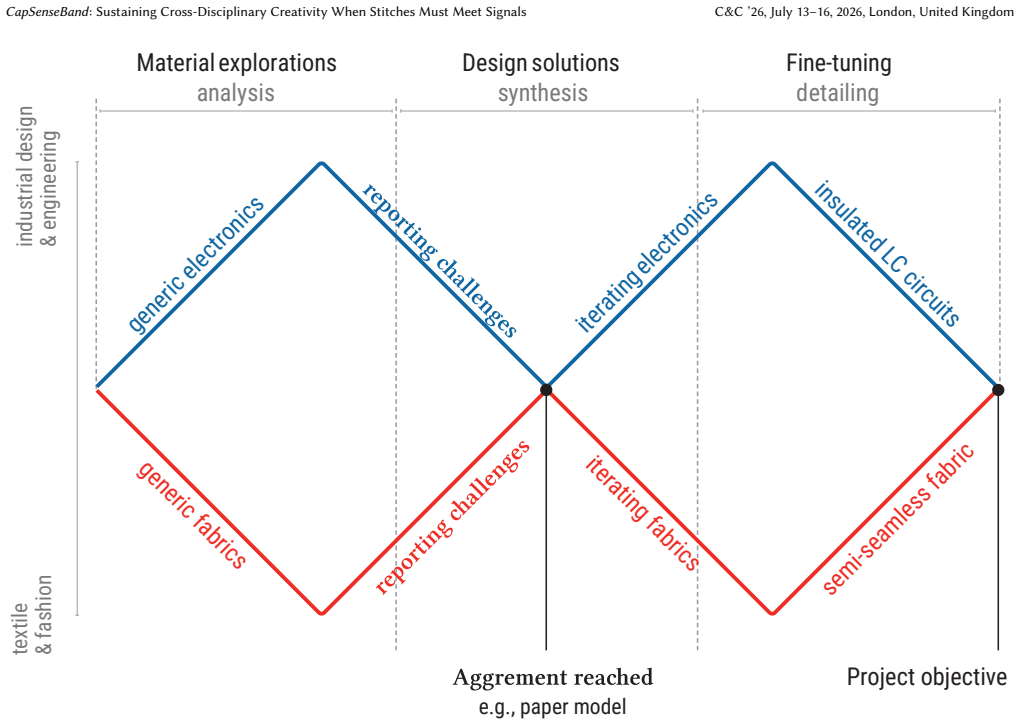
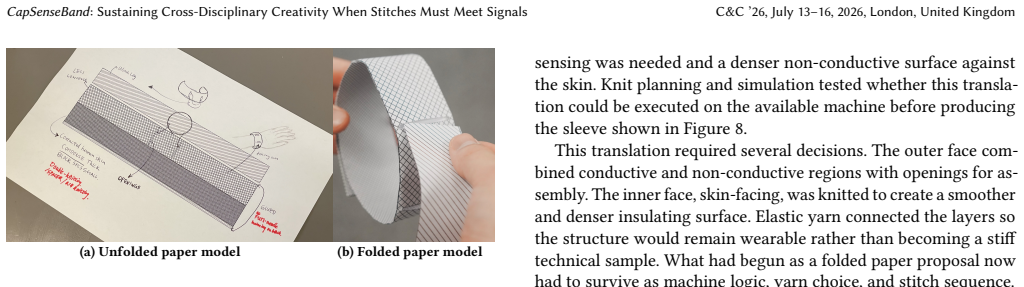
Paper Models functioned as boundary objects in the CapSenseBand project, helping collaborators externalize intent, negotiate spatial and technical constraints, and preserve disciplinary expertise while converging on a shared design. The reusable pattern is to keep discipline-specific probes open early, then converge through artifacts that make material, spatial, and electronic decisions legible before fabrication locks them in.
What carries the argument
Paper Models as boundary objects that externalize intent and make material, spatial, and electronic decisions legible during cross-disciplinary negotiation.
If this is right
- Early probes can remain open to textile reasoning through stitches and yarn while interaction reasoning addresses electrodes and signals.
- Artifacts that render decisions legible reduce the risk that fabrication will lock in unresolved conflicts.
- The swatch-to-sleeve sequence supports convergence without erasing disciplinary knowledge.
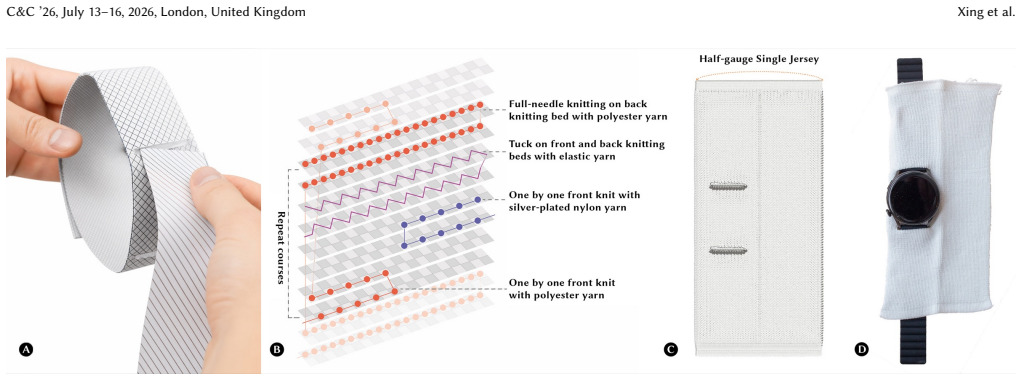
- The double-layer knitted structure with insulated board becomes feasible once spatial and material choices are negotiated visibly.
Where Pith is reading between the lines
- The same boundary-object tactic could be adapted to other hybrid domains such as soft robotics or medical textiles where material and electronic constraints must be reconciled.
- Documenting the exact sequence of swatches, paper models, and prototypes in additional cases would strengthen or refine the claimed pattern.
- Teams might reduce late-stage rework by adopting the early-open-then-converge rhythm even when the specific artifacts differ.
Load-bearing premise
The single case of CapSenseBand and its paper-model use in Analysis-Synthesis-Detailing generalizes to a reusable pattern for other textile-electronics projects.
What would settle it
A second textile-electronics project in which paper models either fail to support negotiation between disciplines or result in one field losing control over its decisions would falsify the reusable-pattern claim.
Figures



read the original abstract
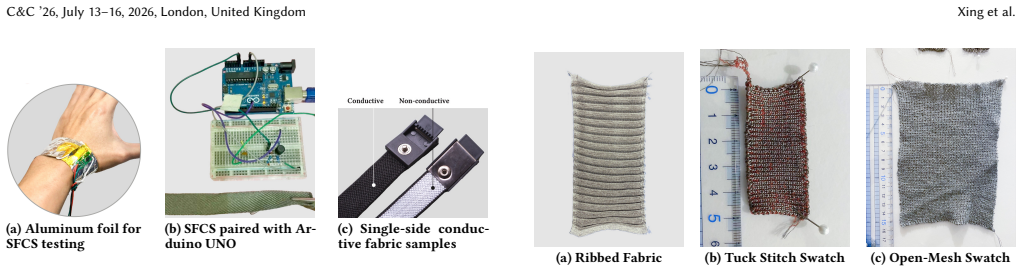
Wearable sensing systems increasingly depend on textiles that are both materially wearable and electronically functional. Their design requires collaboration between textile designers, who reason through stitches, yarn behavior, and machine constraints, and interaction designers, who reason through electrodes, signal paths, and insulation. However, these forms of expertise do not easily translate across disciplinary boundaries. This poster presents CapSenseBand, a knitted capacitive-sensing wristband developed through a research-through-design process organized around Analysis, Synthesis, and Detailing. We document an artifact chain spanning material swatches, a rapid wearable prototype, Paper Models as shared negotiation surfaces, a double-layer knitted structure, and an insulated Swept Frequency Capacitive Sensing breakout board. We show how Paper Models functioned as boundary objects, helping collaborators externalize intent, negotiate spatial and technical constraints, and preserve disciplinary expertise while converging on a shared design. We contribute a reusable swatch-to-sleeve pattern for material-centered HCI: keep discipline-specific probes open early, then converge through artifacts that make material, spatial, and electronic decisions legible before fabrication locks them in.
Editorial analysis
A structured set of objections, weighed in public.
Referee Report
Summary. The paper presents CapSenseBand, a knitted capacitive-sensing wristband developed through a research-through-design process organized around Analysis, Synthesis, and Detailing phases. It documents an artifact chain from material swatches and rapid prototypes to Paper Models, a double-layer knitted structure, and an insulated Swept Frequency Capacitive Sensing board. The authors claim that Paper Models functioned as boundary objects enabling collaborators to externalize intent, negotiate spatial and technical constraints, and preserve disciplinary expertise. They contribute a reusable 'swatch-to-sleeve' pattern for material-centered HCI: maintain discipline-specific probes early, then converge via artifacts that render material, spatial, and electronic decisions legible before fabrication.
Significance. If the pattern generalizes, the work supplies a concrete, documented example of using intermediate artifacts to bridge textile design and interaction design expertise in wearable sensing. The detailed artifact chain offers a model that could inform other cross-disciplinary textile-electronics projects by emphasizing early openness followed by legible convergence points.
major comments (1)
- [Abstract] Abstract: The claim that the swatch-to-sleeve pattern constitutes a 'reusable' contribution for material-centered HCI is load-bearing for the paper's central argument yet rests on a single CapSenseBand case without additional projects, transfer tests, or explicit boundary conditions under which the pattern is expected to hold.
Simulated Author's Rebuttal
We thank the referee for the detailed review and constructive feedback on our manuscript. We address the single major comment below.
read point-by-point responses
-
Referee: [Abstract] Abstract: The claim that the swatch-to-sleeve pattern constitutes a 'reusable' contribution for material-centered HCI is load-bearing for the paper's central argument yet rests on a single CapSenseBand case without additional projects, transfer tests, or explicit boundary conditions under which the pattern is expected to hold.
Authors: We agree that the 'reusable' framing is load-bearing and rests on a single, detailed case without transfer tests or additional projects. Research-through-design work frequently advances patterns from in-depth single cases via transparent artifact documentation, but we accept that the current wording overstates generalizability. In the revision we will (1) qualify the contribution statement in the abstract and conclusion as a pattern proposed from the CapSenseBand project, (2) add explicit boundary conditions drawn from the documented process (e.g., applicability to double-layer knits with swept-frequency capacitive sensing), and (3) include a dedicated limitations paragraph discussing the single-case scope and the need for future transfer studies. revision: yes
Circularity Check
No circularity: qualitative case study with independent observational claim
full rationale
The paper is a research-through-design case study documenting an artifact chain and boundary-object use in one project. Its central claim (Paper Models enabling negotiation while preserving expertise) is presented as an observation from the CapSenseBand process rather than a derivation that reduces to fitted inputs, self-definitions, or self-citation chains. No equations, parameters, or quantitative predictions exist; the reusable swatch-to-sleeve pattern is offered as a contribution inferred from the single case, which does not constitute circularity under the enumerated patterns. The derivation remains self-contained as narrative evidence.
Axiom & Free-Parameter Ledger
axioms (1)
- domain assumption Research-through-design organized around Analysis, Synthesis, and Detailing supports effective cross-disciplinary wearable development.
Reference graph
Works this paper leans on
-
[1]
Lea Albaugh, Scott E Hudson, and Lining Yao. 2023. An Augmented Knitting Machine for Operational Assistance and Guided Improvisation. InProceedings of the 2023 CHI Conference on Human Factors in Computing Systems. ACM, Hamburg Germany, 1–15. doi:10.1145/3544548.3581549 [Online; accessed 2024-02-05]
-
[2]
Lea Albaugh, James McCann, Scott E. Hudson, and Lining Yao. 2021. Engineering Multifunctional Spacer Fabrics Through Machine Knitting. InProceedings of the 2021 CHI Conference on Human Factors in Computing Systems. ACM, Yokohama Japan, 1–12. doi:10.1145/3411764.3445564 [Online; accessed 2024-02-09]
-
[3]
Tone Bratteteig and Ina Wagner. 2012. Disentangling power and decision-making in participatory design. InProceedings of the 12th Participatory Design Conference: Research Papers - Volume 1 (PDC ’12). Association for Computing Machinery, New York, NY, USA, 41–50. doi:10.1145/2347635.2347642 [Online; accessed 2023-07-31]
-
[4]
Marion Buchenau and Jane Fulton Suri. 2000. Experience prototyping. InPro- ceedings of the 3rd conference on Designing interactive systems: processes, practices, methods, and techniques (DIS ’00). Association for Computing Machinery, New York, NY, USA, 424–433. doi:10.1145/347642.347802 [Online; accessed 2022-03- 23]
-
[5]
Paul R. Carlile. 2002. A Pragmatic View of Knowledge and Boundaries: Boundary Objects in New Product Development.Organization Science13, 4 (jul 1 2002), 442–455. doi:10.1287/orsc.13.4.442.2953
-
[6]
Laura Devendorf, Katya Arquilla, Sandra Wirtanen, Allison Anderson, and Steven Frost. 2020. Craftspeople as Technical Collaborators: Lessons Learned through an Experimental Weaving Residency. InProceedings of the 2020 CHI Conference on Human Factors in Computing Systems (CHI ’20). Association for Computing C&C ’26, July 13–16, 2026, London, United Kingdom...
-
[7]
Laura Devendorf, Kathryn Walters, Marianne Fairbanks, Etta Sandry, and Emma R Goodwill. 2023. AdaCAD: Parametric Design as a New Form of Notation for Complex Weaving. InProceedings of the 2023 CHI Conference on Human Factors in Computing Systems. ACM, Hamburg Germany, 1–18. doi:10.1145/3544548. 3581571 [Online; accessed 2023-10-12]
-
[8]
Le Fang, Jiajuan Li, Meichen Liu, Wei Gong, Mingyuan Zhang, Ching Kwan Gor- don Wah, Bo Chai, Yingqing Xu, and Stephen Jia Wang. 2026. EmoFriends: A Modular Toolkit for Prototyping Customizable Emotion-Aware Companions. In Proceedings of the Extended Abstracts of the 2026 CHI Conference on Human Factors in Computing Systems. 1–7
2026
-
[9]
Le Fang, Sark Pangrui Xing, Yonghao Long, Kun-Pyo Lee, and Stephen Jia Wang
-
[10]
EmoSense: Revealing true emotions through microgestures.Advanced Intelligent Systems5, 9 (2023), 2300050
2023
-
[11]
Le Fang, Sark Pangrui Xing, Zhengtao Ma, Zhijie Zhang, Yonghao Long, Kun-Pyo Lee, and Stephen Jia Wang. 2024. Emo-MG framework: LSTM-based multi-modal emotion detection through electroencephalography signals and micro gestures. International Journal of Human–Computer Interaction40, 18 (2024), 5056–5072
2024
-
[12]
Le Fang, Yujie Zhu, Jiajuan Li, Cong Fang, Yingqing Xu, and Stephen Jia Wang
-
[13]
User Perspectives on AI-Supported Emotion Monitoring and Regulation: A Focus Group Study in Non-Clinical Contexts.International Journal of Human– Computer Interaction(2026), 1–26
2026
-
[14]
Bruna Goveia da Rocha, Janne Spork, and Kristina Andersen. 2022. Making Matters: Samples and Documentation in Digital Craftsmanship. InSixteenth International Conference on Tangible, Embedded, and Embodied Interaction. ACM, Daejeon Republic of Korea, 1–10. doi:10.1145/3490149.3502261 [Online; accessed 2022-10-28]
-
[15]
Anja Hertenberger, Barbro Scholz, Beam Contrechoc, Becky Stewart, Ebru Kur- bak, Hannah Perner-Wilson, Irene Posch, Isabel Cabral, Jie Qi, Katharina Childs, Kristi Kuusk, Lynsey Calder, Marina Toeters, Marta Kisand, Martijn Ten Bhömer, Maurin Donneaud, Meg Grant, Melissa Coleman, Mika Satomi, Mili Tharakan, Pauline Vierne, Sara Robertson, Sarah Taylor, an...
-
[16]
Jianan Hu, Eunsuk Hur, and Briony Thomas. 2023. Value-creating practices and barriers for collaboration between designers and artisans: a systematic literature review.International Journal of Fashion Design, Technology and Education0, 0 (jul 3 2023), 1–12. doi:10.1080/17543266.2023.2228337 publisher: Taylor & Francis _eprint: https://doi.org/10.1080/17543...
-
[17]
Giovanni Innella and Paul A Rodgers. 2017. Making Sense: Harnessing Commu- nication through Prototyping. 20 (2017), S1154–S1166. Issue sup1
2017
-
[18]
Lee Jones, Sara Nabil, and Audrey Girouard. 2020. Swatch-bits: Prototyping e-textiles with modular swatches. InProceedings of the Fourteenth International Conference on Tangible, Embedded, and Embodied Interaction. 893–897
2020
-
[19]
Lee Jones, Sara Nabil, Amanda McLeod, and Audrey Girouard. 2020. Wearable Bits: Scaffolding Creativity with a Prototyping Toolkit for Wearable E-textiles. In Proceedings of the Fourteenth International Conference on Tangible, Embedded, and Embodied Interaction (TEI ’20). Association for Computing Machinery, New York, NY, USA, 165–177. doi:10.1145/3374920....
-
[20]
Karana, E
E. Karana, E. Giaccardi, Niels Stamhuis, and J. Goossensen
-
[21]
https://www.semanticscholar.org/paper/ead6c98c7490fe8f0119292e6b8e9e80d8267c6e
The Tuning of Materials: A Designer’s Journey. https://www.semanticscholar.org/paper/ead6c98c7490fe8f0119292e6b8e9e80d8267c6e. Proceedings of the 2016 ACM Conference on Designing Interactive Systems(2016). doi:10.1145/2901790.2901909
-
[22]
Youn-Kyung Lim, Erik Stolterman, and Josh Tenenberg. 2008. The anatomy of prototypes: Prototypes as filters, prototypes as manifestations of design ideas. ACM Transactions on Computer-Human Interaction (TOCHI)15, 2 (2008), 1–27
2008
-
[23]
Youn-Kyung Lim, Erik Stolterman, and Josh Tenenberg. 2008. The anatomy of prototypes: Prototypes as filters, prototypes as manifestations of design ideas. ACM Transactions on Computer-Human Interaction15, 2 (jul 7 2008), 7:1–7:27. doi:10.1145/1375761.1375762
-
[24]
Yiyue Luo, Kui Wu, Tomás Palacios, and Wojciech Matusik. 2021. KnitUI: Fabri- cating interactive and sensing textiles with machine knitting. InProceedings of the 2021 CHI Conference on Human Factors in Computing Systems. 1–12
2021
-
[25]
Yiyue Luo, Kui Wu, Andrew Spielberg, Michael Foshey, Daniela Rus, Tomás Palacios, and Wojciech Matusik. 2022. Digital Fabrication of Pneumatic Actuators with Integrated Sensing by Machine Knitting. InCHI Conference on Human Factors in Computing Systems(New York, NY, USA, 2022-04-29)(CHI ’22). Association for Computing Machinery, 1–13. doi:10.1145/3491102.3517577
-
[26]
Kirk, and Peter Wright
Sara Nabil, Jan Kučera, Nikoletta Karastathi, David S. Kirk, and Peter Wright
-
[27]
InProceedings of the 2019 on designing interactive systems conference (DIS ’19)
Seamless seams: Crafting techniques for embedding fabrics with interactive actuation. InProceedings of the 2019 on designing interactive systems conference (DIS ’19). Association for Computing Machinery, New York, NY, USA, 987–999. doi:10.1145/3322276.3322369 Citation Key: 10.1145/3322276.3322369 number-of- pages: 13 publisher-place: San Diego, CA, USA
-
[28]
Irene Posch, Liza Stark, and Geraldine Fitzpatrick. 2019. eTextiles: reviewing a practice through its tool/kits. InProceedings of the 23rd International Symposium on Wearable Computers (ISWC ’19). Association for Computing Machinery, New York, NY, USA, 195–205. doi:10.1145/3341163.3347738 [Online; accessed 2022- 10-27]
-
[29]
Munehiko Sato, Ivan Poupyrev, and Chris Harrison. 2012. Touché: En- hancing Touch Interaction on Humans, Screens, Liquids, and Everyday Objects. InProceedings of the SIGCHI Conference on Human Factors in Computing Sys- tems(New York, NY, USA, 2012-05-05)(CHI ’12). Association for Computing Machinery, 483–492. doi:10.1145/2207676.2207743
-
[30]
Teddy Seyed, James Devine, Joe Finney, Michal Moskal, Peli de Halleux, Steve Hodges, Thomas Ball, and Asta Roseway. 2021. Rethinking the runway: Using avant-garde fashion to design a system for wearables. InProceedings of the 2021 CHI conference on human factors in computing systems (CHI ’21). Association for Computing Machinery, New York, NY, USA. doi:10...
-
[31]
Teddy Seyed and Anthony Tang. 2019. Mannequette: Understanding and En- abling Collaboration and Creativity on Avant-Garde Fashion-Tech Runways. InProceedings of the 2019 on Designing Interactive Systems Conference. ACM, San Diego CA USA, 317–329. doi:10.1145/3322276.3322305 [Online; accessed 2023-10-12]
-
[32]
Lianne Toussaint and Marina Toeters. 2020. Keeping the Data within the Garment: Balancing Sensing and Actuating in Fashion Technology. InProceedings of the 2020 ACM Designing Interactive Systems Conference. ACM, Eindhoven Netherlands, 2229–2238. doi:10.1145/3357236.3395577 [Online; accessed 2021-02-06]
-
[33]
Hoang Truong, Shuo Zhang, Ufuk Muncuk, Phuc Nguyen, Nam Bui, Anh Nguyen, Qin Lv, Kaushik Chowdhury, Thang Dinh, and Tam Vu. 2018. CapBand: Battery- Free Successive Capacitance Sensing Wristband for Hand Gesture Recognition. InSenSys ’18. Association for Computing Machinery, New York, NY, USA, 54–67. doi:10.1145/3274783.3274854 journalAbbreviation: SenSys ’18
-
[34]
Vasiliki Tsaknaki and Ludvig Elblaus. 2019. A Wearable Nebula Material Inves- tigations of Implicit Interaction. InProceedings of the Thirteenth International Conference on Tangible, Embedded, and Embodied Interaction. ACM, Tempe Ari- zona USA, 625–633. doi:10.1145/3294109.3295623 [Online; accessed 2022-10-28]
-
[35]
Julia van Zilt, Amy Winters, Hannah Carlotta Kelbel, and Miguel Bruns. 2022. The design process of a multi-disciplinary tool for developing interactive textiles. InSixteenth International Conference on Tangible, Embedded, and Embodied In- teraction (TEI ’22). Association for Computing Machinery, New York, NY, USA, 1–16. doi:10.1145/3490149.3502258 [Online...
-
[36]
Qi Wang, Yuan Zeng, Runhua Zhang, Nianding Ye, Linghao Zhu, Xiaohua Sun, and Teng Han. 2023. EmTex: Prototyping Textile-Based Interfaces through An Embroidered Construction Kit. InProceedings of the 36th Annual ACM Symposium on User Interface Software and Technology. ACM, San Francisco CA USA, 1–17. doi:10.1145/3586183.3606815 [Online; accessed 2024-02-08]
-
[37]
Lai Wei, Sark Pangrui Xing, Kenny KN Chow, and Stephen Jia Wang. 2026. Grounding Pedagogical Intents in Embodied AI Teachers: A Human-Centered Framework for Designing and Evaluating Instructional Gestures.International Journal of Human–Computer Interaction(2026), 1–34
2026
-
[38]
2018.The materiality of interaction: notes on the materials of interaction design
Mikael Wiberg. 2018.The materiality of interaction: notes on the materials of interaction design. The MIT Press, Cambridge, Massachusetts
2018
-
[39]
Sark Pangrui Xing, Bart Van Dijk, Pengcheng An, Miguel Bruns, Yaliang Chuang, and Stephen Jia Wang. 2023. Puffy: A step-by-step guide to craft bio-inspired ar- tifacts with interactive materiality. InProceedings of the seventeenth international conference on tangible, embedded, and embodied interaction (TEI ’23). Association for Computing Machinery, 1–14....
-
[40]
Tianhong Catherine Yu, Riku Arakawa, James McCann, and Mayank Goel. 2023. UKnit: A Position-Aware Reconfigurable Machine-Knitted Wearable for Gestural Interaction and Passive Sensing Using Electrical Impedance Tomography. InCHI ’23. Association for Computing Machinery, New York, NY, USA. doi:10.1145/ 3544548.3580692 journalAbbreviation: CHI ’23
arXiv 2023
-
[41]
Clint Zeagler, Stephen Audy, Scott Pobiner, Halley Profita, Scott Gilliland, and Thad Starner. 2013. The electronic textile interface workshop: Facili- tating interdisciplinary collaboration. In2013 IEEE International Symposium on Technology and Society (ISTAS): Social Implications of Wearable Computing and Augmediated Reality in Everyday Life. IEEE, Toro...
-
[42]
Mei Zhang, Rebecca Stewart, and Nick Bryan-Kinns. 2022. Integrating Interactive Technology Concepts With Material Expertise in Textile Design Disciplines. In Designing Interactive Systems Conference(New York, NY, USA, 2022-06-13)(DIS ’22). Association for Computing Machinery, 1277–1287. doi:10.1145/3532106. 3533535
-
[43]
John Zimmerman, Jodi Forlizzi, and Shelley Evenson. 2007. Research through design as a method for interaction design research in HCI. 493–502. doi:10.1145/ 1240624.1240704
arXiv 2007
discussion (0)
Sign in with ORCID, Apple, or X to comment. Anyone can read and Pith papers without signing in.