U-Net-Accelerated Quality-Diversity Optimization for Climate-Adaptive Urban Layouts
Pith reviewed 2026-06-28 03:35 UTC · model grok-4.3
The pith
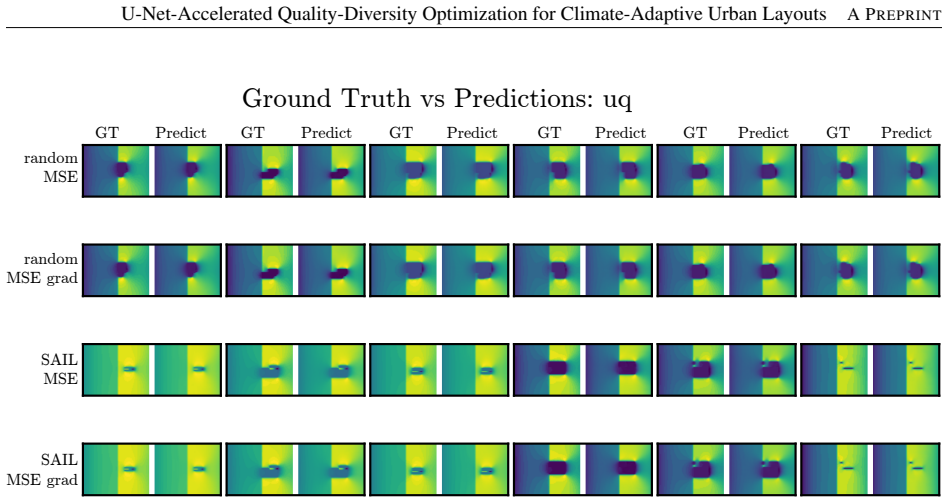
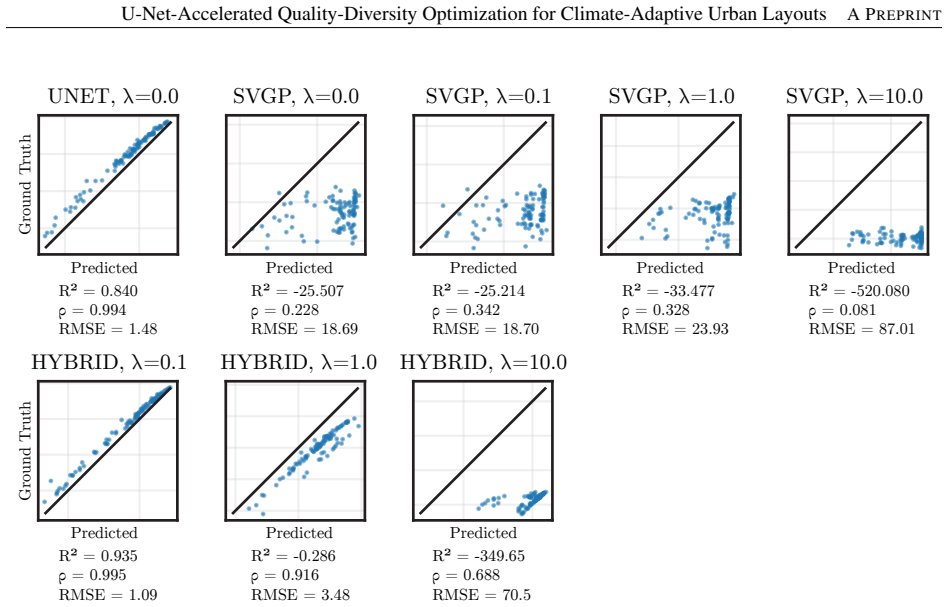
The spatial inductive bias of U-Nets lets them learn the underlying physics mapping for urban climate metrics with R² = 0.996 independent of training data source, enabling offline MAP-Elites to reach fitness rankings of ρ = 0.994 from one b
A machine-rendered reading of the paper's core claim, the machinery that carries it, and where it could break.
Core claim
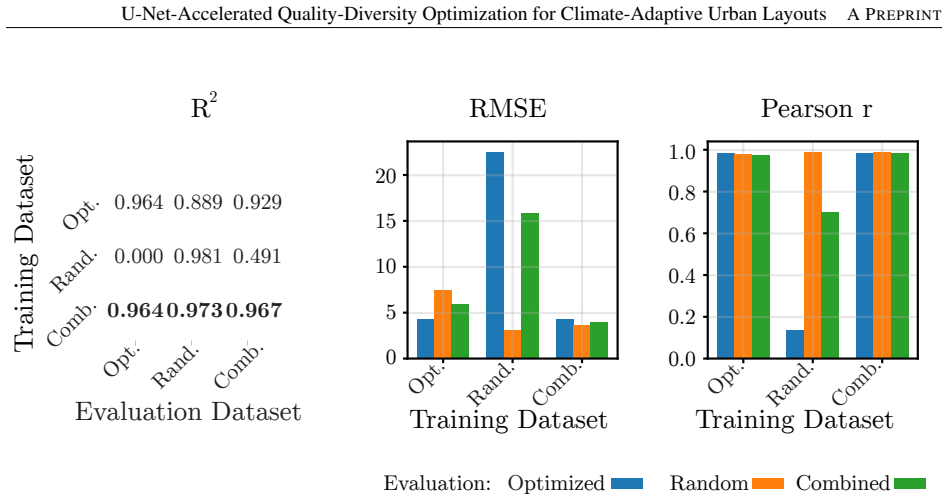
The U-Net surrogate learns the physics mapping robustly (R² = 0.996) completely independent of the training data source. This allows offline QD optimization to achieve highly accurate fitness rankings (ρ = 0.994) using only a one-time batch of random training samples, in contrast to GP surrogates that require actively generated QD archives to generalize.
What carries the argument
U-Net spatial deep-learning surrogate that maps layout grids to climate fitness values via convolutional inductive bias.
Load-bearing premise
That a U-Net trained on quasi-random Sobol samples will continue to produce accurate fitness rankings inside the MAP-Elites archive for the specific climate metrics without domain shift or degradation.
What would settle it
Evaluating the true physics simulator on the final MAP-Elites archive and measuring whether the Spearman rank correlation with U-Net predictions falls substantially below 0.994.
Figures

read the original abstract
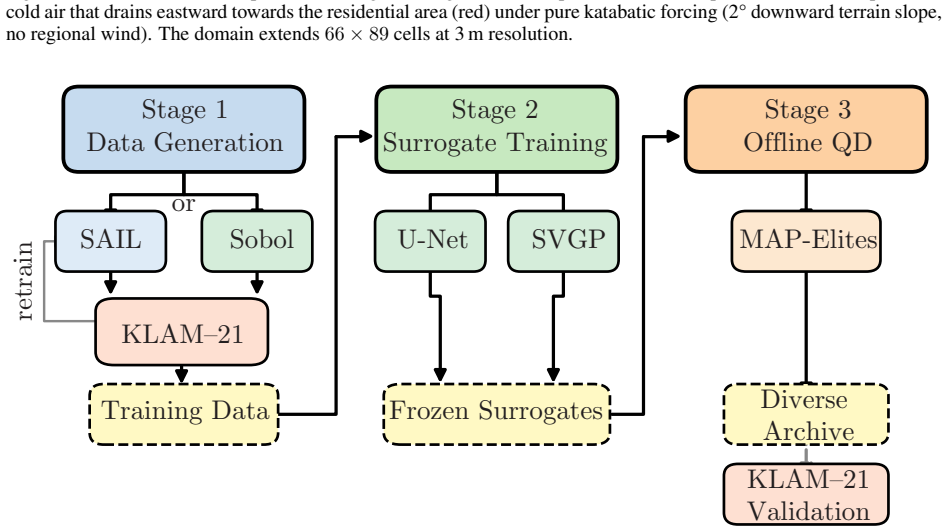
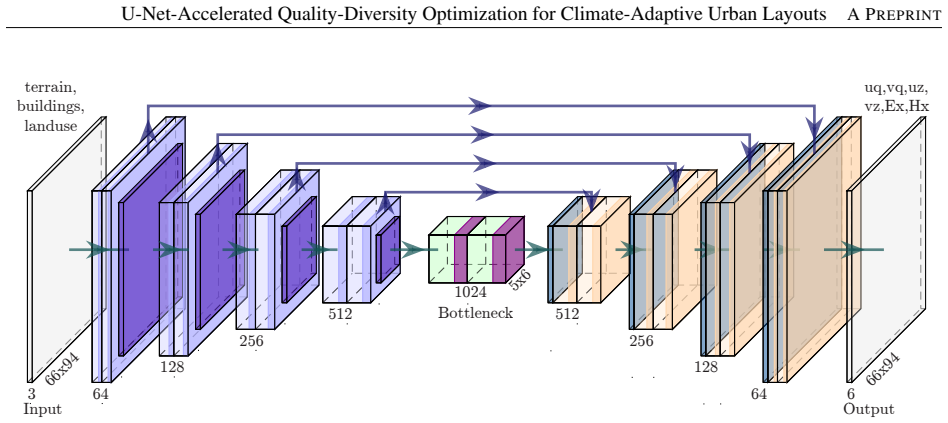
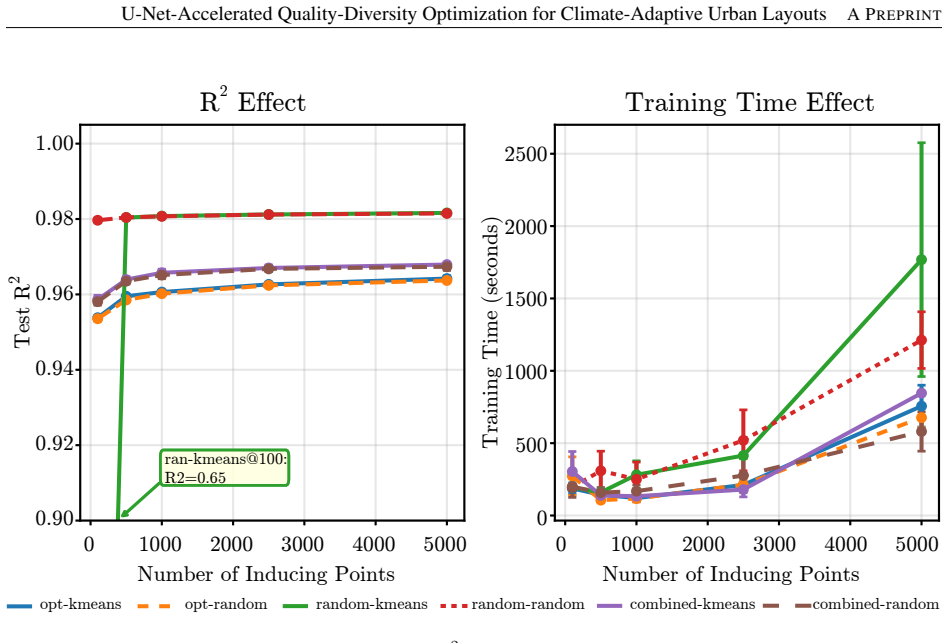
Optimizing urban layouts for climate adaptation requires balancing building density with cold-air ventilation. Because physics-based climate simulations are computationally expensive, planners typically evaluate fewer than ten manual designs. \gls{qd} algorithms offer a way to systematically illuminate the design space, but they require surrogate models to be practical. In this paper, we replace a slow, regulatory physics simulator with a spatial deep-learning surrogate (U-Net) inside an offline MAP-Elites loop. We systematically compare this spatial approach with a traditional \gls{gp} surrogate across different training-data strategies (quasi-random Sobol sampling vs.\ active \gls{qd} bootstrapping). Our results reveal that scalar \gls{gp} surrogates fail catastrophically when trained on random samples, requiring expensive, actively generated \gls{qd} archives to generalize. In contrast, the spatial inductive bias of the U-Net allows it to learn the underlying physics mapping robustly ($R^2 = 0.996$), completely independent of the training data source. This allows offline \gls{qd} optimization to achieve highly accurate fitness rankings ($\rho = 0.994$) using only a one-time batch of random training samples. The resulting pipeline, deployed in the open-source OpenSKIZZE tool, generates thousands of diverse, climate-evaluated building layouts in under ten minutes.
Editorial analysis
A structured set of objections, weighed in public.
Referee Report
Summary. The paper proposes replacing expensive regulatory physics simulators with a U-Net surrogate inside an offline MAP-Elites QD loop for optimizing urban layouts under climate-adaptation constraints (balancing density and cold-air ventilation). It claims that the U-Net's spatial inductive bias enables robust learning of the underlying physics mapping (R² = 0.996) from a single batch of quasi-random Sobol samples, independent of training-data source, yielding accurate fitness rankings (ρ = 0.994) inside the archive; by contrast, scalar GP surrogates fail on random samples and require active QD bootstrapping. The pipeline is deployed in the open-source OpenSKIZZE tool.
Significance. If the reported generalization holds, the work demonstrates a practical route to offline QD that generates thousands of diverse, climate-evaluated layouts in minutes rather than requiring repeated expensive simulations or active archive generation. The explicit GP contrast isolates the contribution of spatial bias and supplies falsifiable metrics (R² on physics mapping, ρ on archive rankings) that directly test the domain-shift risk for the climate metrics.
minor comments (3)
- [Abstract, §3] Abstract and §3: the reported R² = 0.996 and ρ = 0.994 are given without accompanying error bars, training-set sizes, or validation-split details; adding these (and the precise definition of the Sobol batch size) would strengthen the generalization claim.
- [§4.2] §4.2: the input representation of urban layouts to the U-Net (e.g., grid resolution, encoding of building heights and open spaces) is not fully specified; a diagram or pseudocode would clarify how the spatial structure is presented.
- [Results tables] Table 2 or equivalent results table: the GP baseline trained on Sobol samples should report the exact failure mode (e.g., rank correlation near zero) with the same number of training points used for the U-Net to make the contrast quantitative.
Simulated Author's Rebuttal
We thank the referee for the positive summary, significance assessment, and recommendation of minor revision. No specific major comments were raised in the report.
Circularity Check
No significant circularity in derivation chain
full rationale
The paper reports empirical performance metrics (R² = 0.996 for physics mapping, ρ = 0.994 for fitness rankings) obtained by training U-Net and GP surrogates on Sobol samples then evaluating generalization to MAP-Elites archives. These are direct experimental measurements on held-out data, not algebraic reductions or fitted parameters renamed as predictions. No equations, self-citations, or ansatzes are invoked that would make the central claims equivalent to their inputs by construction. The GP contrast serves as an external baseline isolating the contribution of spatial bias, leaving the results self-contained against the reported benchmarks.
Axiom & Free-Parameter Ledger
Reference graph
Works this paper leans on
-
[1]
Proc.\ IEEE Congress on Evolutionary Computation (CEC) , year =
Hagg, Alexander and Asteroth, Alexander and Reith, Dirk , title =. Proc.\ IEEE Congress on Evolutionary Computation (CEC) , year =
-
[2]
Illuminating search spaces by mapping elites
Mouret, Jean-Baptiste and Clune, Jeff , title =. arXiv preprint arXiv:1504.04909 , year =
work page internal anchor Pith review Pith/arXiv arXiv
-
[3]
pyribs: A Bare-Bones
Tjanaka, Bryon and Fontaine, Matthew C and Lee, David H and Zhang, Yulun and Balam, Nivedit Reddy and Dennler, Nathaniel and Garlanka, Sujay S and Klapsis, Nikitas Dimitri and Nikolaidis, Stefanos , booktitle =. pyribs: A Bare-Bones
-
[4]
IEEE Transactions on Evolutionary Computation , volume =
Vassiliades, Vassilis and Chatzilygeroudis, Konstantinos and Mouret, Jean-Baptiste , title =. IEEE Transactions on Evolutionary Computation , volume =
-
[5]
Proceedings of the Genetic and Evolutionary Computation Conference , pages =
Fontaine, Matthew C and Togelius, Julian and Nikolaidis, Stefanos and Hoover, Amy K , title =. Proceedings of the Genetic and Evolutionary Computation Conference , pages =
-
[6]
Advances in Neural Information Processing Systems , year =
Fontaine, Matthew C and Nikolaidis, Stefanos , title =. Advances in Neural Information Processing Systems , year =
-
[7]
Black Box Optimization, Machine Learning, and No-Free Lunch Theorems , pages =
Chatzilygeroudis, Konstantinos and Cully, Antoine and Vassiliades, Vassilis and Mouret, Jean-Baptiste , title =. Black Box Optimization, Machine Learning, and No-Free Lunch Theorems , pages =. 2021 , publisher =
2021
-
[8]
Evolutionary Computation , volume =
Data-Efficient Design Exploration through Surrogate-Assisted Illumination , author =. Evolutionary Computation , volume =
-
[9]
2020 IEEE/RSJ International Conference on Intelligent Robots and Systems (IROS) , pages=
Model-based quality-diversity search for efficient robot learning , author=. 2020 IEEE/RSJ International Conference on Intelligent Robots and Systems (IROS) , pages=. 2020 , organization=
2020
-
[10]
Medical Image Computing and Computer-Assisted Intervention (
Ronneberger, Olaf and Fischer, Philipp and Brox, Thomas , title =. Medical Image Computing and Computer-Assisted Intervention (. 2015 , pages =
2015
-
[11]
, title =
Isola, Phillip and Zhu, Jun-Yan and Zhou, Tinghui and Efros, Alexei A. , title =. Proceedings of the. 2017 , pages =
2017
-
[12]
Hensman, James and Matthews, Alexander G. de G. and Ghahramani, Zoubin , title =. Proceedings of the 18th International Conference on Artificial Intelligence and Statistics (. 2015 , pages =
2015
-
[13]
and Pleiss, Geoff and Weinberger, Kilian Q
Gardner, Jacob R. and Pleiss, Geoff and Weinberger, Kilian Q. and Bindel, David and Wilson, Andrew Gordon , title =. Advances in Neural Information Processing Systems (
-
[14]
Sievers, Uwe , year =. Das
-
[15]
Allegrini, Jonas and Dorer, Viktor and Carmeliet, Jan , journal =. Coupled. 2015 , publisher =
2015
-
[16]
Application of Climatic Guidelines to Urban Planning: The Example of
Alcoforado, Maria-Jo. Application of Climatic Guidelines to Urban Planning: The Example of. Landscape and Urban Planning , volume =. 2009 , publisher =
2009
-
[17]
uter, Bj\
Berchtold, Martin and Zwanzger, Sarah and B\"uter, Bj\"orn and Schneider, Melanie , title =
-
[18]
Kruse, Antje and M\"uller, Nicole and Raffalski, Niklas , title =
-
[19]
AIAA Journal , volume =
Thuerey, Nils and Weissenow, Konstantin and Prantl, Lukas and Hu, Xiangyu , title =. AIAA Journal , volume =
-
[20]
and Alieva, Ayya and Wang, Qing and Brenner, Michael P
Kochkov, Dmitrii and Smith, Jamie A. and Alieva, Ayya and Wang, Qing and Brenner, Michael P. and Hoyer, Stephan , title =. Proceedings of the National Academy of Sciences , volume =
-
[21]
Pathak, Jaideep and Subramanian, Shashank and Harrington, Peter and Raja, Sanjeev and Chattopadhyay, Ashesh and Mardani, Morteza and Kurth, Thorsten and Hall, David and Li, Zongyi and Azizzadenesheli, Kamyar and Hassanzadeh, Pedram and Kashinath, Karthik and Anandkumar, Animashree , title =. arXiv preprint arXiv:2202.11214 , year =
work page internal anchor Pith review Pith/arXiv arXiv
-
[22]
Urban Climate , volume =
Mortezazadeh, Mohammad and Zou, Jiwei and Hosseini, Mazdak and Yang, Siyuan and Wang, Liangzhu Leon , title =. Urban Climate , volume =
-
[23]
, title =
Papadopoulos, Stylianos and Azar, Elie and Woon, Wei Lee and Kontokosta, Constantine E. , title =. Journal of Building Performance Simulation , volume =
-
[24]
Building and Environment , year =
Zhang, Yuling and Rahmani, Aida and Soleimani, Sara and Schlueter, Arno , title =. Building and Environment , year =
-
[25]
International Conference on Parallel Problem Solving from Nature , pages=
Designing air flow with surrogate-assisted phenotypic niching , author=. International Conference on Parallel Problem Solving from Nature , pages=. 2020 , organization=
2020
-
[26]
Machine Learning and Knowledge Extraction , volume =
Full Domain Analysis in Fluid Dynamics , author =. Machine Learning and Knowledge Extraction , volume =. 2025 , publisher =
2025
-
[27]
and Hoover, Amy K
Zhang, Yulun and Fontaine, Matthew C. and Hoover, Amy K. and Togelius, Julian , title =. Proceedings of the Genetic and Evolutionary Computation Conference (. 2022 , publisher =
2022
-
[28]
and Nikolaidis, Stefanos , title =
Bhatt, Varun and Tjanaka, Bryon and Fontaine, Matthew C. and Nikolaidis, Stefanos , title =. Advances in Neural Information Processing Systems (
-
[29]
Bayesian Optimisation for Quality Diversity Search with Coupled Descriptor Functions , journal =
Kent, Paul and Gaier, Adam and Mouret, Jean-Baptiste and Branke, J. Bayesian Optimisation for Quality Diversity Search with Coupled Descriptor Functions , journal =
-
[30]
IEEE Transactions on Evolutionary Computation , volume =
Flageat, Manon and Cully, Antoine , title =. IEEE Transactions on Evolutionary Computation , volume =
-
[31]
Building and Environment , volume =
Wang, Haojie and Ma, Wentao and Niu, Jianlei and You, Rui , title =. Building and Environment , volume =. 2025 , publisher =
2025
-
[32]
Engineering Applications of Artificial Intelligence , volume =
Nowak, David and Werner, Julian and Parsons, Quentin and Johnson, Thomas , title =. Engineering Applications of Artificial Intelligence , volume =. 2024 , publisher =
2024
-
[33]
From Large-Eddy Simulations to Deep Learning: A
Vargiemezis, Theodosis and Gorl. From Large-Eddy Simulations to Deep Learning: A. Sustainable Cities and Society , volume =. 2025 , publisher =
2025
-
[34]
Adversarial Image-to-Image Model to Obtain Highly Detailed Wind Fields from Mesoscale Simulations in Urban Environments , journal =
Milla-Val, Jes. Adversarial Image-to-Image Model to Obtain Highly Detailed Wind Fields from Mesoscale Simulations in Urban Environments , journal =. 2024 , publisher =
2024
-
[35]
Machine learning , volume=
Random forests , author=. Machine learning , volume=. 2001 , publisher=
2001
-
[36]
2006 , publisher=
Gaussian processes for machine learning , author=. 2006 , publisher=
2006
-
[37]
A Statistical Approach to Some Mine Valuation and Allied Problems on the Witwatersrand , author=
discussion (0)
Sign in with ORCID, Apple, or X to comment. Anyone can read and Pith papers without signing in.