Fitting scattered data with optional monotonicity constraints on GPU: LipFit package
Pith reviewed 2026-06-28 05:11 UTC · model grok-4.3
The pith
A construction using tight upper and lower bounds yields optimal Lipschitz-continuous fits to scattered data that respect monotonicity constraints.
A machine-rendered reading of the paper's core claim, the machinery that carries it, and where it could break.
Core claim
The paper establishes that optimal Lipschitz-continuous approximations subject to monotonicity constraints can be obtained directly from tight upper and lower bounding functions on the scattered data points, and that these bounds can be found so that the resulting envelope remains continuous and optimal without any parametric fitting step.
What carries the argument
Tight upper and lower approximations to the data that satisfy the Lipschitz condition and monotonicity constraints simultaneously; their construction supplies the optimal fit as an instance-based method.
If this is right
- The method extends to local Lipschitz interpolation at chosen points.
- Lipschitz smoothing becomes available by allowing controlled relaxation of the bounds.
- Computation proceeds without a training phase and maps directly to GPU parallel execution.
- The approximation remains optimal in the Lipschitz sense while enforcing the shape constraints.
Where Pith is reading between the lines
- Such bounds may allow efficient handling of very large point clouds where grid-based methods become prohibitive.
- The same bounding technique could be tested on problems requiring other shape constraints beyond monotonicity.
- Parallel GPU implementation suggests scalability tests on datasets with millions of points to measure runtime gains.
Load-bearing premise
Scattered data points allow the construction of upper and lower bounds that satisfy the Lipschitz condition and monotonicity constraints everywhere without introducing discontinuities or sacrificing optimality.
What would settle it
Find a set of points and monotonicity constraints where the envelope from the constructed upper and lower bounds either violates the Lipschitz condition, fails to respect monotonicity, or is not the tightest possible continuous fit.
Figures
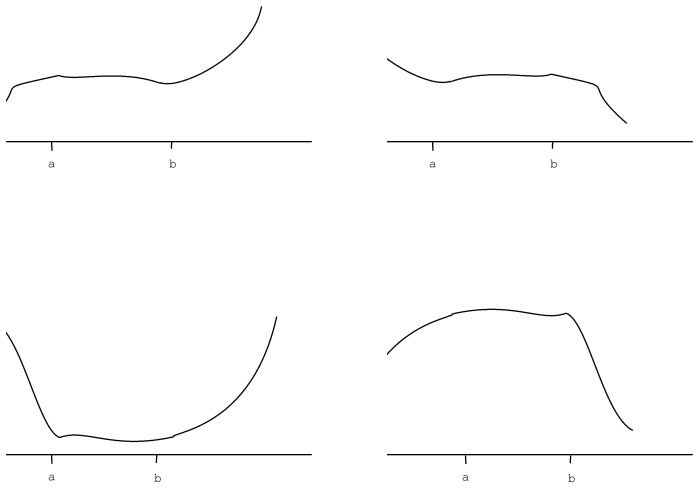
read the original abstract
This paper presents a method of multivariate scattered data interpolation and approximation that produces optimal Lipschitz-continuous approximation, subject to the desired monotonicity constraints. This method relies on tight upper and lower approximations to the data, and is similar in its spirit to the nearest-neighbour approximation but does not suffer from discontinuities. Local Lipschitz interpolation and Lipschitz smoothing are also presented. This approach falls under the umbrella of instance-based approximation with no training phase, and it is suitable for GPU-based parallelisation. A Python GPU-friendly package LipFit which implements the methods discussed is discussed.
Editorial analysis
A structured set of objections, weighed in public.
Referee Report
Summary. The manuscript presents a method for multivariate scattered data interpolation and approximation that produces optimal Lipschitz-continuous approximations subject to optional monotonicity constraints. It relies on constructing tight upper and lower bounds to the data (instance-based, nearest-neighbor-like but continuous), includes local Lipschitz interpolation and smoothing, and is implemented in the GPU-friendly Python package LipFit with no training phase.
Significance. If the optimality and continuity claims are substantiated, the work offers a practical, parallelizable approach to constrained approximation that could be valuable in scientific computing applications requiring Lipschitz continuity or monotonicity. The GPU implementation and package availability are concrete strengths for reproducibility and usability.
major comments (2)
- [Abstract] Abstract: the central claim that the method 'produces optimal Lipschitz-continuous approximation' is asserted without any derivation, error analysis, or validation details; the manuscript must supply a formal argument showing why the upper/lower bound construction simultaneously achieves tightness, Lipschitz continuity, and constraint satisfaction.
- [Method] Method section (bound construction): the assumption that tight upper and lower bounds can be built to satisfy both the Lipschitz condition and monotonicity constraints without introducing discontinuities or losing optimality is load-bearing but lacks explicit algorithmic steps, pseudocode, or a proof sketch demonstrating that the resulting approximant is continuous and optimal.
minor comments (2)
- [Abstract] The abstract and introduction should clarify the precise definition of 'optimality' (e.g., minimal max-norm deviation or pointwise tightest bounds) and cite related work on Lipschitz interpolation.
- [Implementation] Figure captions and package documentation should include timing benchmarks or scaling results on GPU to support the parallelization claim.
Simulated Author's Rebuttal
We thank the referee for their careful reading and constructive comments on our manuscript. The points raised correctly identify areas where additional formal justification would strengthen the presentation. We respond to each major comment below and commit to revisions that address the concerns without misrepresenting the current content.
read point-by-point responses
-
Referee: [Abstract] Abstract: the central claim that the method 'produces optimal Lipschitz-continuous approximation' is asserted without any derivation, error analysis, or validation details; the manuscript must supply a formal argument showing why the upper/lower bound construction simultaneously achieves tightness, Lipschitz continuity, and constraint satisfaction.
Authors: We agree that the abstract asserts the optimality claim without sufficient supporting argument. In the revised manuscript we will add a concise formal justification immediately following the claim in the abstract and expand it in a new subsection of the Methods. The upper (resp. lower) bound at a query point x is constructed as the pointwise infimum (supremum) over the family of all L-Lipschitz functions that pass through the data points, lie above (below) the observed values, and respect the monotonicity constraints. Tightness follows by definition because the bound is the greatest lower (least upper) envelope. Lipschitz continuity of each bound is inherited from the fact that the pointwise infimum of a family of L-Lipschitz functions remains L-Lipschitz. Monotonicity is preserved by restricting the admissible function class. The resulting approximant (midpoint of the bounds) is therefore feasible, continuous, and optimal in the sense that no tighter feasible Lipschitz function exists. A short proof sketch and a numerical validation example will be supplied. revision: yes
-
Referee: [Method] Method section (bound construction): the assumption that tight upper and lower bounds can be built to satisfy both the Lipschitz condition and monotonicity constraints without introducing discontinuities or losing optimality is load-bearing but lacks explicit algorithmic steps, pseudocode, or a proof sketch demonstrating that the resulting approximant is continuous and optimal.
Authors: We accept that the current manuscript presents the bound construction at a high level and omits algorithmic detail. We will insert explicit pseudocode for the GPU-parallel bound evaluation routine, which computes, for each query location, the tightest admissible upper and lower values by taking the minimum (maximum) of per-data-point Lipschitz cones clipped by the monotonicity half-spaces. Continuity follows because each per-point cone is continuous and the pointwise minimum/maximum of finitely many continuous functions is continuous; the final approximant is therefore continuous. Optimality (tightness) is immediate from the envelope definition. A compact proof sketch establishing these properties will be added to the Methods section together with the pseudocode. revision: yes
Circularity Check
No significant circularity
full rationale
The paper presents an instance-based method for producing optimal Lipschitz-continuous approximations to scattered data, optionally subject to monotonicity constraints, via construction of tight upper and lower bounds. No equations, fitting procedures, or derivation steps are described that reduce the optimality claim or any prediction to a self-referential definition, a fitted input renamed as output, or a load-bearing self-citation chain. The approach is explicitly instance-based with no training phase, and the central claim follows directly from the bound-construction process without internal reduction to inputs. This matches the default expectation for non-circular papers in the field.
Axiom & Free-Parameter Ledger
Reference graph
Works this paper leans on
-
[1]
P. Alfeld. Scattered data interpolation in three or more variables. In L. Schumaker and T. Lyche, editors,Mathematical Methods in Computer Aided Geometric Design, pages 1–34. Academic Press, New York, 1989
1989
-
[2]
Beatson and Z
R. Beatson and Z. Ziegler. Monotonicity preserving surface inter- polation.SIAM J. Numer. Anal., 22:401–411, 1985
1985
-
[3]
Beliakov
G. Beliakov. Shape preserving approximation using least squares splines.Approximation Theory and Applications, 16:80–98, 2000
2000
-
[4]
Beliakov
G. Beliakov. Monotone approximation of aggregation operators using least squares splines.International Journal of Uncertainty, Fuzziness and Knowledge-Based Systems, 10:659–676, 2002
2002
-
[5]
Beliakov
G. Beliakov. Monotonicity preserving approximation of multivari- ate scattered data.BIT, 45:653–677, 2005
2005
-
[6]
InterpolationofLipschitzfunctions.Journal of Com- putational and Applied Mathematics, 196:20–44, 2006
G.Beliakov. InterpolationofLipschitzfunctions.Journal of Com- putational and Applied Mathematics, 196:20–44, 2006
2006
-
[7]
Beliakov
G. Beliakov. Smoothing Lipschitz functions.Optim. Methods Softw., 22(6):901–916, Dec. 2007
2007
-
[8]
Beliakov, A
G. Beliakov, A. Pradera, and T. Calvo.Aggregation Functions: A Guide for Practitioners. Springer, Berlin, Heidelberg, 2007
2007
-
[9]
Carlson and F
R. Carlson and F. Fritsch. Monotone piecewise bicubic interpo- lation.SIAM J. Numer. Anal., 22:386–400, 1985
1985
-
[10]
Cherkassky and F
V. Cherkassky and F. Mulier.Learning from Data. Wiley, New York, 1998
1998
-
[11]
Costantini and F
P. Costantini and F. Fontanella. Shape-preserving bivariate in- terpolation.SIAM J. Numer. Anal., 22:488–506, 1985
1985
-
[12]
Costantini and C
P. Costantini and C. Manni. A bicubic shape-preserving blending scheme.Computer Aided Geometric Design, 13:307–331, 1996
1996
-
[13]
Costantini and C
P. Costantini and C. Manni. Comonotone parametric C1 inter- polation of nongridded data.J. Comp. Appl. Math., 75:147–169, 1996
1996
-
[14]
Costantini and C
P. Costantini and C. Manni. Monotonicity-preserving interpo- lation of nongridded data.Computer Aided Geometric Design, 13:467–497, 1996. 16
1996
-
[15]
Costantini and C
P. Costantini and C. Manni. On a class of polynomial triangular macro-elements.J. Comp. Appl. Math., 1996:45–64, 1996
1996
-
[16]
Costantini and C
P. Costantini and C. Manni. A local shape-preserving interpola- tion scheme for scattered data.Computer Aided Geometric De- sign, 16:385–405, 1999
1999
-
[17]
Hall and L
P. Hall and L. Huang. Nonparametric kernel regression subject to monotonicity constraints.Ann. Statist., 29:624–647, 2001
2001
-
[18]
Han and L
L. Han and L. Schumaker. Fitting monotone surfaces to scattered data using C1 piecewise cubics.SIAM J. Numer. Anal., 34:569– 585, 1997
1997
-
[19]
Hastie, R
T. Hastie, R. Tibshirani, and J. Friedman.The Elements of Sta- tistical Learning. Springer-Verlag, New York, Berlin, Heidelberg, 2001
2001
-
[20]
Hutchison, A
J. Hutchison, A. Lo, and T. Poggio. A nonparametric approach to pricing and hedging derivative securities via learning networks. J. of Finance, 49:851–889, 1994
1994
- [21]
-
[22]
K. A. Kopotun, D. Leviatan, and I. A. Shevchuk. Uniform and pointwise shape preserving approximation (SPA) by alge- braic polynomials: an update.The SMAI Journal of computa- tional mathematics, S5:99–108, 2019. URL:https://smai-jcm. centre-mersenne.org/articles/10.5802/smai-jcm.54/,doi: 10.5802/smai-jcm.54
-
[23]
Koutenský, P
F. Koutenský, P. Šimánek, M. Čepek, and A. Kovalenko. Over- coming long inference time of nearest neighbors analysis in regres- sion and uncertainty prediction.SN Computer Science, 5(486), 2024
2024
-
[25]
A. Kravberg, G. L. Marchetti, V. Polianskii, A. Varava, F. T. Pokorny, and D. Kragic. Active nearest neighbor regression through delaunay refinement, 2022.arXiv:2206.08061
-
[26]
R. J. Kunsch. The difficulty of Monte Carlo approximation of multivariate monotone functions.Journal of Approximation The- ory, 241:33–56, 2019.doi:j.jat.2019.01.003. 17
2019
- [27]
-
[28]
Polo-Molina, D
A. Polo-Molina, D. Alfaya, and J. Portela. Monokan: Certified monotonic kolmogorov-arnold network, 2024. v2.arXiv:2409. 11078
2024
-
[29]
J. Schmid. Approximation, characterization, and continu- ity of multivariate monotonic regression functions.Analy- sis and Applications, 20(04):737–775, 2022.doi:10.1142/ S0219530521500299
2022
-
[30]
A. Sharma and H. Wehrheim. Testing monotonicity of machine learning models, 2020.arXiv:2002.12278
-
[31]
R. Sibson. A brief description of natural neighbor interpolation. In V. Barnett, editor,Interpreting Multivariate Data, pages 21–
-
[32]
John Wiley, Chichester, 1981
1981
-
[33]
P. Srisuradetchai and K. Suksrikran. Random kernel k-nearest neighbors regression.Frontiers in Big Data, Volume 7 - 2024, 2024.doi:10.3389/fdata.2024.1402384
-
[34]
K. Takatsu, T. Zhang, and A. K. Kuchibhotla. From isotonic to Lipschitz regression: A new interpolative perspective on shape- restricted estimation, 2026.arXiv:2307.05732
work page internal anchor Pith review Pith/arXiv arXiv 2026
-
[35]
Traub and H
J. Traub and H. Wozniakowski.A General Theory of Optimal Algorithms. Academic Press, New York, 1980
1980
-
[36]
Utreras and M
F. Utreras and M. Varas. Monotone interpolation of scattered data inR s.Constr. Approx., 7:49–68, 1991
1991
- [37]
-
[38]
Willemans and P
K. Willemans and P. Dierckx. Smoothing scattered data with a monotone Powell-Sabin spline surface.Numerical Algorithms, 12:215–232, 1996
1996
-
[39]
J. Zhao, H. Zhang, Y. Wang, Y. Zhai, and Y. Yang. Deep isotonic embedding network: A flexible monotonic neural network.Neural Networks, 171:457–465, 2024.doi:j.neunet.2023.12.026. 18
2024
discussion (0)
Sign in with ORCID, Apple, or X to comment. Anyone can read and Pith papers without signing in.