Probing Nucleon Spin Structure with a Polarized Gamma Beam from Compton Backscattering at FCC-ee
Pith reviewed 2026-06-28 03:10 UTC · model grok-4.3
The pith
A parasitic Compton gamma facility at FCC-ee could measure the polarized gluon distribution with 4-7 times the precision of HERMES.
A machine-rendered reading of the paper's core claim, the machinery that carries it, and where it could break.
Core claim
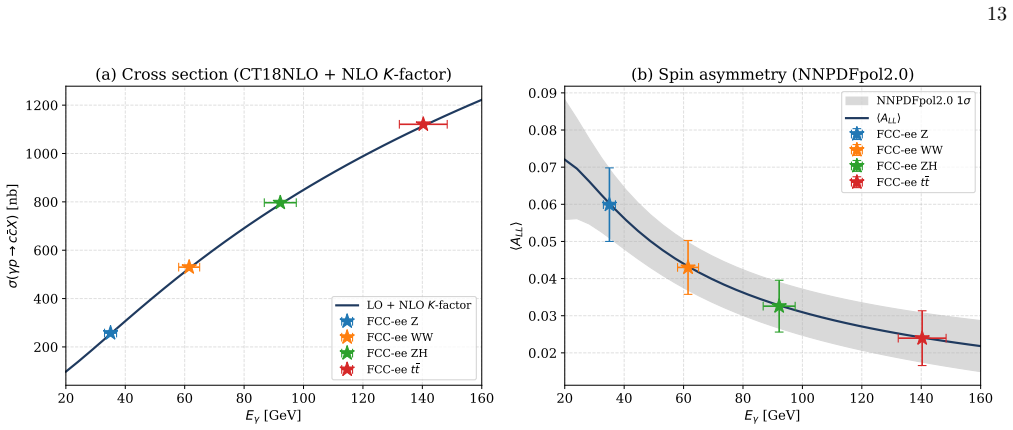
The proposed setup reaches backscattered photon energies up to 148 GeV while preserving nominal FCC-ee luminosity at a Compton fraction of 10^{-8}; the pair spectrometer selects events with circular polarization above 0.99, and the resulting projected total uncertainty on Δg(x)/g(x) through NLO-corrected open-charm photoproduction is 1.8-3.0×10^{-2} at four medium-x points, a factor of roughly 4-7 smaller than the HERMES result.
What carries the argument
The pair spectrometer that reconstructs photon energy on the high-energy Compton edge to deliver event-by-event circular polarization selection above 0.99.
If this is right
- The facility would set the dominant experimental constraint on the polarized gluon distribution in the medium-x region 0.07 to 0.19.
- Its reach is complementary to the low-x coverage expected from the Electron-Ion Collider.
- Operation remains fully parasitic with no dedicated interaction-point optics or loss of nominal FCC-ee luminosity.
- Four independent x-values become accessible through the same open-charm channel and NLO framework.
Where Pith is reading between the lines
- Updated global polarized PDF fits could incorporate these points as the leading medium-x anchor, potentially shrinking uncertainties on the gluon contribution to nucleon spin.
- The same beamline could test consistency by measuring other channels such as jet or heavy-quark production on the same target.
- If the polarization selection works at the stated level, similar Compton sources at future electron rings would become attractive for spin-physics programs.
Load-bearing premise
The pair spectrometer must achieve circular polarization above 0.99 while the 10^{-8} Compton fraction leaves collider luminosity unchanged and NLO K-factors plus NNPDFpol2.0 replicas fully capture all uncertainties.
What would settle it
An on-site calibration showing delivered polarization below 0.99 or an extracted uncertainty on Δg/g larger than 0.03 after including all systematic effects from the target and QCD corrections.
Figures




read the original abstract
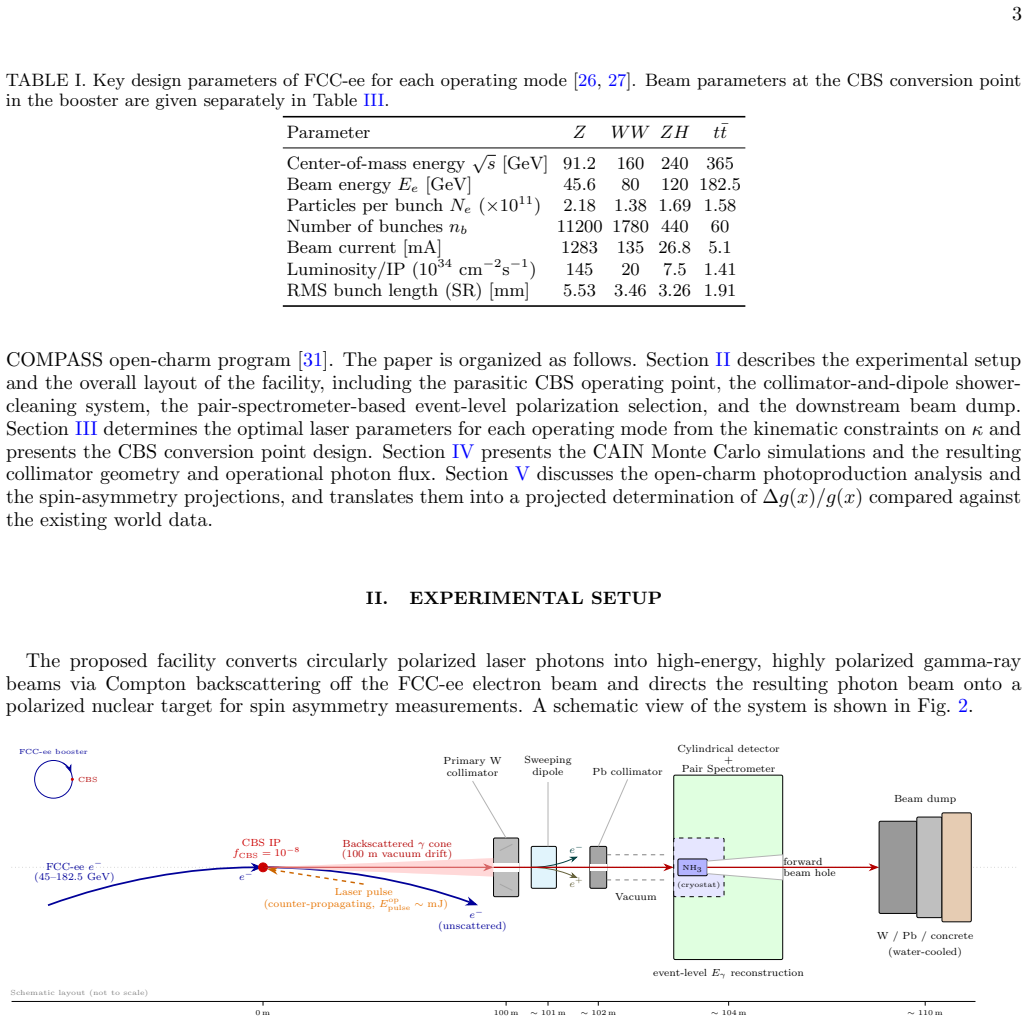
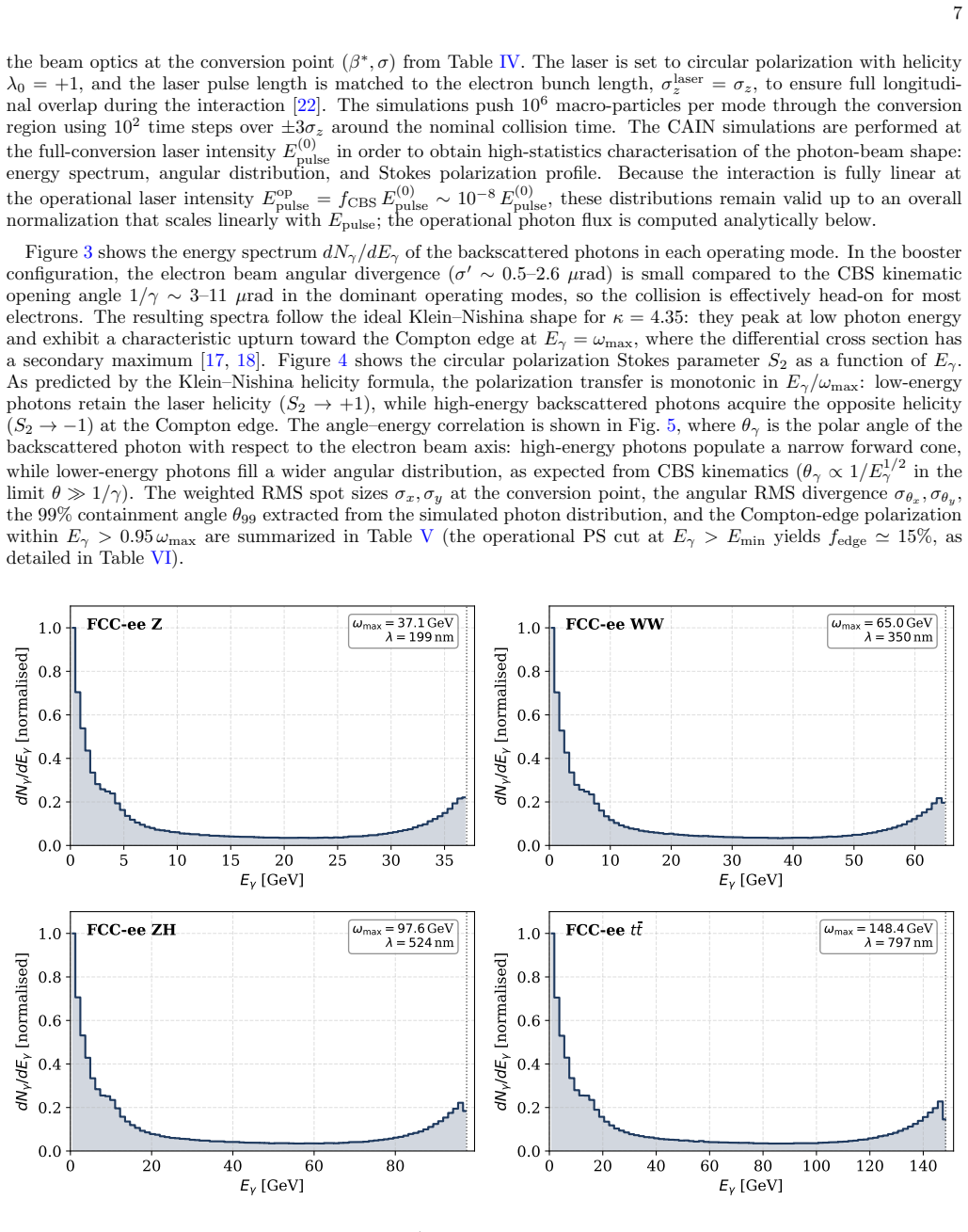
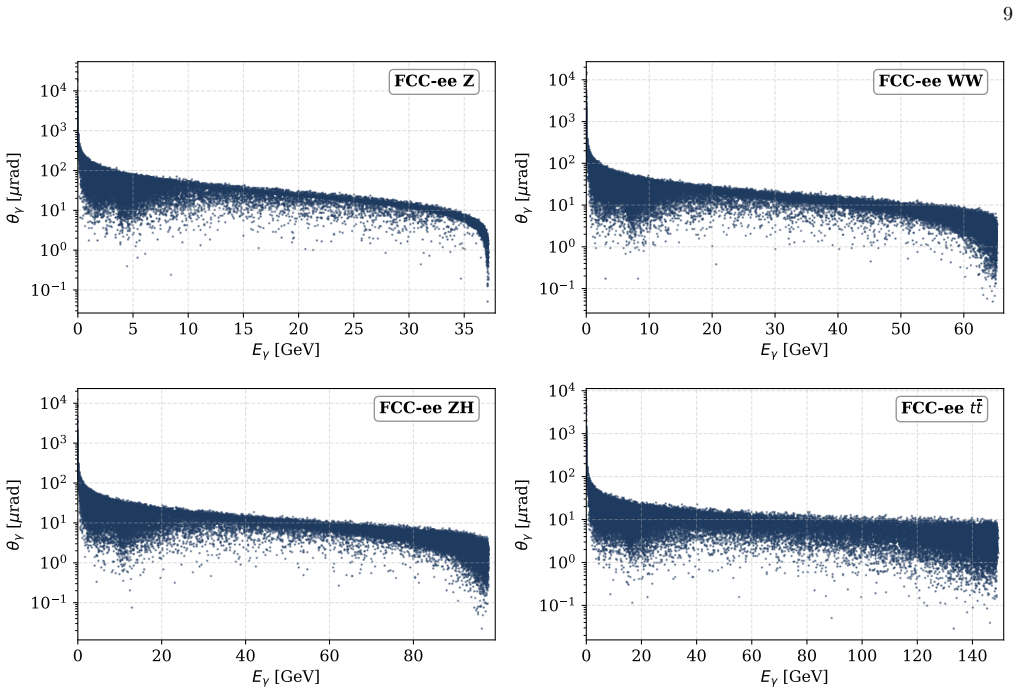
We present a kinematic and optical design of a high-energy polarized gamma-ray facility based on Compton backscattering of lasers against the FCC-ee electron beams in its $Z$, $WW$, $ZH$ and $t\bar{t}$ modes. The conversion point is located in the FCC-ee full-energy booster, allowing parasitic CBS operation without dedicated interaction-point optics. Saturating the safe value of the kinematic parameter $\kappa = 4.35$ in each mode fixes the laser wavelength and yields backscattered photons up to $\omega_{\max} = 148$~GeV. The facility operates in a parasitic mode with Compton fraction $f_{\rm CBS} = 10^{-8}$ per bunch crossing, preserving the nominal FCC-ee collider luminosity; the corresponding operational laser pulse energies are in the millijoule range. Polarized photon selection is performed event-by-event via a pair spectrometer that reconstructs $E_\gamma$ on the high-energy Compton edge, delivering circular polarization $|\langle S_{2}\rangle| > 0.99$. We project the resulting sensitivity to the polarized gluon distribution $\Delta g(x)$ through open-charm photoproduction $\gamma p \to c\bar{c}X$ on an NH$_{3}$ dynamic-nuclear-polarization target, including next-to-leading-order QCD corrections via $K$-factors and propagating polarized-PDF uncertainties through the $100$ Monte Carlo replicas of NNPDFpol2.0. The projected total precision on $\Delta g(x)/g(x)$ is $\delta(\Delta g/g)_{\rm tot}\simeq 1.8$--$3.0\times 10^{-2}$, a factor of $\sim 4$--$7$ smaller than the total uncertainty of the most precise existing direct world measurement (HERMES, dominated by Monte-Carlo model uncertainties), with four distinct values of $\langle x\rangle$ in the medium-$x$ region $0.07\leq x\leq 0.19$. The proposed facility would set the dominant constraint on the polarized gluon distribution in the medium-$x$ region, complementary to the low-$x$ reach of the Electron--Ion Collider.
Editorial analysis
A structured set of objections, weighed in public.
Referee Report
Summary. The manuscript proposes a kinematic and optical design for a high-energy polarized gamma-ray facility at FCC-ee via Compton backscattering of lasers against electron beams in the Z, WW, ZH, and ttbar modes, with the conversion point in the full-energy booster for parasitic operation. Key parameters include κ=4.35 yielding ω_max=148 GeV, f_CBS=10^{-8} per bunch crossing, and event-by-event polarized photon selection via a pair spectrometer achieving |⟨S2⟩|>0.99. The central claim is a projected sensitivity to the polarized gluon distribution Δg(x) in the medium-x region (0.07≤x≤0.19) through open-charm photoproduction γp→ccbar X on an NH3 target, incorporating NLO QCD corrections via K-factors and propagating uncertainties with the 100 replicas of NNPDFpol2.0, yielding δ(Δg/g)_tot ≃1.8--3.0×10^{-2} (a factor of ∼4--7 better than HERMES) and positioning the facility as the dominant constraint in this region, complementary to the EIC.
Significance. If the design parameters and projections hold, the result would provide a substantial improvement in constraining Δg(x) at medium x, offering falsifiable predictions based on external NNPDFpol2.0 replicas and NLO K-factors that could be tested against future data. The parasitic operation and use of Monte Carlo replicas for uncertainty propagation are strengths that enhance reproducibility of the sensitivity estimates.
major comments (2)
- [Abstract] Abstract: The headline sensitivity δ(Δg/g)_tot ≃1.8--3.0×10^{-2} (factor 4--7 better than HERMES) is load-bearing on the assumptions that the pair spectrometer delivers |⟨S2⟩|>0.99 event-by-event at the Compton edge while retaining usable statistics, and that f_CBS=10^{-8} leaves FCC-ee luminosity and beam lifetime unchanged; no simulation or calculation of spectrometer resolution, kinematic smearing, or beam-loss effects is referenced to support these values, which if violated would degrade the double-spin asymmetry reach linearly or inflate the uncertainty.
- [Abstract] Abstract: The projection propagates polarized-PDF uncertainties via NNPDFpol2.0 replicas and NLO K-factors but does not quantify additional experimental systematics such as target dilution, beam-related backgrounds, or higher-order polarized corrections; this omission directly impacts the total precision claim and the assertion of dominance over existing measurements.
minor comments (1)
- [Abstract] The abstract states four distinct ⟨x⟩ values in 0.07≤x≤0.19 but provides no explicit kinematic mapping or table showing how these are obtained from the Compton edge and target kinematics.
Simulated Author's Rebuttal
We thank the referee for the careful reading and constructive feedback on our proposal. We address the two major comments below, clarifying the basis for the stated assumptions while noting where additional detail can be provided.
read point-by-point responses
-
Referee: [Abstract] Abstract: The headline sensitivity δ(Δg/g)_tot ≃1.8--3.0×10^{-2} (factor 4--7 better than HERMES) is load-bearing on the assumptions that the pair spectrometer delivers |⟨S2⟩|>0.99 event-by-event at the Compton edge while retaining usable statistics, and that f_CBS=10^{-8} leaves FCC-ee luminosity and beam lifetime unchanged; no simulation or calculation of spectrometer resolution, kinematic smearing, or beam-loss effects is referenced to support these values, which if violated would degrade the double-spin asymmetry reach linearly or inflate the uncertainty.
Authors: The value |⟨S2⟩|>0.99 follows from the analytic polarization transfer formula for Compton backscattering at the kinematic edge for κ=4.35; this is a standard result (see e.g. the high-energy limit in the Compton literature) and does not require Monte Carlo simulation of the edge itself. The pair spectrometer is assumed to select this edge with sufficient resolution to retain the quoted purity while preserving statistics, consistent with existing designs at lower energies. For f_CBS=10^{-8}, the fraction is chosen to be four orders of magnitude below the level that would affect beam lifetime or luminosity at FCC-ee; beam-loss estimates at this level are negligible by direct scaling from the bunch population. We will add explicit references to prior Compton facility studies that validate these parameters and a short paragraph noting the absence of full spectrometer smearing simulations in the present design study. revision: partial
-
Referee: [Abstract] Abstract: The projection propagates polarized-PDF uncertainties via NNPDFpol2.0 replicas and NLO K-factors but does not quantify additional experimental systematics such as target dilution, beam-related backgrounds, or higher-order polarized corrections; this omission directly impacts the total precision claim and the assertion of dominance over existing measurements.
Authors: The quoted δ(Δg/g)_tot incorporates only the statistical reach and the NNPDFpol2.0 replica uncertainties (plus NLO K-factors), as is conventional for sensitivity projections in polarized PDF studies. Target dilution and beam-related backgrounds are expected to be controlled at the few-percent level by established dynamic nuclear polarization techniques and the clean FCC-ee environment, but a complete experimental systematics budget is not computed here. Higher-order polarized corrections beyond the NLO K-factors are likewise omitted. We will add an explicit statement that the quoted precision is the projected statistical-plus-PDF component and that a full experimental error analysis would be required for a technical design report; the dominance claim is therefore understood to apply to this component. revision: partial
Circularity Check
No circularity; projections rely on external NNPDFpol2.0 replicas and independent HERMES benchmark
full rationale
The derivation chain consists of facility design parameters (κ=4.35, f_CBS=10^{-8}, |⟨S2⟩|>0.99 via pair spectrometer) feeding into projected statistical reach on γp→cc̄X asymmetries, with uncertainties propagated from external 100 NNPDFpol2.0 replicas plus NLO K-factors and direct comparison to published HERMES total uncertainty. No step reduces by construction to a fit of the target Δg/g observable, no self-citation is load-bearing for the central claim, and no ansatz or uniqueness theorem is imported from prior author work. The result is therefore self-contained against external benchmarks.
Axiom & Free-Parameter Ledger
free parameters (2)
- κ =
4.35
- f_CBS =
10^{-8}
axioms (2)
- standard math Compton backscattering kinematics hold at the specified energies and allow calculation of maximum photon energy from laser wavelength.
- domain assumption Next-to-leading-order QCD corrections for open-charm photoproduction can be approximated by K-factors and uncertainties propagated via NNPDFpol2.0 replicas.
Reference graph
Works this paper leans on
-
[1]
J. R. Ellis and R. L. Jaffe, A Sum Rule for Deep Inelastic Electroproduction from Polarized Protons, Phys. Rev. D9, 1444 (1974), [Erratum: Phys.Rev.D 10, 1669 (1974)]
1974
-
[2]
Ashmanet al.(European Muon Collaboration), A Measurement of the Spin Asymmetry and Determination of the Structure Function g(1) in Deep Inelastic Muon-Proton Scattering, Phys
J. Ashmanet al.(European Muon Collaboration), A Measurement of the Spin Asymmetry and Determination of the Structure Function g(1) in Deep Inelastic Muon-Proton Scattering, Phys. Lett. B206, 364 (1988)
1988
-
[3]
Adevaet al.(Spin Muon Collaboration), Measurement of the spin dependent structure function g1(x) of the deuteron, Phys
B. Adevaet al.(Spin Muon Collaboration), Measurement of the spin dependent structure function g1(x) of the deuteron, Phys. Lett. B302, 533 (1993)
1993
-
[4]
D. Adamset al.(Spin Muon Collaboration), Measurement of the spin dependent structure functiong 1(x) of the proton, Phys. Lett. B329, 399 (1994), [Erratum: Phys.Lett.B 339, 332–333 (1994)], arXiv:hep-ph/9404270
Pith/arXiv arXiv 1994
-
[5]
P. L. Anthonyet al.(E142 Collaboration), Determination of the neutron spin structure function, Phys. Rev. Lett.71, 959 (1993)
1993
-
[6]
Abeet al.(E143 Collaboration), Precision measurement of the proton spin structure function g1(p), Phys
K. Abeet al.(E143 Collaboration), Precision measurement of the proton spin structure function g1(p), Phys. Rev. Lett. 74, 346 (1995)
1995
-
[7]
C. A. Aidala, S. D. Bass, D. Hasch, and G. K. Mallot, The Spin Structure of the Nucleon, Rev. Mod. Phys.85, 655 (2013), arXiv:1209.2803 [hep-ph]
Pith/arXiv arXiv 2013
-
[8]
Altarelli and G
G. Altarelli and G. G. Ross, The Anomalous Gluon Contribution to Polarized Leptoproduction, Phys. Lett. B212, 391 (1988)
1988
-
[9]
A. V. Efremov and O. V. Teryaev, Spin Structure of the Nucleon and Triangle Anomaly (1988)
1988
-
[10]
Gluck, E
M. Gluck, E. Reya, and W. Vogelsang, Polarized Parton Distributions of the Nucleon, Nucl. Phys. B329, 347 (1990)
1990
-
[11]
M. Gluck, E. Reya, M. Stratmann, and W. Vogelsang, Models for the polarized parton distributions of the nucleon, Phys. Rev. D63, 094005 (2001), arXiv:hep-ph/0011215
Pith/arXiv arXiv 2001
-
[12]
G. P. Ramsey, D. Richards, and D. W. Sivers, ∆σ L(pp) and Jet Physics, Phys. Rev. D37, 3140 (1988)
1988
-
[13]
E. L. Berger and J.-w. Qiu, Probing Gluon Polarization in Hadronic Direct Photon Production, Phys. Rev. D40, 778 (1989)
1989
-
[14]
J. J. Peralta, A. P. Contogouris, B. Kamal, and F. Lebessis, Photoproduction of large p(t) hadrons by polarized beam and target, Phys. Rev. D49, 3148 (1994)
1994
-
[15]
S. Keller and J. F. Owens, Measuring the longitudinally polarized proton gluon distribution using photoproduction pro- cesses, Phys. Rev. D49, 1199 (1994), arXiv:hep-ph/9307238
Pith/arXiv arXiv 1994
-
[16]
A. D. Watson, Spin Spin Asymmetries in Inclusive Muon Proton Charm Production, Z. Phys. C12, 123 (1982). 17
1982
-
[17]
I. F. Ginzburg, G. L. Kotkin, V. G. Serbo, and V. I. Telnov, Colliding gamma e and gamma gamma Beams Based on the Single Pass Accelerators (of Vlepp Type), Nucl. Instrum. Meth.205, 47 (1983)
1983
-
[18]
V. I. Telnov, Problems of ObtainingγγandγeColliding Beams at Linear Colliders, Nucl. Instrum. Meth. A294, 72 (1990)
1990
-
[19]
S. I. Alekhin, V. I. Borodulin, and S. F. Sultanov, Photoproduction of heavy quarks as a tool for investigation of the spin dependent gluon distributions, Int. J. Mod. Phys. A8, 1603 (1993)
1993
-
[20]
S. Atag, A. Celikel, S. Sultansoy, S. Turkoz, and F. Haciyev, Proposal for direct measurement of polarized gluon distribu- tions, EPL29, 273 (1995)
1995
-
[21]
S. Atag, A. Celikel, F. Haciyev, S. Sultansoy, and S. Turkoz, Probing spin structure of nucleons in scattering of polarized real gamma beam on polarized nuclear targets, Nucl. Instrum. Meth. A381, 23 (1996)
1996
-
[22]
S. Alekhin, V. Borodulin, A. Celikel, M. Kantar, and S. Sultansoy, Probing a nucleon spin structure at TESLA by the real polarized gamma beam, Eur. Phys. J. C11, 301 (1999), arXiv:hep-ph/9811418
Pith/arXiv arXiv 1999
-
[23]
G. Y. Kezerashvili, A. M. Milov, N. Y. Muchnoi, and A. P. Usov, A Compton source of high-energy polarized tagged gamma-ray beams. The ROKK-1M facility, Nucl. Instrum. Meth. B145, 40 (1998)
1998
-
[24]
H. R. Weller, M. W. Ahmed, H. Gao, W. Tornow, Y. K. Wu, M. Gai, and R. Miskimen, Research opportunities at the upgraded HIgammaS facility, Prog. Part. Nucl. Phys.62, 257 (2009)
2009
-
[25]
Filipescuet al., Perspectives for photonuclear research at the Extreme Light Infrastructure - Nuclear Physics (ELI-NP) facility, Eur
D. Filipescuet al., Perspectives for photonuclear research at the Extreme Light Infrastructure - Nuclear Physics (ELI-NP) facility, Eur. Phys. J. A51, 185 (2015)
2015
-
[26]
Abadaet al.(FCC Collaboration), FCC-ee: The Lepton Collider: Future Circular Collider Conceptual Design Report Volume 2, Eur
A. Abadaet al.(FCC Collaboration), FCC-ee: The Lepton Collider: Future Circular Collider Conceptual Design Report Volume 2, Eur. Phys. J. ST228, 261 (2019)
2019
-
[27]
M. Benediktet al.(FCC Collaboration), Future Circular Collider Feasibility Study Report: Volume 1, Physics, Experi- ments, Detectors, Eur. Phys. J. C85, 1468 (2025), arXiv:2505.00272 [hep-ex]
Pith/arXiv arXiv 2025
-
[28]
Agapovet al., Other science opportunities at the FCC-ee, Eur
I. Agapovet al., Other science opportunities at the FCC-ee, Eur. Phys. J. Plus141, 271 (2026)
2026
-
[29]
P. Chen, G. Horton-Smith, T. Ohgaki, A. W. Weidemann, and K. Yokoya, CAIN: Conglomerat d’ABEL et d’interactions nonlineaires, Nucl. Instrum. Meth. A355, 107 (1995)
1995
-
[30]
I. Bojak and M. Stratmann, Photoproduction of heavy quarks in next-to-leading order QCD with longitudinally polarized initial states, Nucl. Phys. B540, 345 (1999), [Erratum: Nucl.Phys.B 569, 694–694 (2000)], arXiv:hep-ph/9807405
Pith/arXiv arXiv 1999
-
[31]
C. Adolphet al.(COMPASS Collaboration), Leading order determination of the gluon polarisation from DIS events with high-pT hadron pairs, Phys. Lett. B718, 922 (2013), arXiv:1202.4064 [hep-ex]
Pith/arXiv arXiv 2013
-
[32]
Adhikariet al.(GlueX Collaboration), The GLUEX beamline and detector, Nucl
S. Adhikariet al.(GlueX Collaboration), The GLUEX beamline and detector, Nucl. Instrum. Meth. A987, 164807 (2021), arXiv:2005.14272 [physics.ins-det]
arXiv 2021
-
[33]
D. G. Crabb and W. Meyer, Solid polarized targets for nuclear and particle physics experiments, Ann. Rev. Nucl. Part. Sci.47, 67 (1997)
1997
-
[34]
Navaset al.(Particle Data Group), Review of particle physics, Phys
S. Navaset al.(Particle Data Group), Review of particle physics, Phys. Rev. D110, 030001 (2024)
2024
-
[35]
A. Buckley, J. Ferrando, S. Lloyd, K. Nordstr¨ om, B. Page, M. R¨ ufenacht, M. Sch¨ onherr, and G. Watt, LHAPDF6: parton density access in the LHC precision era, Eur. Phys. J. C75, 132 (2015), arXiv:1412.7420 [hep-ph]
Pith/arXiv arXiv 2015
-
[36]
T.-J. Houet al., New CTEQ global analysis of quantum chromodynamics with high-precision data from the LHC, Phys. Rev. D103, 014013 (2021), arXiv:1912.10053 [hep-ph]
Pith/arXiv arXiv 2021
-
[37]
J. Cruz-Martinez, T. Hasenack, F. Hekhorn, G. Magni, E. R. Nocera, T. R. Rabemananjara, J. Rojo, T. Sharma, and G. van Seeventer, NNPDFpol2.0: a global determination of polarised PDFs and their uncertainties at next-to-next-to- leading order, JHEP07, 168, arXiv:2503.11814 [hep-ph]
-
[38]
L. Adamczyket al.(STAR Collaboration), Precision Measurement of the Longitudinal Double-spin Asymmetry for Inclusive Jet Production in Polarized Proton Collisions at √s= 200 GeV, Phys. Rev. Lett.115, 092002 (2015), arXiv:1405.5134 [hep-ex]
Pith/arXiv arXiv 2015
-
[39]
A. Adareet al.(PHENIX Collaboration), Inclusive double-helicity asymmetries in neutral-pion and eta-meson production in⃗ p+⃗ pcollisions at √s= 200 GeV, Phys. Rev. D90, 012007 (2014), arXiv:1402.6296 [hep-ex]
arXiv 2014
-
[40]
B. Adevaet al.(Spin Muon Collaboration), Spin asymmetries for events with high p(T) hadrons in DIS and an evaluation of the gluon polarization, Phys. Rev. D70, 012002 (2004), arXiv:hep-ex/0402010
Pith/arXiv arXiv 2004
-
[41]
A. Airapetianet al.(HERMES Collaboration), Leading-Order Determination of the Gluon Polarization from high-p(T) Hadron Electroproduction, JHEP08, 130, arXiv:1002.3921 [hep-ex]
-
[42]
C. Adolphet al.(COMPASS Collaboration), Leading and Next-to-Leading Order Gluon Polarization in the Nucleon and Longitudinal Double Spin Asymmetries from Open Charm Muoproduction, Phys. Rev. D87, 052018 (2013), arXiv:1211.6849 [hep-ex]
Pith/arXiv arXiv 2013
-
[43]
C. Adolphet al.(COMPASS Collaboration), Leading-order determination of the gluon polarisation from semi-inclusive deep inelastic scattering data, Eur. Phys. J. C77, 209 (2017), arXiv:1512.05053 [hep-ex]
Pith/arXiv arXiv 2017
-
[44]
D. de Florian, R. Sassot, M. Stratmann, and W. Vogelsang, Evidence for polarization of gluons in the proton, Phys. Rev. Lett.113, 012001 (2014), arXiv:1404.4293 [hep-ph]
Pith/arXiv arXiv 2014
discussion (0)
Sign in with ORCID, Apple, or X to comment. Anyone can read and Pith papers without signing in.