Fast gravitational waveform models for quasi-circular coalescences of neutron star--black hole binaries
Pith reviewed 2026-06-28 05:28 UTC · model grok-4.3
The pith
New frequency-domain models for NSBH binaries include higher-order modes and tidal effects.
A machine-rendered reading of the paper's core claim, the machinery that carries it, and where it could break.
Core claim
We present IMRPhenomXHM_NSBH and SEOBNRv5HM_ROM_NRTidalv3_NSBH, the first two frequency-domain models for gravitational-wave signals from quasi-circular, aligned-spin neutron star-black hole binaries including higher-order modes beyond the dominant quadrupole, along with IMRPhenomXPHM_NSBH for the precessing case; these incorporate tidal effects via a higher-mode extension of NRTidalv3 and NR-calibrated amplitude models, with performance tested against numerical relativity simulations and applied to real catalog events.
What carries the argument
The waveform models IMRPhenomXHM_NSBH, SEOBNRv5HM_ROM_NRTidalv3_NSBH, and IMRPhenomXPHM_NSBH that extend prior models by adding higher modes and tidal contributions to phasing and amplitude using the higher-mode NRTidalv3 extension and NR-calibrated amplitudes.
If this is right
- Clear improvements appear in parameter estimation analyses of simulated NSBH signals compared with predecessor models.
- Results remain consistent with the literature when the models are applied to real events from the GWTC-3 and GWTC-4 catalogs.
- The models enable more complete extraction of astrophysical information from NSBH gravitational-wave detections by including higher modes.
Where Pith is reading between the lines
- Future detections may use the higher-mode content to place tighter constraints on the neutron-star equation of state.
- The models could be inserted into existing analysis pipelines to improve source localization and multi-messenger follow-up prospects.
- Similar higher-mode extensions might be developed for eccentric or non-quasi-circular NSBH orbits.
Load-bearing premise
The performance and validity of the new models depend on the accuracy of the higher-mode extension of the NRTidalv3 model as well as dedicated amplitude models calibrated to numerical relativity simulations of NSBH mergers.
What would settle it
A mismatch between the new models and additional numerical relativity simulations of NSBH mergers not used for calibration, or inconsistent parameter estimates when re-analyzing real gravitational-wave events from the catalogs.
Figures




read the original abstract
We present IMRPhenomXHM_NSBH and SEOBNRv5HM_ROM_NRTidalv3_NSBH, the first two frequency-domain models for gravitational-wave signals from quasi-circular, aligned-spin neutron star--black hole (NSBH) binaries including higher-order modes beyond the dominant quadrupole. We also present IMRPhenomXPHM_NSBH, an extension of the former model to the spin-precessing case. These models incorporate tidal effects in the gravitational-wave phasing and amplitude using a higher-mode extension of the NRTidalv3 model as well as dedicated amplitude models calibrated to numerical relativity (NR) simulations of NSBH mergers. We test the performance and validity of the new models by comparing them to NR simulations and other existing models for these systems. Finally, we perform parameter estimation studies. The new models show clear improvements over their predecessors in analyses of simulated signals, while yielding results consistent with the literature when applied to real events from the GWTC-3 and GWTC-4 catalogs.
Editorial analysis
A structured set of objections, weighed in public.
Referee Report
Summary. The manuscript presents IMRPhenomXHM_NSBH and SEOBNRv5HM_ROM_NRTidalv3_NSBH as the first frequency-domain models for quasi-circular aligned-spin NSBH binaries including higher-order modes, along with the precessing extension IMRPhenomXPHM_NSBH. These incorporate tidal effects using a higher-mode extension of NRTidalv3 and dedicated NR-calibrated amplitude models. The models are tested against NR simulations and other models, and used in parameter estimation studies on simulated signals and real events from GWTC-3 and GWTC-4, claiming improvements over predecessors.
Significance. These models represent an important advancement by providing the first higher-mode inclusive frequency-domain waveforms for NSBH systems, which are relevant for current and future gravitational-wave observations. The extension of established frameworks like Phenom and EOB to include tidal effects and higher modes in this context is valuable. Credit is due for the calibration to NR and the demonstration of improved performance in parameter estimation analyses.
major comments (2)
- [Abstract and model validation sections] The abstract and validation sections claim 'clear improvements' over predecessors in analyses of simulated signals, but the provided description contains no quantitative metrics (e.g., mismatch values, bias reductions with uncertainties, or statistical measures from PE studies). This is load-bearing for the central claim of model superiority and validity across the parameter space.
- [Amplitude model calibration (likely §3-4)] The performance depends on the higher-mode extension of NRTidalv3 and the dedicated amplitude models calibrated to NR; however, the manuscript must explicitly document the calibration parameter ranges (mass ratio, spins, tidal deformability) and any extrapolation tests to establish the domain of validity.
minor comments (2)
- [Abstract] The abstract would benefit from at least one concrete quantitative result (e.g., a representative mismatch or PE improvement factor) to support the improvement claims.
- [Throughout manuscript] Ensure all model names (IMRPhenomXHM_NSBH, etc.) are used consistently with subscripts and without abbreviation inconsistencies in the text and figures.
Simulated Author's Rebuttal
We thank the referee for the positive assessment and recommendation for minor revision. The comments highlight opportunities to strengthen the presentation of quantitative results and calibration details. We address each major comment below.
read point-by-point responses
-
Referee: [Abstract and model validation sections] The abstract and validation sections claim 'clear improvements' over predecessors in analyses of simulated signals, but the provided description contains no quantitative metrics (e.g., mismatch values, bias reductions with uncertainties, or statistical measures from PE studies). This is load-bearing for the central claim of model superiority and validity across the parameter space.
Authors: We agree that the abstract would benefit from explicit quantitative support for the 'clear improvements' claim. The validation sections already contain mismatch calculations, bias reductions with uncertainties, and statistical measures from the PE studies on simulated signals. We will revise the abstract to include representative quantitative metrics (e.g., average mismatch reductions and specific bias improvements) drawn from those sections, while ensuring the validation text highlights the key statistical results more prominently. revision: yes
-
Referee: [Amplitude model calibration (likely §3-4)] The performance depends on the higher-mode extension of NRTidalv3 and the dedicated amplitude models calibrated to NR; however, the manuscript must explicitly document the calibration parameter ranges (mass ratio, spins, tidal deformability) and any extrapolation tests to establish the domain of validity.
Authors: We will add explicit documentation of the calibration ranges. A new table (or expanded subsection in §3–4) will list the covered mass-ratio, spin, and tidal-deformability ranges from the underlying NR simulations, together with any extrapolation tests performed. This will clearly delineate the domain of validity for both the higher-mode NRTidalv3 extension and the dedicated amplitude models. revision: yes
Circularity Check
No significant circularity in model construction or validation
full rationale
The paper constructs IMRPhenomXHM_NSBH, SEOBNRv5HM_ROM_NRTidalv3_NSBH and IMRPhenomXPHM_NSBH by extending prior Phenom/EOB frameworks with a higher-mode tidal extension of NRTidalv3 plus new NR-calibrated amplitude models. These are then validated by direct comparison to independent NR simulations and existing models, followed by parameter estimation on simulated and real events. No equation or claim reduces a derived quantity to a fitted input by construction, no uniqueness theorem is imported from self-citation, and no ansatz is smuggled via prior work. The central results are the explicit construction and external benchmarking of the models; the derivation chain remains self-contained against external NR benchmarks.
Axiom & Free-Parameter Ledger
free parameters (1)
- amplitude model calibration parameters
axioms (1)
- domain assumption The NRTidalv3 model admits a valid higher-mode extension for NSBH systems that can be incorporated into frequency-domain waveforms.
Reference graph
Works this paper leans on
-
[1]
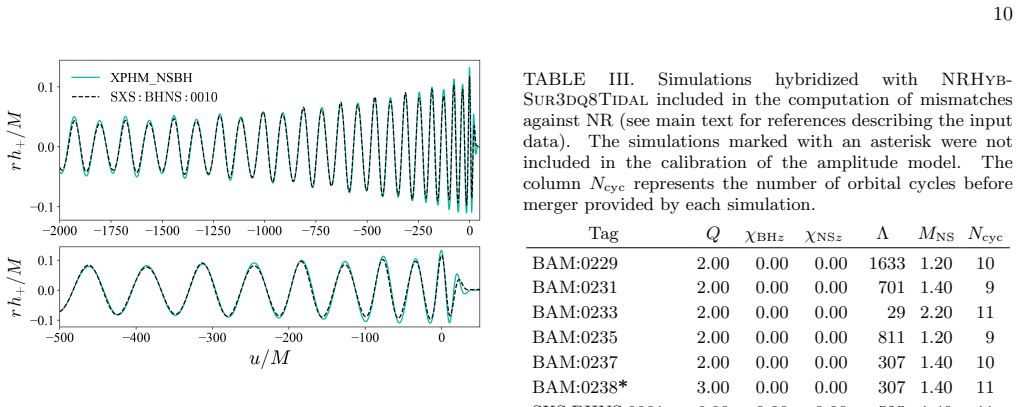
In particu- lar, we consider the simulations listed in Table III, which 8 TABLE II
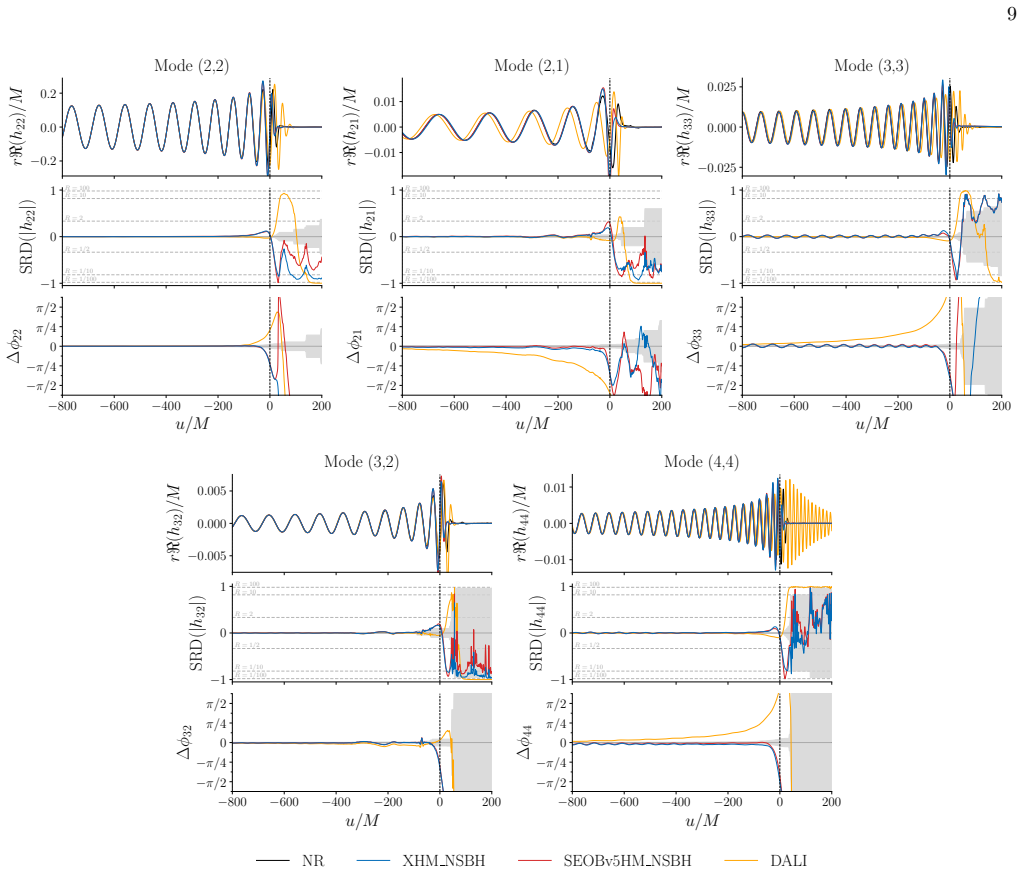
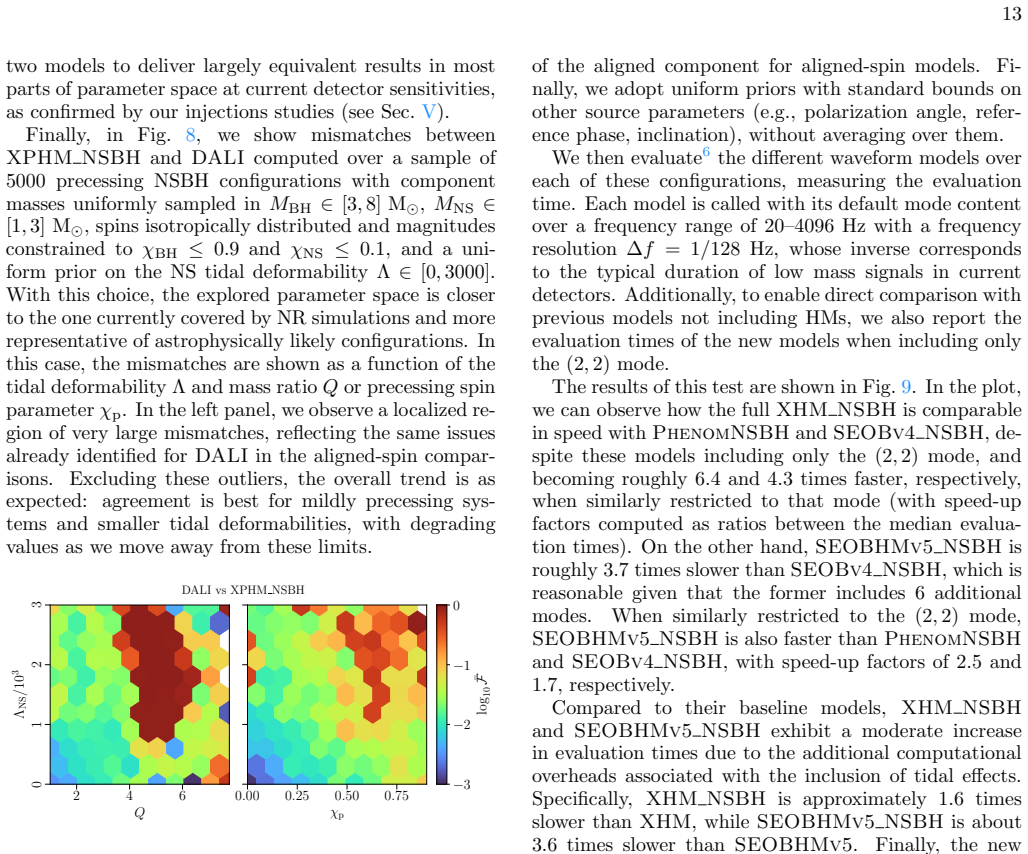
Mismatches against NR We start by computing mismatches between the new waveform models and NR waveforms hybridized with NRHybSur3dq8Tidal, including the previously estab- lished NSBH waveform models from Table II for compar- ison, as well asXHM NSBHandSEOBHMv5 NSBH restricted to the leading-order (2,2) mode. In particu- lar, we consider the simulations li...
2048
-
[2]
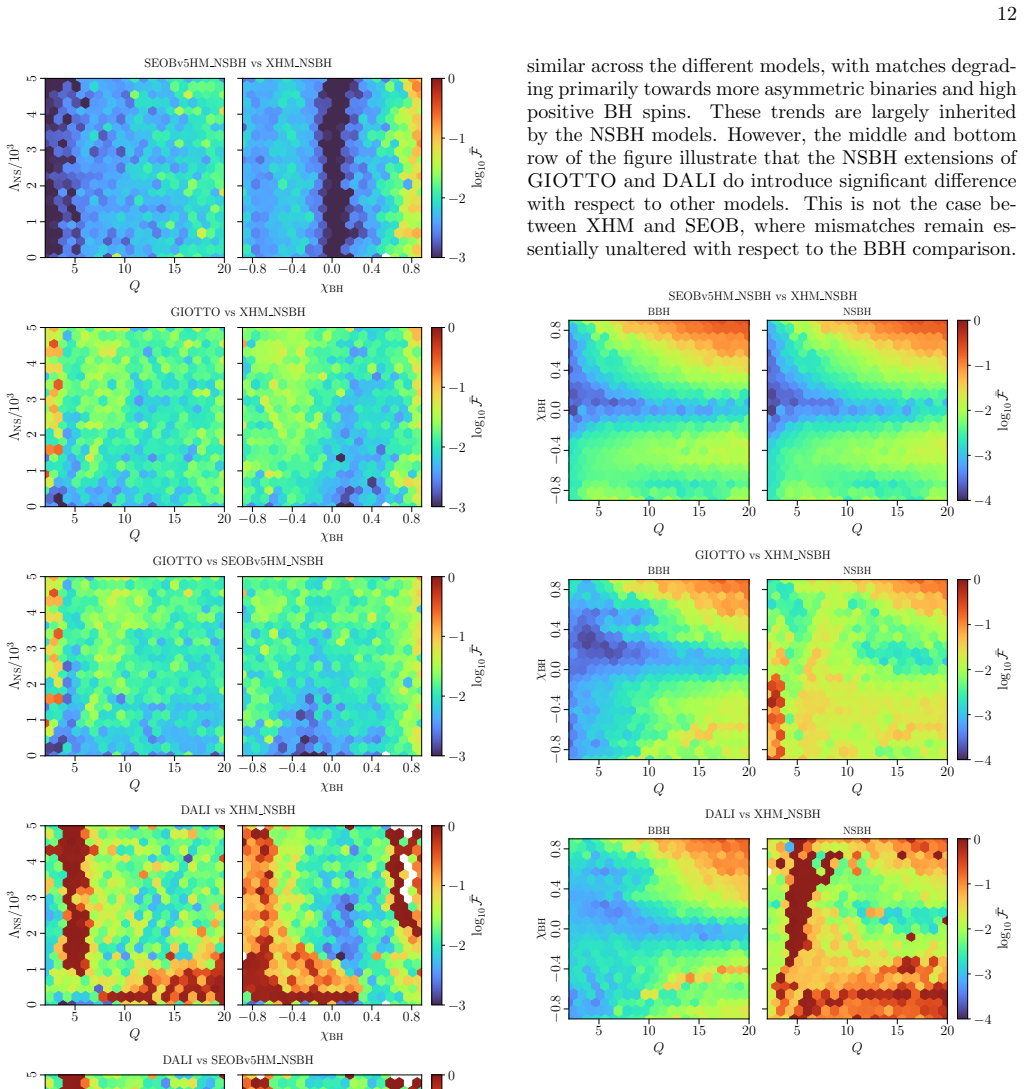
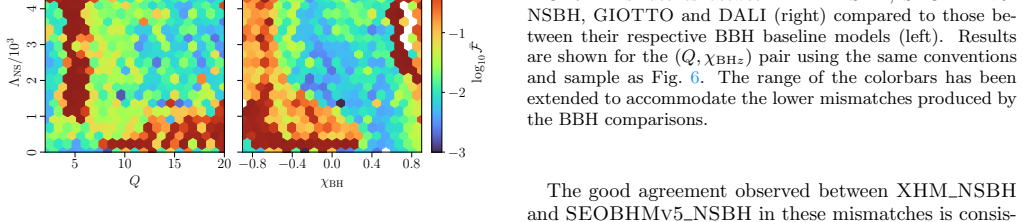
Mismatches between waveform models In this section, we quantify the agreement among XHM NSBH,SEOBHMv5 NSBH,GIOTTO, and DALIby computing pairwise mismatches across the pa- rameter space. In the case of aligned-spin NSBH systems, we compute these mismatches over a sample of 5000 aligned-spin con- figurations with uniform priors in mass ratiosQ∈[2,20], NS ma...
-
[3]
Collocation Points For the calibration of the merger–ringdown amplitude, we select five or six log-spaced frequencies constructed from combinations of characteristic frequencies delimit- ing this regime: the frequency of the MECO,Mf ℓm MECO, which approximately marks the end of the inspiral; the frequency at which the NS is expected to be tidally dis- rup...
-
[4]
Parameter Space Fits Having defined our scheme for the collocation point frequencies, we perform the calibration by fitting the am- plitude of NR simulations at those frequencies as a func- tion of the intrinsic parameters of the system: the mass ratio,Q, the dimensionless spin magnitude of the BH, χBHz, and the tidal deformability of the NS, Λ. How- ever...
-
[5]
Amplitude Ansatz The amplitude ansatz is split in two regions, one for the inspiral, and one for the merger-ringdown, connected together via a windowing function that ensures a smooth transition between the two regions. Specifically, the 22 ansatz is given by Aℓm NSBH(Mf) = [1−W ℓm(Mf)]A ℓm INS(Mf) +W ℓm(Mf)A ℓm MRD(Mf), (A12) whereA ℓm INS andA ℓm MRD ar...
-
[6]
In this case, the parameters are set tof 0 =f ND,σ 0 =σ ND,ϵ=ϵ ND, resulting in wND(f) =w −(f;f ND, σND) +ϵ NDw+(f;f ND, σND)
Nondisruptive (ND) merger:f RD < f tide, and Mtorus = 0. In this case, the parameters are set tof 0 =f ND,σ 0 =σ ND,ϵ=ϵ ND, resulting in wND(f) =w −(f;f ND, σND) +ϵ NDw+(f;f ND, σND). (B7)
-
[7]
In this case, the parameters are set tof 0 =f D,σ 0 =σ D,ϵ= 0, resulting in wD(f) =w −(f;f D, σD).(B8)
Disruptive (D) merger with a torus remnant: fRD > f tide, andM torus >0. In this case, the parameters are set tof 0 =f D,σ 0 =σ D,ϵ= 0, resulting in wD(f) =w −(f;f D, σD).(B8)
-
[8]
In this case, the param- eters are set tof 0 = (1−Q −1)fND +Q −1ftide, σ0 = (σD +σ ND)/2, andϵ= 0
Mildly disruptive merger with no torus remnant: fRD > f tide,M torus = 0. In this case, the param- eters are set tof 0 = (1−Q −1)fND +Q −1ftide, σ0 = (σD +σ ND)/2, andϵ= 0
-
[9]
Here, the information from cases 1 and 2 is combined by settingf 0 =f D, σ0 =σ ND, andϵ=ϵ ND
Mildly disruptive merger with a torus remnant: fRD < f tide,M torus >0. Here, the information from cases 1 and 2 is combined by settingf 0 =f D, σ0 =σ ND, andϵ=ϵ ND. The forms of the fitting formulae forf D/ND,σ D/ND, andϵ D/ND are discussed in detail in the Appendix of 14 As inSEOBNRv4 ROM NRTidalv2 NSBH, the tidal disrup- tion frequency is computed as a...
-
[10]
Abbottet al.(LIGO Scientific, KAGRA, VIRGO), Astrophys
R. Abbottet al.(LIGO Scientific, KAGRA, VIRGO), Astrophys. J. Lett.915, L5 (2021), arXiv:2106.15163 [astro-ph.HE]
arXiv 2021
-
[11]
Aasiet al.(LIGO Scientific), Class
J. Aasiet al.(LIGO Scientific), Class. Quant. Grav.32, 074001 (2015), arXiv:1411.4547 [gr-qc]
Pith/arXiv arXiv 2015
-
[12]
F. Acerneseet al.(VIRGO), Class. Quant. Grav.32, 024001 (2015), arXiv:1408.3978 [gr-qc]
Pith/arXiv arXiv 2015
-
[13]
Akutsuet al.(KAGRA), Nature Astron.3, 35 (2019), arXiv:1811.08079 [gr-qc]
T. Akutsuet al.(KAGRA), Nature Astron.3, 35 (2019), arXiv:1811.08079 [gr-qc]
arXiv 2019
-
[14]
R. Essick and P. Landry, Astrophys. J.904, 80 (2020), arXiv:2007.01372 [astro-ph.HE]
arXiv 2020
-
[15]
Abbottet al.(LIGO Scientific, VIRGO), Phys
R. Abbottet al.(LIGO Scientific, VIRGO), Phys. Rev. D109, 022001 (2024), arXiv:2108.01045 [gr-qc]
Pith/arXiv arXiv 2024
-
[16]
M. Pillaset al., Limits on the Ejecta Mass Dur- ing the Search for Kilonovae Associated with Neutron Star-Black Hole Mergers: A case study of S230518h, GW230529, S230627c and the Low-Significance Candi- date S240422ed (2025), arXiv:2503.15422 [astro-ph.HE]
arXiv 2025
-
[17]
Abbottet al.(LIGO Scientific, Virgo), Astrophys
R. Abbottet al.(LIGO Scientific, Virgo), Astrophys. J. Lett.896, L44 (2020), arXiv:2006.12611 [astro-ph.HE]
Pith/arXiv arXiv 2020
-
[18]
E. R. Most, L. J. Papenfort, L. R. Weih, and L. Rez- zolla, Mon. Not. Roy. Astron. Soc.499, L82 (2020), arXiv:2006.14601 [astro-ph.HE]
arXiv 2020
-
[19]
V. Dexheimer, R. O. Gomes, T. Kl¨ ahn, S. Han, and M. Salinas, Phys. Rev. C103, 025808 (2021), arXiv:2007.08493 [astro-ph.HE]
Pith/arXiv arXiv 2021
-
[20]
I. Tews, P. T. H. Pang, T. Dietrich, M. W. Coughlin, S. Antier, M. Bulla, J. Heinzel, and L. Issa, Astrophys. J. Lett.908, L1 (2021), arXiv:2007.06057 [astro-ph.HE]
arXiv 2021
-
[21]
A. G. Abacet al.(LIGO Scientific, VIRGO, KAGRA), arXiv e-prints 10.48550/arXiv.2508.18082, arXiv:2508.18082 [gr-qc]
work page internal anchor Pith review Pith/arXiv arXiv doi:10.48550/arxiv.2508.18082
-
[22]
A. G. Abacet al.(LIGO Scientific, Virgo,, KA- GRA, VIRGO), Astrophys. J. Lett.970, L34 (2024), arXiv:2404.04248 [astro-ph.HE]
arXiv 2024
-
[23]
F. ¨Ozel, D. Psaltis, R. Narayan, and J. E. McClintock, ApJ725, 1918 (2010), arXiv:1006.2834 [astro-ph.GA]
Pith/arXiv arXiv 1918
-
[24]
C. S. Ye, K. Kremer, S. M. Ransom, and F. A. Rasio, Astrophys. J.975, 77 (2024), arXiv:2408.00076 [astro- ph.HE]
arXiv 2024
-
[25]
C. L. Fryer, K. Belczynski, G. Wiktorowicz, M. Do- minik, V. Kalogera, and D. E. Holz, ApJ749, 91 (2012), arXiv:1110.1726 [astro-ph.SR]
Pith/arXiv arXiv 2012
-
[26]
K. Belczynski, G. Wiktorowicz, C. L. Fryer, D. E. Holz, and V. Kalogera, ApJ757, 91 (2012), arXiv:1110.1635 [astro-ph.GA]
Pith/arXiv arXiv 2012
-
[27]
T. A. Thompson, C. S. Kochanek, K. Z. Stanek, C. Badenes, R. S. Post, T. Jayasinghe, D. W. Latham, A. Bieryla, G. A. Esquerdo, P. Berlind, M. L. Calkins, J. Tayar, L. Lindegren, J. A. Johnson, T. W. S. Holoien, K. Auchettl, and K. Covey, Science366, 637 (2019), arXiv:1806.02751 [astro-ph.HE]
arXiv 2019
-
[28]
T. Jayasinghe, K. Z. Stanek, T. A. Thompson, C. S. Kochanek, D. M. Rowan, P. J. Vallely, K. G. Strass- meier, M. Weber, J. T. Hinkle, F. J. Hambsch, D. V. Martin, J. L. Prieto, T. Pessi, D. Huber, K. Auchettl, L. A. Lopez, I. Ilyin, C. Badenes, A. W. Howard, H. Isaacson, and S. J. Murphy, MNRAS504, 2577 (2021), arXiv:2101.02212 [astro-ph.SR]
arXiv 2021
-
[29]
E. D. Barret al., Science383, 275 (2024), 25 arXiv:2401.09872 [astro-ph.HE]
arXiv 2024
-
[30]
L. Boccioli and G. Fragione, Phys. Rev. D110, 023007 (2024), arXiv:2404.05927 [astro-ph.HE]
arXiv 2024
-
[31]
C. L. Fryer, A. Olejak, and K. Belczynski, Astrophys. J.931, 94 (2022), arXiv:2204.13025 [astro-ph.HE]
arXiv 2022
- [32]
- [33]
-
[34]
Z. Xinget al., Mass-gap Black Holes in Coalescing Neu- tron Star Black Hole Binaries (2024), arXiv:2410.20415 [astro-ph.HE]
arXiv 2024
-
[35]
M. A. Sedda, Commun. Phys.3, 43 (2020), arXiv:2003.02279 [astro-ph.GA]
arXiv 2020
-
[36]
D. Chattopadhyay, S. Stevenson, J. R. Hurley, M. Bailes, and F. Broekgaarden, Mon. Not. Roy. Astron. Soc.504, 3682 (2021), arXiv:2011.13503 [astro-ph.HE]
arXiv 2021
-
[37]
A. Vigna-G´ omez, S. L. Schrøder, E. Ramirez-Ruiz, D. R. Aguilera-Dena, A. Batta, N. Langer, and R. Willcox, Astrophys. J. Lett.920, L17 (2021), arXiv:2106.12381 [astro-ph.HE]
arXiv 2021
-
[38]
S. L. Shapiro and I. Wasserman, ApJ260, 838 (1982)
1982
-
[39]
B. D. Lackey, K. Kyutoku, M. Shibata, P. R. Brady, and J. L. Friedman, Phys. Rev. D89, 043009 (2014), arXiv:1303.6298 [gr-qc]
Pith/arXiv arXiv 2014
-
[40]
K. Topolski, S. D. Tootle, and L. Rezzolla, Phys. Rev. D111, 064023 (2025), arXiv:2409.06777 [gr-qc]
arXiv 2025
-
[41]
O. Steppohn, S. H. V¨ olkel, and T. Dietrich, Phys. Rev. D113, 024011 (2026), arXiv:2508.15534 [gr-qc]
arXiv 2026
-
[42]
F. Foucart, Phys. Rev. D86, 124007 (2012), arXiv:1207.6304 [astro-ph.HE]
Pith/arXiv arXiv 2012
-
[43]
K. Kyutoku, K. Ioka, H. Okawa, M. Shibata, and K. Taniguchi, Phys. Rev. D92, 044028 (2015), arXiv:1502.05402 [astro-ph.HE]
Pith/arXiv arXiv 2015
-
[44]
R. Fern´ andez, F. Foucart, D. Kasen, J. Lippuner, D. De- sai, and L. F. Roberts, Class. Quant. Grav.34, 154001 (2017), arXiv:1612.04829 [astro-ph.HE]
Pith/arXiv arXiv 2017
-
[45]
V. Paschalidis, M. Ruiz, and S. L. Shapiro, Astrophys. J. Lett.806, L14 (2015), arXiv:1410.7392 [astro-ph.HE]
Pith/arXiv arXiv 2015
-
[46]
K. Hayashi, K. Kiuchi, K. Kyutoku, Y. Sekiguchi, and M. Shibata, Phys. Rev. D107, 123001 (2023), arXiv:2211.07158 [astro-ph.HE]
arXiv 2023
-
[47]
O. Gottliebet al., Astrophys. J. Lett.954, L21 (2023), arXiv:2306.14947 [astro-ph.HE]
arXiv 2023
-
[48]
Tsang, J
D. Tsang, J. S. Read, T. Hinderer, A. L. Piro, and R. Bondarescu, Phys. Rev. Lett.108, 011102 (2012)
2012
-
[49]
W. E. East, L. Lehner, S. L. Liebling, and C. Palenzuela, Astrophys. J. Lett.912, L18 (2021), arXiv:2101.12214 [astro-ph.HE]
arXiv 2021
-
[50]
S. T. McWilliams and J. Levin, Astrophys. J.742, 90 (2011), arXiv:1101.1969 [astro-ph.HE]
Pith/arXiv arXiv 2011
-
[51]
R. M. Wald, Phys. Rev. D10, 1680 (1974)
1974
-
[52]
J. Levin, D. J. D’Orazio, and S. Garcia-Saenz, Phys. Rev. D98, 123002 (2018), arXiv:1808.07887 [astro- ph.HE]
Pith/arXiv arXiv 2018
-
[53]
J. E. Thompson, E. Fauchon-Jones, S. Khan, E. Ni- toglia, F. Pannarale, T. Dietrich, and M. Hannam, Phys. Rev. D101, 124059 (2020), arXiv:2002.08383 [gr- qc]
arXiv 2020
-
[54]
A. Mataset al., Phys. Rev. D102, 043023 (2020), arXiv:2004.10001 [gr-qc]
arXiv 2020
-
[55]
Y. Huang, C.-J. Haster, S. Vitale, V. Varma, F. Foucart, and S. Biscoveanu, Phys. Rev. D103, 083001 (2021), arXiv:2005.11850 [gr-qc]
arXiv 2021
-
[56]
K. Barkett, Y. Chen, M. A. Scheel, and V. Varma, Phys. Rev. D102, 024031 (2020), arXiv:1911.10440 [gr-qc]
arXiv 2020
-
[57]
A. Gonzalez, R. Gamba, M. Breschi, F. Zappa, G. Carullo, S. Bernuzzi, and A. Nagar, Phys. Rev. D 107, 084026 (2023), arXiv:2212.03909 [gr-qc]
arXiv 2023
-
[58]
A. Gonzalez, S. Bernuzzi, A. Rashti, F. Brandoli, and R. Gamba, arXiv e-prints (2025), arXiv:2507.00113 [gr- qc]
Pith/arXiv arXiv 2025
- [59]
-
[60]
B. Zackay, L. Dai, and T. Venumadhav, Relative Bin- ning and Fast Likelihood Evaluation for Gravitational Wave Parameter Estimation (2018), arXiv:1806.08792 [astro-ph.IM]
Pith/arXiv arXiv 2018
-
[61]
A. Buonanno and T. Damour, Phys. Rev. D59, 084006 (1999), arXiv:gr-qc/9811091
Pith/arXiv arXiv 1999
-
[62]
L. Pompiliet al., Phys. Rev. D108, 124035 (2023), arXiv:2303.18039 [gr-qc]
arXiv 2023
-
[63]
S. Khan, S. Husa, M. Hannam, F. Ohme, M. P¨ urrer, X. Jim´ enez Forteza, and A. Boh´ e, Phys. Rev. D93, 044007 (2016), arXiv:1508.07253 [gr-qc]
Pith/arXiv arXiv 2016
-
[64]
G. Pratten, S. Husa, C. Garcia-Quiros, M. Colleoni, A. Ramos-Buades, H. Estelles, and R. Jaume, Phys. Rev. D102, 064001 (2020), arXiv:2001.11412 [gr-qc]
arXiv 2020
-
[65]
C. Garc´ ıa-Quir´ os, M. Colleoni, S. Husa, H. Estell´ es, G. Pratten, A. Ramos-Buades, M. Mateu-Lucena, and R. Jaume, Phys. Rev. D102, 064002 (2020), arXiv:2001.10914 [gr-qc]
arXiv 2020
-
[66]
C. Garc´ ıa-Quir´ os, S. Husa, M. Mateu-Lucena, and A. Borchers, Class. Quant. Grav.38, 015006 (2021), arXiv:2001.10897 [gr-qc]
arXiv 2021
-
[67]
A. Abac, T. Dietrich, A. Buonanno, J. Steinhoff, and M. Ujevic, Phys. Rev. D109, 024062 (2024), arXiv:2311.07456 [gr-qc]
arXiv 2024
- [68]
-
[69]
G. Prattenet al., Phys. Rev. D103, 104056 (2021), arXiv:2004.06503 [gr-qc]. [61]http://www.black-holes.org/SpEC.html, spEC - Spectral Einstein Code
Pith/arXiv arXiv 2021
-
[70]
T. Yamamoto, M. Shibata, and K. Taniguchi, Phys. Rev. D78, 064054 (2008), arXiv:0806.4007 [gr-qc]
Pith/arXiv arXiv 2008
-
[71]
B. Bruegmann, J. A. Gonzalez, M. Hannam, S. Husa, U. Sperhake, and W. Tichy, Phys. Rev. D77, 024027 (2008), arXiv:gr-qc/0610128
Pith/arXiv arXiv 2008
-
[72]
M. Thierfelder, S. Bernuzzi, and B. Bruegmann, Phys. Rev. D84, 044012 (2011), arXiv:1104.4751 [gr-qc]
Pith/arXiv arXiv 2011
-
[73]
L. Lindblom, M. A. Scheel, L. E. Kidder, R. Owen, and O. Rinne, Class. Quant. Grav.23, S447 (2006), arXiv:gr-qc/0512093
Pith/arXiv arXiv 2006
-
[74]
F. Foucartet al., Phys. Rev. D103, 064007 (2021), arXiv:2010.14518 [gr-qc]
arXiv 2021
-
[75]
M. Campanelli, C. O. Lousto, P. Marronetti, and Y. Zlo- chower, Phys. Rev. Lett.96, 111101 (2006), arXiv:gr- qc/0511048
arXiv 2006
-
[76]
black-holes.org/simulations/index.html
SXS Gravitational Waveform Database,https://data. black-holes.org/simulations/index.html
-
[77]
F. Foucartet al., Phys. Rev. D99, 044008 (2019), arXiv:1812.06988 [gr-qc]
Pith/arXiv arXiv 2019
-
[78]
K. Kyutoku, M. Shibata, and K. Taniguchi, Phys. Rev. D82, 044049 (2010), [Erratum: Phys.Rev.D 84, 049902 (2011)], arXiv:1008.1460 [astro-ph.HE]. 26
Pith/arXiv arXiv 2010
-
[79]
K. Kyutoku, H. Okawa, M. Shibata, and K. Taniguchi, Phys. Rev. D84, 064018 (2011), arXiv:1108.1189 [astro- ph.HE]
Pith/arXiv arXiv 2011
-
[80]
K. Kyutoku, K. Ioka, and M. Shibata, Phys. Rev. D88, 041503 (2013), arXiv:1305.6309 [astro-ph.HE]
Pith/arXiv arXiv 2013
discussion (0)
Sign in with ORCID, Apple, or X to comment. Anyone can read and Pith papers without signing in.