Cosmic variance or galaxy bias? Disentangling finite-volume and galaxy formation effects in cosmological analysis
Pith reviewed 2026-06-28 05:01 UTC · model grok-4.3
The pith
Cosmic variance in galaxy surveys can be recast as additional bias parameters in perturbation theory to separate it from galaxy formation effects when measuring the BAO scale.
A machine-rendered reading of the paper's core claim, the machinery that carries it, and where it could break.
Core claim
By introducing a new set of bias parameters within halo/galaxy Eulerian perturbation theory, the density field from an arbitrary cosmic realization can be related to its ensemble-average counterpart, enabling a description of cosmic variance in terms of galaxy biasing. When applied to the non-linear BAO shift, this disentangles the uncertainty sources, and comparison to variance-suppressed simulations confirms an expected reduction in BAO peak position uncertainty.
What carries the argument
A new set of bias parameters in Eulerian perturbation theory that relate an arbitrary density field realization to the ensemble average.
If this is right
- The uncertainty on the measured BAO peak position decreases once the new bias parameters are included.
- Perturbative cosmological analyses that estimate bias parameters must account for possible mixing with cosmic-variance terms.
- Practical strategies exist to incorporate the reformulated cosmic variance into parameter inference pipelines.
Where Pith is reading between the lines
- The same bias-parameter mapping could be tested on other two-point statistics such as the power spectrum shape beyond the BAO feature.
- Survey design choices that alter the effective volume might be re-optimized by treating the new parameters as additional degrees of freedom.
- If the parameters prove stable, they could reduce the need for large numbers of mock catalogs in covariance estimation.
Load-bearing premise
The newly introduced bias parameters remain well-behaved and can be constrained independently of the cosmic-variance effects without the formalism becoming degenerate for realistic survey geometries.
What would settle it
A direct comparison of the scatter in BAO peak position measured from an ensemble of standard simulations versus variance-suppressed simulations, after fitting the new bias parameters, would show whether the claimed uncertainty reduction occurs.
Figures
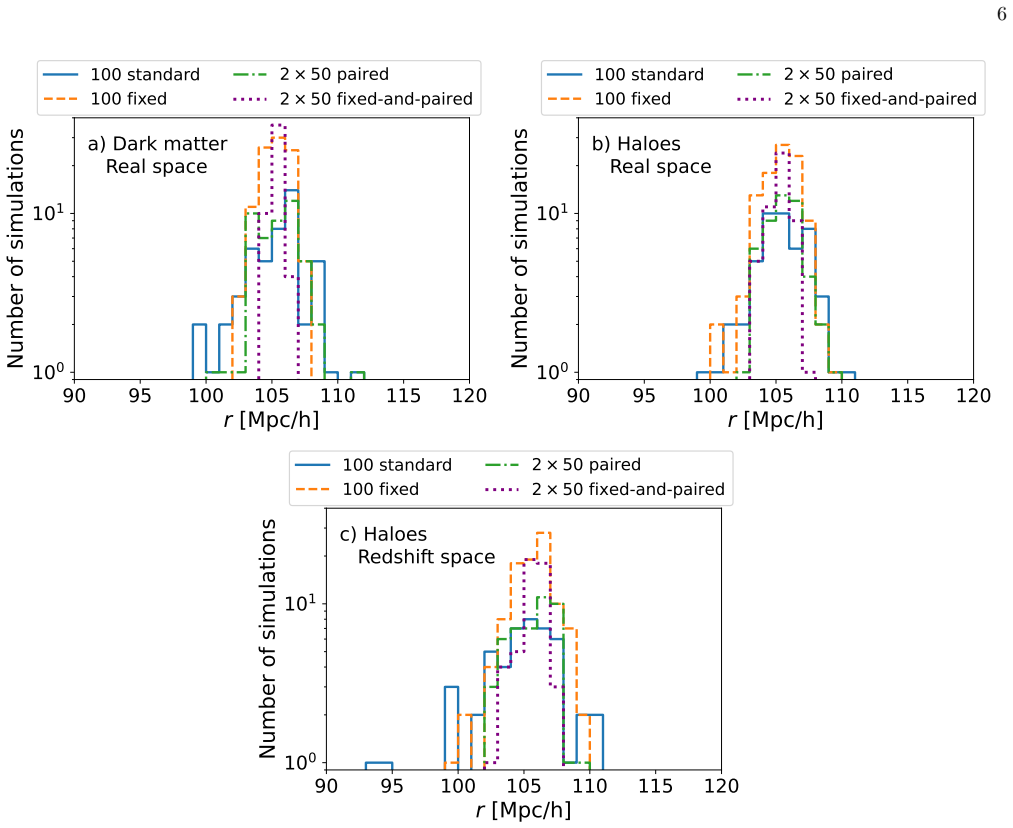
read the original abstract
Current and forthcoming galaxy redshift surveys, such as DESI and Euclid, are going to bring cosmological analysis to an unprecedentedly exquisite level of precision in the determination of the cosmological parameters. However, these efforts require a high degree of control over theory and systematics, to obtain unbiased results. In this sense, the cosmic variance associated to finite-volume effects represents a major challenge and should adequately accounted for. In this work, we revisit the definition of cosmic variance and develop a novel framework to describe it using a `galaxy biasing' formalism. In particular, we use halo/galaxy Eulerian perturbation theory to relate the density field from an arbitrary cosmic realization to its counterpart having statistical properties reproducing the ensemble average, introducing a new set of bias parameters. We then apply this idea to the description of the non-linear shift of BAO, disentangling the source of uncertainty from cosmic variance and galaxy biasing associated with the measurement of the BAO scale. We finally check our analytical argument against cosmological variance-suppressed $N$-body simulations, finding an expected reduction in the uncertainty on the BAO peak position. We conclude that extra care should be used when inferring cosmological information from perturbative approaches involving the estimation of bias parameters and propose new practical strategies to optimally leverage the novel formulation of cosmic variance presented herein in cosmological analysis.
Editorial analysis
A structured set of objections, weighed in public.
Referee Report
Summary. The manuscript proposes a framework that employs halo/galaxy Eulerian perturbation theory to map the density field of an arbitrary cosmic realization onto a counterpart with ensemble-average statistical properties, thereby introducing a new set of bias parameters. This formalism is applied to the nonlinear BAO shift in order to separate contributions from cosmic variance (finite-volume effects) and standard galaxy bias; the approach is checked against variance-suppressed N-body simulations, which reportedly yield a reduction in uncertainty on the BAO peak position.
Significance. If the new parameters prove non-degenerate with the standard bias expansion and survey window, the method could improve control over finite-volume systematics in analyses of DESI and Euclid data. The use of perturbation theory combined with direct simulation validation is a constructive element; however, the practical utility hinges on whether the enlarged parameter space remains identifiable under realistic selection functions.
major comments (2)
- [Abstract] Abstract: the central claim that the new bias parameters disentangle cosmic variance from galaxy bias rests on an unshown mapping that relates a single realization to the ensemble average. In a finite-volume survey the only available field is the realization itself, so any effective bias description fitted to it risks absorbing the variance signal it is intended to isolate; no explicit demonstration is given that the parameters remain well-conditioned once realistic masks and selection functions are included.
- The validation step against variance-suppressed N-body simulations is cited as showing reduced BAO uncertainty, yet without details on how the new parameters are constrained (e.g., priors, degeneracy tests with standard bias coefficients, or impact of survey geometry) it is impossible to judge whether the reported improvement is robust or an artifact of the idealized mapping.
minor comments (1)
- [Abstract] The abstract would benefit from a concise statement of the number and perturbative order of the newly introduced bias parameters.
Simulated Author's Rebuttal
We thank the referee for their comments on our manuscript. We address each major comment below, providing clarifications from the paper and indicating where revisions will be made.
read point-by-point responses
-
Referee: [Abstract] Abstract: the central claim that the new bias parameters disentangle cosmic variance from galaxy bias rests on an unshown mapping that relates a single realization to the ensemble average. In a finite-volume survey the only available field is the realization itself, so any effective bias description fitted to it risks absorbing the variance signal it is intended to isolate; no explicit demonstration is given that the parameters remain well-conditioned once realistic masks and selection functions are included.
Authors: The mapping is derived in Section 2 of the manuscript using Eulerian perturbation theory for halos/galaxies, explicitly relating the density field of an arbitrary realization to one with ensemble-average properties via the new bias parameters. We agree that the risk of absorption in a single realization is a valid concern and that conditioning under realistic masks is not demonstrated in the current work. We will add a paragraph discussing this limitation and potential mitigation strategies in the revised version. revision: partial
-
Referee: The validation step against variance-suppressed N-body simulations is cited as showing reduced BAO uncertainty, yet without details on how the new parameters are constrained (e.g., priors, degeneracy tests with standard bias coefficients, or impact of survey geometry) it is impossible to judge whether the reported improvement is robust or an artifact of the idealized mapping.
Authors: The variance-suppressed simulations are used to isolate the BAO shift contributions as described in Section 4. We will revise the methods and results sections to include explicit details on the fitting procedure, priors for the new parameters, and degeneracy tests with the standard bias expansion. The idealized setup is intentional to test the formalism, but we will note the limitations regarding survey geometry. revision: yes
- Full numerical demonstration of parameter conditioning under realistic survey masks and selection functions, which would require new simulation suites beyond the scope of this study.
Circularity Check
No circularity: new bias parameters introduced as modeling tool, not shown to reduce to input by construction
full rationale
The abstract describes using Eulerian PT to introduce a new set of bias parameters that map an arbitrary realization onto an ensemble-average counterpart, then applying the mapping to separate cosmic-variance and galaxy-bias contributions to the nonlinear BAO shift. No equations are supplied that would demonstrate the new parameters are fitted to the target quantity and then renamed as a prediction, nor is any load-bearing step shown to rest solely on a self-citation whose content is itself unverified. The framework is presented as an independent modeling choice whose validity is checked against variance-suppressed simulations, satisfying the criteria for a self-contained derivation.
Axiom & Free-Parameter Ledger
free parameters (1)
- new set of bias parameters
axioms (1)
- domain assumption halo/galaxy Eulerian perturbation theory is applicable to finite-volume density fields
invented entities (1)
-
new bias parameters for cosmic variance
no independent evidence
Forward citations
Cited by 1 Pith paper
-
HI Simulations for Cosmology with the SKA Observatory
Overview of HI modeling methods finds consistency in cosmic HI density but systematic differences in HI-halo mass relation shape and redshift evolution.
Reference graph
Works this paper leans on
-
[1]
M. Levi, C. Bebek, T. Beers, R. Blum, R. Cahn, D. Eisen- stein, B. Flaugher, K. Honscheid, R. Kron, O. Lahav, P. McDonald, N. Roe, D. Schlegel, and representing the DESI collaboration, The DESI Experiment, a whitepa- per for Snowmass 2013, arXiv e-prints , arXiv:1308.0847 (2013), arXiv:1308.0847 [astro-ph.CO]
Pith/arXiv arXiv 2013
-
[2]
L. Amendola, S. Appleby, A. Avgoustidis, D. Bacon, T. Baker, M. Baldi, N. Bartolo, A. Blanchard, C. Bon- vin, S. Borgani, E. Branchini, C. Burrage, S. Camera, C. Carbone, L. Casarini, M. Cropper, C. de Rham, J. P. Dietrich, C. Di Porto, R. Durrer, A. Ealet, P. G. Ferreira, F. Finelli, J. Garc´ ıa-Bellido, T. Giannantonio, L. Guzzo, A. Heavens, L. Heisenbe...
arXiv 2018
-
[3]
M. Braglia, X. Chen, and A. Loeb, Exotic Dark Matter and the DESI Anomaly, arXiv e-prints , arXiv:2507.13925 (2025), arXiv:2507.13925 [astro- ph.CO]
arXiv 2025
- [4]
-
[5]
M. Cortˆ es and A. R. Liddle, Interpreting DESI’s evidence for evolving dark energy, J. Cosmology Astropart. Phys. 2024, 007 (2024), arXiv:2404.08056 [astro-ph.CO]
arXiv 2024
- [6]
-
[7]
J. Zheng, D.-C. Qiang, and Z.-Q. You, Cosmolog- ical constraints on dark energy models using DESI BAO 2024, arXiv e-prints , arXiv:2412.04830 (2024), arXiv:2412.04830 [astro-ph.CO]
arXiv 2024
-
[8]
L. A. Ure˜ na-L´ opez, F. Lozano-Rodr´ ıguez, J. O. Rom´ an- Herrera, J. Aguilar, S. Ahlen, D. Bianchi, D. Brooks, T. Claybaugh, A. de la Macorra, A. Dey, S. Ferraro, J. E. Forero-Romero, E. Gazta˜ naga, S. G. A. Gontcho, G. Gutierrez, K. Honscheid, C. Howlett, M. Ishak, R. Ke- hoe, D. Kirkby, T. Kisner, A. Lambert, M. Landriau, L. Le Guillou, M. Manera, ...
arXiv 2025
-
[9]
K. Lodha, A. Shafieloo, R. Calderon, E. Linder, W. Sohn, J. L. Cervantes-Cota, A. de Mattia, J. Garc´ ıa-Bellido, M. Ishak, W. Matthewson, J. Aguilar, S. Ahlen, D. Brooks, T. Claybaugh, A. de la Macorra, A. Dey, B. Dey, P. Doel, J. E. Forero-Romero, E. Gazta˜ naga, S. G. A. Gontcho, C. Howlett, S. Juneau, S. Kent, T. Kisner, A. Lambert, M. Landriau, L. Le...
arXiv 2024
-
[10]
F. Beutler and E. Di Dio, Modeling relativistic contri- butions to the halo power spectrum dipole, J. Cosmol- ogy Astropart. Phys.2020, 048 (2020), arXiv:2004.08014 [astro-ph.CO]
arXiv 2020
- [11]
-
[12]
F. Lepori, S. Schulz, I. Tutusaus, M. A. Breton, S. Saga, C. Viglione, J. Adamek, C. Bonvin, L. Dam, P. Fosalba, L. Amendola, S. Andreon, C. Baccigalupi, M. Baldi, S. Bardelli, D. Bonino, E. Branchini, M. Bres- cia, J. Brinchmann, A. Caillat, S. Camera, V. Capo- bianco, C. Carbone, J. Carretero, S. Casas, M. Castel- lano, G. Castignani, S. Cavuoti, A. Cim...
arXiv 2025
-
[13]
J. R. Bermejo-Climent, R. Demina, A. Krolewski, E. Chaussidon, M. Rezaie, S. Ahlen, S. Bailey, D. Bianchi, D. Brooks, E. Burtin, T. Claybaugh, A. de la Macorra, A. Dey, P. Doel, G. Farren, S. Ferraro, J. E. Forero-Romero, E. Gazta˜ naga, S. Gontcho A Gontcho, G. Gutierrez, C. Hahn, K. Honscheid, C. Howlett, R. Ke- hoe, D. Kirkby, T. Kisner, M. Landriau, L...
arXiv 2025
-
[14]
E. Chaussidon, C. Y` eche, A. de Mattia, C. Pay- erne, P. McDonald, A. J. Ross, S. Ahlen, D. Bianchi, D. Brooks, E. Burtin, T. Claybaugh, A. de la Ma- corra, P. Doel, S. Ferraro, A. Font-Ribera, J. E. Forero- Romero, E. Gazta˜ naga, H. Gil-Mar´ ın, S. G. A. Gontcho, G. Gutierrez, J. Guy, K. Honscheid, C. Howlett, D. Huterer, R. Kehoe, D. Kirkby, T. Kisner...
arXiv 2024
-
[15]
DESI Collaboration, M. Abdul-Karim, J. Aguilar, S. Ahlen, S. Alam, L. Allen, C. Allende Prieto, O. Alves, A. Anand, U. Andrade, E. Armengaud, A. Aviles, S. Bai- 9 ley, C. Baltay, P. Bansal, A. Bault, J. Behera, S. Ben- Zvi, D. Bianchi, C. Blake, S. Brieden, A. Brodzeller, D. Brooks, E. Buckley-Geer, E. Burtin, R. Calderon, R. Canning, A. Carnero Rosell, P...
Pith/arXiv arXiv 2025
-
[16]
DESI Collaboration, M. Abdul-Karim, J. Aguilar, S. Ahlen, C. Allende Prieto, O. Alves, A. Anand, U. An- drade, E. Armengaud, A. Aviles, S. Bailey, A. Bault, J. Behera, S. BenZvi, D. Bianchi, C. Blake, A. Brodzeller, D. Brooks, E. Buckley-Geer, E. Burtin, R. Calderon, R. Canning, A. Carnero Rosell, P. Carrilho, L. Casas, F. J. Castander, R. Cereskaite, M. ...
Pith/arXiv arXiv 2025
-
[17]
F. Bernardeau, S. Colombi, E. Gazta˜ naga, and R. Scoc- cimarro, Large-scale structure of the Universe and cos- mological perturbation theory, Phys. Rep.367, 1 (2002), arXiv:astro-ph/0112551 [astro-ph]
Pith/arXiv arXiv 2002
-
[18]
P. McDonald and A. Roy, Clustering of dark matter trac- ers: generalizing bias for the coming era of precision LSS, J. Cosmology Astropart. Phys.2009, 020 (2009), arXiv:0902.0991 [astro-ph.CO]
Pith/arXiv arXiv 2009
-
[19]
K. F. Werner and C. Porciani, Renormalization of lin- ear halo bias in N-body simulations, MNRAS492, 1614 (2020), arXiv:1907.03774 [astro-ph.CO]
arXiv 2020
-
[20]
F. S. Kitaura, A. Balaguera-Antol´ ınez, F. Sinigaglia, and M. Pellejero-Ib´ a˜ nez, The cosmic web connection to the dark matter halo distribution through gravity, MNRAS 512, 2245 (2022), arXiv:2005.11598 [astro-ph.CO]
arXiv 2022
-
[21]
Y. B. Zel’dovich, Gravitational instability: An approxi- mate theory for large density perturbations., A&A5, 84 (1970)
1970
-
[22]
B. D. Sherwin and M. Zaldarriaga, Shift of the baryon acoustic oscillation scale: A simple physical picture, Phys. Rev. D85, 103523 (2012), arXiv:1202.3998 [astro- ph.CO]
Pith/arXiv arXiv 2012
-
[23]
C.-H. Chuang, G. Yepes, F.-S. Kitaura, M. Pellejero- Ibanez, S. Rodr´ ıguez-Torres, Y. Feng, R. B. Metcalf, R. H. Wechsler, C. Zhao, C.-H. To, S. Alam, A. Banerjee, J. DeRose, C. Giocoli, A. Knebe, and G. Reyes, UNIT project: Universe N-body simulations for the Investiga- tion of Theoretical models from galaxy surveys, MNRAS 487, 48 (2019), arXiv:1811.021...
Pith/arXiv arXiv 2019
-
[24]
V. Springel, N. Yoshida, and S. D. M. White, GADGET: a code for collisionless and gasdynamical cosmological simulations, New A6, 79 (2001), arXiv:astro-ph/0003162 [astro-ph]
Pith/arXiv arXiv 2001
-
[25]
V. Springel, The cosmological simulation code GADGET-2, MNRAS364, 1105 (2005), arXiv:astro- ph/0505010 [astro-ph]
arXiv 2005
-
[26]
Y. Feng, M.-Y. Chu, U. Seljak, and P. McDon- ald, FASTPM: a new scheme for fast simulations of dark matter and haloes, MNRAS463, 2273 (2016), 10 arXiv:1603.00476 [astro-ph.CO]
Pith/arXiv arXiv 2016
-
[27]
X. Xu, N. Padmanabhan, D. J. Eisenstein, K. T. Mehta, and A. J. Cuesta, A 2 per cent distance to z = 0.35 by reconstructing baryon acoustic oscillations - II. Fitting techniques, MNRAS427, 2146 (2012), arXiv:1202.0091 [astro-ph.CO]
Pith/arXiv arXiv 2012
-
[28]
M. Vargas-Maga˜ na, S. Ho, X. Xu, A. G. S´ anchez, R. O’Connell, D. J. Eisenstein, A. J. Cuesta, W. J. Per- cival, A. J. Ross, E. Aubourg, J. R. Brownstein, S. Es- coffier, D. Kirkby, M. Manera, D. P. Schneider, J. L. Tin- ker, and B. A. Weaver, The clustering of Galaxies in the SDSS-III Baryon Oscillation Spectroscopic Survey: po- tential systematics in ...
arXiv 2014
-
[29]
C. Zhao, C.-H. Chuang, F.-S. Kitaura, Y. Liang, M. Pellejero-Ibanez, C. Tao, M. Vargas-Maga˜ na, A. Variu, and G. Yepes, Improving baryon acoustic oscillation measurement with the combination of cos- mic voids and galaxies, MNRAS491, 4554 (2020), arXiv:1802.03990 [astro-ph.CO]
arXiv 2020
-
[30]
C. Zhao, A. Variu, M. He, D. Forero-S´ anchez, A. Tamone, C.-H. Chuang, F.-S. Kitaura, C. Tao, J. Yu, J.-P. Kneib, W. J. Percival, H. Shan, G.-B. Zhao, E. Burtin, K. S. Dawson, G. Rossi, D. P. Schneider, and A. de la Macorra, The completed SDSS-IV extended Baryon Oscillation Spectroscopic Survey: cosmological implications from multitracer BAO analysis wit...
arXiv 2022
-
[31]
M. Schmittfull, T. Baldauf, and M. Zaldarriaga, Iterative initial condition reconstruction, Phys. Rev. D96, 023505 (2017), arXiv:1704.06634 [astro-ph.CO]
arXiv 2017
-
[32]
R. Hada and D. J. Eisenstein, An iterative reconstruction of cosmological initial density fields, MNRAS478, 1866 (2018), arXiv:1804.04738 [astro-ph.CO]
Pith/arXiv arXiv 2018
-
[33]
F. S. Kitaura, The initial conditions of the universe from constrained simulations., MNRAS429, L84 (2013), arXiv:1203.4184 [astro-ph.CO]
Pith/arXiv arXiv 2013
-
[34]
J. Jasche and B. D. Wandelt, Bayesian physical re- construction of initial conditions from large-scale struc- ture surveys, MNRAS432, 894 (2013), arXiv:1203.3639 [astro-ph.CO]
Pith/arXiv arXiv 2013
-
[35]
H. Wang, H. J. Mo, X. Yang, and F. C. van den Bosch, Reconstructing the Initial Density Field of the Local Uni- verse: Methods and Tests with Mock Catalogs, ApJ772, 63 (2013), arXiv:1301.1348 [astro-ph.CO]
Pith/arXiv arXiv 2013
-
[36]
J. Jasche and G. Lavaux, Physical Bayesian mod- elling of the non-linear matter distribution: New in- sights into the nearby universe, A&A625, A64 (2019), arXiv:1806.11117 [astro-ph.CO]
Pith/arXiv arXiv 2019
-
[37]
F.-S. Kitaura, M. Ata, S. A. Rodr´ ıguez-Torres, M. Hern´ andez-S´ anchez, A. Balaguera-Antol´ ınez, and G. Yepes, COSMIC BIRTH: efficient Bayesian inference of the evolving cosmic web from galaxy surveys, MNRAS 502, 3456 (2021), arXiv:1911.00284 [astro-ph.CO]
arXiv 2021
-
[38]
P. Rossell´ o, F. S. Kitaura, D. Forero-S´ anchez, F. Sinigaglia, and G. Favole, Differentiable Fuzzy Cosmic-Web for Field Level Inference, arXiv e-prints , arXiv:2506.03969 (2025), arXiv:2506.03969 [astro- ph.CO]
Pith/arXiv arXiv 2025
- [39]
-
[40]
F.-S. Kitaura, C.-H. Chuang, Y. Liang, C. Zhao, C. Tao, S. Rodr´ ıguez-Torres, D. J. Eisenstein, H. Gil-Mar´ ın, J.- P. Kneib, C. McBride, W. J. Percival, A. J. Ross, A. G. S´ anchez, J. Tinker, R. Tojeiro, M. Vargas-Magana, and G.-B. Zhao, Signatures of the Primordial Universe from Its Emptiness: Measurement of Baryon Acoustic Oscilla- tions from Minima ...
Pith/arXiv arXiv 2016
-
[41]
Y. Liang, C. Zhao, C.-H. Chuang, F.-S. Kitaura, and C. Tao, Measuring baryon acoustic oscillations from the clustering of voids, MNRAS459, 4020 (2016), arXiv:1511.04391 [astro-ph.CO]
Pith/arXiv arXiv 2016
-
[42]
C. Zhao, C. Tao, Y. Liang, F.-S. Kitaura, and C.- H. Chuang, DIVE in the cosmic web: voids with De- launay triangulation from discrete matter tracer distri- butions, MNRAS459, 2670 (2016), arXiv:1511.04299 [astro-ph.CO]
Pith/arXiv arXiv 2016
-
[43]
F. Sinigaglia, F.-S. Kitaura, K. Nagamine, Y. Oku, and A. Balaguera-Antol´ ınez, Field-level Lyman-αforest mod- eling in redshift space via augmented nonlocal Fluc- tuating Gunn-Peterson Approximation, A&A682, A21 (2024), arXiv:2305.10428 [astro-ph.CO]
arXiv 2024
-
[44]
J. M. Coloma-Nadal, F.-S. Kitaura, J. E. Garc´ ıa-Farieta, F. Sinigaglia, G. Favole, and D. Forero S´ anchez, The hierarchical cosmic web and assembly bias, J. Cosmol- ogy Astropart. Phys.2024, 083 (2024), arXiv:2403.19337 [astro-ph.CO]
arXiv 2024
-
[45]
F. Sinigaglia, F.-S. Kitaura, K. Nagamine, and Y. Oku, The Negative Baryon Acoustic Oscillation Shift in the LyαForest from Cosmological Simulations, ApJ971, L22 (2024), arXiv:2407.03918 [astro-ph.CO]
arXiv 2024
discussion (0)
Sign in with ORCID, Apple, or X to comment. Anyone can read and Pith papers without signing in.