HI Simulations for Cosmology with the SKA Observatory
Pith reviewed 2026-06-25 19:53 UTC · model grok-4.3
The pith
Semi-analytical and empirical models agree on cosmic HI density but differ systematically in the HI-halo mass relation and its redshift evolution.
A machine-rendered reading of the paper's core claim, the machinery that carries it, and where it could break.
Core claim
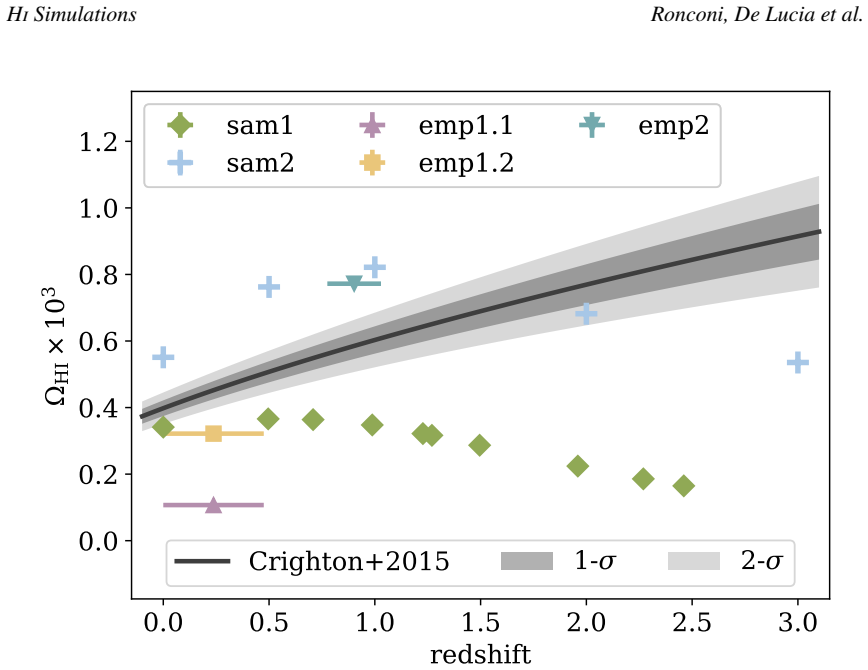
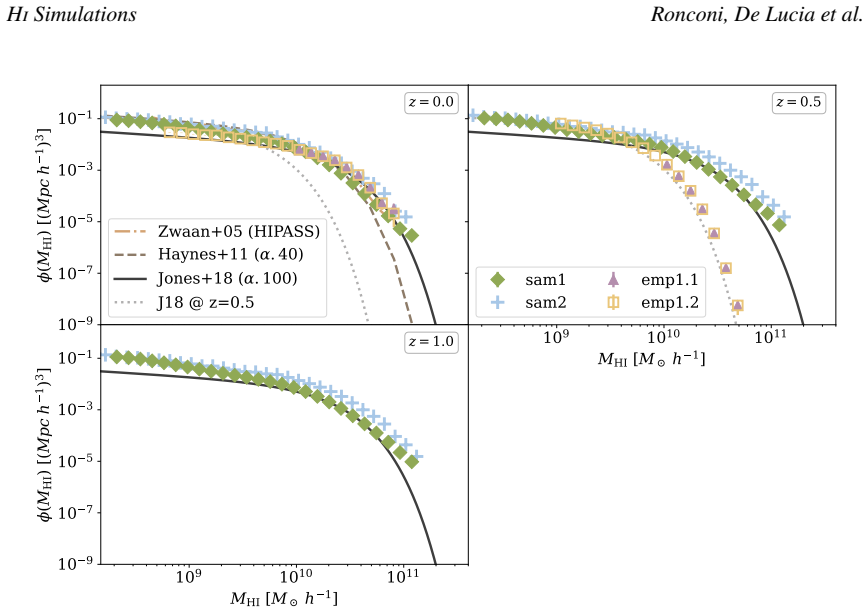
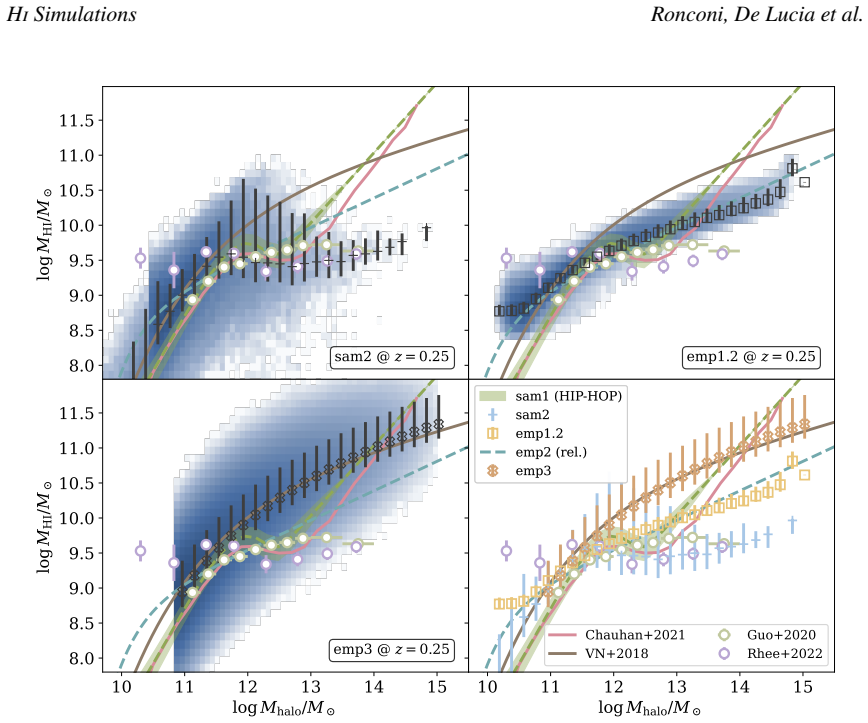
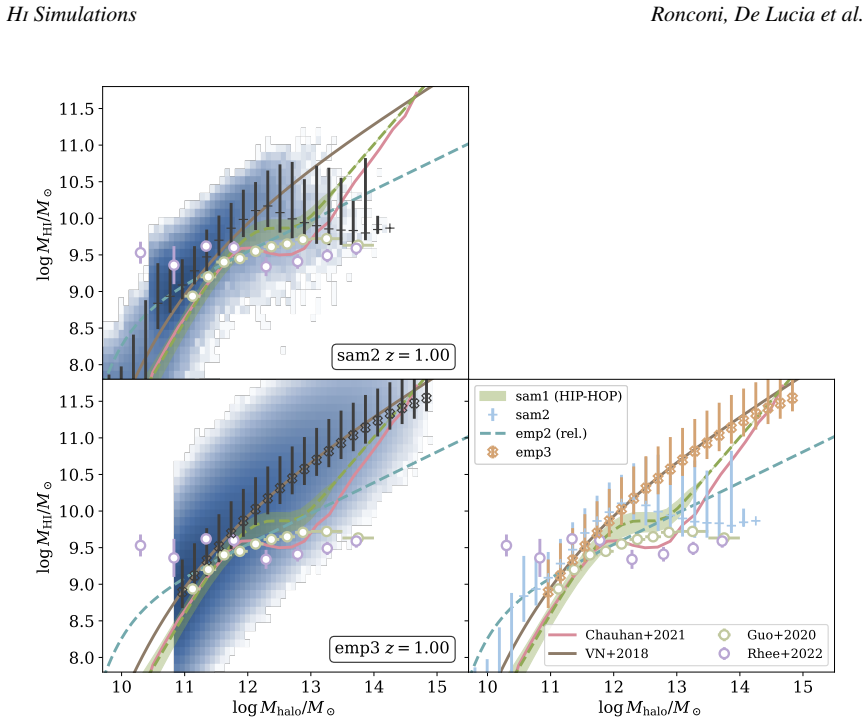
By comparing the predictions from the different methods considered, we find overall consistency in integrated quantities such as Ω_HI, yet systematic differences in the detailed shape and scatter of the HI--halo mass relation and its redshift evolution. Semi-analytical models offer physically grounded predictions but depend on assumed prescriptions, while empirical methods provide flexibility and computational efficiency at the expense of robustness in extrapolated regions of the parameter space.
What carries the argument
The direct comparison of semi-analytical models that self-consistently evolve baryonic components within dark matter merger trees against empirical schemes based on fast approximations for large ensemble studies.
If this is right
- New HI measurements will supply critical observational constraints to refine and calibrate current simulation methodologies.
- Increasingly realistic HI simulations will help interpret data and guide survey design and analysis strategies.
- Integrated quantities such as the cosmic HI density remain robust across modeling approaches.
- The detailed HI-halo mass relation and its evolution require further calibration because different methods produce systematic variations in shape and scatter.
Where Pith is reading between the lines
- If future data favor one class of models over the other in the scatter at fixed halo mass, that could guide which approach to prioritize for volume-limited forecasts.
- Empirical models might be adjusted using semi-analytical outputs in well-constrained regimes to combine speed with physical insight for very large mock catalogs.
- Differences in redshift evolution could alter predictions for how HI traces the growth of cosmic structure at higher redshifts.
Load-bearing premise
The collection of semi-analytical and empirical models examined is representative enough of plausible physical assumptions to support general statements about differences between the two classes.
What would settle it
New HI observations that either remove the reported systematic differences in the HI-halo mass relation across redshifts or produce substantially larger discrepancies than those identified in the comparison.
Figures
read the original abstract
We present a comparative overview of state-of-the-art methods for modelling the distribution of neutral hydrogen (HI) in the post-reionization Universe, developed in preparation for upcoming SKAO cosmological surveys. Our aim is to assess how different physical and empirical assumptions reflect into predictions for key observables such as the cosmic HI density, the HI mass function, and the HI-halo mass relation. We consider both: (i) semi-analytical approaches that self-consistently evolve baryonic components within dark matter merger trees through physically motivated prescriptions and (ii) empirical schemes tailored to different observables and based on fast approximations designed for large ensemble studies. By comparing the predictions from the different methods considered, we find overall consistency in integrated quantities such as $\Omega_{\mathrm{HI}}$, yet systematic differences in the detailed shape and scatter of the HI--halo mass relation and its redshift evolution. Semi-analytical models offer physically grounded predictions but depend on assumed prescriptions, while empirical methods provide flexibility and computational efficiency at the expense of robustness in extrapolated regions of the parameter space. The increasing number of HI measurements from SKA precursors and pathfinders (including surveys with MeerKAT, ASKAP, and FAST) will provide critical observational constraints to refine and calibrate current simulation methodologies. In turn, increasingly realistic HI simulations play a key role in interpreting these data, guiding survey design and analysis strategies, in preparation for the advent of SKAO data.
Editorial analysis
A structured set of objections, weighed in public.
Referee Report
Summary. The manuscript provides a comparative overview of semi-analytical and empirical methods for modeling neutral hydrogen (HI) distribution in the post-reionization Universe in preparation for SKAO surveys. It assesses how different physical and empirical assumptions affect predictions for key observables including the cosmic HI density Ω_HI, the HI mass function, and the HI-halo mass relation. The central finding is overall consistency across methods in integrated quantities such as Ω_HI, accompanied by systematic differences in the detailed shape, scatter, and redshift evolution of the HI-halo mass relation.
Significance. If the reported class-level differences hold after addressing model selection, the work would help quantify modeling uncertainties relevant to interpreting SKA precursor data from MeerKAT, ASKAP, and FAST and to guiding SKAO survey design. The explicit contrast between physically motivated but prescription-dependent semi-analytical models and computationally efficient but less robust empirical schemes identifies where future observations can provide calibration.
major comments (1)
- [Model selection and comparison sections] The headline claim of systematic differences between the semi-analytical and empirical classes (abstract and concluding discussion) is load-bearing for the paper's utility, yet rests on the untested assumption that the finite set of examined models spans the dominant physical variations within each class. The manuscript does not demonstrate coverage of key variants such as alternative feedback implementations or HI assignment schemes, leaving open the possibility that reported differences are model-specific rather than class-wide.
minor comments (2)
- The abstract would be strengthened by stating the exact number of models in each category and the redshift range over which the comparisons are performed.
- Figure captions comparing the HI-halo mass relation should explicitly label which curves correspond to semi-analytical versus empirical approaches and note any shared parameter choices.
Simulated Author's Rebuttal
We thank the referee for the constructive report and the recommendation for major revision. We address the major comment point by point below, proposing targeted revisions to clarify the scope of our model comparison while preserving the paper's core findings on consistency in integrated quantities and differences in the HI-halo mass relation.
read point-by-point responses
-
Referee: [Model selection and comparison sections] The headline claim of systematic differences between the semi-analytical and empirical classes (abstract and concluding discussion) is load-bearing for the paper's utility, yet rests on the untested assumption that the finite set of examined models spans the dominant physical variations within each class. The manuscript does not demonstrate coverage of key variants such as alternative feedback implementations or HI assignment schemes, leaving open the possibility that reported differences are model-specific rather than class-wide.
Authors: We agree that the manuscript should more explicitly address the rationale and limitations of model selection. The models examined are the primary state-of-the-art examples used in the SKAO preparation literature, chosen because they represent the dominant semi-analytical frameworks (varying in merger-tree evolution and baryonic prescriptions) and empirical schemes (differing in observable-based HI assignments) available at the time of writing. Nevertheless, we acknowledge that the comparison does not exhaustively sample all possible variants. In revision, we will add a dedicated paragraph to the model selection section discussing the criteria for inclusion, noting unexamined alternatives such as different AGN feedback implementations or alternative HI partitioning schemes, and qualifying that the reported class-level trends are based on the models considered. We will also revise the abstract and concluding discussion to state that systematic differences are observed among the examined models, while the consistency in Ω_HI holds across them. These changes will be made without expanding the model set, as the work is a comparative overview rather than a comprehensive parameter survey. revision: yes
Circularity Check
No circularity: inter-model comparison without derivation chain
full rationale
The paper is a comparative overview of existing semi-analytical and empirical HI modeling methods, reporting consistency in integrated quantities like Ω_HI and differences in the HI-halo mass relation shape and evolution. No new derivation, prediction, or first-principles result is claimed that reduces by construction to fitted inputs, self-citations, or ansatzes defined inside the paper. The central claims rest on direct inter-model comparisons rather than any load-bearing step that equates output to input. This is self-contained against external benchmarks and matches the expected honest non-finding for such survey-style work.
Axiom & Free-Parameter Ledger
Reference graph
Works this paper leans on
-
[1]
2026 ,publisher =
Priyamvad Tripathi and author2 and author3 and author4 and author5 ,title =. 2026 ,publisher =
2026
-
[2]
2026 ,publisher =
Marco Regis and author2 and author3 and author4 and author5 ,title =. 2026 ,publisher =
2026
-
[3]
2026 ,publisher =
Jacobo Asorey&Hale and author2 and author3 and author4 and author5 ,title =. 2026 ,publisher =
2026
-
[4]
2026 ,publisher =
Manisha Caleb and author2 and author3 and author4 and author5 ,title =. 2026 ,publisher =
2026
-
[5]
2026 ,publisher =
Aishrila Mazumder and author2 and author3 and author4 and author5 ,title =. 2026 ,publisher =
2026
-
[6]
2026 ,publisher =
Steven Cunnington&Wang and author2 and author3 and author4 and author5 ,title =. 2026 ,publisher =
2026
-
[7]
2026 ,publisher =
José Fonseca and author2 and author3 and author4 and author5 ,title =. 2026 ,publisher =
2026
-
[8]
2026 ,publisher =
Stefano Camera and author2 and author3 and author4 and author5 ,title =. 2026 ,publisher =
2026
-
[9]
2026 ,publisher =
Khandakar Md Asif Elahi and author2 and author3 and author4 and author5 ,title =. 2026 ,publisher =
2026
-
[10]
2026 ,publisher =
Ian Harrison and author2 and author3 and author4 and author5 ,title =. 2026 ,publisher =
2026
-
[11]
2026 ,publisher =
Tommaso Ronconi and author2 and author3 and author4 and author5 ,title =. 2026 ,publisher =
2026
-
[12]
2026 ,publisher =
Suman Majumdar and author2 and author3 and author4 and author5 ,title =. 2026 ,publisher =
2026
-
[13]
2026 ,publisher =
Daniele Bertacca and author2 and author3 and author4 and author5 ,title =. 2026 ,publisher =
2026
-
[14]
2026 ,publisher =
Joël Mayor and author2 and author3 and author4 and author5 ,title =. 2026 ,publisher =
2026
-
[15]
2026 ,publisher =
Ainulnabilah Nasirudin and author2 and author3 and author4 and author5 ,title =. 2026 ,publisher =
2026
-
[16]
2026 ,publisher =
Debanjan Sarkar and author2 and author3 and author4 and author5 ,title =. 2026 ,publisher =
2026
-
[17]
2026 ,publisher =
Marta Spinelli and author2 and author3 and author4 and author5 ,title =. 2026 ,publisher =
2026
-
[18]
2026 ,publisher =
Suman Chatterjee and author2 and author3 and author4 and author5 ,title =. 2026 ,publisher =
2026
-
[19]
2026 ,publisher =
Tessa Baker and author2 and author3 and author4 and author5 ,title =. 2026 ,publisher =
2026
-
[20]
2026 ,publisher =
Laura Wolz and author2 and author3 and author4 and author5 ,title =. 2026 ,publisher =
2026
-
[21]
2026 ,publisher =
Mamta Pandey-Pommier and author2 and author3 and author4 and author5 ,title =. 2026 ,publisher =
2026
-
[22]
Lagos and author2 and author3 and author4 and author5 ,title =
Claudia D.P. Lagos and author2 and author3 and author4 and author5 ,title =. 2026 ,publisher =
2026
-
[23]
Damped Ly absorbers and atomic hydrogen in galaxies: the view of the GAEA model. , keywords =. doi:10.1093/mnras/staa2067 , archivePrefix =. 2007.05040 , primaryClass =
-
[24]
A multitracer empirically driven approach to line-intensity mapping light cones
Sato-Polito, Gabriela and Kokron, Nickolas and Bernal, Jos \'e Luis. A multitracer empirically driven approach to line-intensity mapping light cones. Mon. Not. Roy. Astron. Soc. 2023. doi:10.1093/mnras/stad2498. arXiv:2212.08056
-
[25]
UniverseMachine: The Correlation between Galaxy Growth and Dark Matter Halo Assembly from z=0-10
Behroozi, Peter and Wechsler, Risa H. and Hearin, Andrew P. and Conroy, Charlie. UniverseMachine: The correlation between galaxy growth and dark matter halo assembly from z = 0 - 10. Mon. Not. Roy. Astron. Soc. 2019. doi:10.1093/mnras/stz1182. arXiv:1806.07893
work page internal anchor Pith review Pith/arXiv arXiv doi:10.1093/mnras/stz1182 2019
-
[26]
SIMPLE: Simple Intensity Map Producer for Line Emission
Lujan Niemeyer, Maja and Bernal, Jos \'e Luis and Komatsu, Eiichiro. SIMPLE: Simple Intensity Map Producer for Line Emission. Astrophys. J. 2023. doi:10.3847/1538-4357/acfef4. arXiv:2307.08475
-
[27]
Constraining the shape of dark matter haloes with globular clusters and diffuse stellar light in the E-MOSAICS simulations. , keywords =. doi:10.1093/mnras/stad920 , adsurl =
-
[28]
FIREbox: simulating galaxies at high dynamic range in a cosmological volume. , keywords =. doi:10.1093/mnras/stad1205 , archivePrefix =. 2205.15325 , primaryClass =
-
[29]
The COLIBRE project: cosmological hydrodynamical simulations of galaxy formation and evolution
The COLIBRE project: cosmological hydrodynamical simulations of galaxy formation and evolution. arXiv e-prints , keywords =. doi:10.48550/arXiv.2508.21126 , archivePrefix =. 2508.21126 , primaryClass =
work page internal anchor Pith review Pith/arXiv arXiv doi:10.48550/arxiv.2508.21126
-
[30]
Generating dark matter halo merger trees. , keywords =. doi:10.1111/j.1365-2966.2007.12517.x , archivePrefix =. 0708.1382 , primaryClass =
-
[31]
Building Merger Trees from Cosmological N-body Simulations
Building merger trees from cosmological N-body simulations. Towards improving galaxy formation models using subhaloes. , keywords =. doi:10.1051/0004-6361/200911787 , archivePrefix =. 0902.0679 , primaryClass =
work page internal anchor Pith review Pith/arXiv arXiv doi:10.1051/0004-6361/200911787
-
[32]
Populating a cluster of galaxies - I. Results at z=0. , keywords =. doi:10.1046/j.1365-8711.2001.04912.x , archivePrefix =. astro-ph/0012055 , primaryClass =
-
[33]
Chemical enrichment of the intracluster and intergalactic medium in a hierarchical galaxy formation model. , keywords =. doi:10.1111/j.1365-2966.2004.07584.x , archivePrefix =. astro-ph/0310268 , primaryClass =
-
[34]
Physical properties of E+A galaxies formed from galaxy merging and interaction
The many lives of active galactic nuclei: cooling flows, black holes and the luminosities and colours of galaxies. , keywords =. doi:10.1111/j.1365-2966.2005.09675.x , archivePrefix =. astro-ph/0508046 , primaryClass =
-
[35]
Approximate Methods for the Generation of Dark Matter Halo Catalogs in the Age of Precision Cosmology. Galaxies , keywords =. doi:10.3390/galaxies4040053 , archivePrefix =. 1605.07752 , primaryClass =
work page internal anchor Pith review Pith/arXiv arXiv doi:10.3390/galaxies4040053
-
[36]
The atomic hydrogen content of the post-reionization Universe , volume=
The atomic hydrogen content of the post-reionization Universe. , keywords =. doi:10.1093/mnras/staa604 , archivePrefix =. 1909.02242 , primaryClass =
-
[37]
2019 , eprint=
Anticipated Performance of the Square Kilometre Array -- Phase 1 (SKA1) , author=. 2019 , eprint=
2019
-
[38]
Cunnington, Steven and others. The foreground transfer function for H\,i intensity mapping signal reconstruction: MeerKLASS and precision cosmology applications. Mon. Not. Roy. Astron. Soc. 2023. doi:10.1093/mnras/stad1567. arXiv:2302.07034
-
[39]
Interpreting the unresolved intensity of cosmologically redshifted line radiation
Switzer, Eric R. and Chang, Tzu-Ching and Masui, Kiyoshi W. and Pen, Ue-Li and Voytek, Tabitha C. Interpreting the unresolved intensity of cosmologically redshifted line radiation. Astrophys. J. 2015. doi:10.1088/0004-637X/815/1/51. arXiv:1504.07527
work page internal anchor Pith review Pith/arXiv arXiv doi:10.1088/0004-637x/815/1/51 2015
-
[40]
Steven G. Murray , title =. 2018 , publisher =. doi:10.21105/joss.00850 , url =
-
[41]
Generating Log-normal Mock Catalog of Galaxies in Redshift Space
Agrawal, Aniket and Makiya, Ryu and Chiang, Chi-Ting and Jeong, Donghui and Saito, Shun and Komatsu, Eiichiro. Generating Log-normal Mock Catalog of Galaxies in Redshift Space. JCAP. 2017. doi:10.1088/1475-7516/2017/10/003. arXiv:1706.09195
work page internal anchor Pith review Pith/arXiv arXiv doi:10.1088/1475-7516/2017/10/003 2017
-
[42]
MeerKLASS Collaboration and others. MeerKLASS L-band deep-field intensity maps: entering the H\,i dominated regime. Mon. Not. Roy. Astron. Soc. 2025. doi:10.1093/mnras/staf195. arXiv:2407.21626
-
[43]
New fitting formula for cosmic non-linear density distribution
Shin, Jihye and Kim, Juhan and Pichon, Christophe and Jeong, Donghui and Park, Changbom. New Fitting Formula for Cosmic Nonlinear Density Distribution. Astrophys. J. 2017. doi:10.3847/1538-4357/aa74b9. arXiv:1705.06863
work page internal anchor Pith review Pith/arXiv arXiv doi:10.3847/1538-4357/aa74b9 2017
-
[44]
2015 , publisher=
Advancing Astrophysics with the Square Kilometre Array (AASKA14) , author=. 2015 , publisher=
2015
-
[45]
Euclid. V. The Flagship galaxy mock catalogue: a comprehensive simulation for the Euclid mission. arXiv e-prints , keywords =. doi:10.48550/arXiv.2405.13495 , archivePrefix =. 2405.13495 , primaryClass =
-
[46]
The Connection between Galaxies and their Dark Matter Halos
Wechsler, Risa H. and Tinker, Jeremy L. The Connection Between Galaxies and Their Dark Matter Halos. Annual Review of Astronomy and Astrophysics. 2018. doi:https://doi.org/10.1146/annurev-astro-081817-051756
work page internal anchor Pith review doi:10.1146/annurev-astro-081817-051756 2018
-
[47]
Painting a full radio sky -- Empirical mock catalogues with multiple source populations for future radio surveys. arXiv e-prints , keywords =. doi:10.48550/arXiv.2603.25650 , archivePrefix =. 2603.25650 , primaryClass =
-
[48]
Carbone, Carmelita and Petkova, Margarita and Dolag, Klaus , title =. 2016 , month =. doi:10.1088/1475-7516/2016/07/034 , url =
-
[49]
Parimbelli, G. and Carbone, C. and Bel, J. and Bose, B. and Calabrese, M. and Carella, E. and Zennaro, M. , title =. 2022 , month =. doi:10.1088/1475-7516/2022/11/041 , url =
-
[50]
Hernández-Molinero, Beatriz and Carbone, Carmelita and Jimenez, Raul and Garay, Carlos Peña , title =. 2024 , month =. doi:10.1088/1475-7516/2024/01/006 , url =
-
[51]
Monthly Notices of the Royal Astronomical Society , volume =
Bonaldi, Anna and Bonato, Matteo and Galluzzi, Vincenzo and Harrison, Ian and Massardi, Marcella and Kay, Scott and DeZotti, Gianfranco and Brown, Michael L , title =. Monthly Notices of the Royal Astronomical Society , volume =. 2018 , month =. doi:10.1093/mnras/sty2603 , url =
-
[52]
Monthly Notices of the Royal Astronomical Society , volume =
Bonaldi, Anna and Hartley, Philippa and Ronconi, Tommaso and DeZotti, Gianfranco and Bonato, Matteo , title =. Monthly Notices of the Royal Astronomical Society , volume =. 2023 , month =. doi:10.1093/mnras/stad1913 , url =
-
[53]
Guo, Hong and Zheng, Zheng and Behroozi, Peter S. and Zehavi, Idit and Chuang, Chia-Hsun and Comparat, Johan and Favole, Ginevra and Gottloeber, Stefan and Klypin, Anatoly and Prada, Francisco and Rodríguez-Torres, Sergio A. and Weinberg, David H. and Yepes, Gustavo , title =. Monthly Notices of the Royal Astronomical Society , volume =. 2016 , month =. d...
-
[54]
Monthly Notices of the Royal Astronomical Society , volume =
Ronconi, Tommaso and Lapi, Andrea and Viel, Matteo and Sartori, Alberto , title = ". Monthly Notices of the Royal Astronomical Society , volume =. 2020 , month =. doi:10.1093/mnras/staa2201 , url =
-
[55]
Monthly Notices of the Royal Astronomical Society , volume =
Hale, C L and Jarvis, M J and Delvecchio, I and Hatfield, P W and Novak, M and Smolčić, V and Zamorani, G , title = ". Monthly Notices of the Royal Astronomical Society , volume =. 2017 , month =. doi:10.1093/mnras/stx2954 , url =
-
[56]
and Giovanelli, Riccardo and Haynes, Martha P
Martin, Ann M. and Giovanelli, Riccardo and Haynes, Martha P. and Guzzo, Luigi , title =. 2012 , month =. doi:10.1088/0004-637X/750/1/38 , url =
-
[57]
Monthly Notices of the Royal Astronomical Society: Letters , volume =
Mondal, Rajesh and Bharadwaj, Somnath and Majumdar, Suman and Bera, Apurba and Acharyya, Ayan , title =. Monthly Notices of the Royal Astronomical Society: Letters , volume =. 2015 , month =. doi:10.1093/mnrasl/slv015 , url =
-
[58]
Monthly Notices of the Royal Astronomical Society , volume =
Mondal, Rajesh and Bharadwaj, Somnath and Majumdar, Suman , title =. Monthly Notices of the Royal Astronomical Society , volume =. 2015 , month =. doi:10.1093/mnras/stv2772 , url =
-
[59]
and Gawiser, Eric and Prochaska, Jason X
Cooke, Jeff and Wolfe, Arthur M. and Gawiser, Eric and Prochaska, Jason X. , title =. 2006 , month =. doi:10.1086/507476 , url =
-
[60]
Kim, Han-Seek and Wyithe, J. Stuart. B. and Baugh, C. M. and Lagos, C. d. P. and Power, C. and Park, Jaehong , title =. Monthly Notices of the Royal Astronomical Society , volume =. 2016 , month =. doi:10.1093/mnras/stw2779 , url =
-
[61]
Sheth, Ravi K. and Tormen, Giuseppe , title =. Monthly Notices of the Royal Astronomical Society , volume =. 2002 , month =. doi:10.1046/j.1365-8711.2002.04950.x , url =
-
[62]
Jenkins, A. and Frenk, C. S. and White, S. D. M. and Colberg, J. M. and Cole, S. and Evrard, A. E. and Couchman, H. M. P. and Yoshida, N. , title =. Monthly Notices of the Royal Astronomical Society , volume =. 2001 , month =. doi:10.1046/j.1365-8711.2001.04029.x , url =
-
[63]
Bagla, J. S. and Khandai, Nishikanta and Datta, Kanan K. , title =. Monthly Notices of the Royal Astronomical Society , volume =. 2010 , month =. doi:10.1111/j.1365-2966.2010.16933.x , url =
-
[64]
Mondal, Rajesh and Bharadwaj, Somnath and Datta, Kanan K. , title =. Monthly Notices of the Royal Astronomical Society , volume =. 2017 , month =. doi:10.1093/mnras/stx2888 , url =
-
[65]
Hitz, Pascal and Berner, Pascale and Crichton, Devin and Hennig, John and Refregier, Alexandre , title =. 2025 , month =. doi:10.1088/1475-7516/2025/04/003 , url =
-
[67]
R., Cole, S., Efstathiou, G., & Kaiser, N
Excursion Set Mass Functions for Hierarchical Gaussian Fluctuations. , year = 1991, month = oct, volume =. doi:10.1086/170520 , adsurl =
-
[68]
The Mass Function of Cosmic Structures with Non-Spherical Collapse
The Mass Function of Cosmic Structures with Nonspherical Collapse. , year = 1995, month = jul, volume =. doi:10.1086/175853 , archivePrefix =. astro-ph/9406029 , primaryClass =
work page internal anchor Pith review Pith/arXiv arXiv doi:10.1086/175853 1995
-
[69]
Monthly Notices of the Royal Astronomical Society , volume =
Monaco, Pierluigi , title =. Monthly Notices of the Royal Astronomical Society , volume =. 1997 , month =. doi:10.1093/mnras/290.3.439 , url =
-
[70]
L. B. Newburgh and K. Bandura and M. A. Bucher, et al. , title =. Ground-based and Airborne Telescopes VI , editor =. 2016 , doi =
2016
-
[71]
, title =
Devin Crichton and Moumita Aich and Adam Amara, et al. , title =. Journal of Astronomical Telescopes, Instruments, and Systems , number =. 2022 , doi =
2022
-
[72]
Monthly Notices of the Royal Astronomical Society , volume =
Padmanabhan, Hamsa and Refregier, Alexandre and Amara, Adam , title =. Monthly Notices of the Royal Astronomical Society , volume =. 2017 , month =. doi:10.1093/mnras/stx979 , url =
-
[73]
Barnes, Luke A. and Haehnelt, Martin G. , title =. Monthly Notices of the Royal Astronomical Society , volume =. 2014 , month =. doi:10.1093/mnras/stu445 , url =
-
[74]
, archivePrefix = "arXiv", eprint =
Bull, Philip and Ferreira, Pedro G. and Patel, Prina and Santos, Mário G. , title =. 2015 , month =. doi:10.1088/0004-637X/803/1/21 , url =
-
[75]
PyCosmo: An integrated cosmological Boltzmann solver , journal =. 2018 , issn =. doi:https://doi.org/10.1016/j.ascom.2018.08.001 , url =
-
[76]
Predicting cosmological observables with PyCosmo , journal =. 2021 , issn =. doi:https://doi.org/10.1016/j.ascom.2021.100484 , url =
-
[77]
Symbolic implementation of extensions of the PyCosmo Boltzmann solver , journal =. 2022 , issn =. doi:https://doi.org/10.1016/j.ascom.2022.100603 , url =
-
[78]
HInet: Generating Neutral Hydrogen from Dark Matter with Neural Networks. , keywords =. doi:10.3847/1538-4357/ac033a , archivePrefix =. 2007.10340 , primaryClass =
-
[79]
Modeling assembly bias with machine learning and symbolic regression. arXiv e-prints , keywords =. doi:10.48550/arXiv.2012.00111 , archivePrefix =. 2012.00111 , primaryClass =
-
[80]
Simulating the joint evolution of quasars, galaxies and their large-scale distribution
Simulations of the formation, evolution and clustering of galaxies and quasars. , keywords =. doi:10.1038/nature03597 , archivePrefix =. astro-ph/0504097 , primaryClass =
work page internal anchor Pith review Pith/arXiv arXiv doi:10.1038/nature03597
-
[81]
Resolving cosmic structure formation with the Millennium-II Simulation. , keywords =. doi:10.1111/j.1365-2966.2009.15191.x , archivePrefix =. 0903.3041 , primaryClass =
discussion (0)
Sign in with ORCID, Apple, or X to comment. Anyone can read and Pith papers without signing in.