Source Side Mitigation of AI Datacenter Power Fluctuations with a Hybrid Energy Storage System and Residual Differentiable Predictive Control
Pith reviewed 2026-07-01 07:34 UTC · model grok-4.3
The pith
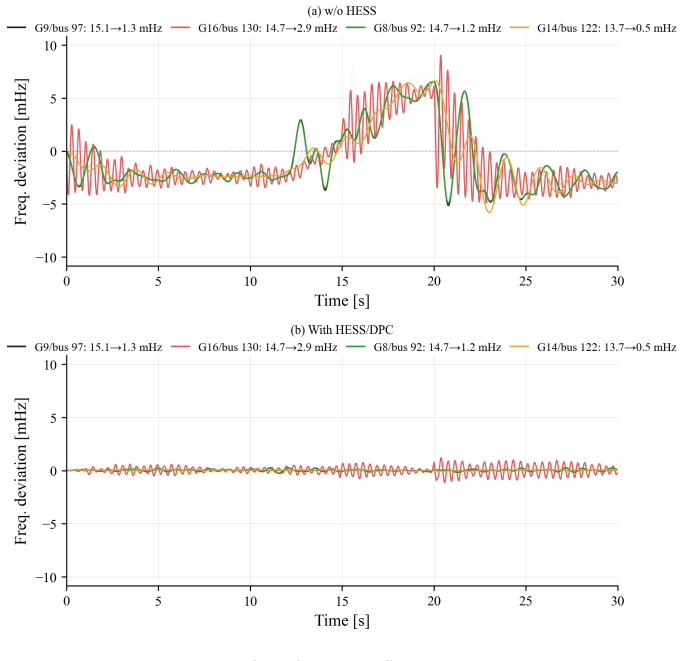
A hybrid energy storage system with residual differentiable predictive control smooths AI datacenter power fluctuations at the source and cuts generator frequency deviations by more than 80 percent in bulk-system simulations.
A machine-rendered reading of the paper's core claim, the machinery that carries it, and where it could break.
Core claim
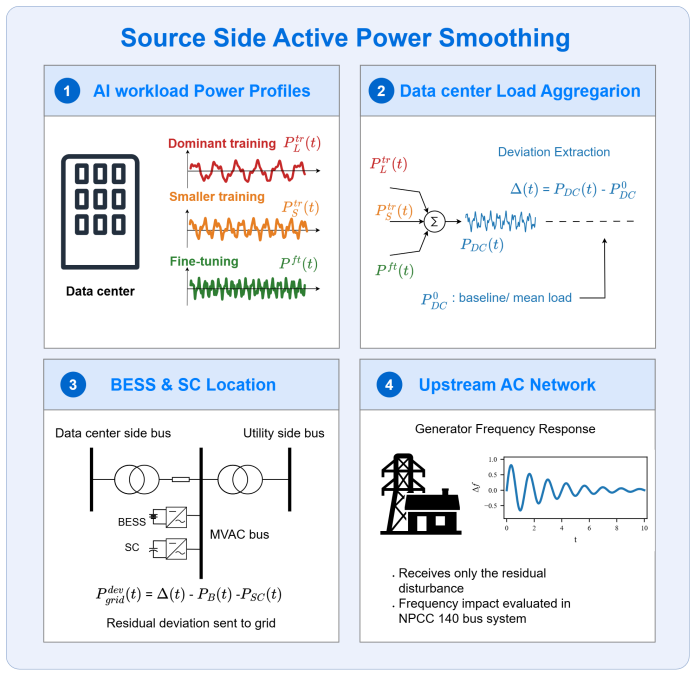
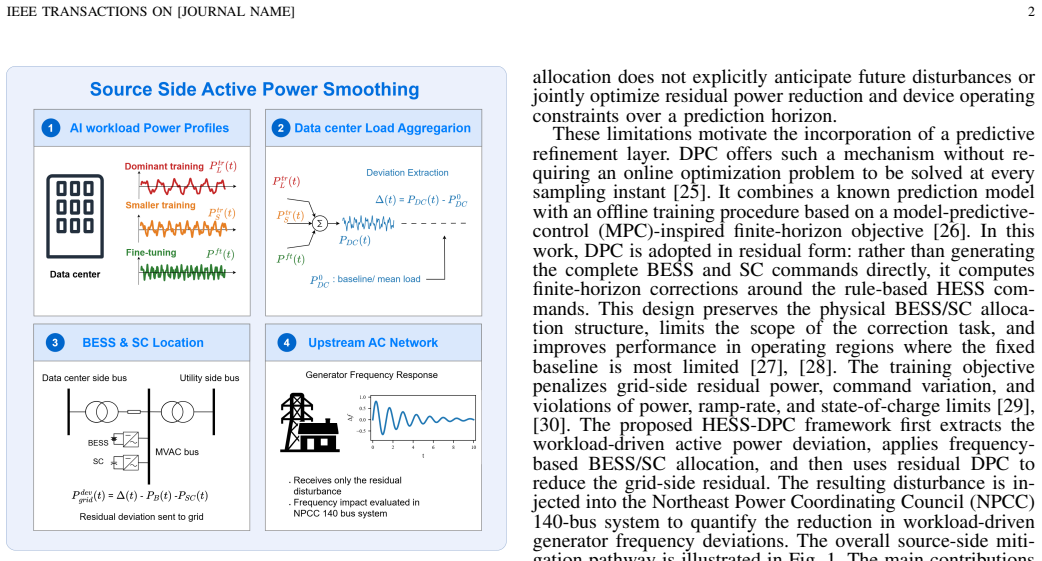
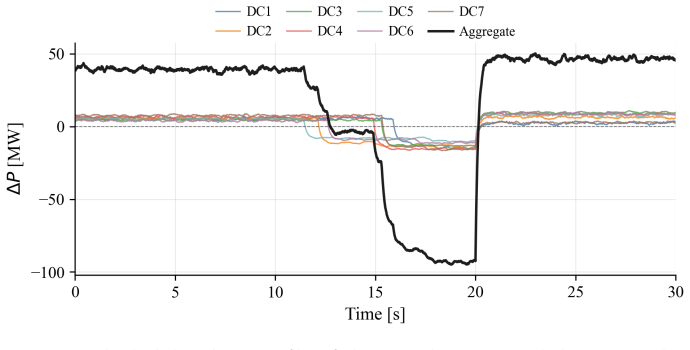
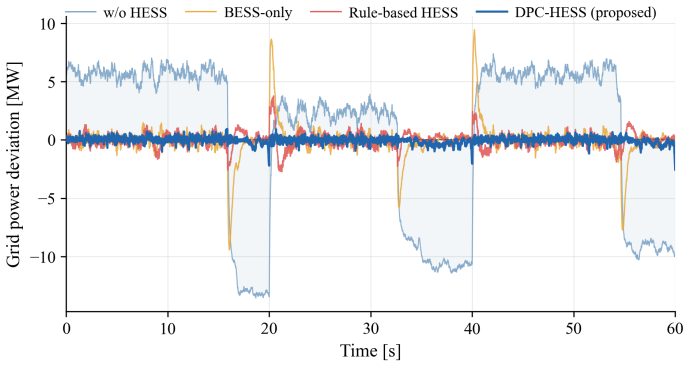
The HESS-DPC framework first builds a workload-driven disturbance model that represents point-of-interconnection load deviation as the superposition of training and fine-tuning workloads. A frequency-based rule-based controller then splits the deviation, sending the energy-dominant part to the battery energy storage system and the fast-varying part to the supercapacitor. A residual differentiable predictive control policy trained offline supplies finite-horizon command corrections around this baseline while enforcing a one-step safeguard. On the NPCC 140-bus system the combined controller reduces grid-side residuals during transitions, improves supercapacitor state-of-charge sustainability,
What carries the argument
The residual differentiable predictive control policy, which computes finite-horizon command corrections around the frequency-based rule-based baseline while enforcing a one-step safeguard, to overcome the anticipation and constraint limits of fixed-frequency power allocation between battery and supercapacitor.
If this is right
- Grid-side residual power deviations decrease during AI workload transitions.
- Supercapacitor state-of-charge remains sustainable over longer operating periods.
- Peak-to-peak frequency deviations at every monitored generator fall by more than 80 percent.
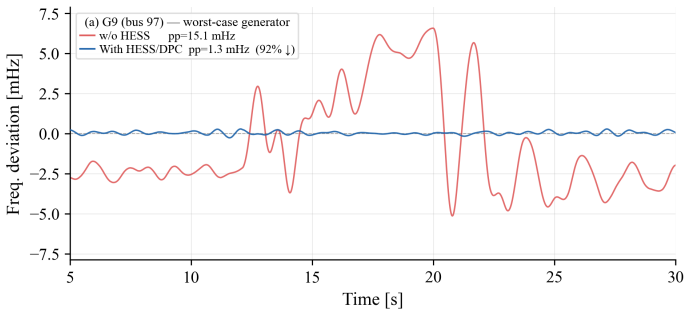
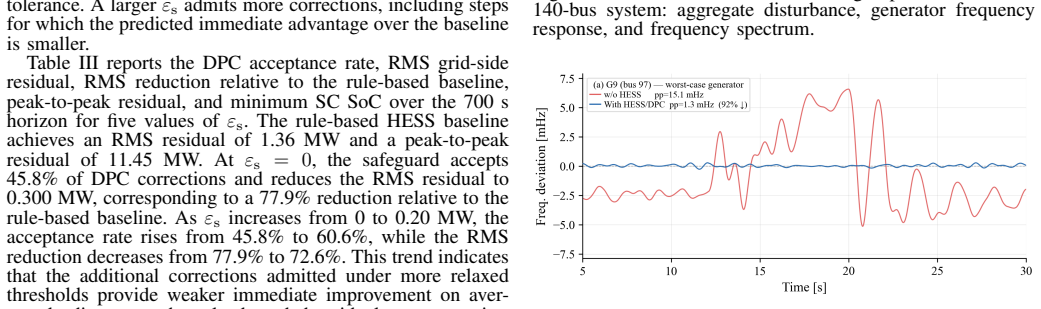
- The worst-affected generator response improves from 15.1 mHz to 1.3 mHz.
Where Pith is reading between the lines
- The same hybrid-storage-plus-residual-control pattern could be tested on other large, structured loads such as cryptocurrency mining farms or hyperscale training clusters.
- Grid operators might incorporate source-side smoothing capability into interconnection studies rather than treating all datacenter load as fixed.
- Hardware-in-the-loop experiments on actual AI server racks would show whether the offline-trained policy transfers when real-time workload telemetry replaces the modeled superposition.
- Adding on-site renewables to the hybrid storage mix could further reduce the residual seen by the grid during low-workload intervals.
Load-bearing premise
The workload-driven disturbance model accurately represents point-of-interconnection load deviation as the superposition of training and fine-tuning workloads.
What would settle it
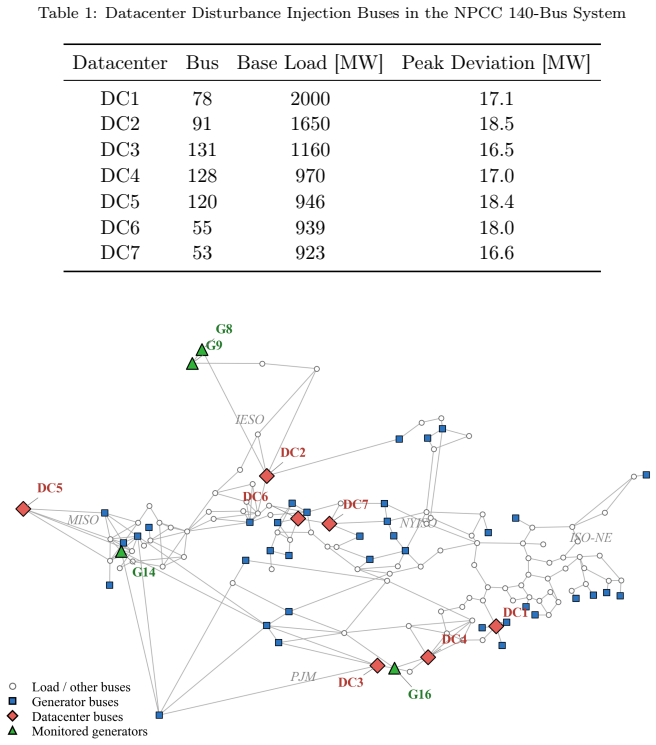
Re-running the NPCC 140-bus simulations with an alternative disturbance model that replaces the training-plus-fine-tuning superposition by unstructured random bursts and finding generator frequency deviations above 5 mHz would falsify the reported mitigation performance.
Figures
read the original abstract
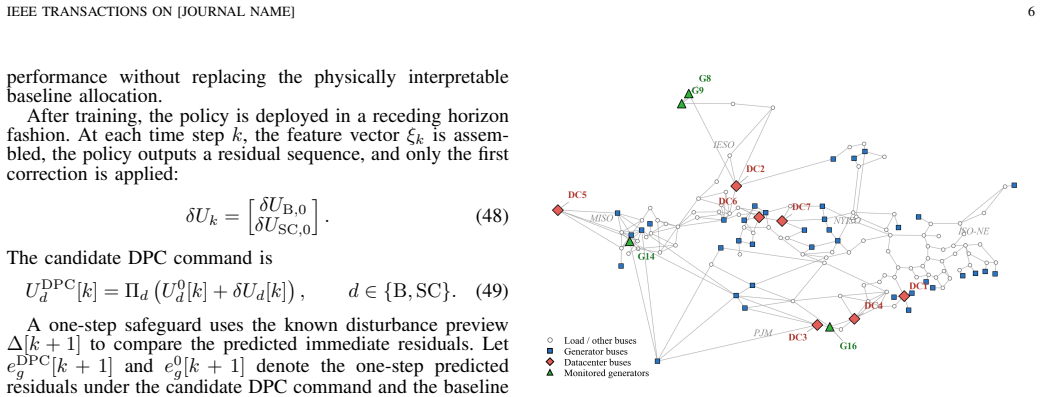
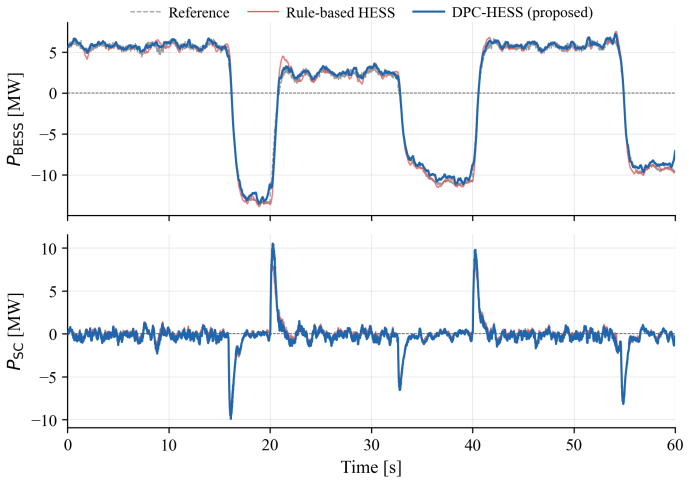
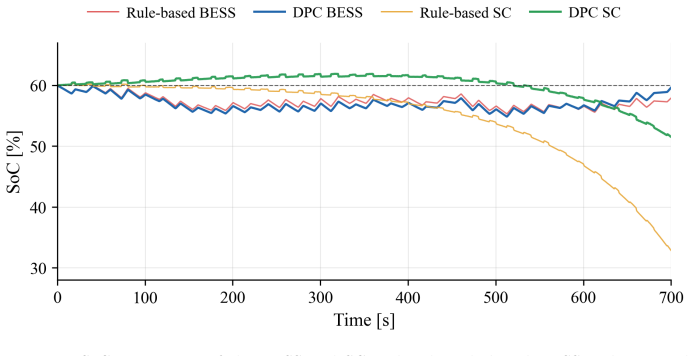
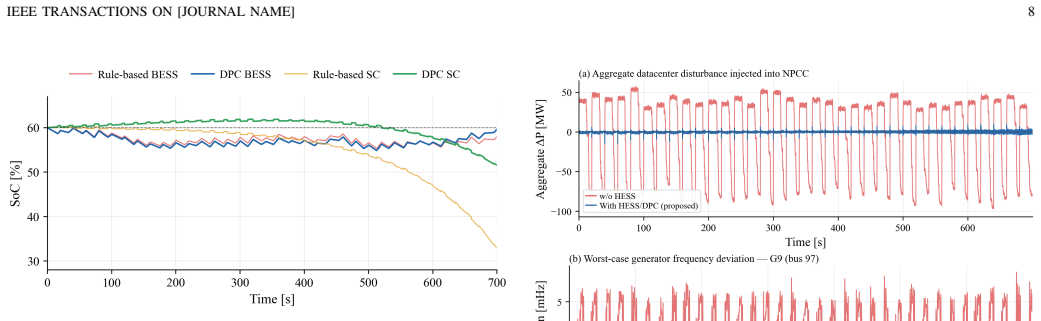
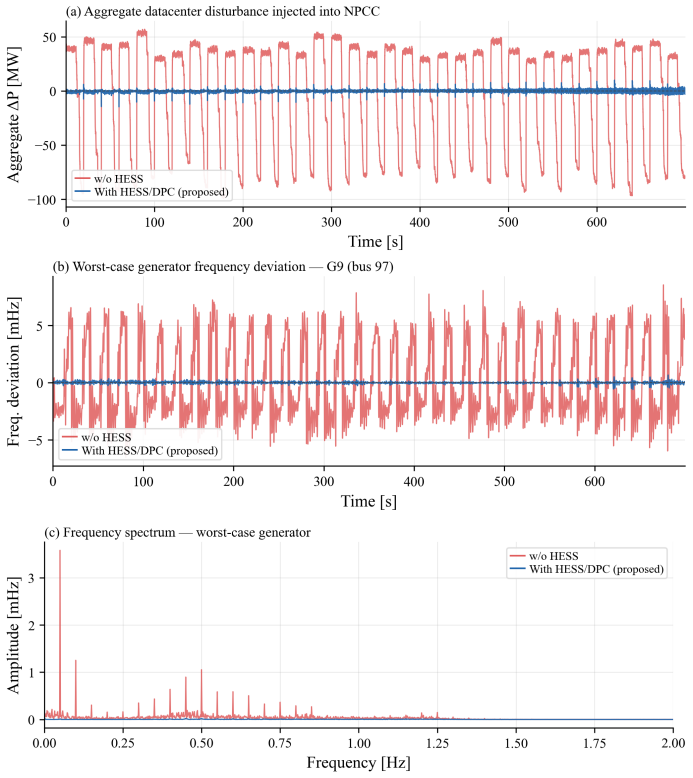
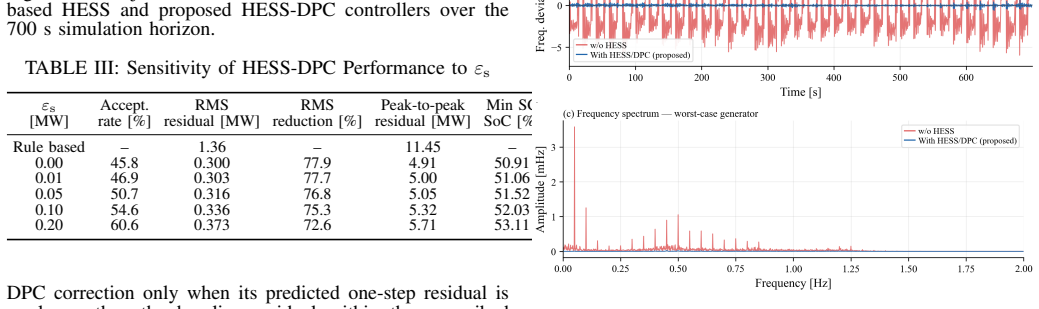
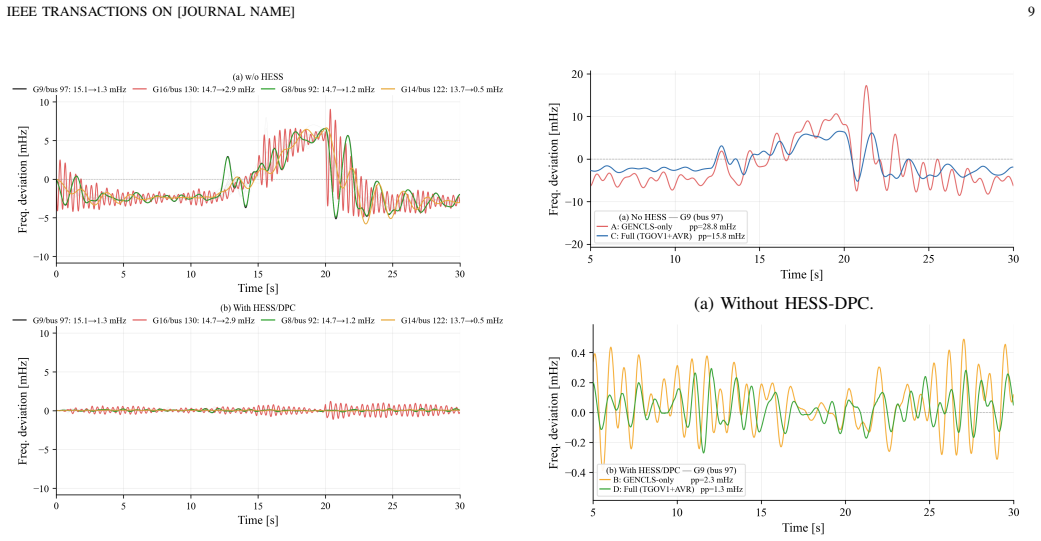
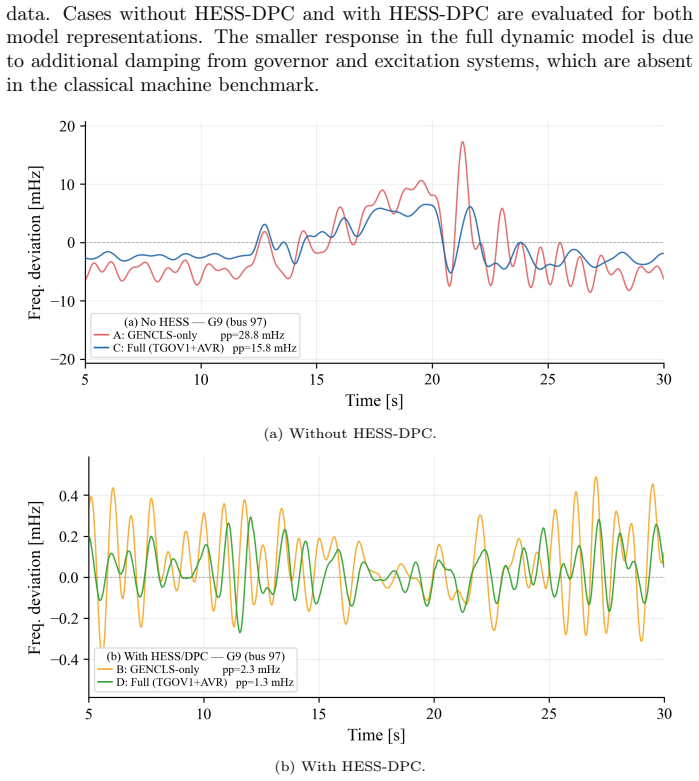
The rapid growth of hyperscale AI datacenters introduces structured, workload-driven active-power fluctuations at the point of interconnection. These fluctuations appear to the grid as time-varying disturbance injections that cannot be captured by conventional peak- or average-load representations. To reduce the residual power disturbance before it propagates into the bulk power system, this paper proposes a hybrid energy storage system with differentiable predictive control (HESS-DPC) framework for datacenter-side power smoothing. A workload-driven disturbance model is first established, representing the point-of-interconnection load deviation as the superposition of training and fine-tuning workloads to capture the structured forcing inputs that can excite generator frequency dynamics. A frequency-based rule-based controller then allocates this deviation between a battery energy storage system (BESS) and a supercapacitor (SC), assigning the energy-dominant component to the BESS and the fast-varying component to the SC. To overcome the anticipation and constraint limitations of fixed-frequency decomposition, a residual differentiable predictive control policy is trained offline to compute finite-horizon command corrections around the rule-based baseline while enforcing a one-step safeguard. Simulations on the NPCC 140-bus system show that HESS-DPC reduces grid-side residual deviations during workload transitions, improves SC state-of-charge sustainability over extended operation, and reduces generator peak-to-peak frequency deviations by more than 80 percent across all monitored generators, with the worst-affected generator response falling from 15.1 mHz to 1.3 mHz. These results confirm that local active-power smoothing at the datacenter point of interconnection can substantially mitigate frequency disturbances caused by AI workloads.
Editorial analysis
A structured set of objections, weighed in public.
Referee Report
Summary. The manuscript proposes a hybrid energy storage system with differentiable predictive control (HESS-DPC) to mitigate structured active-power fluctuations from AI datacenters at the point of interconnection. It establishes a workload-driven disturbance model as the superposition of training and fine-tuning workloads, applies a frequency-based rule-based controller to allocate deviations between BESS and supercapacitor, and trains a residual DPC policy for finite-horizon corrections around the baseline while enforcing safeguards. Simulations on the NPCC 140-bus system report that HESS-DPC reduces grid-side residuals, improves SC state-of-charge sustainability, and cuts generator peak-to-peak frequency deviations by more than 80 percent (worst case from 15.1 mHz to 1.3 mHz).
Significance. If the reported simulation outcomes hold, the work demonstrates that local datacenter-side power smoothing can substantially attenuate frequency disturbances propagating into the bulk system from AI workloads. The combination of explicit workload superposition modeling with residual DPC around a rule-based baseline provides a concrete, implementable framework; the quantified frequency reductions across monitored generators on a standard test system indicate practical relevance for grid integration of hyperscale AI facilities.
minor comments (3)
- The abstract and introduction would benefit from explicit statements on the time scales and sampling rates used for the workload superposition model and the DPC prediction horizon to clarify how the structured forcing inputs align with generator dynamics.
- Figure captions and simulation result tables should include the exact number of monitored generators, the duration of the extended operation test, and the specific workload transition profiles applied, to support direct reproducibility of the 80 percent reduction claim.
- A brief discussion of how the one-step safeguard in the residual DPC policy interacts with the rule-based frequency allocation under constraint violations would improve clarity on the method's robustness.
Simulated Author's Rebuttal
We thank the referee for the detailed summary of our HESS-DPC framework and for the positive assessment of its significance in mitigating AI datacenter-induced frequency disturbances on the NPCC 140-bus system. The recommendation for minor revision is noted. No specific major comments were provided in the report.
Circularity Check
No significant circularity detected
full rationale
The paper's chain proceeds from an explicit workload-superposition disturbance model to a frequency-based rule-based allocation between BESS and SC, followed by offline training of a residual DPC policy that computes corrections around that baseline while enforcing a one-step safeguard. All performance metrics (grid-side residual reduction, SC SoC sustainability, >80% drop in generator frequency deviations) are obtained from direct simulation on the NPCC 140-bus system under the stated workload injections; none of the reported outcomes are obtained by algebraic reduction to the fitted policy parameters or by renaming the input disturbance model. No self-citation, uniqueness theorem, or ansatz smuggling appears in the provided derivation steps, so the simulation results remain independent of the method's internal construction.
Axiom & Free-Parameter Ledger
Reference graph
Works this paper leans on
-
[1]
Characteristics and risks of emerging large loads,
North American Electric Reliability Corporation, “Characteristics and risks of emerging large loads,” 2025
2025
-
[2]
Electromagnetic transient modeling of large data centers for grid-level studies,
B. A. Ross and J. Follum, “Electromagnetic transient modeling of large data centers for grid-level studies,” [Online]. Available: https://www.pnnl.gov/publications/ electromagnetic-transient-modeling- large-data-centers-grid-level-studies, Pacific Northwest National Labora- tory (PNNL), Tech. Rep. PNNL-38817, December 2025, alpha Release. Prepared for the...
2025
-
[3]
2024 united states data center energy usage report,
A. Shehabi, S. J. Smith, A. Hubbard, A. Newkirk, N. Lei, M. A. B. Siddik, B. Holecek, J. G. Koomey, E. R. Masanet, and D. A. Sartor, “2024 united states data center energy usage report,” 2024
2024
-
[4]
Power stabilization for ai training datacenters,
E. Choukse, B. Warrier, S. Heath, L. Belmont, A. Zhao, H. A. Khan, B. Harry, M. Kappel, R. J. Hewett, K. Dattaet al., “Power stabilization for ai training datacenters,”arXiv preprint arXiv:2508.14318, 2025
-
[5]
Deep learning workload scheduling in gpu datacenters: A survey,
Z. Ye, W. Gao, Q. Hu, P. Sun, X. Wang, Y . Luo, T. Zhang, and Y . Wen, “Deep learning workload scheduling in gpu datacenters: A survey,”ACM Computing Surveys, vol. 56, no. 6, pp. 1–38, 2024
2024
-
[6]
Characterizing power management opportunities for llms in the cloud,
P. Patel, E. Choukse, C. Zhang, ´I. Goiri, B. Warrier, N. Mahalingam, and R. Bianchini, “Characterizing power management opportunities for llms in the cloud,” inProceedings of the 29th ACM International Conference on Architectural Support for Programming Languages and Operating Systems, Volume 3, 2024, pp. 207–222
2024
-
[7]
G. Wilkins, F. Kazhamiaka, and R. Rajagopal, “From servers to sites: Compositional power trace generation of llm inference for infrastructure planning,”arXiv preprint arXiv:2603.18383, 2026
-
[8]
Event records showing data center response to faults,
R. O’Keefe, “Event records showing data center response to faults,” Presentation, NERC LLTF April Meeting and Technical Workshop, 2025
2025
-
[9]
Unplanned data center load transfer update,
M. Parker and B. Sterling, “Unplanned data center load transfer update,” Presentation, NERC LLTF June Workshop, 2025
2025
-
[10]
The unseen ai disruptions for power grids: Llm-induced transients,
Y . Li, M. Mughees, Y . Chen, and Y . R. Li, “The unseen ai disruptions for power grids: Llm-induced transients,”arXiv preprint arXiv:2409.11416, 2024
-
[11]
Data center model for transient stability analysis of power systems,
A. Jimenez-Ruiz and F. Milano, “Data center model for transient stability analysis of power systems,”arXiv preprint arXiv:2505.16575, 2025
-
[12]
M100 exadata: a data collection campaign on the cineca’s marconi100 tier-0 supercomputer,
A. Borghesi, C. Di Santi, M. Molan, M. S. Ardebili, A. Mauri, M. Guarrasi, D. Galetti, M. Cestari, F. Barchi, L. Beniniet al., “M100 exadata: a data collection campaign on the cineca’s marconi100 tier-0 supercomputer,”Scientific Data, vol. 10, no. 1, p. 288, 2023
2023
-
[13]
Power modeling for effective datacenter planning and compute management,
A. Radovanovic, B. Chen, S. Talukdar, B. Roy, A. Duarte, and M. Shah- bazi, “Power modeling for effective datacenter planning and compute management,”IEEE Transactions on Smart Grid, vol. 13, no. 2, pp. 1611–1621, 2021
2021
-
[14]
Measurement adequacy for monitoring data center oscillations,
K. Chatterjee, J. D. Follum, A. Varghese, S. Biswas, E. Farantatos, and L. Zhu, “Measurement adequacy for monitoring data center oscillations,” Pacific Northwest National Laboratory, Richland, W A, USA, Technical Report, 2026
2026
-
[15]
Modeling framework for data center,
S. Talukdar, S. Marti, K. Prabakar, and D. Vaidhynathan, “Modeling framework for data center,” National Renewable Energy Laboratory, Golden, CO, USA, Technical Report NREL/TP-2C00-97716, 2026
2026
-
[16]
Wide-area power system oscillations from large- scale ai workloads,
M.-S. Ko and H. Zhu, “Wide-area power system oscillations from large- scale ai workloads,”IEEE Transactions on Power Systems, 2026
2026
-
[17]
Mitigation of datacenter demand ramping and fluc- tuation using hybrid ESS and supercapacitor,
M.-S. Koet al., “Mitigation of datacenter demand ramping and fluc- tuation using hybrid ESS and supercapacitor,”arXiv preprint, vol. arXiv:2512.08076, 2025
-
[18]
Relia- bility Guideline: Risk Mitigation for Emerging Large Loads,
North American Electric Reliability Corporation, “Relia- bility Guideline: Risk Mitigation for Emerging Large Loads,” North American Electric Reliability Corpora- tion, Reliability Guideline, May 2026. [Online]. Avail- able: https://www.nerc.com/globalassets/our-work/guidelines/reliability/ RG Risk-Mitigation-For-Emerging-Large-Loads.pdf
2026
-
[19]
Wide-area power system oscillations from large- scale ai workloads,
M.-S. Ko and H. Zhu, “Wide-area power system oscillations from large- scale ai workloads,”IEEE Transactions on Power Systems, pp. 1–14, 2026
2026
-
[20]
White paper: Grid forming functional specifications for bps- connected battery energy storage systems,
North American Electric Reliability Corporation, “White paper: Grid forming functional specifications for bps- connected battery energy storage systems,” [Online]. Available: https://www.nerc.com/globalassets/our-work/reports/white- papers/white paper gfm functional specification.pdf, 2023
2023
-
[21]
Hierarchical control of hybrid en- ergy storage system in dc microgrids,
J. Xiao, P. Wang, and L. Setyawan, “Hierarchical control of hybrid en- ergy storage system in dc microgrids,”IEEE Transactions on Industrial Electronics, vol. 62, no. 8, pp. 4915–4924, 2015
2015
-
[22]
Virtual capacity of hybrid energy storage systems using adaptive state of charge range control for smoothing renewable intermittency,
J. W. Shimet al., “Virtual capacity of hybrid energy storage systems using adaptive state of charge range control for smoothing renewable intermittency,”IEEE Access, vol. 8, pp. 126 951–126 964, 2020
2020
-
[23]
Modified repetitive control based on comb filters for harmonics control in grid-connected applications,
T. Chmielewski, W. Jarzyna, D. Zieli ´nski, K. Gopakumar, and M. Chmielewska, “Modified repetitive control based on comb filters for harmonics control in grid-connected applications,”Electric Power Systems Research, vol. 200, p. 107412, 2021
2021
-
[24]
A new battery/ultracapacitor hybrid energy storage system for electric, hybrid, and plug-in hybrid electric vehicles,
J. Cao and A. Emadi, “A new battery/ultracapacitor hybrid energy storage system for electric, hybrid, and plug-in hybrid electric vehicles,” IEEE Transactions on power electronics, vol. 27, no. 1, pp. 122–132, 2011
2011
-
[25]
Differen- tiable mpc for end-to-end planning and control,
B. Amos, I. Jimenez, J. Sacks, B. Boots, and J. Z. Kolter, “Differen- tiable mpc for end-to-end planning and control,”Advances in neural information processing systems, vol. 31, 2018
2018
-
[26]
Differentiable predictive control: Deep learning alternative to explicit model predictive control for unknown nonlinear systems,
J. Drgo ˇna, K. Ki ˇs, A. Tuor, D. Vrabie, and M. Klau ˇco, “Differentiable predictive control: Deep learning alternative to explicit model predictive control for unknown nonlinear systems,”Journal of Process Control, vol. 116, pp. 80–92, 2022
2022
-
[27]
T. Silver, K. Allen, J. Tenenbaum, and L. Kaelbling, “Residual policy learning,”arXiv preprint arXiv:1812.06298, 2018
work page internal anchor Pith review Pith/arXiv arXiv 2018
-
[28]
Residual reinforcement learning for robot control,
T. Johannink, S. Bahl, A. Nair, J. Luo, A. Kumar, M. Loskyll, J. A. Ojea, E. Solowjow, and S. Levine, “Residual reinforcement learning for robot control,” in2019 international conference on robotics and automation (ICRA). IEEE, 2019, pp. 6023–6029
2019
-
[29]
Approximating explicit model predictive control using constrained neural networks,
S. Chen, K. Saulnier, N. Atanasov, D. D. Lee, V . Kumar, G. J. Pap- pas, and M. Morari, “Approximating explicit model predictive control using constrained neural networks,” in2018 Annual American control conference (ACC). IEEE, 2018, pp. 1520–1527
2018
-
[30]
Con- strained model predictive control: Stability and optimality,
D. Q. Mayne, J. B. Rawlings, C. V . Rao, and P. O. Scokaert, “Con- strained model predictive control: Stability and optimality,”Automatica, vol. 36, no. 6, pp. 789–814, 2000
2000
-
[31]
Hybrid symbolic-numeric framework for power system modeling and analysis,
H. Cui, F. Li, and K. Tomsovic, “Hybrid symbolic-numeric framework for power system modeling and analysis,”IEEE Transactions on Power Systems, vol. 36, no. 2, pp. 1373–1384, 2021
2021
-
[32]
Evaluating the risk to bulk power system reliability from large load induced oscillations,
S. Biswas, A. C. Varghese, K. Chatterjee, S. Nekkalapu, B. Ross, and J. Follum, “Evaluating the risk to bulk power system reliability from large load induced oscillations,”Authorea Preprints, 2025
2025
-
[33]
Large load disturbance events,
Energy Systems Integration Group (ESIG), “Large load disturbance events,” Energy Systems Integration Group, Tech. Rep. ESIG-LLTF- 2026-01, Mar. 2026
2026
discussion (0)
Sign in with ORCID, Apple, or X to comment. Anyone can read and Pith papers without signing in.