Stabilizing the parquet problem
Pith reviewed 2026-06-28 04:17 UTC · model grok-4.3
The pith
Convergence failures in solving the parquet equations occur even without vertex divergences and can be fixed by a Jacobian-based stabilization strategy.
A machine-rendered reading of the paper's core claim, the machinery that carries it, and where it could break.
Core claim
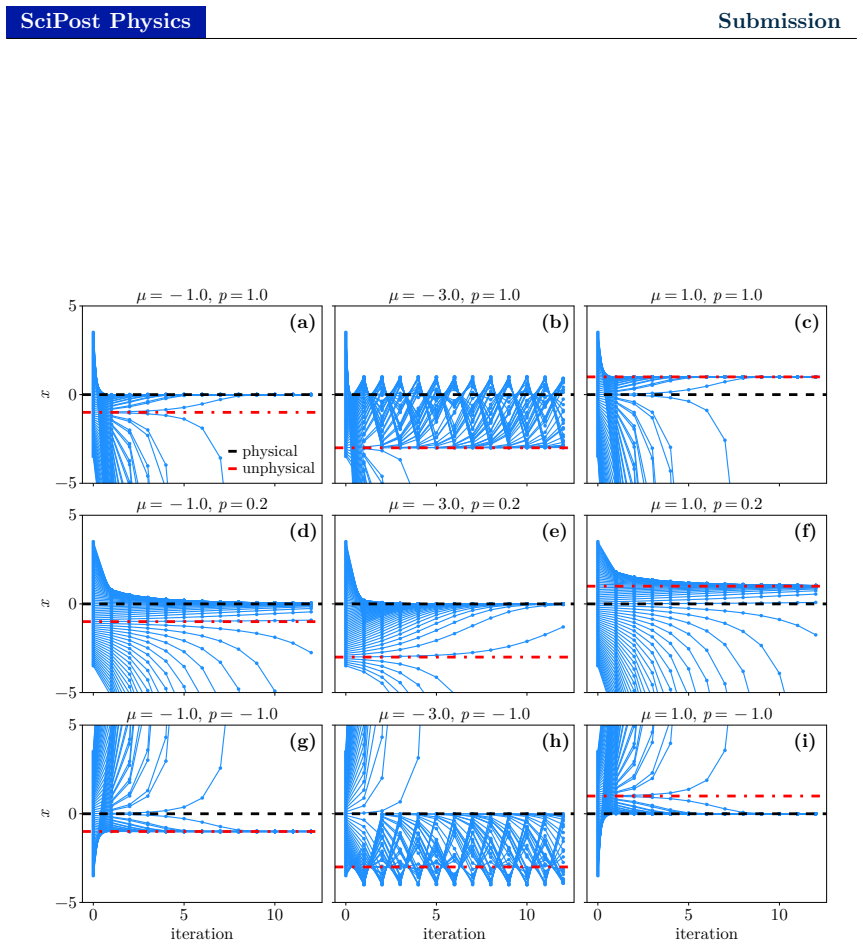
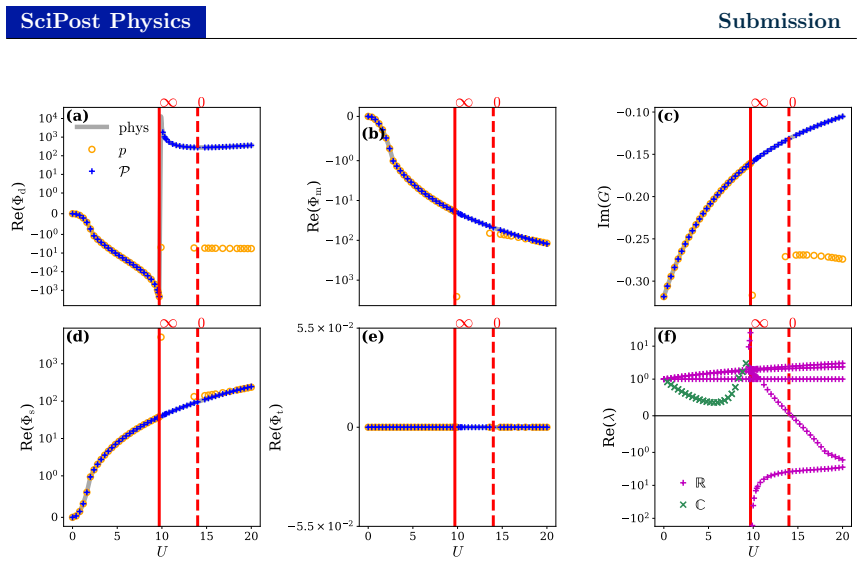
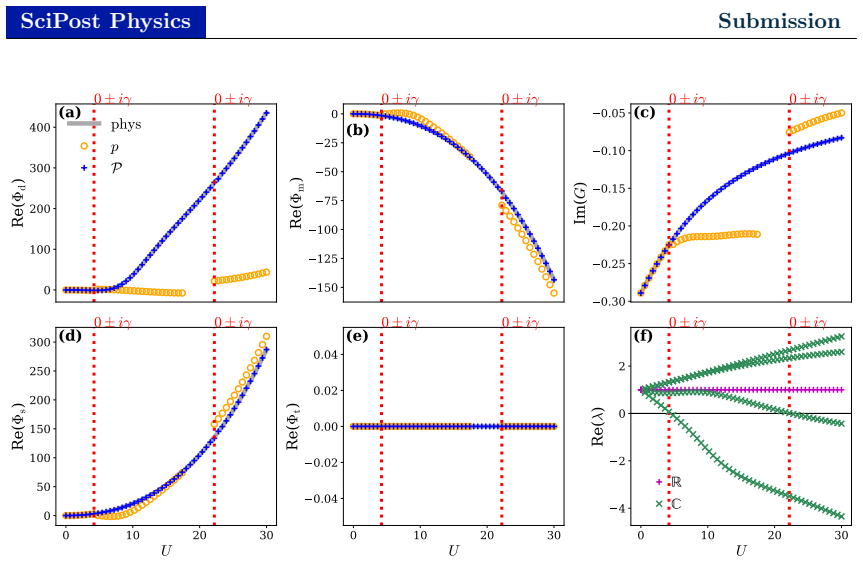
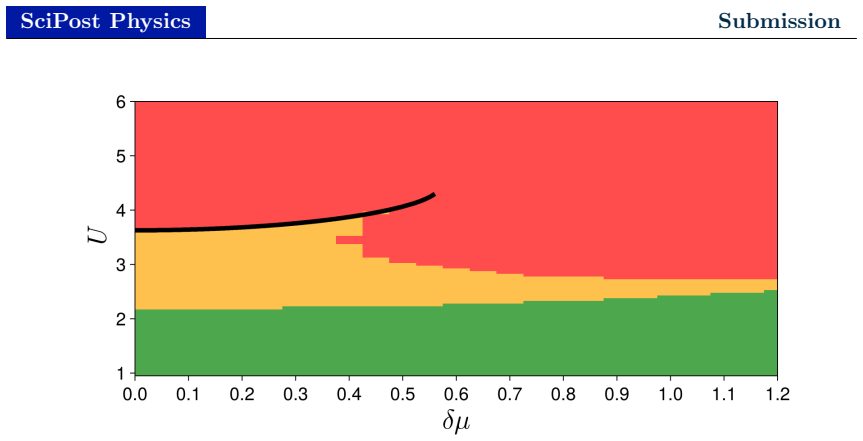
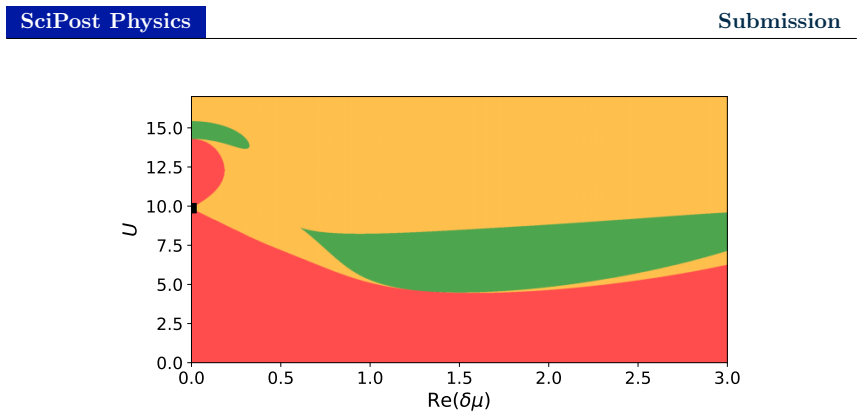
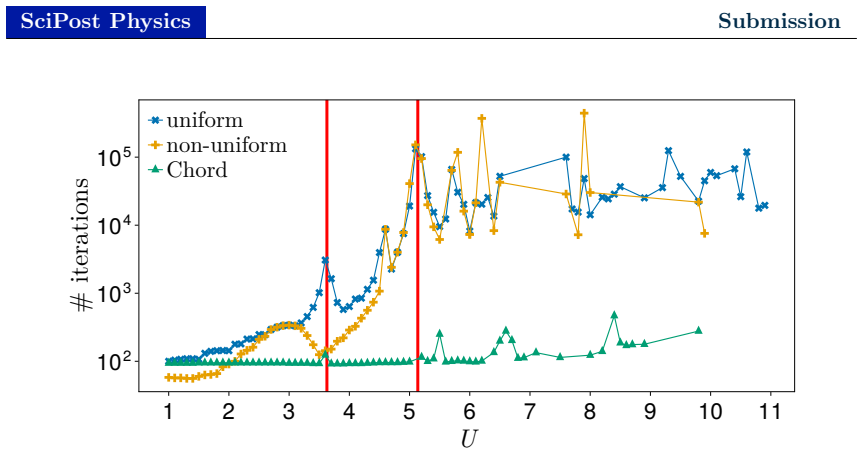
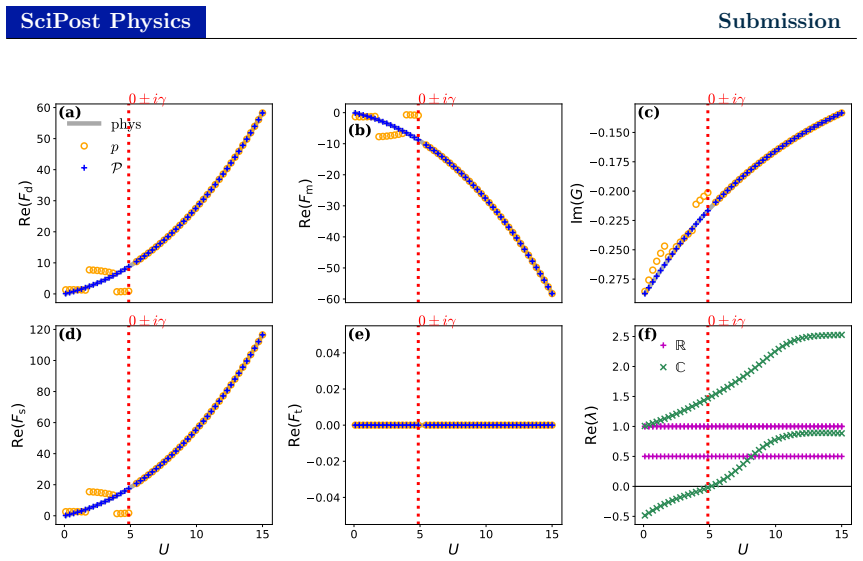
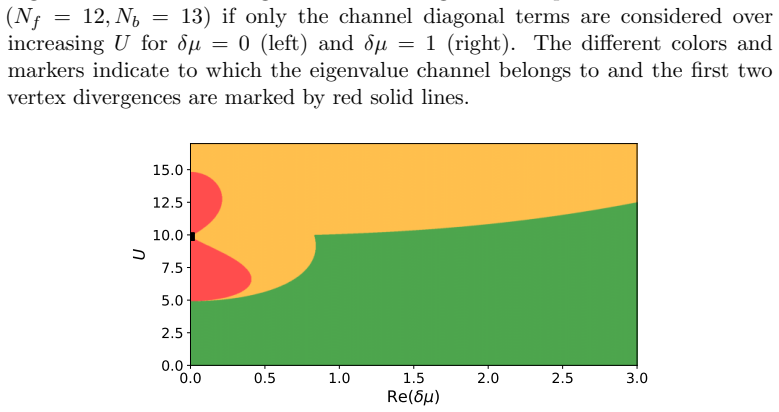
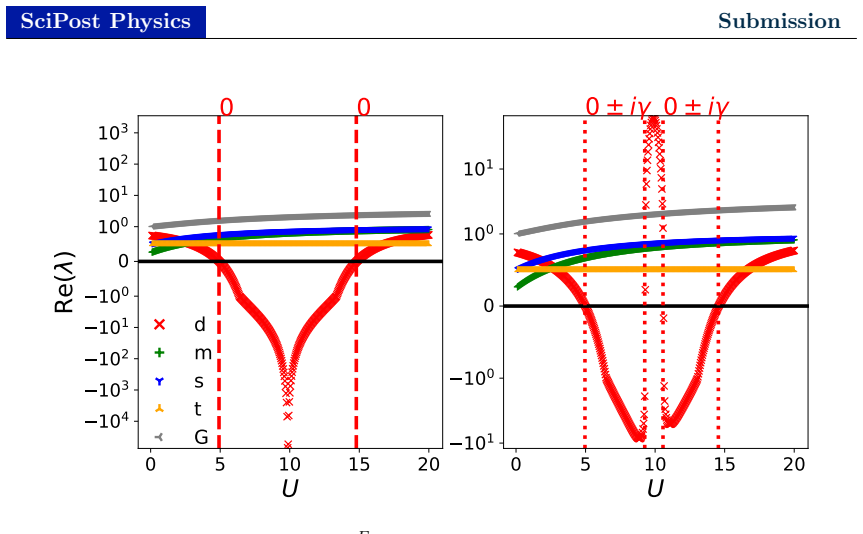
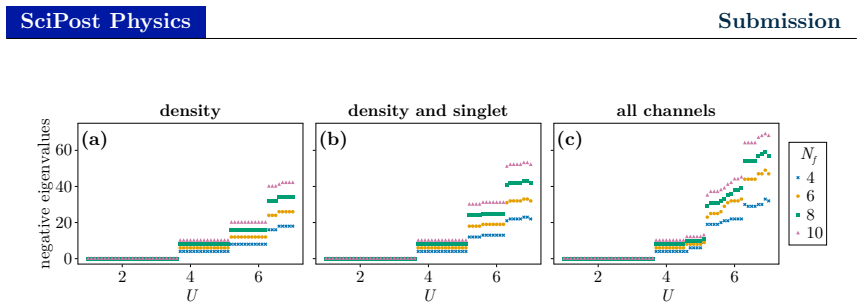
The physical fixed point of the parquet iteration becomes unstable when the spectrum of the Jacobian of the damped fixed-point iteration satisfies an explicit criterion. Misleading convergence issues appear independently of divergences of the two-particle irreducible vertex and are therefore not directly produced by crossings of solutions of the multivalued Luttinger-Ward functional. A controlled stabilization strategy restores convergence to the physical solution in the identified instability regimes, as verified explicitly for the zero-point model and the atomic-limit Hubbard model.
What carries the argument
The spectrum of the Jacobian associated with the damped fixed-point iteration procedure, which supplies the explicit stability criterion for the physical fixed point.
If this is right
- The physical solution remains reachable by iteration even when the two-particle vertex diverges.
- Convergence can be maintained across multiple divergence lines of the Luttinger-Ward functional.
- The same stabilization procedure applies to both the zero-point model and the atomic-limit Hubbard model.
- Misleading convergence failures are decoupled from the multivalued character of the Luttinger-Ward functional.
Where Pith is reading between the lines
- The Jacobian diagnostic could be applied to other self-consistent diagrammatic schemes that rely on fixed-point iteration.
- The method may allow parquet-based calculations to reach intermediate-coupling regimes relevant to real materials without manual intervention.
- Similar stability analysis might clarify convergence problems reported in related many-body resummation techniques.
Load-bearing premise
The spectrum of the Jacobian of the damped fixed-point iteration fully determines whether the physical fixed point is stable.
What would settle it
An explicit numerical run in which the iteration converges to the physical parquet solution in a parameter region where the Jacobian spectrum predicts instability, or fails to converge in a region where the spectrum predicts stability.
Figures








read the original abstract
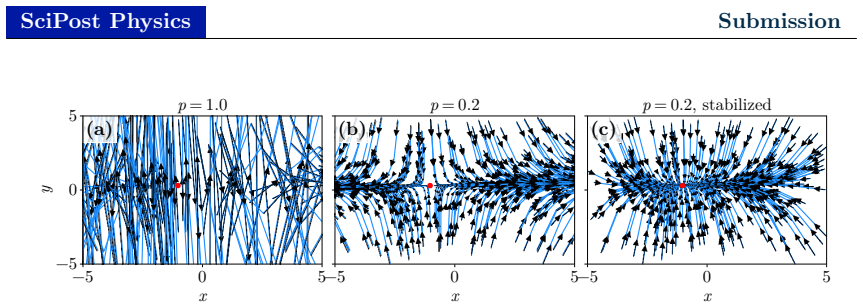
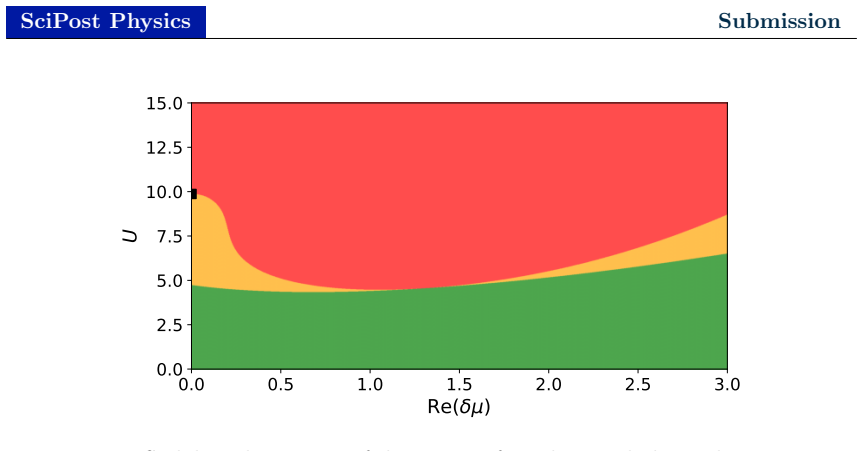
We systematically analyze the stability of the iterative solution of the parquet equations by studying the spectrum of the Jacobian associated with the commonly used damped fixed-point iteration procedure. In this context, we provide an explicit criterion that determines when the physical fixed point of the parquet iteration becomes unstable. Importantly, we demonstrate that misleading convergence issues, observed in parquet calculation at intermediate-to-high interaction values, are not restricted to parameter regions where the two-particle irreducible vertex diverges, but can also arise in absence of vertex divergences. Hence, the misleading convergence issues of parquet-based algorithms are not directly caused by the crossings of two solutions of the (multivalued) Luttinger-Ward functional, that are associated with vertex divergences. Building on these insights, we introduce a controlled stabilization strategy that allows the convergence to the physical solution in the instability regimes. We apply this procedure to the zero-point model and the Hubbard model in the atomic limit, where we successfully stabilize the physical solution deep in the non-perturbative regime, even across multiple divergence lines.
Editorial analysis
A structured set of objections, weighed in public.
Referee Report
Summary. The manuscript analyzes the stability of the iterative solution of the parquet equations via the spectrum of the Jacobian of the commonly used damped fixed-point iteration. It derives an explicit criterion for when the physical fixed point becomes unstable and shows that misleading convergence issues at intermediate-to-high interactions arise even without divergences in the two-particle irreducible vertex. This decouples the issues from crossings of Luttinger-Ward functional solutions. A controlled stabilization strategy is introduced and demonstrated on the zero-point model and the atomic-limit Hubbard model, where the physical solution is stabilized deep in the non-perturbative regime across multiple divergence lines.
Significance. If the central claims hold, the work provides a systematic diagnostic and practical stabilization method for parquet calculations in strongly correlated systems, addressing a known practical obstacle. The explicit Jacobian-based criterion and its application to concrete models with successful stabilization across divergence lines are strengths that could improve reliability of non-perturbative parquet results.
major comments (1)
- [Abstract] Abstract (stability analysis paragraph): The claim that the Jacobian spectrum of the damped iteration fully determines stability of the physical fixed point (i.e., that convergence fails precisely when an eigenvalue leaves the unit disk) is load-bearing for separating convergence issues from Luttinger-Ward crossings. No independent verification is provided that the eigenvalue threshold coincides with actual loss of convergence in parameter regions without vertex divergences, leaving open whether other mechanisms (finite basin size, damping dependence) could produce the observed failures independently.
minor comments (2)
- The definition of the damped iteration map and the precise form of the Jacobian matrix should be stated explicitly with equation numbers in the main text for reproducibility.
- In the applications section, quantitative measures of stabilization success (e.g., distance to reference solutions or iteration counts before/after stabilization) would strengthen the demonstration.
Simulated Author's Rebuttal
We thank the referee for the careful reading and constructive feedback. We respond to the major comment below.
read point-by-point responses
-
Referee: [Abstract] Abstract (stability analysis paragraph): The claim that the Jacobian spectrum of the damped iteration fully determines stability of the physical fixed point (i.e., that convergence fails precisely when an eigenvalue leaves the unit disk) is load-bearing for separating convergence issues from Luttinger-Ward crossings. No independent verification is provided that the eigenvalue threshold coincides with actual loss of convergence in parameter regions without vertex divergences, leaving open whether other mechanisms (finite basin size, damping dependence) could produce the observed failures independently.
Authors: We agree that explicit verification strengthens the claim. The stability criterion follows directly from linear stability analysis of the damped fixed-point map, which by construction identifies loss of local stability when the spectral radius exceeds unity. To address the concern, we will add in the revision a dedicated numerical check: a parameter scan in the zero-point model (away from vertex divergences) that directly compares the eigenvalue threshold against the observed onset of iteration divergence for varying damping factors. This will confirm coincidence and exclude independent mechanisms such as basin-size effects in the presented cases. The abstract and main text will be updated to reference this verification. revision: yes
Circularity Check
No significant circularity; stability criterion derived directly from Jacobian analysis
full rationale
The paper analyzes the stability of the parquet iteration by computing the spectrum of the Jacobian of the standard damped fixed-point map and derives an explicit criterion for when the physical fixed point loses stability. This is a direct mathematical construction from the iteration procedure itself, not a fit, self-definition, or reduction to prior self-citations. The demonstration that misleading convergence issues occur without vertex divergences follows from applying this criterion to the zero-point and atomic-limit Hubbard models. The introduced stabilization strategy is presented as a controlled procedure built on the same Jacobian analysis. No quoted step reduces the central result to its inputs by construction, and the derivation remains self-contained against external benchmarks.
Axiom & Free-Parameter Ledger
axioms (1)
- domain assumption The damped fixed-point iteration is the commonly used procedure whose stability is representative of parquet solvers.
Reference graph
Works this paper leans on
-
[1]
H. Eßl, M. Reitner, E. Kozik and A. Toschi,Origin of misleading convergence in self-consistent many-electron theories: Fundamental aspects and practical implications, Phys. Rev. Lett. (2026), doi:10.1103/zjy7-4jqd
-
[2]
C. De Dominicis and P. C. Martin,Stationary entropy principle and renormalization in normal and superfluid systems. i. algebraic formulation, Journal of Mathematical Physics5(1), 14 (1964), doi:10.1063/1.1704062
-
[3]
C. De Dominicis and P. C. Martin,Stationary entropy principle and renormalization in normal and superfluid systems. ii. diagrammatic formulation, Journal of Mathematical Physics5(1), 31 (1964), doi:10.1063/1.1704064
-
[4]
N. E. Bickers,Self-Consistent Many-Body Theory for Condensed Matter Systems, pp. 237–296, Springer New York, New York, NY, ISBN 978-0-387-21717-8, doi:10.1007/0- 387-21717-7 6 (2004)
work page doi:10.1007/0- 2004
-
[5]
E. Kozik, M. Ferrero and A. Georges,Nonexistence of the Luttinger-Ward Functional and Misleading Convergence of Skeleton Diagrammatic Series for Hubbard-Like Models, Phys. Rev. Lett.114, 156402 (2015), doi:10.1103/PhysRevLett.114.156402
-
[6]
R. Rossi and F. Werner,Skeleton series and multivaluedness of the self-energy functional in zero space-time dimensions, Journal of Physics A: Mathematical and Theoretical48(48), 485202 (2015), doi:10.1088/1751-8113/48/48/485202
-
[7]
A. J. Kim and V. Sacksteder,Multivaluedness of the Luttinger-Ward functional in the fermionic and bosonic system with replicas, Phys. Rev. B101, 115146 (2020), doi:10.1103/PhysRevB.101.115146
-
[8]
E. Kozik, K. Van Houcke, E. Gull, L. Pollet, N. Prokof’ev, B. Svistunov and M. Troyer, Diagrammatic Monte Carlo for correlated fermions, Europhysics Letters90(1), 10004 (2010), doi:10.1209/0295-5075/90/10004
-
[9]
T. Sch¨ afer, N. Wentzell, F. ˇSimkovic, Y.-Y. He, C. Hille, M. Klett, C. J. Eck- hardt, B. Arzhang, V. Harkov, F. m. c.-M. Le R´ egent, A. Kirsch, Y. Wang et al.,Tracking the footprints of spin fluctuations: A multimethod, multimessen- ger study of the two-dimensional Hubbard model, Phys. Rev. X11, 011058 (2021), doi:10.1103/PhysRevX.11.011058
-
[10]
T. Sch¨ afer and A. Toschi,How to read between the lines of electronic spectra: the diagnostics of fluctuations in strongly correlated electron systems, Journal of Physics: Condensed Matter33(21), 214001 (2021), doi:10.1088/1361-648X/abeb44
-
[11]
A. Kauch, P. Pudleiner, K. Astleithner, P. Thunstr¨ om, T. Ribic and K. Held,Generic optical excitations of correlated systems: π-tons, Phys. Rev. Lett.124, 047401 (2020), doi:10.1103/PhysRevLett.124.047401
-
[12]
P. Pudleiner, P. Thunstr¨ om, A. Valli, A. Kauch, G. Li and K. Held,Parquet approxi- mation for molecules: Spectrum and optical conductivity of the Pariser-Parr-Pople model, Phys. Rev. B99, 125111 (2019), doi:10.1103/PhysRevB.99.125111
-
[13]
P. Pudleiner, A. Kauch, K. Held and G. Li,Competition between antiferromagnetic and charge density wave fluctuations in the extended Hubbard model, Phys. Rev. B 100, 075108 (2019), doi:10.1103/PhysRevB.100.075108. 48 SciPost Physics Submission
-
[14]
J.-M. Lihm, D. Kiese, S.-S. B. Lee and F. B. Kugler,The finite-difference parquet method: Enhanced electron–paramagnon scattering opens a pseudo- gap, Proceedings of the National Academy of Sciences123(10), e2525308123 (2026), doi:10.1073/pnas.2525308123, https://www.pnas.org/doi/pdf/10.1073/ pnas.2525308123
-
[15]
S. X. Yang, H. Fotso, J. Liu, T. A. Maier, K. Tomko, E. F. D’Azevedo, R. T. Scalettar, T. Pruschke and M. Jarrell,Parquet approximation for the4 × 4Hubbard cluster, Phys. Rev. E80, 046706 (2009), doi:10.1103/PhysRevE.80.046706
-
[16]
K.-M. Tam, H. Fotso, S.-X. Yang, T.-W. Lee, J. Moreno, J. Ramanujam and M. Jarrell, Solving the parquet equations for the Hubbard model beyond weak coupling, Phys. Rev. E87, 013311 (2013), doi:10.1103/PhysRevE.87.013311
-
[17]
G. Li, N. Wentzell, P. Pudleiner, P. Thunstr¨ om and K. Held,Efficient implemen- tation of the parquet equations: Role of the reducible vertex function and its kernel approximation, Phys. Rev. B93, 165103 (2016), doi:10.1103/PhysRevB.93.165103
-
[18]
N. Wentzell, G. Li, A. Tagliavini, C. Taranto, G. Rohringer, K. Held, A. Toschi and S. Andergassen,High-frequency asymptotics of the vertex function: Diagrammatic parametrization and algorithmic implementation, Phys. Rev. B102, 085106 (2020), doi:10.1103/PhysRevB.102.085106
-
[19]
G. Li, A. Kauch, P. Pudleiner and K. Held,The victory project v1.0: An efficient parquet equations solver, Comput. Phys. Commun241, 146 (2019), doi:https://doi.org/10.1016/j.cpc.2019.03.008
-
[20]
C. J. Eckhardt, C. Honerkamp, K. Held and A. Kauch,Truncated unity parquet solver, Phys. Rev. B101, 155104 (2020), doi:10.1103/PhysRevB.101.155104
-
[21]
F. Krien, A. Kauch and K. Held,Tiling with triangles: parquet and GW γ methods unified, Phys. Rev. Research3, 013149 (2021), doi:10.1103/PhysRevResearch.3.013149
-
[22]
F. Krien and A. Kauch,The plain and simple parquet approximation: single-and multi-boson exchange in the two-dimensional Hubbard model, Europ. Phys. J. B95(4), 69 (2022), doi:10.1140/epjb/s10051-022-00329-6
-
[23]
S. Rohshap, M. K. Ritter, H. Shinaoka, J. von Delft, M. Wallerberger and A. Kauch, Two-particle calculations with quantics tensor trains: Solving the parquet equations, Phys. Rev. Res.7, 023087 (2025), doi:10.1103/PhysRevResearch.7.023087
-
[24]
A. Toschi, A. A. Katanin and K. Held,Dynamical vertex approximation: A step beyond dynamical mean-field theory, Phys. Rev. B75, 045118 (2007), doi:10.1103/PhysRevB.75.045118
-
[25]
T. Sch¨ afer, G. Rohringer, O. Gunnarsson, S. Ciuchi, G. Sangiovanni and A. Toschi, Divergent precursors of the Mott-Hubbard transition at the two-particle level, Phys. Rev. Lett.110, 246405 (2013), doi:10.1103/PhysRevLett.110.246405
-
[26]
O. Gunnarsson, G. Rohringer, T. Sch¨ afer, G. Sangiovanni and A. Toschi,Breakdown of traditional many-body theories for correlated electrons, Phys. Rev. Lett.119, 056402 (2017), doi:10.1103/PhysRevLett.119.056402
-
[27]
D. Springer, P. Chalupa, S. Ciuchi, G. Sangiovanni and A. Toschi,Interplay between local response and vertex divergences in many-fermion systems with on-site attraction, Physical Review B101(15) (2020), doi:10.1103/physrevb.101.155148. 49 SciPost Physics Submission
-
[28]
Gievers, H
M. Gievers, H. Eßl, S. Rohshap, A. Kauch and A. Toschi,Instabilities in self-consistent diagrammatic approaches and how to cure them,in preparation(2026)
2026
-
[29]
T. Sch¨ afer, S. Ciuchi, M. Wallerberger, P. Thunstr¨ om, O. Gunnarsson, G. Sangiovanni, G. Rohringer and A. Toschi,Nonperturbative landscape of the Mott-Hubbard transition: Multiple divergence lines around the critical endpoint, Phys. Rev. B94, 235108 (2016), doi:10.1103/PhysRevB.94.235108
-
[30]
P. Thunstr¨ om, O. Gunnarsson, S. Ciuchi and G. Rohringer,Analytical investigation of singularities in two-particle irreducible vertex functions of the Hubbard atom, Phys. Rev. B98, 235107 (2018), doi:10.1103/PhysRevB.98.235107
-
[31]
H. Shinaoka, M. Wallerberger, Y. Murakami, K. Nogaki, R. Sakurai, P. Werner and A. Kauch,Multiscale space-time ansatz for correlation functions of quan- tum systems based on quantics tensor trains, Phys. Rev. X13, 021015 (2023), doi:10.1103/PhysRevX.13.021015
-
[32]
Adaptive Patching for Tensor Train Computations
G. Grosso, M. K. Ritter, S. Rohshap, S. Badr, A. Kauch, M. Wallerberger, J. von Delft and H. Shinaoka,Adaptive patching for tensor train computations, doi:10.48550/arXiv.2602.22372 (2026),2602.22372
work page internal anchor Pith review Pith/arXiv arXiv doi:10.48550/arxiv.2602.22372 2026
-
[33]
M. Wallerberger, H. Shinaoka and A. Kauch,Solving the Bethe-Salpeter equation with exponential convergence, Phys. Rev. Res.3, 033168 (2021), doi:10.1103/PhysRevResearch.3.033168
-
[34]
A. Al-Eryani, M. Gievers and K. Fraboulet,Functional renormalization with interaction flows: A single-boson exchange perspective and application to electron-phonon systems, Phys. Rev. Res.8, 023029 (2026), doi:10.1103/7y6x-p6zx
-
[35]
G. Rohringer, A. Valli and A. Toschi,Local electronic correlation at the two-particle level, Phys. Rev. B86, 125114 (2012), doi:10.1103/PhysRevB.86.125114
-
[36]
Reviews of Modern Physics , volume =
G. Rohringer, H. Hafermann, A. Toschi, A. A. Katanin, A. E. Antipov, M. I. Katsnelson, A. I. Lichtenstein, A. N. Rubtsov and K. Held,Diagrammatic routes to nonlocal correlations beyond dynamical mean field theory, Rev. Mod. Phys.90, 025003 (2018), doi:10.1103/RevModPhys.90.025003
-
[37]
K. Held,Beyond DMFT: Spin fluctuations, pseudogaps and superconductivity(2022), doi:https://doi.org/10.48550/arXiv.2208.03174,2208.03174
-
[38]
E. Gull, A. J. Millis, A. I. Lichtenstein, A. N. Rubtsov, M. Troyer and P. Werner, Continuous-time Monte Carlo methods for quantum impurity models, Rev. Mod. Phys. 83, 349 (2011), doi:10.1103/RevModPhys.83.349
-
[39]
K. Van Houcke, E. Kozik, N. Prokof’ev and B. Svistunov,Diagrammatic Monte Carlo, Physics Procedia6, 95 (2010), doi:https://doi.org/10.1016/j.phpro.2010.09.034, Computer Simulations Studies in Condensed Matter Physics XXI
-
[40]
K. V. Houcke, E. Kozik, R. Rossi, Y. Deng and F. Werner,Physical and unphysical regimes of self-consistent many-body perturbation theory, SciPost Phys.16, 133 (2024), doi:10.21468/SciPostPhys.16.5.133
-
[41]
A. J. Kim and E. Kozik,Misleading convergence of the skeleton diagrammatic technique: when the correct solution can be found, doi:https://doi.org/10.48550/arXiv.2212.14768 (2022),2212.14768. 50 SciPost Physics Submission
-
[42]
M. Pelz, S. Adler, M. Reitner and A. Toschi,Highly nonperturbative nature of the Mott metal-insulator transition: Two-particle vertex divergences in the coexistence region, Phys. Rev. B108, 155101 (2023), doi:10.1103/PhysRevB.108.155101
-
[43]
H. Eßl, M. Reitner, G. Sangiovanni and A. Toschi,General Shiba mapping for on-site four-point correlation functions, Phys. Rev. Res.6, 033061 (2024), doi:10.1103/PhysRevResearch.6.033061
-
[44]
J. Vuˇ ciˇ cevi´ c, N. Wentzell, M. Ferrero and O. Parcollet,Practical consequences of the Luttinger-Ward functional multivaluedness for cluster DMFT methods, Phys. Rev. B 97, 125141 (2018), doi:10.1103/PhysRevB.97.125141
-
[45]
M. Meixner, M. Reitner, T. Sch¨ afer and A. Toschi,Non-perturbative effects of short-range spatial correlations at the two-particle level, doi:https://doi.org/10.48550/arXiv.2512.17716 (2025),2512.17716
-
[46]
P. Chalupa, T. Sch¨ afer, M. Reitner, D. Springer, S. Andergassen and A. Toschi, Fingerprints of the local moment formation and its Kondo screening in the generalized susceptibilities of many-electron problems, Phys. Rev. Lett.126, 056403 (2021), doi:10.1103/PhysRevLett.126.056403
-
[47]
M. Reitner, P. Chalupa, L. Del Re, D. Springer, S. Ciuchi, G. Sangiovanni and A. Toschi, Attractive effect of a strong electronic repulsion: The physics of vertex divergences, Physical Review Letters125(19) (2020), doi:10.1103/physrevlett.125.196403
-
[48]
K. Byczuk, M. Kollar, K. Held, Y.-F. Yang, I. A. Nekrasov, T. Pruschke and D. Voll- hardt,Kinks in the dispersion of strongly correlated electrons, Nature Physics3(3), 168 (2007), doi:10.1038/nphys538
-
[49]
M. Eckstein, M. Kollar and P. Werner,Thermalization after an interac- tion quench in the Hubbard model, Physical Review Letters103(5) (2009), doi:10.1103/physrevlett.103.056403
-
[50]
S. Adler, F. Krien, P. Chalupa-Gantner, G. Sangiovanni and A. Toschi, Non-perturbative intertwining between spin and charge correlations: A “smok- ing gun” single-boson-exchange result, SciPost Phys.16, 054 (2024), doi:10.21468/SciPostPhys.16.2.054
-
[51]
T. B. Mazitov and A. A. Katanin,Local magnetic moment formation and Kondo screening in the half-filled single-band Hubbard model, Physical Review B105(8) (2022), doi:10.1103/physrevb.105.l081111
-
[52]
E. A. Stepanov, S. Brener, V. Harkov, M. I. Katsnelson and A. I. Lichtenstein,Spin dynamics of itinerant electrons: Local magnetic moment formation and Berry phase, Physical Review B105(15) (2022), doi:10.1103/physrevb.105.155151
-
[53]
Meixner, H
M. Meixner, H. Eßl, A. Toschi and T. Sch¨ afer,On degeneracies of density, magnetic, and pairing responses: How competing orders echo underlying symmetries in the Hubbard model,in preparation(2026)
2026
-
[54]
S. Badr,ParquetIR.jl: Efficiently solving the parquet equations using a sparse repre- sentation, doi:https://doi.org/10.34726/hss.2024.126082 (2024)
-
[55]
M. Reitner, L. Del Re, M. Capone and A. Toschi,Nonperturbative feats in the physics of correlated antiferromagnets, Phys. Rev. Res.7, 033264 (2025), doi:10.1103/ympr- 9m73. 51 SciPost Physics Submission
-
[56]
Generating functional for the full parquet approximation
V. Janis,Generating functional for the full parquet approximation, doi:10.48550/arXiv.cond-mat/9806118 (1998),cond-mat/9806118
work page internal anchor Pith review Pith/arXiv arXiv doi:10.48550/arxiv.cond-mat/9806118 1998
-
[57]
V. Janiˇ s,Stability of self-consistent solutions for the Hubbard model at intermediate and strong coupling, Phys. Rev. B60(16), 11345 (1999), doi:10.1103/PhysRevB.60.11345
-
[58]
C. J. Eckhardt, P. Kappl, A. Kauch and K. Held,A functional-analysis derivation of the parquet equation, SciPost Phys.15, 203 (2023), doi:10.21468/SciPostPhys.15.5.203
-
[59]
V. Janiˇ s, A. Kauch and V. Pokorn´ y,Thermodynamically consistent description of criticality in models of correlated electrons, Phys. Rev. B95, 045108 (2017), doi:10.1103/PhysRevB.95.045108
-
[60]
P. Chalupa-Gantner,The nonperturbative feats of local electronic correlation: The physics of irreducible vertex divergences, Ph.D. thesis, doi:10.34726/HSS.2022.58056 (2022)
-
[61]
Wieser,Violation of Ward Identities in the Parquet Approximation(2023)
D. Wieser,Violation of Ward Identities in the Parquet Approximation(2023)
2023
-
[62]
T. Ayral and O. Parcollet,Mott physics and collective modes: An atomic approxi- mation of the four-particle irreducible functional, Phys. Rev. B94, 075159 (2016), doi:10.1103/PhysRevB.94.075159
-
[63]
J. Argyris, G. Faust, M. Haase and R. Friedrich,Die Erforschung des Chaos, Springer Berlin Heidelberg, ISBN 9783662545461, doi:10.1007/978-3-662-54546-1 (2017)
-
[64]
S. H. Strogatz,Nonlinear Dynamics and Chaos: With Applications to Physics, Biology, Chemistry, and Engineering, Studies in Nonlinearity. Westview Press, Cambridge (Mass.), ISBN 978-0-7382-0453-6, doi:https://doi.org/10.1201/9780429492563 (1994)
-
[65]
S¨ uli and D
E. S¨ uli and D. F. Mayers,An Introduction to Numerical Analysis, Cambridge University Press (2003)
2003
-
[66]
D. G. Anderson,Iterative Procedures for Nonlinear Integral Equations, Journal of the ACM12(4), 547 (1965), doi:10.1145/321296.321305
-
[67]
S. Pollock and L. G. Rebholz,Anderson acceleration for contractive and non- contractive operators, IMA Journal of Numerical Analysis41(4), 2841 (2021), doi:10.1093/imanum/draa095
-
[68]
H.-r. Fang and Y. Saad,Two classes of multisecant methods for nonlinear acceleration, Numerical Linear Algebra with Applications16(3), 197 (2009), doi:10.1002/nla.617
-
[69]
H. F. Walker and P. Ni,Anderson Acceleration for Fixed-Point Iterations, SIAM Journal on Numerical Analysis49(4), 1715 (2011), doi:10.1137/10078356X
-
[70]
Y. Yang, A. Townsend and D. Appel¨ o,Anderson acceleration based on the H–s Sobolev norm for contractive and noncontractive fixed-point operators, Journal of Computa- tional and Applied Mathematics403, 113844 (2022), doi:10.1016/j.cam.2021.113844
-
[71]
P. K. Mogensen, K. Carlsson, S. Villemot, S. Lyon, M. Gomez, C. Rackauckas, T. Holy, D. Widmann, T. Kelman, D. Karrasch, A. Levitt, A. N. Risethet al., JuliaNLSolvers/NLsolve.jl: v4.5.1, doi:10.5281/zenodo.4404703 (2020)
-
[72]
A. Georges, G. Kotliar, W. Krauth and M. J. Rozenberg,Dynamical mean-field theory of strongly correlated fermion systems and the limit of infinite dimensions, Rev. Mod. Phys.68, 13 (1996), doi:10.1103/RevModPhys.68.13. 52 SciPost Physics Submission
-
[73]
E. L. Allgower and K. Georg,Introduction to Numerical Continuation Methods, Society for Industrial and Applied Mathematics, ISBN 978-0-89871-544-6 978-0-89871-915-4, doi:10.1137/1.9780898719154 (2003)
-
[74]
M. Reitner, L. Crippa, D. R. Fus, J. C. Budich, A. Toschi and G. Sangiovanni, Protection of correlation-induced phase instabilities by exceptional susceptibilities, Phys. Rev. Res.6, L022031 (2024), doi:10.1103/PhysRevResearch.6.L022031
-
[75]
I. V. Oseledets,Approximation of matrices with logarithmic number of parameters, Doklady Mathematics80(2), 653 (2009), doi:10.1134/s1064562409050056
-
[76]
M. K. Ritter, Y. N´ u˜ nez Fern´ andez, M. Wallerberger, J. von Delft, H. Shinaoka and X. Waintal,Quantics tensor cross interpolation for high-resolution parsimonious representations of multivariate functions, Physical Review Letters132(5) (2024), doi:https://doi.org/10.1103/physrevlett.132.056501
-
[77]
Diagnosing phase transitions through time-scale entanglement
S. Rohshap, H. Ishida, F. Bippus, A. Kauch, K. Held, H. Shinaoka and M. Wallerberger,Diagnosing phase transitions through time scale entanglement, doi:https://doi.org/10.48550/arXiv.2507.11276 (2025),2507.11276
work page internal anchor Pith review Pith/arXiv arXiv doi:10.48550/arxiv.2507.11276 2025
-
[78]
S. Rohshap, J.-W. Li, A. Lorenz, S. Hasil, K. Held, A. Kauch and M. Wallerberger, Entanglement across scales: Quantics tensor trains as a natural framework for renor- malization, Phys. Rev. Res.7, 043313 (2025), doi:10.1103/qlrs-6f8t
-
[79]
Gievers, Marcel, Walter, Elias, Ge, Anxiang, Delft, Jan von and Kugler, Fabian B., Multiloop flow equations for single-boson exchange fRG, Eur. Phys. J. B95(7), 108 (2022), doi:10.1140/epjb/s10051-022-00353-6
-
[80]
D. Kiese, N. Wentzell, I. Krivenko, O. Parcollet, K. Held and F. Krien,Embedded multi-boson exchange: A step beyond quantum cluster theories, Phys. Rev. Res.6, 043159 (2024), doi:10.1103/PhysRevResearch.6.043159
discussion (0)
Sign in with ORCID, Apple, or X to comment. Anyone can read and Pith papers without signing in.