Bridging Roche Lobe Overflow and micro-TDEs: The Runaway Evolution of Eccentric Mass Transfer in Star-Black Hole Binaries
Pith reviewed 2026-06-28 05:05 UTC · model grok-4.3
The pith
Eccentric star-black hole binaries evolve either to runaway stellar disruption or to stable mass transfer depending on pericenter distance.
A machine-rendered reading of the paper's core claim, the machinery that carries it, and where it could break.
Core claim
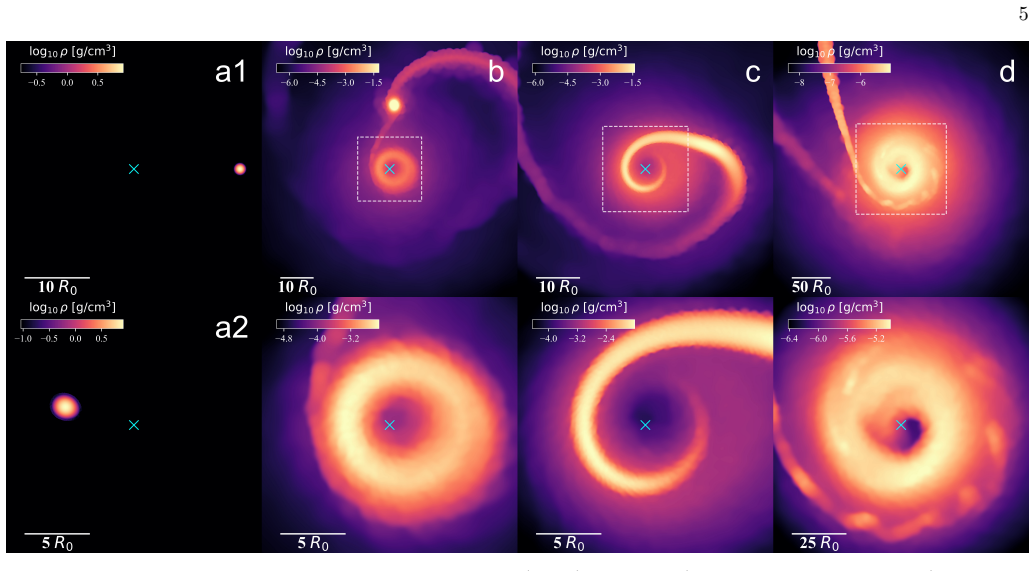
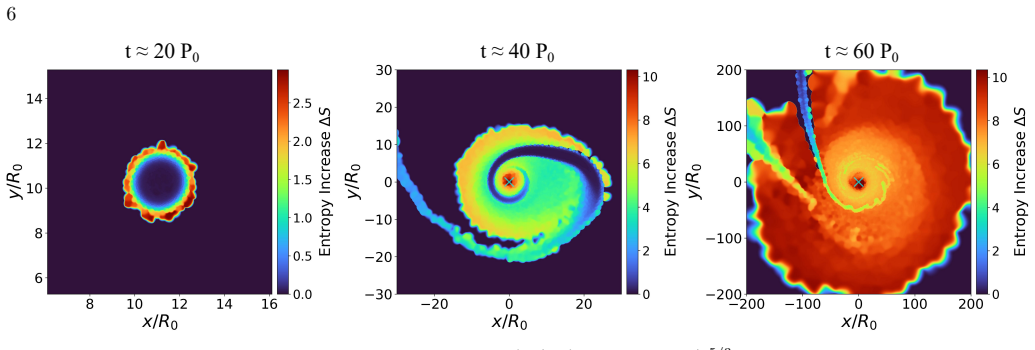
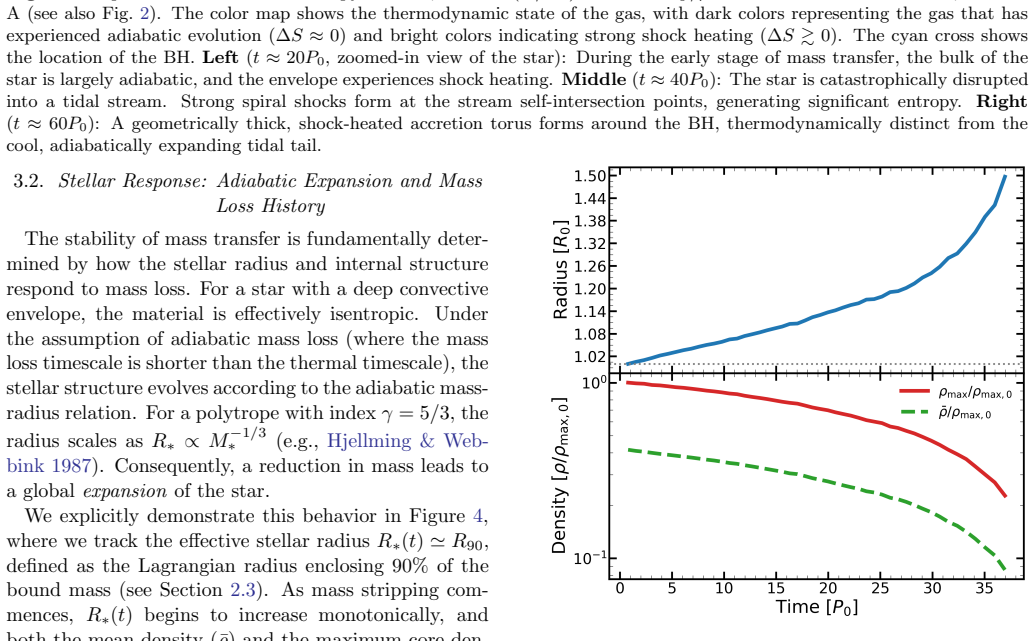
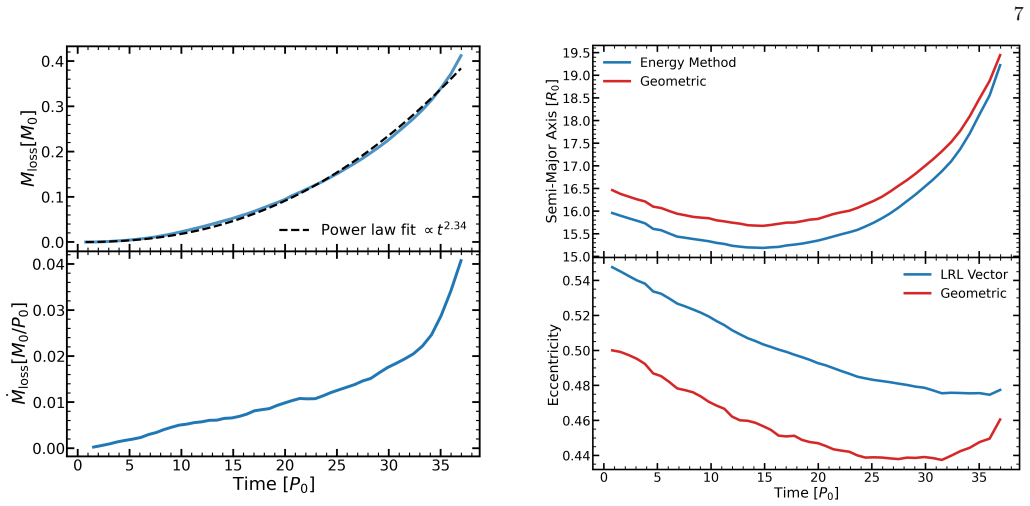
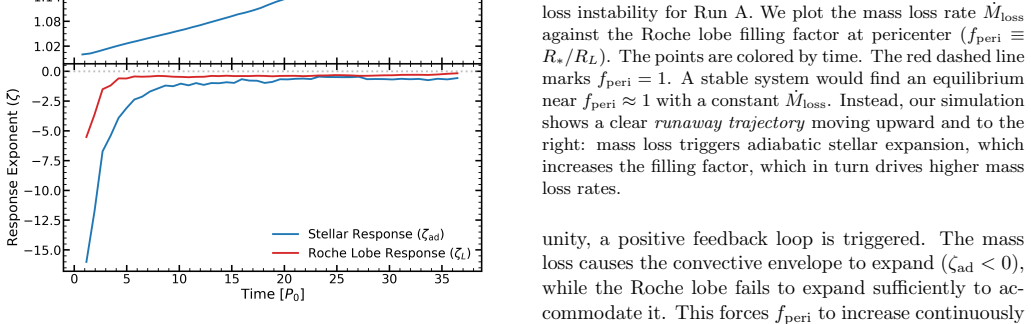
Binary systems may undergo mass transfer while maintaining significant orbital eccentricities. Stellar-mass black holes can strip stars on eccentric orbits and produce micro-tidal disruption events. Our SPH simulations reveal that these binaries can evolve along two distinct pathways, dictated by the competition between mass-transfer-driven stellar expansion and orbital widening: (i) Runaway disruption (b0≲3.45), in which mass loss at pericenter drives adiabatic expansion of the stellar envelope, leading to unstable Roche-lobe overflow and runaway disruption of the star. (ii) Stable mass transfer (b0≳3.57), in which the binary settles into a long-lived, stable mass-transfer phase lasting up
What carries the argument
The competition between mass-transfer-driven stellar expansion and orbital widening, tracked via SPH simulations of pericenter mass loss over tens to over 100 orbits.
If this is right
- For b0 ≲ 3.45 the stripped debris forms a thick accretion flow with hyper-Eddington accretion rates onto the black hole, potentially powering fast X-ray/UV or blue/optical transients.
- For b0 ≳ 3.57 the binary settles into a long-lived stable mass-transfer phase regulated by orbital expansion from pericenter mass loss.
- Runaway cases end in complete stellar disruption via unstable Roche-lobe overflow.
- These eccentric mass-transfer events could manifest observationally as repeating, quasi-periodic flares.
Where Pith is reading between the lines
- If the bifurcation is real, X-ray monitoring campaigns could separate periodic flare sources from one-time transients by their orbital periods.
- The narrow transition window between 3.45 and 3.57 invites targeted simulations at finer b0 spacing to test whether the switch is continuous or abrupt.
- Repeating the runs with different stellar masses or rotation rates would show whether the same pericenter thresholds apply beyond the Sun-like case examined here.
Load-bearing premise
The SPH simulations with the chosen resolution and artificial viscosity accurately capture the long-term adiabatic response of the stellar envelope and the orbital evolution over tens to over 100 periods without dominant numerical artifacts.
What would settle it
A higher-resolution simulation or observation of a system with initial b0 equal to 3.5 that shows neither runaway disruption within roughly 50 orbits nor stable transfer persisting beyond 100 orbits would falsify the claimed sharp bifurcation.
Figures




read the original abstract
Binary systems may undergo mass transfer while maintaining significant orbital eccentricities. Stellar-mass black holes (sBHs) can strip stars on eccentric orbits and produce micro-tidal disruption events (micro-TDEs). While previous hydrodynamical studies have focused on compact systems on the verge of disruption, the transition between self-regulated eccentric mass transfer and runaway disruption remains poorly understood. We present SPH simulations of a Sun-like star interacting with a $10\,M_\odot$ sBH across a range of initial eccentricities ($e_0=0.30$--$0.70$) and pericenter distances ($b_0=3.33$--$3.57$ in units of the tidal radius), tracking the systems for tens to over 100 orbital periods. Our results reveal that these binaries can evolve along two distinct pathways, dictated by the competition between mass-transfer-driven stellar expansion and orbital widening: (i) Runaway disruption ($b_0\lesssim 3.45$), in which mass loss at pericenter drives adiabatic expansion of the stellar envelope, leading to unstable Roche-lobe overflow and runaway disruption of the star. The stripped debris forms a thick accretion flow with hyper-Eddington accretion rates onto the sBH, potentially powering fast X-ray/UV or blue/optical transients. (ii) Stable mass transfer ($b_0\gtrsim 3.57$), in which the binary settles into a long-lived, stable mass-transfer phase lasting up to 150 orbits (the limit of our simulation), regulated by orbital expansion from pericenter mass loss. These eccentric mass-transfer events could manifest observationally as repeating, quasi-periodic flares.
Editorial analysis
A structured set of objections, weighed in public.
Referee Report
Summary. The paper uses SPH hydrodynamical simulations to study eccentric mass transfer in Sun-like star + 10 M⊙ black hole binaries with initial eccentricities 0.3–0.7 and pericenter distances b0 = 3.33–3.57 (in tidal radii). It reports that the systems bifurcate into two pathways: (i) runaway disruption for b0 ≲ 3.45, driven by mass-loss-induced adiabatic stellar expansion leading to unstable RLOF, hyper-Eddington accretion, and micro-TDE-like debris; (ii) stable, long-lived mass transfer (up to 150 orbits) for b0 ≳ 3.57, regulated by orbital expansion. These are presented as bridging Roche-lobe overflow and micro-TDEs with potential for repeating flares.
Significance. If the reported bifurcation is physically robust rather than numerical, the work would provide a concrete evolutionary link between stable eccentric mass transfer and runaway disruption, with direct implications for transient rates and accretion physics in stellar-mass BH binaries. The long integration times and explicit mapping to observable signatures are strengths, but the absence of documented convergence or energy-conservation metrics over >100 orbits limits the current weight of the result.
major comments (1)
- [Simulation setup and results sections] Simulation setup and results sections: The central bifurcation at b0 ≈ 3.45–3.57 is extracted from SPH runs integrated for tens to >100 orbits, yet the manuscript provides no convergence tests in particle number, artificial viscosity parameters, or global energy conservation diagnostics. Without these, it is impossible to rule out that the reported adiabatic envelope expansion (and thus the distinction between runaway and stable pathways) is influenced by numerical dissipation or heating on orbital timescales.
minor comments (1)
- [Abstract] Abstract: The range b0 = 3.33–3.57 is stated, but the precise mapping of the two pathways to the sampled b0 values would benefit from an explicit table or figure reference in the abstract itself.
Simulated Author's Rebuttal
We thank the referee for their careful review and for recognizing the potential implications of the reported bifurcation between runaway disruption and stable eccentric mass transfer. We address the major comment on numerical convergence below and will incorporate the requested diagnostics in the revised manuscript.
read point-by-point responses
-
Referee: [Simulation setup and results sections] Simulation setup and results sections: The central bifurcation at b0 ≈ 3.45–3.57 is extracted from SPH runs integrated for tens to >100 orbits, yet the manuscript provides no convergence tests in particle number, artificial viscosity parameters, or global energy conservation diagnostics. Without these, it is impossible to rule out that the reported adiabatic envelope expansion (and thus the distinction between runaway and stable pathways) is influenced by numerical dissipation or heating on orbital timescales.
Authors: We agree that the original manuscript lacks explicit documentation of convergence tests and energy conservation metrics, which is a substantive limitation for long-term SPH integrations. In the revised version we will add a dedicated subsection (or appendix) presenting: (i) resolution studies at doubled particle number for representative runs at b0 = 3.45 and b0 = 3.57, (ii) sensitivity tests varying the artificial viscosity parameters, and (iii) time-series plots of total energy (kinetic + gravitational + internal) and its fractional conservation error over the full integration lengths (>100 orbits). These additions will directly demonstrate that the adiabatic envelope expansion and the bifurcation are not driven by numerical dissipation or heating. revision: yes
Circularity Check
No circularity: results are direct outputs of numerical hydrodynamics
full rationale
The paper reports outcomes of SPH simulations evolved over tens to >100 orbits for different initial b0 values. The claimed bifurcation at b0 ~3.45-3.57 between runaway disruption (adiabatic envelope expansion) and stable mass transfer (orbital widening) is an emergent numerical result, not an algebraic identity, fitted parameter renamed as prediction, or reduction via self-citation. No load-bearing equations or uniqueness theorems are invoked that collapse to the inputs by construction. The central claims remain independent of the simulation setup itself.
Axiom & Free-Parameter Ledger
free parameters (2)
- initial eccentricity e0
- initial pericenter distance b0
axioms (1)
- domain assumption Smoothed-particle hydrodynamics with the adopted resolution and artificial viscosity faithfully reproduces the adiabatic expansion of the stellar envelope and the orbital response to mass loss over >100 periods
Reference graph
Works this paper leans on
-
[1]
Bandopadhyay, A., Coughlin, E. R., & Nixon, C. J. 2025, ApJ, 987, 16, doi: 10.3847/1538-4357/add9a5
-
[2]
Beniamini, P., Perets, H. B., & Granot, J. 2025, arXiv e-prints, arXiv:2509.22779, doi: 10.48550/arXiv.2509.22779 14
-
[3]
Broggi, L., Stone, N. C., Ryu, T., et al. 2024, The Open Journal of Astrophysics, 7, 48, doi: 10.33232/001c.120086
-
[4]
2024, ApJ, 977, 80, doi: 10.3847/1538-4357/ad8b24
Chen, J.-H., Dai, L., Liu, S.-F., & Ou, J.-W. 2024, ApJ, 977, 80, doi: 10.3847/1538-4357/ad8b24
-
[5]
Coughlin, E. R., & Nixon, C. J. 2019, ApJL, 883, L17, doi: 10.3847/2041-8213/ab412d
-
[6]
2016, ApJ, 825, 71, doi: 10.3847/0004-637X/825/1/71
Dosopoulou, F., & Kalogera, V. 2016, ApJ, 825, 71, doi: 10.3847/0004-637X/825/1/71
-
[7]
2015, MNRAS, 449, 771, doi: 10.1093/mnras/stv350
Rosswog, S. 2015, MNRAS, 449, 771, doi: 10.1093/mnras/stv350
-
[8]
2011, ApJ, 732, 74, doi: 10.1088/0004-637X/732/2/74
Guillochon, J., Ramirez-Ruiz, E., & Lin, D. 2011, ApJ, 732, 74, doi: 10.1088/0004-637X/732/2/74
-
[9]
Hamers, A. S., & Dosopoulou, F. 2019, ApJ, 872, 119, doi: 10.3847/1538-4357/ab001d
-
[10]
Hjellming, M. S., & Webbink, R. F. 1987, ApJ, 318, 794, doi: 10.1086/165412
-
[11]
Ho, A. Y. Q., Perley, D. A., Gal-Yam, A., et al. 2023, ApJ, 949, 120, doi: 10.3847/1538-4357/acc533 Kıro˘ glu, F., Lombardi, J. C., Kremer, K., et al. 2023, ApJ, 948, 89, doi: 10.3847/1538-4357/acc24c
-
[12]
Kremer, K., Lombardi, J. C., Lu, W., Piro, A. L., & Rasio, F. A. 2022, ApJ, 933, 203, doi: 10.3847/1538-4357/ac714f
-
[13]
Kremer, K., Lu, W., Piro, A. L., et al. 2021, ApJ, 911, 104, doi: 10.3847/1538-4357/abeb14
-
[14]
2013, MNRAS, 429, 3040, doi: 10.1093/mnras/sts567
Li, G., & Loeb, A. 2013, MNRAS, 429, 3040, doi: 10.1093/mnras/sts567
-
[15]
2024, MNRAS, 527, 4317, doi: 10.1093/mnras/stad3470
Linial, I., & Quataert, E. 2024a, MNRAS, 527, 4317, doi: 10.1093/mnras/stad3470 —. 2024b, ApJ, 974, 67, doi: 10.3847/1538-4357/ad67cf
-
[16]
2023, ApJ, 945, 86, doi: 10.3847/1538-4357/acbd3d
Linial, I., & Sari, R. 2023, ApJ, 945, 86, doi: 10.3847/1538-4357/acbd3d
-
[17]
2025, ApJ, 979, 40, doi: 10.3847/1538-4357/ad9b0b
Liu, C., Yarza, R., & Ramirez-Ruiz, E. 2025, ApJ, 979, 40, doi: 10.3847/1538-4357/ad9b0b
-
[18]
2021, MNRAS, 503, 603, doi: 10.1093/mnras/stab459
Lu, W., Fuller, J., Raveh, Y., et al. 2021, MNRAS, 503, 603, doi: 10.1093/mnras/stab459
-
[19]
2023, MNRAS, 524, 6247, doi: 10.1093/mnras/stad2203
Lu, W., & Quataert, E. 2023, MNRAS, 524, 6247, doi: 10.1093/mnras/stad2203
-
[20]
Manukian, H., Guillochon, J., Ramirez-Ruiz, E., & O’Leary, R. M. 2013, ApJL, 771, L28, doi: 10.1088/2041-8205/771/2/l28
-
[21]
Miles, P. R., Coughlin, E. R., & Nixon, C. J. 2020, ApJ, 899, 36, doi: 10.3847/1538-4357/ab9c9f
-
[22]
Monaghan, J. J. 1992, ARA&A, 30, 543, doi: 10.1146/annurev.aa.30.090192.002551
-
[23]
Monaghan, J. J., & Gingold, R. A. 1983, Journal of Computational Physics, 52, 374, doi: 10.1016/0021-9991(83)90036-0 O’Connor, B., Gill, R., DeLaunay, J., et al. 2025, ApJL, 994, L17, doi: 10.3847/2041-8213/ae1741 Paczy´ nski, B. 1971, ARA&A, 9, 183, doi: 10.1146/annurev.aa.09.090171.001151
-
[24]
2025, arXiv e-prints, arXiv:2509.05243, doi: 10.48550/arXiv.2509.05243
Parkosidis, A., Toonen, S., Dosopoulou, F., & Laplace, E. 2025, arXiv e-prints, arXiv:2509.05243, doi: 10.48550/arXiv.2509.05243
-
[25]
2011, ApJS, 192, 3, doi: 10.1088/0067-0049/192/1/3
Paxton, B., Bildsten, L., Dotter, A., et al. 2011, ApJS, 192, 3, doi: 10.1088/0067-0049/192/1/3
-
[26]
Price, D. J., Wurster, J., Tricco, T. S., et al. 2018, PASA, 35, e031, doi: 10.1017/pasa.2018.25 Reg¨ os, E., Bailey, V. C., & Mardling, R. 2005, MNRAS, 358, 544, doi: 10.1111/j.1365-2966.2005.08813.x
-
[27]
Ryu, T., Krolik, J., Piran, T., & Noble, S. C. 2020, ApJ, 904, 100, doi: 10.3847/1538-4357/abb3ce
-
[28]
Ryu, T., Sari, R., de Mink, S. E., et al. 2025, A&A, 702, A61, doi: 10.1051/0004-6361/202555651
-
[29]
F., Willems, B., Kalogera, V., & Rasio, F
Sepinsky, J. F., Willems, B., Kalogera, V., & Rasio, F. A. 2007, ApJ, 667, 1170, doi: 10.1086/520911 —. 2009, ApJ, 702, 1387, doi: 10.1088/0004-637X/702/2/1387
-
[30]
2024, MNRAS, 529, 3729, doi: 10.1093/mnras/stae773
Shahaf, S., Hallakoun, N., Mazeh, T., et al. 2024, MNRAS, 529, 3729, doi: 10.1093/mnras/stae773
-
[31]
Turk, M. J., Smith, B. D., Oishi, J. S., et al. 2011, ApJS, 192, 9, doi: 10.1088/0067-0049/192/1/9
-
[32]
Vos, J., Østensen, R. H., N´ emeth, P., et al. 2013, A&A, 559, A54, doi: 10.1051/0004-6361/201322200
-
[33]
2019, Contributions of the Astronomical Observatory Skalnate Pleso, 49, 264
Vos, J., Vuˇ ckovi´ c, M., Chen, X., et al. 2019, Contributions of the Astronomical Observatory Skalnate Pleso, 49, 264
2019
-
[34]
Perets, H. B. 2024, A&A, 685, A45, doi: 10.1051/0004-6361/202348357
-
[35]
2024, ApJ, 961, 149, doi: 10.3847/1538-4357/ad11d3
Xin, C., Haiman, Z., Perna, R., Wang, Y., & Ryu, T. 2024, ApJ, 961, 149, doi: 10.3847/1538-4357/ad11d3
-
[36]
Yao, P. Z., & Quataert, E. 2025, arXiv e-prints, arXiv:2505.10611, doi: 10.48550/arXiv.2505.10611
work page internal anchor Pith review Pith/arXiv arXiv doi:10.48550/arxiv.2505.10611 2025
-
[37]
Y., Mckeever, E., Arras, P., & Weinberg, N
Yu, H., Lau, S. Y., Mckeever, E., Arras, P., & Weinberg, N. N. 2026, ApJ, 999, 129, doi: 10.3847/1538-4357/ae3718
discussion (0)
Sign in with ORCID, Apple, or X to comment. Anyone can read and Pith papers without signing in.