A Survey of Smart Grid Emerging Use Cases and Relevant 5G and 6G Capabilities and Features
Pith reviewed 2026-06-28 05:02 UTC · model grok-4.3
The pith
Smart grid emerging use cases receive quantified service requirements that 5G and 6G capabilities can address through network slicing, edge computing, and related enablers.
A machine-rendered reading of the paper's core claim, the machinery that carries it, and where it could break.
Core claim
This survey identifies emerging smart grid use cases such as smart distributed voltage control, real-time fault detection and self-healing, smart and autonomous monitoring, and predictive maintenance; quantifies their associated service performance requirements; and places them inside an SG architecture that incorporates 5G and 6G capabilities including network slicing, edge computing, spectrum management, AI-driven optimization, digital twins, and O-RAN.
What carries the argument
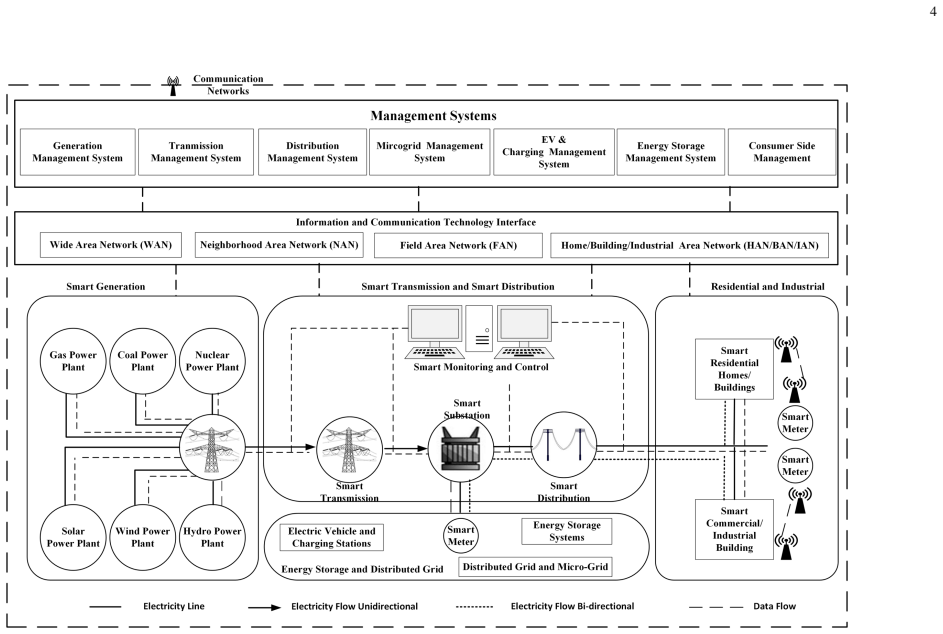
The integrated smart grid architecture that merges digital communication infrastructure with distributed energy resources, microgrids, energy storage systems, and cybersecurity frameworks, then links these elements to 5G/6G enablers.
If this is right
- Network operators can match specific use cases to the appropriate 5G or 6G feature set once the quantified requirements are accepted.
- System designers obtain explicit targets for latency, reliability, and data rate when planning smart distributed voltage control or predictive maintenance.
- Future research must address the open challenges of scalability, intelligence, and security that remain after the listed enablers are deployed.
- Digital twins and AI optimization become concrete tools for meeting the performance numbers attached to autonomous monitoring.
Where Pith is reading between the lines
- Utilities could run controlled pilots that test whether the stated requirements actually produce measurable improvements in fault recovery time.
- Policy makers might use the quantified numbers to set minimum performance standards for communication links serving critical grid functions.
- The same mapping exercise could be repeated for additional use cases such as vehicle-to-grid coordination once data become available.
Load-bearing premise
The four selected use cases and the performance numbers assigned to them correctly represent the most relevant high-complexity smart-grid scenarios and their real technical demands.
What would settle it
Field measurements from an operating smart grid that show the actual latency or reliability needed for real-time fault detection and self-healing differ by more than an order of magnitude from the values stated in the survey.
Figures

read the original abstract
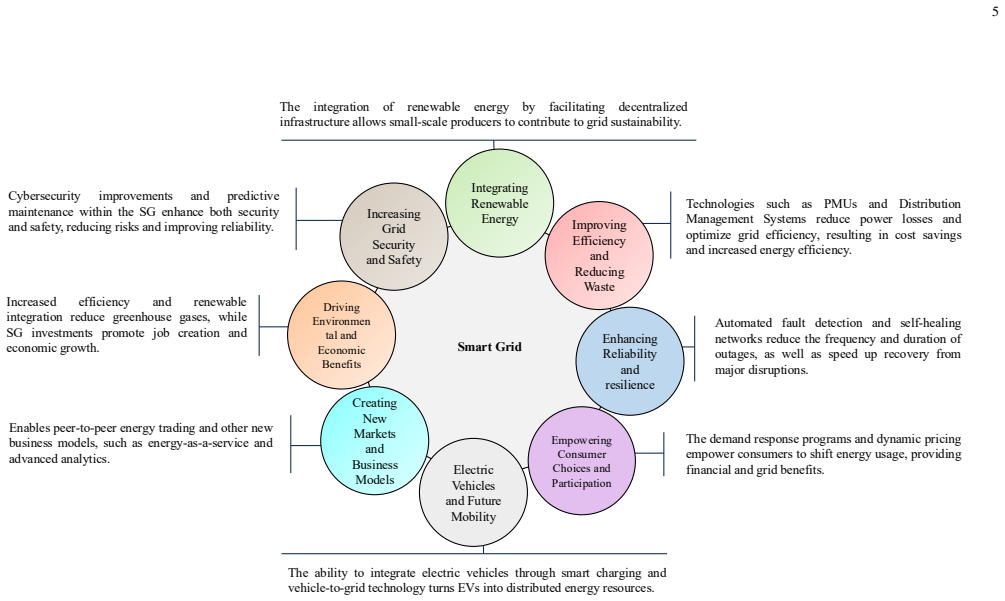
The growing complexity of modern energy systems has led to the adoption of Smart Grid (SG) that use advanced communication technologies to facilitate efficient, reliable, secure, and sustainable energy operation and management. Unlike existing surveys that often treat grid and communication domains separately, this work rigorously quantifies service requirements for high-complexity emerging scenarios. It provides a comprehensive overview of SG architecture that integrates digital communication infrastructure with distributed energy resources (DERs), microgrids, energy storage systems, and cybersecurity frameworks. Furthermore, emerging SG use cases such as smart distributed voltage control, real-time fault detection and self-healing, smart and autonomous monitoring, and predictive maintenance are identified, and more importantly, service performance requirements associated with these use cases have been quantified. Additionally, key capabilities and emerging SG enablers of fifth-generation (5G) and sixth-generation (6G) networks are described. These capabilities and enablers include network slicing, edge computing, spectrum management, artificial intelligence (AI) driven optimization, digital twins, and Open-Radio Access Network (O-RAN). Finally, the paper discusses open challenges and future research directions for designing scalable, intelligent, and secure next-generation SG systems.
Editorial analysis
A structured set of objections, weighed in public.
Referee Report
Summary. This survey paper claims to rigorously quantify service requirements for high-complexity emerging smart grid (SG) scenarios, provides a comprehensive overview of SG architecture integrating digital communication infrastructure with DERs, microgrids, energy storage, and cybersecurity, identifies use cases including smart distributed voltage control, real-time fault detection and self-healing, smart autonomous monitoring, and predictive maintenance along with their quantified performance requirements, describes 5G/6G capabilities and enablers such as network slicing, edge computing, spectrum management, AI-driven optimization, digital twins, and O-RAN, and discusses open challenges and future research directions for scalable, intelligent, and secure next-generation SG systems.
Significance. If the quantified requirements accurately synthesize and validate real technical needs across the listed use cases without selection bias, and the architecture overview is balanced, the paper could serve as a useful bridging reference between energy systems and wireless communications research, highlighting integration points for 5G/6G enablers in SG. As a survey without new empirical or theoretical derivations, its value lies in organization and synthesis rather than original results.
major comments (2)
- [Abstract] Abstract: the claim that the work 'rigorously quantifies service requirements for high-complexity emerging scenarios' is not supported by any described methodology, data sources, verification steps, or derivation process; as a survey, this appears to be a compilation of literature values, which undermines the 'rigorous quantification' assertion central to the paper's positioning.
- [Use cases and requirements section] Use cases and requirements section (inferred from abstract description of quantified use cases such as real-time fault detection): without explicit criteria for selecting the emerging scenarios, sources for the performance numbers (e.g., standards, measurements, or prior works), or validation against actual grid data, the quantified requirements cannot be assessed for completeness or accuracy, directly affecting the central claim of providing a rigorous overview.
minor comments (2)
- Ensure consistent terminology between 'smart grid' and 'SG' throughout, and add a dedicated methodology subsection explaining how requirements were collected and synthesized even if from existing sources.
- Update references to include the most recent 3GPP releases and SG standards (e.g., IEEE 2030 series) given the fast pace of 5G/6G and grid evolution.
Simulated Author's Rebuttal
We thank the referee for the constructive feedback on our survey paper. We agree that the abstract's phrasing regarding 'rigorous quantification' requires clarification to better reflect the survey nature of the work, which synthesizes existing literature rather than deriving new values. We address each major comment below and will make revisions to improve transparency on sources and selection criteria.
read point-by-point responses
-
Referee: [Abstract] Abstract: the claim that the work 'rigorously quantifies service requirements for high-complexity emerging scenarios' is not supported by any described methodology, data sources, verification steps, or derivation process; as a survey, this appears to be a compilation of literature values, which undermines the 'rigorous quantification' assertion central to the paper's positioning.
Authors: We acknowledge the concern and agree that 'rigorously quantifies' may suggest an original methodological process or empirical derivation not present in a survey. The requirements are synthesized from published standards, measurements in prior works, and literature values. We will revise the abstract to state that the paper 'synthesizes and presents quantified service requirements drawn from a comprehensive review of standards and literature' to accurately position the contribution. We will also add an explicit 'Sources and Synthesis Methodology' subsection detailing how values were compiled. revision: yes
-
Referee: [Use cases and requirements section] Use cases and requirements section (inferred from abstract description of quantified use cases such as real-time fault detection): without explicit criteria for selecting the emerging scenarios, sources for the performance numbers (e.g., standards, measurements, or prior works), or validation against actual grid data, the quantified requirements cannot be assessed for completeness or accuracy, directly affecting the central claim of providing a rigorous overview.
Authors: We agree that explicit selection criteria and source citations are needed for transparency and will add them in revision: criteria will include relevance to high-complexity scenarios, integration potential with 5G/6G, and coverage of key SG challenges; each performance metric will be directly attributed to its source (e.g., 3GPP specifications, IEC 61850, or specific papers). As this is a survey without new empirical data collection, independent validation against fresh grid measurements falls outside scope; however, citing origins will enable readers to evaluate the values. revision: partial
Circularity Check
No circularity: survey compiles literature values without derivation chain
full rationale
The paper is explicitly a survey whose central claim is an organized overview of existing SG use cases and 5G/6G capabilities drawn from prior literature. No equations, fitted parameters, or mathematical derivations appear in the provided abstract or described structure. The phrase 'rigorously quantifies service requirements' is presented as synthesis of documented values rather than an original derivation that could reduce to its own inputs by construction. No self-citation load-bearing steps, uniqueness theorems, or ansatz smuggling are invoked to support any core result. The work is therefore self-contained as a literature review with no detectable circular reduction.
Axiom & Free-Parameter Ledger
Reference graph
Works this paper leans on
-
[1]
Tripathi and J
N. Tripathi and J. H. Reed,Cellular Communications: A Comprehensive and Practical Guide. NJ, USA: Wiley-IEEE Press, 2014
2014
-
[2]
Munich, Germany: Rohde & Schwarz, 2019
Rohde & Schwarz,Radio Fundamentals for Cellular Networks White Paper. Munich, Germany: Rohde & Schwarz, 2019
2019
-
[3]
Tripathi and J
N. Tripathi and J. H. Reed,5G Evolution—On the Path to 6G White Paper. Munich, Germany: Rohde & Schwarz, 2020
2020
-
[4]
IEEE Communi- cations Surveys and Tutorials15, 21–38 (2013).https://doi.org/10.1109/SURV
X. Fang, S. Misra, G. Xue, and D. Yang, “Smart Grid—The New and Improved Power Grid: A Survey,”IEEE Commun. Surveys Tuts., vol. 14, no. 4, pp. 944–980, 2012, doi: 10.1109/SURV .2011.101911.00087
-
[5]
S. F. Bush,Smart Grid: Communication-Enabled Intelligence for the Electric Power Grid. NJ, USA: Wiley-IEEE Press, 2014, doi: 10.1002/9781118820216
-
[6]
Cybersecurity Considerations for Dis- tributed Energy Resources on the U.S. Electric Grid,
U.S. Department of Energy, “Cybersecurity Considerations for Dis- tributed Energy Resources on the U.S. Electric Grid,” Oct. 2022
2022
-
[7]
Boosting 5G on Smart Grid Communication: A Smart RAN Slicing Approach,
D. Carrilloet al., “Boosting 5G on Smart Grid Communication: A Smart RAN Slicing Approach,”IEEE Wireless Commun., vol. 30, no. 5, pp. 170–178, Oct. 2023, doi: 10.1109/MWC.004.2200079
-
[8]
M. Ghorbanian, S. H. Dolatabadi, M. Masjedi, and P. Siano, “Com- munication in Smart Grids: A Comprehensive Review on the Ex- isting and Future Communication and Information Infrastructures,” IEEE Syst. J., vol. 13, no. 4, pp. 4001–4014, Dec. 2019, doi: 10.1109/JSYST.2019.2928090
-
[9]
Smart Grid Technologies and Application in the Sustainable Energy Transition: A Review,
M. J. B. Kabeyi and O. A. Olanrewaju, “Smart Grid Technologies and Application in the Sustainable Energy Transition: A Review,” Int. J. Sustain. Energy, vol. 42, no. 1, pp. 685–758, 2023, doi: 10.1080/14786451.2023.2222298
-
[10]
Y . Sanjalawe, S. Al-E’Mari, S. Fraihat, S. N. Makhadmeh, and E. Alzubi, “AI-Powered Smart Grids in the 6G Era: A Comprehensive Survey on Security and Intelligent Energy Systems,”IEEE Open J. Commun. Soc., vol. 6, pp. 7677–7719, 2025, doi: 10.1109/OJCOMS.2025.3609144
-
[11]
How Beyond-5G and 6G Makes IIoT and the Smart Grid Green—A Survey,
P. Varga, ´A. I. J´aszber´enyi, D. P´asztor, B. Nagy, M. Nasar, and D. Raisz, “How Beyond-5G and 6G Makes IIoT and the Smart Grid Green—A Survey,”Sensors, vol. 25, Art. no. 4222, 2025, doi: 10.3390/s25134222
-
[12]
Challenges for quantum software engineering: An industrial application scenario perspective,
S. V . Singh, A. Khursheed, and Z. Alam, “Wired Communication Technologies and Networks for Smart Grid—A Review,” inCyber Security in Intelligent Computing and Communications, R. Agrawalet al., Eds., vol. 1007, Singapore: Springer Nature, 2022, doi: 10.1007/978- 981-16-8012-0 15
-
[13]
Next G Alliance,6G Radio Technology Part I: Basic Radio Technologies, Nov. 2023. [Online]. Available: https://nextgalliance.org/white papers/ 6g-radio-technology-part-i-basic-radio-technologies/
2023
-
[14]
A. Colak, N. Guler, and K. Ahmed, ”Intelligent Communication Tech- niques for Smart Grid Systems: A Survey,” in2021 9th International Conference on Smart Grid (icSmartGrid), Setubal, Portugal, 2021, pp. 273–277, doi: 10.1109/icSmartGrid52357.2021.9551027
-
[15]
A. Mulla, J. Baviskar, S. Khare, and F. Kazi, ”The Wireless Technologies for Smart Grid Communication: A Review,” in2015 Fifth International Conference on Communication Systems and Net- work Technologies (CSNT), Gwalior, India, 2015, pp. 442–447, doi: 10.1109/CSNT.2015.146
-
[16]
R. H. Abdelwahab, M. El-Habrouk, and T. H. Abdelhamid, ”Survey of Communication Techniques in Smart Grids,” in2019 21st International Middle East Power Systems Conference (MEPCON), Cairo, Egypt, 2019, pp. 550–555, doi: 10.1109/MEPCON47431.2019.9007961
-
[17]
Research on the Application of 5G mMTC in the Smart Grid,
R. Liu, J. Zhang, L. Li, Y . Tian, and Z. Fang, “Research on the Application of 5G mMTC in the Smart Grid,” in2023 IEEE 11th Joint International Information Technology and Artificial Intelli- gence Conference (ITAIC), Chongqing, China, 2023, pp. 94–98, doi: 10.1109/ITAIC58329.2023.10408759
-
[18]
R. S. de Carvalho, P. K. Sen, L. F. Ramos, and L. Neves Canha, ”Communication System Design for an Advanced Metering Infrastruc- ture,” in2018 IEEE International Conference on Smart Energy Grid Engineering (SEGE), Oshawa, ON, Canada, 2018, pp. 62–67, doi: 10.1109/SEGE.2018.8499505
-
[19]
Performance Comparison of an Implemented Wired and Wire- less Micro Smart Grid,
A. O. Abdulridha, I. B. Al-Mashhadani, S. M. Hashim, and K. A. Reshak, “Performance Comparison of an Implemented Wired and Wire- less Micro Smart Grid,” in2023 15th International Conference on Developments in eSystems Engineering (DeSE), Baghdad & Anbar, Iraq, 2023, pp. 7–12, doi: 10.1109/DeSE58274.2023.10099600
-
[20]
Understanding the Benefits of the Smart Grid,
U.S. Department of Energy, “Understanding the Benefits of the Smart Grid,” Jun. 2010, p. 11. [Online]. Available: https://netl.doe.gov/sites/default/files/Smartgrid/06-18-2010 Understanding-Smart-Grid-Benefits.pdf
2010
-
[21]
The Smart Grid: An Introduction,
U.S. Department of Energy, “The Smart Grid: An Introduction,” pre- pared by Litos Strategic Communication, Contract No. DE-AC26- 04NT41817, p. 14. [Online]. Available: https://www.energy.gov/oe/ downloads/smart-grid-introduction-0
-
[22]
3GPP TS 22.104 V19.2.0 (2024-06),
3GPP, “3GPP TS 22.104 V19.2.0 (2024-06),”Service Requirements for Cyber-Physical Control Applications in Vertical Domains, 2024
2024
-
[23]
Verticals URLLC Use Cases and Requirements,
NGMN Alliance, “Verticals URLLC Use Cases and Requirements,” Ver- sion 2.5.4, Feb. 2020. [Online]. Available: https://ngmn.org/wp-content/ uploads/200210-Verticals-URLLC-Requirements-v2.5.4.pdf
2020
-
[24]
3GPP TR 22.867 V18.2.0 (2021-12),
3GPP, “3GPP TR 22.867 V18.2.0 (2021-12),”Study on 5G Smart Energy and Infrastructure, 2021
2021
-
[25]
3GPP TR 22.804 V16.3.0 (2020-07),
3GPP, “3GPP TR 22.804 V16.3.0 (2020-07),”Communication for Au- tomation in Vertical Domains, 2020
2020
-
[26]
Recommendation ITU-R M.2160-0,
ITU, “Recommendation ITU-R M.2160-0,”Framework and Overall Objectives of IMT for 2030 and Beyond, 2023
2030
-
[27]
Tripathi and J
N. Tripathi and J. H. Reed,6G Vision, Performance Targets, and Candidate Radio Technologies White Paper, Rohde & Schwarz
-
[28]
Tripathi and J
N. Tripathi and J. H. Reed,Emerging Trends in Wireless Infrastructure White Paper, Rohde & Schwarz
-
[29]
3GPP TS 23.501 V19.3.0,
3GPP, “3GPP TS 23.501 V19.3.0,”System Architecture for the 5G System (5GS); Stage 2 (Release 19), Mar. 2025
2025
-
[30]
A. Gopstein, C. Nguyen, C. O’Fallon, and D. Wollman,NIST Framework and Roadmap for Smart Grid Interoperability Standards, Release 4.0. [Online]. Available: https://doi.org/10.6028/NIST.SP.1108r4
-
[31]
3GPP TR 28.903 V18.0.1 (2023-06),
3GPP, “3GPP TR 28.903 V18.0.1 (2023-06),”Study on Alignment with ETSI MEC for Edge Computing Management, 2023
2023
-
[32]
3GPP TS 23.434 V19.5.0 (2025-03),
3GPP, “3GPP TS 23.434 V19.5.0 (2025-03),”Service Enabler Ar- chitecture Layer for Verticals (SEAL); Functional Architecture and Information Flows, 2025
2025
-
[33]
[Online]
Next G Alliance,6G Radio Technology Part II: Basic Radio Technolo- gies, May 2024. [Online]. Available: https://nextgalliance.org/white papers/6g-radio-technologypart-ii-basic-radio-technologies/
2024
-
[34]
[Online]
Next G Alliance,Sustainable AI in Telecom: Promises and Challenges in 6G, February 2025. [Online]. Available: https://nextgalliance.org/white papers/sustainable-ai-in-telecompromises-and-challenges-in-6g/
2025
-
[35]
3GPP TR 22.837 V19.4.0,
3GPP, “3GPP TR 22.837 V19.4.0,”Feasibility Study on Integrated Sensing and Communication (Release 19), Jun. 2024
2024
-
[36]
Next G Alliance,6G Digital Twins Use Cases and Requirements, Mar. 2025. [Online]. Available: https://nextgalliance.org/white papers/ 6g-digital-twins-use-cases-and-requirements
2025
-
[37]
Kumar, N
M. Kumar, N. Tripathi, J. Reed, and A. Mehrizi-Sani,A Wireless Communication Enabled Framework with Automated Data Collection, Decision Making, and Recommendations for a Smart Grid, USPTO, Oct. 2025, Provisional Patent Application No. 63/904,325. 20
2025
-
[38]
What is a Digital Twin?,
T. Swartzendruber, “What is a Digital Twin?,” GE Vernova, Jun
-
[39]
Available: https://www.gevernova.com/software/blog/ what-digital-twin
[Online]. Available: https://www.gevernova.com/software/blog/ what-digital-twin
-
[40]
5G Cellular Communications – Journey and Destination,
N. D. Tripathi and J. H. Reed, “5G Cellular Communications – Journey and Destination,”The Wireless University, Apr. 2019. [Online]. Avail- able: https://thewirelessuniversity.com/
2019
-
[41]
Artificial intelligence-assisted network slicing: Network assurance and service provisioning in 6G,
J. Wang, J. Liu, J. Li, and N. Kato, “Artificial intelligence-assisted network slicing: Network assurance and service provisioning in 6G,” IEEE Veh. Technol. Mag., vol. 18, no. 1, pp. xx–xx, Mar. 2023, doi: 10.1109/MVT.2022.3228399
-
[42]
O-RAN Empowering Vertical Industry: Scenarios, Solutions and Best Practice,
O-RAN Alliance, “O-RAN Empowering Vertical Industry: Scenarios, Solutions and Best Practice,” O-RAN.WG1.Vertical Industry White Paper, Dec. 2023
2023
-
[43]
Smart Grid 5G Network Slicing,
GSMA, “Smart Grid 5G Network Slicing,” Mar. 2020. [Online]. Available: https://www.gsma.com/solutions-and-impact/technologies/ networks/gsma resources/smart-grid-5g-network-slicing/
2020
-
[44]
5G Network Slicing Enabling the Smart Grid,
Huawei, “5G Network Slicing Enabling the Smart Grid,” White Paper. [Online]. Available: https://www-file.huawei.com/-/media/corporate/ pdf/news/5g-network-slicing-enabling-the-smart-grid.pdf
-
[45]
N. D. Tripathi and V . K. Shah,Fundamentals of O-RAN, NJ, USA: Wiley-IEEE Press, 2025
2025
-
[46]
M. Mitev, A. Chorti, H. V . Poor, and G. P. Fettweis, ”What Physical Layer Security Can Do for 6G Security,”IEEE Open Journal of Vehicular Technology, vol. 4, pp. 375–388, 2023, doi: 10.1109/OJVT.2023.3245071
-
[47]
Q. Li, M. El-Hajjar, K. Cao, C. Xu, H. Haas, and L. Hanzo, ”Holo- graphic Metasurface-Based Beamforming for Multi-Altitude LEO Satel- lite Networks,”IEEE Transactions on Wireless Communications, vol. 24, no. 4, pp. 3103–3116, Apr. 2025, doi: 10.1109/TWC.2025.3527962
-
[48]
Q. Li, M. El-Hajjar, C. Xu, J. An, C. Yuen and L. Hanzo, ”Stacked Intelligent Metasurfaces for Holographic MIMO-Aided Cell-Free Net- works,” in IEEE Transactions on Communications, vol. 72, no. 11, pp. 7139-7151, Nov. 2024, doi: 10.1109/TCOMM.2024.3403499
-
[49]
Q. Li, M. El-Hajjar, Y . Sun, and L. Hanzo, ”Performance Analysis of Reconfigurable Holographic Surfaces in the Near-Field Scenario of Cell- Free Networks Under Hardware Impairments,”IEEE Transactions on Wireless Communications, vol. 23, no. 9, pp. 11972–11984, Sep. 2024, doi: 10.1109/TWC.2024.3386850. Manoj Kumarreceived his Master of Science de- gree in...
discussion (0)
Sign in with ORCID, Apple, or X to comment. Anyone can read and Pith papers without signing in.