Time-frequency analysis of nonlinear Compton scattering via joint probability distributions
Pith reviewed 2026-06-30 14:45 UTC · model grok-4.3
The pith
A non-negative joint distribution enables probabilistic time-frequency analysis of nonlinear Compton scattering.
A machine-rendered reading of the paper's core claim, the machinery that carries it, and where it could break.
Core claim
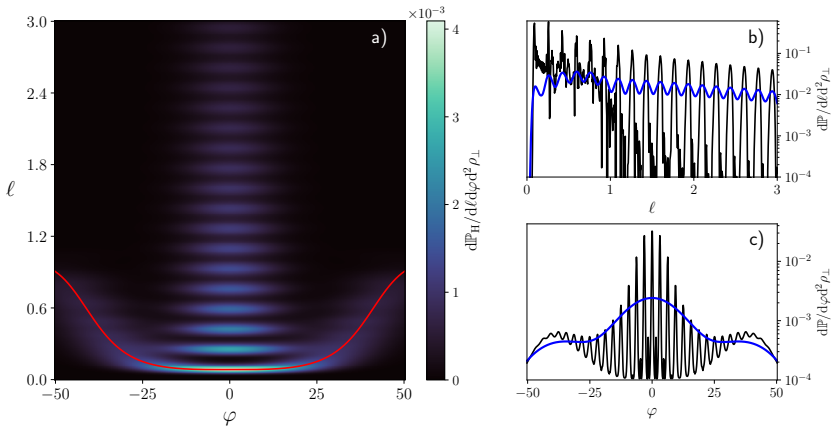
In this work, we demonstrate how a JD can be devised within the SFQED framework. Specifically, we focus on constructing a non-negative JD, which allows for a clear probabilistic interpretation. We study the properties of the proposed distribution and test its utility by applying it to the nonlinear Compton scattering in complex laser pulse configurations with carrier-envelope phase and variable polarization.
What carries the argument
The non-negative joint distribution (JD) constructed for the emitted radiation spectrum in the SFQED framework, enabling simultaneous time and frequency analysis.
If this is right
- Allows simultaneous time and energy domain analysis of nonlocal SFQED effects such as harmonic generation and ponderomotive red shift.
- Provides probabilistic interpretation for spectral features accumulated during the particle-field interaction.
- Can be applied to complex laser pulse configurations including those with carrier-envelope phase and variable polarization.
- Reveals sub-harmonic structures and spectral broadening in the emitted radiation.
Where Pith is reading between the lines
- This joint distribution approach could be extended to analyze other strong-field QED processes such as nonlinear Breit-Wheeler pair production.
- It may guide optimization of laser pulse shapes to control specific time-frequency features in the output radiation.
- Links to classical time-frequency signal processing techniques could suggest refinements for handling quantum nonlocal effects.
Load-bearing premise
A non-negative joint distribution can be defined for the emitted radiation spectrum while preserving a valid probabilistic interpretation under the nonlocal accumulation of SFQED effects.
What would settle it
A calculation showing that the proposed joint distribution takes negative values for a standard nonlinear Compton scattering case, or fails to match the known time-integrated spectrum.
Figures



read the original abstract
The interaction of charged particles with an intense laser pulse gives rise to a number of characteristic spectral features of emitted radiation, including the generation of harmonics, spectral broadening due to the phase-dependent ponderomotive red shift, and the emergence of intricate sub-harmonic structures. These effects are accumulated over the course of the interaction with the electromagnetic field and are therefore inherently nonlocal in nature. For a deeper understanding of strong-field quantum electrodynamics (SFQED) processes and their practical applications, it is desirable to employ tools that enable simultaneous analysis in the time and energy domains. In time-frequency analysis, such tools are provided by joint distributions (JDs). In this work, we demonstrate how a JD can be devised within the SFQED framework. Specifically, we focus on constructing a non-negative JD, which allows for a clear probabilistic interpretation. We study the properties of the proposed distribution and test its utility by applying it to the nonlinear Compton scattering in complex laser pulse configurations with carrier-envelope phase and variable polarization.
Editorial analysis
A structured set of objections, weighed in public.
Referee Report
Summary. The paper claims to construct a non-negative joint distribution (JD) within the strong-field QED framework for time-frequency analysis of nonlinear Compton scattering. It addresses nonlocal effects such as harmonics, phase-dependent ponderomotive red shifts, and sub-harmonic structures in intense laser pulses, and demonstrates the JD on configurations with carrier-envelope phase and variable polarization to enable probabilistic interpretation.
Significance. If the non-negative JD exactly reproduces the radiation spectrum marginals while exposing time-frequency correlations, it would supply a useful probabilistic tool for analyzing nonlocal SFQED accumulation; the manuscript's focus on complex pulse shapes is a practical strength.
major comments (1)
- [JD construction (abstract and methods section)] The central construction must be shown to preserve exact single-time and single-frequency marginals of the emitted radiation spectrum. The skeptic concern is load-bearing: any kernel or smoothing imposed for non-negativity risks violating the marginal property under nonlocal phase-dependent ponderomotive shifts and sub-harmonic interference, yet the abstract provides no indication whether the JD is derived from the SFQED S-matrix or imposed externally.
Simulated Author's Rebuttal
We thank the referee for the careful review and for highlighting the importance of verifying the marginal properties of the joint distribution. We address the single major comment below.
read point-by-point responses
-
Referee: [JD construction (abstract and methods section)] The central construction must be shown to preserve exact single-time and single-frequency marginals of the emitted radiation spectrum. The skeptic concern is load-bearing: any kernel or smoothing imposed for non-negativity risks violating the marginal property under nonlocal phase-dependent ponderomotive shifts and sub-harmonic interference, yet the abstract provides no indication whether the JD is derived from the SFQED S-matrix or imposed externally.
Authors: The joint distribution is constructed directly from the SFQED S-matrix elements for nonlinear Compton scattering, rather than being imposed externally; this is stated in the manuscript as devising the JD "within the SFQED framework." The specific form chosen ensures that the single-time and single-frequency marginals are recovered exactly by construction upon integration over the conjugate variable, without additional kernels that would violate this property. We acknowledge that the abstract does not explicitly demonstrate this and that explicit verification under the nonlocal effects mentioned would strengthen the paper. In the revised manuscript we will add a short derivation in the methods section proving the marginals are preserved, together with a numerical check for the CEP-dependent and polarization-varying pulses already considered in the work. revision: yes
Circularity Check
No circularity; construction presented as independent methodological step
full rationale
The abstract and available description present the construction of a non-negative joint distribution (JD) as a new tool devised within the SFQED framework for analyzing nonlocal effects in nonlinear Compton scattering. No equations, parameter fits, self-citations, or uniqueness theorems are quoted that would reduce the claimed JD to a redefinition of its inputs or to a prior result by the same authors. The central claim remains a methodological proposal whose validity can be checked against external SFQED spectra and marginals, without internal circular reduction visible in the provided material.
Axiom & Free-Parameter Ledger
Reference graph
Works this paper leans on
-
[1]
Throughout this paper we always consider unpolarized quantities, i.e
by multiplying result with the Lorentz invariant light-front phase space element of the final states and performing integration over the electron final momenta with aid of the delta function. Throughout this paper we always consider unpolarized quantities, i.e. we average over the initial electron spin and sum over all final spin and polarization states [...
-
[2]
Locally constant field approximation We consider the angular resolved LCFA probability rate [58] and compare it with the angular resolved Husimi JPD, Eq. (15). The former is based on the idea that the formation length of the emitted photon [59] is much smaller than the spatial and temporal inhomo- geneities of the external field [8, 60]; thus, the field c...
-
[3]
The idea behind the LMA differs from the LCFA
Locally monochromatic approximation Now as we studied relation between the LCFA and Husimi JPD, we turn to the locally monochromatic approximation and try to understand what are the differences and similar- ities between it and the Husimi JPD. The idea behind the LMA differs from the LCFA. The former relies on the separation of time scales in plane-wave-l...
-
[4]
C. N. Danson, C. Haefner, J. Bromage, T. Butcher, J.-C. F. Chanteloup, E. A. Chowdhury, A. Galvanauskas, L. A. Gizzi, J. Hein, D. I. Hillier, N. W. Hopps, Y. Kato, E. A. Khazanov, R. Kodama, G. Korn, R. Li, Y. Li, J. Limpert, J. Ma, C. H. Nam, D. Neely, D. Papadopoulos, R. R. Penman, L. Qian, J. J. Rocca, A. A. Shaykin, C. W. Siders, C. Spindloe, S. Szatm...
2019
-
[5]
J. W. Yoon, Y. G. Kim, I. W. Choi, J. H. Sung, H. W. Lee, S. K. Lee, and C. H. Nam, Realization of laser intensity over 10 23 W/cm2, Optica8, 630 (2021). 22
2021
-
[6]
Maksimchuk, J
A. Maksimchuk, J. Nees, B. Hou, R. Anthony, J. Bae, F. Bayer, M. Burger, P. T. Campbell, J. Cardarelli, V. Contreras, N. Ernst, F. Falcoz, R. Fitzgarrald, I. Jovanovic, G. Kalinchenko, C. Kuranz, J. Latham, Y. Ma, A. McKelvey, T. Nutting, Q. Qian, B. K. Russell, G. Sucha, A. G. R. Thomas, R. Van Camp, E. Viges, L. Willingale, G. Young, Q. Zhang, and K. Kr...
2025
-
[7]
Di Piazza, C
A. Di Piazza, C. M¨ uller, K. Z. Hatsagortsyan, and C. H. Keitel, Extremely high-intensity laser interactions with fundamental quantum systems, Rev. Mod. Phys.84, 1177 (2012)
2012
-
[8]
Gonoskov, T
A. Gonoskov, T. Blackburn, M. Marklund, and S. Bulanov, Charged particle motion and radiation in strong electromagnetic fields, Reviews of Modern Physics94, 045001 (2022)
2022
-
[9]
Fedotov, A
A. Fedotov, A. Ilderton, F. Karbstein, B. King, D. Seipt, H. Taya, and G. Torgrimsson, Advances in QED with intense background fields, Physics Reports Advances in QED with intense background fields,1010, 1 (2023)
2023
-
[10]
H. R. Reiss, Absorption of light by light, Journal of Mathematical Physics3, 59 (1962)
1962
-
[11]
V. I. Ritus, Quantum effects of the interaction of elementary particles with an intense elec- tromagnetic field, Journal of Soviet Laser Research6, 497 (1985)
1985
-
[12]
Ilderton, Trident pair production in strong laser pulses, Phys
A. Ilderton, Trident pair production in strong laser pulses, Phys. Rev. Lett.106, 020404 (2011)
2011
-
[13]
Torgrimsson, Nonlinear photon trident versus double compton scattering and resummation of one-step terms, Phys
G. Torgrimsson, Nonlinear photon trident versus double compton scattering and resummation of one-step terms, Phys. Rev. D102, 116008 (2020)
2020
-
[14]
Seipt and B
D. Seipt and B. K¨ ampfer, Two-photon compton process in pulsed intense laser fields, Phys. Rev. D85, 101701 (2012)
2012
-
[15]
Ahmadiniaz, C
N. Ahmadiniaz, C. B¨ ahtz, A. Benediktovitch, C. B¨ omer, L. Bocklage, T. E. Cowan, J. Ed- wards, S. Evans, S. Franchino Vi˜ nas, H. Gies, and et al., Towards a vacuum birefringence experiment at the helmholtz international beamline for extreme fields (letter of intent of the biref@hibef collaboration), High Power Laser Science and Engineering13, e7 (2025)
2025
-
[16]
King, Interference effects in nonlinear Compton scattering due to pulse envelope, Physical Review D103, 036018 (2021)
B. King, Interference effects in nonlinear Compton scattering due to pulse envelope, Physical Review D103, 036018 (2021)
2021
-
[17]
A. I. Titov, B. K¨ ampfer, T. Shibata, A. Hosaka, and H. Takabe, Laser pulse-shape dependence of compton scattering, The European Physical Journal D68, 299 (2014)
2014
-
[18]
Y. X. Zhang, S. Rykovanov, M. Shi, C. L. Zhong, X. T. He, B. Qiao, and M. Zepf, Giant isolated attosecond pulses from two-color laser-plasma interactions, Phys. Rev. Lett.124, 23 114802 (2020)
2020
-
[19]
Q. Xin, Y. Wang, X. Yan, and B. Eliasson, Giant isolated half-cycle attosecond pulses gener- ated in coherent bremsstrahlung emission regime, Phys. Rev. E107, 035201 (2023)
2023
-
[20]
Z. Chen, Y. Wang, C. Li, Y. Kang, L. Qin, M. Sun, and X. Yan, Petawatt half-cycle zep- tosecond pulse emission in coherent bremsstrahlung regime, Physics of Plasmas32, 013302 (2025)
2025
-
[21]
C. Li, Y. Wang, Z. Chen, Y. Kang, M. Sun, L. Qin, B. Eliasson, and X. Yan, Generation of 100-tw half-cycle zeptosecond x-ray pulses in the cascaded regime, Phys. Rev. Appl.23, 024047 (2025)
2025
-
[22]
Cohen, Time-frequency distributions-a review, Proceedings of the IEEE77, 941 (1989)
L. Cohen, Time-frequency distributions-a review, Proceedings of the IEEE77, 941 (1989)
1989
-
[23]
Cohen,Time Frequency Analysis: Theory and Applications(Pearson Education, Englewood Cliffs, N.J, 1995)
L. Cohen,Time Frequency Analysis: Theory and Applications(Pearson Education, Englewood Cliffs, N.J, 1995)
1995
-
[24]
C. P. Ridgers, J. G. Kirk, R. Duclous, T. G. Blackburn, C. S. Brady, K. Bennett, T. D. Arber, and A. R. Bell, Modelling gamma-ray photon emission and pair production in high-intensity laser–matter interactions, Journal of Computational Physics260, 273 (2014)
2014
-
[25]
Gonoskov, S
A. Gonoskov, S. Bastrakov, E. Efimenko, A. Ilderton, M. Marklund, I. Meyerov, A. Mu- raviev, A. Sergeev, I. Surmin, and E. Wallin, Extended particle-in-cell schemes for physics in ultrastrong laser fields: Review and developments, Physical Review E92, 023305 (2015)
2015
-
[26]
Fedeli, N
L. Fedeli, N. Za¨ ım, A. Sainte-Marie, M. Th´ evenet, A. Huebl, A. Myers, J.-L. Vay, and H. Vin- centi, Picsar-qed: a monte carlo module to simulate strong-field quantum electrodynamics in particle-in-cell codes for exascale architectures, New Journal of Physics24, 025009 (2022)
2022
-
[27]
Heinzl, B
T. Heinzl, B. King, and A. J. MacLeod, Locally monochromatic approximation to QED in intense laser fields, Physical Review A102, 063110 (2020)
2020
-
[28]
Bialynicki-Birula, P
I. Bialynicki-Birula, P. G´ ornicki, and J. Rafelski, Phase-space structure of the Dirac vacuum, Physical Review D44, 1825 (1991)
1991
-
[29]
Hebenstreit, A
F. Hebenstreit, A. Ilderton, M. Marklund, and J. Zamanian, Strong field effects in laser pulses: The Wigner formalism, Physical Review D83, 065007 (2011)
2011
-
[30]
Peatross, C
J. Peatross, C. M¨ uller, K. Z. Hatsagortsyan, and C. H. Keitel, Photoemission of a single- electron wave packet in a strong laser field, Phys. Rev. Lett.100, 153601 (2008)
2008
-
[31]
Pukhov, S
A. Pukhov, S. Gordienko, and T. Baeva, Temporal Structure of Attosecond Pulses from Intense Laser-Atom Interactions, Physical Review Letters91, 173002 (2003). 24
2003
-
[32]
M. C. Kohler, C. Ott, P. Raith, R. Heck, I. Schlegel, C. H. Keitel, and T. Pfeifer, High Harmonic Generation Via Continuum Wave-Packet Interference, Physical Review Letters105, 203902 (2010)
2010
-
[33]
Boca and V
M. Boca and V. Florescu, Nonlinear Compton scattering with a laser pulse, Physical Review A80, 053403 (2009)
2009
-
[34]
Volkov States and Non-linear Compton Scattering in Short and Intense Laser Pulses
D. Seipt, Volkov states and non-linear compton scattering in short and intense laser pulses (2017), arXiv:1701.03692 [physics.plasm-ph]
work page internal anchor Pith review Pith/arXiv arXiv 2017
-
[35]
Heinzl, Light-Cone Quantization: Foundations and Applications (Springer, Berlin, Heidel- berg, 2001) pp
T. Heinzl, Light-Cone Quantization: Foundations and Applications (Springer, Berlin, Heidel- berg, 2001) pp. 55–142
2001
-
[36]
Seipt,Strong-field qed processes in short laser pulses, Ph.D
D. Seipt,Strong-field qed processes in short laser pulses, Ph.D. thesis, Technische Universit¨ at Dresden (2012)
2012
-
[37]
Ilderton, B
A. Ilderton, B. King, and A. MacLeod, Absorption cross section in an intense plane wave background, Physical Review D100, 076002 (2019)
2019
-
[38]
Seipt, V
D. Seipt, V. Kharin, S. Rykovanov, A. Surzhykov, and S. Fritzsche, Analytical results for nonlinear Compton scattering in short intense laser pulses, Journal of Plasma Physics82, 655820203 (2016)
2016
-
[39]
Seipt and B
D. Seipt and B. K¨ ampfer, Nonlinear Compton scattering of ultrashort intense laser pulses, Physical Review A83, 022101 (2011)
2011
-
[40]
The question of existence of the positive-definite fully differential and polarization/spin- resolved joint distribution in constant crossed field was recently addressed in [?]
-
[41]
E. P. Wigner, Quantum-mechanical distribution functions revisited, inPart I: Physical Chem- istry. Part II: Solid State Physics, edited by A. S. Wightman (Springer Berlin Heidelberg, Berlin, Heidelberg, 1997) pp. 251–262
1997
-
[42]
Seipt and B
D. Seipt and B. K¨ ampfer, Nonlinear Compton scattering of ultrahigh-intensity laser pulses, Laser Physics23, 075301 (2013)
2013
-
[43]
Larin and D
N. Larin and D. Seipt, Extended locally monochromatic approximations of strong-field qed processes, Phys. Rev. A112, 032819 (2025)
2025
-
[44]
Mugur-Sch¨ achter, Study of wigner’s theorem on joint probabilities, Foundations of Physics 9, 389 (1979)
M. Mugur-Sch¨ achter, Study of wigner’s theorem on joint probabilities, Foundations of Physics 9, 389 (1979)
1979
-
[45]
Cohen, Generalized phase-space distribution functions, Journal of Mathematical Physics7, 781 (1966)
L. Cohen, Generalized phase-space distribution functions, Journal of Mathematical Physics7, 781 (1966). 25
1966
-
[46]
Cohen and Y
L. Cohen and Y. I. Zaparovanny, Positive quantum joint distributions, Journal of Mathemat- ical Physics21, 794 (1980)
1980
-
[47]
P. D. Finch and R. Groblicki, Bivariate probability densities with given margins, Foundations of Physics14, 549 (1984)
1984
-
[48]
Cohen and T
L. Cohen and T. Posch, Positive time-frequency distribution functions, IEEE Transactions on Acoustics, Speech, and Signal Processing33, 31 (1985)
1985
-
[49]
Schweizer and A
B. Schweizer and A. Sklar, Probability distributions with given margins: Note on a paper by finch and groblicki, Foundations of Physics16, 1061 (1986)
1986
-
[50]
N. D. Cartwright, A non-negative Wigner-type distribution, Physica A: Statistical Mechanics and its Applications83, 210 (1976)
1976
-
[51]
Soto and P
F. Soto and P. Claverie, Some properties of the smoothed wigner function, Physica A: Statis- tical Mechanics and its Applications109, 193 (1981)
1981
-
[52]
Bertrand, J
P. Bertrand, J. Doremus, B. Izrar, V. Nguyen, and M. Feix, Obtaining non-negative quantum mechanical distribution function, Physics Letters A94, 415 (1983)
1983
-
[53]
A. J. E. M. Janssen, Positivity properties of phase-plane distribution functions, Journal of Mathematical Physics25, 2240 (1984)
1984
-
[54]
Janssen and T
A. Janssen and T. Claasen, On positivity of time-frequency distributions, IEEE Transactions on Acoustics, Speech, and Signal Processing33, 1029 (1985)
1985
-
[55]
Husimi, Some formal properties of the density matrix, Nippon Sugaku-Buturigakkwai Kizi Dai 3 Ki22, 264 (1940)
K. Husimi, Some formal properties of the density matrix, Nippon Sugaku-Buturigakkwai Kizi Dai 3 Ki22, 264 (1940)
1940
-
[56]
Lee, Theory and application of the quantum phase-space distribution functions, Physics Reports259, 147 (1995)
H.-W. Lee, Theory and application of the quantum phase-space distribution functions, Physics Reports259, 147 (1995)
1995
-
[57]
R. J. Glauber, Coherent and incoherent states of the radiation field, Phys. Rev.131, 2766 (1963)
1963
-
[58]
R. L. Hudson, When is the wigner quasi-probability density non-negative?, Reports on Math- ematical Physics6, 249 (1974)
1974
-
[59]
Soto and P
F. Soto and P. Claverie, When is the wigner function of multidimensional systems nonnega- tive?, Journal of Mathematical Physics24, 97 (1983)
1983
-
[60]
Kohlf¨ urst, Phase-space analysis of the schwinger effect in inhomogeneous electromagnetic fields, The European Physical Journal Plus133, 191 (2018)
C. Kohlf¨ urst, Phase-space analysis of the schwinger effect in inhomogeneous electromagnetic fields, The European Physical Journal Plus133, 191 (2018)
2018
-
[61]
T. G. Blackburn, D. Seipt, S. S. Bulanov, and M. Marklund, Radiation beaming in the quan- 26 tum regime, Physical Review A101, 012505 (2020)
2020
-
[62]
Baier and V
V. Baier and V. Katkov, Concept of formation length in radiation theory, Physics Reports 409, 261 (2005)
2005
-
[63]
Di Piazza, M
A. Di Piazza, M. Tamburini, S. Meuren, and C. H. Keitel, Implementing nonlinear Comp- ton scattering beyond the local-constant-field approximation, Physical Review A98, 012134 (2018)
2018
-
[64]
V. Dinu, C. Harvey, A. Ilderton, M. Marklund, and G. Torgrimsson, Quantum radiation reaction: From interference to incoherence, Phys. Rev. Lett.116, 044801 (2016)
2016
-
[65]
Ilderton, B
A. Ilderton, B. King, and D. Seipt, Extended locally constant field approximation for nonlinear Compton scattering, Physical Review A99, 042121 (2019)
2019
-
[66]
T. G. Blackburn, D. Seipt, S. S. Bulanov, and M. Marklund, Benchmarking semiclassical approaches to strong-field qed: Nonlinear compton scattering in intense laser pulses, Physics of Plasmas25, 083108 (2018)
2018
-
[67]
I. M. Ternov, Synchrotron radiation, Physics-Uspekhi38, 409 (1995)
1995
-
[68]
Krajewska and J
K. Krajewska and J. Z. Kami´ nski, Compton-based coherent comb structures in radiation and matter domains, Laser Physics Letters11, 035301 (2014)
2014
-
[69]
Z. Shao, Q. Dong, H. Teng, Z. Li, D. Yue, Q. Liu, Z. Wei, and J. Zhang, Nonlinear spectral features of the relativistic interaction between electron and ultrashort laser pulse, Phys. Rev. A107, 053109 (2023)
2023
-
[70]
G. A. Krafft, B. Terzi´ c, E. Johnson, and G. Wilson, Scattered spectra from inverse compton sources operating at high laser fields and high electron energies, Phys. Rev. Accel. Beams26, 034401 (2023)
2023
-
[71]
Timoshenko, M
A. Timoshenko, M. Malakhov, A. Fedotov, and S. Rykovanov, Pulse-stacking technique for nonlinear compton scattering: Compensation of nonlinear broadening and generation of mul- ticolor gamma sources, Phys. Rev. A112, L061501 (2025)
2025
-
[72]
Seipt and B
D. Seipt and B. K¨ ampfer, Asymmetries of azimuthal photon distributions in nonlinear Comp- ton scattering in ultrashort intense laser pulses, Physical Review A88, 012127 (2013)
2013
-
[73]
Mackenroth, A
F. Mackenroth, A. Di Piazza, and C. H. Keitel, Determining the Carrier-Envelope Phase of Intense Few-Cycle Laser Pulses, Physical Review Letters105, 063903 (2010)
2010
-
[74]
A. I. Titov, B. K¨ ampfer, A. Hosaka, T. Nousch, and D. Seipt, Determination of the carrier envelope phase for short, circularly polarized laser pulses, Phys. Rev. D93, 045010 (2016). 27
2016
-
[75]
Li, Y.-Y
J.-X. Li, Y.-Y. Chen, K. Z. Hatsagortsyan, and C. H. Keitel, Single-shot carrier-envelope phase determination of long superintense laser pulses, Phys. Rev. Lett.120, 124803 (2018)
2018
-
[76]
A. Ipp, J. Evers, C. H. Keitel, and K. Z. Hatsagortsyan, Streaking at high energies with electrons and positrons, Physics Letters B702, 383 (2011)
2011
-
[77]
P. B. Corkum, N. H. Burnett, and M. Y. Ivanov, Subfemtosecond pulses, Opt. Lett.19, 1870 (1994)
1994
-
[78]
Yeung, J
M. Yeung, J. Bierbach, E. Eckner, S. Rykovanov, S. Kuschel, A. S¨ avert, M. F¨ orster, C. R¨ odel, G. G. Paulus, S. Cousens, M. Coughlan, B. Dromey, and M. Zepf, Noncollinear polarization gating of attosecond pulse trains in the relativistic regime, Phys. Rev. Lett.115, 193903 (2015)
2015
-
[79]
Valialshchikov, V
M. Valialshchikov, V. Kharin, and S. Rykovanov, Narrow Bandwidth Gamma Comb from Nonlinear Compton Scattering Using the Polarization Gating Technique, Physical Review Letters126, 194801 (2021)
2021
-
[80]
Harvey, T
C. Harvey, T. Heinzl, and A. Ilderton, Signatures of high-intensity Compton scattering, Phys- ical Review A79, 063407 (2009)
2009
discussion (0)
Sign in with ORCID, Apple, or X to comment. Anyone can read and Pith papers without signing in.