Emergent Self-Similar Quantum Revivals in Spiral Drives
Pith reviewed 2026-06-28 05:43 UTC · model grok-4.3
The pith
Quasiperiodic spiral kicks in a many-body system generate self-similar quantum revivals from an emergent dynamical attractor that forces all momentum modes into identical closed orbits at nested times.
A machine-rendered reading of the paper's core claim, the machinery that carries it, and where it could break.
Core claim
In a many-body system driven by quasiperiodic spiral kicks the system recurrently returns close to its initial state at a hierarchically nested sequence of times originating from an emergent dynamical attractor such that all momentum modes eventually fall into the same closed orbits at self-similar times, justified analytically via quasiperiodic SU(2) cocycles.
What carries the argument
The emergent dynamical attractor, identified via quasiperiodic SU(2) cocycles, that synchronizes all momentum modes into identical closed orbits at self-similar revival times.
If this is right
- Fidelity and entanglement entropy both display the same self-similar temporal structure.
- Entanglement scaling between consecutive revivals switches between volume law and area law when driving parameters are changed.
- Integrability-breaking perturbations produce a long-lived prethermal regime whose lifetime is algebraically tunable before eventual heating.
- Special momentum modes realize the attractor through a generalized spin-echo process.
Where Pith is reading between the lines
- The attractor mechanism may generalize to other quasiperiodic drives whose Floquet operators lie in SU(2).
- The tunable prethermal lifetime offers a route to control heating rates in periodically driven simulators.
- Observation of the nested revival hierarchy would constitute direct evidence for the attractor without requiring full state tomography.
Load-bearing premise
An emergent dynamical attractor exists and pulls every momentum mode into the same closed orbit at the self-similar times under exact quasiperiodic driving.
What would settle it
Direct measurement of the predicted nested revival times in a quantum simulator realizing the spiral drive, or the absence of such times when the drive is exactly quasiperiodic and unperturbed.
Figures

read the original abstract
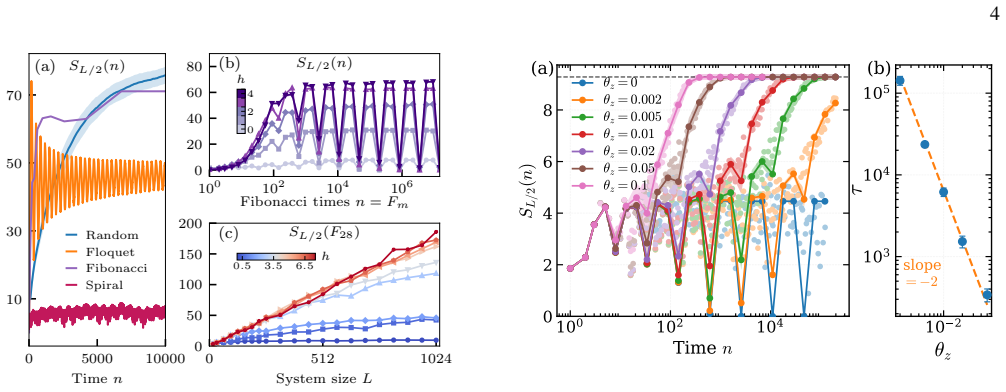
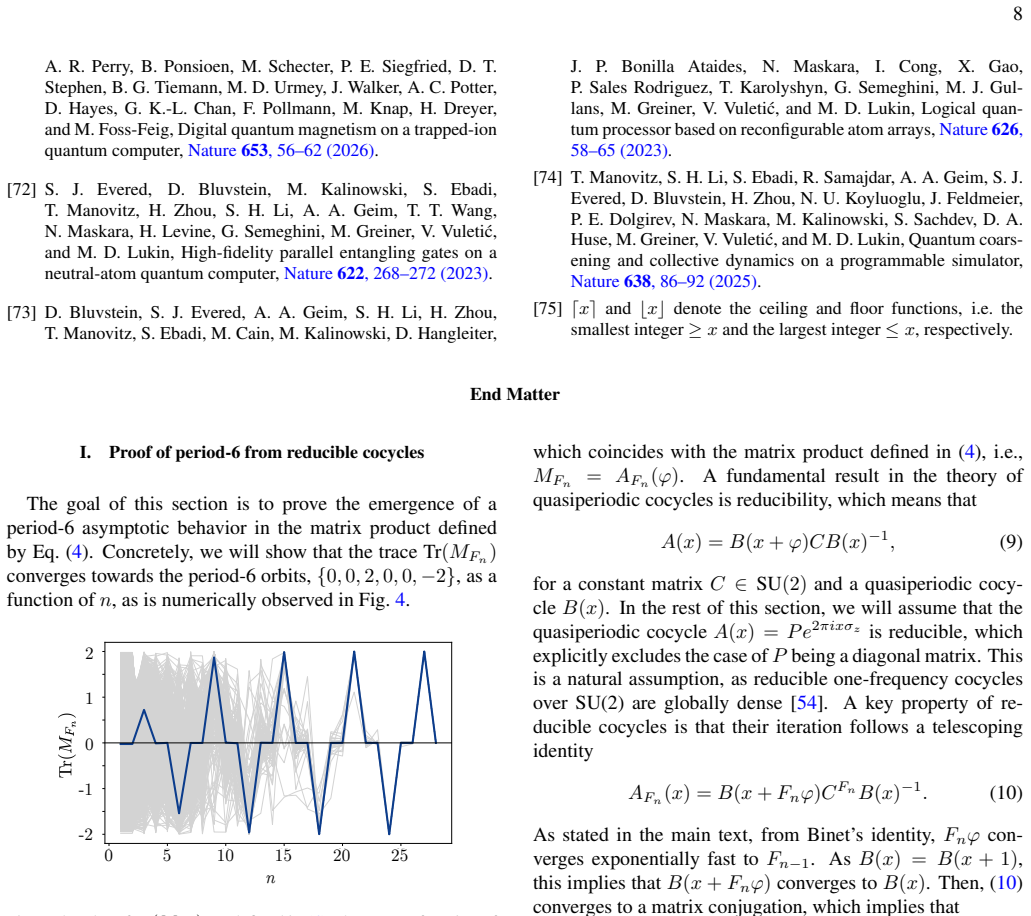
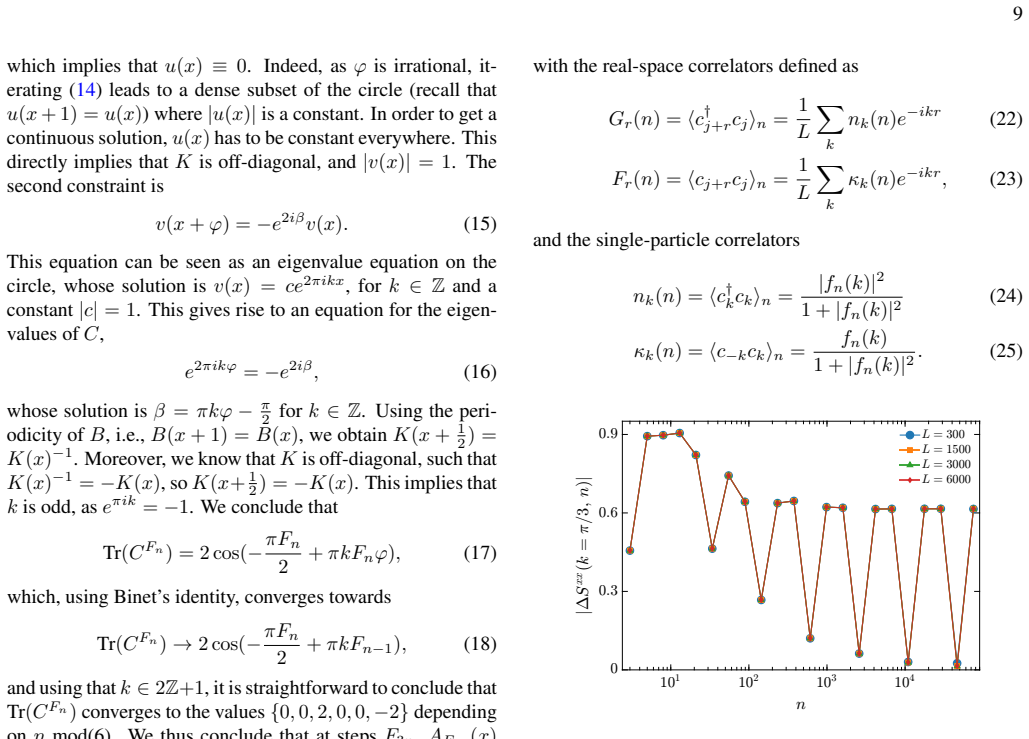
We uncover a distinct form of nonequilibrium temporal order: self-similar quantum revivals in a many-body system driven by quasiperiodic spiral kicks, where the system recurrently returns close to its initial state at a hierarchically nested sequence of times. We demonstrate that both the fidelity and entanglement entropy exhibit this self-similar temporal structure. It originates from an emergent dynamical attractor, which we identify, such that all momentum modes eventually fall into the same closed orbits at self-similar times. We analytically justify this behavior and show that, for special momentum modes, this attractor arises as a consequence of a generalized spin echo process, and more generally we prove its existence using quasiperiodic SU(2) cocycles. Interestingly, the dynamics between consecutive revivals supports either volume- or area-law entanglement scaling, tunable via the driving parameters. In the presence of integrability-breaking perturbations, the system eventually heats up, but a long-lived prethermal regime with algebraically tunable lifetime occurs before heating sets in. Our results establish self-similar quantum revivals as a new paradigm for nonequilibrium quantum matter and provide a realistic route for its observation in current quantum simulators.
Editorial analysis
A structured set of objections, weighed in public.
Referee Report
Summary. The manuscript claims that a many-body system driven by quasiperiodic spiral kicks exhibits self-similar quantum revivals, in which the system returns close to its initial state at a hierarchically nested sequence of times. This structure arises from an emergent dynamical attractor that organizes all momentum modes into the same closed orbits at self-similar times; the attractor is identified numerically via fidelity and entanglement entropy and is analytically justified, for special modes via a generalized spin-echo process and in general via quasiperiodic SU(2) cocycles. The dynamics between revivals permits tunable volume- or area-law entanglement scaling, and integrability-breaking perturbations produce a long-lived prethermal regime with algebraically tunable lifetime before eventual heating.
Significance. If the analytical justification via cocycles holds without hidden parameters, the work identifies a new form of nonequilibrium temporal order and supplies a concrete, simulator-accessible route to its observation. The explicit construction of the attractor, the demonstration that all momentum modes collapse onto the same orbits, and the separation between the ideal attractor and the prethermal regime under perturbations are substantive strengths.
minor comments (3)
- The model Hamiltonian and the precise definition of the spiral-kick protocol should be stated explicitly in the main text (rather than deferred to an appendix) to allow immediate reproduction of the numerics.
- Figure captions for the fidelity and entanglement plots should indicate the driving parameters used and the precise times at which the nested revivals occur, to make the self-similar hierarchy visually unambiguous.
- A brief remark on the numerical convergence with system size or momentum discretization would strengthen the claim that the attractor organizes all modes.
Simulated Author's Rebuttal
We thank the referee for their positive summary of our manuscript and for recommending minor revision. No specific major comments were provided in the report.
Circularity Check
No significant circularity; derivation relies on external cocycle framework
full rationale
The central claim of an emergent dynamical attractor organizing momentum modes into closed orbits at self-similar times is justified analytically via quasiperiodic SU(2) cocycles, presented as an independent mathematical tool rather than a self-referential definition or fitted input. No load-bearing steps reduce by construction to the paper's own equations, parameters, or self-citations. The prethermal regime under perturbations is treated separately and does not create a definitional loop. This is a standard case of a self-contained derivation against external benchmarks.
Axiom & Free-Parameter Ledger
axioms (1)
- standard math Properties of quasiperiodic SU(2) cocycles allow proof of closed orbits for all momentum modes at self-similar times
invented entities (1)
-
emergent dynamical attractor
no independent evidence
Reference graph
Works this paper leans on
-
[1]
Levine and P
D. Levine and P. J. Steinhardt, Quasicrystals: A new class of ordered structures, Phys. Rev. Lett.53, 2477 (1984)
1984
-
[2]
Shechtman, I
D. Shechtman, I. Blech, D. Gratias, and J. W. Cahn, Metallic phase with long-range orientational order and no translational symmetry, Phys. Rev. Lett.53, 1951 (1984)
1951
-
[3]
Jagannathan, The fibonacci quasicrystal: Case study of hid- den dimensions and multifractality, Rev
A. Jagannathan, The fibonacci quasicrystal: Case study of hid- den dimensions and multifractality, Rev. Mod. Phys.93, 045001 (2021)
2021
-
[4]
Kohmoto, B
M. Kohmoto, B. Sutherland, and C. Tang, Critical wave func- tions and a cantor-set spectrum of a one-dimensional quasicrys- tal model, Phys. Rev. B35, 1020 (1987)
1987
-
[5]
Y . E. Kraus and O. Zilberberg, Quasiperiodicity and topology transcend dimensions, Nat. Phys.12, 624 (2016)
2016
-
[6]
Y . Wang, C. Cheng, X.-J. Liu, and D. Yu, Many-body critical phase: Extended and nonthermal, Phys. Rev. Lett.126, 080602 (2021)
2021
-
[7]
Gonçalves, B
M. Gonçalves, B. Amorim, F. Riche, E. V . Castro, and P. Ribeiro, Incommensurability enabled quasi-fractal order in 1D narrow-band moiré systems, Nat. Phys.20, 1933 (2024)
1933
-
[8]
Bukov, L
M. Bukov, L. D’Alessio, and A. Polkovnikov, Universal high- frequency behavior of periodically driven systems: from dy- namical stabilization to Floquet engineering, Adv. Phys.64, 139 (2015)
2015
-
[9]
Khemani, A
V . Khemani, A. Lazarides, R. Moessner, and S. L. Sondhi, Phase structure of driven quantum systems, Phys. Rev. Lett. 116, 250401 (2016)
2016
-
[10]
D. V . Else, B. Bauer, and C. Nayak, Floquet time crystals, Phys. Rev. Lett.117, 090402 (2016)
2016
-
[11]
Moessner and S
R. Moessner and S. L. Sondhi, Equilibration and order in quan- tum Floquet matter, Nat. Phys.13, 424 (2017). 6
2017
-
[12]
Harper, R
F. Harper, R. Roy, M. S. Rudner, and S. L. Sondhi, Topology and broken symmetry in Floquet systems, Annu. Rev. Condens. Matter Phys.11, 345 (2020)
2020
-
[13]
Autti, V
S. Autti, V . B. Eltsov, and G. E. V olovik, Observation of a time quasicrystal and its transition to a superfluid time crystal, Phys. Rev. Lett.120, 215301 (2018)
2018
-
[14]
Flicker, Time quasilattices in dissipative dynamical systems, SciPost Phys.5, 001 (2018)
F. Flicker, Time quasilattices in dissipative dynamical systems, SciPost Phys.5, 001 (2018)
2018
-
[15]
Giergiel, A
K. Giergiel, A. Kuro ´s, and K. Sacha, Discrete time quasicrys- tals, Phys. Rev. B99, 220303 (2019)
2019
-
[16]
Pizzi, J
A. Pizzi, J. Knolle, and A. Nunnenkamp, Period-n Discrete Time Crystals and Quasicrystals with Ultracold Bosons, Phys. Rev. Lett.123, 150601 (2019)
2019
-
[17]
Chinzei and T
K. Chinzei and T. N. Ikeda, Time crystals protected by Floquet dynamical symmetry in hubbard models, Phys. Rev. Lett.125, 060601 (2020)
2020
-
[18]
P. T. Dumitrescu, R. Vasseur, and A. C. Potter, Logarithmically slow relaxation in quasiperiodically driven random spin chains, Phys. Rev. Lett.120, 070602 (2018)
2018
-
[19]
H. Zhao, F. Mintert, and J. Knolle, Floquet time spirals and sta- ble discrete-time quasicrystals in quasiperiodically driven quan- tum many-body systems, Phys. Rev. B100, 134302 (2019)
2019
-
[20]
D. V . Else, W. W. Ho, and P. T. Dumitrescu, Long-Lived Inter- acting Phases of Matter Protected by Multiple Time-Translation Symmetries in Quasiperiodically Driven Systems, Phys. Rev. X 10, 021032 (2020)
2020
-
[21]
L. J. I. Moon, P. M. Schindler, Y . Sun, E. Druga, J. Knolle, R. Moessner, H. Zhao, M. Bukov, and A. Ajoy, Experimental observation of a time rondeau crystal, Nature Physics , 1 (2025)
2025
-
[22]
G. He, B. Ye, R. Gong, C. Yao, Z. Liu, K. W. Murch, N. Y . Yao, and C. Zu, Experimental Realization of Discrete Time Qua- sicrystals, Phys. Rev. X15, 011055 (2025)
2025
-
[23]
J. Fang, Q. Zhou, and X. Wen, Phase transitions in quasiperiod- ically driven quantum critical systems: Analytical results, Phys. Rev. B111, 094304 (2025)
2025
-
[24]
D.-Y . Zhu, Z.-Y . Zhang, Q.-F. Wang, Y . Ma, T.-Y . Han, C. Yu, Q.-Q. Fang, S.-Y . Shao, Q. Li, Y .-J. Wang, J. Zhang, H.-C. Chen, X. Liu, J.-D. Nan, Y .-M. Yin, L.-H. Zhang, G.-C. Guo, B. Liu, D.-S. Ding, and B.-S. Shi, Observation of discrete time quasicrystal in rydberg atomic gases, arXiv:2509.21248
-
[25]
L.-H. Mo, R. Moessner, and H. Zhao, Complex and tunable heating in conformal field theories with structured drives via classical ergodicity breaking, Phys. Rev. B112, 184304 (2025)
2025
-
[26]
Schmid, Y
H. Schmid, Y . Peng, G. Refael, and F. von Oppen, Self-Similar Phase Diagram of the Fibonacci-Driven Quantum Ising Model, Phys. Rev. Lett.134, 240404 (2025)
2025
-
[27]
F. Eckstein, H. Schmid, Q. Preiss, S. Trebst, F. von Oppen, and G.-Y . Zhu, Dynamical self-dual criticality in fibonacci- monitored quantum ising chains, arXiv:2605.24086
-
[28]
D’Alessio and M
L. D’Alessio and M. Rigol, Long-time behavior of isolated pe- riodically driven interacting lattice systems, Phys. Rev. X4, 041048 (2014)
2014
-
[29]
Lazarides, A
A. Lazarides, A. Das, and R. Moessner, Equilibrium states of generic quantum systems subject to periodic driving, Phys. Rev. E90, 012110 (2014)
2014
-
[30]
Ponte, A
P. Ponte, A. Chandran, Z. Papi ´c, and D. A. Abanin, Period- ically driven ergodic and many-body localized quantum sys- tems, Ann. Phys.353, 196 (2015)
2015
-
[31]
D. A. Abanin, W. De Roeck, and F. Huveneers, Exponentially slow heating in periodically driven many-body systems, Phys. Rev. Lett.115, 256803 (2015)
2015
-
[32]
T. Mori, T. Kuwahara, and K. Saito, Rigorous bound on energy absorption and generic relaxation in periodically driven quan- tum systems, Phys. Rev. Lett.116, 120401 (2016)
2016
-
[33]
D. A. Abanin, W. De Roeck, W. W. Ho, and F. Huveneers, Effective hamiltonians, prethermalization, and slow energy ab- sorption in periodically driven many-body systems, Phys. Rev. B95, 014112 (2017)
2017
-
[34]
Abanin, W
D. Abanin, W. De Roeck, W. W. Ho, and F. Huveneers, A rig- orous theory of many-body prethermalization for periodically driven and closed quantum systems, Commun. Math. Phys. 354, 809 (2017)
2017
-
[35]
D. V . Else, B. Bauer, and C. Nayak, Prethermal phases of matter protected by time-translation symmetry, Phys. Rev. X7, 011026 (2017)
2017
-
[36]
Ponte, Z
P. Ponte, Z. Papi ´c, F. Huveneers, and D. A. Abanin, Many- body localization in periodically driven systems, Phys. Rev. Lett.114, 140401 (2015)
2015
-
[37]
Lazarides, A
A. Lazarides, A. Das, and R. Moessner, Fate of many-body lo- calization under periodic driving, Phys. Rev. Lett.115, 030402 (2015)
2015
-
[38]
D. A. Abanin, W. De Roeck, and F. Huveneers, Theory of many-body localization in periodically driven systems, Ann. Phys.372, 1 (2016)
2016
-
[39]
C. W. von Keyserlingk, V . Khemani, and S. L. Sondhi, Absolute stability and spatiotemporal long-range order in Floquet sys- tems, Phys. Rev. B94, 085112 (2016)
2016
-
[40]
Zhang, P
J. Zhang, P. W. Hess, A. Kyprianidis, P. Becker, A. Lee, J. Smith, G. Pagano, I.-D. Potirniche, A. C. Potter, A. Vish- wanath, N. Y . Yao, and C. Monroe, Observation of a discrete time crystal, Nature543, 217 (2017)
2017
-
[41]
S. Choi, J. Choi, R. Landig, G. Kucsko, H. Zhou, J. Isoya, F. Jelezko, S. Onoda, H. Sumiya, V . Khemani, C. von Key- serlingk, N. Y . Yao, E. Demler, and M. D. Lukin, Observation of discrete time-crystalline order in a disordered dipolar many- body system, Nature543, 221 (2017)
2017
-
[42]
N. Y . Yao, A. C. Potter, I.-D. Potirniche, and A. Vishwanath, Discrete time crystals: Rigidity, criticality, and realizations, Phys. Rev. Lett.118, 030401 (2017)
2017
-
[43]
D. M. Long, P. J. D. Crowley, and A. Chandran, Many-body lo- calization with quasiperiodic driving, Phys. Rev. B105, 144204 (2022)
2022
-
[44]
M. P. Zaletel, M. Lukin, C. Monroe, C. Nayak, F. Wilczek, and N. Y . Yao, Colloquium: Quantum and classical discrete time crystals, Rev. Mod. Phys.95, 031001 (2023)
2023
-
[45]
Nandy, A
S. Nandy, A. Sen, and D. Sen, Aperiodically driven integrable systems and their emergent steady states, Phys. Rev. X7, 031034 (2017)
2017
-
[46]
Peng and G
Y . Peng and G. Refael, Time-quasiperiodic topological su- perconductors with majorana multiplexing, Phys. Rev. B98, 220509 (2018)
2018
-
[47]
P. J. D. Crowley, I. Martin, and A. Chandran, Topological clas- sification of quasiperiodically driven quantum systems, Phys. Rev. B99, 064306 (2019)
2019
-
[48]
Boyers, P
E. Boyers, P. J. D. Crowley, A. Chandran, and A. O. Sushkov, Exploring 2D Synthetic Quantum Hall Physics with 7 a Quasiperiodically Driven Qubit, Phys. Rev. Lett.125, 160505 (2020)
2020
-
[49]
P. J. D. Crowley, I. Martin, and A. Chandran, Half-Integer Quantized Topological Response in Quasiperiodically Driven Quantum Systems, Phys. Rev. Lett.125, 100601 (2020)
2020
-
[50]
Lapierre, K
B. Lapierre, K. Choo, A. Tiwari, C. Tauber, T. Neupert, and R. Chitra, Fine structure of heating in a quasiperiodically driven critical quantum system, Phys. Rev. Res.2, 033461 (2020)
2020
-
[51]
D. M. Long, P. J. D. Crowley, and A. Chandran, Nonadiabatic topological energy pumps with quasiperiodic driving, Phys. Rev. Lett.126, 106805 (2021)
2021
-
[52]
Pilatowsky-Cameo, S
S. Pilatowsky-Cameo, S. Choi, and W. W. Ho, Critically slow hilbert-space ergodicity in quantum morphic drives, Phys. Rev. Lett.135, 140402 (2025)
2025
-
[53]
J. Wu, C. Liu, D. Bulmash, and W. W. Ho, Geometric quantum drives and topological dynamical responses: hyperbolically- driven quantum systems and beyond, arXiv:2503.08242
-
[54]
Krikorian, Global density of reducible quasi-periodic cocy- cles on T x SU(2), Annals of Mathematics154, 269 (2001)
R. Krikorian, Global density of reducible quasi-periodic cocy- cles on T x SU(2), Annals of Mathematics154, 269 (2001)
2001
-
[55]
Avila and R
A. Avila and R. Krikorian, Reducibility or nonuniform hy- perbolicity for quasiperiodic Schrödinger cocycles, Annals of Mathematics 2,164, 911 (2006)
2006
-
[56]
Sutherland, Simple system with quasiperiodic dynamics: a spin in a magnetic field, Phys
B. Sutherland, Simple system with quasiperiodic dynamics: a spin in a magnetic field, Phys. Rev. Lett.57, 770 (1986)
1986
-
[57]
X. Wen, R. Fan, A. Vishwanath, and Y . Gu, Periodically, quasiperiodically, and randomly driven conformal field theo- ries, Phys. Rev. Res.3, 023044 (2021)
2021
-
[58]
Pilatowsky-Cameo, C
S. Pilatowsky-Cameo, C. B. Dag, W. W. Ho, and S. Choi, Com- plete hilbert-space ergodicity in quantum dynamics of general- ized fibonacci drives, Phys. Rev. Lett.131, 250401 (2023)
2023
-
[59]
B. Lapierre, L.-H. Mo, and S. Ryu, Entanglement transitions in structured and random nonunitary gaussian circuits (2025), arXiv:2507.03768 [quant-ph]
arXiv 2025
-
[60]
[61, 62]
See more details in Supplementary material, which includes Refs. [61, 62]
-
[61]
Dreyer, M
H. Dreyer, M. Bejan, and E. Granet, Quantum computing criti- cal exponents, Phys. Rev. A104, 062614 (2021)
2021
-
[62]
Granet, C
E. Granet, C. Zhang, and H. Dreyer, V olume-Law to Area- Law Entanglement Transition in a Nonunitary Periodic Gaus- sian Circuit, Phys. Rev. Lett.130, 230401 (2023)
2023
-
[63]
We note that the set of reducible single frequency cocycles over SU(2) is dense [54], which justifies this assumption
-
[64]
Bianchi, L
E. Bianchi, L. Hackl, and M. Kieburg, Page curve for fermionic gaussian states, Phys. Rev. B103, L241118 (2021)
2021
-
[65]
Mori, Heating rates under fast periodic driving beyond linear response, Physical review letters128, 050604 (2022)
T. Mori, Heating rates under fast periodic driving beyond linear response, Physical review letters128, 050604 (2022)
2022
-
[66]
X. Mi, M. Ippoliti, C. Quintana, A. Greene, Z. Chen, J. Gross, F. Arute, K. Arya, J. Atalaya, R. Babbush, J. C. Bardin, J. Basso, A. Bengtsson, A. Bilmes, A. Bourassa, L. Brill, M. Broughton, B. B. Buckley, D. A. Buell, B. Burkett, N. Bush- nell, B. Chiaro, R. Collins, W. Courtney, D. Debroy, S. De- mura, A. R. Derk, A. Dunsworth, D. Eppens, C. Erickson, ...
2021
-
[67]
Z.-H. Liu, Y . Liu, G.-H. Liang, C.-L. Deng, K. Chen, Y .-H. Shi, T.-M. Li, L. Zhang, B.-J. Chen, C.-P. Fang, D. Feng, X.-Y . Gu, Y . He, K. Huang, H. Li, H.-T. Liu, L. Li, Z.-Y . Mei, Z.-Y . Peng, J.-C. Song, M.-C. Wang, S.-L. Wang, Z. Wang, Y . Xiao, M. Xu, Y .-S. Xu, Y . Yan, Y .-H. Yu, W.-P. Yuan, J.-C. Zhang, J.- J. Zhao, K. Zhao, S.-Y . Zhou, Z.-A. ...
2026
-
[68]
W. Huang, X.-C. Zhou, L. Zhang, J. Zhang, Y . Zhou, B.- C. Yao, Z. Guo, P. Huang, Q. Li, Y . Liang, Y . Liu, J. Qiu, D. Sun, X. Sun, Z. Wang, C. Xie, Y . Xiong, X. Yang, J. Zhang, Z. Zhang, J. Chu, W. Guo, J. Jiang, X. Linpeng, W. Ren, Y . Yuan, J. Niu, Z. Tao, S. Liu, Y . Zhong, X.-J. Liu, and D. Yu, Experimental observation of exact quantum critical sta...
-
[69]
Chertkov, J
E. Chertkov, J. Bohnet, D. Francois, J. Gaebler, D. Gresh, A. Hankin, K. Lee, D. Hayes, B. Neyenhuis, R. Stutz, A. C. Pot- ter, and M. Foss-Feig, Holographic dynamics simulations with a trapped-ion quantum computer, Nature Physics18, 1074–1079 (2022)
2022
-
[70]
Moses, C
S. Moses, C. Baldwin, M. Allman, R. Ancona, L. As- carrunz, C. Barnes, J. Bartolotta, B. Bjork, P. Blanchard, M. Bohn, J. Bohnet, N. Brown, N. Burdick, W. Burton, S. Campbell, J. Campora, C. Carron, J. Chambers, J. Chan, Y . Chen, A. Chernoguzov, E. Chertkov, J. Colina, J. Curtis, R. Daniel, M. DeCross, D. Deen, C. Delaney, J. Dreiling, C. Ertsgaard, J. E...
2023
-
[71]
Haghshenas, E
R. Haghshenas, E. Chertkov, M. Mills, W. Kadow, S.-H. Lin, Y . H. Chen, C. Cade, I. Niesen, T. Beguši ´c, M. S. Rudolph, C. Cirstoiu, K. Hémery, C. Mc Keever, M. Lubasch, E. Granet, C. H. Baldwin, J. P. Bartolotta, M. Bohn, J. J. Burau, J. Cline, M. DeCross, J. M. Dreiling, C. Foltz, D. Francois, J. P. Gae- bler, C. N. Gilbreth, J. Gray, D. Gresh, A. Hall...
2026
-
[72]
S. J. Evered, D. Bluvstein, M. Kalinowski, S. Ebadi, T. Manovitz, H. Zhou, S. H. Li, A. A. Geim, T. T. Wang, N. Maskara, H. Levine, G. Semeghini, M. Greiner, V . Vuleti´c, and M. D. Lukin, High-fidelity parallel entangling gates on a neutral-atom quantum computer, Nature622, 268–272 (2023)
2023
-
[73]
Bluvstein, S
D. Bluvstein, S. J. Evered, A. A. Geim, S. H. Li, H. Zhou, T. Manovitz, S. Ebadi, M. Cain, M. Kalinowski, D. Hangleiter, J. P. Bonilla Ataides, N. Maskara, I. Cong, X. Gao, P. Sales Rodriguez, T. Karolyshyn, G. Semeghini, M. J. Gul- lans, M. Greiner, V . Vuleti´c, and M. D. Lukin, Logical quan- tum processor based on reconfigurable atom arrays, Nature626,...
2023
-
[74]
Manovitz, S
T. Manovitz, S. H. Li, S. Ebadi, R. Samajdar, A. A. Geim, S. J. Evered, D. Bluvstein, H. Zhou, N. U. Koyluoglu, J. Feldmeier, P. E. Dolgirev, N. Maskara, M. Kalinowski, S. Sachdev, D. A. Huse, M. Greiner, V . Vuleti´c, and M. D. Lukin, Quantum coars- ening and collective dynamics on a programmable simulator, Nature638, 86–92 (2025). [75]⌈x⌉and⌊x⌋denote th...
2025
-
[75]
Plugging these definitions into (13) leads to the first constraint u(x+φ) =−u(x),(14) 9 which implies thatu(x)≡0
=−A(x);(12) introducingK(x) =B x+ 1 2 −1 B(x), this condition is equivalent to K(x+φ) =−CK(x)C −1.(13) Up to conjugacy,C=diag(e iβ, e−iβ), andK(x) = u(x)v(x) −¯v(x) ¯u(x) . Plugging these definitions into (13) leads to the first constraint u(x+φ) =−u(x),(14) 9 which implies thatu(x)≡0. Indeed, asφis irrational, it- erating (14) leads to a dense subset of ...
-
[76]
Moreover, we know thatKis off-diagonal, such that K(x) −1 =−K(x), soK(x+ 1
= K(x) −1. Moreover, we know thatKis off-diagonal, such that K(x) −1 =−K(x), soK(x+ 1
-
[77]
Emergent Self-Similar Quantum Revivals in Spiral Drives
=−K(x). This implies that kis odd, ase πik =−1. We conclude that Tr(CFn) = 2 cos(−πFn 2 +πkF nφ),(17) which, using Binet’s identity, converges towards Tr(CFn)→2 cos(− πFn 2 +πkF n−1),(18) and using thatk∈2Z+1, it is straightforward to conclude that Tr(CFn)converges to the values{0,0,2,0,0,−2}depending onnmod(6). We thus conclude that at stepsF 3n,A F3n(x)...
2026
-
[78]
In Appendix S-1, we review the Gaussian-state formalism used to compute the time evolution of observables
-
[79]
In Appendix S-2, we prove convergence to the period-6 cycle, both in special cases and through perturbative arguments
-
[80]
In Appendix S-3, we demonstrate the emergence of revivals for spiral drives defined by different irrational numbers
discussion (0)
Sign in with ORCID, Apple, or X to comment. Anyone can read and Pith papers without signing in.