TOI-3664 b, TOI-4034 b & TOI-6564 b: Three new hot Jupiters around stars approaching the terminal age main sequence
Pith reviewed 2026-06-28 03:33 UTC · model grok-4.3
The pith
Three new hot Jupiters have been discovered orbiting stars that are approaching the end of their main-sequence lifetimes.
A machine-rendered reading of the paper's core claim, the machinery that carries it, and where it could break.
Core claim
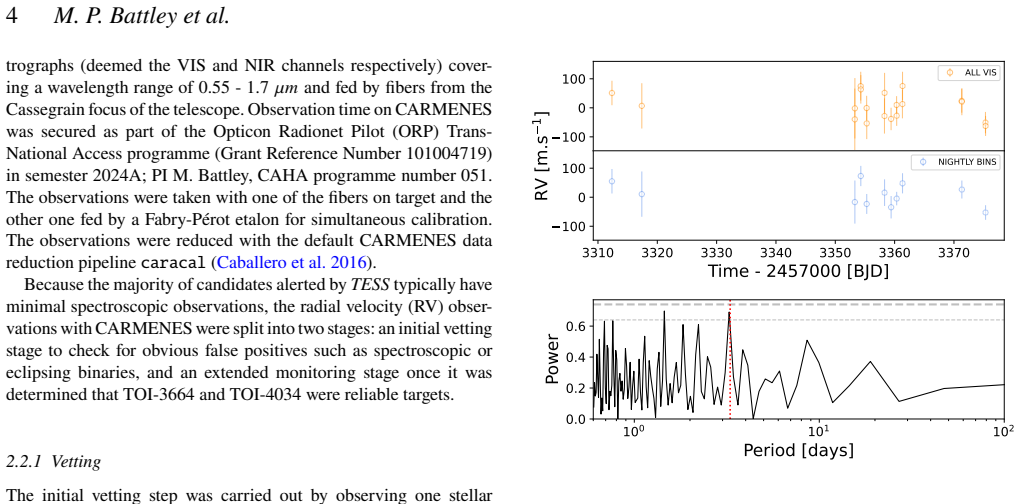
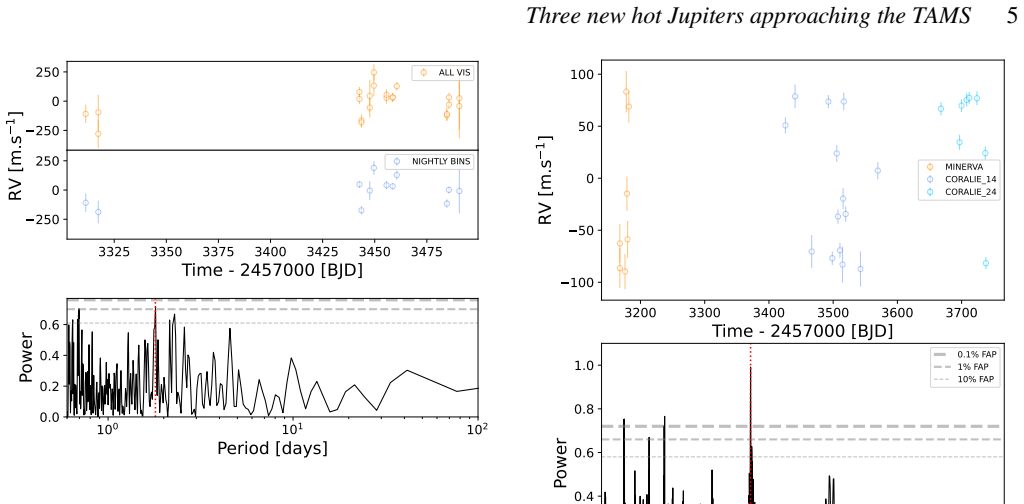
The authors present three new hot Jupiters around stars approaching the terminal age main sequence. TOI-3664 b has a period of 3.30 days, radius 1.22 RJup and mass 0.36 MJup around a 9.0 Gyr star of 0.98 solar masses. TOI-4034 b has a period of 1.80 days, radius 1.58 RJup and mass 0.87 MJup around a 5.7 Gyr star of 1.19 solar masses. TOI-6564 b has a period of 3.99 days, radius 1.46 RJup and mass 0.70 MJup around a 4.0 Gyr star of 1.18 solar masses. The planets have low densities and the hosts' advanced states make them useful for studying later stages of hot Jupiter evolution, adding steps to the age-ladder.
What carries the argument
The age-ladder for hot Jupiter evolution, constructed from systems with ages determined by combining astrometry, gyrochronology, isochrones and lithium abundance to place planets at comparable evolutionary states despite different stellar masses.
If this is right
- These planets enable study of hot Jupiter inflation and evolution as their hosts brighten toward the end of the main sequence.
- The low densities of the planets align with slight inflation due to increasing stellar luminosity.
- The similar evolutionary states of the systems despite different ages and masses demonstrate the value of multi-indicator age determination.
- Additional such systems will help build a more complete timeline of how close-in gas giants respond to stellar changes over billions of years.
Where Pith is reading between the lines
- The combination of age indicators used here could be standardized for other TESS-detected planets to fill gaps in the evolutionary sequence.
- Long-term monitoring of these systems might detect changes in planetary radii or orbits as the stars evolve off the main sequence.
- These examples suggest that hot Jupiters around sub-solar to solar-mass stars may persist into the late main sequence without being engulfed.
- Comparison with younger hot Jupiters could quantify the rate of radius inflation over time.
Load-bearing premise
The derived planetary parameters and system ages accurately represent true planets rather than stellar activity or false positives, and the ages correctly indicate the evolutionary states of the hosts.
What would settle it
Spectroscopic or photometric data showing that any of the transit signals is caused by stellar activity, a background eclipsing binary, or other false positive, or independent age estimates that place the stars at much younger or older stages inconsistent with the terminal age main sequence.
Figures





read the original abstract
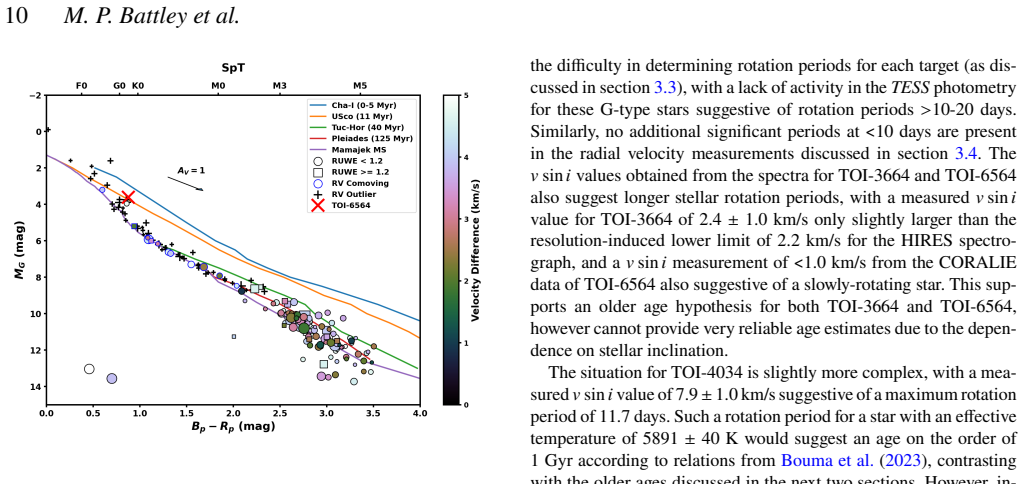
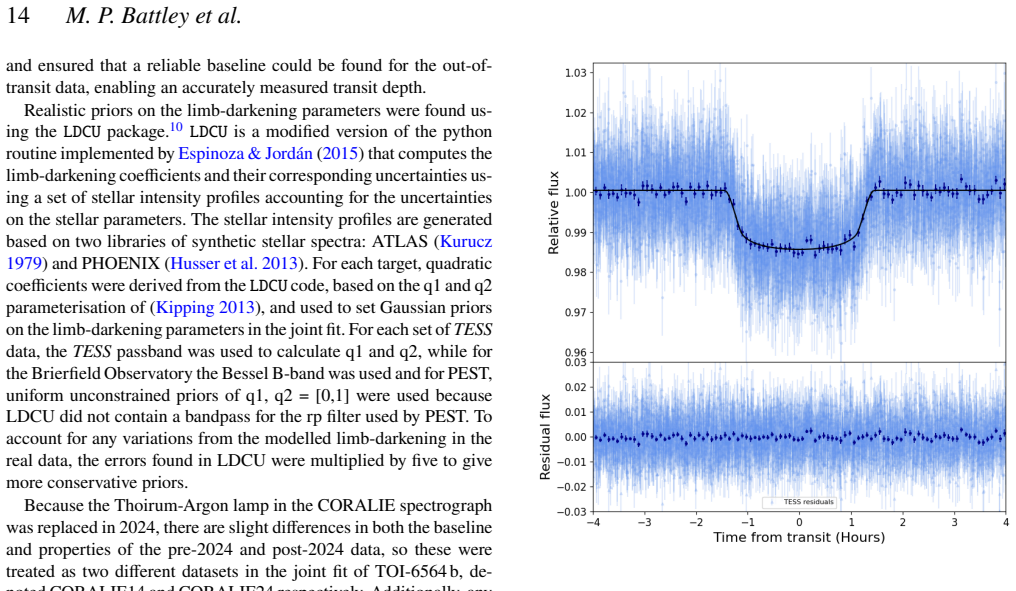
Studying the evolution of hot Jupiters requires a sample of well-characterised systems across all evolutionary states. We present three new gas giant exoplanets around stars approaching the end of the main sequence, a comparatively unexplored epoch of hot Jupiter evolution. These planets were discovered by TESS before being vetted and confirmed through dedicated spectroscopic follow-up programmes by CARMENES, CORALIE and MINERVA-Australis. TOI-3664 b has a period of 3.30 days, a radius of 1.22 +/- 0.03 RJup and a mass of 0.36 +/- 0.12 MJup. TOI-4034 b is a short-period hot Jupiter with a period of 1.80 days, a radius of 1.58 +/- 0.02 RJup and a mass of 0.87 +/- 0.16 MJup. Meanwhile TOI-6564 b has a period of 3.99 days, radius of 1.46 +/- 0.02 RJup and mass of 0.70 +/- 0.07 MJup. All three planets have radii larger than Jupiter but sub-Jupiter masses, in line with slight inflation as their hosts increase in luminosity towards the end of the main sequence. These exoplanets' low densities and hosts' advanced evolutionary states make them interesting planets with which to study the later stages of hot Jupiter evolution. Careful analysis was undertaken to determine the ages of each system, considering astrometry, gyrochronology, stellar isochrones and lithium abundance, yielding ages of 9.0 +2.4/-2.1 Gyr, 5.7 +/- 0.5 Gyr and 4.0 +/- 1.0 Gyr for TOI-3664, TOI-4034 and TOI-6564 respectively, yet each system has a similar evolutionary state because of their differing stellar masses (0.98 +/- 0.03, 1.19 +0.13/-0.03 and 1.18 +0.16/-0.03 M*). These three planets add more steps to the "age-ladder" of exoplanetary evolution, building towards the community's goal of understanding how planets evolve over time.
Editorial analysis
A structured set of objections, weighed in public.
Referee Report
Summary. The paper claims the discovery and characterization of three new hot Jupiters (TOI-3664 b, TOI-4034 b, TOI-6564 b) found by TESS and confirmed with RV follow-up from CARMENES, CORALIE and MINERVA-Australis. The planets have periods 3.30, 1.80 and 3.99 days, radii 1.22-1.58 R_Jup and masses 0.36-0.87 M_Jup. Host-star ages (9.0+2.4/-2.1, 5.7±0.5 and 4.0±1.0 Gyr) are derived from astrometry, gyrochronology, isochrones and lithium; the hosts (0.98, 1.19 and 1.18 M_sun) are stated to occupy similar evolutionary states approaching the terminal-age main sequence because of their differing masses, thereby adding steps to the age-ladder for hot-Jupiter evolution.
Significance. If the fractional evolutionary states are shown to be comparable, the systems would supply useful benchmarks for testing hot-Jupiter inflation and orbital evolution as host stars increase in luminosity near the end of the main sequence. The multi-instrument confirmation and combination of several independent age indicators are strengths of the analysis.
major comments (1)
- [Stellar parameters and evolutionary-state discussion (abstract and § on stellar ages)] The central claim that the three systems are at 'similar evolutionary state' near TAMS rests on the statement that this follows 'because of their differing stellar masses'. No explicit calculation of fractional main-sequence age (age/t_TAMS) or core-hydrogen fraction from the isochrone fits is provided to verify that the reported ages place the 0.98 M_sun, 1.19 M_sun and 1.18 M_sun stars at comparable positions (within ~0.1 in fractional age) on the main sequence. Standard models predict substantially different main-sequence lifetimes for these masses, so this verification is required to support the age-ladder interpretation.
minor comments (2)
- [Abstract] Abstract: uncertainty notation '9.0 +2.4/-2.1 Gyr' should be written in the conventional superscript/subscript form 9.0^{+2.4}_{-2.1}.
- [Abstract and planetary-parameters section] The statement of 'slight inflation' would be strengthened by a short quantitative comparison of the measured radii to theoretical expectations at the derived masses, ages and incident fluxes.
Simulated Author's Rebuttal
We thank the referee for their constructive review and for highlighting the need to strengthen the evolutionary-state discussion. We address the major comment below and will revise the manuscript accordingly to provide the requested verification.
read point-by-point responses
-
Referee: The central claim that the three systems are at 'similar evolutionary state' near TAMS rests on the statement that this follows 'because of their differing stellar masses'. No explicit calculation of fractional main-sequence age (age/t_TAMS) or core-hydrogen fraction from the isochrone fits is provided to verify that the reported ages place the 0.98 M_sun, 1.19 M_sun and 1.18 M_sun stars at comparable positions (within ~0.1 in fractional age) on the main sequence. Standard models predict substantially different main-sequence lifetimes for these masses, so this verification is required to support the age-ladder interpretation.
Authors: We agree that an explicit calculation of fractional main-sequence age is required to substantiate the claim. In the revised manuscript we will add a table (or subsection) reporting age/t_TAMS for each star, computed from the isochrone-derived ages and the main-sequence lifetimes predicted by the same stellar models used in the isochrone fitting. We will also quote the corresponding core-hydrogen fractions where available from the models. This will confirm that the three stars lie within ~0.1 of each other in fractional age despite their mass differences, thereby supporting the age-ladder interpretation. revision: yes
Circularity Check
No circularity: direct observational measurements and standard age derivations
full rationale
The paper reports planet parameters (periods, radii, masses) from TESS photometry and independent spectroscopy (CARMENES, CORALIE, MINERVA-Australis) with no equations reducing these to author-defined inputs. Stellar ages are obtained via multiple external methods (astrometry, gyrochronology, isochrones, lithium) whose outputs are not fitted to force the 'similar evolutionary state' conclusion; the differing masses naturally yield comparable fractional main-sequence ages via standard stellar evolution timescales. No self-citations, ansatzes, or uniqueness theorems are invoked as load-bearing. The derivation chain is self-contained against external benchmarks.
Axiom & Free-Parameter Ledger
Reference graph
Works this paper leans on
-
[1]
Comprehensive analytic formulae for stellar evolution as a function of mass and metallicity. , keywords =. doi:10.1046/j.1365-8711.2000.03426.x , archivePrefix =. astro-ph/0001295 , primaryClass =
-
[2]
ApJ , fjournal=
Fournier, Paul , title=. ApJ , fjournal=
-
[3]
An important paper , journal=
-
[4]
Another Unreal Paper , journal=
-
[5]
A Last Unreal Paper , journal=
-
[6]
The CARMENES search for exoplanets around M dwarfs. Radial velocities and activity indicators from cross-correlation functions with weighted binary masks. , keywords =. doi:10.1051/0004-6361/201937222 , archivePrefix =. 2003.07471 , primaryClass =
-
[7]
The TESS Faint-star Search: 1617 TOIs from the TESS Primary Mission. , keywords =. doi:10.3847/1538-4365/ac5688 , archivePrefix =. 2112.02176 , primaryClass =
-
[8]
American Astronomical Society Meeting Abstracts \#233 , year = 2019, series =
A Quick look into the first discoveries of TESS. American Astronomical Society Meeting Abstracts \#233 , year = 2019, series =
2019
-
[9]
Research Notes of the American Astronomical Society , keywords =
Photometry of 10 Million Stars from the First Two Years of TESS Full Frame Images: Part I. Research Notes of the American Astronomical Society , keywords =. doi:10.3847/2515-5172/abca2e , archivePrefix =. 2011.06459 , primaryClass =
-
[10]
Research Notes of the American Astronomical Society , keywords =
Photometry of 10 Million Stars from the First Two Years of TESS Full Frame Images: Part II. Research Notes of the American Astronomical Society , keywords =. doi:10.3847/2515-5172/abca2d , adsurl =
-
[11]
Research Notes of the American Astronomical Society , keywords =
Quick-look Pipeline Lightcurves for 9.1 Million Stars Observed over the First Year of the TESS Extended Mission. Research Notes of the American Astronomical Society , keywords =. doi:10.3847/2515-5172/ac2ef0 , archivePrefix =. 2110.05542 , primaryClass =
-
[12]
Proper motions of the optically visible open clusters based on the UCAC4 catalog. , keywords =. doi:10.1051/0004-6361/201323226 , adsurl =
-
[13]
Clusters and mirages: cataloguing stellar aggregates in the Milky Way. , keywords =. doi:10.1051/0004-6361/201936691 , archivePrefix =. 1911.07075 , primaryClass =
-
[14]
doi:10.1051/0004-6361/201629512 , pmid =
2016 , journal =. doi:10.1051/0004-6361/201629512 , pmid =
-
[15]
Gaia Data Release 2. Summary of the contents and survey properties
2018 , journal =. doi:10.1051/0004-6361/201833051 , pmid =
work page internal anchor Pith review doi:10.1051/0004-6361/201833051 2018
-
[16]
Kov. 2002 , journal =. doi:10.1051/0004-6361:20020802 , pmid =
-
[17]
Jenkins, Jon M. and Twicken, Joseph D. and McCauliff, Sean and Campbell, Jennifer and Sanderfer, Dwight and Lung, David and Mansouri-Samani, Masoud and Girouard, Forrest and Tenenbaum, Peter and Klaus, Todd and Smith, Jeffrey C. and Caldwell, Douglas A. and Chacon, A. D. and Henze, Christopher and Heiges, Cory and Latham, David W. and Morgan, Edward and S...
-
[18]
Ground-based and Airborne Instrumentation for Astronomy V , year = 2014, editor =
CARMENES instrument overview. Ground-based and Airborne Instrumentation for Astronomy V , year = 2014, editor =. doi:10.1117/12.2056453 , adsurl =
-
[19]
The CARMENES search for exoplanets around M dwarfs. High-resolution optical and near-infrared spectroscopy of 324 survey stars. , keywords =. doi:10.1051/0004-6361/201732054 , archivePrefix =. 1711.06576 , primaryClass =
work page internal anchor Pith review Pith/arXiv arXiv doi:10.1051/0004-6361/201732054
-
[20]
Spectrum radial velocity analyser (SERVAL). High-precision radial velocities and two alternative spectral indicators. , keywords =. doi:10.1051/0004-6361/201731483 , archivePrefix =. 1710.10114 , primaryClass =
work page internal anchor Pith review Pith/arXiv arXiv doi:10.1051/0004-6361/201731483
-
[21]
Precision Stellar Characterization of FGKM Stars using an Empirical Spectral Library
Precision Stellar Characterization of FGKM Stars using an Empirical Spectral Library. , keywords =. doi:10.3847/1538-4357/836/1/77 , archivePrefix =. 1701.00922 , primaryClass =
work page internal anchor Pith review Pith/arXiv arXiv doi:10.3847/1538-4357/836/1/77
-
[22]
SpecMatch-Emp: Empirical SpecMatch
-
[23]
ARIADNE: Measuring accurate and precise stellar parameters through SED fitting. , keywords =. doi:10.1093/mnras/stac956 , archivePrefix =. 2204.03769 , primaryClass =
-
[24]
American Institute of Physics Conference Series , year = "2004", editor =
Nested Sampling. American Institute of Physics Conference Series , year = "2004", editor =. doi:10.1063/1.1835238 , adsurl =
-
[25]
Skilling, John. Nested sampling for general Bayesian computation. Bayesian Anal. 2006. doi:10.1214/06-BA127
-
[26]
Husser, Tim-Oliver and von Berg, Sebastian Wende - and Dreizler, Stefan and Homeier, Derek and Reiners, Ansgar and Barman, Travis and Hauschildt, Peter H , doi =. Astronomy. arXiv , arxivId =:1303.5632 , issn =
-
[27]
and Homeier, D
Allard, F. and Homeier, D. and Freytag, B. , doi =. Philosophical Transactions of the Royal Society A: Mathematical, Physical and Engineering Sciences , keywords =
-
[28]
The Astrophysical Journal , number =
Hauschildt, Peter H and Allard, France and Baron, E , doi =. The Astrophysical Journal , number =
-
[29]
1993", month =
ATLAS9 Stellar Atmosphere Programs and 2 km/s grid. ATLAS9 Stellar Atmosphere Programs and 2 km/s grid. Kurucz CD-ROM No. 13. Cambridge , year = "1993", month = "Jan", volume =
1993
-
[30]
Modelling of Stellar Atmospheres , year =
New Grids of ATLAS9 Model Atmospheres. Modelling of Stellar Atmospheres , year =
-
[31]
dynesty: A Dynamic Nested Sampling Package for Estimating Bayesian Posteriors and Evidences
DYNESTY: a dynamic nested sampling package for estimating Bayesian posteriors and evidences. , keywords =. doi:10.1093/mnras/staa278 , archivePrefix =. 1904.02180 , primaryClass =
work page internal anchor Pith review Pith/arXiv arXiv doi:10.1093/mnras/staa278 1904
-
[32]
The Two Micron All Sky Survey (2MASS). , keywords =. doi:10.1086/498708 , adsurl =
-
[33]
The Wide-field Infrared Survey Explorer (WISE): Mission Description and Initial On-orbit Performance. , keywords =. doi:10.1088/0004-6256/140/6/1868 , archivePrefix =. 1008.0031 , primaryClass =
work page internal anchor Pith review Pith/arXiv arXiv doi:10.1088/0004-6256/140/6/1868
-
[34]
The TESS Input Catalog and Candidate Target List
The TESS Input Catalog and Candidate Target List. , keywords =. doi:10.3847/1538-3881/aad050 , archivePrefix =. 1706.00495 , primaryClass =
work page internal anchor Pith review Pith/arXiv arXiv doi:10.3847/1538-3881/aad050
-
[35]
The Revised TESS Input Catalog and Candidate Target List. , keywords =. doi:10.3847/1538-3881/ab3467 , archivePrefix =. 1905.10694 , primaryClass =
-
[36]
, keywords =
The Tycho-2 catalogue of the 2.5 million brightest stars. , keywords =
-
[37]
Kinematika i Fizika Nebesnykh Tel , year = 2001, month = oct, volume =
All-sky compiled catalogue of 2.5 million stars. Kinematika i Fizika Nebesnykh Tel , year = 2001, month = oct, volume =
2001
-
[38]
The Pan-STARRS1 Surveys. arXiv e-prints , keywords =. doi:10.48550/arXiv.1612.05560 , archivePrefix =. 1612.05560 , primaryClass =
work page internal anchor Pith review Pith/arXiv arXiv doi:10.48550/arxiv.1612.05560
-
[39]
, year = 2009, month = mar, volume =
The Spitzer/GLIMPSE Surveys: A New View of the Milky Way. , year = 2009, month = mar, volume =. doi:10.1086/597811 , adsurl =
-
[40]
GALEX catalogs of UV sources: statistical properties and sample science applications: hot white dwarfs in the Milky Way. , keywords =. doi:10.1007/s10509-010-0581-x , adsurl =
-
[41]
Contributions of the Astronomical Observatory Skalnate Pleso , keywords =
The APASS all-sky, multi-epoch BVgri photometric survey. Contributions of the Astronomical Observatory Skalnate Pleso , keywords =
-
[42]
The Eleventh and Twelfth Data Releases of the Sloan Digital Sky Survey: Final Data from SDSS-III
The Eleventh and Twelfth Data Releases of the Sloan Digital Sky Survey: Final Data from SDSS-III. , keywords =. doi:10.1088/0067-0049/219/1/12 , archivePrefix =. 1501.00963 , primaryClass =
work page internal anchor Pith review Pith/arXiv arXiv doi:10.1088/0067-0049/219/1/12
-
[43]
A new catalogue of Stroemgren-Crawford uvbybeta photometry
A new catalogue of Str \"o mgren-Crawford uvby photometry. , keywords =. doi:10.1051/0004-6361/201526413 , archivePrefix =. 1506.04568 , primaryClass =
work page internal anchor Pith review Pith/arXiv arXiv doi:10.1051/0004-6361/201526413
-
[44]
A search for young exoplanets in Sectors 1-5 of the TESS full-frame images. , keywords =. doi:10.1093/mnras/staa1626 , archivePrefix =. 2006.01721 , primaryClass =
-
[45]
ascl:1812.013 , adsurl =
Lightkurve: Kepler and TESS time series analysis in Python. ascl:1812.013 , adsurl =
-
[46]
Instrumentation in Astronomy VIII , year = 1994, editor =
HIRES: the high-resolution echelle spectrometer on the Keck 10-m Telescope. Instrumentation in Astronomy VIII , year = 1994, editor =. doi:10.1117/12.176725 , adsurl =
-
[47]
Gaia-TESS synergy: improving the identification of transit candidates. , keywords =. doi:10.1051/0004-6361/202244207 , archivePrefix =. 2209.05845 , primaryClass =
-
[48]
Astronomy Letters , keywords =
The speckle polarimeter of the 2.5-m telescope: Design and calibration. Astronomy Letters , keywords =. doi:10.1134/S1063773717050036 , adsurl =
-
[49]
, pages =
Lomb, N.R. , pages =. 1976 , journal =
1976
-
[50]
, pages =
Scargle, J.D. , pages =. 1982 , journal =
1982
-
[51]
, archivePrefix = "arXiv", eprint =
Assessing the statistical significance of periodogram peaks. , keywords =. doi:10.1111/j.1365-2966.2008.12689.x , archivePrefix =. 0711.0330 , primaryClass =
-
[52]
Prevalence of Earth-size Planets Orbiting Sun-like Stars
-
[53]
2000 , journal =
Queloz, Didier and Mayor, M and Weber, Lizzy and Burnet, M and Confino, B and Naef, D and Pepe, F , month =. 2000 , journal =
2000
-
[54]
Pepe, F. and Mayor, M. and Galland, F. and Naef, D. and Queloz, D. and Santos, N. C. and Udry, S. and Burnet, M. , number =. 2002 , journal =. doi:10.1051/0004-6361:20020433 , issn =
-
[55]
Determining stellar atmospheric parameters and chemical abundances of FGK stars with iSpec
Determining stellar atmospheric parameters and chemical abundances of FGK stars with iSpec. , keywords =. doi:10.1051/0004-6361/201423945 , archivePrefix =. 1407.2608 , primaryClass =
work page internal anchor Pith review Pith/arXiv arXiv doi:10.1051/0004-6361/201423945
-
[56]
STEPARSYN: A Bayesian code to infer stellar atmospheric parameters using spectral synthesis. , keywords =. doi:10.1051/0004-6361/202141763 , archivePrefix =. 2110.00444 , primaryClass =
-
[57]
Minerva-Australis. I. Design, Commissioning, and First Photometric Results. , keywords =. doi:10.1088/1538-3873/ab03aa , archivePrefix =. 1901.11231 , primaryClass =
-
[58]
AstroImageJ: Image Processing and Photometric Extraction for Ultra-precise Astronomical Light Curves. , keywords =. doi:10.3847/1538-3881/153/2/77 , archivePrefix =. 1701.04817 , primaryClass =
work page internal anchor Pith review Pith/arXiv arXiv doi:10.3847/1538-3881/153/2/77
-
[59]
Astropy: A Community Python Package for Astronomy
doi:10.1051/0004-6361/201322068 , Eid =. arXiv , Author =:1307.6212 , Journal =
work page internal anchor Pith review Pith/arXiv arXiv doi:10.1051/0004-6361/201322068
-
[60]
The Astropy Project: Building an inclusive, open-science project and status of the v2.0 core package
The Astropy Project: Building an Open-science Project and Status of the v2.0 Core Package. , keywords =. doi:10.3847/1538-3881/aabc4f , archivePrefix =. 1801.02634 , primaryClass =
work page internal anchor Pith review Pith/arXiv arXiv doi:10.3847/1538-3881/aabc4f
-
[61]
The Astropy Project: Sustaining and Growing a Community-oriented Open-source Project and the Latest Major Release (v5.0) of the Core Package. , keywords =. doi:10.3847/1538-4357/ac7c74 , archivePrefix =. 2206.14220 , primaryClass =
work page internal anchor Pith review Pith/arXiv arXiv doi:10.3847/1538-4357/ac7c74
-
[62]
Quantifying the Limits of TESS Stellar Rotation Measurements with the K2-TESS Overlap. , keywords =. doi:10.3847/1538-4357/adcecc , archivePrefix =. 2504.13262 , primaryClass =
-
[63]
Origins of Hot Jupiters. , keywords =. doi:10.1146/annurev-astro-081817-051853 , archivePrefix =. 1801.06117 , primaryClass =
work page internal anchor Pith review Pith/arXiv arXiv doi:10.1146/annurev-astro-081817-051853
-
[64]
A Jovian planet in an eccentric 11.5 day orbit around HD1397 discovered by TESS
A Jovian planet in an eccentric 11.5 day orbit around HD 1397 discovered by TESS. , keywords =. doi:10.1051/0004-6361/201834577 , archivePrefix =. 1811.01882 , primaryClass =
work page internal anchor Pith review Pith/arXiv arXiv doi:10.1051/0004-6361/201834577
-
[65]
TOI-257b (HD 19916b): a warm sub-saturn orbiting an evolved F-type star. , keywords =. doi:10.1093/mnras/staa3960 , archivePrefix =. 2001.07345 , primaryClass =
-
[66]
TOI-1842b: A Transiting Warm Saturn Undergoing Reinflation around an Evolving Subgiant. , keywords =. doi:10.3847/1538-3881/ac3f39 , archivePrefix =. 2112.00198 , primaryClass =
-
[67]
Summary of the content and survey properties
Gaia Data Release 3. Summary of the content and survey properties. , keywords =. doi:10.1051/0004-6361/202243940 , archivePrefix =. 2208.00211 , primaryClass =
-
[68]
2016, ApJS, 222, 8, doi: 10.3847/0067-0049/222/1/8
MESA Isochrones and Stellar Tracks (MIST) 0: Methods for the Construction of Stellar Isochrones. , keywords =. doi:10.3847/0067-0049/222/1/8 , archivePrefix =. 1601.05144 , primaryClass =
work page internal anchor Pith review Pith/arXiv arXiv doi:10.3847/0067-0049/222/1/8
-
[69]
Mesa Isochrones and Stellar Tracks (MIST). I. Solar-scaled Models. , keywords =. doi:10.3847/0004-637X/823/2/102 , archivePrefix =. 1604.08592 , primaryClass =
work page internal anchor Pith review Pith/arXiv arXiv doi:10.3847/0004-637x/823/2/102
-
[70]
American Astronomical Society Meeting Abstracts \#223 , year = 2014, series =
All Sky Automated Survey for SuperNovae (ASAS-SN or ``Assassin''). American Astronomical Society Meeting Abstracts \#223 , year = 2014, series =
2014
-
[71]
The All-Sky Automated Survey for Supernovae (ASAS-SN) Light Curve Server v1.0
The All-Sky Automated Survey for Supernovae (ASAS-SN) Light Curve Server v1.0. , keywords =. doi:10.1088/1538-3873/aa80d9 , archivePrefix =. 1706.07060 , primaryClass =
work page internal anchor Pith review Pith/arXiv arXiv doi:10.1088/1538-3873/aa80d9
-
[72]
kima: Exoplanet detection in radial velocities
kima: Exoplanet detection in radial velocities. The Journal of Open Source Software , keywords =. doi:10.21105/joss.00487 , archivePrefix =. 1806.08305 , primaryClass =
work page internal anchor Pith review Pith/arXiv arXiv doi:10.21105/joss.00487
-
[73]
Espinoza, Néstor and Jord. 2015 , journal =. doi:10.1093/mnras/stv744 , issn =
-
[74]
2015 , journal =
Kreidberg, Laura , pages =. 2015 , journal =
2015
-
[75]
Fulton, Benjamin J. and Petigura, Erik A. and Blunt, Sarah and Sinukoff, Evan , number =. 2018 , journal =. doi:10.1088/1538-3873/aaaaa8 , issn =
-
[76]
2018 , journal =
Foreman-Mackey, D , number =. 2018 , journal =
2018
-
[77]
Bayesian priors for the eccentricity of transiting planets
Bayesian priors for the eccentricity of transiting planets. , keywords =. doi:10.1093/mnras/stu1561 , archivePrefix =. 1408.1393 , primaryClass =
work page internal anchor Pith review Pith/arXiv arXiv doi:10.1093/mnras/stu1561
-
[78]
Espinoza, Néstor and Kossakowski, Diana and Brahm, Rafael , number =. 2019 , journal =. doi:10.1093/mnras/stz2688 , issn =
-
[79]
Efficient, uninformative sampling of limb darkening coefficients for two-parameter laws
Efficient, uninformative sampling of limb darkening coefficients for two-parameter laws. , keywords =. doi:10.1093/mnras/stt1435 , archivePrefix =. 1308.0009 , primaryClass =
work page internal anchor Pith review Pith/arXiv arXiv doi:10.1093/mnras/stt1435
-
[80]
Model atmospheres for G, F, A, B, and O stars. , keywords =. doi:10.1086/190589 , adsurl =
discussion (0)
Sign in with ORCID, Apple, or X to comment. Anyone can read and Pith papers without signing in.