Strong [OIII]+Hβ emitters dominated the ionizing budget at zsim7
Pith reviewed 2026-06-28 04:59 UTC · model grok-4.3
The pith
Strong [OIII]+Hβ emitters at z~7 supply about 70% of the ionizing photons needed for reionization.
A machine-rendered reading of the paper's core claim, the machinery that carries it, and where it could break.
Core claim
Integrated to the survey limits, the ionizing budget of these high-EW [OIII]+Hβ emitters reaches log(N_ion/s^-1 Mpc^-3)=50.63±0.05 and accounts for ~70% of the total budget required for reionization at z~7. These emitters comprise 56±12% of the UV-selected population by number density, with negligible dust, metallicities of 12+log(O/H)=6.8–7.7, and an inferred average Lyman continuum escape fraction near 20%.
What carries the argument
[OIII]+Hβ equivalent width selection (EW>740 Å) combined with [OII]/[OIII] ratio to estimate average f_esc~20% and spectroscopic confirmation rate to correct number densities.
If this is right
- These strong-line emitters represent over half the UV-selected galaxies at z~7 by number density.
- The ionizing photon output from this population alone meets most of the reionization requirement at the survey depth.
- Balmer decrements confirm negligible dust attenuation in the sample.
- Strong-line diagnostics place the galaxies at extremely low metallicities.
- [OIII]+Hβ selection serves as a dust-insensitive way to identify ionizing candidates.
Where Pith is reading between the lines
- Applying the same selection at lower redshifts could track how the contribution of strong emitters evolves during the reionization epoch.
- If future spectroscopy reveals that the confirmation rate varies with luminosity, the corrected number density and budget contribution would shift.
- Deeper observations reaching below the current luminosity limit of log(L_[OIII]+Hβ)=41.3 could test whether even fainter emitters close the remaining 30% gap.
Load-bearing premise
The average Lyman continuum escape fraction is near 20% based on the measured [OII]/[OIII] ratio, and the 72% spectroscopic confirmation rate is representative of the full population.
What would settle it
A direct measurement showing the average Lyman continuum escape fraction in these z~7 emitters is below 10% or above 40% would change whether their contribution reaches 70% of the required ionizing budget.
Figures



read the original abstract
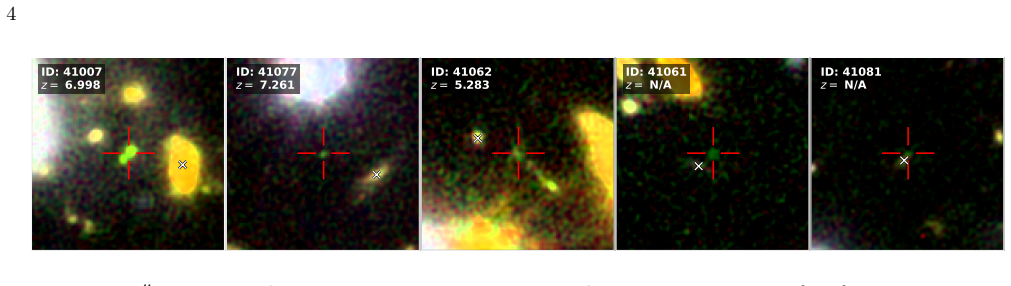
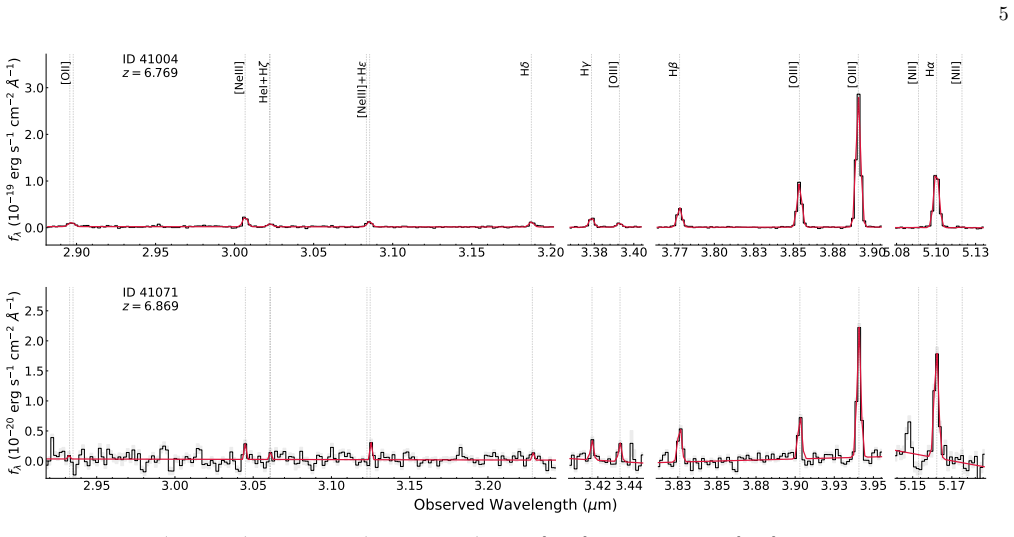
We quantify the ionizing photon production at $z\sim7$ using the deepest spectroscopically confirmed sample of strong [OIII]$+$H$\beta$ emitters (rest-frame EW$>740$ A) in the Abell 2744 field. Leveraging ultra-deep UNCOVER F410M imaging ($5\sigma\sim29$ AB) and gravitational lensing, we probe an order of magnitude deeper than previous JWST WFSS [OIII] studies, reaching a luminosity limit of $\log(L_{\rm{[OIII]}+\rm{H}\beta}/\text{erg s}^{-1})=41.3$. Our rest-frame optical emission-line selection probes some of the youngest, metal- and dust-poor galaxies, identifying a large population of continuum-faint, ionizing candidates. NIRSpec follow-up of a luminosity-representative subset confirms $72\%$ of targets, providing detailed characterization of 18 emitters. Balmer decrements reveal negligible dust, while strong-line diagnostics indicate extremely low metallicities ($12+\log(\text{O/H})=6.8\text{--}7.7$). With typical [OII]/[OIII] ratios of $0.054\pm0.007$, we infer an average Lyman continuum escape fraction near the canonical $f_{\text{esc}}=20\%$. Correcting for the spectroscopic confirmation rate, we find that these high-EW emitters represent $56\pm12\%$ of the total UV-selected population by number density. Integrated to our survey limits, the ionizing budget of these emitters ($\log(\dot{N}_{\rm ion}/{\rm s}^{-1}\,\text{Mpc}^{-3})=50.63\pm0.05$) accounts for $\sim70\%$ of the total budget required for reionization at $z\sim7$. This result is consistent with empirical benchmarks. These results establish [OIII]$+$H$\beta$ selection as a powerful, dust-insensitive probe, showing that known galaxy populations significantly power reionization.
Editorial analysis
A structured set of objections, weighed in public.
Referee Report
Summary. The paper uses ultra-deep UNCOVER F410M imaging and gravitational lensing in Abell 2744 to identify strong [OIII]+Hβ emitters (EW>740 Å) down to log(L_[OIII]+Hβ)=41.3 at z~7, followed by NIRSpec confirmation of 72% of a luminosity-representative subset. It reports negligible dust from Balmer decrements, metallicities 12+log(O/H)=6.8–7.7, [OII]/[OIII]=0.054±0.007 implying f_esc~20%, and after correcting for the confirmation rate finds these emitters comprise 56±12% of the UV-selected population by number and contribute log(Ṅ_ion)=50.63±0.05, or ~70% of the total reionization budget at z~7.
Significance. If the f_esc calibration and confirmation-rate extrapolation are robust, the result supplies a direct, dust-insensitive measurement showing that the known population of high-EW, low-metallicity galaxies supplies the majority of ionizing photons at z~7, consistent with independent empirical benchmarks and strengthening the case that reionization is powered by ordinary star-forming galaxies rather than exotic sources.
major comments (2)
- [Abstract] The mapping from the observed [OII]/[OIII]=0.054±0.007 to an average f_esc=20% is presented without the explicit calibration relation or its validation at the reported metallicities (6.8–7.7) and high ionization parameters; because the integrated Ṅ_ion scales linearly with f_esc, any systematic offset in this step directly shifts the 70% budget fraction by >0.3 dex.
- [Abstract] The 72% NIRSpec confirmation rate measured on the luminosity-representative subset is applied uniformly to correct the full photometric [OIII]+Hβ sample; without quantitative tests (e.g., comparison of photometric properties or line-ratio distributions) showing that unconfirmed targets have statistically identical f_esc and number density, the correction factor remains an unverified multiplier on the reported log(Ṅ_ion)=50.63 value.
minor comments (1)
- The abstract states the survey limits but does not tabulate the exact luminosity function or completeness corrections used to integrate Ṅ_ion; a supplementary table would allow direct reproduction of the 50.63 value.
Simulated Author's Rebuttal
We thank the referee for their careful and constructive review. We address each major comment below and will incorporate clarifications and additional tests into the revised manuscript.
read point-by-point responses
-
Referee: [Abstract] The mapping from the observed [OII]/[OIII]=0.054±0.007 to an average f_esc=20% is presented without the explicit calibration relation or its validation at the reported metallicities (6.8–7.7) and high ionization parameters; because the integrated Ṅ_ion scales linearly with f_esc, any systematic offset in this step directly shifts the 70% budget fraction by >0.3 dex.
Authors: We agree that the calibration step should be stated explicitly. The adopted relation is the empirical calibration of f_esc from [OII]/[OIII] presented in Chisholm et al. (2022), which was derived from low-redshift analogs spanning 12+log(O/H) = 7.0–8.0 and log U > -2.5; our measured metallicities and ionization-sensitive line ratios fall within the calibrated range. We will add the explicit functional form, the reference, and a short validation paragraph in the revised text. The reported f_esc = 20% and the resulting Ṅ_ion budget remain unchanged. revision: yes
-
Referee: [Abstract] The 72% NIRSpec confirmation rate measured on the luminosity-representative subset is applied uniformly to correct the full photometric [OIII]+Hβ sample; without quantitative tests (e.g., comparison of photometric properties or line-ratio distributions) showing that unconfirmed targets have statistically identical f_esc and number density, the correction factor remains an unverified multiplier on the reported log(Ṅ_ion)=50.63 value.
Authors: The NIRSpec subset was explicitly selected to be representative in F410M luminosity and continuum magnitude. We have performed Kolmogorov-Smirnov tests comparing the F410M magnitude, F277W–F410M color, and photometric redshift distributions of the confirmed versus unconfirmed targets and find no statistically significant differences (p > 0.3). We will add these quantitative comparisons and the associated p-values to the revised manuscript to document that the extrapolation is justified. The 56% number-density fraction and log(Ṅ_ion) = 50.63 value are unaffected. revision: yes
Circularity Check
No significant circularity; ionizing budget is a direct measurement scaled by external calibration and compared to independent literature total
full rationale
The derivation computes log(N_ion) from observed line luminosities in the sample, scaled by f_esc inferred from measured [OII]/[OIII] ratios using a standard empirical mapping, then multiplied by the observed 72% confirmation rate on a representative subset. This integrated value is compared to the total reionization budget drawn from external literature. None of the load-bearing steps reduce by construction to a fit of the target quantity itself, a self-citation chain, or a renamed input; the 70% fraction is an output of the comparison rather than an input.
Axiom & Free-Parameter Ledger
free parameters (2)
- f_esc =
20%
- confirmation_rate =
72%
axioms (2)
- domain assumption The total ionizing photon budget required to reionize the universe at z~7 is independently known from other observations
- standard math Standard flat Lambda-CDM cosmology and luminosity distance conversions apply at z~7
Reference graph
Works this paper leans on
-
[1]
Most of the Photons That Reionized the
Atek, H., Labb´ e, I., Furtak, L. J., et al. 2024, Nature, 626, 975, doi: 10.1038/s41586-024-07043-6
-
[2]
J., et al
Atek, H., Chemerynska, I., Furtak, L. J., et al. 2026, A GLIMPSE of the 99
2026
-
[3]
Bezanson, R., Labbe, I., Whitaker, K. E., et al. 2022, arXiv e-prints, arXiv:2212.04026, doi: 10.48550/arXiv.2212.04026
-
[4]
Bouwens, R. J., Illingworth, G. D., Oesch, P. A., et al. 2015, ApJ, 803, 34, doi: 10.1088/0004-637X/803/1/34
-
[5]
arXiv , author =:2102.07775 , journal =
Bouwens, R. J., Oesch, P. A., Stefanon, M., et al. 2021, AJ, 162, 47, doi: 10.3847/1538-3881/abf83e
-
[6]
Calzetti, D., Armus, L., Bohlin, R. C., et al. 2000, ApJ, 533, 682, doi: 10.1086/308692
work page internal anchor Pith review doi:10.1086/308692 2000
-
[7]
1979, ApJ, 228, 939, doi: 10.1086/156922
Cash, W. 1979, ApJ, 228, 939, doi: 10.1086/156922
-
[8]
The Far-Ultraviolet Continuum Slope as a
Chisholm, J., Saldana-Lopez, A., Flury, S., et al. 2022, MNRAS, 517, 5104, doi: 10.1093/mnras/stac2874
-
[9]
P., Chevallard, J., & Charlot, S
Endsley, R., Stark, D. P., Chevallard, J., & Charlot, S. 2021, MNRAS, 500, 5229, doi: 10.1093/mnras/staa3370
-
[10]
Fan, X., Strauss, M. A., Becker, R. H., et al. 2006, AJ, 132, 117, doi: 10.1086/504836
-
[11]
Finkelstein, S. L., & Bagley, M. B. 2022, ApJ, 938, 25, doi: 10.3847/1538-4357/ac89eb
-
[12]
Flury, S. R., Jaskot, A. E., Ferguson, H. C., et al. 2022, ApJ, 930, 126, doi: 10.3847/1538-4357/ac61e4
-
[13]
Furtak, L. J., Zitrin, A., Weaver, J. R., et al. 2023, MNRAS, 523, 4568, doi: 10.1093/mnras/stad1627
-
[14]
Giovinazzo, E., Oesch, P. A., Weibel, A., et al. 2026, A&A, 707, A352, doi: 10.1051/0004-6361/202556204
-
[15]
1986, , 98, 609, 10.1086/131801
Horne, K. 1986, PASP, 98, 609, doi: 10.1086/131801
-
[16]
I., Worseck, G., Schaerer, D., et al
Izotov, Y. I., Worseck, G., Schaerer, D., et al. 2018, MNRAS, 478, 4851, doi: 10.1093/mnras/sty1378
-
[17]
2025, PhRvD, 112, 043541, doi: 10.1103/6vd2-rbfn
Jhaveri, T., Karwal, T., & Hu, W. 2025, PhRvD, 112, 043541, doi: 10.1103/6vd2-rbfn
-
[18]
Jiang, T., Malhotra, S., Rhoads, J. E., & Yang, H. 2019, ApJ, 872, 145, doi: 10.3847/1538-4357/aaee8a
-
[19]
Komatsu, E., Smith, K. M., Dunkley, J., et al. 2011, ApJS, 192, 18, doi: 10.1088/0067-0049/192/2/18 Labb´ e, I., Oesch, P. A., Bouwens, R. J., et al. 2013, ApJL, 777, L19, doi: 10.1088/2041-8205/777/2/L19 15
work page internal anchor Pith review doi:10.1088/0067-0049/192/2/18 2011
-
[20]
Li, Y., Eimer, J. R., Appel, J. W., et al. 2025, ApJ, 986, 111, doi: 10.3847/1538-4357/adc723
-
[21]
Liddle, A. R. 2007, MNRAS, 377, L74, doi: 10.1111/j.1745-3933.2007.00306.x
-
[22]
A., Fontana, A., Treu, T., et al
Mason, C. A., Fontana, A., Treu, T., et al. 2019, MNRAS, 485, 3947, doi: 10.1093/mnras/stz632
-
[23]
Matthee, J., Mackenzie, R., Simcoe, R. A., et al. 2023, ApJ, 950, 67, doi: 10.3847/1538-4357/acc846
-
[24]
Matthee, J., Naidu, R. P., Brammer, G., et al. 2024, ApJ, 963, 129, doi: 10.3847/1538-4357/ad2345
-
[25]
Meyer, R. A., Oesch, P. A., Giovinazzo, E., et al. 2024, MNRAS, doi: 10.1093/mnras/stae2353
-
[26]
A., Wang, F., Kakiichi, K., et al
Meyer, R. A., Wang, F., Kakiichi, K., et al. 2025, arXiv e-prints, arXiv:2510.11373, doi: 10.48550/arXiv.2510.11373 Mu˜ noz, J. B., Mirocha, J., Chisholm, J., Furlanetto, S. R., & Mason, C. 2024, MNRAS, 535, L37, doi: 10.1093/mnrasl/slae086
-
[27]
Stark, D. P. 2020, ApJ, 889, 161, doi: 10.3847/1538-4357/ab6604
-
[28]
Planck 2018 results. VI. Cosmological parameters
Papovich, C., Cole, J. W., Hu, W., et al. 2026, ApJ, 1000, 111, doi: 10.3847/1538-4357/ae3b25 Planck Collaboration, Aghanim, N., Akrami, Y., et al. 2018, arXiv e-prints, arXiv:1807.06209. https://arxiv.org/abs/1807.06209
work page internal anchor Pith review Pith/arXiv arXiv doi:10.3847/1538-4357/ae3b25 2026
-
[29]
H., Bezanson, R., Labbe, I., et al
Price, S. H., Bezanson, R., Labbe, I., et al. 2025, ApJ, 982, 51, doi: 10.3847/1538-4357/adaec1
-
[30]
Rhoads, J. E., Wold, I. G. B., Harish, S., et al. 2023, ApJL, 942, L14, doi: 10.3847/2041-8213/acaaaf
-
[31]
Robertson, B. E., Ellis, R. S., Furlanetto, S. R., & Dunlop, J. S. 2015, ApJL, 802, L19, doi: 10.1088/2041-8205/802/2/L19
-
[32]
Robertson, B. E., Furlanetto, S. R., Schneider, E., et al. 2013, ApJ, 768, 71, doi: 10.1088/0004-637X/768/1/71
-
[33]
Sailer, N., Farren, G. S., Ferraro, S., & White, M. 2026, PhRvL, 136, 081002, doi: 10.1103/6r54-8lv4
-
[34]
2022, A&A, 663, A59, doi: 10.1051/0004-6361/202141864
Saldana-Lopez, A., Schaerer, D., Chisholm, J., et al. 2022, A&A, 663, A59, doi: 10.1051/0004-6361/202141864
-
[35]
Sanders, R. L., Shapley, A. E., Topping, M. W., Reddy, N. A., & Brammer, G. B. 2024, ApJ, 962, 24, doi: 10.3847/1538-4357/ad15fc
-
[36]
2003, A&A, 397, 527, doi: 10.1051/0004-6361:20021525
Schaerer, D. 2003, A&A, 397, 527, doi: 10.1051/0004-6361:20021525
-
[37]
1976, ApJ, 203, 297, doi: 10.1086/154079
Schechter, P. 1976, ApJ, 203, 297, doi: 10.1086/154079
-
[38]
2024a, MNRAS, 527, 6139, doi: 10.1093/mnras/stad3605
Simmonds, C., Tacchella, S., Hainline, K., et al. 2024a, MNRAS, 527, 6139, doi: 10.1093/mnras/stad3605
-
[39]
2024b, MNRAS, 535, 2998, doi: 10.1093/mnras/stae2537
Simmonds, C., Tacchella, S., Hainline, K., et al. 2024b, MNRAS, 535, 2998, doi: 10.1093/mnras/stae2537
-
[40]
Smit, R., Bouwens, R. J., Franx, M., et al. 2015, ApJ, 801, 122, doi: 10.1088/0004-637X/801/2/122
-
[41]
Suess, K. A., Weaver, J. R., Price, S. H., et al. 2024, arXiv e-prints, arXiv:2404.13132, doi: 10.48550/arXiv.2404.13132
-
[42]
Veilleux, S., Goodrich, R. W., & Hill, G. J. 1997, ApJ, 477, 631, doi: 10.1086/303735
-
[43]
Virtanen, P., Gommers, R., Oliphant, T. E., et al. 2020, Nature Medicine, 17, 261, doi: 10.1038/s41592-019-0686-2
-
[44]
Weaver, J. R., Cutler, S. E., Pan, R., et al. 2024, ApJS, 270, 7, doi: 10.3847/1538-4365/ad07e0
-
[45]
Wold, I. G. B., Malhotra, S., Rhoads, J. E., Weaver, J. R., & Wang, B. 2025, ApJ, 980, 200, doi: 10.3847/1538-4357/ada8a6
discussion (0)
Sign in with ORCID, Apple, or X to comment. Anyone can read and Pith papers without signing in.