Towards Unified and Data-Efficient Prognostics and Health Management with Tabular Foundation Models
Pith reviewed 2026-06-28 06:40 UTC · model grok-4.3
The pith
Converting unit-level signals to tabular rows lets foundation models handle multiple PHM tasks with top average ranks and strong low-data performance.
A machine-rendered reading of the paper's core claim, the machinery that carries it, and where it could break.
Core claim
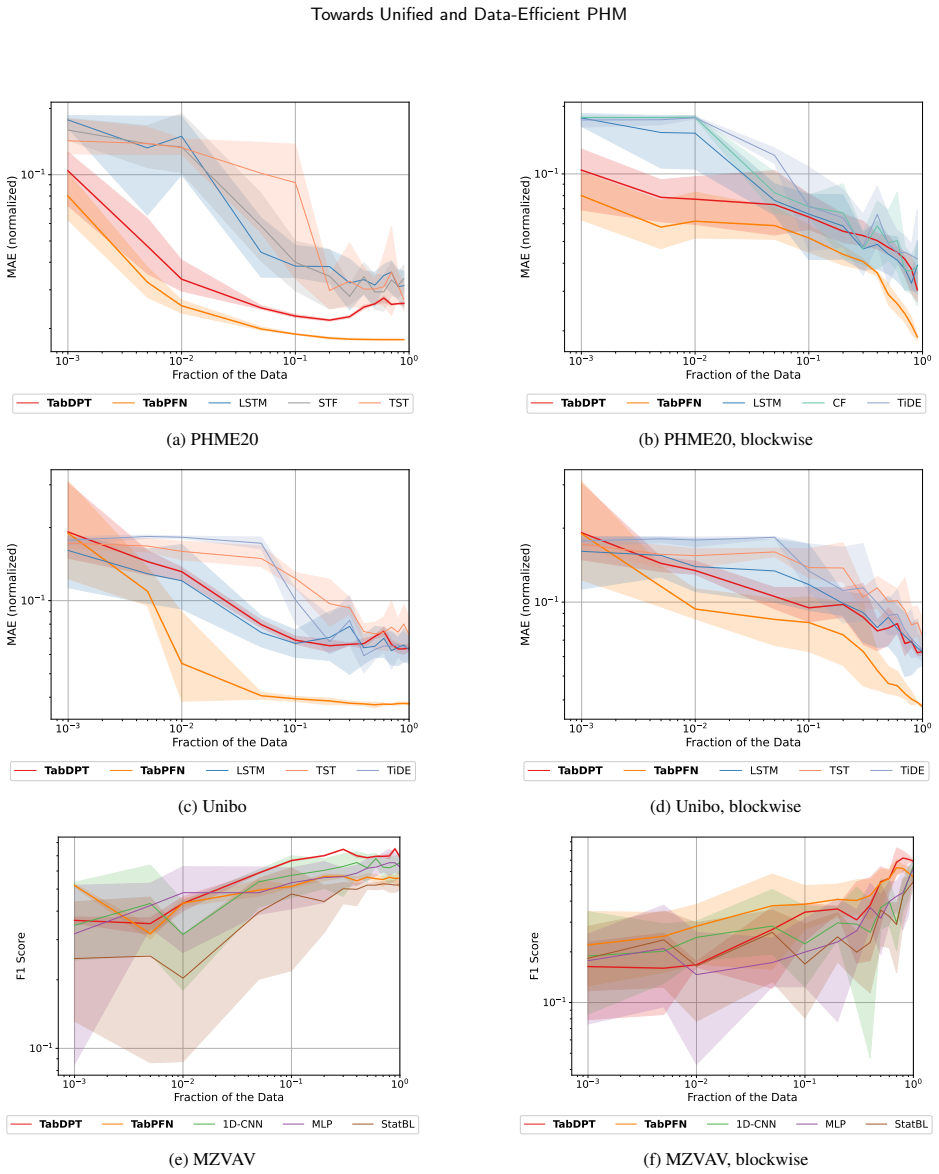
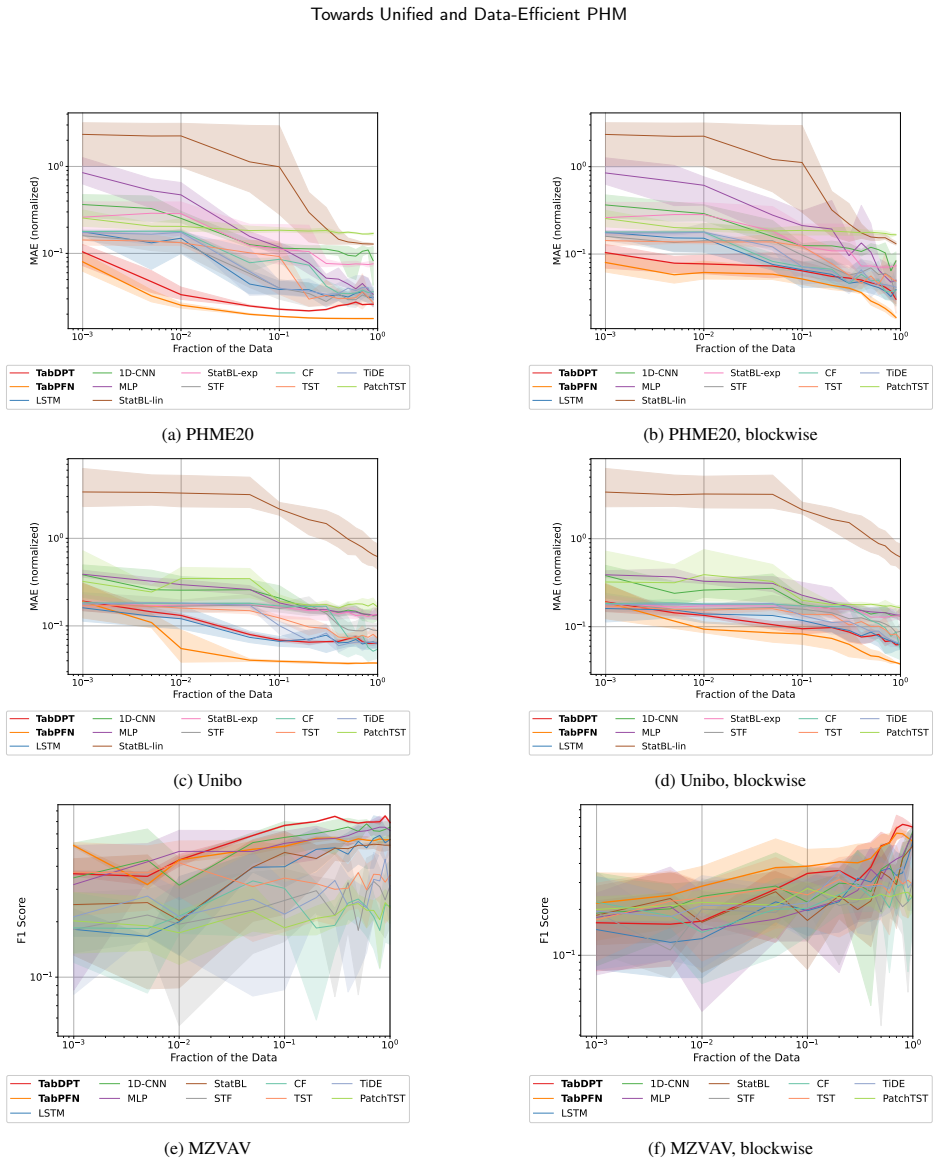
By converting raw unit-level signals into tabular rows, tabular foundation models perform well across multiple PHM tasks—including prognostics and diagnostics—and achieve the best average ranks; PFN-based models are competitive in low-data regimes.
What carries the argument
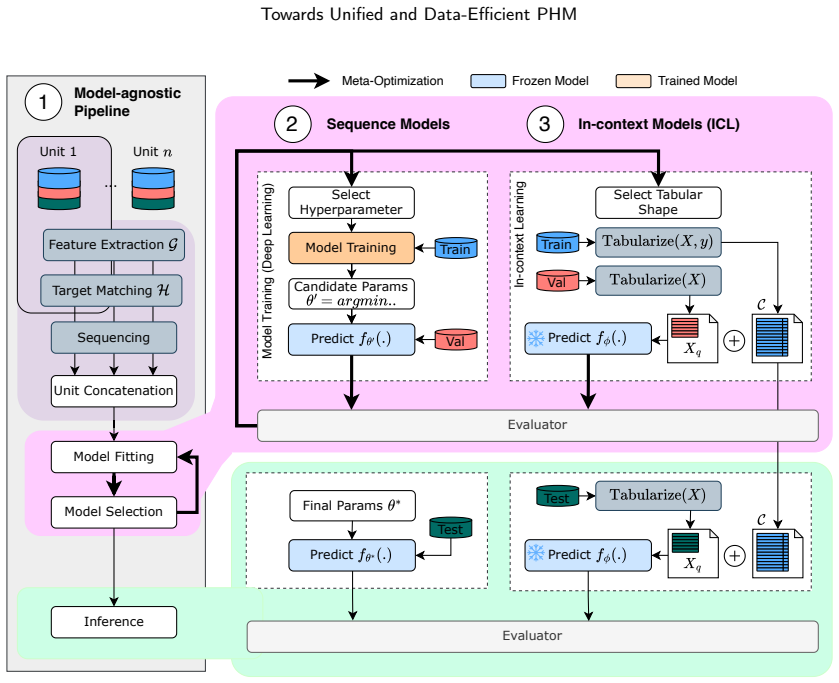
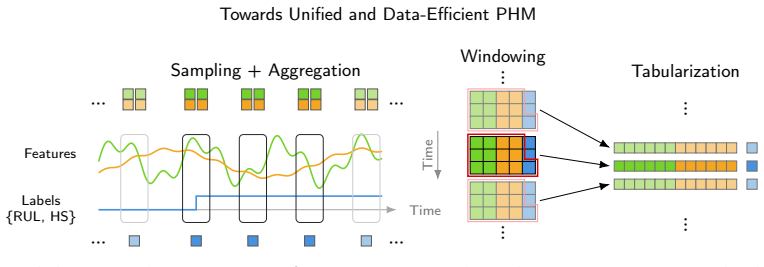
The conversion of time-varying condition-monitoring signals into tabular rows that supports in-context learning with tabular foundation models.
If this is right
- A single tabular foundation model can serve as a reusable interface for mixed diagnostic and prognostic problems without task-specific retraining.
- PFN-based tabular models reduce the labeled data volume required for acceptable accuracy on industrial assets.
- Performance hinges on constructing representative context examples during subsampling of the tabular rows.
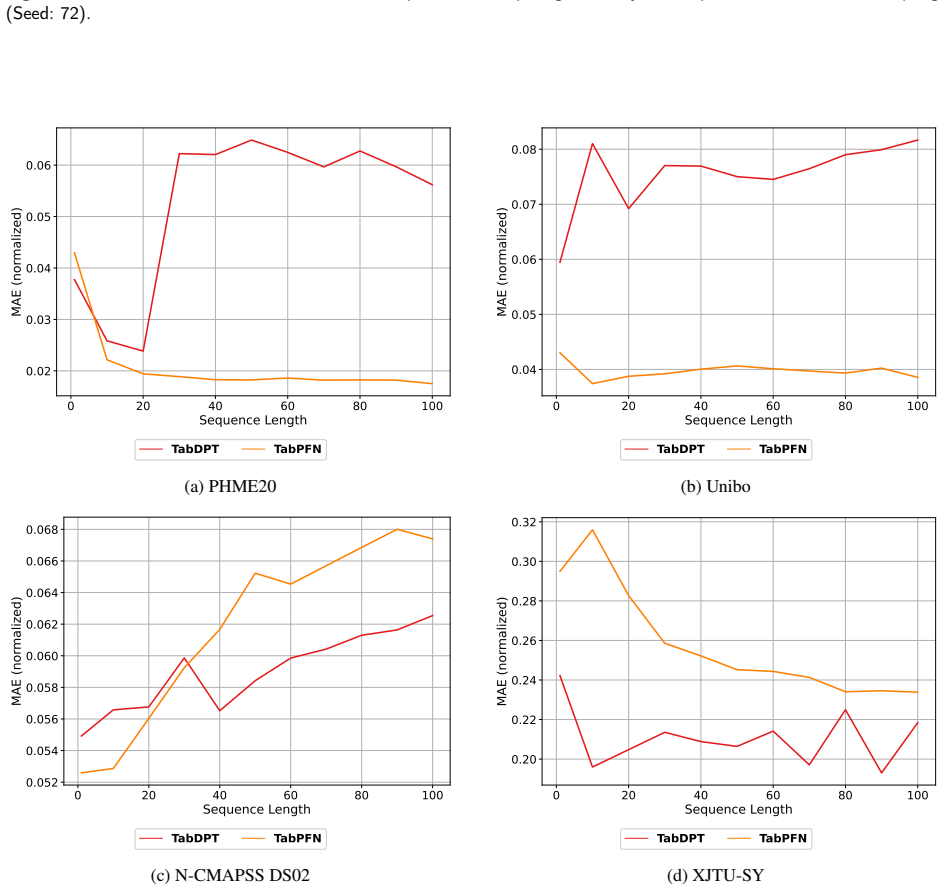
- Temporal ordering information can be retained sufficiently in the row format to support both classification and regression PHM objectives.
Where Pith is reading between the lines
- The same tabular conversion step could be tested on other fragmented time-series domains such as predictive maintenance in energy or transportation networks.
- An ablation that varies the number of context rows per query would quantify exactly how much historical context the models need to match sequence-model accuracy.
- If tabular foundation models continue to improve, they might allow maintenance planners to deploy one pretrained system across fleets with different sensor suites and failure modes.
Load-bearing premise
Turning time-varying signals into static tabular rows still keeps the temporal information needed for accurate diagnosis and remaining-life prediction.
What would settle it
A controlled test in which the same signals are presented with temporal order deliberately shuffled in the tabular rows, and performance on prognostic tasks drops sharply while diagnostic tasks remain stable, would show the representation fails to preserve required timing.
Figures
read the original abstract
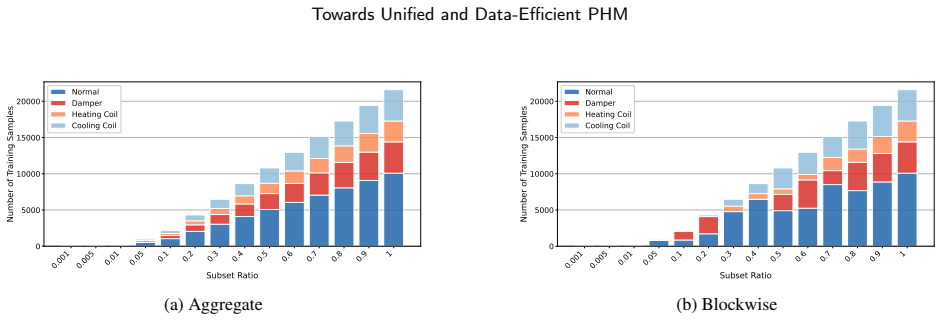
Data-driven Prognostics and Health Management (PHM) uses time-varying condition-monitoring data to diagnose system states and estimate remaining useful life in engineered assets. These tasks are central to maintenance planning, but industrial PHM data are often fragmented, partially observed, and poorly labeled, which hinders supervised learning. Foundation models offer a route toward reusable predictive systems, yet most time-series foundation models are designed for forecasting and assume long, coherent, regularly sampled sequences. To address this gap, we propose a framework for applying Tabular Foundation Models to industrial time series using in-context learning, and we evaluate them on a variety of PHM tasks. By converting raw unit-level signals into tabular rows, we show that these models perform well across multiple tasks - including prognostics, and diagnostics - and are highly data efficient. We compare them directly with sequence models, transformer baselines, and gradient-boosted trees under a common evaluation protocol. The results indicate that tabular foundation models achieve the best average ranks across prognostic and diagnostic tasks. Our findings further show that PFN-based models are competitive in low-data regimes, that temporal context can be preserved in the tabular representation, and that performance depends on representative context construction under subsampling. These results demonstrate that tabular foundation models provide a practical and general interface for heterogeneous PHM problems.
Editorial analysis
A structured set of objections, weighed in public.
Referee Report
Summary. The paper proposes converting unit-level time-varying condition-monitoring signals from PHM applications into tabular rows to enable in-context learning with Tabular Foundation Models (TFMs), particularly PFN-based ones. It claims these models achieve the best average ranks across prognostic and diagnostic tasks compared to sequence models, transformers, and gradient-boosted trees, while being highly data-efficient in low-data regimes. The work asserts that temporal context can be preserved in the tabular representation and that performance depends on representative context construction under subsampling, offering a unified interface for heterogeneous, fragmented PHM data.
Significance. If the empirical claims hold under rigorous verification, the result would be significant for PHM by demonstrating a practical route to reusable, data-efficient predictive systems that bypass the need for large labeled datasets or task-specific retraining. It would also extend the applicability of tabular foundation models beyond static tabular data to time-series condition monitoring, with potential impact on industrial maintenance where data fragmentation is common. The direct comparison under a common protocol and emphasis on low-data performance are strengths.
major comments (2)
- [Abstract] Abstract: The central performance claim (best average ranks across tasks and data efficiency) cannot be evaluated because the text supplies no dataset descriptions, metric definitions (e.g., how RUL error or diagnostic accuracy is computed), statistical tests for rank differences, or exclusion criteria for tasks/models. This information is load-bearing for any assertion of superiority.
- [Abstract] Abstract (framework and results paragraph): The assertion that 'temporal context can be preserved in the tabular representation' and that results 'depend on representative context construction under subsampling' is not supported by any description of the encoding (row ordering, explicit time deltas, cumulative statistics, or windowing) or by an ablation that isolates the contribution of temporal order versus marginal feature distributions. Without this, it is unclear whether the approach retains the sequential degradation dynamics required for prognostics.
Simulated Author's Rebuttal
We thank the referee for the constructive feedback on the abstract. We agree that it should be more self-contained to support the central claims and will revise it accordingly while ensuring the full manuscript details remain clear. Below we respond to each major comment.
read point-by-point responses
-
Referee: [Abstract] Abstract: The central performance claim (best average ranks across tasks and data efficiency) cannot be evaluated because the text supplies no dataset descriptions, metric definitions (e.g., how RUL error or diagnostic accuracy is computed), statistical tests for rank differences, or exclusion criteria for tasks/models. This information is load-bearing for any assertion of superiority.
Authors: We agree the abstract should reference key evaluation elements for self-containment. The full manuscript (Sections 3 and 4) details the datasets (e.g., C-MAPSS variants and other PHM benchmarks), metrics (RMSE for RUL estimation, accuracy/F1 for diagnostics), the common protocol across models, and task inclusion criteria. Statistical significance tests on rank differences are not currently reported. We will revise the abstract to briefly note the evaluation setup, datasets, and metrics while keeping length constraints in mind; we will also explore adding rank significance tests if they can be computed without new experiments. revision: partial
-
Referee: [Abstract] Abstract (framework and results paragraph): The assertion that 'temporal context can be preserved in the tabular representation' and that results 'depend on representative context construction under subsampling' is not supported by any description of the encoding (row ordering, explicit time deltas, cumulative statistics, or windowing) or by an ablation that isolates the contribution of temporal order versus marginal feature distributions. Without this, it is unclear whether the approach retains the sequential degradation dynamics required for prognostics.
Authors: The abstract summarizes findings whose supporting details appear in the method (Section 2) and results (Section 5). Section 2 describes the signal-to-table conversion, including feature extraction, windowing, and how rows are ordered to retain temporal structure via cumulative statistics and time-aware features. Section 5 reports performance under varying subsampling regimes, showing sensitivity to context construction. An explicit ablation separating temporal ordering from marginal distributions is not present. We will revise the abstract to reference the encoding approach in Section 2 and clarify the subsampling results; we can expand the method description if needed but note that space in the abstract is limited. revision: partial
Circularity Check
No circularity: empirical benchmarking with no derivations or self-referential predictions
full rationale
The paper is an empirical evaluation of tabular foundation models on PHM tasks via conversion of time-series signals to tabular rows and in-context learning. It reports average ranks, data-efficiency comparisons, and observations about temporal context preservation, all grounded in experimental results under a shared protocol against baselines. No equations, fitted parameters renamed as predictions, self-citation load-bearing uniqueness theorems, or ansatzes appear in the derivation chain. The central claims rest on observable performance metrics rather than any reduction to inputs by construction. This is the standard case of a self-contained empirical study.
Axiom & Free-Parameter Ledger
Reference graph
Works this paper leans on
-
[1]
Chronos-2: From univariate to universal forecasting
Ansari,A.F.,Shchur,O.,Küken,J.,Auer,A.,Han,B.,Mercado,P.,Rangapuram,S.S.,Shen,H.,Stella,L.,Zhang,X.,Goswami,M.,Kapoor, S., Maddix, D.C., Guerron, P., Hu, T., Yin, J., Erickson, N., Desai, P.M., Wang, H., Rangwala, H., Karypis, G., Wang, Y., Bohlke-Schneider, M., 2025. Chronos-2: From univariate to universal forecasting. URL:https://arxiv.org/abs/2510.1582...
Pith/arXiv arXiv 2025
-
[2]
Chronos: Learning the language of time series
Ansari,A.F.,Stella,L.,Turkmen,A.C.,Zhang,X.,Mercado,P.,Shen,H.,Shchur,O.,Rangapuram,S.S.,Arango,S.P.,Kapoor,S.,Zschiegner, J., Maddix, D.C., Wang, H., Mahoney, M.W., Torkkola, K., Wilson, A.G., Bohlke-Schneider, M., Wang, B., 2024. Chronos: Learning the language of time series. URL:https://openreview.net/forum?id=gerNCVqqtR. expert Certification
2024
-
[3]
Arbel,M.,Salinas,D.,Hutter,F.,2026. Equitabpfn:Atarget-permutationequivariantpriorfittednetwork,in:AdvancesinNeuralInformation ProcessingSystems,CurranAssociates,Inc..pp.62586–62609.URL:https://proceedings.neurips.cc/paper_files/paper/2025/ file/5a66c7adffdbde9dd5e78820cbf6935c-Paper-Conference.pdf
2026
-
[4]
Aircraft engine run-to-failure dataset under real flight conditions for prognostics and diagnostics
Arias Chao, M., Kulkarni, C., Goebel, K., Fink, O., 2021. Aircraft engine run-to-failure dataset under real flight conditions for prognostics and diagnostics. Data 6, 5. doi:10.3390/data6010005
-
[5]
Bole,B.,Kulkarni,C.S.,Daigle,M.,2014. Adaptationofanelectrochemistry-basedli-ionbatterymodeltoaccountfordeteriorationobserved under randomized use. Annual Conference of the PHM Society 6. doi:10.36001/phmconf.2014.v6i1.2490
-
[6]
To charge or to sell? ev pack useful life estimation via lstms, cnns, and autoencoders
Bosello, M., Falcomer, C., Rossi, C., Pau, G., 2023. To charge or to sell? ev pack useful life estimation via lstms, cnns, and autoencoders. Energies 16, 2837. doi:10.3390/en16062837
-
[7]
Explore the time series forecasting potential of tabpfn leveraging the intrinsic periodicity of data, in: ICML 2025 Workshop on Foundation Models for Structured Data (FMSD)
Cai, S., Sun, X., Zhong, H., 2025. Explore the time series forecasting potential of tabpfn leveraging the intrinsic periodicity of data, in: ICML 2025 Workshop on Foundation Models for Structured Data (FMSD). URL:https://openreview.net/forum?id=7JGD1kNlzU. workshop paper
2025
-
[8]
Case Western Reserve University Bearing Data Center Website.https: //engineering.case.edu/bearingdatacenter/download-data-file
Case Western Reserve University Bearing Data Center, . Case Western Reserve University Bearing Data Center Website.https: //engineering.case.edu/bearingdatacenter/download-data-file. Accessed: 2026-05-29
2026
-
[9]
Large language model-based autonomous agent for prognostics and health management
Cha, M., Yoon, S.i., Kim, S., Kang, D., Nam, K., Lee, T., Kim, J.Y., 2025. Large language model-based autonomous agent for prognostics and health management. Machines 13, 831. URL:https://www.mdpi.com/2075-1702/13/9/831, doi:10.3390/machines13090831
-
[10]
XGBoost: A scalable tree boosting system,
Chen,T.,Guestrin,C.,2016. Xgboost:Ascalabletreeboostingsystem,in:Proceedingsofthe22ndACMSIGKDDInternationalConference on Knowledge Discovery and Data Mining, pp. 785–794. doi:10.1145/2939672.2939785
-
[11]
Long-termforecastingwithtide:Time-seriesdenseencoder
Das,A.,Kong,W.,Leach,A.,Mathur,S.K.,Sen,R.,Yu,R.,2023. Long-termforecastingwithtide:Time-seriesdenseencoder. Transactions on Machine Learning Research
2023
-
[12]
A decoder-only foundation model for time-series forecasting, in: Salakhutdinov, R., Kolter, Z., Heller, K., Weller, A., Oliver, N., Scarlett, J., Berkenkamp, F
Das, A., Kong, W., Sen, R., Zhou, Y., 2024. A decoder-only foundation model for time-series forecasting, in: Salakhutdinov, R., Kolter, Z., Heller, K., Weller, A., Oliver, N., Scarlett, J., Berkenkamp, F. (Eds.), Proceedings of the 41st International Conference on Machine Learning, PMLR. pp. 10148–10167. URL:https://proceedings.mlr.press/v235/das24c.html
2024
-
[13]
A survey on in-context learning, in: Proceedings of the 2024 conference on empirical methods in natural language processing, pp
Dong, Q., Li, L., Dai, D., Zheng, C., Ma, J., Li, R., Xia, H., Xu, J., Wu, Z., Chang, B., et al., 2024. A survey on in-context learning, in: Proceedings of the 2024 conference on empirical methods in natural language processing, pp. 1107–1128
2024
-
[14]
Forecastpfn: Synthetically-trained zero-shot forecasting
Dooley, S., Khurana, G.S., Mohapatra, C., Naidu, S.V., White, C., 2024. Forecastpfn: Synthetically-trained zero-shot forecasting. Advances in Neural Information Processing Systems 36
2024
-
[15]
Douze, M., Guzhva, A., Deng, C., Johnson, J., Szilvasy, G., Mazaré, P.E., Lomeli, M., Hosseini, L., Jégou, H., 2024. The faiss library. URL: https://arxiv.org/abs/2401.08281, doi:10.48550/arXiv.2401.08281,arXiv:2401.08281
work page internal anchor Pith review Pith/arXiv arXiv doi:10.48550/arxiv.2401.08281 2024
-
[16]
Unifault:Afaultdiagnosisfoundationmodelfrombearingdata
Eldele,E.,Ragab,M.,Qing,X.,Chen,Z.,Wu,M.,Li,X.,Lee,J.,etal.,2025. Unifault:Afaultdiagnosisfoundationmodelfrombearingdata. arXiv preprint arXiv:2504.01373
arXiv 2025
-
[17]
Feng, C., Huang, L., Krompass, D., . Only the curve shape matters: Training foundation models for zero-shot multivariate time series forecasting through next curve shape prediction. URL:http://arxiv.org/abs/2402.07570,arXiv:2402.07570 [cs]
-
[18]
Feng, T., Chen, Y., Tsai, C.Y., Sun, Y., Das, A., El Maghraoui, K., Lin, S., Patel, D., 2026. PHMForge: Evaluating llm agents on industrial prognostics through mcp-native, algorithm-grounded tools. URL:https://arxiv.org/abs/2604.01532, doi:10.48550/arXiv.2604. 01532,arXiv:2604.01532
work page internal anchor Pith review Pith/arXiv arXiv doi:10.48550/arxiv.2604 2026
-
[19]
Fink, O., Nejjar, I., Sharma, V., Faghih Niresi, K., Sun, H., Dong, H., Xu, C., Wei, A., Bizzi, A., Theiler, R., Tian, Y., Von Krannichfeldt, L., Ma, Z., Garmaev, S., Zhang, Z., Zhao, M., Steiner, K., Kesmen, Y., 2026. From physics to machine learning and back: Part II - Learning and observational bias in prognostics and health management (PHM). Reliabili...
-
[20]
User’s guide for the commercial modular aero-propulsion system simulation (C-MAPSS)
Frederick, D.K., DeCastro, J.A., Litt, J.S., 2007. User’s guide for the commercial modular aero-propulsion system simulation (C-MAPSS). Technical Report NASA/TM—2007-215026. NASA Glenn Research Center
2007
-
[21]
Buildingfaultdetectiondatatoaiddiagnosticalgorithmcreationandperformance testing
Granderson,J.,Lin,G.,Harding,A.,Im,P.,Chen,Y.,2020a. Buildingfaultdetectiondatatoaiddiagnosticalgorithmcreationandperformance testing. ScientificData7,65. URL:https://www.nature.com/articles/s41597-020-0398-6,doi:10.1038/s41597-020-0398-6
-
[22]
Granderson, J., Lin, G., Harding, A., Im, P., Chen, Y., 2020b. Dataset for building fault detection and diagnostics algorithm creation andperformancetestingURL:https://figshare.com/articles/dataset/LBNLDataSynthesisInventory_pdf/11752740,doi:10. 6084/m9.figshare.11752740.v3
-
[23]
Long-range transformers for dynamic spatiotemporal forecasting.arXiv:2109.12218
Grigsby, J., Wang, Z., Qi, Y., 2021. Long-range transformers for dynamic spatiotemporal forecasting.arXiv:2109.12218
arXiv 2021
-
[24]
Creation of publicly available data sets for prognostics and diagnostics addressing data scenarios relevant to industrial applications
Hagmeyer, S., Mauthe, F., Zeiler, P., 2021. Creation of publicly available data sets for prognostics and diagnostics addressing data scenarios relevant to industrial applications. International Journal of Prognostics and Health Management 12
2021
-
[25]
Helwig, N., Pignanelli, E., Schütze, A., 2015. Condition monitoring of a complex hydraulic system using multivariate statistics, in: 2015 IEEE International Instrumentation and Measurement Technology Conference (I2MTC) Proceedings, pp. 210–215. doi:10.1109/I2MTC. 2015.7151267
-
[26]
Tabpfn: A transformer that solves small tabular classification problems in a second, in: The Eleventh International Conference on Learning Representations
Hollmann, N., Müller, S., Eggensperger, K., Hutter, F., 2023. Tabpfn: A transformer that solves small tabular classification problems in a second, in: The Eleventh International Conference on Learning Representations. R. Theiler, L. Telyatnikov et al. Page 41 of 43 Towards Unified and Data-Efficient PHM
2023
-
[27]
Accurate predictions on small data with a tabular foundation model
Hollmann, N., Müller, S., Purucker, L., Krishnakumar, A., Körfer, M., Hoo, S.B., Schirrmeister, R.T., Hutter, F., 2025. Accurate predictions on small data with a tabular foundation model. Nature 637, 319–326
2025
-
[28]
Hoo, S.B., Müller, S., Salinas, D., Hutter, F., 2024. The tabular foundation model tabpfn outperforms specialized time series forecasting models based on simple features, in: NeurIPS 2024 Workshop on Table Representation Learning (TRL). URL:https://neurips.cc/ virtual/2024/103164. neurIPS 2024 workshop paper
2024
-
[29]
Remaining useful life prediction for experimental filtration system: A data challenge
İnce, K., Sirkeci, E., Genç, Y., 2020. Remaining useful life prediction for experimental filtration system: A data challenge. PHM Society European Conference 5. doi:10.36001/phme.2020.v5i1.1317
-
[30]
Time-llm:Timeseriesforecasting by reprogramming large language models, in: Kim, B., Yue, Y., Chaudhuri, S., Fragkiadaki, K., Khan, M., Sun, Y
Jin,M.,Wang,S.,Ma,L.,Chu,Z.,Zhang,J.,Shi,X.,Chen,P.Y.,Liang,Y.,Li,Y.F.,Pan,S.,Wen,Q.,2024. Time-llm:Timeseriesforecasting by reprogramming large language models, in: Kim, B., Yue, Y., Chaudhuri, S., Fragkiadaki, K., Khan, M., Sun, Y. (Eds.), International ConferenceonLearningRepresentations,pp.23857–23880. URL:https://proceedings.iclr.cc/paper_files/paper...
2024
-
[31]
Carte: Pretraining and transfer for tabular learning, in: Forty-first International Conference on Machine Learning
Kim, M.J., Grinsztajn, L., Varoquaux, G., 2024. Carte: Pretraining and transfer for tabular learning, in: Forty-first International Conference on Machine Learning
2024
-
[32]
LeCun, Y., Bengio, Y., Hinton, G., 2015. Deep learning. Nature 521, 436–444. doi:10.1038/nature14539
-
[33]
Lee, J., Yoon, W., Kim, S., Kim, D., Kim, S., So, C.H., Kang, J., 2019. Biobert: a pre-trained biomedical language representation model for biomedical text mining. Bioinformatics 36, 1234–1240. URL:http://dx.doi.org/10.1093/bioinformatics/btz682, doi:10.1093/bioinformatics/btz682
-
[34]
Lei, Y., Li, N., Guo, L., Li, N., Yan, T., Lin, J., 2018. Machinery health prognostics: A systematic review from data acquisition to remaining useful life prediction. Mechanical Systems and Signal Processing 104, 799–834. doi:10.1016/j.ymssp.2017.11.016
-
[35]
Smalldatachallengesforintelligentprognosticsandhealthmanagement:areview
Li,C.,Li,S.,Feng,Y.,Gryllias,K.,Gu,F.,Pecht,M.,2024. Smalldatachallengesforintelligentprognosticsandhealthmanagement:areview. Artificial Intelligence Review 57, 214
2024
-
[36]
ICL4RUL:In-contextlearning-basedaircraftengineremainingusefullifeprediction
Liu,D.,Qu,G.,Xu,Y.,Qiu,T.,Ding,S.,Guo,K.,2025. ICL4RUL:In-contextlearning-basedaircraftengineremainingusefullifeprediction. IEEE Internet of Things Journal 12, 29766–29783. URL:https://ieeexplore.ieee.org/document/10998956, doi:10.1109/JIOT. 2025.3569131
-
[37]
Timer: Generative pre-trained transformers are large time series models
Liu, Y., Zhang, H., Li, C., Huang, X., Wang, J., Long, M., . Timer: Generative pre-trained transformers are large time series models. URL: http://arxiv.org/abs/2402.02368,arXiv:2402.02368 [cs, stat]
-
[38]
TabDPT: Scaling tabular foundation models on real data URL:https://openreview.net/forum?id=pIZxEOZCId
Ma, J., Thomas, V., Hosseinzadeh, R., Labach, A., Kamkari, H., Cresswell, J.C., Golestan, K., Yu, G., Caterini, A.L., Volkovs, M., 2025. TabDPT: Scaling tabular foundation models on real data URL:https://openreview.net/forum?id=pIZxEOZCId
2025
-
[39]
Early fault classification in rotating machinery with limited data using tabpfn
Magadán, L., Roldán-Gómez, J., Granda, J., Suárez, F., 2023. Early fault classification in rotating machinery with limited data using tabpfn. IEEE Sensors Journal 23, 30960–30970. doi:10.1109/JSEN.2023.3331100
-
[40]
Overview and analysis of publicly available degradation data sets for tasks within prognostics and health management, in: 35th european safety and reliability conference.(accepted)
Mauthe, F., Steinmann, L., Neu, M., Zeiler, P., 2025. Overview and analysis of publicly available degradation data sets for tasks within prognostics and health management, in: 35th european safety and reliability conference.(accepted). Research Publishing
2025
-
[41]
Asurveyofdeeplearningandfoundationmodelsfortime series forecasting
Miller,J.A.,Aldosari,M.,Saeed,F.,Barna,N.H.,Rana,S.,Arpinar,I.B.,Liu,N.,. Asurveyofdeeplearningandfoundationmodelsfortime series forecasting. URL:http://arxiv.org/abs/2401.13912, doi:10.48550/arXiv.2401.13912,arXiv:2401.13912 [cs]
-
[42]
Nguyen, N., Sinthong, P., Kalagnanam, J., 2023
Nie, Y., H. Nguyen, N., Sinthong, P., Kalagnanam, J., 2023. A time series is worth 64 words: Long-term forecasting with transformers, in: International Conference on Learning Representations
2023
-
[43]
Can generalist foundation models outcompete special-purpose tuning? case study in medicine
Nori, H., Lee, Y.T., Zhang, S., Carignan, D., Edgar, R., Fusi, N., King, N., Larson, J., Li, Y., Liu, W., Luo, R., McKinney, S.M., Ness, R.O., Poon, H., Qin, T., Usuyama, N., White, C., Horvitz, E., 2023. Can generalist foundation models outcompete special-purpose tuning? case study in medicine. arXiv preprint arXiv:2311.16452 URL:https://arxiv.org/abs/2311.16452
arXiv 2023
-
[44]
Acomparativestudyofdeeplearningmodelbasedequipmentfaultdiagnosisandprognosis
Qiao,X.,Liow,H.Y.,Jauw,V.L.,Lim,C.S.,2025. Acomparativestudyofdeeplearningmodelbasedequipmentfaultdiagnosisandprognosis. International Journal of Prognostics and Health Management 16. doi:10.36001/IJPHM.2025.v16i1.4254
-
[45]
Qu, J., Holzmüller, D., Varoquaux, G., Morvan, M.L., 2025. Tabicl: A tabular foundation model for in-context learning on large data, in: Proceedings of the 38th International Conference on Machine Learning (ICML 2025). URL:https://arxiv.org/abs/2502.05564. accepted at ICML 2025
Pith/arXiv arXiv 2025
-
[46]
Performance Benchmarking and Analysis of Prognostic Methods for CMAPSS Datasets
Ramasso, E., Saxena, A., 2014. Performance Benchmarking and Analysis of Prognostic Methods for CMAPSS Datasets. International JournalofPrognosticsandHealthManagement5. URL:https://papers.phmsociety.org/index.php/ijphm/article/view/2236, doi:10.36001/ijphm.2014.v5i2.2236
-
[47]
Salinas-Camus, M., Goebel, K., Eleftheroglou, N., 2025. A comprehensive review and evaluation framework for data-driven prognostics: Uncertainty, robustness, interpretability, and feasibility. Mechanical Systems and Signal Processing 237, 113015. doi:10.1016/j.ymssp. 2025.113015
-
[48]
Saxena, A., Goebel, K., Simon, D., Eklund, N., 2008. Damage propagation modeling for aircraft engine run-to-failure simulation, in: 2008 International Conference on Prognostics and Health Management, pp. 1–9. doi:10.1109/PHM.2008.4711414
-
[49]
Siami-Namini, S., Tavakoli, N., Siami Namin, A., 2019. The performance of lstm and bilstm in forecasting time series, in: 2019 IEEE International Conference on Big Data (Big Data), pp. 3285–3292. doi:10.1109/BigData47090.2019.9005997
-
[50]
Atutorialforfeatureengineeringintheprognosticsandhealthmanagementofgearsandbearings
Sim,J.,Kim,S.,Park,H.J.,Choi,J.H.,2020. Atutorialforfeatureengineeringintheprognosticsandhealthmanagementofgearsandbearings. Applied Sciences 10, 5639. doi:10.3390/app10165639
-
[51]
Journal of Vibration and Acoustics 147, 041002
Sun,L.,Wu,J.,Wang,J.,Wen,S.,Li,G.,Liu,Y.,2025.Faultdiagnosisofslewingbearingusingaudiblesoundsignalbasedontimegan–tabpfn method. Journal of Vibration and Acoustics 147, 041002. doi:10.1115/1.4068223
-
[52]
Picid: A Modular Evaluation Infrastructure for Reproducible PHM Across Tasks and Domains
Telyatnikov, L., Theiler, R., Von Krannichfeldt, L., Fink, O., 2026. Picid: A modular evaluation infrastructure for reproducible phm across tasks and domains. URL:https://arxiv.org/abs/2605.28345, doi:10.48550/arXiv.2605.28345,arXiv:2605.28345
work page internal anchor Pith review Pith/arXiv arXiv doi:10.48550/arxiv.2605.28345 2026
-
[53]
Theiler,R.,Comito,L.,Leko,D.,VonKrannichfeldt,L.,Telyatnikov,L.,Fink,O.,2026. Frompapertobenchmark:agentic,framework-based reproduction of under-specified methods in machine health intelligence. URL:https://arxiv.org/abs/2605.28371, doi:10.48550/ arXiv.2605.28371,arXiv:2605.28371. R. Theiler, L. Telyatnikov et al. Page 42 of 43 Towards Unified and Data-Ef...
Pith/arXiv arXiv 2026
-
[54]
Tu, S., Zhang, Y., Zhang, J., Fu, Z., Zhang, Y., Yang, Y., 2024. Powerpm: Foundation model for power systems, in: Globerson, A., Mackey, L., Belgrave, D., Fan, A., Paquet, U., Tomczak, J., Zhang, C. (Eds.), Advances in Neural Information Processing Sys- tems, Curran Associates, Inc.. pp. 115233–115260. URL:https://proceedings.neurips.cc/paper_files/paper/...
-
[55]
Deep learning for smart manufacturing: Methods and applications
Wang, J., Ma, Y., Zhang, L., Gao, R.X., Wu, D., 2018. Deep learning for smart manufacturing: Methods and applications. Journal of Manufacturing Systems 48, 144–156. doi:10.1016/j.jmsy.2018.01.003
-
[56]
Deep time series models: A comprehensive survey and benchmark
Wang, Y., Wu, H., Dong, J., Liu, Y., Wang, C., Long, M., Wang, J., 2026. Deep time series models: A comprehensive survey and benchmark. IEEE Transactions on Pattern Analysis and Machine Intelligence URL:https://doi.org/10.1109/TPAMI.2026.3690845, doi:10.1109/TPAMI.2026.3690845
-
[58]
Wong,K.L.,Bosello,M.,Tse,R.,Falcomer,C.,Rossi,C.,Pau,G.,2021b. Li-ionbatteriesstate-of-chargeestimationusingdeeplstmatvarious battery specifications and discharge cycles, in: Proceedings of the Conference on Information Technology for Social Good, Association for Computing Machinery, New York, NY, USA. p. 85–90. URL:https://doi.org/10.1145/3462203.3475878...
-
[59]
Unified training of universal time series forecasting transformers, in: Salakhutdinov, R., Kolter, Z., Heller, K., Weller, A., Oliver, N., Scarlett, J., Berkenkamp, F
Woo, G., Liu, C., Kumar, A., Xiong, C., Savarese, S., Sahoo, D., 2024. Unified training of universal time series forecasting transformers, in: Salakhutdinov, R., Kolter, Z., Heller, K., Weller, A., Oliver, N., Scarlett, J., Berkenkamp, F. (Eds.), Proceedings of the 41st International Conference on Machine Learning, PMLR. pp. 53140–53164. URL:https://proce...
2024
-
[60]
Hydra - a framework for elegantly configuring complex applications
Yadan, O., 2019. Hydra - a framework for elegantly configuring complex applications. Github. URL:https://github.com/ facebookresearch/hydra
2019
-
[61]
Xjtu-sy rolling element bearing accelerated life test datasets: A tutorial
Yaguo, L., Tianyu, H., Biao, W., Naipeng, L., Tao, Y., Jun, Y., 2019. Xjtu-sy rolling element bearing accelerated life test datasets: A tutorial. Journal of Mechanical Engineering 55, 1–6
2019
-
[62]
Renewable and Sustainable Energy Reviews 227, 116527
Yao,J.,Han,T.,2026.Utilizinglarge-scalefoundationmodelsforprognosticsandhealthmanagementinwindturbines:Techniques,challenges, and future directions. Renewable and Sustainable Energy Reviews 227, 116527. doi:10.1016/j.rser.2025.116527
-
[63]
PDMBench: A Standardized Platform for Predictive Maintenance Research
Zhang, S., Wang, T., Kulkarni, A., Adams, S., Bhattacharya, S., Tiyyagura, S.R., Bowen, E., Veeramani, B., Zhou, D., 2025. PDMBench: A Standardized Platform for Predictive Maintenance Research. URL:https://openreview.net/forum?id=oJhj8wOCNB. openReview preprint
2025
-
[64]
Crossformer: Transformer utilizing cross-dimension dependency for multivariate time series forecasting, in: The eleventh international conference on learning representations
Zhang, Y., Yan, J., 2023. Crossformer: Transformer utilizing cross-dimension dependency for multivariate time series forecasting, in: The eleventh international conference on learning representations
2023
-
[65]
Deeplearninganditsapplicationstomachinehealthmonitoring
Zhao,R.,Yan,R.,Chen,Z.,Mao,K.,Wang,P.,Gao,R.X.,2019. Deeplearninganditsapplicationstomachinehealthmonitoring. Mechanical Systems and Signal Processing 115, 213–237. doi:10.1016/j.ymssp.2018.05.050
-
[66]
A comprehensive survey on pretrained foundation models: A history from bert to chatgpt
Zhou, C., Li, Q., Li, C., Yu, J., Liu, Y., Wang, G., Zhang, K., Ji, C., Yan, Q., He, L., et al., 2025. A comprehensive survey on pretrained foundation models: A history from bert to chatgpt. International Journal of Machine Learning and Cybernetics 16, 9851–9915
2025
-
[67]
Predictive maintenance in the industry 4.0: A systematic literature review
Zonta, T., da Costa, C.A., da Rosa Righi, R., de Lima, M.J., da Trindade, E.S., Li, G., 2020. Predictive maintenance in the industry 4.0: A systematic literature review. Computers & Industrial Engineering 150, 106889. doi:10.1016/j.cie.2020.106889. R. Theiler, L. Telyatnikov et al. Page 43 of 43
discussion (0)
Sign in with ORCID, Apple, or X to comment. Anyone can read and Pith papers without signing in.