Black Bounce Solutions from a Self-Interacting 3-Form Field in General Relativity
Pith reviewed 2026-06-28 04:37 UTC · model grok-4.3
The pith
Self-interacting 3-form fields source two families of regular black-bounce solutions in general relativity.
A machine-rendered reading of the paper's core claim, the machinery that carries it, and where it could break.
Core claim
By exploiting the Hodge duality between a 3-form and a 1-form in four dimensions, the Einstein, scalar, and 3-form equations are reduced and integrated directly from the action without metric-first reconstruction. This produces two distinct families. The first has a globally phantom scalar and an arctangent metric function. The second has constant 3-form Lagrangian and a scalar that is phantom near the bounce yet canonical outside the event horizon. Both families are globally regular, as shown by the finite Kretschmann scalar, and display asymmetric horizon structures determined by the 3-form energy-density profile.
What carries the argument
Hodge duality between the 3-form and a 1-form in four dimensions, which reduces the field equations to algebraic combinations that integrate exactly from the action.
If this is right
- The geometries interpolate smoothly between black-hole exteriors and traversable wormhole throats.
- One family recovers the Schwarzschild-(anti)de Sitter solution when the 3-form coupling constant is set to zero.
- The second family produces a scalar that changes from phantom to canonical behavior while remaining inside general relativity.
- Horizon asymmetry is inherited directly from the spatial distribution of 3-form energy density.
Where Pith is reading between the lines
- The same duality reduction might generate regular solutions when the 3-form is coupled to additional fields such as electromagnetism.
- Stability analysis under linear perturbations could determine whether the asymmetric horizons persist or evolve into symmetric configurations.
- Light deflection or shadow observations of compact objects could test for the predicted horizon asymmetry.
Load-bearing premise
The self-interacting 3-form must supply exactly the anisotropic stresses that keep the geometry regular through the bounce region.
What would settle it
Direct substitution of the reported metric functions and 3-form profiles into the Einstein equations to verify whether the equations hold identically for both families.
Figures

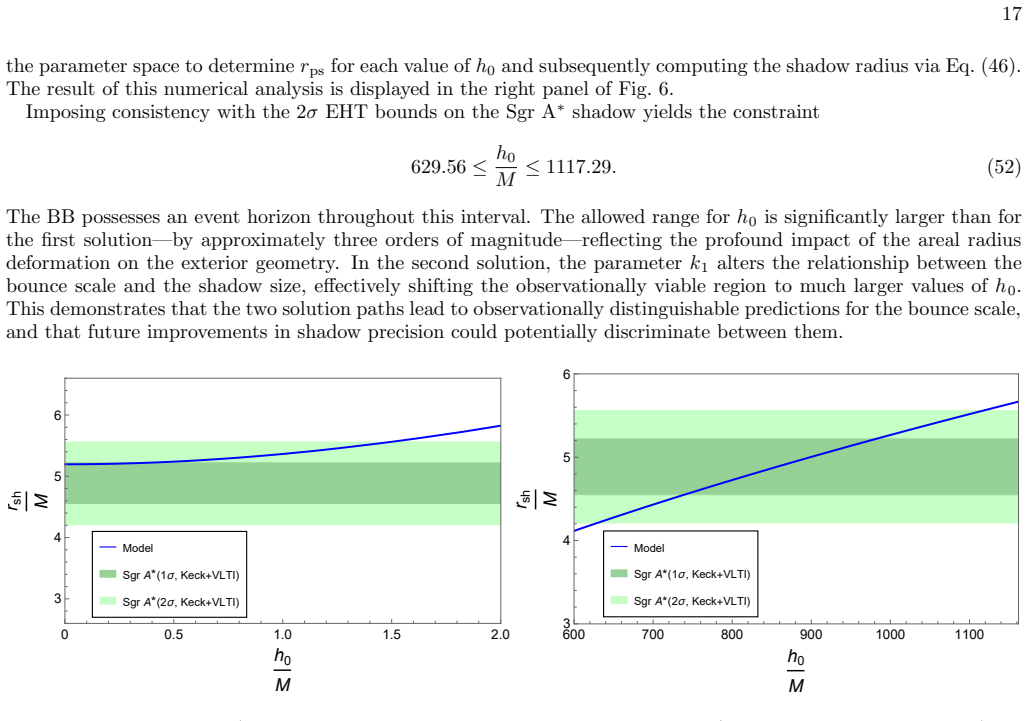
read the original abstract
We construct a new class of black-bounce solutions sourced by a self-interacting 3-form field minimally coupled to general relativity and a scalar field. The 3-form field, which naturally arises in string theory, supergravity, and cosmological models, provides the anisotropic effective stresses required to sustain regular geometries that interpolate smoothly between black holes and traversable wormholes. By exploiting the Hodge duality between a 3-form and a 1-form in four dimensions, we reduce the field equations and obtain exact solutions through the direct integration of the coupled equations of motion. In particular, the solutions are derived from algebraic combinations and manipulations of the Einstein, scalar, and 3-form field equations, starting from a complete action principle, without employing the usual reconstruction procedure in which the metric ansatz is imposed a priori and the matter sector is reconstructed afterwards. This approach reveals two distinct classes of solutions. The first one yields a globally phantom scalar field and a metric function with a characteristic arctangent dependence, reducing to the Schwarzschild-(anti) de Sitter spacetime in the limit of vanishing 3-form coupling. The second class produces a constant 3-form Lagrangian and, remarkably, a partially canonical scalar field, namely phantom only near the bounce and canonical outside the event horizon, a feature previously attainable mainly in modified theories of gravity, but which emerges here within pure general relativity. Both families are globally regular, as confirmed by the finiteness of the Kretschmann scalar, and exhibit an asymmetric horizon structure inherited from the 3-form energy-density distribution. These results demonstrate that the 3-form black-bounce framework is both mathematically consistent and observationally viable.
Editorial analysis
A structured set of objections, weighed in public.
Referee Report
Summary. The paper constructs two classes of black-bounce solutions in GR sourced by a self-interacting 3-form field minimally coupled to GR and a scalar field. Using Hodge duality between 3-form and 1-form in 4D, the field equations are reduced and exact solutions obtained via direct algebraic manipulation and integration from the action (without metric-first reconstruction). The first class yields a globally phantom scalar with an arctangent metric function that reduces to Schwarzschild-(anti)de Sitter for vanishing 3-form coupling. The second class has constant 3-form Lagrangian and produces a scalar that is phantom only near the bounce but canonical outside the horizon. Both families are globally regular (finite Kretschmann scalar) with asymmetric horizons inherited from the 3-form energy density.
Significance. If the derivations hold without hidden assumptions or circularity, the work would be significant for providing exact, regular black-bounce interpolations between black holes and wormholes sourced by 3-forms (motivated by string theory/supergravity) entirely within standard GR. The direct-integration method and the second class's region-dependent effective scalar behavior (without modified gravity) would be notable strengths, as would the explicit demonstration of asymmetric horizons from the matter sector.
major comments (2)
- [Abstract] Abstract: the claim that the second class produces 'a partially canonical scalar field, namely phantom only near the bounce and canonical outside the event horizon' within pure GR requires explicit verification. A standard scalar kinetic term has a fixed global sign in the action; the mechanism by which 3-form coupling alone induces an effective sign change across regions (while satisfying the fixed-sign field equations everywhere) is not obvious from algebraic manipulation of the Einstein/scalar/3-form equations. The derivation of this family must demonstrate how the effective phantom-to-canonical transition arises without an explicit position-dependent coefficient in the action or an effective description that violates the original equations.
- [Abstract] Abstract: the assertion of global regularity 'as confirmed by the finiteness of the Kretschmann scalar' for both families is load-bearing for the central claim of black-bounce solutions. Without the explicit computation of the Kretschmann invariant (or at least the relevant curvature components) from the metric functions in each class, it is impossible to confirm that no singularities remain at the bounce or horizons.
Simulated Author's Rebuttal
We thank the referee for their careful reading and constructive comments on our manuscript. We address the two major comments point by point below. Both concerns can be resolved by adding explicit derivations and computations to the revised manuscript.
read point-by-point responses
-
Referee: [Abstract] the claim that the second class produces 'a partially canonical scalar field, namely phantom only near the bounce and canonical outside the event horizon' within pure GR requires explicit verification. A standard scalar kinetic term has a fixed global sign in the action; the mechanism by which 3-form coupling alone induces an effective sign change across regions (while satisfying the fixed-sign field equations everywhere) is not obvious from algebraic manipulation of the Einstein/scalar/3-form equations. The derivation of this family must demonstrate how the effective phantom-to-canonical transition arises without an explicit position-dependent coefficient in the action or an effective description that violates the original equations.
Authors: We agree that the abstract claim benefits from explicit verification. In the second class the 3-form Lagrangian is constant, which through the Einstein equations imposes a specific algebraic relation between the scalar gradient, the metric function, and the 3-form energy density. This relation causes the effective sign of the scalar kinetic term (extracted from the stress-energy tensor) to flip across the bounce while the underlying action retains fixed signs everywhere. We will add a dedicated paragraph (or short appendix) in the revised manuscript that starts from the coupled field equations, substitutes the constant-Lagrangian ansatz, solves for the scalar derivative, and explicitly evaluates the sign of the kinetic contribution in each region, confirming consistency with the original equations without position-dependent coefficients. revision: yes
-
Referee: [Abstract] the assertion of global regularity 'as confirmed by the finiteness of the Kretschmann scalar' for both families is load-bearing for the central claim of black-bounce solutions. Without the explicit computation of the Kretschmann invariant (or at least the relevant curvature components) from the metric functions in each class, it is impossible to confirm that no singularities remain at the bounce or horizons.
Authors: We agree that an explicit evaluation of the Kretschmann scalar is required to substantiate global regularity. Although the metric functions are constructed to be regular at the bounce and the horizons are coordinate singularities, we will compute the Kretschmann invariant directly from the metric components for both families in the revised manuscript. The resulting expression will be shown to remain finite at the bounce, at the horizons, and at spatial infinity, thereby confirming the absence of curvature singularities. This calculation will be placed in a new appendix or subsection. revision: yes
Circularity Check
No circularity: solutions obtained by direct integration from action via Hodge duality and algebraic manipulation of field equations
full rationale
The paper states that exact solutions are derived from algebraic combinations and manipulations of the Einstein, scalar, and 3-form field equations starting from a complete action principle, without reconstruction. No self-definitional steps, fitted inputs renamed as predictions, or load-bearing self-citations are identifiable from the derivation description. The approach relies on the Hodge duality to reduce equations and integrate directly, keeping the chain self-contained against the input action and field equations rather than reducing to tautological inputs by construction.
Axiom & Free-Parameter Ledger
Reference graph
Works this paper leans on
-
[1]
Limiting cases and asymptotic behavior If the 3-form field is switched off by settingh 0 = 0, the metric function (28) reduces, for the positive radial branch r≥0, to the familiar Schwarzschild–(anti-)de Sitter solution: A(r) = 1− 2M r − Λ 3 r2.(30) Thus, our solution contains the standard Λ-vacuum black hole as a limiting case, with the 3-form parameterh...
-
[2]
The constant offset inL(H 2) acts as an effective cosmological constant contribution, which, together with the explicit Λ term, determines the asymptotic behavior of the spacetime
The matter sector For the solution (28), the 3-form invariantH 2 and the Lagrangian are given by H2 =− 36h5 0 (h2 0 +r 2)2 " 9h0M −2r+ π h0 (h2 0 +r 2) + 2h5 0Λ + 2h3 0(−3 +r 2Λ)−18M(h 2 0 +r 2) arctan r h0 #−1 ,(34) LH = 1 216κ 2 81M2π2 h2 0 + 36πM h0 −3 +h 2 0Λ + 4 −3 +h 2 0Λ 2 ,(35) L(H2) =L H H2 + 1 2κ2 9πM h3 0 + 2Λ .(36) Remarkably, the LagrangianL(...
-
[3]
An exact, albeit lengthy, expression forKcan be obtained using algebraic computing software
Regularity The regularity of the solution is confirmed by computing the Kretschmann scalarK=R abcdRabcd. An exact, albeit lengthy, expression forKcan be obtained using algebraic computing software. We find thatKis finite everywhere, including at the bouncer= 0 and in the asymptotic limitsr→ ±∞, where it approaches the (A)dS valueK→8Λ 2/3. The absence of c...
-
[4]
This difference originates from the deformation parameter k1, which modifies the algebraic structure of the metric function through the rational correction in Σ(r)
+ (−1 +k1)2r i + 18M 8 + (−4 +k1)k1 arccoth h0 √−1 +k 1 r (−1 +k 1)7/2 !# , (42) 13 with the integration constants calibrated as a0 =− 3πM 8 + (−4 +k1)k1 16(−1 +k 1)2 − 1 h2 0(−1 +k 1) 3/2 − Λ 3 , a 1 = 6M.(43) The presence of the inverse hyperbolic cotangent function, arccoth, signals the distinct asymptotic structure of this solution compared to the arc...
-
[5]
The deformation parameterk 1 provides an additional degree of freedom that allows the horizon positions and the asymptotic behavior to be tuned independently of the bounce scaleh 0
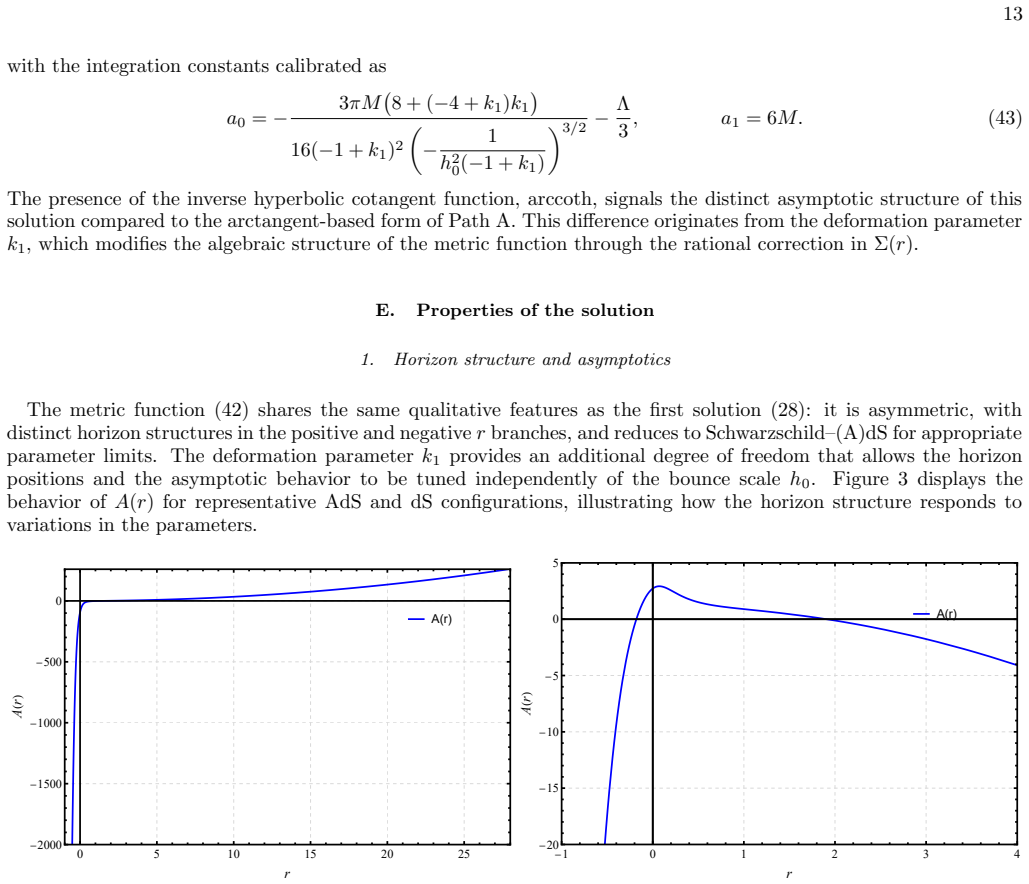
Horizon structure and asymptotics The metric function (42) shares the same qualitative features as the first solution (28): it is asymmetric, with distinct horizon structures in the positive and negativerbranches, and reduces to Schwarzschild–(A)dS for appropriate parameter limits. The deformation parameterk 1 provides an additional degree of freedom that...
2000
-
[6]
Figure 4 illustrates the radial profile ofKfor a representative choice of parameters
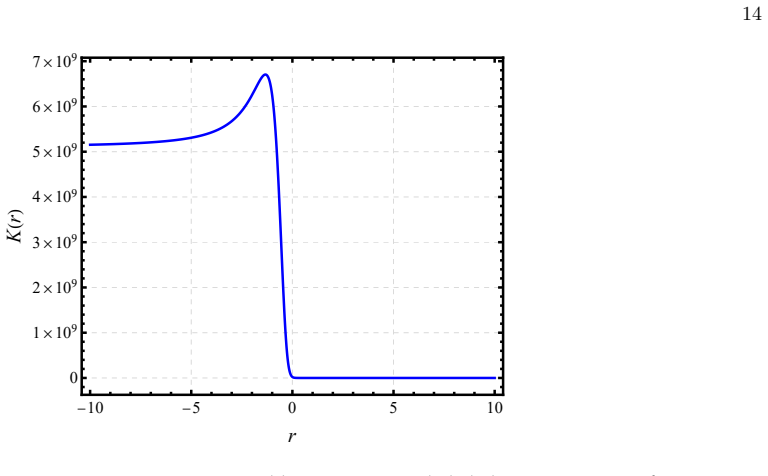
Regularity The Kretschmann scalarK=R abcdRabcd for this solution has been computed analytically and is found to be finite everywhere, including at the bouncer= 0 and in the asymptotic limitsr→ ±∞. Figure 4 illustrates the radial profile ofKfor a representative choice of parameters. The smooth, peaked structure nearr= 0 reflects the curvature concentration...
-
[7]
Graphical representation of the Kretschmann scalarK(r) for the solution (42)–(41), with parameters{M= 1, h 0 = 1.1,Λ =−1, k 1 = 0.9}
The matter sector A striking feature of this second solution is that the 3-form LagrangianL(H 2) is aconstant: L(H2) = 9πM 8−4k 1 +k 2 1 16(−1 +k 1)2κ2 − 1 h2 0(−1 +k 1) 3/2 + Λ κ2 ,(44) 14 -10 -5 0 5 10 0 1 × 10⁹ 2 × 10⁹ 3 × 10⁹ 4 × 10⁹ 5 × 10⁹ 6 × 10⁹ 7 × 10⁹ r K(r) Figure 4. Graphical representation of the Kretschmann scalarK(r) for the solution (42)–(...
-
[8]
The kinetic coupling functionϵ(r), determined by Eq
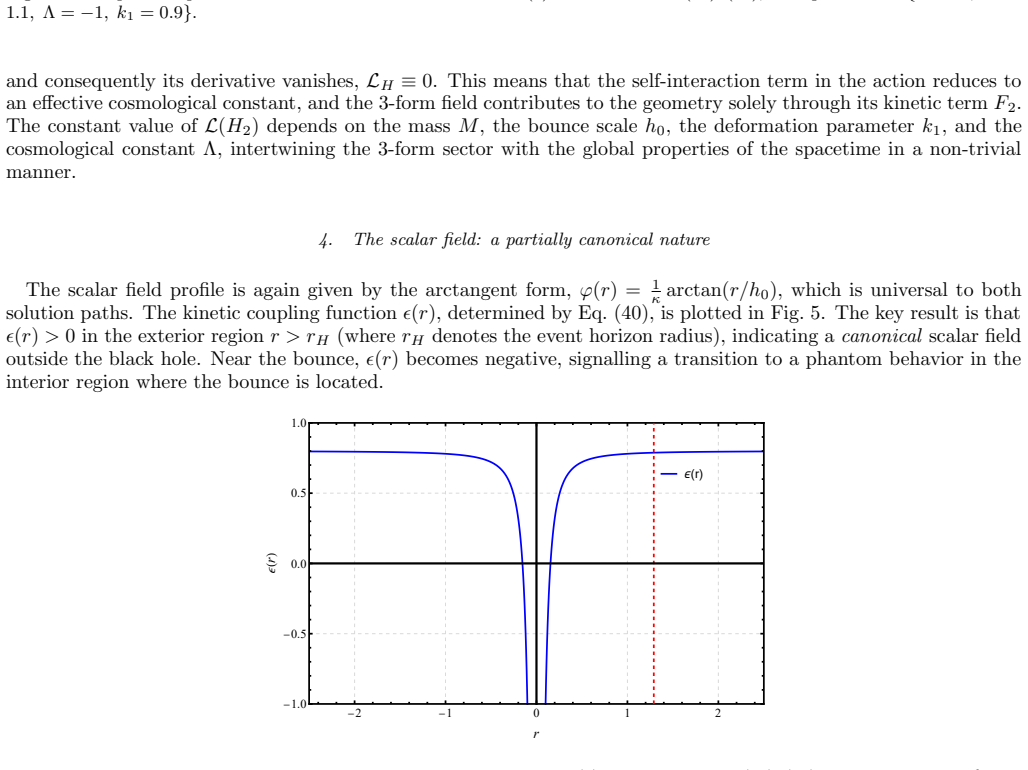
The scalar field: a partially canonical nature The scalar field profile is again given by the arctangent form,φ(r) = 1 κ arctan(r/h0), which is universal to both solution paths. The kinetic coupling functionϵ(r), determined by Eq. (40), is plotted in Fig. 5. The key result is that ϵ(r)>0 in the exterior regionr > r H (wherer H denotes the event horizon ra...
-
[9]
Both solutions are globally regular, asymptotically (A)dS (or flat for Λ = 0), and exhibit the characteristic asymmetric horizon structure of BB geometries
In Path B (this section), leavingϵ(r) free and solving forV(r) yields a constant 3-form Lagrangian and a solution with a partially canonical scalar field, where the areal radius is deformed by the additional parameterk 1 that controls the transition between canonical and phantom behavior. Both solutions are globally regular, asymptotically (A)dS (or flat ...
2018
-
[10]
M. Kalb and P. Ramond, Phys. Rev. D9(1974), 2273-2284 doi:10.1103/PhysRevD.9.2273
-
[11]
M. B. Green, J. H. Schwarz and E. Witten, Cambridge University Press, 2012, ISBN 978-1-139-53477-2, 978-1-107-02911-8 doi:10.1017/CBO9781139248563
-
[12]
J. Polchinski, Cambridge University Press, 2007, ISBN 978-0-511-25227-3, 978-0-521-67227-6, 978-0-521-63303-1 doi:10.1017/CBO9780511816079
-
[13]
L. Baulieu, M. P. Bellon and A. Tanzini, Phys. Lett. B565(2003), 211-221 doi:10.1016/S0370-2693(03)00759-7 [arXiv:hep- th/0303165 [hep-th]]
-
[14]
E. Cremmer, B. Julia and J. Scherk, Phys. Lett. B76(1978), 409-412 doi:10.1016/0370-2693(78)90894-8
-
[15]
C. P. Burgess, G. Choi and F. Quevedo, JHEP03(2024), 051 doi:10.1007/JHEP03(2024)051 [arXiv:2301.00549 [hep-th]]
-
[16]
T. S. Koivisto, D. F. Mota and C. Pitrou, JHEP09(2009), 092 doi:10.1088/1126-6708/2009/09/092 [arXiv:0903.4158 [astro-ph.CO]]
work page internal anchor Pith review Pith/arXiv arXiv doi:10.1088/1126-6708/2009/09/092 2009
-
[17]
T. S. Koivisto and N. J. Nunes, Phys. Rev. D80(2009), 103509 doi:10.1103/PhysRevD.80.103509 [arXiv:0908.0920 [astro- ph.CO]]
work page internal anchor Pith review Pith/arXiv arXiv doi:10.1103/physrevd.80.103509 2009
-
[18]
D. J. Mulryne, J. Noller and N. J. Nunes, JCAP12(2012), 016 doi:10.1088/1475-7516/2012/12/016 [arXiv:1209.2156 [astro-ph.CO]]
work page internal anchor Pith review Pith/arXiv arXiv doi:10.1088/1475-7516/2012/12/016 2012
-
[19]
T. S. Koivisto and N. J. Nunes, Phys. Lett. B685(2010), 105-109 doi:10.1016/j.physletb.2010.01.051 [arXiv:0907.3883 [astro-ph.CO]]
work page internal anchor Pith review Pith/arXiv arXiv doi:10.1016/j.physletb.2010.01.051 2010
-
[20]
Stability of the 3-form field during inflation
A. De Felice, K. Karwan and P. Wongjun, Phys. Rev. D85(2012), 123545 doi:10.1103/PhysRevD.85.123545 [arXiv:1202.0896 [hep-ph]]
work page internal anchor Pith review Pith/arXiv arXiv doi:10.1103/physrevd.85.123545 2012
-
[21]
F. R. Urban and T. S. Koivisto, JCAP09(2012), 025 doi:10.1088/1475-7516/2012/09/025 [arXiv:1207.7328 [astro-ph.CO]]
work page internal anchor Pith review Pith/arXiv arXiv doi:10.1088/1475-7516/2012/09/025 2012
-
[22]
A. De Felice, K. Karwan and P. Wongjun, Phys. Rev. D86(2012), 103526 doi:10.1103/PhysRevD.86.103526 [arXiv:1209.5156 [astro-ph.CO]]
work page internal anchor Pith review Pith/arXiv arXiv doi:10.1103/physrevd.86.103526 2012
-
[23]
F. R. Urban, JCAP08(2013), 008 doi:10.1088/1475-7516/2013/08/008 [arXiv:1306.6429 [astro-ph.CO]]. 20
work page internal anchor Pith review Pith/arXiv arXiv doi:10.1088/1475-7516/2013/08/008 2013
-
[24]
K. S. Kumar, J. Marto, N. J. Nunes and P. V. Moniz, JCAP06(2014), 064 doi:10.1088/1475-7516/2014/06/064 [arXiv:1404.0211 [gr-qc]]
work page internal anchor Pith review Pith/arXiv arXiv doi:10.1088/1475-7516/2014/06/064 2014
-
[25]
Non-Gaussianity in multiple three-form field inflation
K. Sravan Kumar, D. J. Mulryne, N. J. Nunes, J. Marto and P. Vargas Moniz, Phys. Rev. D94(2016) no.10, 103504 doi:10.1103/PhysRevD.94.103504 [arXiv:1606.07114 [astro-ph.CO]]
work page internal anchor Pith review Pith/arXiv arXiv doi:10.1103/physrevd.94.103504 2016
-
[26]
J. Morais, M. Bouhmadi-L´ opez, K. Sravan Kumar, J. Marto and Y. Tavakoli, Phys. Dark Univ.15(2017), 7-30 doi:10.1016/j.dark.2016.11.002 [arXiv:1608.01679 [gr-qc]]
work page internal anchor Pith review Pith/arXiv arXiv doi:10.1016/j.dark.2016.11.002 2017
-
[27]
A. De Felice and A. Hell, JHEP11(2025), 132 doi:10.1007/JHEP11(2025)132 [arXiv:2509.02323 [gr-qc]]
-
[28]
R. V. Maluf and J. C. S. Neves, Eur. Phys. J. C82(2022) no.2, 135 doi:10.1140/epjc/s10052-022-10109-2 [arXiv:2111.13165 [gr-qc]]
-
[29]
K. Karthikeyan and A. M. Thomas, Phys. Rev. D105(2022) no.10, 103505 doi:10.1103/PhysRevD.105.103505 [arXiv:2112.11945 [gr-qc]]
- [30]
-
[31]
T. Manton and S. Alexander, Phys. Rev. D110(2024) no.4, 044067 [erratum: Phys. Rev. D112(2025) no.10, 109902] doi:10.1103/PhysRevD.110.044067 [arXiv:2401.14452 [gr-qc]]
-
[32]
A. Hell and I. Obata, JCAP05(2026), 082 doi:10.1088/1475-7516/2026/05/082 [arXiv:2602.21675 [hep-th]]
-
[33]
C. Capanelli, L. Jenks, E. W. Kolb and E. McDonough, JHEP06(2024), 075 doi:10.1007/JHEP06(2024)075 [arXiv:2309.02485 [hep-ph]]
-
[34]
B. J. Barros and F. S. N. Lobo, Phys. Rev. D98(2018) no.4, 044012 doi:10.1103/PhysRevD.98.044012 [arXiv:1806.10488 [gr-qc]]
work page internal anchor Pith review Pith/arXiv arXiv doi:10.1103/physrevd.98.044012 2018
-
[35]
B. J. Barros, Z. Haghani, T. Harko and F. S. N. Lobo, Eur. Phys. J. C81(2021) no.4, 307 doi:10.1140/epjc/s10052-021- 09105-9 [arXiv:2101.04445 [gr-qc]]
-
[36]
M. Bouhmadi-L´ opez, C. Y. Chen, X. Y. Chew, Y. C. Ong and D. h. Yeom, JCAP10(2021), 059 doi:10.1088/1475- 7516/2021/10/059 [arXiv:2108.07302 [gr-qc]]
-
[37]
V. da Fonseca, B. J. Barros, T. Barreiro and N. J. Nunes, Phys. Dark Univ.47(2025), 101827 doi:10.1016/j.dark.2025.101827 [arXiv:2410.11658 [gr-qc]]
-
[38]
N. Ganiyeva, B. J. Barros, ´A. de la Cruz-Dombriz and F. S. N. Lobo, Eur. Phys. J. C85(2025) no.8, 914 doi:10.1140/epjc/s10052-025-14653-5 [arXiv:2412.19408 [gr-qc]]
-
[39]
M. Bouhmadi-L´ opez, H. W. Chiang, C. G. Boiza and P. Chen, [arXiv:2512.09991 [astro-ph.CO]]
-
[40]
Black-bounce to traversable wormhole
A. Simpson and M. Visser, JCAP02(2019), 042 doi:10.1088/1475-7516/2019/02/042 [arXiv:1812.07114 [gr-qc]]
work page internal anchor Pith review Pith/arXiv arXiv doi:10.1088/1475-7516/2019/02/042 2019
-
[41]
M. E. Rodrigues and M. V. d. S. Silva, Phys. Rev. D107(2023) no.4, 044064 doi:10.1103/PhysRevD.107.044064 [arXiv:2302.10772 [gr-qc]]
-
[42]
M. V. de Sousa Silva, M. E. Rodrigues and C. F. S. Pereira, Phys. Dark Univ.52(2026), 102293 doi:10.1016/j.dark.2026.102293 [arXiv:2601.17848 [gr-qc]]
-
[43]
M. V. d. S. Silva, T. M. Crispim, G. Alencar, R. R. Landim and M. E. Rodrigues, Class. Quant. Grav.43(2026) no.1, 015005 doi:10.1088/1361-6382/ae2730 [arXiv:2502.19186 [gr-qc]]
-
[44]
K. Akiyamaet al.[Event Horizon Telescope], Astrophys. J. Lett.930(2022) no.2, L12 doi:10.3847/2041-8213/ac6674 [arXiv:2311.08680 [astro-ph.HE]]
work page internal anchor Pith review Pith/arXiv arXiv doi:10.3847/2041-8213/ac6674 2022
-
[45]
T. Do, A. Hees, A. Ghez, G. D. Martinez, D. S. Chu, S. Jia, S. Sakai, J. R. Lu, A. K. Gautam and K. K. O’Neil,et al. Science365(2019) no.6454, 664-668 doi:10.1126/science.aav8137 [arXiv:1907.10731 [astro-ph.GA]]
-
[46]
R. Abuteret al.[GRAVITY], Astron. Astrophys.636(2020), L5 doi:10.1051/0004-6361/202037813 [arXiv:2004.07187 [astro-ph.GA]]
discussion (0)
Sign in with ORCID, Apple, or X to comment. Anyone can read and Pith papers without signing in.