Complex Analysis of Askaryan Radiation: UHECR Reconstruction with Askaryan Radio Array
Pith reviewed 2026-06-28 04:33 UTC · model grok-4.3
The pith
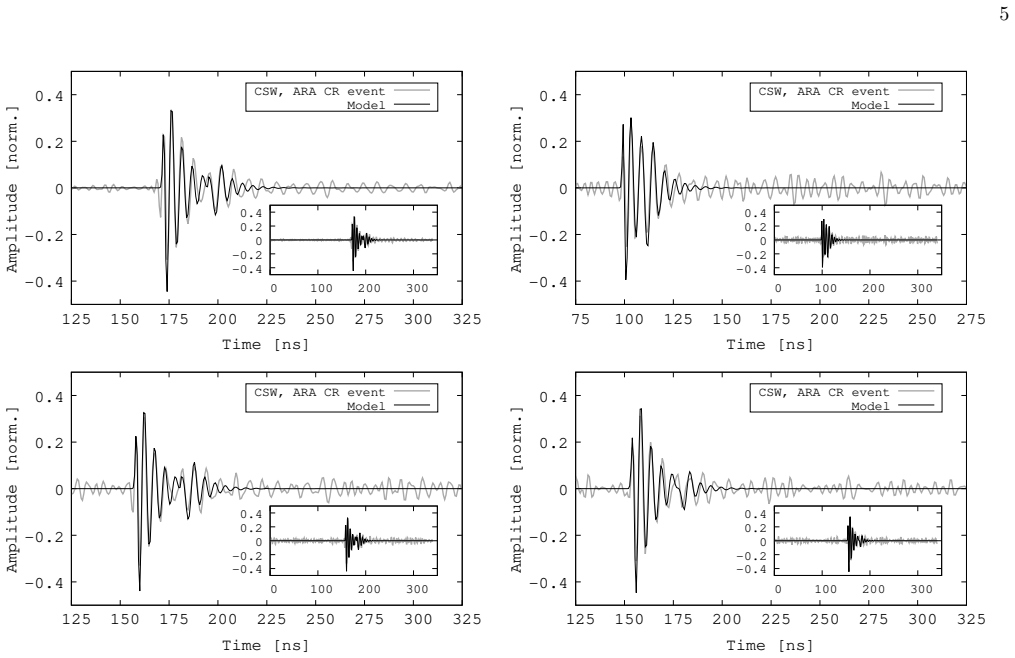
An analytical model of Askaryan radiation plus detector response matches the summed waveforms of 13 ARA events with correlations of 0.69 to 0.86.
A machine-rendered reading of the paper's core claim, the machinery that carries it, and where it could break.
Core claim
The coherently summed waveforms from the UHECR candidates match the analytic Askaryan-plus-channel model with correlation coefficients between 0.69 and 0.86 and with minimal fractional power differences, thereby confirming that the 13 events are produced by UHECR cascades; the same formalism yields an Askaryan E-field that reproduces the ARA measurements.
What carries the argument
The analytic Askaryan radiation model that includes the net negative charge excess and is convolved with the ARA RF channel transfer function, used both to generate template waveforms and to invert observed data for the incident electric field.
If this is right
- The 13 recorded events can be treated as confirmed UHECR cascades on the basis of the reported waveform matches.
- The analytic expression supplies a direct route to extract the Askaryan electric-field vector from the observed voltage traces.
- The same model supplies a template that can be used for future event selection or parameter estimation in radio arrays.
- The decomposition into geomagnetic and Askaryan components becomes available once the channel response is removed.
Where Pith is reading between the lines
- If the model holds, similar analytic templates could be generated for other ice-based radio detectors without requiring full Monte-Carlo shower libraries.
- The reported correlation range sets a practical threshold that future analyses could test against large ensembles of background waveforms.
- Recovering the E-field opens the possibility of estimating cascade energy or depth of maximum from radio data alone.
Load-bearing premise
A waveform correlation of 0.69-0.86 with the analytic model is sufficient to confirm that the signals come from UHECR cascades rather than from other sources or noise.
What would settle it
Demonstrating that waveforms synthesized from non-cascade sources or from detector noise alone can achieve the same 0.69-0.86 correlation range with the analytic template would falsify the confirmation.
Figures




read the original abstract
Ultra-high energy cosmic rays (UHECR) can produce relativistic cascades that emit radio-frequency (RF) pulses in the 0.05-1 GHz bandwidth via two distinct effects: the geomagnetic effect, and the Askaryan effect. The geomagnetic effect occurs when the magnetic field of the Earth causes cascade charges to form a transverse current that radiates linearly polarized radiation aligned with the Lorentz force direction. The Askaryan effect is caused by the net negative charge excess in the cascade that radiates linearly polarized radiation along the Cherenkov cone. When UHECR cascades enter solid, RF transparent matter at altitudes where the cascade develops, Askaryan radiation can propagate through the solid matter to RF detectors. The Askaryan Radio Array (ARA) at the South Pole has observed 13 UHECR candidates in precisely this fashion. We present an analytical model that confirms the events are UHECRs. The model includes Askaryan radiation and the ARA RF channel response. The coherently summed waveforms (CSWs) from the UHECR candidates match our model with correlation coefficients between 0.69 and 0.86, and with minimal fractional power differences. Finally, we demonstrate how to use the analytic formalism to obtain the Askaryan $\vec{E}$-field, and that it matches the results from ARA.
Editorial analysis
A structured set of objections, weighed in public.
Referee Report
Summary. The paper presents an analytical model of Askaryan radiation that incorporates the ARA RF channel response. It claims this model confirms 13 observed events as UHECR cascades because the coherently summed waveforms (CSWs) match the model with correlation coefficients 0.69–0.86 and minimal fractional power differences. The work also shows how to reconstruct the Askaryan E-field from the data and reports consistency with ARA results.
Significance. An analytical (as opposed to purely simulation-based) confirmation and reconstruction method for Askaryan signals in ice could be useful for UHECR radio arrays if the model is shown to be specific. The reported correlations and E-field reconstruction, if supported by explicit uniqueness tests and derivations, would constitute a concrete technical contribution.
major comments (3)
- [Abstract] Abstract: the claim that correlations of 0.69–0.86 'confirm the events are UHECRs' is load-bearing for the central result, yet no distribution of expected correlations from thermal noise, anthropogenic RF, or non-Askaryan transients (under the identical channel response) is provided; without this, the reported range is compatible with both signal and plausible backgrounds.
- [Abstract] Abstract: the model 'includes Askaryan radiation and the ARA RF channel response,' but no equations, derivation steps, or parameter list are supplied; it is therefore impossible to determine whether the reported matches are independent of any fitted parameters embedded in the channel response or whether they reduce to those parameters by construction.
- [Abstract] Abstract: 'minimal fractional power differences' is stated without a definition of the metric, numerical values, or exclusion criteria, preventing assessment of whether this quantity adds independent confirmation beyond the correlation coefficient.
minor comments (1)
- [Abstract] The abstract refers to 'the results from ARA' for the E-field comparison but does not specify which ARA data products or prior publications are used.
Simulated Author's Rebuttal
We thank the referee for the careful and constructive review. The comments highlight important points for strengthening the statistical interpretation and clarity of the abstract. We address each major comment below and will incorporate revisions to the manuscript.
read point-by-point responses
-
Referee: [Abstract] Abstract: the claim that correlations of 0.69–0.86 'confirm the events are UHECRs' is load-bearing for the central result, yet no distribution of expected correlations from thermal noise, anthropogenic RF, or non-Askaryan transients (under the identical channel response) is provided; without this, the reported range is compatible with both signal and plausible backgrounds.
Authors: We agree that a direct comparison against background distributions would strengthen the claim. The manuscript presents the observed correlations as supporting evidence in the context of the existing ARA event selection criteria. In the revised version we will add Monte Carlo simulations of thermal noise, anthropogenic RF, and non-Askaryan transients convolved with the identical ARA channel response, showing the resulting correlation-coefficient distribution under the null hypothesis. This will allow quantitative assessment of the significance of the 0.69–0.86 range. revision: yes
-
Referee: [Abstract] Abstract: the model 'includes Askaryan radiation and the ARA RF channel response,' but no equations, derivation steps, or parameter list are supplied; it is therefore impossible to determine whether the reported matches are independent of any fitted parameters embedded in the channel response or whether they reduce to those parameters by construction.
Authors: The abstract is a concise summary; the full analytical model, derivation of the Askaryan radiation, convolution with the independently measured ARA RF channel response, all equations, derivation steps, and parameter values appear in Sections 2 and 3. The channel response is taken from separate calibration data and is not adjusted to the UHECR candidates, so the matches are not by construction. We will revise the abstract to include an explicit reference to these sections and, space permitting, a key equation. revision: partial
-
Referee: [Abstract] Abstract: 'minimal fractional power differences' is stated without a definition of the metric, numerical values, or exclusion criteria, preventing assessment of whether this quantity adds independent confirmation beyond the correlation coefficient.
Authors: We will define the fractional power difference metric explicitly, report the numerical values obtained for each of the 13 events, and state the exclusion criteria in the revised manuscript. This will clarify the independent information provided by the metric relative to the correlation coefficients. revision: yes
Circularity Check
No circularity: analytical model match presented as independent comparison
full rationale
The paper introduces an analytical model of Askaryan radiation plus ARA channel response and reports that observed CSWs correlate with it at 0.69-0.86. No quoted equations, parameter-fitting procedure, or self-citation chain shows that the reported correlations are forced by construction (e.g., no indication that channel-response parameters were derived from the same 13 events or that the model is defined in terms of the target match). The derivation therefore remains self-contained; absence of background-distribution tests is a specificity concern, not a circularity reduction.
Axiom & Free-Parameter Ledger
Reference graph
Works this paper leans on
-
[1]
The second assumption we make is that calibration pulse events resemble Askaryan pulses. Though that is the purpose of the calibration pulser system design in ARA [16, 18], the original pulser voltage is transmitted through an ARA dipole, propagates through ice to the A5 trigger string, and is converted to the observed trace. None of these effects, howeve...
1915
-
[2]
Radiowave Detection of Ultra-High Energy Neutrinos and Cosmic Rays
T. Huege and D. Besson, Progress of Theoretical and Experimental Physics2017, 12A106 (2017), ISSN 2050- 3911, 1701.02987
work page internal anchor Pith review Pith/arXiv arXiv 2017
- [3]
-
[4]
Radio detection of air showers with the ARIANNA experiment on the Ross Ice Shelf
S. Barwick, D. Besson, A. Burgman, E. Chiem, A. Hall- gren, J. Hanson, S. Klein, S. Kleinfelder, A. Nelles, C. Persichilli, et al., Astroparticle Physics90, 50 (2017), ISSN 0927-6505, 1612.04473
work page internal anchor Pith review Pith/arXiv arXiv 2017
-
[5]
N. Alden, S. Ali, P. Allison, S. Archambault, J. J. Beatty, D. Z. Besson, A. Bishop, P. Chen, Y. C. Chen, Y. C. Chen, et al., Phys. Rev. Lett. pp. – (2026), URLhttps: //link.aps.org/doi/10.1103/xwqy-yzrk
-
[6]
S. Agarwal, J. A. Aguilar, N. Alden, S. Ali, P. Allison, M. Betts, D. Besson, A. Bishop, O. Botner, S. Bouma, et al., arXiv (2025), 2512.17664
-
[7]
E. Zas, F. Halzen, and T. Stanev, Physical Review D45, 362 (1992)
1992
-
[8]
Alvarez-Mu˜ niz, C
J. Alvarez-Mu˜ niz, C. James, R. Protheroe, and E. Zas, Astroparticle Physics32, 100 (2009), ISSN 0927-6505. 8
2009
-
[9]
J. Alameddine, J. Albrecht, J. Ammerman-Yebra, L. Arrabito, A. Alves, D. Baack, A. Coleman, H. Dem- binski, D. Els¨ asser, R. Engel, et al., Astroparticle Physics 166, 103072 (2025), ISSN 0927-6505, 2409.15999
-
[10]
Practical and accurate calculations of Askaryan radiation
J. Alvarez-Muniz, A. Romero-Wolf, and E. Zas, Physical Review D84, 103003 (2011), ISSN 2470-0029, 1106.6283
work page internal anchor Pith review Pith/arXiv arXiv 2011
-
[11]
J. Alvarez-Muniz, P. M. Hansen, A. Romero-Wolf, and E. Zas, Phys. Rev. D101, 083005 (2020), URLhttps: //link.aps.org/doi/10.1103/PhysRevD.101.083005
-
[12]
Glaser et al, The European Physical Journal C80, 77 (2020), ISSN 1434-6044, 1906.01670
C. Glaser et al, The European Physical Journal C80, 77 (2020), ISSN 1434-6044, 1906.01670
-
[13]
R. V. Buniy and J. P. Ralston, Physical Review D65 (2001), ISSN 2470-0029
2001
-
[14]
J. C. Hanson and A. L. Connolly, Astroparticle Physics 91, 75 (2017), ISSN 0927-6505
2017
-
[15]
J. C. Hanson and R. Hartig, Phys. Rev. D105, 123019 (2022), URLhttps://link.aps.org/doi/10. 1103/PhysRevD.105.123019
2022
-
[16]
J. C. Hanson and R. Hartig, Physical Review D0000, 0000 (2026)
2026
-
[17]
P. Allison, S. Archambault, J. J. Beatty, D. Z. Besson, A. Bishop, C. C. Chen, C. H. Chen, P. Chen, Y. C. Chen, B. A. Clark, et al., Physical Review D105, 122006 (2022), ISSN 2470-0010, 2202.07080
- [18]
-
[19]
P. Allison, J. Auffenberg, R. Bard, J. Beatty, D. Besson, S. B¨ oser, C. Chen, P. Chen, A. Connolly, and J. Davies, Astroparticle Physics35, 457 (2012), ISSN 0927-6505, 1105.2854
-
[20]
The ARA Collaboration, Astroparticle Physics 70, 62 (2015), ISSN 0927-6505, URLhttps: //www.sciencedirect.com/science/article/pii/ S0927650515000687
2015
-
[21]
J. Avva, K. Bechtol, T. Chesebro, L. Cremonesi, C. Dea- conu, A. Gupta, A. Ludwig, W. Messino, C. Miki, R. Nichol, et al., Nuclear Instruments and Methods in Physics Research Section A: Accelerators, Spectrometers, Detectors and Associated Equipment869, 46 (2017), ISSN 0168-9002, 1605.03525
work page internal anchor Pith review Pith/arXiv arXiv 2017
-
[22]
Time Domain Response of the ARIANNA Detector
S. Barwick, E. Berg, D. Besson, T. Duffin, J. Han- son, S. Klein, S. Kleinfelder, M. Piasecki, K. Ratzlaff, C. Reed, et al., Astroparticle Physics62, 139 (2015), ISSN 0927-6505, 1406.0820
work page internal anchor Pith review Pith/arXiv arXiv 2015
-
[23]
P. A. Jansson,Deconvolution of Images and Spec- tra(Dover Publications, Mineola, NY, 2012), ISBN 9780486453255, classic text covering inverse filtering, noise amplification, and stability issues in deconvolution
2012
discussion (0)
Sign in with ORCID, Apple, or X to comment. Anyone can read and Pith papers without signing in.