PHKT:Personalized Dynamic Hypergraph-enhanced KAN-Transformer for Multi-behavior Sequential Recommendation
Pith reviewed 2026-06-28 00:02 UTC · model grok-4.3
The pith
PHKT combines a personalized dynamic hypergraph with KAN inside a Transformer to model user-specific high-order relationships and nonlinear patterns in multi-behavior sequences.
A machine-rendered reading of the paper's core claim, the machinery that carries it, and where it could break.
Core claim
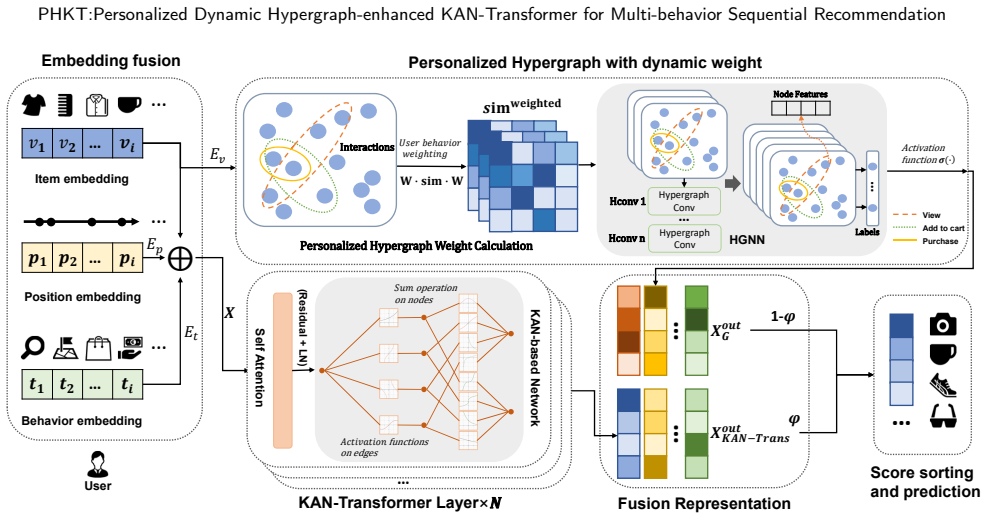
The PHKT architecture introduces a personalized dynamic hypergraph module that performs behavior-aware weighting of item similarities drawn from a user's historical sequence to capture user-specific heterogeneous high-order relationships; it employs a Transformer backbone to track the evolution of short- and long-term preferences; and it replaces the conventional MLP inside the feedforward network with a Kolmogorov-Arnold Network to strengthen fine-grained nonlinear modeling of varied latent patterns, yielding improved target behavior prediction.
What carries the argument
Personalized dynamic hypergraph module that applies behavior-aware weighting to item similarities from user sequences, paired with KAN substitution for the MLP inside the Transformer's feedforward network.
If this is right
- User-specific high-order relationships become explicitly representable through behavior-weighted hyperedges.
- Nonlinear responses to distinct latent patterns receive finer modeling inside the sequence backbone.
- Short- and long-term preference evolution can be tracked while respecting behavior-type heterogeneity.
- Target behavior prediction improves measurably on real e-commerce logs containing multiple action types.
Where Pith is reading between the lines
- The same hypergraph-plus-KAN pattern might transfer to other sequential tasks that mix interaction types, such as session-based advertising or content streams.
- If KAN proves stable under the reported training regime, similar feedforward substitutions could be tested in non-recommendation Transformer applications that face heterogeneous inputs.
- Scalability questions remain open: whether the dynamic hypergraph construction stays tractable when user histories grow beyond the lengths seen in the three evaluated datasets.
Load-bearing premise
The assumption that the hypergraph weighting scheme and KAN replacement directly fix the stated limits in heterogeneous semantics and nonlinear modeling without introducing offsetting costs or unreported tuning demands.
What would settle it
A re-run on the same three datasets in which PHKT fails to beat the strongest baselines once hyperparameter search budgets are equalized across all models.
Figures



read the original abstract
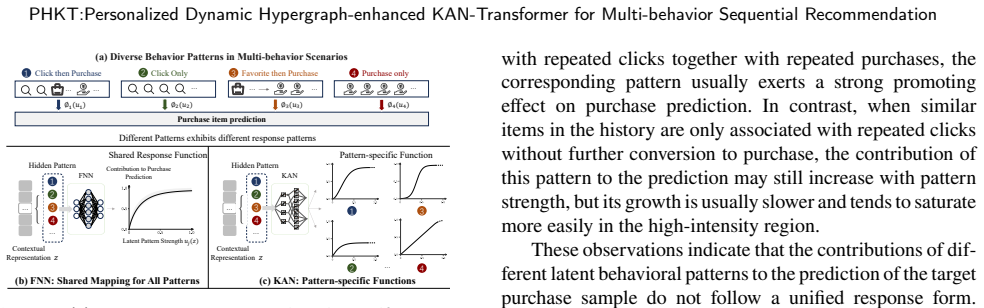
In multi-behavior recommendation, auxiliary behaviors such as clicks, add-to-cart, and purchases can provide richer supervisory information for predicting target behaviors. Although existing graph and hypergraph methods are capable of modeling high-order relationships among users, items, and behaviors, they still have limitations in heterogeneous semantics, user-specific weighting, and sequence dependency modeling. While standard Transformers excel at sequence modeling, their shared feedforward mapping struggles to accommodate the differentiated requirements of heterogeneous latent patterns in multi-behavior scenarios. To address this, this paper proposes the Personalized Hypergraph-enhanced Kolmogorov-Arnold Network Transformer (PHKT). Specifically, we design a personalized dynamic hypergraph module that performs behavior-aware weighting of item similarities based on users' historical behavior sequences to capture user-specific heterogeneous high-order relationships. Meanwhile, a Transformer is used as the temporal backbone to model the evolution of short- and long-term preferences, and KAN is introduced to replace the traditional MLP in the feedforward network to enhance fine-grained modeling capability for nonlinear responses to different latent patterns. Experiments on three real datasets, Tmall, RetailRocket, and IJCAI, show that PHKT consistently outperforms nine strong baseline models across multiple evaluation metrics, demonstrating its effectiveness in multi-behavior preference modeling and target behavior prediction.
Editorial analysis
A structured set of objections, weighed in public.
Referee Report
Summary. The manuscript proposes PHKT, a model for multi-behavior sequential recommendation that combines a personalized dynamic hypergraph module (to capture user-specific, behavior-aware high-order item relationships from historical sequences) with a Transformer backbone whose feedforward network replaces the standard MLP with a Kolmogorov-Arnold Network (KAN) to better model heterogeneous nonlinear patterns. The central empirical claim is that PHKT consistently outperforms nine strong baselines across multiple metrics on the Tmall, RetailRocket, and IJCAI datasets.
Significance. If the performance gains can be shown to arise specifically from the proposed hypergraph personalization and KAN substitution (rather than from unmentioned tuning or implementation choices), the architecture could offer a practical advance in handling heterogeneous semantics and differentiated latent patterns in multi-behavior recommendation.
major comments (2)
- [Experiments] Experiments (and abstract): The claim of consistent outperformance over nine baselines is presented without any ablation results (e.g., PHKT minus personalized dynamic hypergraph, or PHKT minus KAN) or details on whether baselines received equivalent hyperparameter search budgets. This makes attribution of gains to the two proposed components impossible to verify and renders the headline result non-load-bearing.
- [§3] §3 (Method): The personalized dynamic hypergraph is described at a high level but supplies no explicit equations for the user-specific behavior-aware weighting of item similarities or for how the dynamic construction differs from prior static or non-personalized hypergraph approaches; without these, it is unclear whether the module introduces new modeling power or merely reparameterizes existing ideas.
minor comments (2)
- [Title] The title is missing a space after the colon ('PHKT:Personalized').
- [Abstract] Abstract: 'multiple evaluation metrics' is stated without naming them (HR@K, NDCG@K, etc.) or reporting statistical significance tests.
Simulated Author's Rebuttal
We thank the referee for the constructive feedback. We address the two major comments below and will revise the manuscript to strengthen the empirical attribution and methodological clarity.
read point-by-point responses
-
Referee: [Experiments] Experiments (and abstract): The claim of consistent outperformance over nine baselines is presented without any ablation results (e.g., PHKT minus personalized dynamic hypergraph, or PHKT minus KAN) or details on whether baselines received equivalent hyperparameter search budgets. This makes attribution of gains to the two proposed components impossible to verify and renders the headline result non-load-bearing.
Authors: We agree the absence of ablations limits causal attribution. In the revision we will add two ablation variants (PHKT w/o personalized dynamic hypergraph; PHKT w/ MLP instead of KAN) and report the resulting drops on all three datasets. For baselines we followed the hyper-parameter values published in their original papers and performed a comparable grid search for PHKT; we will add an explicit paragraph in §4.1 documenting the search ranges and confirming equivalent computational budgets were allocated. revision: yes
-
Referee: [§3] §3 (Method): The personalized dynamic hypergraph is described at a high level but supplies no explicit equations for the user-specific behavior-aware weighting of item similarities or for how the dynamic construction differs from prior static or non-personalized hypergraph approaches; without these, it is unclear whether the module introduces new modeling power or merely reparameterizes existing ideas.
Authors: We will insert the missing formalization in §3.2. The revised text will include: (i) the equation for user-specific behavior-aware similarity weights derived from the historical multi-behavior sequence, (ii) the dynamic hyperedge construction rule that updates hyperedges at each time step using the latest sequence prefix, and (iii) a direct comparison paragraph contrasting the approach with static hypergraphs (e.g., those in prior works) by emphasizing per-user, per-behavior weighting and temporal dynamism. revision: yes
Circularity Check
No circularity in derivation chain; empirical model proposal with no self-referential reductions
full rationale
The paper proposes PHKT as a new architecture combining a personalized dynamic hypergraph module for user-specific behavior-aware relations and KAN substitution in the Transformer FFN for nonlinear pattern modeling. The abstract and description contain no equations, derivations, fitted parameters presented as predictions, or load-bearing self-citations that reduce the central claims to inputs by construction. Claims rest on experimental outperformance across three datasets against baselines, which constitutes independent empirical validation rather than a mathematical chain that collapses to tautology. No ansatzes, uniqueness theorems, or renamings of known results are invoked in a way that creates circularity.
Axiom & Free-Parameter Ledger
Reference graph
Works this paper leans on
-
[1]
Chang, H.S., Agarwal, N., McCallum, A., 2024. To copy, or not to copy; that is a critical issue of the output softmax layer in neural sequential recommenders, in: Proceedings of the 17th ACM Interna- tional Conference on Web Search and Data Mining, pp. 67–76
2024
-
[2]
Sequential recommendation with graph neural networks, in:Proceedingsof the44thInternationalACMSIGIR Conferenceon Research and Development in Information Retrieval, pp
Chang, J., Gao, C., Zheng, Y., Hui, Y., Niu, Y., Song, Y., Jin, D., Li, Y., 2021. Sequential recommendation with graph neural networks, in:Proceedingsof the44thInternationalACMSIGIR Conferenceon Research and Development in Information Retrieval, pp. 378–387
2021
-
[3]
Clash-of-Leges: A bilingual dataset for conflict detection and explanation in statutory law
Chen,R.,Fan,J.,Wu,M.,Cheng,R.,Chai,M.,2026. Gxnsrec:Multi- behavior sequential recommender based on graph cross networks. Expert Systems with Applications 297, 129387. doi:10.1016/j.eswa. 2025.129387
-
[4]
Hypergraph temporal multi-behaviorrecommendation
Choi, J., Kwon, J., Kim, Y., Kim, Y., 2025. Hypergraph temporal multi-behaviorrecommendation. EngineeringApplicationsofArtifi- cial Intelligence 145, 110112
2025
-
[5]
Du, X., Yuan, H., Zhao, P., Qu, J., Zhuang, F., Liu, G., Liu, Y., Sheng, V.S., 2023. Frequency enhanced hybrid attention network for sequentialrecommendation,in:Proceedingsofthe46thInternational ACM SIGIR Conference on Research and Development in Informa- tion Retrieval, pp. 78–88. doi:10.1145/3539618.3591689
-
[6]
Multi-behavioral sequential recommendation, in: Proceedings of the 18th ACM Con- ference on Recommender Systems, pp
Elsayed,S.,Rashed,A.,Schmidt-Thieme,L.,2024. Multi-behavioral sequential recommendation, in: Proceedings of the 18th ACM Con- ference on Recommender Systems, pp. 902–906
2024
-
[7]
Hypergraph neuralnetworks,in:ProceedingsoftheAAAIconferenceonartificial intelligence, pp
Feng, Y., You, H., Zhang, Z., Ji, R., Gao, Y., 2019. Hypergraph neuralnetworks,in:ProceedingsoftheAAAIconferenceonartificial intelligence, pp. 3558–3565
2019
-
[8]
Session- based recommendations with recurrent neural networks
Hidasi, B., Karatzoglou, A., Baltrunas, L., Tikk, D., 2015. Session- based recommendations with recurrent neural networks. arXiv preprint arXiv:1511.06939
Pith/arXiv arXiv 2015
-
[9]
Jin, B., Gao, C., He, X., Jin, D., Li, Y., 2020. Multi-behavior recommendation with graph convolutional networks, in: Proceedings of the 43rd international ACM SIGIR conference on research and development in information retrieval, pp. 659–668
2020
-
[10]
Kang, W.C., McAuley, J., 2018. Self-attentive sequential recom- mendation, in: 2018 IEEE International Conference on Data Mining (ICDM), pp. 197–206. doi:10.1109/ICDM.2018.00035
-
[11]
Multi-interest network with dynamic routingforrecommendationattmall,in:Proceedingsofthe28thACM internationalconferenceoninformationandknowledgemanagement, pp
Li, C., Liu, Z., Wu, M., Xu, Y., Zhao, H., Huang, P., Kang, G., Chen, Q., Li, W., Lee, D.L., 2019. Multi-interest network with dynamic routingforrecommendationattmall,in:Proceedingsofthe28thACM internationalconferenceoninformationandknowledgemanagement, pp. 2615–2623
2019
-
[12]
Knowledge-BasedSystems, 114133
Li, H., Zhang, X., Weng, H., Shen, Y., Cai, K., Wang, D., Qin, Z., Deng,S.,2025.Disentangledprogressivenegativesamplingforgraph collaborativefilteringrecommendation. Knowledge-BasedSystems, 114133
2025
-
[13]
Hypergraph-enhanced multi-interest learning for multi-behavior sequential recommenda- tion
Li, Q., Ma, H., Jin, W., Ji, Y., Li, Z., 2024a. Hypergraph-enhanced multi-interest learning for multi-behavior sequential recommenda- tion. Expert Systems with Applications 255, 124497
-
[14]
Recent developments in recommender systems: A survey
Li, Y., Liu, K., Satapathy, R., Wang, S., Cambria, E., 2024b. Recent developments in recommender systems: A survey. IEEE Computa- tional Intelligence Magazine 19, 78–95
-
[15]
Fuzzyclustering-baseddual-channelcontrastive learning for multi-behavior recommendation
Liao,J.,Jantan,A.,Liu,Z.,Senapati,T.,Ulutagay,G.,Abualigah,L., Ahmed,O.H.,2025. Fuzzyclustering-baseddual-channelcontrastive learning for multi-behavior recommendation. Engineering Applica- tions of Artificial Intelligence 157, 111381
2025
-
[16]
Liao, S., Mok, P., 2024. Hypergraph-enhanced contrastively regu- larized transformer for multi-behavior e-commerce product recom- mendation, in: 2024 IEEE International Conference on Data Mining (ICDM), IEEE. pp. 767–772
2024
-
[17]
Weighted nonlinear information extension based time series kolmogorov–arnoldnetworkforindustrialapplicationwithsoftsens- ing
Liu, G.Y., Zhu, Q.X., Zhang, N., He, Y.L., Zhang, M.Q., Xu, Y., 2025a. Weighted nonlinear information extension based time series kolmogorov–arnoldnetworkforindustrialapplicationwithsoftsens- ing. Engineering Applications of Artificial Intelligence 160, 111719
-
[18]
Liu, Y., Xia, L., Huang, C., 2024a. SelfGNN: Self-supervised graph neural networks for sequential recommendation, in: Proceedings of the 47th International ACM SIGIR Conference on Research and Development in Information Retrieval, pp. 1609–1618
-
[19]
Multi-behavior generative recommendation, in: Proceedings of the 33rd ACM International Conference on Information and Knowledge Management, pp
Liu, Z., Hou, Y., McAuley, J., 2024b. Multi-behavior generative recommendation, in: Proceedings of the 33rd ACM International Conference on Information and Knowledge Management, pp. 1575– 1585
-
[20]
KAN:kolmogorov-arnoldnetworks, in: The Thirteenth International Conference on Learning Represen- tations, ICLR 2025, Singapore, April 24-28, 2025, OpenReview.net
Liu, Z., Wang, Y., Vaidya, S., Ruehle, F., Halverson, J., Soljacic, M., Hou,T.Y.,Tegmark,M.,2025b. KAN:kolmogorov-arnoldnetworks, in: The Thirteenth International Conference on Learning Represen- tations, ICLR 2025, Singapore, April 24-28, 2025, OpenReview.net. URL:https://openreview.net/forum?id=Ozo7qJ5vZi. R. Du et al. Page 13 of 14 PHKT:Personalized Dy...
2025
-
[21]
Dynamic multi-interest graph neural network for session-based recommendation, in: Proceedings of the AAAI Conference on Artificial Intelligence, pp
Lv, M., Liu, X., Xu, Y., 2025. Dynamic multi-interest graph neural network for session-based recommendation, in: Proceedings of the AAAI Conference on Artificial Intelligence, pp. 12328–12336
2025
-
[22]
Ls- tgnn:Longandshort-termtemporalgraphneuralnetworkforsession- based recommendation, in: Proceedings of the AAAI Conference on Artificial Intelligence, pp
Ou, Z., Zhang, X., Zhu, Y., Lyu, S., Liu, J., Ao, T., 2025. Ls- tgnn:Longandshort-termtemporalgraphneuralnetworkforsession- based recommendation, in: Proceedings of the AAAI Conference on Artificial Intelligence, pp. 12426–12434
2025
-
[23]
Adaptivedissemination process in weighted hypergraphs
Pan,Q.,Wang,Z.,Wang,H.,Tang,J.,2025. Adaptivedissemination process in weighted hypergraphs. Expert Systems with Applications 268, 126340
2025
-
[24]
Park, J.D., Kim, K.M., Shin, W.Y., 2024. Cf-kan: Kolmogorov- arnold network-based collaborative filtering to mitigate catastrophic forgettinginrecommendersystems. arXivpreprintarXiv:2409.05878
arXiv 2024
-
[25]
Factoriz- ing personalized markov chains for next-basket recommendation, in: Proceedingsofthe19thinternationalconferenceonWorldwideweb, pp
Rendle, S., Freudenthaler, C., Schmidt-Thieme, L., 2010. Factoriz- ing personalized markov chains for next-basket recommendation, in: Proceedingsofthe19thinternationalconferenceonWorldwideweb, pp. 811–820
2010
-
[26]
Llm-powered explanations: Unraveling recommendations through subgraph reasoning
Shi,G.,Deng,X.,Luo,L.,Xia,L.,Bao,L.,Ye,B.,Du,F.,Pan,S.,Li, Y., 2025. Llm-powered explanations: Unraveling recommendations through subgraph reasoning. Knowledge-Based Systems , 114307
2025
-
[27]
A survey on kolmogorov-arnold network
Somvanshi, S., Javed, S.A., Islam, M.M., Pandit, D., Das, S., 2025. A survey on kolmogorov-arnold network. ACM Computing Surveys 58, 1–35
2025
-
[28]
Personalized behavior-aware transformer for multi-behavior sequential recommendation, in: Pro- ceedings of the 31st ACM International Conference on Multimedia, pp
Su, J., Chen, C., Lin, Z., et al., 2023. Personalized behavior-aware transformer for multi-behavior sequential recommendation, in: Pro- ceedings of the 31st ACM International Conference on Multimedia, pp. 6321–6331
2023
-
[29]
Sun, F., Liu, J., Wu, J., Pei, C., Lin, X., Ou, W., Jiang, P., 2019. Bert4rec:Sequentialrecommendationwithbidirectionalencoderrep- resentations from transformer, in: Proceedings of the 28th ACM In- ternationalConferenceonInformationandKnowledgeManagement, ACM. pp. 1441–1450. doi:10.1145/3357384.3357895
-
[30]
Tan,Y.K.,Xu,X.,Liu,Y.,2016. Improvedrecurrentneuralnetworks forsession-basedrecommendations,in:Proceedingsofthe1stWork- shop on Deep Learning for Recommender Systems. doi:10.1145/ 2988450.2988452
arXiv 2016
-
[31]
Personalized top-n sequential recom- mendationviaconvolutionalsequenceembedding,in:Proceedingsof the eleventh ACM international conference on web search and data mining, pp
Tang, J., Wang, K., 2018. Personalized top-n sequential recom- mendationviaconvolutionalsequenceembedding,in:Proceedingsof the eleventh ACM international conference on web search and data mining, pp. 565–573
2018
-
[32]
Attention is all you need
Vaswani,A.,Shazeer,N.,Parmar,N.,Uszkoreit,J.,Jones,L.,Gomez, A.N., Kaiser, Ł., Polosukhin, I., 2017. Attention is all you need. Advances in neural information processing systems 30
2017
-
[33]
Wang, D., Yao, H., Yu, D., Song, S., Weng, H., Xu, G., Deng, S.,
-
[34]
Neural Networks 184, 107062
Graph intention embedding neural network for tag-aware recommendation. Neural Networks 184, 107062
-
[35]
Multi-viewenhancedgraphattentionnetworkforsession-basedmusic recommendation
Wang, D., Zhang, X., Yin, Y., Yu, D., Xu, G., Deng, S., 2023. Multi-viewenhancedgraphattentionnetworkforsession-basedmusic recommendation. ACM Transactions on Information Systems 42, 1– 30
2023
-
[36]
Self- supervisedhypergraphconvolutionalnetworksforsession-basedrec- ommendation, in: Proceedings of the AAAI conference on artificial intelligence, pp
Xia, X., Yin, H., Yu, J., Wang, Q., Cui, L., Zhang, X., 2021. Self- supervisedhypergraphconvolutionalnetworksforsession-basedrec- ommendation, in: Proceedings of the AAAI conference on artificial intelligence, pp. 4503–4511
2021
-
[37]
Xu, J., Chen, Z., Li, J., Yang, S., Wang, W., Hu, X., Ngai, E.,
-
[38]
Fourierkan-gcf:Fourierkolmogorov–arnoldnetwork–aneffec- tive and efficient feature transformation for graph collaborative filter- ing. arxiv: https://arxiv. org/abs/2406.01034 (2024). arXiv preprint arXiv:2406.01034
arXiv 2024
-
[39]
cd-mbrec: Enhancing multi-behavior recommendation by explicitly modeling commonality and diversity
Yan, C., Zhu, Z., Zhang, Y., Guan, X., Wan, Y., 2025. cd-mbrec: Enhancing multi-behavior recommendation by explicitly modeling commonality and diversity. Intelligent Data Analysis 29, 292–305
2025
-
[40]
Yang, Q., Wang, S., Guo, D., Yu, D., Xiao, Q., Wang, D., Luo, C.,
-
[41]
Cascading multimodal feature enhanced contrast learning for music recommendation, in: 2024 IEEE International Conference on Data Mining (ICDM), IEEE. pp. 905–910
2024
-
[42]
Multi-behaviorhypergraph- enhanced transformer for sequential recommendation, in: Proceed- ingsofthe28thACMSIGKDDConferenceonKnowledgeDiscovery and Data Mining, pp
Yang,Y.,Huang,C.,Xia,L.,etal.,2022. Multi-behaviorhypergraph- enhanced transformer for sequential recommendation, in: Proceed- ingsofthe28thACMSIGKDDConferenceonKnowledgeDiscovery and Data Mining, pp. 2263–2274
2022
-
[43]
Graph masked autoencoder for sequentialrecommendation,in:Proceedingsofthe46thInternational ACM SIGIR Conference on Research and Development in Informa- tion Retrieval, pp
Ye, Y., Xia, L., Huang, C., 2023. Graph masked autoencoder for sequentialrecommendation,in:Proceedingsofthe46thInternational ACM SIGIR Conference on Research and Development in Informa- tion Retrieval, pp. 321–330
2023
-
[44]
Mhaner:Amulti-sourceheterogeneousgraphattention network for explainable recommendation in online games
Yu, D., Wang, X., Xiong, Y., Shen, X., Wu, R., Wang, D., Zou, Z., Xu,G.,2024. Mhaner:Amulti-sourceheterogeneousgraphattention network for explainable recommendation in online games. ACM Transactions on Intelligent Systems and Technology 15, 1–23
2024
-
[45]
Multi- behavioral recommendation algorithm based on decoupled graph convolution
Yu, X., Ding, P., Yu, J., Lin, J., Guo, L., Liu, G., Xi, L., 2026. Multi- behavioral recommendation algorithm based on decoupled graph convolution. Expert Systems with Applications 298, 129618
2026
-
[46]
Multivariate hawkes spatio-temporal point process with attentionforpointofinterestrecommendation
Zhang, X., Weng, H., Wei, Y., Wang, D., Chen, J., Liang, T., Yin, Y., 2025. Multivariate hawkes spatio-temporal point process with attentionforpointofinterestrecommendation. Neurocomputing619, 129161
2025
-
[47]
Enhanced recommendation with hypergraph mixture of experts
Zhou, Z., Chen, Z., Ma, G., Lin, Z., Tan, Y., Wang, S., Yang, C., 2026. Enhanced recommendation with hypergraph mixture of experts. ExpertSystemswithApplications297,129333. doi:10.1016/ j.eswa.2025.129333. R. Du et al. Page 14 of 14
arXiv 2026
discussion (0)
Sign in with ORCID, Apple, or X to comment. Anyone can read and Pith papers without signing in.