Beyond Critical Minerals Targets: Digital Rock Physics as Infrastructure for Secure and Circular Supply Chains
Pith reviewed 2026-06-27 22:52 UTC · model grok-4.3
The pith
Digital Rock Physics should be treated as shared policy infrastructure that links mineral textures to viable processing decisions for critical minerals.
A machine-rendered reading of the paper's core claim, the machinery that carries it, and where it could break.
Core claim
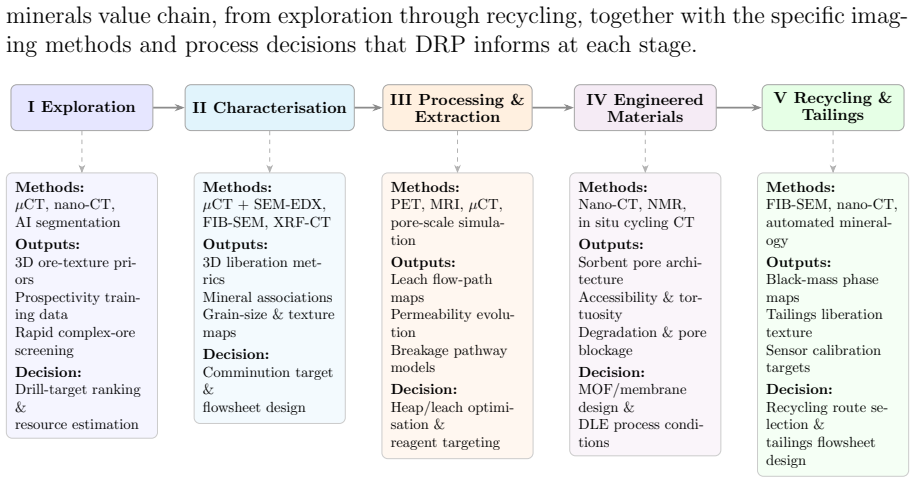
Treated as shared implementation infrastructure, Digital Rock Physics can turn critical minerals strategies into practical routes for supply security, resource efficiency, circularity, and more environmentally responsible development by connecting mineral texture and reactive pathways to decisions on ore characterisation, liberation prediction, leaching, Direct Lithium Extraction, mine-waste valorisation, and battery recycling.
What carries the argument
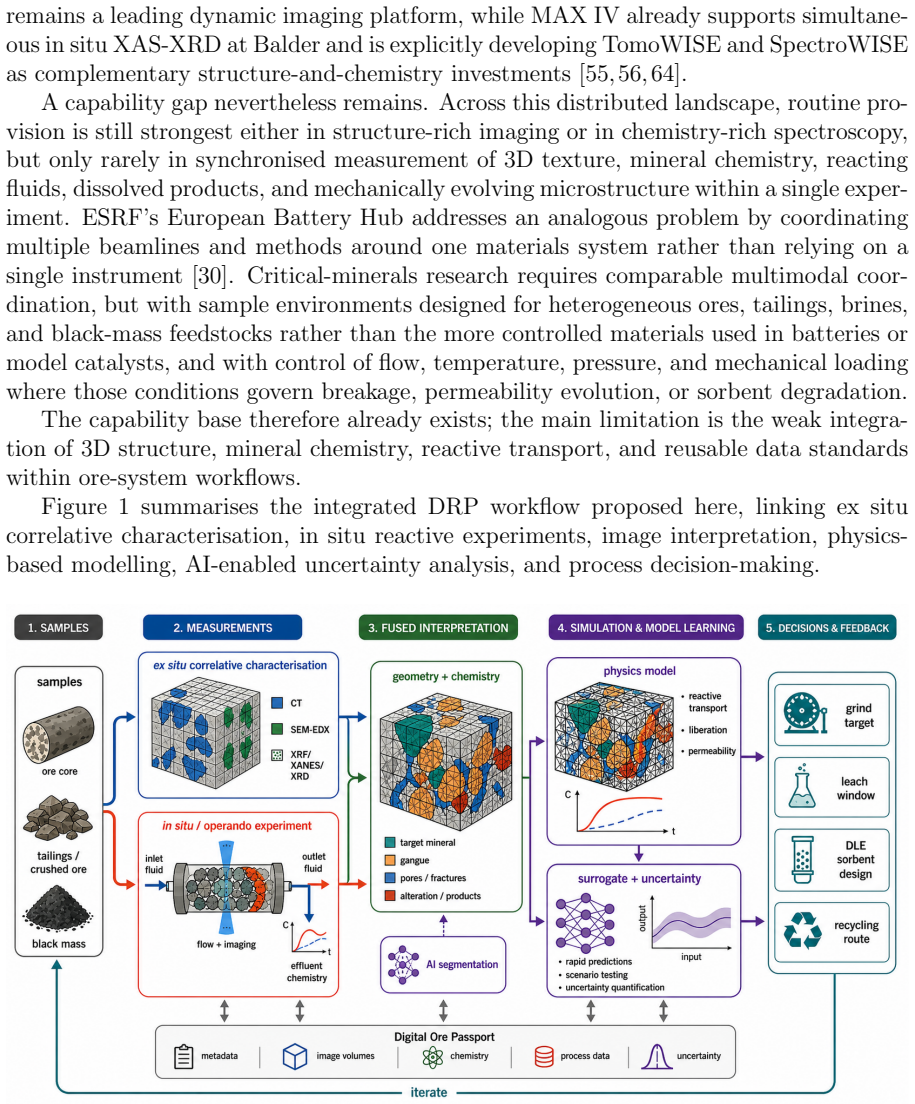
Digital Rock Physics (DRP), the combination of three-dimensional imaging, correlative chemistry, AI-enabled image analysis, and pore-scale modelling that connects mineral texture and reactive pathways to processing viability.
If this is right
- DRP enables determination of which prospective regional resources can be processed viably and with lower environmental impact.
- Implementation of the EU Critical Raw Materials Act and UK Vision 2035 depends on this kind of pre-competitive data infrastructure in addition to permitting reforms.
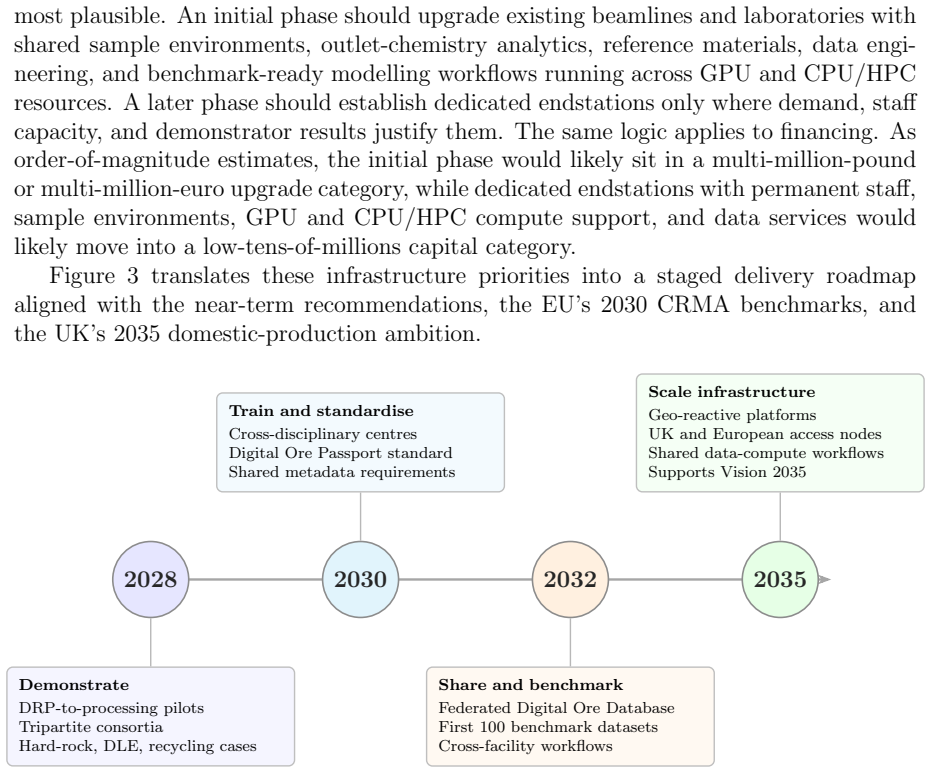
- A UK-European policy agenda built on translational demonstrators, cross-disciplinary training, a Digital Ore Passport standard, a federated Digital Ore Database, and integrated geo-reactive end stations follows directly.
- Adoption supports supply security, resource efficiency, circularity, and environmentally responsible development for complex or historically worked resources.
Where Pith is reading between the lines
- Standardising DRP outputs across borders could reduce duplication in national resource assessments.
- The same infrastructure might later extend to predictive screening of emerging recycling chemistries before pilot investment.
- Policy prioritisation of DRP end stations could shift research funding toward integrated imaging-modelling workflows rather than isolated techniques.
Load-bearing premise
Combining three-dimensional imaging, correlative chemistry, AI image analysis, and pore-scale modelling can reliably connect mineral textures and reactive pathways to viable processing decisions for ores, brines, waste streams, and recycling feedstocks.
What would settle it
A set of blind tests on real ore and waste samples where DRP-derived predictions of processing outcomes diverge substantially from measured laboratory or pilot-scale results.
Figures
read the original abstract
The United Kingdom and Europe are moving rapidly from critical minerals target-setting to implementation. The EU Critical Raw Materials Act and the UK's Vision 2035 create ambitious benchmarks for domestic extraction, processing, recycling, circularity, and supply-chain resilience, but many prospective regional resources remain complex, under-explored, historically worked, or economically marginal. This paper argues that implementation will depend not only on permitting reform and project designation, but also on pre-competitive measurement, modelling, and data infrastructure capable of determining which ores, brines, waste streams, and recycling feedstocks can be processed viably and with lower environmental impact. Digital Rock Physics (DRP) should therefore be understood as enabling infrastructure for resource policy rather than as a specialist laboratory method alone. By combining three-dimensional imaging, correlative chemistry, AI-enabled image analysis, and pore-scale modelling, DRP can connect mineral texture and reactive pathways to decisions about ore characterisation, liberation prediction, leaching, Direct Lithium Extraction, mine-waste valorisation, and battery recycling. The paper sets out a UK-European policy agenda built around translational demonstrators, cross-disciplinary training, a Digital Ore Passport standard, a federated Digital Ore Database, and integrated geo-reactive end stations. Treated as shared implementation infrastructure, DRP could help turn critical minerals strategies into practical routes for supply security, resource efficiency, circularity, and more environmentally responsible development.
Editorial analysis
A structured set of objections, weighed in public.
Referee Report
Summary. The manuscript argues that Digital Rock Physics (DRP) should be treated as shared pre-competitive infrastructure for implementing UK and EU critical minerals policies. By combining three-dimensional imaging, correlative chemistry, AI-enabled image analysis, and pore-scale modelling, DRP can link mineral textures and reactive pathways to viable processing decisions for ores, brines, waste streams, and recycling feedstocks. It outlines a policy agenda of translational demonstrators, cross-disciplinary training, a Digital Ore Passport standard, a federated Digital Ore Database, and integrated geo-reactive end stations to advance supply security, resource efficiency, circularity, and lower environmental impact.
Significance. If the claimed connectivity between DRP techniques and processing decisions can be established, the work could help reframe DRP as policy-relevant infrastructure rather than a specialist method, potentially guiding public investment in data standards and facilities for critical minerals implementation.
major comments (2)
- [Abstract] Abstract: The central assertion that DRP 'can connect mineral texture and reactive pathways to decisions about ore characterisation, liberation prediction, leaching, Direct Lithium Extraction, mine-waste valorisation, and battery recycling' is advanced without any cited studies, datasets, or methodological examples demonstrating such connections; this connectivity is load-bearing for the claim that DRP constitutes enabling infrastructure.
- [Abstract] Abstract (policy agenda paragraph): The proposals for a 'Digital Ore Passport standard' and 'federated Digital Ore Database' are presented without discussion of technical requirements, interoperability challenges, or validation approaches, leaving the implementation pathway unspecified despite its role in the overall argument.
minor comments (1)
- The manuscript introduces several new terms (e.g., 'Digital Ore Passport', 'geo-reactive end stations') without providing concise definitions or references to analogous existing standards.
Simulated Author's Rebuttal
We thank the referee for the constructive feedback, which highlights opportunities to strengthen the evidentiary grounding and implementation clarity of the manuscript. We address each major comment below.
read point-by-point responses
-
Referee: [Abstract] Abstract: The central assertion that DRP 'can connect mineral texture and reactive pathways to decisions about ore characterisation, liberation prediction, leaching, Direct Lithium Extraction, mine-waste valorisation, and battery recycling' is advanced without any cited studies, datasets, or methodological examples demonstrating such connections; this connectivity is load-bearing for the claim that DRP constitutes enabling infrastructure.
Authors: The referee is correct that the abstract advances this connectivity without inline citations. The full manuscript develops the argument by reference to established DRP literature on texture-reactivity linkages, but the abstract itself does not. We will revise the abstract to incorporate 1-2 representative citations (e.g., studies on AI-enabled liberation prediction and pore-scale reactive transport) so that the load-bearing claim is explicitly supported. revision: yes
-
Referee: [Abstract] Abstract (policy agenda paragraph): The proposals for a 'Digital Ore Passport standard' and 'federated Digital Ore Database' are presented without discussion of technical requirements, interoperability challenges, or validation approaches, leaving the implementation pathway unspecified despite its role in the overall argument.
Authors: We agree that the policy proposals are presented at a strategic level without technical detail on requirements or challenges. This is consistent with the manuscript's scope as a policy-position paper rather than a standards-development document. To respond to the comment, we will add a short paragraph in the policy-agenda section that flags key issues (data interoperability, validation via demonstrators, and governance) while noting that detailed technical specifications lie outside the present work. revision: partial
Circularity Check
No significant circularity
full rationale
The manuscript is a qualitative policy position paper with no equations, derivations, fitted parameters, predictions, or technical modeling steps. Its claims are forward-looking recommendations about DRP as infrastructure; none reduce by construction to inputs, self-citations, or ansatzes. The argument is self-contained as advocacy and does not invoke load-bearing uniqueness theorems or renamed empirical patterns.
Axiom & Free-Parameter Ledger
Reference graph
Works this paper leans on
-
[1]
A Benchmark Dataset for Machine Learning Surrogates of Pore-Scale CO 2-Water Interaction,
Abdellatif, A., Menke, H.P., Maes, J., Elsheikh, A.H., & Doster, F., “A Benchmark Dataset for Machine Learning Surrogates of Pore-Scale CO 2-Water Interaction,” Scientific Data, 2026. DOI:https://doi.org/10.1038/s41597-025-05794-z
-
[2]
Department of Energy, August 2025.https://arpa-e.e nergy.gov/sites/default/files/2025-09/ARPA-E%20FY%202023%20Annual%20 Report.pdf
Advanced Research Projects Agency-Energy (ARPA-E),ARPA-E FY 2023 Annual Report to Congress, U.S. Department of Energy, August 2025.https://arpa-e.e nergy.gov/sites/default/files/2025-09/ARPA-E%20FY%202023%20Annual%20 Report.pdf
2023
-
[3]
Mapping Critical Raw Materials (CRM) hard rock deposits in Europe,
Albert, C., Bertrand, G., Berthier, H., de Oliveira, D.P.S., & Tulstrup, J., “Mapping Critical Raw Materials (CRM) hard rock deposits in Europe,”Advances in Geo- sciences, 67, 45–55, 2025. DOI:https://doi.org/10.5194/adgeo-67-45-2025. 17
-
[4]
Towards mine tailings valorization: Recovery of critical materials from Chilean mine tailings,
Araya, N., Kraslawski, A., & Cisternas, L.A., “Towards mine tailings valorization: Recovery of critical materials from Chilean mine tailings,”Journal of Cleaner Pro- duction, 263, 121555, 2020. DOI:https://doi.org/10.1016/j.jclepro.2020.1 21555
-
[5]
Mi- croporous Polymer Sorbents for Direct Lithium Extraction,
Baird, E.J., Kingsbury, R.S., Wang, X., Gang, O., Zhu, Y., & Whittaker, M.L., “Mi- croporous Polymer Sorbents for Direct Lithium Extraction,”ACS Energy Letters, 9(9), 4229–4237, 2024. DOI:https://doi.org/10.1021/acsenergylett.4c01590
-
[6]
Fast X-Ray Micro-CT Study of the Impact of Brine Salinity on the Pore-Scale Fluid Distribution During Waterflooding,
Bartels, W.-B., Lin, Q., de Winter, D.A.M., Mahani, H., Berg, S., Cnudde, V., & Ajo-Franklin, J.B., “Fast X-Ray Micro-CT Study of the Impact of Brine Salinity on the Pore-Scale Fluid Distribution During Waterflooding,”Petrophysics, 58(1), 36–47, 2017
2017
-
[7]
The contribution of applied mineralogy to sustainability in the mine life cycle,
Becker, M., “The contribution of applied mineralogy to sustainability in the mine life cycle,”Minerals Engineering, 202, 108121, 2023. DOI:https://doi.org/10.1 016/j.mineng.2023.108121
arXiv 2023
-
[8]
From interface dynamics to Darcy scale description of multiphase flow in porous media,
Berg, S., Armstrong, R.T., R¨ ucker, M., Hansen, A., Kjelstrup, S., & Bedeaux, D., “From interface dynamics to Darcy scale description of multiphase flow in porous media,”Advances in Colloid and Interface Science, 351, 103791, 2026. DOI:https: //doi.org/10.1016/j.cis.2026.103791
-
[9]
Pore-scale imaging and modelling,
Blunt, M.J., Bijeljic, B., Dong, H., Gharbi, O., Iglauer, S., Mostaghimi, P., Paluszny, A., & Pentland, C., “Pore-scale imaging and modelling,”Advances in Water Re- sources, 51, 197–216, 2013. DOI:https://doi.org/10.1016/j.advwatres.2012.0 3.003
-
[10]
Applied Machine Learning for Geometallurgical Throughput Prediction: A Case Study Using Production Data at the Tropicana Gold Mining Complex,
Both, C., & Dimitrakopoulos, R., “Applied Machine Learning for Geometallurgical Throughput Prediction: A Case Study Using Production Data at the Tropicana Gold Mining Complex,”Minerals, 11(11), 1257, 2021. DOI:https://doi.org/10 .3390/min11111257
2021
-
[11]
Report identifies areas of the UK prospective for critical raw materials,
British Geological Survey, “Report identifies areas of the UK prospective for critical raw materials,” 2022.https://www.bgs.ac.uk/news/report-identifies-areas -of-the-uk-prospective-for-critical-raw-materials/. Accessed March 24, 2026
2022
-
[12]
Buyse, F., Dewaele, S., Boone, M.N., & Cnudde, V., “Combining Automated Miner- alogy with X-ray Computed Tomography for Internal Characterization of Ore Sam- ples at the Microscopic Scale,”Natural Resources Research, 32(2), 461–478, 2023. DOI:https://doi.org/10.1007/s11053-023-10161-z
-
[13]
Decreasing Ore Grades in Global Metallic Mining: A Theoretical Issue or a Global Reality?,
Calvo, G., Mudd, G., Valero, A., & Valero, A., “Decreasing Ore Grades in Global Metallic Mining: A Theoretical Issue or a Global Reality?,”Resources, 5(4), 36,
-
[14]
DOI:https://doi.org/10.3390/resources5040036
-
[15]
X-ray micro CT and nano CT research LAB,
CEITEC, “X-ray micro CT and nano CT research LAB,”https://www.ceitec .eu/x-ray-micro-ct-and-nano-ct-research-lab/t9853. Accessed March 27, 2026. 18
2026
-
[16]
Metal-organic frameworks for extraction of radionu- clide/noble metals/lithium,
Cao, X., Gao, H., & Zeng, Y., “Metal-organic frameworks for extraction of radionu- clide/noble metals/lithium,” inMetal Organic Frameworks for Energy and Environ- mental Applications, 13–33, 2026. DOI:https://doi.org/10.1016/B978-0-443-4 0377-4.00002-1
-
[17]
Critical Materials Innovation Hub (CMI),
Department of Energy, “Critical Materials Innovation Hub (CMI),”https://www. energy.gov/eere/ammto/critical-materials-institute-energy-innovatio n-hub. Accessed March 26, 2026
2026
-
[18]
Project Selection for Critical Materials Supply Chain Re- search Facility,
Department of Energy, “Project Selection for Critical Materials Supply Chain Re- search Facility,”https://www.energy.gov/fecm/project-selection-critica l-materials-supply-chain-research-facility. Accessed March 26, 2026
2026
-
[19]
U.S. Department of Energy Launches Mine of the Future Initiatives to Bolster the U.S. Mining Industry,
Department of Energy, “U.S. Department of Energy Launches Mine of the Future Initiatives to Bolster the U.S. Mining Industry,” September 26, 2025.https://ww w.energy.gov/fecm/articles/us-department-energy-launches-mine-futur e-initiatives-bolster-us-mining-industry. Accessed March 26, 2026
2025
-
[20]
U.S. Department of Energy Invests$45 Million to Support Regional Consortia Focused on Securing Domestic Critical Minerals and Materials,
Department of Energy, “U.S. Department of Energy Invests$45 Million to Support Regional Consortia Focused on Securing Domestic Critical Minerals and Materials,” January 6, 2025.https://www.energy.gov/hgeo/articles/us-department-ene rgy-invests-45-million-support-regional-consortia-focused-securing. Accessed March 26, 2026
2025
-
[21]
Welcome to DIAD,
Diamond Light Source, “Welcome to DIAD,”https://www.diamond.ac.uk/Inst ruments/Imaging-and-Microscopy/DIAD.html. Accessed March 25, 2026
2026
-
[22]
XRF Beamlines for Industry,
Diamond Light Source, “XRF Beamlines for Industry,”https://www.diamond.ac .uk/industry/Techniques-Available/Spectroscopy/X-ray-Fluorescence-XRF /XRF-beamlines.html. Accessed March 25, 2026
2026
-
[23]
NIKON XT H 225/320 LC Computer Tomography, University of Strathclyde,
ECCSEL ERIC, “NIKON XT H 225/320 LC Computer Tomography, University of Strathclyde,” Facility catalogue,https://eccsel.eu/catalogue/facility/?id=1
-
[24]
Accessed March 27, 2026
2026
-
[25]
EGDI – European Geological Data Infrastructure,
EuroGeoSurveys, “EGDI – European Geological Data Infrastructure,”https://eu rogeosurveys.org/projects/egdi/. Accessed March 24, 2026
2026
-
[26]
Map of Critical Raw Material Deposits in Europe,
EuroGeoSurveys, “Map of Critical Raw Material Deposits in Europe,” 2016, updated online.https://eurogeosurveys.org/egs-publications/map-of-critical-raw -material-deposits-in-europe/. Accessed March 24, 2026
2016
-
[27]
The two wide maps data sets of EuroGeoSurveys,
EuroGeoSurveys, “The two wide maps data sets of EuroGeoSurveys,” including the lithium mineralization map of Europe, 2020.https://eurogeosurveys.org/the-t wo-wide-maps-data-sets-of-eurogeosurveys/. Accessed March 24, 2026
2020
-
[28]
The European Critical Raw Materials Board,
European Commission, “The European Critical Raw Materials Board,”https:// single-market-economy.ec.europa.eu/sectors/raw-materials/areas-speci fic-interest/critical-raw-materials/critical-raw-materials-act/board _en. Accessed March 24, 2026. 19
2026
-
[29]
Selected strategic projects under CRMA,
European Commission, “Selected strategic projects under CRMA,”https://sing le-market-economy.ec.europa.eu/sectors/raw-materials/areas-specific-i nterest/critical-raw-materials/strategic-projects-under-crma/selected -projects_en. Accessed March 26, 2026
2026
-
[30]
European Commission CORDIS, “Recycling of end of life battery packs for domestic raw material supply chains and enhanced circular economy (BATRAW),” Project ID 101058359.https://cordis.europa.eu/project/id/101058359. Accessed March 24, 2026
arXiv 2026
-
[31]
RMIS – Raw Materials Information System,
European Commission Joint Research Centre, “RMIS – Raw Materials Information System,”https://rmis.jrc.ec.europa.eu/. Accessed March 24, 2026
2026
-
[32]
European Battery HUB (Eu- Bat),
European Synchrotron Radiation Facility (ESRF), “European Battery HUB (Eu- Bat),”https://www.esrf.fr/HUB/EuBattery. Accessed March 25, 2026
2026
-
[33]
ID16B - Nano-analysis Beam- line,
European Synchrotron Radiation Facility (ESRF), “ID16B - Nano-analysis Beam- line,”https://www.esrf.fr/UsersAndScience/Experiments/ID16B. Accessed March 25, 2026
2026
-
[34]
ID26 - X-ray absorption and emission spectroscopy,
European Synchrotron Radiation Facility (ESRF), “ID26 - X-ray absorption and emission spectroscopy,”https://www.esrf.fr/UsersAndScience/Experiments/ ID26. Accessed March 25, 2026
2026
-
[35]
Materials Chemistry - EH3,
European Synchrotron Radiation Facility (ESRF), “Materials Chemistry - EH3,” https://www.esrf.fr/home/UsersAndScience/Experiments/ID15A/materials -chemistry--eh3.html. Accessed March 25, 2026
2026
-
[36]
European Union, “Regulation (EU) 2024/1252 of the European Parliament and of the Council of 11 April 2024 establishing a framework for ensuring a secure and sustainable supply of critical raw materials,”Official Journal of the European Union, 2024.https://eur-lex.europa.eu/eli/reg/2024/1252/oj/eng
2024
-
[37]
Facility access,
EXCITE Network, “Facility access,”https://excite-network.eu/access/tna-p ortal/. Accessed March 27, 2026
2026
-
[38]
Fagan-Endres, M.A., Harrison, S.T.L., Johns, M.L., & Sederman, A.J., “Magnetic resonance imaging characterisation of the influence of flowrate on liquid distribution in drip irrigated heap leaching,”Hydrometallurgy, 157, 116–124, 2015. DOI:https: //doi.org/10.1016/j.hydromet.2015.10.003
-
[39]
Porous materials: The next frontier in energy technologies,
Farber, E.M., Seraphim, N.M., Tamakuwala, K., Stein, A., R¨ ucker, M., & Eisenberg, D., “Porous materials: The next frontier in energy technologies,”Science, 387(6730), eadn9391, 2025. DOI:https://doi.org/10.1126/science.adn9391
-
[40]
Gao, P., Yuan, S., Han, Y., Li, Y., & Chen, H., “Experimental Study on the Effect of Pretreatment with High-Voltage Electrical Pulses on Mineral Libera- tion and Separation of Magnetite Ore,”Minerals, 7(9), 153, 2017. DOI:https: //doi.org/10.3390/min7090153. 20
-
[41]
Determination of the spatial distribution of wetting in the pore networks of rocks,
Garfi, G., John, C.M., R¨ ucker, M., Lin, Q., Spurin, C., Berg, S., & Krevor, S., “Determination of the spatial distribution of wetting in the pore networks of rocks,” Journal of Colloid and Interface Science, 613, 786–795, 2022. DOI:https://doi. org/10.1016/j.jcis.2021.12.183
-
[42]
Predicting porosity, permeability, and tortuosity of porous media from images by deep learning,
Graczyk, K.M., & Matyka, M., “Predicting porosity, permeability, and tortuosity of porous media from images by deep learning,”Scientific Reports, 10, 21459, 2020. DOI:https://doi.org/10.1038/s41598-020-78415-x
-
[43]
The value of automated mineralogy,
Gu, Y., Schouwstra, R.P., & Rule, C., “The value of automated mineralogy,”Min- erals Engineering, 58, 100–103, 2014. DOI:https://doi.org/10.1016/j.mineng .2014.01.020
-
[45]
HM Government,Resilience for the Future: The UK’s Critical Minerals Strategy, London, 2022.https://www.gov.uk/government/publications/uk-critical-m ineral-strategy
2022
-
[46]
Accessed March 26, 2026
HM Government,Vision 2035: Critical Minerals Strategy, London, updated 23 Jan- uary 2026.https://www.gov.uk/government/publications/uk-critical-miner als-strategy/vision-2035-critical-minerals-strategy. Accessed March 26, 2026
2035
-
[47]
International Energy Agency (IEA),Global Critical Minerals Outlook 2025, IEA, Paris, 2025.https://www.iea.org/reports/global-critical-minerals-outlo ok-2025
2025
-
[48]
Critical Minerals and Materials Recovery Tech- nology Collaboration Programme (CMMR TCP),
International Energy Agency (IEA), “Critical Minerals and Materials Recovery Tech- nology Collaboration Programme (CMMR TCP),”Technology Collaboration Pro- gramme: Cross-cutting, 2026.https://www.iea.org/programmes/technology-c ollaboration-programme/cross-cutting. Accessed May 24, 2026
2026
-
[49]
Subsur- face hydrogen storage controlled by small-scale rock heterogeneities,
Jangda, Z., Menke, H., Busch, A., Geiger, S., Bultreys, T., & Singh, K., “Subsur- face hydrogen storage controlled by small-scale rock heterogeneities,”International Journal of Hydrogen Energy, 72, 467–482, 2024. DOI:https://doi.org/10.1016/ j.ijhydene.2024.02.233
2024
-
[50]
2021 Physics-informed machine learning.Nature Reviews Physics3, 422–440
Karniadakis, G.E., Kevrekidis, I.G., Lu, L., Perdikaris, P., Wang, S., & Yang, L., “Physics-informed machine learning,”Nature Reviews Physics, 3, 422–440, 2021. DOI:https://doi.org/10.1038/s42254-021-00314-5
-
[51]
Koch, P.H., Lund, C., & Rosenkranz, J., “Automated drill core mineralogical characterization method for texture classification and modal mineralogy estima- tion for geometallurgy,”Minerals Engineering, 136, 99–110, 2019. DOI:https: //doi.org/10.1016/j.mineng.2019.03.008. 21
-
[52]
Kyle, J.R., & Ketcham, R.A., “Application of high resolution X-ray computed to- mography to mineral deposit origin, evaluation, and processing,”Ore Geology Re- views, 65, 821–839, 2015. DOI:https://doi.org/10.1016/j.oregeorev.2014.0 9.034
-
[53]
Lishchuk, V., Koch, P.H., Ghorbani, Y., & Butcher, A.R., “Towards integrated geometallurgical approach: Critical review of current practices and future trends,” Minerals Engineering, 145, 106072, 2020. DOI:https://doi.org/10.1016/j.mine ng.2019.106072
-
[54]
Lishchuk, V., Lund, C., & Ghorbani, Y., “Evaluation and comparison of different machine-learning methods to integrate sparse process data into a spatial model in geometallurgy,”Minerals Engineering, 138, 144–153, 2019. DOI:https://doi.or g/10.1016/j.mineng.2019.01.032
-
[55]
Maes, J., & Menke, H.P., “GeoChemFoam: Direct Modelling of Multiphase Reac- tive Transport in Real Pore Geometries with Equilibrium Reactions,”Transport in Porous Media, 139, 271–299, 2021. DOI:https://doi.org/10.1007/s11242-021 -01661-8
-
[56]
Permanent Carbon Dioxide Storage into Basalt: The CarbFix Pilot Project, Iceland,
Matter, J.M., Broecker, W.S., Stute, M., Gislason, S.R., Oelkers, E.H., Stefansson, A.,et al., “Permanent Carbon Dioxide Storage into Basalt: The CarbFix Pilot Project, Iceland,”Energy Procedia, 1(1), 3641–3646, 2009. DOI:https://doi.org/ 10.1016/j.egypro.2009.02.160
-
[57]
Beamlines,
MAX IV Laboratory, “Beamlines,” including proposed SpectroWISE and Tomo- WISE beamlines,https://www.maxiv.lu.se/beamlines-accelerators/beamli nes/. Accessed March 25, 2026
2026
-
[58]
Multimodal in-situ XAS-XRD,
MAX IV Laboratory, “Multimodal in-situ XAS-XRD,”https://www.maxiv.lu.s e/beamlines-accelerators/beamlines/balder/experimental-station/multi modal-in-situ-xas-xrd/. Accessed March 25, 2026
2026
-
[59]
Dynamic Three- Dimensional Pore-Scale Imaging of Reaction in a Carbonate at Reservoir Condi- tions,
Menke, H.P., Bijeljic, B., Andrew, M.G., & Blunt, M.J., “Dynamic Three- Dimensional Pore-Scale Imaging of Reaction in a Carbonate at Reservoir Condi- tions,”Environmental Science & Technology, 49(7), 4407–4414, 2015. DOI:https: //doi.org/10.1021/es505789f
-
[60]
Machine learn- ing for sustainable geoenergy: uncertainty, physics and decision-ready inference,
Menke, H.P., Elsheikh, A.H., Wei, L., Wang, N., & Busch, A., “Machine learn- ing for sustainable geoenergy: uncertainty, physics and decision-ready inference,” arXiv:2603.14907, 2026. DOI:https://doi.org/10.48550/arXiv.2603.14907
-
[61]
Menke, H.P., Maes, J., & Geiger, S., “Upscaling the porosity-permeability rela- tionship of a microporous carbonate for Darcy-scale flow with machine learning,” Scientific Reports, 11(1), 2625, 2021. DOI:https://doi.org/10.1038/s41598-0 21-82029-2
-
[62]
Mojid, R.A., Lee, M.-G., & You, J.-K., “A review on advances in direct lithium ex- traction from continental brines: Ion-sieve adsorption and electrochemical methods for varied Mg/Li ratios,”Sustainable Materials and Technologies, 41, e00923, 2024. DOI:https://doi.org/10.1016/j.susmat.2024.e00923. 22
-
[63]
Digital Porous Media Portal (DPMP) for Publication, Analysis, and Simulation of Porous Media Images,
Prodanovic, M., Esteva, M., Ketcham, R., Chang, B., Turhan, C., Gentle, J., Khan, S., & Belcher, V., “Digital Porous Media Portal (DPMP) for Publication, Analysis, and Simulation of Porous Media Images,”Digital Porous Media Portal, 2025. DOI: https://doi.org/10.17612/FGMN-D889. Repository note: the Digital Rocks Portal has been re-branded as the Digital P...
-
[64]
Energy and greenhouse gas impacts of mining and mineral processing operations,
Norgate, T., & Haque, N., “Energy and greenhouse gas impacts of mining and mineral processing operations,”Journal of Cleaner Production, 18(3), 266–274, 2010. DOI:https://doi.org/10.1016/j.jclepro.2009.09.020
-
[65]
Nwaila, G.T., Ghorbani, Y., Zhang, S.-E., Tolmay, V., Rose, D.H., & Nwaila, N.G., “Valorisation of mine waste - Part II: Resource evaluation for consolidated and mineralised mine waste using the Central African Copperbelt as an exam- ple,”Journal of Environmental Management, 288, 113553, 2021. DOI:https: //doi.org/10.1016/j.jenvman.2021.113553
-
[66]
Beamline Information — BL: SLS/TOMCAT,
Paul Scherrer Institute (PSI), “Beamline Information — BL: SLS/TOMCAT,”ht tps://www.psi.ch/de/sls/tomcat/beamlines. Accessed March 24, 2026
2026
-
[67]
A Review of Sensor-Based Sorting in Mineral Processing: The Potential Benefits of Sensor Fusion,
Peukert, W., Xu, Z., & Dowd, P.A., “A Review of Sensor-Based Sorting in Mineral Processing: The Potential Benefits of Sensor Fusion,”Minerals, 12(11), 1364, 2022. DOI:https://doi.org/10.3390/min12111364
-
[68]
Digital Rocks Portal (Digital Porous Media): Connecting data, simulation and community,
Prodanovi´ c, M., Esteva, M., McClure, J., Chang, B.C., Santos, M., Radhakrishnan, S.,et al., “Digital Rocks Portal (Digital Porous Media): Connecting data, simulation and community,”E3S Web of Conferences, 367, 01010, 2023. DOI:https://doi. org/10.1051/e3sconf/202336701010
-
[69]
Reich, M., & Simon, A.C., “Critical Minerals,”Annual Review of Earth and Plan- etary Sciences, 53, 149–177, 2025. DOI:https://doi.org/10.1146/annurev-ear th-040523-023316
-
[70]
Recovery of strategically important critical minerals from mine tailings,
Sarker, P.K., Haque, N., Bhuiyan, M.A.H., Bruckard, W., & Pramanik, B.K., “Recovery of strategically important critical minerals from mine tailings,”Jour- nal of Environmental Chemical Engineering, 10(3), 107622, 2022. DOI:https: //doi.org/10.1016/j.jece.2022.107622
-
[71]
NXCT at the Henry Moseley X-ray Imaging Facility,
University of Manchester, “NXCT at the Henry Moseley X-ray Imaging Facility,” Research Explorer,https://research.manchester.ac.uk/en/equipments/nxct -at-the-henry-moseley-x-ray-imaging-facility/. Accessed March 27, 2026
2026
-
[72]
The UCL Centre for Correlative X-ray Microscopy,
University College London, “The UCL Centre for Correlative X-ray Microscopy,” https://www.ucl.ac.uk/engineering/chemical-engineering/research/cros s-disciplinary-centres/ucl-electrochemical-innovation-lab/ucl-centr e-correlative-x-ray-microscopy. Accessed March 27, 2026
2026
-
[73]
Uliana, D., & Ulsen, C., “Mineral liberation by 3D X-ray microtomography and SEM-based image analysis in low-grade iron ores with different mineralogy and tex- ture,”Minerals Engineering, 222, 109150, 2025. DOI:https://doi.org/10.1016/ j.mineng.2024.109150. 23
arXiv 2025
-
[74]
Vanderbruggen, A., Gugala, E., Blannin, R., Bachmann, K., Serna-Guerrero, R., & Rudolph, M., “Automated mineralogy as a novel approach for the compositional and textural characterization of spent lithium-ion batteries,”Minerals Engineering, 169, 106924, 2021. DOI:https://doi.org/10.1016/j.mineng.2021.106924
-
[75]
Yang, L., Zuo, R., & Kreuzer, O.P., “Artificial intelligence for mineral exploration: A review and perspectives on future directions from data science,”Earth-Science Reviews, 255, 104941, 2024. DOI:https://doi.org/10.1016/j.earscirev.2024 .104941
-
[76]
Upscaling reactive transport models from pore-scale to continuum-scale using deep learning method,
You, J., & Lee, K.J., “Upscaling reactive transport models from pore-scale to continuum-scale using deep learning method,”Geoenergy Science and Engineering, 242, 212850, 2024. DOI:https://doi.org/10.1016/j.geoen.2024.212850
-
[77]
Support vector machine: A tool for mapping mineral prospectivity,
Zuo, R., & Carranza, E.J.M., “Support vector machine: A tool for mapping mineral prospectivity,”Computers & Geosciences, 37(12), 1967–1975, 2011. DOI:https: //doi.org/10.1016/j.cageo.2010.09.014. 24
discussion (0)
Sign in with ORCID, Apple, or X to comment. Anyone can read and Pith papers without signing in.