The X-ray emission of the long-period transient and accreting cataclysmic variable ASKAP J174508.9-505149
Pith reviewed 2026-06-28 00:40 UTC · model grok-4.3
The pith
X-ray periodicity and spectrum classify ASKAP J174508.9-505149 as an accreting magnetic cataclysmic variable.
A machine-rendered reading of the paper's core claim, the machinery that carries it, and where it could break.
Core claim
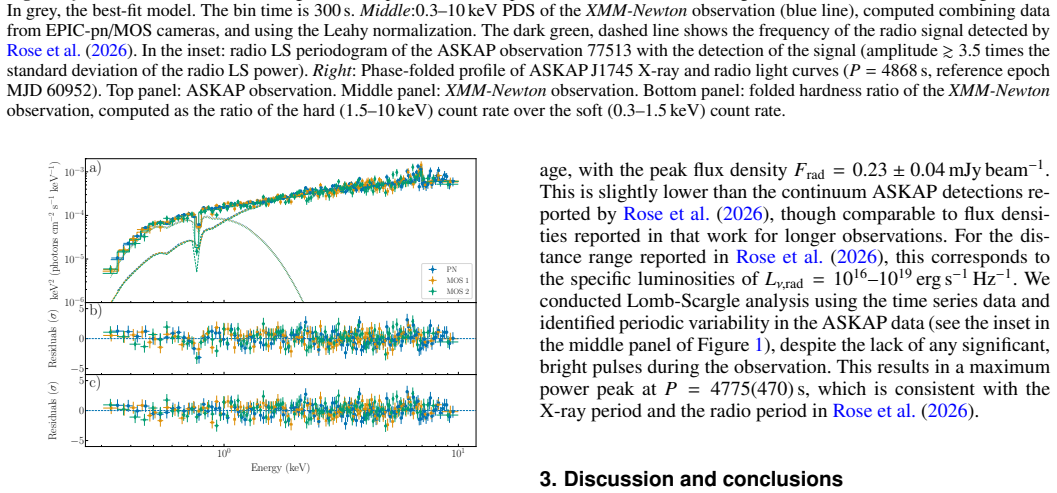
The source shows X-ray variability with a detected periodicity of 4868(22) s consistent with radio and optical periods, and the same period appears in the hardness ratio. Spectral analysis reveals a black-body component at approximately 0.1 keV, a collisionally ionized plasma at approximately 15 keV, and an absorption feature at 0.77 keV possibly due to Oxygen-VII. Combined with the periodicity and variable emission, these features establish the object as an accreting magnetic cataclysmic variable, the first such long-period transient recognized as this type of system.
What carries the argument
The X-ray periodicity of 4868 s together with the three-component spectral model (soft blackbody, hot plasma, and 0.77 keV absorption) that matches expectations for magnetically channeled accretion onto a white dwarf.
If this is right
- The detected long-term modulation in X-rays and B-band photometry points to additional orbital or precessional variability in the system.
- Variable X-ray emission phased with the periodicity indicates accretion onto magnetic poles of the white dwarf.
- This source being the second LPT with detected X-ray periodicity and variable emission suggests a common mechanism among some LPTs.
- Simultaneous multi-band data confirm that the periodic signal is intrinsic to the binary and not band-specific.
Where Pith is reading between the lines
- If additional LPTs show similar X-ray properties, radio emission in white-dwarf binaries may arise from the same magnetic accretion process.
- Targeted X-ray follow-up of other LPTs could quickly identify more accreting CVs without requiring full multi-year monitoring.
- The 0.77 keV absorption feature, if confirmed as Oxygen-VII, offers a potential probe of the ionization state in the accretion column.
Load-bearing premise
The observed X-ray periodicity, hardness modulation, and spectral components are together sufficient to conclusively classify the source as an accreting magnetic cataclysmic variable.
What would settle it
An X-ray observation that finds a period differing by more than a few percent from 4868 s, or a spectrum lacking both the hot plasma component and the 0.77 keV absorption while showing a different overall shape, would falsify the classification.
Figures

read the original abstract
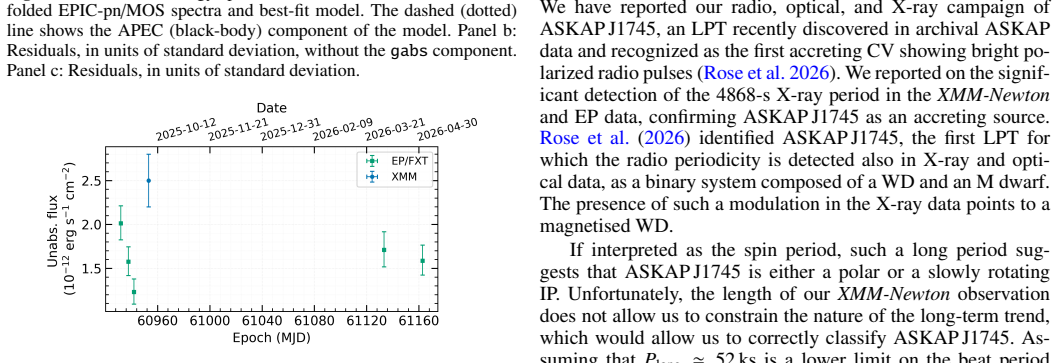
Long-period transients (LPTs) challenge our knowledge of the mechanism producing radio periodic pulsations in compact objects. Some LPTs have been associated with systems hosting a white dwarf and a low-mass star in a detached binary. Recently, a new LPT (ASKAP\,J174508.9-505149) has been classified as an accreting cataclysmic variable (CV). In the present letter, we report on the detailed study of the X-ray variability of ASKAP\,J174508.9-505149 as observed by \emph{XMM-Newton} and \emph{Einstein Probe} between September 2025 and May 2026. Simultaneous optical and radio observations are also presented. We studied the timing variability of the source, and estimated an X-ray periodicity of $P=4868(22)$\,s, consistent with radio and optical periods. We also observe the same periodicity in the hardness ratio extracted from the \emph{XMM-Newton} observation, peaking at the minimum of the modulation. A long-term modulation is also present in the X-rays and in the B-band photometry, but it is poorly constrained by the current dataset. Spectral X-ray analysis shows the presence of a black-body component ($\sim$0.1\,keV), a collisionally ionised plasma ($\sim$15\,keV), and an absorption feature at 0.77 keV (possibly due to Oxygen-VII). This is the third LPT detected in the X-ray band, the second with a detected X-ray periodicity and variable X-ray emission, and the first conclusively recognised as an accreting magnetic CV.
Editorial analysis
A structured set of objections, weighed in public.
Referee Report
Summary. The manuscript reports X-ray timing and spectral analysis of the long-period transient ASKAP J174508.9-505149 using XMM-Newton and Einstein Probe observations (Sep 2025–May 2026), together with simultaneous optical and radio data. It measures an X-ray periodicity of 4868(22) s consistent with radio and optical periods, notes the same periodicity in the hardness ratio (peaking at flux minimum), identifies a long-term modulation, and fits the spectrum with a ~0.1 keV black-body, ~15 keV collisionally ionized plasma, and a 0.77 keV absorption feature (attributed to O VII). The paper concludes that this is the third X-ray-detected LPT, the second with detected X-ray periodicity and variability, and the first conclusively recognised as an accreting magnetic CV.
Significance. If the classification holds, the work supplies the first multi-band X-ray confirmation of an LPT as an accreting magnetic CV, strengthening the association between LPTs and white-dwarf binaries and providing a concrete observational anchor for models of periodic radio emission in such systems. The cross-band periodicity consistency is a clear observational strength.
major comments (1)
- [Abstract] Abstract (final sentence): the claim that the source is 'the first conclusively recognised as an accreting magnetic CV' is not supported by the data presented. The reported spectral components (black-body at ~0.1 keV, collisionally ionised plasma at ~15 keV, absorption feature at 0.77 keV) are also seen in non-magnetic CVs; the 0.77 keV feature lacks reported line significance, equivalent width, or velocity width; and the X-ray periodicity is not demonstrated to be the white-dwarf spin period (distinct from orbital period) via beat-frequency analysis or other diagnostics. No polarimetry, cyclotron harmonics, or other unique magnetic-CV signatures are invoked to exclude non-magnetic interpretations.
minor comments (2)
- [Abstract] Abstract: no fit statistics (e.g., reduced χ², degrees of freedom, or null-hypothesis probability) or parameter uncertainties are provided for the spectral model.
- [Abstract] Abstract: the long-term modulation is described as 'present but poorly constrained'; quantitative limits on its period or amplitude would improve clarity.
Simulated Author's Rebuttal
We thank the referee for the constructive and detailed review. We address the major comment on the abstract claim point by point below and agree that revision is warranted.
read point-by-point responses
-
Referee: [Abstract] Abstract (final sentence): the claim that the source is 'the first conclusively recognised as an accreting magnetic CV' is not supported by the data presented. The reported spectral components (black-body at ~0.1 keV, collisionally ionised plasma at ~15 keV, absorption feature at 0.77 keV) are also seen in non-magnetic CVs; the 0.77 keV feature lacks reported line significance, equivalent width, or velocity width; and the X-ray periodicity is not demonstrated to be the white-dwarf spin period (distinct from orbital period) via beat-frequency analysis or other diagnostics. No polarimetry, cyclotron harmonics, or other unique magnetic-CV signatures are invoked to exclude non-magnetic interpretations.
Authors: We acknowledge that the individual spectral components (black-body, ~15 keV plasma, and 0.77 keV absorption) are not exclusive to magnetic CVs and can appear in non-magnetic systems. We will add the statistical significance, equivalent width, and any velocity information for the 0.77 keV feature in the revised spectral analysis section. The X-ray periodicity of 4868(22) s is consistent across radio, optical, and X-ray bands, with the same period detected in the hardness ratio (peaking at flux minimum), which is a signature often associated with magnetic accretion; however, we agree that beat-frequency analysis to distinguish spin from orbital period is not performed, and no cyclotron harmonics or polarimetry data are available to provide unique magnetic signatures. We therefore accept that the phrasing 'conclusively recognised' overstates the case on the basis of the presented data alone. We will revise the abstract to state that this is the first LPT with detected X-ray periodicity and variability consistent with an accreting magnetic CV, removing the word 'conclusively'. revision: yes
Circularity Check
No circularity: purely observational report
full rationale
The manuscript is an observational report of XMM-Newton and Einstein Probe data on ASKAP J174508.9-505149. It presents measured X-ray periodicity (P=4868(22) s), hardness-ratio modulation, long-term variability, and spectral components (black-body ~0.1 keV, collisionally ionised plasma ~15 keV, absorption feature at 0.77 keV). No equations, derivations, or predictions appear that reduce by construction to fitted inputs. The classification statement is an interpretive summary of the observed features rather than a self-referential or fitted-input step. No self-citation load-bearing chains, uniqueness theorems, or ansatzes are present in the text.
Axiom & Free-Parameter Ledger
free parameters (1)
- X-ray period =
4868 s
Reference graph
Works this paper leans on
-
[1]
doi:10.1109/TAP.1969.1139448 , journal =
-
[2]
GW231123: a Binary Black Hole Merger with Total Mass 190-265 $M_{\odot}$
doi:10.3847/2041-8213/ae0c9c , eid =. arXiv , author =:2507.08219 , journal =
work page internal anchor Pith review Pith/arXiv arXiv doi:10.3847/2041-8213/ae0c9c 2041
-
[3]
arXiv , author =:1902.08507 , journal =
doi:10.3847/1538-4357/ab20cb , eid =. arXiv , author =:1902.08507 , journal =
-
[4]
arXiv , author =:2507.19698 , journal =
doi:10.3847/1538-4357/adf4df , eid =. arXiv , author =:2507.19698 , journal =
-
[5]
arXiv , author =:1902.10045 , journal =
doi:10.3847/1538-4365/ab6bcb , eid =. arXiv , author =:1902.10045 , journal =
-
[6]
arXiv , author =:2201.11184 , journal =
doi:10.3847/1538-4365/ac6751 , eid =. arXiv , author =:2201.11184 , journal =
-
[7]
doi:10.1086/166683 , journal =
-
[8]
arXiv , author =:astro-ph/0411185 , keywords =
Growing Black Holes: Accretion in a Cosmological Context , doi =. arXiv , author =:astro-ph/0411185 , keywords =
-
[9]
, keywords =. doi:10.1111/j.1365-2966.2009.15014.x , eprint =
-
[10]
doi:10.1093/mnras/stu2291 , eprint =
, keywords =. doi:10.1093/mnras/stu2291 , eprint =
-
[11]
doi:10.1093/mnras/staa2063 , eprint =
, keywords =. doi:10.1093/mnras/staa2063 , eprint =
-
[12]
doi:10.1088/0067-0049/203/2/21 , eid =. arXiv , author =:1207.7137 , journal =
work page internal anchor Pith review Pith/arXiv arXiv doi:10.1088/0067-0049/203/2/21
-
[13]
doi:10.1093/mnras/stab3693 , eprint =
, keywords =. doi:10.1093/mnras/stab3693 , eprint =
-
[14]
doi:10.1093/mnras/stac2887 , eprint =
, keywords =. doi:10.1093/mnras/stac2887 , eprint =
-
[15]
doi:10.1093/mnras/stad3175 , eprint =
, keywords =. doi:10.1093/mnras/stad3175 , eprint =
-
[16]
doi:10.1093/mnras/stad3332 , eprint =
, keywords =. doi:10.1093/mnras/stad3332 , eprint =
-
[17]
arXiv , author =:2501.09974 , journal =
doi:10.1051/0004-6361/202452640 , eid =. arXiv , author =:2501.09974 , journal =
-
[18]
doi:10.1093/mnrasl/slu127 , eprint =
, keywords =. doi:10.1093/mnrasl/slu127 , eprint =
-
[19]
doi:10.1093/mnras/stab1473 , eprint =
, keywords =. doi:10.1093/mnras/stab1473 , eprint =
-
[20]
, keywords =. doi:10.1086/528983 , eprint =
-
[21]
doi:10.1093/mnras/stab2547 , eprint =
, keywords =. doi:10.1093/mnras/stab2547 , eprint =
-
[22]
arXiv , author =:1410.0958 , keywords =
Journal of Physics Conference Series , doi =. arXiv , author =:1410.0958 , keywords =
-
[23]
Laser Interferometer Space Antenna
doi:10.48550/arXiv.1702.00786 , eid =. arXiv , author =:1702.00786 , journal =
work page internal anchor Pith review Pith/arXiv arXiv doi:10.48550/arxiv.1702.00786
-
[24]
arXiv , author =:2212.07391 , journal =
doi:10.1051/0004-6361/202244576 , eid =. arXiv , author =:2212.07391 , journal =
-
[25]
arXiv , author =:2407.03915 , journal =
doi:10.1051/0004-6361/202450034 , eid =. arXiv , author =:2407.03915 , journal =
-
[26]
arXiv , author =:2507.14875 , journal =
doi:10.1051/0004-6361/202555122 , eid =. arXiv , author =:2507.14875 , journal =
-
[27]
doi:10.1038/346042a0 , journal =
-
[28]
doi:10.1086/168070 , journal =
-
[29]
arXiv , author =:2404.07089 , journal =
doi:10.1051/0004-6361/202449515 , eid =. arXiv , author =:2404.07089 , journal =
-
[30]
doi:10.1088/0004-637X/697/2/1695 , eprint =
, keywords =. doi:10.1088/0004-637X/697/2/1695 , eprint =
-
[31]
doi:10.1088/2041-8205/716/2/L140 , eprint =
, keywords =. doi:10.1088/2041-8205/716/2/L140 , eprint =
-
[32]
doi:10.1093/mnras/stw167 , eprint =
, keywords =. doi:10.1093/mnras/stw167 , eprint =
-
[33]
ASKAP J144834 - 685644: a newly discovered long period radio transient detected from radio to X-rays. , keywords =. doi:10.1093/mnras/staf1227 , archivePrefix =. 2507.13453 , primaryClass =
-
[34]
, keywords =. doi:10.1038/s41586-021-03394-6 , eprint =
-
[35]
doi:10.1051/0004-6361/202348881 , eid =. arXiv , author =:2401.17275 , journal =
-
[36]
arXiv , author =:2506.17138 , journal =
doi:10.3847/1538-4357/adec9b , eid =. arXiv , author =:2506.17138 , journal =
-
[37]
Astronomical Data Analysis Software and Systems V , editor =
-
[38]
doi:10.1051/0004-6361:20041412 , eprint =
, keywords =. doi:10.1051/0004-6361:20041412 , eprint =
-
[39]
Astropy: A Community Python Package for Astronomy
doi:10.1051/0004-6361/201322068 , eid =. arXiv , author =:1307.6212 , journal =
work page internal anchor Pith review Pith/arXiv arXiv doi:10.1051/0004-6361/201322068
-
[40]
The Astropy Project: Building an inclusive, open-science project and status of the v2.0 core package
doi:10.3847/1538-3881/aabc4f , eid =. arXiv , author =:1801.02634 , journal =
work page internal anchor Pith review Pith/arXiv arXiv doi:10.3847/1538-3881/aabc4f
-
[41]
doi:10.3847/1538-4357/ac7c74 , eid =. arXiv , author =:2206.14220 , journal =
work page internal anchor Pith review Pith/arXiv arXiv doi:10.3847/1538-4357/ac7c74
-
[42]
doi:10.1093/mnras/stz1027 , eprint =
, keywords =. doi:10.1093/mnras/stz1027 , eprint =
-
[43]
doi:10.1093/mnras/stad3719 , journal =
-
[44]
arXiv , author =:2303.16168 , journal =
doi:10.1051/0004-6361/202346522 , eid =. arXiv , author =:2303.16168 , journal =
-
[45]
doi:10.1073/pnas.20.5.254 , journal =
-
[46]
, archivePrefix = "arXiv", eprint =
, keywords =. doi:10.1111/j.1365-2966.2010.16203.x , eprint =
-
[47]
The ultraluminous X-ray sources NGC 1313 X-1 and X-2: a broadband study with NuSTAR and XMM-Newton
doi:10.1088/0004-637X/778/2/163 , eid =. arXiv , author =:1310.0745 , journal =
work page internal anchor Pith review Pith/arXiv arXiv doi:10.1088/0004-637x/778/2/163
-
[48]
doi:10.1038/nature13791 , eprint =
, keywords =. doi:10.1038/nature13791 , eprint =
-
[49]
ascl , author =:1502.021 , howpublished =
-
[50]
ascl , author =:1805.019 , howpublished =
-
[51]
arXiv , author =:1905.06423 , journal =
doi:10.3847/1538-4357/ab6d00 , eid =. arXiv , author =:1905.06423 , journal =
-
[52]
arXiv , author =:2012.11397 , journal =
doi:10.3847/1538-4357/abda4a , eid =. arXiv , author =:2012.11397 , journal =
-
[53]
arXiv , author =:2112.00339 , journal =
doi:10.3847/1538-4357/ac8d67 , eid =. arXiv , author =:2112.00339 , journal =
-
[54]
doi:10.21105/joss.07389 , eid =
The Journal of Open Source Software , keywords =. doi:10.21105/joss.07389 , eid =
-
[55]
arXiv , author =:2509.13865 , journal =
doi:10.48550/arXiv.2509.13865 , eid =. arXiv , author =:2509.13865 , journal =
-
[56]
doi:10.1146/annurev.aa.24.090186.002541 , journal =
-
[57]
doi:10.1093/mnras/stv330 , eprint =
, keywords =. doi:10.1093/mnras/stv330 , eprint =
-
[58]
doi:10.1093/mnrasl/slv045 , eprint =
, keywords =. doi:10.1093/mnrasl/slv045 , eprint =
-
[59]
Handbook of X-ray and Gamma-ray Astrophysics , doi =
-
[60]
arXiv , author =:2203.06384 , journal =
doi:10.1016/j.softx.2022.101194 , eid =. arXiv , author =:2203.06384 , journal =
-
[61]
Fermi Large Area Telescope Fourth Source Catalog Data Release 4 (4FGL-DR4)
doi:10.48550/arXiv.2307.12546 , eid =. arXiv , author =:2307.12546 , journal =
work page internal anchor Pith review Pith/arXiv arXiv doi:10.48550/arxiv.2307.12546
-
[62]
, archivePrefix = "arXiv", eprint =
, keywords =. doi:10.1111/j.1365-2966.2008.12689.x , eprint =
-
[63]
doi:10.1093/mnras/stab3259 , eprint =
, keywords =. doi:10.1093/mnras/stab3259 , eprint =
-
[64]
doi:10.1093/mnras/stad836 , eprint =
, keywords =. doi:10.1093/mnras/stad836 , eprint =
-
[65]
doi:10.1086/181711 , journal =
-
[66]
arXiv , author =:2311.16243 , journal =
doi:10.1051/0004-6361/202348471 , eid =. arXiv , author =:2311.16243 , journal =
-
[67]
doi:10.1016/S0273-1177(01)00414-8 , eprint =
Advances in Space Research , keywords =. doi:10.1016/S0273-1177(01)00414-8 , eprint =
-
[68]
doi:10.1088/0004-637X/746/2/131 , eid =. arXiv , author =:1112.0535 , journal =
work page internal anchor Pith review Pith/arXiv arXiv doi:10.1088/0004-637x/746/2/131
-
[69]
arXiv , author =:2401.06061 , journal =
doi:10.1051/0004-6361/202449214 , eid =. arXiv , author =:2401.06061 , journal =
-
[70]
doi:10.1038/161686a0 , journal =
-
[71]
doi:10.1093/mnras/stx032 , eprint =
, keywords =. doi:10.1093/mnras/stx032 , eprint =
-
[72]
, month = mar, pages =
-
[73]
doi:10.1093/mnras/175.2.395 , journal =
-
[74]
From hadrons to quarks in neutron stars: a review
doi:10.1088/1361-6633/aaae14 , eid =. arXiv , author =:1707.04966 , journal =
work page internal anchor Pith review Pith/arXiv arXiv doi:10.1088/1361-6633/aaae14
-
[75]
The X-ray luminosity of rotation-powered neutron stars
, keywords =. doi:10.48550/arXiv.astro-ph/9708169 , eprint =
work page internal anchor Pith review Pith/arXiv arXiv doi:10.48550/arxiv.astro-ph/9708169
-
[76]
arXiv , author =:2211.13894 , journal =
doi:10.3847/1538-4357/ac8d95 , eid =. arXiv , author =:2211.13894 , journal =
-
[77]
, keywords =. doi:10.1111/j.1365-2966.2004.07955.x , eprint =
-
[78]
doi:10.1038/s41550-019-0903-z , eprint =
Nature Astronomy , keywords =. doi:10.1038/s41550-019-0903-z , eprint =
-
[79]
arXiv , author =:2405.04574 , journal =
doi:10.3847/1538-4357/ad320a , eid =. arXiv , author =:2405.04574 , journal =
-
[80]
A model-independent analysis of the variability of GRS 1915+105
, keywords =. doi:10.48550/arXiv.astro-ph/0001103 , eprint =
work page internal anchor Pith review Pith/arXiv arXiv doi:10.48550/arxiv.astro-ph/0001103
discussion (0)
Sign in with ORCID, Apple, or X to comment. Anyone can read and Pith papers without signing in.